
Appendix B
Samples of Questionnaires Used to Evaluate Undergraduate Student Learning
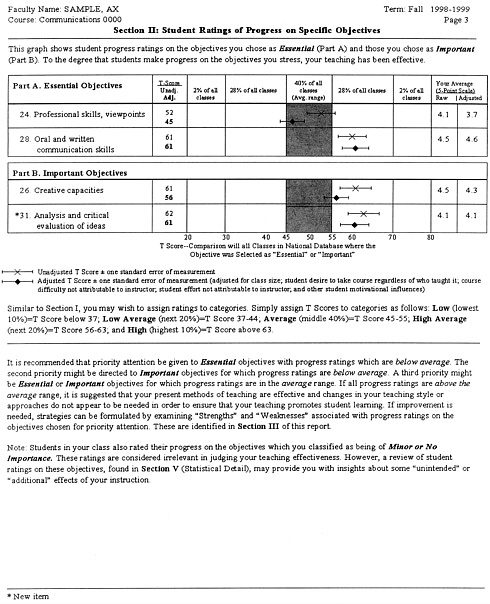
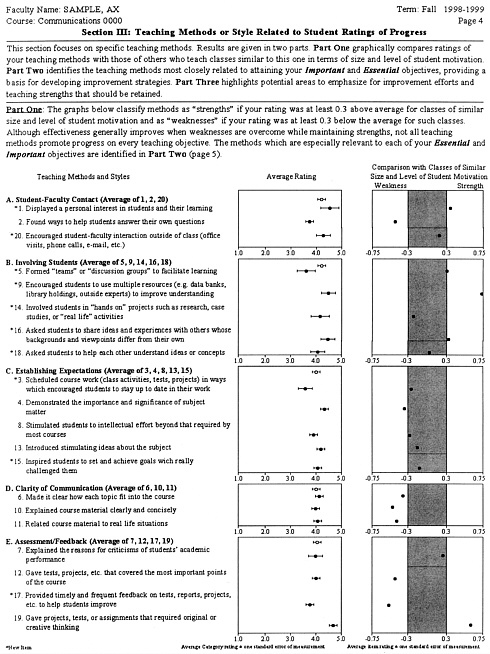
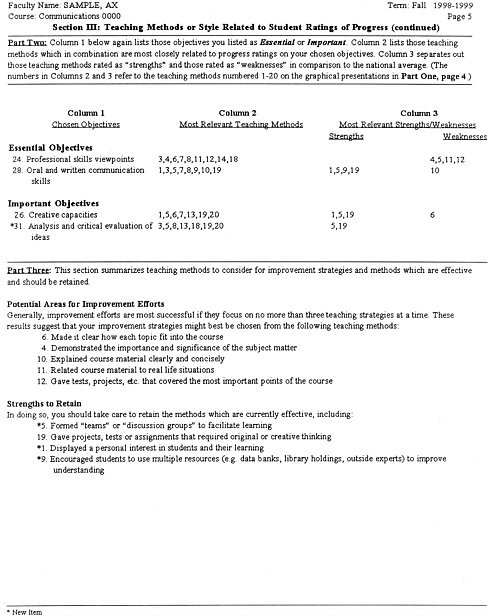
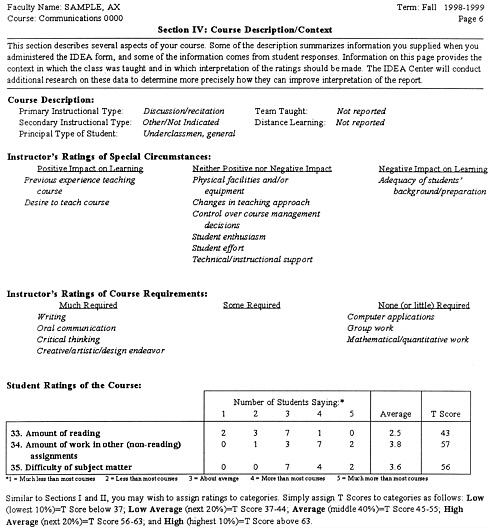
The student questionnaires included in this appendix exemplify several approaches to assessing student learning and, in turn, using that information to improve teaching. The College Student Report 2000 (from the Carnegie Foundation for the Advancement of Teaching and Pew Forum on Undergraduate Education, 2000) and the Student Instructional Report II (from the Educational Testing Service) are generic approaches to evaluating learning. Evaluation forms from several universities are presented to demonstrate the kind of information that might be sought from students and the variety of ways (e.g., end-of-semester, midsemester) and settings (e.g., classroom, laboratory) in which students can be queried.
|
Form |
Found on Page(s) |
|
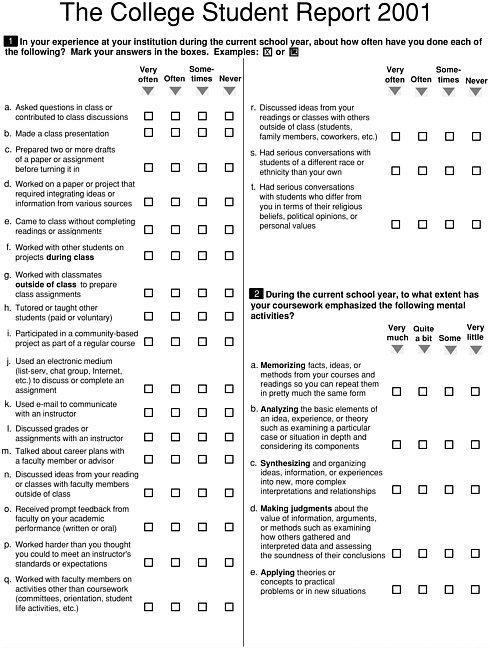
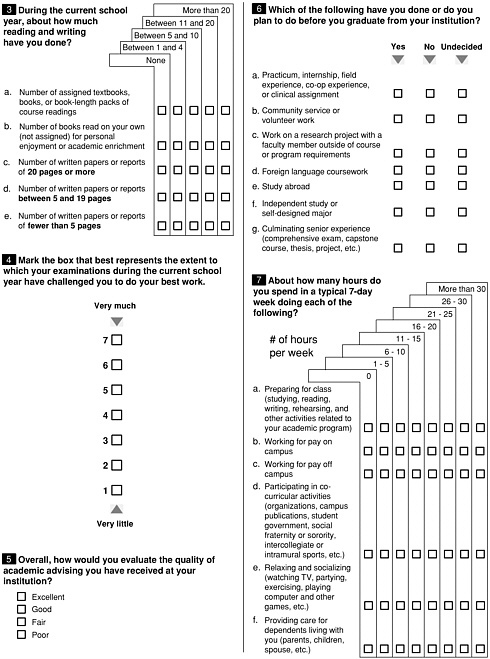
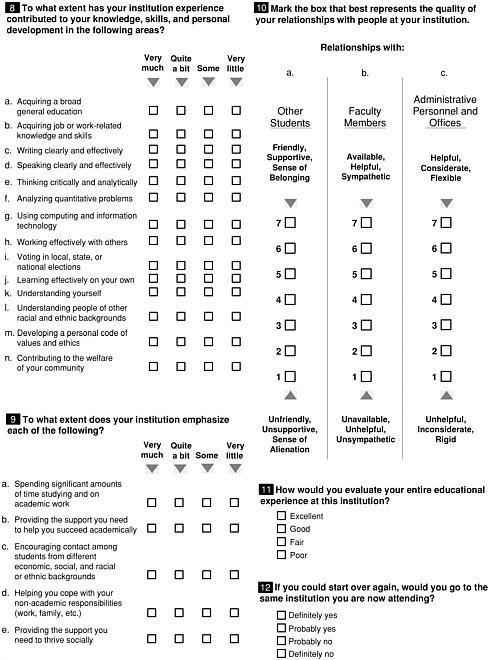
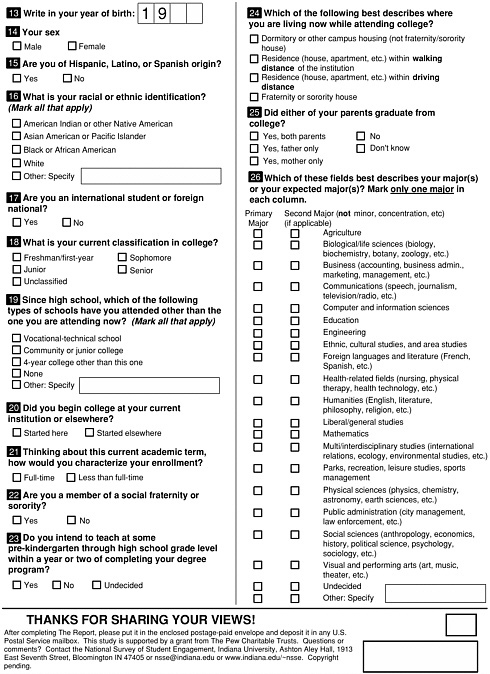
The College Student Report 2001. From the Carnegie Foundation for the Advancement of Teaching and Pew Forum on Undergraduate Education (2002). |
147–150 |
|
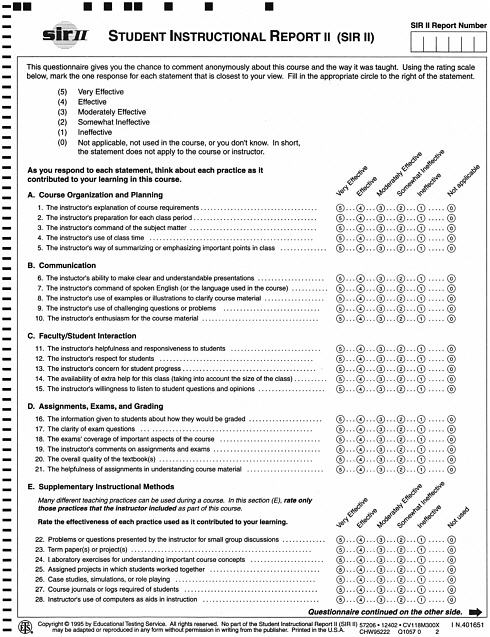
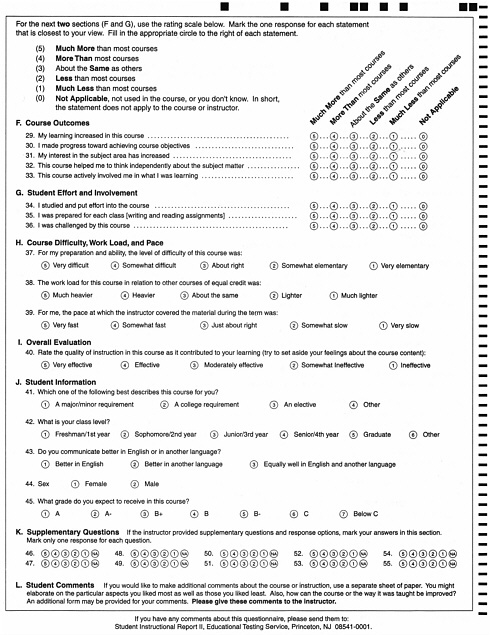
Student Instructional Report II. Used nationally and produced by the Educational Testing Service. |
151–152 |
|
Form |
Found on Page(s) |
|
Carnegie Mellon University Eberly Center for Teaching Excellence |
|
|
Teaching Improvement Form—Lecture Courses |
153–156 |
|
Teaching Improvement Form—Laboratory Courses |
157–159 |
|
Teaching Improvement Form—Discussion Courses |
160–162 |
|
Harvard University Derek Bok Center for Teaching and Learning |
|
|
Mid-Course Evaluation Form |
163 |
|
End-of-Semester Course Evaluation Form |
164–165 |
|
Kansas State University IDEA Center |
|
|
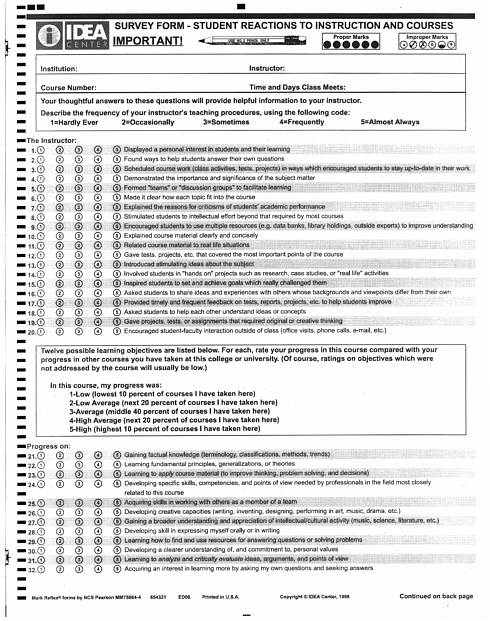
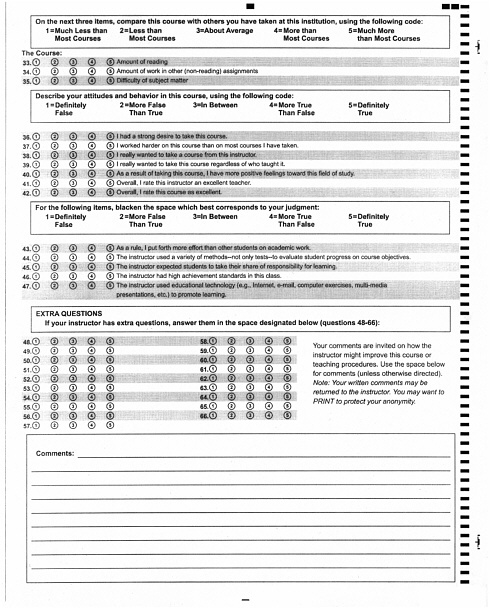
Student Reactions to Instruction and Courses |
166–167 |
|
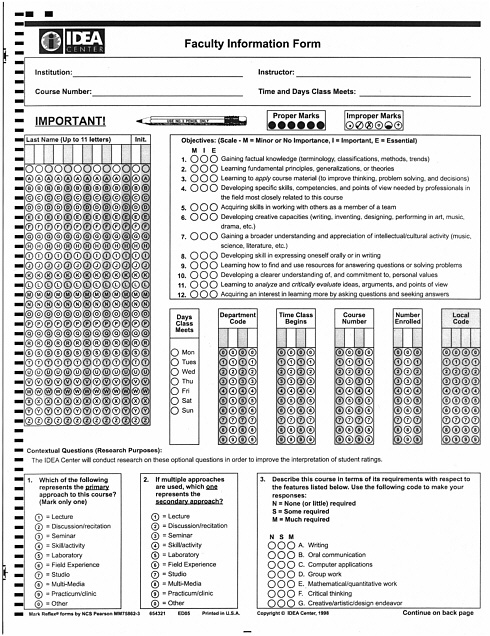
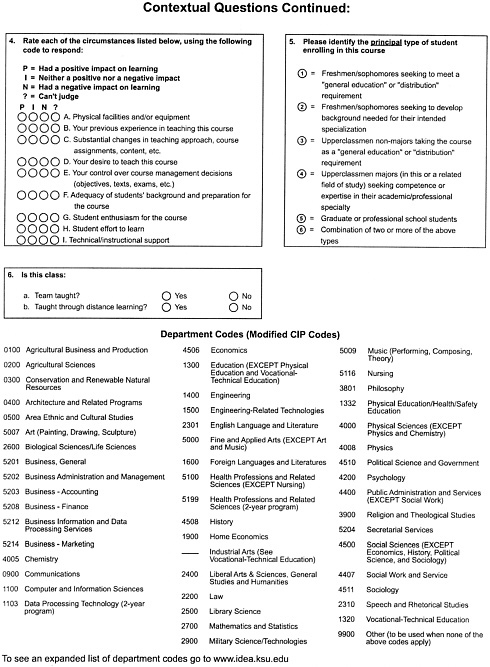
Faculty Information Form for Student Evaluations |
168–169 |
|
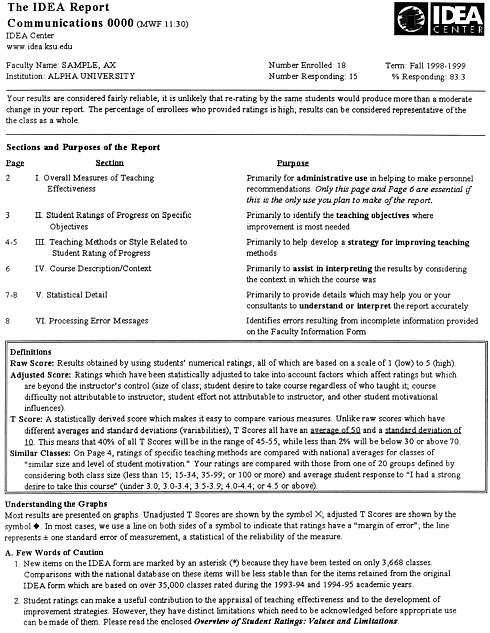
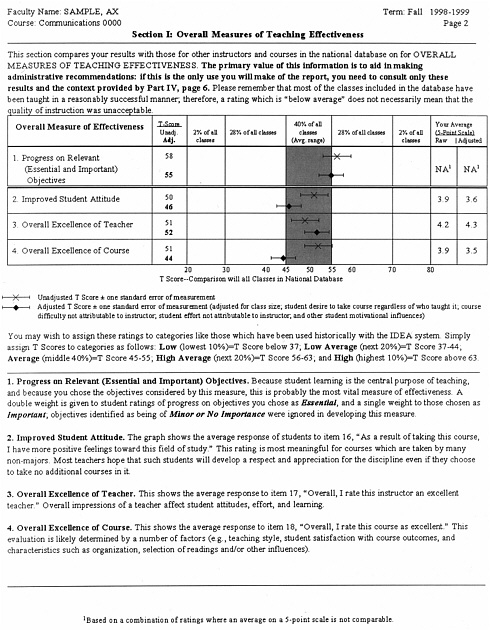
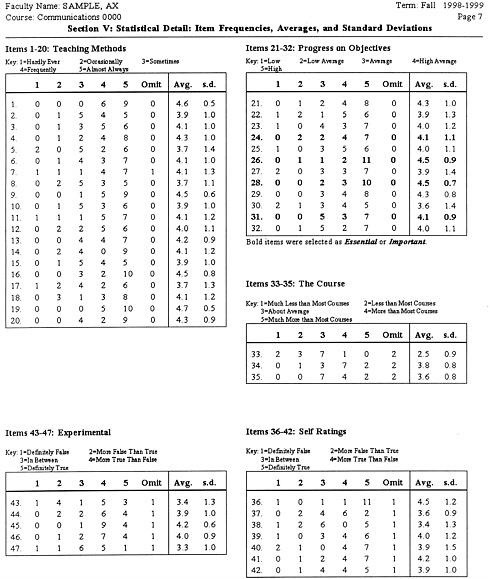
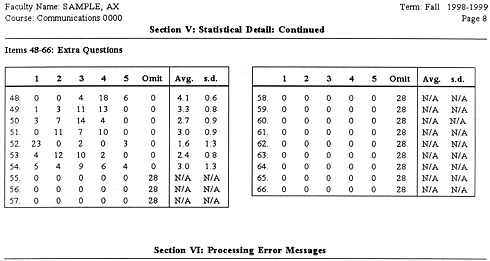
Sample Results of Student Evaluations |
170–177 |
|
Hampshire College |
|
|
End-of-Semester Course Evaluation Forms |
178–182 |
|
Instructor Objectives Report |
183–184 |
Teaching Improvement Form — Lecture Courses
Instructor: ______________________ Time to complete form __________
Course Title/Number: _________________ Date of Evaluation: ____________
Instructions: This section includes items about a variety of aspects of teaching. Please give an overall rating of each aspect of teaching and also check any of the specific strengths or concerns which match your experience in the course.
|
OVERALL RATING (Select one for each category) |
SPECIFIC STRENGTHS (Check all that apply) |
SPECIFIC CONCERNS (Check all that apply) |
|
Course Organization |
||
|
❑ commendable ❑ fine ❑ needs improvement |
❑ good continuity ❑ lectures and assignments are coordinated well ❑ lectures and section meetings are coordinated well (if applicable) ❑ other strengths? ______________________________ ______________________________ |
❑ course objectives weren’t clear ❑ doesn’t give big picture ❑ lectures don’t prepare students for assignments/exams ❑ fell behind schedule often ❑ other concerns? ______________________________ ______________________________ |
|
Lecturing |
||
|
❑ commendable ❑ fine ❑ needs improvement |
❑ useful syllabus ❑ stimu lares interest ❑ engaging speaking style ❑ key ideas emphasized ❑ easy to take notes ❑ effective examples ❑ good summaries provided ❑ other strengths? ______________________________ ______________________________ |
❑ speech is hard to understand ❑ pitched too high for students ❑ unclear explanations ❑ unclear board writing ❑ talks too fast ❑ not enough examples ❑ starts or ends late ❑ other concerns? ______________________________ ______________________________ |
|
Interaction and Discussion |
||
|
❑ commendable ❑ fine ❑ need improvement ❑ not applicable |
❑ responds well to student questions ❑ encourages active participation ❑ right amount of interaction for this size and type of class ❑ student contributions valued ❑ useful in-class activities (e.g. groups, simulations, demonstrations) ❑ other strengths? ______________________________ ______________________________ |
❑ not enough interaction ❑ too few participants ❑ speech is hard to understand ❑ not enough opportunities to participate ❑ instructor doesn’t respond effectively to questions ❑ instructor’s questions not stated clearly ❑ other concerns? ______________________________ ______________________________ |
|
OVERALL RATING (Select one for each category) |
SPECIFIC STRENGTHS (Check all that apply) |
SPECIFIC CONCERNS (Check all that apply) |
|
Visual Aids (e.g. board work, transpariencies and computer projection) |
||
|
❑ commendable ❑ fine ❑ need improvement ❑ not applicable |
❑ well organized ❑ emphasize key points ❑ appropriately detailed ❑ very helpful to my learning ❑ well designed ❑ other strengths? ______________________________ ______________________________ |
❑ too fast ❑ poor handwriting ❑ wordy ❑ not enough written explanation ❑ other concerns? _____________________________ _____________________________ |
|
Texts and Readings |
||
|
❑ commendable ❑ fine ❑ need improvement |
❑ high quality (content or readability) ❑ match course goals well ❑ other strengths? _____________________________ _____________________________ |
❑ difficult to leam from ❑ not discussed enough in lecture ❑ too expensive ❑ difficult to obtain copies ❑ other concerns? _____________________________ _____________________________ |
|
Handouts, Reserve or Online Materials |
||
|
❑ commendable ❑ fine ❑ need improvement ❑ not applicable ❑ haven't used enough to evaluate |
❑ very helpful ❑ motivating ❑ enhanced my learning ❑ other strengths? _____________________________ _____________________________ |
❑ not enough ❑ too many ❑ not helpful ❑ other concerns? ____________________________ ____________________________ |
|
Testing |
||
|
❑ commendable ❑ fine ❑ need improvement ❑ not applicable |
❑ good coverage of material ❑ appropriately challenging ❑ right length for amount of time given ❑ other strengths? ____________________________ ____________________________ |
❑ unreasonably difficult ❑ poor coverage of materials ❑ too few tests/quizzes ❑ too many test/quizzes ❑ unclear grading criteria ❑ other concerns? ____________________________ ____________________________ |
|
Assignments |
||
|
❑ commendable ❑ fine ❑ need improvement ❑ not applicable |
❑ appropriately challenging ❑ clear grading criteria ❑ helpful feedback ❑ appropriate number ❑ interesting and/or useful questions assigned ❑ other strengths? ______________________________ ______________________________ |
❑ poor coverage of material ❑ inconsistent grading ❑ insufficient comrnents on returned assignments ❑ slow or no return ❑ other concerns? ______________________________ ______________________________ |
|
OVERALL RATING (Select one for each category) |
SPECIFIC STRENGTHS (Check all that apply) |
SPECIFIC CONCERNS (Check all that apply) |
|
Attitude to Students |
||
|
❑ commendable ❑ fine ❑ needs improvement |
❑ personable & approachable ❑ help readily available out of class ❑ concerned about individual students’ needs ❑ attentive to needs of diverse student populations ❑ other strengths? |
❑ not sufficiently accessible to students out of class ❑ unresponsive to students’ requests for help or review ❑ other concerns? |
|
Classroom Control and Climate |
||
|
❑ commendable ❑ fine ❑ need improvement |
❑ students are respectful toward professor ❑ students are respectful toward each other ❑ other strengths? |
❑ some students disruptive in class ❑ poor physical environment for this type of class ❑ other concerns? |
Overall Evaluation (Circle one for each question.)
|
How heavy/light is the workload for this course compared with other courses you have taken this year? |
||||
|
Much lighter |
Lighter |
About the same |
Heavier |
Much Heavier |
|
How is the pace in this course? |
||||
|
Too slow |
A bit slow |
Just right |
A bit fast Too fast |
|
|
How challenging do you find this course? |
||||
|
Too easy |
A bit easy |
Just right |
A bit difficult |
Too difficult |
|
How much do you think you have learned in this course compared with other courses you have taken this year? |
||||
|
Almost nothing |
Little |
A fair amount |
Much |
A great deal |
|
How well has this course met your expectations? |
||||
|
Not at all |
Not very well |
Adequately |
Well |
Very well |
Overall, what contributed most significantly to your learning in this course? In other words, what are the important features to retain the next time this course is taught?
Overall, what made your learning in this course more difficult? In other words, what are the most important changes you would suggest for the next time this course is taught?
Any comments about this form?
Student Information (Circle one for each question.)
|
Main reason for taking course: |
Required |
Interested |
Required and Interested |
Other |
|||||
|
Class: |
First-Year |
Sophomore |
Junior |
Senior |
|
Masters |
Ph.D. |
Other |
|
|
Current Grade in the Course: |
|||||||||
|
Undergraduate: |
A |
B |
C |
D |
R |
Don’t Know |
|||
|
Graduate: |
|
A |
A- |
B+ |
B |
B- |
Don’t Know |
||
|
% of Classes Attended for this Course: |
0-20% |
|
21-40% |
41-60% |
61-80% |
81-100% |
|||
Teaching Improvement Form — Laboratory Courses
Instructor: _____________________ Time to complete form ____________
Course Title/Number: ______________________ Date of Evalution: _______
Instructions: This section includes items about a variety of aspects of teaching. Please give an overall rating of each aspect of teaching and also check of the specific strengths or concerns which match your experience in the course.
|
OVERALL RATING (Select one for each category) |
SPECIFIC STRENGTHS (Check all that apply) |
SPECIFIC CONCERNS (Check all that apply) |
|
Content |
||
|
❑ commendable ❑ fine ❑ needs improvement |
❑ appropriately challenging ❑ good breadth of topics and techniques ❑ other strengths? _________________________ _________________________ |
❑ pitched too low for students ❑ pitched too high for students ❑ does not relate materials to learning in prior courses ❑ other concerns? _________________________ _________________________ |
|
Organization |
||
|
❑ commendable ❑ fine ❑ needs improvement ❑ not applicable |
❑ useful syllabus ❑ instructor well prepared and organized ❑ logical order of experiments ❑ class time managaed well ❑ other strengths? __________________________________ __________________________________ |
❑ seems disorganized ❑ difficult to see purpose of some experiments ❑ not enough time allotted per experiment ❑ not enough time allotted to write reports ❑ other concerns? ___________________________________ ___________________________________ |
|
Lectures/Presentations |
||
|
❑ commendable ❑ fine ❑ need improvement ❑ not applicable |
❑ excellent explanations ❑ provided good preparation for lab work ❑ good use of board or other visual aids ❑ dynamic, engaging style ❑ right amount of interaction for this size and type of class ❑ other strengths? __________________________________ __________________________________ |
❑ speech is hard to understand ❑ language used is too complex ❑ unclear explanations ❑ poor use of visual aids ❑ other concerns? __________________________________ __________________________________ |
|
Experiments |
||
|
❑ commendable ❑ fine ❑ need improvement ❑ not applicable |
❑ managed well ❑ clearly stated goals ❑ ample opportunitites to ask questions ❑ thorough follow-through on questions ❑ other strenghts? __________________________________ __________________________________ |
❑ unclear instructions ❑ individual attention not available when needed ❑ underlying rationale for techniques not explained ❑ instructor or TAs not sufficiently familiar with experiments and equipment ❑ too few opportunities to interact with other students ❑ other concerns? _________________________________ _________________________________ |
|
OVERALL RATING (Select one for each category) |
SPECIFIC STRENGTHS (Check all that apply) |
SPECIFIC CONCERNS (Check all that apply) |
|
Course Materials (e.g. laboratory manual, handouts) |
||
|
❑ commendable ❑ fine ❑ need improvement ❑ not applicable |
❑ good variety ❑ helpful ❑ clear directions given ❑ other strengths? ______________________________ ______________________________ |
❑ confusing ❑ need more procedural details ❑ need more connection to theory ❑ difficult to access needed information ❑ other concerns? ______________________________ ______________________________ |
|
Assignments (e.g. homework, notebooks, written exercises) |
||
|
❑ commendable ❑ fine ❑ needs improvement ❑ not applicable |
❑ appropriately challenging ❑ well specified assignments ❑ enhanced my learning ❑ other strengths? ______________________________ ______________________________ |
❑ unclear instructions for assignments ❑ connection to course goals not apparent ❑ other concerns? ______________________________ ______________________________ |
|
Feedback and Grading |
||
|
❑ commendable ❑ fine ❑ needs improvement |
❑ clear grading criteria ❑ reports returned in a reasonable time ❑ helpful feedback on reports ❑ other strengths? ______________________________ ______________________________ |
❑ not enough feedback ❑ unclear or unhelpful feedback ❑ unfair grading ❑ unclear grading criteria ❑ connection to course goals not apparent ❑ other concerns? ______________________________ ______________________________ |
|
Attitude to Students |
||
|
❑ commendable ❑ fine ❑ needs improvement ❑ not applicable |
❑ personable and approachable ❑ patient with students ❑ genuine interest in individual students ❑ welcomes student involvement ❑ provides individual attention ❑ other strengths? ______________________________ ______________________________ |
❑ little encouragement provided ❑ unresponsive to student requests ❑ showed little concern about equipment failures or difficulties ❑ other concerns? ______________________________ ______________________________ |
Overall Evaluation (Circle one for each question.)
|
How heavy/light is the workload for this course compared with other courses you have taken this year? |
||||
|
Much lighter |
Lighter |
About the same |
Heavier |
Much Heavier |
|
How is the pace in this course? |
||||
|
Too slow |
A bit slow |
Just right |
A bit fast Too fast |
|
|
How challenging do you find this course? |
||||
|
Too easy |
A bit easy |
Just right |
A bit difficult |
Too difficult |
|
How much do you think you have learned in this course compared with other courses you have taken this year? |
||||
|
Almost nothing |
Little |
A fair amount |
Much |
A great deal |
|
How well has this course met your expectations? |
||||
|
Not at all |
Not very well |
Adequately |
Well |
Very well |
Overall, what contributed most significantly to your learning in this course? In other words, what are the important features to retain the next time this course is taught?
Overall, what made your learning in this course more difficult? In other words, what are the changes features to retain the next time this course is taught?
Any comments about this form?
Student Information (Circle one for each question.)
|
Main reason for taking course: |
Required |
Interested |
Required and Interested |
Other |
|||||
|
Class: |
First-Year |
Sophomore |
Junior |
Senior |
|
Masters |
Ph.D. |
Other |
|
|
Current Grade in the Course: |
|||||||||
|
Undergraduate: |
A |
B |
C |
D |
R |
Don’t Know |
|||
|
Graduate: |
|
A |
A- |
B+ |
B |
B- |
Don’t Know |
||
|
% of Classes Attended for this Course: |
0-20% |
|
21-40% |
41-60% |
61-80% |
81-100% |
|||
This form is adapted from the Teaching Improvement Form used at the City University of Hong Kong.
Teaching Improvement Form — Discussion Courses
Instructor: ______________________ Time to complete form _________________
Course Title/Number: ________________________ Date of Evaluation: _______
Instructions: This section includes items about a variety of aspects of teaching. Please give an overall rating of each aspect of teaching and also check any of the specific strengths or concerns which match your experience in the course.
|
OVERALL RATING (Select one for each category) |
SPECIFIC STRENGTHS (Check all that apply) |
SPECIFIC CONCERNS (Check all that apply) |
|
Course Content |
||
|
❑ commendable ❑ fine ❑ needs improvement |
❑ good breadth ❑ good depth of treatment ❑ appropriately challenging ❑ other strengths? ______________________________ ______________________________ |
❑ assumes too much prior knowledge ❑ does not relate materials to learning in prior courses ❑ pitched too low for students ❑ other concerns? ______________________________ ______________________________ |
|
Organization |
||
|
❑ commendable ❑ fine ❑ needs improvement |
❑ useful syllabus ❑ instructor clearly well prepared ❑ logical order of topics ❑ managed class time well ❑ other strengths? ______________________________ ______________________________ |
❑ course objectives weren't clear ❑ couldn't see big picture ❑ couldn't see continuity between classes ❑ stated or ended late ❑ other concerns? ______________________________ ______________________________ |
|
Discussion |
||
|
❑ commendable ❑ fine ❑ needs improvement |
❑ well managed ❑ clearly stated goals ❑ ample opportunities to ask questions ❑ thorough follow up to student questions ❑ good summaries by instructor ❑ other strengths? ______________________________ ______________________________ |
❑ too controlled ❑ not controlled enough ❑ unclear goals ❑ inequitable distribution of participation ❑ too few opportunities to interact with other students ❑ contribution of students not always acknowledged ❑ other concerns? ______________________________ ______________________________ |
|
Lectures/Presentations |
||
|
❑ commendable ❑ fine ❑ need improvement ❑ not applicable |
❑ excellent explanations ❑ good use of board or visual aids ❑ dynamic, engaging style ❑ interesting examples ❑ other strengths? ______________________________ ______________________________ |
❑ speech is hard to understand ❑ language used is too complex ❑ unclear explanations ❑ lacks examples ❑ unhelpful examples ❑ other concerns? ______________________________ ______________________________ |
|
OVERALL RATING (Select one for each category) |
SPECIFIC STRENGTHS (Check all that apply) |
SPECIFIC CONCERNS (Check all that apply) |
|
Attitude to Students |
||
|
❑ commendable ❑ fine ❑ needs improvement |
❑ personable and approachable ❑ genuine interest in individual students ❑ welcomes student involvement ❑ attentive to needs of diverse student populations ❑ other strengths? ______________________________ ______________________________ |
❑ willing to provide individual attention ❑ little encouragement provided ❑ unresponsive to student requests ❑ other concerns? ______________________________ ______________________________ |
|
Course Materials (e.g. text, readings, handouts) |
||
|
❑ commendable ❑ fine ❑ need improvement |
❑ well chosen ❑ engaging ❑ good variety ❑ appropriately challenging ❑ enhanced my learning ❑ other strengths? ______________________________ ______________________________ |
❑ some not relevant to course goals ❑ too few readings ❑ too many readings ❑ some were a waste of time ❑ other concerns? ______________________________ ______________________________ |
|
In-Class Activities (e.g simulations, small groups, demonstrations) |
||
|
❑ commendable ❑ fine ❑ need improvement ❑ not applicable |
❑ well designed ❑ engaging ❑ good variety ❑ clearly related to course goals ❑ other strengths? ______________________________ ______________________________ |
❑ too few ❑ too many ❑ some were a waste of time ❑ unclear instructions ❑ other concerns? ______________________________ ______________________________ |
|
Assiqnments/Testing |
||
|
❑ commendable ❑ fine ❑ needs improvement |
❑ appropriately challenging ❑ well specified assignments ❑ helpful feedback ❑ appropriate number ❑ interesting and/or useful questions ❑ other strengths? ______________________________ ______________________________ |
❑ slow or no return ❑ poor coverage of material ❑ too many assignments/tests ❑ not enough assignments/tests ❑ unclear grading criteria ❑ unclear feed back ❑ assignments not connected to what happens in class ❑ other concerns? ______________________________ ______________________________ |
Overall Evaluation (Circle one for each question.)
|
How heavy/light is the workload for this course compared with other courses you have taken this year? |
||||
|
Much lighter |
Lighter |
About the same |
Heavier |
Much Heavier |
|
How is the pace in this course? |
||||
|
Too slow |
A bit slow |
Just right |
A bit fast Too fast |
|
|
How challenging do you find this course? |
||||
|
Too easy |
A bit easy |
Just right |
A bit difficult |
Too difficult |
|
How much do you think you have learned in this course compared with other courses you have taken this year? |
||||
|
Almost nothing |
Little |
A fair amount |
Much |
A great deal |
|
How well has this course met your expectations? |
||||
|
Not al all |
Not very well |
Adequately |
Well |
Very well |
Overall, what contrubuted most sugnificantly to your learning in this course? In other words, what are the important features to retain the next time this course is taught?
Overall, what made your learning in this course more difficult? In other words, what are the important features to retain the next time this course is taught?
Any comments about this form?
Student Information (Circle one for each question.)
|
Main reason for taking course: |
Required |
Interested |
Required and Interested |
Other |
|||||
|
Class: |
First-Year |
Sophomore |
Junior |
Senior |
|
Masters |
Ph.D. |
Other |
|
|
Current Grade in the Course: |
|||||||||
|
Undergraduate: |
A |
B |
C |
D |
R |
Don’t Know |
|||
|
Graduate: |
|
A |
A- |
B+ |
B |
B- |
Don’t Know |
||
|
% of Classes Attended for this Course: |
0-20% |
|
21-40% |
41-60% |
61-80% |
81-100% |
|||
This form is adapted from the Teaching Improvement Form used at the City University of Hong Kong.
Derek Bok Center for Teaching and Learning, Harvard University Form 3
Mid-Course Evaluations
1. What do you like the most about this course?
2. What do you like the least about this course?
3. What would you like to see happen that isn't happening?
4. Please rate this course so far on a scale from 1 to 10:
(poor) 1  10 (excellent)
Derek Bok Center for Teaching and Learning, Harvard University Form 4
Class Evaluation
Please take a few moments to provide feedback to us on how you are finding the course, and any suggestions for improvement you may have. Written comments are especially helpful to US.
Please do NOT write your name on this form.
|
STUDENT PREPARATION FOR CLASS |
Please circle: |
||
|
1. Do you understand what is expected of you in preparation and participation for sections? |
Yes |
Sometimes |
No |
|
2. Do you review the lecture notes and readings before sections? |
Yes |
Sometimes |
No |
|
3. Do you attempt to do the homework before sections? |
Yes |
Sometimes |
No |
|
4. When you have the lecture notes ahead of time, do you read them before lectures? |
Yes |
Sometimes |
No |
|
5. Do you work on homework assignments with other students (this is allowed)? |
Yes |
Sometimes |
No |
|
6. Do you prepare questions on the material you don't understand before section? |
Yes |
Sometimes |
No |
|
7. Are you usually well prepared for class? |
Yes |
Sometimes |
No |
|
8. Do the assignments make sense to you? |
Yes |
Sometimes |
No |
|
9. Outside of lectures and sections, how many hours per week do you spend on reading, computing, homework, etc., for the class? |
_____ Hours |
||
|
7. How much of the reading assigned in the book have you done? |
Comment. |
||
|
8. What would help you to learn the material better? |
|||
|
EVALUATION OF INSTRUCTOR |
DISAGREE |
AGREE |
|||
|
1. The instructor is well prepared. |
1 |
2 |
3 |
4 |
5 |
|
2. The instructor explains the material clearly. |
1 |
2 |
3 |
4 |
5 |
|
3. The instructor answers questions well. |
1 |
2 |
3 |
4 |
5 |
|
4. The instructor shows genuine concern for student learning and the quality of teaching. |
1 |
2 |
3 |
4 |
5 |
|
5. The instructor is accessible outside of class. |
1 |
2 |
3 |
4 |
5 |
|
6. The instructor effectively directs and stimulates participation. |
1 |
2 |
3 |
4 |
5 |
|
7. The instructor adjusts the pace of the class to students' level of understanding. |
1 |
2 |
3 |
4 |
5 |
|
8. Do you have any suggestions or comments for the instructor? |
|||||
Hampshire College
Student Course Evaluation
Part 1 Progress on Course Objectives
On each of the objectives listed below, rate the progress you have made as a result of taking this course by filling in the appropriate circle on the following scale:
|
None |
Little |
Some |
Much |
Very Much |
|
○ |
○ |
○ |
○ |
○ |
In rating your progress, consider each objective carefully. Because the objectives are stated in general terms, interpret each of them in the context of this course; for instance, if an objective includes a list of items, consider the objective only in terms of the relevant item(s). Also, because most courses do not attempt to achieve all of these objectives, there are likely to be some objectives on which you have made no progress. Thus, an answer of "None" may simply mean that the objective in question was not one the course sought to achieve.
|
|
None |
Little |
Some |
Much |
Very Much |
|
1. Gaining knowledge of facts, terms, classifications, works, major figures, etc. |
○ |
○ |
○ |
○ |
○ |
|
2. Gaining an understanding of theories, fundamental concepts, or other important ideas. |
○ |
○ |
○ |
○ |
○ |
|
3. Learning to understand professional/scholarly literature. |
○ |
○ |
○ |
○ |
○ |
|
4. Learning to interpret primary texts or works. |
○ |
○ |
○ |
○ |
○ |
|
5. Developing skill in critical thinking. |
○ |
○ |
○ |
○ |
○ |
|
6. Developing skill in problem solving. |
○ |
○ |
○ |
○ |
○ |
|
7. Developing skill in critical/analytical writing. |
○ |
○ |
○ |
○ |
○ |
|
8. Developing creative capacities. |
○ |
○ |
○ |
○ |
○ |
|
9. Learning techniques and methods for gaining new knowledge in this subject. |
○ |
○ |
○ |
○ |
○ |
Hampshire College Student Course Evaluation, Part I, page 2
|
10. Developing the ability to conceive and carry out independent work. |
○ |
○ |
○ |
○ |
○ |
|
11. Developing the ability to work collaboratively with others. |
○ |
○ |
○ |
○ |
○ |
|
12. Developing skill in expressing ideas orally. |
○ |
○ |
○ |
○ |
○ |
|
13. Developing skill in expression through art, music, media, writing, design, or performance. |
○ |
○ |
○ |
○ |
○ |
|
14. Developing specific skills or competencies, such as artistic techniques, production methods, laboratory methods, quantitative techniques, computer applications, or fieldwork methods. |
○ |
○ |
○ |
○ |
○ |
|
15. Gaining an understanding of the relevance of the subject matter to real-world issues. |
○ |
○ |
○ |
○ |
○ |
|
16. Gaining an understanding of the historical and social context in which the subject has developed. |
○ |
○ |
○ |
○ |
○ |
|
17. Gaining an understanding of different views and perspectives on the subject. |
○ |
○ |
○ |
○ |
○ |
|
18. Discovering the implications of the course material for understanding myself (interests, talents, preconceptions, values, etc.). |
○ |
○ |
○ |
○ |
○ |
Hampshire College
Student Course Evaluation
Part 2 General Questions
Indicate your level of agreement with each of the next twelve statements by filling in the appropriate circle on the following scale:
|
Strongly Agree |
Disagree |
Disagree |
Neutral |
Strongly Agree |
|
○ |
○ |
○ |
○ |
○ |
|
|
Strongly Agree |
Disagree |
Disagree |
Neutral |
Strongly Agree |
|
Questions 19-21 refer to this course’s instructor or, if the course has two instructors, to: __________________. |
|||||
|
19. I really wanted to take a course from this instructor. |
○ |
○ |
○ |
○ |
○ |
|
20. I would like to take another course from this instructor. |
○ |
○ |
○ |
○ |
○ |
|
21. Overall, I rate this instructor an excellent teacher. |
○ |
○ |
○ |
○ |
○ |
|
Answer questions 22-24 only if this course has two instructors, these questions refer to: _____________________. |
|||||
|
22. I really wanted to take a course from this instructor. |
○ |
○ |
○ |
○ |
○ |
|
23. I would like to take another course from this instructor. |
○ |
○ |
○ |
○ |
○ |
|
24. Overall, I rate this instructor an excellent teacher. |
○ |
○ |
○ |
○ |
○ |
|
Please answer all of the remaining questions. |
|||||
|
25. I really wanted to take this course, regardless of who taught it. |
○ |
○ |
○ |
○ |
○ |
|
26. As a result of taking this course, I have a new or increased interest in this subject. |
○ |
○ |
○ |
○ |
○ |
Hampshire College Student Course Evaluation, Part 2, page 2
|
27. I put considerable effort into this course. |
○ |
○ |
○ |
○ |
○ |
|
28. I had an adequate background for this course. |
○ |
○ |
○ |
○ |
○ |
|
29. Overall, I rate this an excellent course. |
○ |
○ |
○ |
○ |
○ |
|
30. Overall, I learned a great deal in this course. |
○ |
○ |
○ |
○ |
○ |
|
31. Please indicate how this course fits into your educational program (choose only one) ○ Course-based Division I exam ○ Project-based Division I exam ○ Division II concentration ○ Division III ○ Other (please specify) __________________________________________ |
|||||
|
32. Please indicate any other reason(s) you had for taking this course (choose all that apply). ○ Curiosity ○ Recommendation of student or faculty member ○ Acquisition of particular skills ○ Graduate or professional school requirement ○ Prerequisite for another course ○ Other (please specify) __________________________________________ |
|||||
Hampshire College
Instructor Objectives Report
Course Number _____________
(please print clearly)
Course Objectives
On each of the objectives listed below, rate the importance of this objective in your course by filling in the appropriate circle on the following scale:
|
Minor Importance |
Moderate Importance |
Essential |
|
○ |
○ |
○ |
The rating “Minor Importance” should be understood to mean “of no more than minor importance.”
|
|
Minor Importance |
Moderate Importance |
Essential |
|
1. Gaining knowledge of facts, terms, classifications, works, major figures, etc. |
○ |
○ |
○ |
|
2. Gaining an understanding of theories, fundamental concepts, or other important ideas. |
○ |
○ |
○ |
|
3. Learning to understand professional/ scholarly literature. |
○ |
○ |
○ |
|
4. Learning to interpret primary texts or works. |
○ |
○ |
○ |
|
5. Developing skill in critical thinking. |
○ |
○ |
○ |
|
6. Developing skill in problem solving. |
○ |
○ |
○ |
|
7. Developing skill in critical/analytical writing. |
○ |
○ |
○ |
|
8. Developing creative capacities. |
○ |
○ |
○ |
|
9. Learning techniques and methods for gaining new knowledge in this subject. |
○ |
○ |
○ |
|
10. Developing the ability to conceive and carry out independent work. |
○ |
○ |
○ |
Hampshire College Instructor Objectives Report, page 2
|
11. Developing the ability to work collaboratively with others. |
○ |
○ |
○ |
|
12. Developing skill in expressing ideas orally. |
○ |
○ |
○ |
|
13. Developing skill in expression through art, music, media, writing, design, or performance. |
○ |
○ |
○ |
|
14. Developing specific skills or competencies, such as artistic techniques, production methods, laboratory methods, quantitative techniques, computer applications, or fieldwork methods. |
○ |
○ |
○ |
|
15. Gaining an understanding of the relevance of the subject matter to real-world issues. |
○ |
○ |
○ |
|
16. Gaining an understanding of the historical and social context in which the subject has developed. |
○ |
○ |
○ |
|
17. Gaining an understanding of different views and perspectives on the subject. |
○ |
○ |
○ |
|
18. Discovering the implications of the course material for understanding myself (interests, talents, preconceptions, values, etc.). |
○ |
○ |
○ |


