
Page 14
2
Magnitude of the Problem
When the Cold War ended, it became possible to reduce the size of U.S. forces significantly. Between 1989 and 1999, the number of active duty military personnel, as well as civilian DoD employees, was reduced by 34 percent (CBO, 2000). Because of the downsizing, a surplus of equipment became available from the procurement programs of the 1980s; therefore, there was a corresponding reduction in the purchasing of new weapons.
By the end of the 1990s, the downsizing was essentially complete. However, because of the downturn in procurement, the average age of many kinds of military equipment had increased. This older equipment requires increased maintenance and is vulnerable to a lack of parts, which has led to the cannibalization of one unit to keep another running. The overall result has been lower mission-capable rates and a decrease in readiness.
Although U.S. military forces must be modernized to meet the challenges of the twenty-first century, DoD has been caught in a vicious cost spiral of modernization costs and constantly increasing support costs. Because of a relatively flat total budget, funds needed for modernization are often siphoned off to meet growing support costs, which continue to increase as equipment ages. This trend must be reversed. The problem of maintaining and modernizing aging avionics is acute.
DIMINISHING MANUFACTURING SOURCES/ OUT-OF-PRODUCTION PARTS
As the size of U.S. forces has decreased, there has been a corresponding consolidation of the defense industrial base, including a consolidation of the suppliers of avionics components. The reduction in the number of prime contractors, combined with reduced procurement budgets, has led to a commensurate reduction in market opportunities for lower tier suppliers. This has further exacerbated the DMS problem.
Even companies that have continued to supply DoD have, in many cases, shifted their focus to meeting the requirements of commercial markets, which are characterized by ever shorter product life cycles. As a result of these trends, fewer suppliers of legacy avionics components are available today, and parts that are available are going out of production at an accelerating pace.
Transition Analysis of Component Technology (TACTech), Incorporated, is a company that tracks the availability of electronic components and provides information tools for managing parts obsolescence. Table 2-1 shows the rates at which standardized military/aerospace devices listed in the TACTech database went out of production between 1986 and 1996. During that 10-year period, the percentage of parts that
Page 15
|
Year |
Number of Parts in TACTech Database |
Number of Parts Discontinued |
Percentage of Parts Discontinued |
|
1986 |
22,341 |
1,675 |
7.5 |
|
1988 |
30,811 |
2,975 |
9.6 |
|
1990 |
55,326 |
4,371 |
7.9 |
|
1992 |
72,089 |
7,593 |
10.9 |
|
1994 |
58,295 |
9,659 |
16.5 |
|
1996 |
45,873 |
6,210 |
13.5 |
Source: TACTech, 1997.
were discontinued almost doubled, from 7.5 percent of the total to 13.5 percent of the total. There is every reason to believe that these percentages will increase in the future. Although the total number of unique part styles is decreasing as levels of circuit integration increase, the percentage of discontinued parts is not expected to decrease at the same rate.
A significant portion of funds allocated to each weapon system is being used to contend with the DMS/ OP problem. Estimates of the cumulative amount of money required to address DMS/OP for the F-15, F-22, and U-2 (including development, production, and installation) are close to $1 billion each (U.S. Air Force, 2000a). It is important to stress that these funds are required simply to maintain current functions and do not buy any additional capability.
RISING SUPPORT COSTS
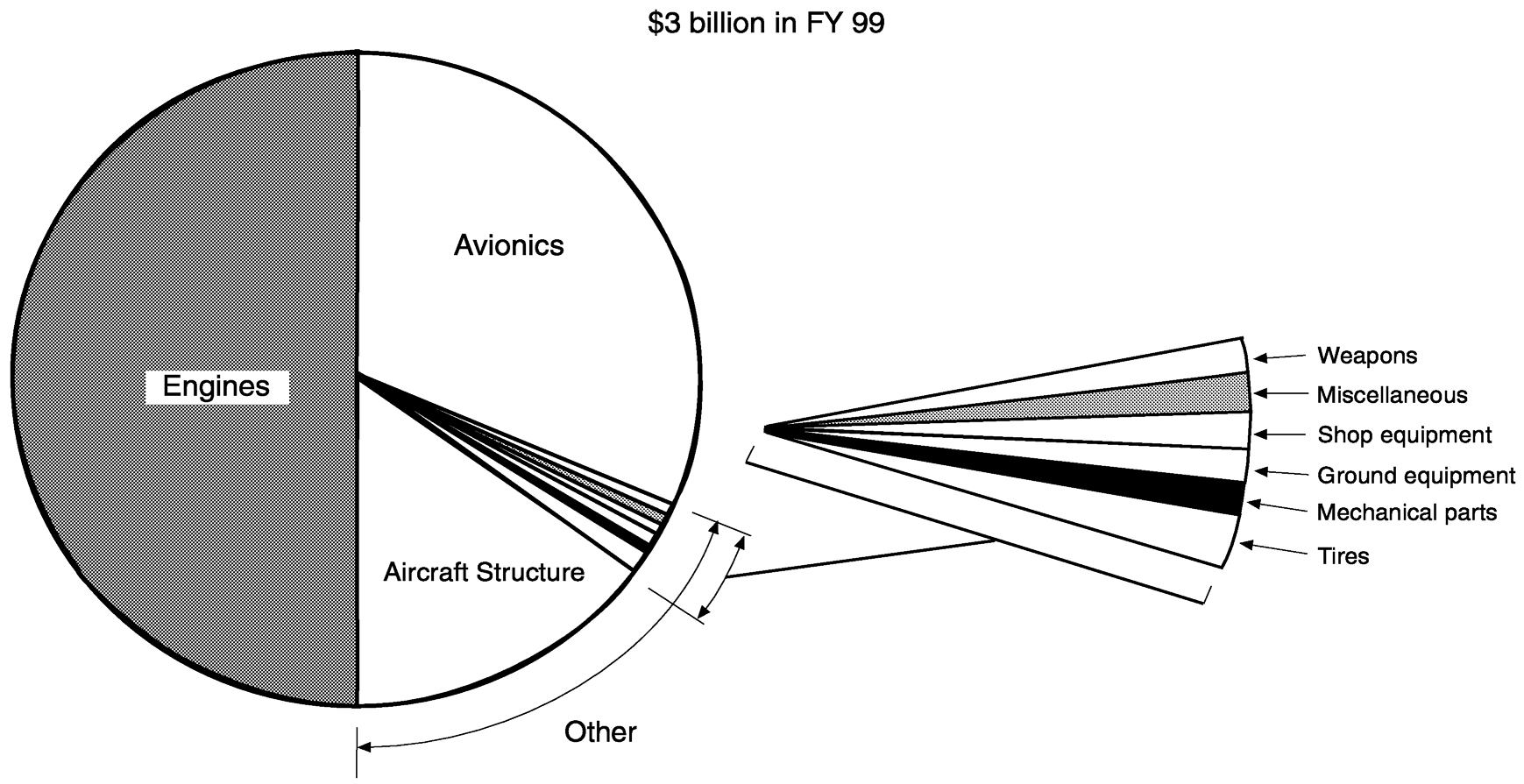
A DoD report, Product Support for the 21st Century: A Year Later (September 2000) notes that DoD spends about $62 billion annually to support and maintain its equipment (DUSD[AT&L], 2000). In fiscal year 1999 (FY99), the Air Force spent about $3 billion for depot-level repairs of its aircraft. Approximately one-third of this, or $1 billion, was spent on maintaining and supporting avionics systems (operations and maintenance [O&M] funds), as shown in Figure 2-1 . An additional
~ enlarge ~
FIGURE 2-1 Cost of avionics in depot-level aircraft maintenance for FY99. Source: U.S. Air Force, 2000a.
Page 16
~ enlarge ~
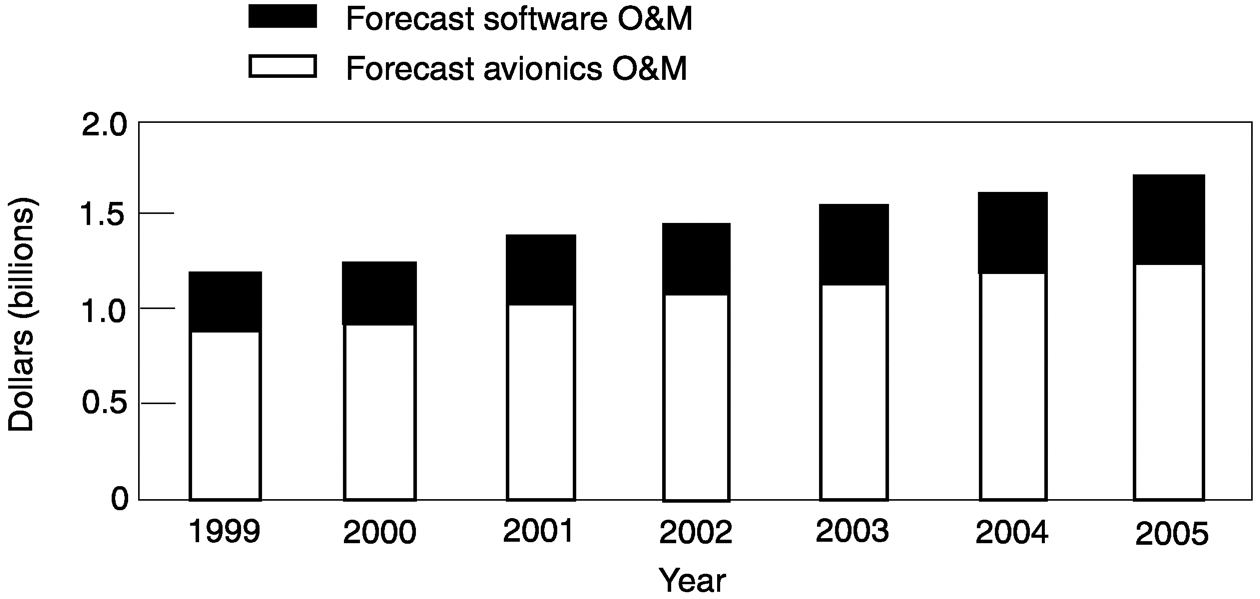
FIGURE 2-2 Projected depot-level avionics operations and maintenance costs. Source: U.S. Air Force, 2000b.
$250 million to $275 million per year is needed to address the aging avionics problem (personal communication from Lt. Gen. R. Raggio, Commander, Aeronautical Systems Center, July 2, 2000). In fact, avionics systems are the second largest component of Air Force O&M costs after engines.
Because of the growing DMS/OP problem, depot-level support costs for avionics are projected to increase by about 50 percent in the next five years ( Figure 2-2 ). Monies spent strictly on DMS/OP for one-for-one replacement are not available for modifications that could improve the reliability or maintainability of avionics components or reduce TOC. Thus, the Air Force is compelled to continue to play catch-up with its O&M funds. For example, O&M budget constraints on the Air Mobility Command have left insufficient funds for the C-5, C-141, and C-17 to fly the required number of flight hours to meet training requirements (U.S. Air Force, 2000a).
BUDGET FOR MODERNIZING AVIONICS
The Air Force must maintain an inventory of approximately 6,000 aircraft to sustain 195 active air wings. For the past five years, the average annual procurement of new aircraft has been only 25 aircraft: 22 in 1996, 22 in 1997, 24 in 1998, 26 in 1999, and 28 in 2000 (Hitt, 2000). If this low rate of procurement continues, the USAF will turn over its aircraft inventory every 240 years. Until something is done to reverse this trend, as the age of aircraft increases, O&M costs will also increase. With an essentially flat DoD budget and strong pressure against increasing aircraft procurements, O&M dollars are being diverted from budgets for modernization, which exacerbates the problem. The limited remaining dollars for modifications are being used to fund modifications to enable airplanes to operate in controlled airspace and to make existing aircraft compatible with the new “smart weapons” that are coming into the inventory. Consequently, very few dollars are left to modernize aging avionics systems or the infrastructure to support these systems.
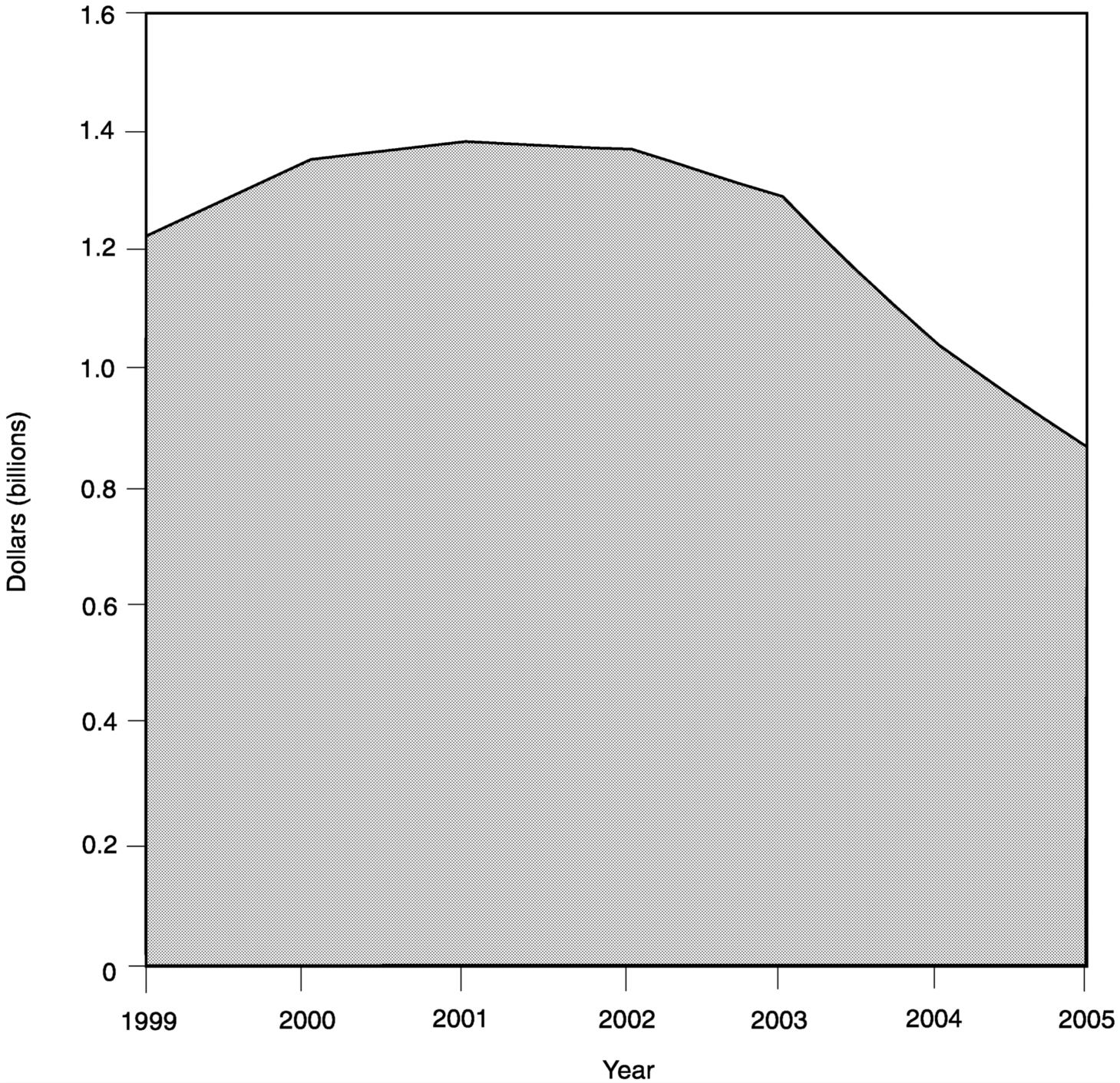
The Air Force modernization account (modernization includes R&D, testing, evaluation, and procurement), approximately $20 billion per year, has remained at about that level throughout the 1990s and is projected to remain flat through FY07 (Durante, 2000). Figure 2-3 shows funding for avionics modernization from the FY01 President's Budget Request (PBR) (PBR, 2000).
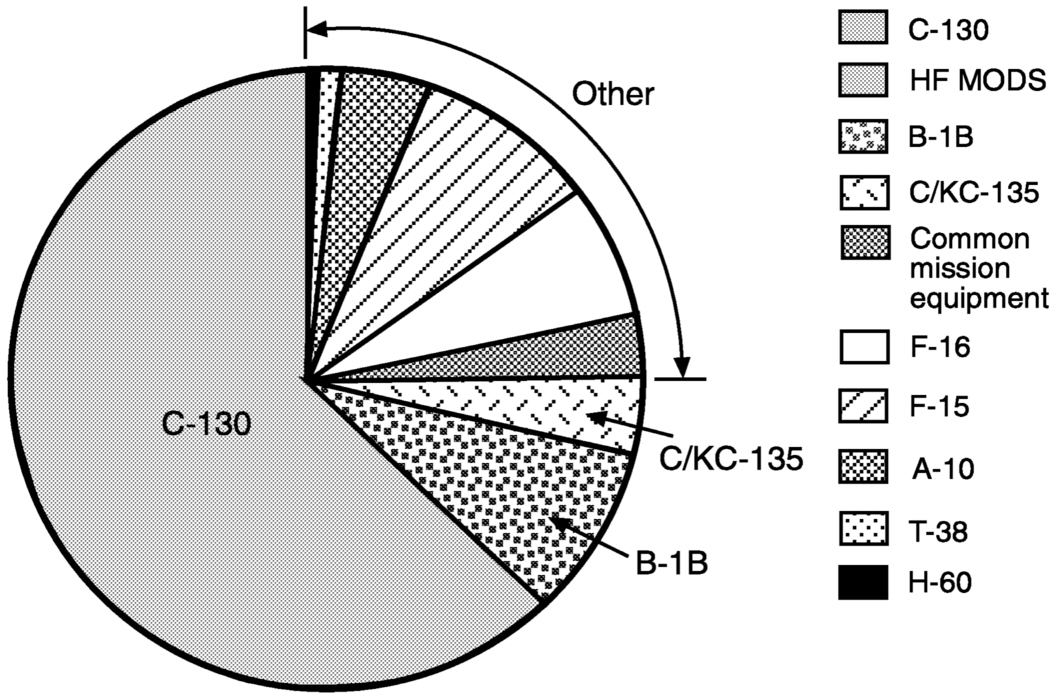
As Figure 2-3 shows, funding would increase through FY01 and decrease thereafter. According to the committee's analysis, however, the avionics investments already approved in the FY01 PBR will cost an additional $5 billion beyond FY05, which is inconsistent with the decrease after FY01. Figure 2-4 shows a breakdown of funds already committed to out-year costs by weapon system, which are dominated by modifications to the C-130.
Some of the upgrades funded in the PBR will be necessary to ensure that U.S. aircraft meet the requirements of the GATM. In addition, most of the transport aircraft from Air Mobility Command will be provided with the TCAS and ground proximity warning equipment. These upgrades account for approximately 20 percent of the modernization budget each year.
Page 17
~ enlarge ~
FIGURE 2-3 FY01 President's Budget Request for avionics modernization. Source: PBR, 2000.
~ enlarge ~
FIGURE 2-4 Out-year costs after FY05 for avionics modernization (approximately $5 billion). Source: U.S. Air Force, 2000a.
Page 18
Unfortunately, these modifications do not replace high-TOC subsystems or out-of-production avionics components and, therefore, will not substantially improve the DMS/OP picture. For instance, the complex F-16 APG-68 radar has the highest O&M cost of all F-16 avionics, yet none of the planned modifications in the budget involve upgrading or replacing the F-16 radar (PBR, 2000). Because GATM upgrades are considered necessary for aircraft to continue flying, they take priority over the replacement of these high-TOC subsystems. To put the issue in perspective, the shortage of funds available to address the aging avionics problem is so acute that an option under consideration by Air Combat Command is the early retirement of the F-117 stealth fighter because of insufficient funds to replace the infrared acquisition and designation system (IRADS), the color multipurpose display system (CMDS), and the electronic data transfer system (EDTS), all of which are facing obsolescence problems.
~ enlarge ~
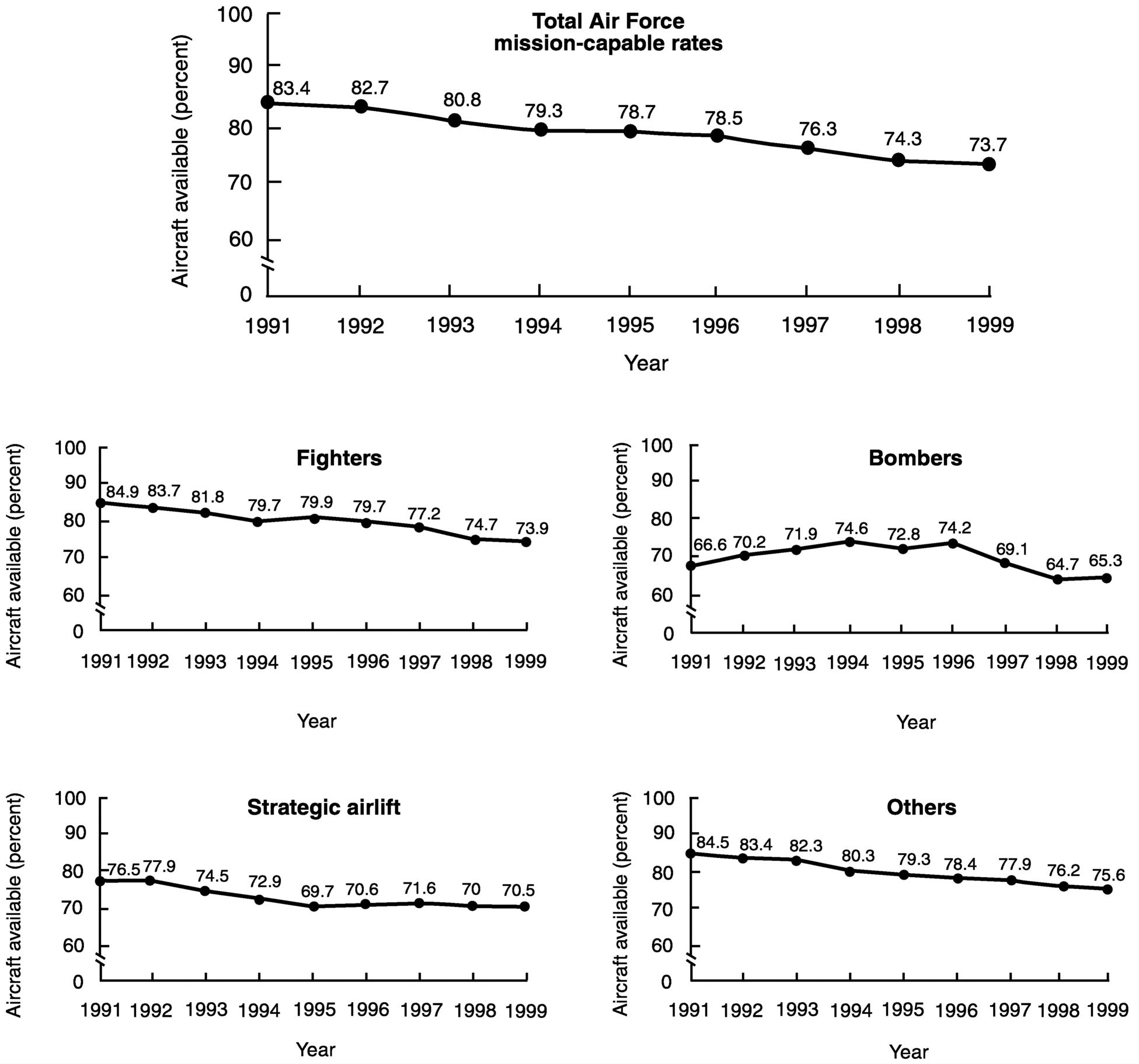
FIGURE 2-5 Declining Air Force mission-capable rate. Source: Air Force Magazine, 1999.
Page 19
|
Type |
Quantity |
Role |
|
USAF |
||
|
A-10 Thunderbolt II |
127 |
Close air support/forward air control |
|
OA-10 Thunderbolt II |
99 |
Close air support/forward air control |
|
B-1B Lancer |
81 |
Strategic bomber |
|
B-2A Spirit |
19 |
Strategic bomber |
|
B-52H Stratofortress |
85 |
Strategic bomber |
|
C-5A Galaxy |
28 |
Transport |
|
C-5B Galaxy |
50 |
Transport |
|
C-5C Galaxy |
2 |
Transport |
|
C-9A/C Nightingale |
23 |
Transport |
|
C-12 Huron |
36 |
Transport |
|
C-17A Globemaster III |
41 |
Tactical transport |
|
C-21A (Learjet 35A) |
79 |
Transport/communications |
|
C-23A Sherpa |
3 |
Freight transport |
|
VC-25A (Boeing 747) |
2 |
Presidential transport |
|
C-27A Spartan (G.222) |
10 |
Transport |
|
C-130E/H/J Hercules |
183 |
Transport |
|
EC-130E/H Hercules |
22 |
Electronic intelligence |
|
AC-130H/U Spectre |
21 |
Gunship |
|
MC-130E/H/P Hercules |
66 |
Special operations |
|
NC-130 Hercules |
4 |
Test and evaluation |
|
C-135A/B/C/E |
7 |
Transport |
|
EC-135 |
12 |
Electronic intelligence |
|
OC-135 |
3 |
“Open Sky” Treaty |
|
RC-135 |
20 |
Reconnaissance |
|
KC-135 |
249 |
Tanker |
|
NKC-135 |
2 |
Tanker |
|
C-137B/C |
6 |
VIP transport |
|
C-141B Starlifter |
95 |
Transport |
|
E-3B/C Sentry |
32 |
AWACS |
|
E-4B (Boeing 747) |
4 |
AACP |
|
E-8C J-STARS |
5 |
Surveillance |
|
E-9A (DHC Dash-8) |
2 |
Range surveillance |
|
EC-18B/D (Boeing 707) |
4 |
Reconnaissance/surveillance |
|
F-15A/B/C/D Eagle |
404 |
Fighter |
|
F-15E Eagle |
201 |
Fighter/attack |
|
F-15A/B/C/D Eagle |
14 |
Test |
|
F-16A Fighting Falcon |
3 |
Fighter/attack |
|
F-16B Fighting Falcon |
18 |
Fighter/attack |
|
F-16C Fighting Falcon |
568 |
Fighter/attack |
|
F-16D Fighting Falcon |
88 |
Fighter/attack |
|
F-117 Nighhawk |
52 |
Attack |
|
KC-10A Stratotanker |
59 |
Tanker |
|
RQ-1A Predator (UAV) |
6 |
Reconnaissance/surveillance |
|
TG-3 (glider) |
3 |
Reconnaissance/surveillance |
|
TG-4 (glider) |
14 |
Reconnaissance/surveillance |
|
TG-7 (glider) |
9 |
Training |
|
TG-9 (glider) |
4 |
Reconnaissance/surveillance |
|
TG-10 (glider) |
1 |
Training |
|
TG-11 (glider) |
2 |
Training |
|
HH-1H Iroquois |
8 |
Missile support |
|
UH-1N Iroquois |
64 |
Missile support |
|
TH-53A Sea Stallion |
6 |
Search and rescue |
|
MH-53J Sea Stallion |
40 |
Special operations |
|
HH-60G Black Hawk |
54 |
Search and rescue |
|
MH-60G Black Hawk |
10 |
Special operations |
|
T-1A Jayhawk |
183 |
Training |
|
T-3A Firefly |
111 |
Training |
|
T-37B Tweet |
415 |
Training |
|
T-38A Talon |
414 |
Training |
|
AT-38B Talon |
78 |
Training |
|
T-41 Mescalero |
3 |
Training |
|
T-43A (Boeing 737) |
10 |
Training |
|
CT-43A (Boeing 737) |
1 |
Training |
|
TC-18E (Boeing 707) |
2 |
Training |
|
UV-18 Twin Otter |
2 |
Parachute training |
|
U-2R/S |
31 |
Reconnaissance |
|
TU-2R/S |
4 |
Training |
|
WC-130H/W |
3 |
Weather reconnaissance |
|
Total |
4,307 |
|
|
Air Force Reserve (AFRES) |
||
|
27 |
Close air support |
|
|
OA-10 Thunderbolt II |
27 |
Forward air control |
|
B-52H Stratofortress |
9 |
Strategic bomber |
|
C-130 Hercules |
112 |
Transport |
|
C-141B Starlifter |
44 |
Transport |
|
C-5A Galaxy |
32 |
Transport |
|
F-16C Fighting Falcon |
56 |
Fighter/attack |
|
F-16D Fighting Falcon |
8 |
Fighter/attack |
|
HH-60G Black Hawk |
21 |
Special operations/search and rescue |
|
KC-135E/R |
75 |
Tanker |
|
WC-130H/W |
10 |
Weather reconnaissance |
|
Total |
421 |
|
|
Air National Guard (ANG) |
||
|
A-10 Thunderbolt II |
78 |
Close air support |
|
OA-10 Thunderbolt II |
18 |
Close air support |
|
B-1B Lancer |
14 |
Strategic bomber |
|
C-5A Galaxy |
14 |
Transport |
|
C-130 Hercules |
215 |
Transport |
|
C-141B Starlifter |
16 |
Transport |
|
C-21 (Learjet 35A) |
4 |
Transport/commun. |
|
C-22B (Boeing 727) |
3 |
Transport |
|
C-26A/B (Metro III) |
11 |
Transport |
|
F-15A/B/C/D Eagle |
90 |
Interception |
|
F-16A Fighting Falcon |
102 |
Fighter/attack |
|
F-16B Fighting Falcon |
26 |
Fighter/attack |
|
F-16C Fighting Falcon |
340 |
Fighter/attack |
|
F-16D Fighting Falcon |
29 |
Fighter/attack |
|
HH-60G Black Hawk |
17 |
Special operations/search and rescue |
|
KC-135 Stratotanker |
225 |
Tanker |
|
T-43 (Boeing 737) |
2 |
Training |
|
Total |
1,204 |
|
|
Grand Total |
5,932 |
Page 20
DECLINING READINESS
Beyond the problem of rising maintenance/logistics costs and insufficient resources for modernization is the fundamental issue of combat and mobility readiness.
The Air Force reports that mission-capable rates for its aircraft have declined by 10 percentage points—from 83 percent to 73 percent— since 1991. And rates of cannibalization (a measure of how often maintenance crews must take a part off one aircraft to maintain another) increased by 78 percent between 1995 and 1998, indicating a shortage of spare parts (CBO, 2000).
These data are illustrated in Figure 2-5 . Although the committee does not have specific data linking the decline in readiness to aging avionics, the fact that avionics maintenance accounts for approximately one-third of total aircraft maintenance costs supports this conclusion. Air Force officials from the Air Combat Command and Air Mobility Command interviewed by committee members confirmed the linkage (personal communications with Brig. Gen. Randolph Bigum, director of requirements, Air Combat Command; and Maj. Gen. Michael Wooley, commander, Tanker Air-Lift Control Center, Air Mobility Command, September 26, 2000).
The magnitude of the Air Force's aging avionics problem cannot be fully comprehended without considering the diversity of types of aircraft flown (68 in the Air Force, 11 in the Air Force Reserve, and 17 in the Air National Guard), the small fleets of some types of aircraft (e.g., only 1 CT-43A), the multiple versions of the same aircraft (e.g., F-15 A, B, C, D, and E), and multiple users of the same aircraft (e.g., A-10 used by Air Force, Air Force Reserve, and Air National Guard). In light of these data ( Table 2.2 ), the committee concluded that the magnitude of the aging avionics problem is large and is growing. This urgent problem must be addressed by Air Force management through enterprise management supported by informed program management.


