
4
“They Thought the World Was Flat?” Applying the Principles of How People Learn in Teaching High School History
Robert B. Bain
For at least a century, educational critics and school reformers have pointed to high school history teaching as the model for poor and ineffective pedagogy. Consider, for example, the introduction to a series of nineteenth-century books on teaching written by psychologist G. Stanley Hall:
History was chosen for the subject of the first volume of this educational library because, after much observation in the schoolrooms of many of the larger cities in the eastern part of our country, the editor … is convinced that no subject so widely taught is, on the whole, taught so poorly, almost sure to create a distaste for historical study—perhaps forever.1
History education, Hall observed, involved generally unprepared teachers who used ineffective methods to turn history into the driest of school subjects. “The high educational value of history is too great,” Hall explained, “to be left to teachers who merely hear recitations, keeping the finger on the place in the text-book, and only asking the questions conveniently printed for them in the margin or the back of the book.”2 In a call to instructional arms, Hall and other late-nineteenth-century reformers urged teachers to move beyond lecture, recitation, and textbooks, asking them to “saturate” history teaching with more active historical pedagogy.
Most subsequent educational critics have shared Hall’s concerns about the quality of history instruction and embraced the recommendation that teachers reform history teaching to make it more effective and engaging. However, critics have disagreed vigorously about the goals and features of an improved pedagogy. The language of reform reflects these disagreements, often urging history teachers to choose either student-centered or teacher-
centered pedagogies, an emphasis on facts or concepts, hands-on learning or lecture, textbooks or primary sources, depth or breadth, inquiry or direct instruction.
History teachers know that the choices are neither so dichotomous nor so simple. Framing the instructional situation as a set of either-or choices, such as abandoning textbooks in favor of primary sources or substituting student inquiry projects for teachers’ lectures, ignores the perennial challenges that history students and, consequently, history teachers face in trying to learn history and develop historical understanding. History is a vast and constantly expanding storehouse of information about people and events in the past. For students, learning history leads to encounters with thousands of unfamiliar and distant names, dates, people, places, events, and stories. Working with such content is a complex enterprise not easily reduced to choices between learning facts and mastering historical thinking processes. Indeed, attention to one is necessary to foster the other. As How People Learn suggests, storing information in memory in a way that allows it to be retrieved effectively depends on the thoughtful organization of content, while core historical concepts “such as stability and change” require familiarity with the sequence of events to give them meaning. Moreover, learning history entails teaching students to think quite differently than their “natural” inclinations. As Wineburg3 suggests, historical thinking may often be an “unnatural” act, requiring us to think outside familiar and comfortable assumptions and world views. Such work, then, requires both substantial knowledge and skill on the part of the teacher to help students learn historical content while expanding their capacities to use evidence, assess interpretations, and analyze change over time.
This chapter addresses the challenges high school history teachers confront every day when, facing large classes, predefined course goals, and the required use of textbooks, they try to engage students in the intellectual work of learning and “doing” history. Given the demands on history teachers and the intellectual challenges students face while learning history, how might high school history teachers use the ideas found in How People Learn to construct history-specific instructional environments that support students as they work toward deeper historical understanding? As a veteran high school history teacher with over 25 years of experience, I begin by showing how I cast traditional history topics and curricular objectives as historical problems for my students to study. Reformers have long argued that historical inquiry ought to be part of history teaching, but often teachers see it as something either on the margins of instruction or as a replacement for traditional teaching. This chapter takes a different approach by building upon traditional curricular mandates and pedagogy to place inquiry at the heart of instruction. Using a case study developed around my students’ studies of Columbus, exploration, and the concept of the “flat earth,” I focus on ways
teachers can restructure familiar curricular objectives into historiographic problems that engage students in historical thinking. Formulating such historical problems is a critical first step in history teaching.
But it is not sufficient simply to add problem formulation to the extant history curriculum and pedagogy. This chapter goes beyond problem formulation to suggest ways teachers might design history-specific “tools” to help students do history throughout the curriculum. These modest cognitive tools—“mindtools” as David Jonassen4 calls them—provide useful ways to help students grapple with sophisticated historical content while performing complex historical thinking and acquiring substantive knowledge. Again drawing on my experiences with my students, this chapter makes a case for transforming lectures and textbooks from mere accounts of events into supports that help students grapple with historical problems as they learn historical content and construct historical meaning.
WHERE TO BEGIN? TRANSFORMING TOPICS AND OBJECTIVES INTO HISTORICAL PROBLEMS
History begins with—and often ends with—questions, problems, puzzles, curiosities, and mysteries. Historians frame and build their historical research around problems emerging from a complex mix of personal and professional interests, unexamined and underexamined questions, gaps in established literature and knowledge, and recurring puzzles and issues. Like detectives working intently on solving the mystery at hand, historians face questions and puzzles that direct their scholarship, giving it meaning and providing coherence.5 Seeking the answers to perplexing questions does more than simply make history an engaging activity for historians; working with problems also helps historians select, organize, and structure their historical facts. It is no surprise, therefore, that most attempts to reform history education urge teachers to begin with “big” questions. If historians are driven to learn content by their questions, so, too, might students find history engaging, relevant, and meaningful if they understood the fundamental puzzles involved. Students, like historians, can use historical problems to organize data and direct their inquiries and studies. Therefore, creating and using good questions is as crucial for the teacher as it is for the researcher.
However, much as high school history teachers might wish to frame their instruction around the historical problems arising from compelling interests, gaps, puzzles, or mysteries, they must deal with a different set of constraints from those faced by historians. History teachers are charged with teaching their students a history that others have already written; thus they typically begin with course outcomes in hand, determined by curricular mandates (i.e., district or state) or the imperatives of external testing (i.e.,
state exams, Advanced Placement or International Baccalaureate tests). Using the normative discourse of curriculum and standards documents, history is cast into discrete behavioral objectives and measurable student outcomes, readily used by the bureaucracies of schooling, such as testing and textbooks. Although the authors of those outcomes often started with compelling questions, central ideas, and enduring problems, the bigger issues gradually fall away as the curricula are written, reshaped, vetted, voted upon, and adopted. History, then, arrives at the classroom door as lists of things students must learn and, thus, teachers must teach—missing the problems and questions that make the content coherent, significant, and even fascinating.
Of course, beginning with measurable outcomes helps teachers establish targets for teaching and learning. However, curricular objectives rarely connect outcomes to their intellectual roots, that is, to the historical problems and questions that generated such understanding in the first place. Whatever their value for conducting assessments, lists of curricular objectives do not (nor are they intended to) provide the disciplinary connections, patterns, or relationships that enable teachers and students to construct coherent pictures of the history they study. Lists of instructional outcomes rarely frame history as an unfinished mystery that invites students to join the investigation or points teachers toward historiographic questions that might begin and sustain instruction. Nor do curricular lists help teachers anticipate students’ preinstructional understandings, develop a reasonable and educationally sound trajectory of lessons, or build connections across content objectives. Yet the knowledge base summarized in How People Learn suggests that these are critical to effective teaching and learning. Given the form of most standards documents, history teachers must offer the intellectual and historical context necessary to provide meaning and coherence across discrete objectives.
One way teachers can build instructional cohesion, as suggested in How People Learn, is to organize the curriculum around history’s key concepts, big ideas, and central questions.6 Teachers can provide instructional substance by grounding the abstractions found in standards and curriculum documents in meaningful historical problems. But how do we move from lists of loosely connected objectives to central historiographic questions? How do we transform inert historical topics into historical problems?
In a sense, history teachers in the United States must play a form of instructional Jeopardy by inventing the big questions to fit the curricular answers. Like historians working backward from given events to the questions that precipitated them,7 history teachers work backward from given objectives to the big historical questions. Unlike historians, however, who work only along historical lines of thinking, teachers must be bifocal by pursuing both historical and instructional lines of thinking. History teachers must go beyond merely doing history or thinking historically themselves;
they must be able to help others learn history and learn to think historically. Therefore, history teachers have to employ an instructional as well as historical logic when designing history problems, moving beyond historiographic issues to consider their students and the context within which their students learn history.
What does this mean in practice? First, teachers should try to design historiographic problems that provide links across objectives to connect the multiple scales of instructional time that teachers and students share: activities, lessons, units, and courses. Ideally, each scale is clearly nested within and connected to others, so students can see how activities become lessons forming coherent units that combine for unified courses. Unfortunately, students rarely experience such coherence in their history courses, as reflected in their belief that history comprises lists of facts, packaged in chronological containers—such as textbook chapters—that have little discernable connection to each other. Unifying problems, if well designed and historically interesting, can provide a larger frame to help students develop meaningful connections across activities, lessons, units, and courses.
Second, in creating instructional problems, teachers also must pay attention to the multiple facets of historical knowledge—history’s facts, concepts, and disciplinary patterns of thinking. Aiming for instructional coherence does not mean that teachers will sacrifice the substance and rigor of the discipline in crafting problems to study. Good problems look to both the contours and details of historical stories, asking, for example, “How has democracy in the United States changed over time? What explains differences in mobility or technology over time?” Working with such problems requires students to grapple with important historical details while extending their understanding of and skill in using key historical concepts, such as significance, cause and effect, change and continuity, evidence, and historical accounts.
Further, in creating instructional problems, teachers must carefully consider the hidden challenges their students face when studying history and employing historical thinking. For example, extraordinary knowledge and skill are required to “put oneself in another’s shoes,” for the world views of previous generations of people were profoundly different from our own. Ninth graders can “imagine” what it felt like to be a European explorer or Native American, but their natural inclination will be to presume more similarity than difference across time. Students find it difficult to imagine a world not yet shaped by science or the Industrial Revolution, a world in which there were no social services and running water, a world in which U.S. citizens did not take democracy for granted. Students’ historical present—recognized or not—shapes their understanding of the past—another dimension for teachers to consider in designing historical problems for students to study.8
Thus, in constructing problems or questions, high school history teachers must work on multiple instructional and historiographic levels, crafting historical problems that are transportable across scales of instructional time—activities, lessons, units, and courses—while capturing the factual, conceptual, and cognitive processes central to generating historical understanding and challenging students’ assumptions. In framing these problems, history teachers must ask, “What historical questions will connect the course activities and provoke my students to learn content as they extend their capacity for historical thinking?” The following case study embodies this question by first describing the complex historical problems I used to organize my high school course and then creating a related problem for a unit within that course.
“Problematizing” Historical Accounts to Raise Year-Long Historical Questions
Creating central questions or problems challenges teachers to work at the intersection of two separate junctures—what is historically significant and what is instructive for and interesting to students. In my high school history courses, I often met this challenge by “problematizing” historical accounts—history’s stories, interpretations, narratives, and representations. Focusing on historical accounts gave me material to create a robust set of problems that stimulated, organized, and guided instruction over an entire course.
What do I mean by problematizing historical accounts? At the unit level—instruction ranging from about a week to a month—it means raising questions about particular historical stories, narratives, or interpretations. At the level of the whole course, however, it means raising questions that are fundamental to historical understanding:
What is the difference between historical accounts and the “past”? How do events that occurred in the past and the accounts that people create about the past differ? If the past is fleeting, happening only once and then disappearing, how is it possible for people living in the present to create accounts of the past? How do historians move from evidence of the past to construct historical explanations and interpretations? How do historians use evidence, determine significance, structure turning points, and explain continuity and change within their accounts? Are some historical accounts “better” than others? Why? By what standards do historians assess historical accounts? Why do accounts of the same event differ and change
over time? Does it make a difference which version of the past we accept?
Such questions touch upon every facet of the discipline of history, constituting the foundational problems historians confront when doing history.
Though it might appear obvious, focusing on historical accounts would already represent a major break from traditional history instruction. The accounts that historians write and adults read—such as the currently popular biography of John Adams or the groundbreaking Cheese and the Worms9—are typically too rich and deep, too complex and time-consuming, to find their way into textbooks. Students do not read about John Adams’ life, his relationship with his wife, his travels to Europe, his passions and enthusiasms, but rather read that he was President, that he held certain positions, and that he died on the same day as Thomas Jefferson. Only these discrete bits of information, the traces of historical accounts, make their way into textbooks or into curricular objectives.
Raising questions about accounts helps students see the water in which they are swimming. Historical accounts—or rather, the vestigial remains of historical accounts—are ubiquitous in high school history courses. Textbooks, media, handouts, lectures, classroom materials, technology, and teachers surround history students with fragments of historical narratives and interpretations, yet rarely do students see the nature and structure of these interpretations. Much of high school history finds students exploring vast evidenceless and authorless expanses of curriculum that promote, as historian David Lowenthal10 asserts, a “credulous allegiance” to some version of the past:
Historical faith is instilled in school. “Youngsters have been taught history as they were taught math as a finite subject with definite right or wrong answers,” frets a museum director. Most history texts are “written as if their authors did not exist….” High marks depend on giving the “correct” gloss to regurgitated facts. Textbook certitude makes it hard for teachers to deal with doubt and controversy; saying “I don’t know” violates the authoritative norm and threatens classroom control.
Problematizing historical accounts, then, makes visible what is obscured, hidden, or simply absent in many history classrooms. It helps move school history beyond reproducing others’ conclusions to understanding how people produced those conclusions, while considering the limitations and strengths of various interpretations. By making historical accounts our essential historical problem, we can help students develop familiarity with historical writing; identify ways in which people have interpreted past events; recognize, compare, and analyze different and competing interpretations of events; examine reasons for shifts in interpretations over time; study the ways people use evidence to reason historically; and consider interpretations in relation-
ship to various historical periods. Indeed, all of the familiar features of history classrooms—textbooks, lectures, primary sources, maps, time lines, and even worksheets—take on new meaning for students when viewed as historical accounts.
This approach does not preclude using themes, such as changes in migration, ideas, or political culture, but rather forces teachers to anchor their themes in the issues of historical representation and interpretation. Nor does a focus on interpretation favor process at the expense of facts. In looking carefully at historical accounts, we must teach historical facts; more important however, we must also raise questions about why we should (or whether we should) consider particular sets of facts important. The study of interpretations demands that students look carefully at the ways people use facts to form and support historical accounts. Indeed, factual understanding becomes even more significant as students grapple with how people use facts in representing the past.
Moreover, a focus on multiple, shifting accounts does not mean students will hold all accounts to be equally compelling or plausible; rather, like historians, students must develop tools to evaluate and access competing stories of the past, considering evidence and argument while learning to judge what constitutes sound historical reasoning. In systematically questioning historical interpretations over the course of a school year, we can help students understand that accounts differ, and that those differences lie in the questions authors ask, the criteria they use to select evidence, and the spatial and temporal backdrop people use to tell their stories.
Therefore, I placed the fundamental questions about historical understanding cited earlier at the heart of our study for the year.
In creating historical stories or interpretations, what questions were the historians trying to answer? How did the historians, typically not present at the events they were studying, use evidence from the past to answer their questions and construct explanations or interpretations? Within their accounts, how did the historians determine significance, structure turning points, and explain continuity/change over time? Why do accounts of the same events differ, shift in interpretation, or come into and out of fashion? Are some historical accounts “better” than others? Why? By what standards are we assessing historical accounts? Does it make a difference which version of the past we accept?
Teachers will need to explicitly introduce and help students frame central problems and concepts at the outset of a course and use them regularly, even before the students fully understand them. That is what I did, using the distinctions between “the past” and “history” to introduce students to the problems involved in creating and using historical accounts. On the surface, the difference between the past and history appears to be an easy one for students to perceive and understand. But high school teachers know how
long it takes for students to fully understand and employ such distinctions in their thinking.
There are many ways to introduce these ideas, but a particularly powerful one is to have students write a short history of an event they all shared and then compare their respective histories. For example, an activity I often used was to have students write a history of the first day of school that they would read aloud on the second day. The great variance in students’ choice of facts, details, stories, and perspectives revealed differences between the event under study (i.e., the first day of school) and the accounts of that event. This simple activity helped reveal the distinctions between events and historical accounts because students experienced the differences when writing about and comparing their shared pasts.
The most significant instructional goal and feature of the activity involved our naming these distinctions by creating two new and key terms—“H(ev)” and “H(ac)”—standing for “history-as-event” and “history-as-account.” Why make up such new historical terms? Students typically enter history class with established conceptions and assumptions about history. They use the word “history” in two very different ways: (1) history as a past occurrence (“Well, that happened in history.”) or (2) history as an account of a past occurrence (“I wrote that in my history.”) Their everyday and common-sense uses of the word “history” blur the distinction between the past and accounts of the past and reinforce typical conceptions that history is but a mirror of the past. A crucial instructional move, therefore, involves creating a language to help students break out of their ordinary, customary use of “history” to make fundamental disciplinary distinctions.
Once defined, the phrases “history-as-event” and “history-as-account” or the invented terms H(ev) and H(ac) were used almost daily by students to name and frame materials commonly encountered, including textbooks, films, and class lectures. This simple linguistic device helped them situate accounts, regardless of how authoritative, in relationship to the events described by those accounts. This, in turn, heightened students’ sensitivity to and awareness of when we were discussing an interpretation and when we were discussing an event. In exploring the distinction between history-as-event and history-as-account, students generated questions they used to consider the relationship between events and the accounts that describe them. For example, one class produced these questions:
How do accounts relate to the event they describe? Do the accounts capture the full event? Is it possible for accounts to fully capture events? How and why do accounts of the same event differ? Do they use different facts? Different sources? Different pictures? Different language? Do the accounts identify different turning points or significant events in the game?
Are the accounts connected to each together? Are there other possible accounts of the event? Do accounts serve different purposes? What explains the fact that people studying the same event create differing accounts? Can one account be better than another? How can we assess competing truth claims? Does it matter which version of an event we accept as true? What makes one account more compelling than another? How does an account use evidence to make its claims?
These questions, initially discussed in relationship to students’ history of the first day of class, formed a valuable backdrop for each successive unit. Initial distinctions, introduced and then used regularly, helped students demystify historical accounts by constantly reminding them that historical texts are products of human thought involving investigation, selection, evaluation, and interpretation.
Establishing these initial distinctions provided students with the beginnings of a new conceptual map for the discipline of history, a map we used regularly to locate their position in historical territory. “So, were we just now working with events or accounts of those events? Who constructed the account? What evidence did they use in building the narrative or interpretation?”
No one should think that merely pointing out conceptual distinctions through a classroom activity equips students to make consistent, regular, and independent use of these distinctions. Established habits of thinking that history and the past are the same do not disappear overnight. Merely generating questions about historical accounts did not mean that my students developed the knowledge and skill needed to answer those questions, or even to raise those questions on their own. In making conceptual distinctions between the past and accounts of the past, it did not follow automatically that students developed the intellectual skills to analyze, evaluate, or construct historical accounts. Indeed, students did not even fully grasp the distinctions represented in the new linguistic conventions they were using, such as history-as-event/H(ev) and history-as-account/H(ac). Still, while not lulled into thinking that introducing concepts meant students had mastered those concepts, I expected students to use these terms regularly. In subsequent activities, the terms served as intellectual “mindtools” to guide student thinking, helping and, at times, forcing students to analyze their everyday uses of the word “history.” Thus in building on students’ nascent historical thinking, I tried to push them to develop more refined and nuanced historical knowledge and skill while framing a historical problem large enough to inform our entire course.
Accounting for the “Flat Earth”: Building a Unit-Level Problem
How might we create a problem for a unit of study that would engage students, assist in posing the larger disciplinary questions about accounts noted above, and meet curricular objectives such as those that characterize the traditional topic of European exploration of the Americas? Early in the school year, I asked a class of ninth-grade history students, “What do you know about Columbus sailing the ocean blue in 1492? And what do you know about the people of Europe on the eve of Columbus’ voyages? What were they like? What did they believe and think?”
|
Ben |
Well, people of Europe didn’t know anything about the United States or Canada, because people had not been there yet. They wanted to get to China to trade, but most people were scared to sail across the Atlantic. |
|
Teacher |
Why? What were their fears? |
|
Ben |
The world was flat and you could fall off it … |
|
Amanda |
People would not give him money for his ships because they figured he would fail. But Columbus proved them wrong…. |
|
Ellen |
Not really. Columbus never really went all the way around the earth. |
|
Teacher |
So? |
|
Ellen |
Well, people could still believe the earth was flat, just that there was another land before you got to the end of the earth. |
|
Teacher |
Oh, then, people would have to really wait until someone sailed all the way around the world before they changed their ideas? |
|
Ellen |
Yeah. |
|
Teacher |
Well, for how long did this idea exist? |
|
Bill |
All the way back to earliest times. Everyone always thought the world was flat. |
|
Ellen |
Except some scientists, right? |
With some gentle questioning on my part, the students collectively told the standard and widely accepted story of Columbus, an Italian sailor who received funds from the king and queen of Spain to go to the east by sailing west. Europeans thought this was “crazy” because people had thought—forever—that the world was flat. Columbus, motivated by his search for
gold, did land in the New World, but thought he had arrived in China and the Indies, which is why he named the people there “Indians” before conquering them.
For about 10 to 15 minutes, I probed students’ ideas about Columbus and fifteenth-century Europe, capturing key points of agreement and disagreement on the chalkboard. I then encouraged students to think about the source of their understanding, expanding our discussion by asking, “How do you know that the flat-earth story is true? Where did you learn about it? What evidence do you have?” After a few minutes of comments ranging from “everyone knows” to “our elementary teacher told us,” it was clear that students could not point to a specific account that supported their understanding of the event.
Because historical accounts were the focus for both the course and the unit, I gave the students several excerpts from the writing of nineteenth-century historians, excerpts I selected to substantiate the common view that Europeans at the time of Columbus typically believed the earth was flat (see Box 4-1). I used these nineteenth-century historical accounts simply to support students’ preinstructional thinking about the flat earth, intending to return to analyze the accounts later in the unit.11 I asked the students to read the accounts and to look for places where the accounts supported, extended, or contested their thinking about Columbus and Europeans.
In general, these accounts typify the story about Europe and Columbus that emerged in historical writing in the nineteenth century, a story that, as the students’ discussion revealed, continues to hold sway with most students (and adults). The excerpts tell of Columbus’ attempt to sail west to China and the challenges posed by other Europeans and their beliefs about the flat world. They reveal how the irrational beliefs of European sailors, clergy, and nobility hindered Columbus, who knew, heroically, that the world was round. They show how, in trying to achieve his dream, Columbus encountered European sailors who were afraid he and his crew would fall off the edge of the earth, clergy who were horrified by his heretical neglect of the Church and the Scripture, and elites who were shocked by Columbus’ disregard for established geographic knowledge. According to these accounts, Columbus was different from other Europeans of his age: daring, courageous, and blessed with the humanist’s faith that people were capable of great things if they learned enough and tried hard enough.
By design, little in these accounts surprised the students, confirming much of what they knew already about Columbus and the era in which he lived.
|
Carlos |
He [Columbus] proved everyone wrong because he guessed the world was round. |
|
Ellen |
I think I knew that others wouldn’t fund him |
|
|
because they thought the world was flat and he would fall off the edge. How could that be a good investment? |
|
Jim |
Well, he didn’t know much geography because he thought he was going to India, that’s why he called people Indians, right? |
The only hint of surprise for students was that no account mentioned the “discovery” of a people and a new land. Mark brought up this point, telling us, “Columbus thought he discovered America, but there were natives living there.” Concerning the story of the flat earth, students were confident that the flat-earth belief was a real obstacle to Columbus and other explorers.
However, most contemporary historians no longer regard this to be the case. This story of the pre-Columbian belief in the flat earth therefore provides a wonderful opportunity to explore both the details of life in fifteenth-century Europe and larger issues concerning the relationship between historical accounts and the events they attempt to represent. Columbus, most historians today argue, was hardly alone in believing the world was round; indeed, according to recent historical accounts, most educated or even partially educated Europeans believed the world was round.12 The elite, for example, did not resist Columbus because they thought he would fall off the earth’s edge; rather, they thought he had underestimated the size of the earth and would never be able to sail so far in open water (a quite reasonable concern had there not been an unanticipated land mass upon which Columbus could stumble).
Yet my students believed with unquestioning certitude that people prior to Columbus thought the earth was flat. Schooled by their culture and entering the history classroom filled with specific stories about historical events we were studying, they were hardly historical blank slates. The flat-earth story is a part of the national, collective memory. Adults regularly use it as metaphor to describe the ignorance or superstitions of the masses. “Belief in the flat earth” is shorthand for any idea that blinds people to seeking and seeing the truth. My high school students understood and could use this flat-earth metaphor. And like most people, they did not see that this story of the fifteenth-century belief in a flat earth was simply an account of the past and not the past itself. For them, the flat-earth belief was an undisputed feature of the event. Whatever distinctions students had made in our earlier lessons between events and accounts, they had not yet realized that those distinctions were relevant to their own beliefs about the flat-earth story. When faced with a story of the past that they themselves held, students returned to their presumptions that the past is a given, an unwavering set of facts that historians unearth, dust off, and then display.
|
BOX 4-1
|
Two critical features of teaching history are displayed here. The first involves probing students’ thinking about the historical problem they are studying and making their thinking visible for all to see. History education entails helping students learn to think historically. Students’ thinking resides at the instructional center; therefore, teachers must regularly take stock of it
|
and make it visible. The above class discussion is an example of a formative assessment whereby I tried to probe the thinking of the whole class. I asked students to weigh in on the problem, had them spend time documenting their thinking by writing about it in their journals, and then collected their thinking on the board.
Gathering student thinking is but a first step. History teachers do not take stock of student thinking merely to stimulate interest—though it certainly can have that important effect—but also to hold it up for critical examination. This observation leads to the second key feature of history teaching demonstrated here: asking students to explain how they know what they know about the historical event. Merely asking students to retell a historical story or narrate an event is insufficient for high school history students; rather, teachers must press students to document their understanding, and to explain the evidence they are using to draw conclusions or to accept one historical account over another. Like a historian querying a text, I prodded my students by asking for evidence and support. And like a historian who uses sources to extend understanding, I asked the students how each new piece of evidence or account supported, extended, or contested their historical thinking. Here again, language used regularly—“support,” “extend,” or “contest”—helped novice historians analyze critically the relationship between new sources and their own understanding.
In this case, my students could not point to the specific source of their knowledge about the flat earth, and so I provided them with historical accounts to support their ideas. Then to challenge their thinking and to draw the distinction between the story they knew and the event under study, I provided students with two sources of evidence that contested their assumptions and ideas: the first, a picture of a classical statue of Atlas holding up a celestial globe, created between 150 and 73 B.C.E.; and the second, an explanation by Carl Sagan of how the classical scholar Eratosthenes determined the circumference of the world in the third century B.C.E. (see Box 4-2). In groups of three, students discussed how these sources supported, extended, and/or contested their thinking about Columbus and the flat-earth idea. We then began our class discussion by asking, “If, as you and other historians have explained, people prior to 1492 generally believed that the earth was flat, then how do we explain the classical story of Atlas holding up a round earth or of Eratosthenes figuring out the earth’s circumference over 2,000 years ago?”
The pictures of Atlas resonated with stories the students knew or pictures they had seen before. The story of Eratosthenes—though not explicitly remembered from earlier courses—connected with students’ ideas that some ancient “scientists” were capable of unusually progressive thinking, such as building the pyramids or planning great inventions. In other words, these stories were familiar to the students, yet they made no connection between these stories and that of the flat earth. They had compartmentalized their understandings and did not see that they possessed ideas relevant to the question at hand. Use of the pictures of Atlas or stories of pre-Columbian geographers called upon features of students’ background knowledge to provoke them to reconsider the certitude with which they held the flat-earth story:
|
Andrew |
Those other stories [accounts we read before] made it sound as if Columbus was the scientist who discovered the earth was round. But I think other scientists had figured out the world was round, like Galileo. I mean, didn’t he? |
|
Teacher |
I think, I mean, wasn’t Galileo born in the sixteenth century, after the Columbian voyages? |
|
Andrew |
Ok, but what I mean is that I don’t really think that Columbus was the first to prove the world was round. I mean, he didn’t exactly prove it. These others had thought it was round and he just proved you wouldn’t fall off the edge of the earth. They thought it. He proved it. |
|
Sarena |
Now, I sort of remember that many educated people believed the earth was round. Seems odd, that everyone believed the earth was flat but Columbus, doesn’t it? |
As I orchestrated the class discussion, I intentionally prodded students to consider the story of the flat earth as a specific historical account that may or may not be supported by evidence and, like all historical accounts, one that emerged at a particular time and place:
So, did fifteenth-century people believe that the earth was flat? What evidence do you have? What evidence do other accounts provide? Was it possible that people at one time, say during the Classical era, had such knowledge of the world, only to forget it later? Why might the flat-earth story emerge? What purpose would it serve? Does it make a difference which version of the story people believe? Could it be that the view adopted throughout our culture is unsupported by evidence? When did it develop and become popular? Why?
The conversation in the class turned to the discrepant information students confronted, the discrepancies that resided at the juncture of their assumed ideas about the past and the presented evidence. The discussion about this specific case also began to call into question what the students generally believed about people in the past. “If people at the time of Columbus believed in a flat earth,” I asked, “what might explain how people at least 1,500 years before Columbus crafted globes or created (and resolved) problems about the earth’s circumference? Is it possible that at one time people had knowledge of a round earth that was ‘lost’?”
|
BOX 4-2 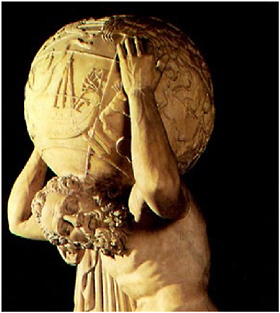 The Atlas Farnese In 1575, this marble figure of Atlas holding a celestial globe was found in Rome. It is called the Atlas Farnese, as Farnese was the name of the collection it entered. It was created by sculptor Crates. The exact date of the sculpture is not known. However, scholars assume that it was made sometime after 150 A.D. because of the representation of the vernal equinox on the globe, which is similar to that in Ptolemy’s Almagest. To give you an idea of the size, the sphere has a diameter of about 251/2 inches. THE STORY OF ERATOSTHENES AND THE EARTH’S CIRCUMFERENCE ‘The discovery that the Earth is a little world was made, as so many important human discoveries were, in the ancient Near East, in a time some humans call the third century BC, in the greatest metropolis of the age, the Egyptian city of Alexandria. Here there lived a man named Eratosthenes. … He was an astronomer, historian, geographer, philosopher, poet, theater critic and mathematician…. He was also the director of the great library of Alexandria, where one day he read in a papyrus book that in the southern frontier outpost of Syene … at noon on June 21 vertical sticks cast no shadows. On the summer solstice, the longest day of the year, the shadows of temple columns grew shorter. At noon, they were gone. The sun was directly overhead. It was an observation that someone else might easily have ignored. Sticks, shadows, reflections in wells, the position of the Sun— |
|
of what possible importance could such simple everyday matters be? But Eratosthenes was a scientist, and his musings on these commonplaces changed the world; in a way, they made the world. Eratosthenes had the presence of mind to do an experiment, actually to observe whether in Alexandria vertical sticks cast shadows near noon on June 21. And, he discovered, sticks do. Eratosthenes asked himself how, at the same moment, a stick in Syene could cast no shadow and a stick in Alexandria, far to the north, could cast a pronounced shadow. Consider a map of ancient Egypt with two vertical sticks of equal length, one stuck in Alexandria, the other in Syene. Suppose that, at a certain moment, each stick casts no shadow at all. This is perfectly easy to understand—provided the Earth is flat. The Sun would then be directly overhead. If the two sticks cast shadows of equal length, that also would make sense of a flat Earth: the Sun’s rays would then be inclined at the same angle to the two sticks. But how could it be that at the same instant there was no shadow at Syene and a substantial shadow at Alexandria? The only possible answer, he saw, was that the surface of the Earth is curved. Not only that: the greater the curvature, the greater the difference in the shadow lengths. The Sun is so far away that its rays are parallel when they reach the Earth. Sticks placed at different angles to the Sun’s rays cast shadows of different lengths. For the observed difference in the shadow lengths, the distance between Alexandria and Syene had to be about seven degrees along the surface of the Earth; that is, if you imagine the sticks extending down to the center of the Earth, they would there intersect at an angle of seven degrees. Seven degrees is something like one-fiftieth of three hundred and sixty degrees, the full circumference of the Earth. Eratosthenes knew that the distance between Alexandria and Syene was approximately 800 kilometers, because he hired a man to pace it out. Eight hundred kilometers times 50 is 40,000 kilometers: so that must be the circumference of the Earth. This is the right answer. Eratosthenes’ only tools were sticks, eyes, feet and brains, plus a taste for experiment. With them he deduced the circumference of the Earth with an error of only a few percent, a remarkable achievement for 2,200 years ago. He was the first person to accurately measure the size of the planet.’ SOURCE: Sagan (1985, pp. 5-7). |
To help students frame this problem more sharply—as well as to begin revealing the core historiographic debate—students read selections from the work of two contemporary scholars, Daniel Boorstin and Stephen Jay Gould (see Box 4-3). In one excerpt, Boorstin argues that the Middle Ages was a “great interruption” in the intellectual progress begun in Classical times, describing this interruption as an era when people were “more concerned with faith than facts.”13 On the other hand, Gould rejects the idea of a great interruption in European geographic knowledge, pointing to a story of continuity rather than discontinuity of ideas.
I used these excerpts strategically, for I wanted to provoke an in-class discussion and move the class toward framing an instructional/historical problem that would guide our study of European discovery: “Did people in 1492 generally believe in the flat earth? If not, when did the story of the flat earth arise? Who promoted that account? Why would people tell stories about the flat earth if the stories were not supported by evidence? What historical accounts explain European exploration of the Americas? How have historians changed those accounts over time?”
In thus problematizing the Columbian account and framing these questions, I sharpened the larger historiographic questions we were using to structure the entire course and the specific curricular objectives for the unit under study. In investigating these questions and analyzing the shifting and competing interpretations of exploration and explorers, high school history students also worked toward mastering the key content objectives for this unit of history. For example, while grappling with issues related to the nature of historical interpretation and knowledge, students had to study the context for and impact of European exploration from a number of perspectives. Historical knowledge—facts, concepts, and processes—shaped almost every feature of the unit, from the framing of the problem through the questions we employed during discussions. Students learned historical facts in the context of these large historical questions, and once they understood the questions, they saw they could not answer them without factual knowledge. The old and false distinction between facts and interpretations or between content and process collapses here. How can students learn about the accounts of the past—the growth of the flat-earth story, for example—without studying the knowledge and ideas of fourteenth- and fifteenth-century Europeans, the features of the waning Middle Ages, the emerging renaissance, tensions between the orthodoxy of the church and new scientific ideas, or the new mercantile impulses that promulgated reasonable risks in the name of profit? As students studied the development of the flat-earth story, an idea of the late eighteenth/early nineteenth century, they also worked with facts about early American national growth, conflicts with Britain and France, and Protestant concerns about Irish immigration. In trying to understand how
this account of the past developed and became popular, students used specific factual detail to make their cases.
Learning historical content, though, was not the only factor that shaped the instruction. In helping students frame a historiographic problem, we publicly took stock of students’ background knowledge and of their historical conceptions and misconceptions. Simply revealing students’ thinking does not help them achieve higher levels of understanding. But by making visible what students thought, I was able to use their ideas to design subsequent instruction and thus encourage them to use historical evidence to question or support their ideas. The activities discussed above asked students to juxtapose their understanding against historical evidence or established historical accounts. The pedagogical moves were specifically historical; that is, in probing students’ knowledge about a historical event, we went beyond just surveying what students knew or what they wanted to learn, a popular technique that begins many lessons (e.g., “Know-Want to know-Learned” charts). Rather, like historians, we used new evidence and other historical accounts to support, extend, or contest students’ understanding. In establishing the unit problem, we created a place for students to consider the relationship among their own historical interpretations of the events, those of other historians, and historical evidence. Again, the three verbs I consistently asked students to use—“support,” “extend,” and “contest”—helped them situate historical interpretations and sources in relationship to their understanding.
Unit-level historical and instructional problems, then, emerged at the intersection of the essential course problems, the unit’s specific curricular objectives, and students’ understanding. Having formed historical problems and with sources now in hand, we might say that the students were doing history. However, we are cautioned by How People Learn and by scholarship on the challenges novices face in employing expert thinking to look beyond the trappings of the activity and consider the supports students may need to use the problems and resources effectively as they study history.
DESIGNING A “HISTORY-CONSIDERATE” LEARNING ENVIRONMENT: TOOLS FOR HISTORICAL THINKING
A central feature of learning, as How People Learn points out, involves students “engag[ing] in active processes as represented by the phrase ‘to do.’” 14 The students in this case study were engaged in the active processes of history as they raised historiographic problems about accounts in general and the case of Columbus in particular, and in the subsequent use of historical sources to investigate those problems. In emphasizing the need to en-
|
BOX 4-3 ‘Christian Europe did not carry on the work of [ancient thinkers such as] Ptolemy. Instead the leaders of orthodox Christendom built a grand barrier against the progress of knowledge about the earth. Christian geographers in the Middle Ages spent their energies embroidering a neat, theologically appealing picture of what was already known, or what was supposed to be known…. It is easier to recount what happened than to explain satisfactorily how it happened or why. After the death of Ptolemy, Christianity conquered the Roman Empire and most of Europe. Then we observe a Europe-wide phenomenon of scholarly amnesia, which afflicted the continent from A.D. 300 to at least 1400. During those centuries Christian faith and dogma suppressed the useful image of the world that had been so slowly, so painfully, and so scrupulously drawn by ancient geographers…. We have no lack of evidence of what the medieval Christian geographers thought. More than six hundred mappae mundi, maps of the world, survive from the Middle Ages…. What was surprising was the Great Interruption. All people have wanted to believe themselves at the center. But after the accumulated advances of classical geography, it required amnesiac effort to ignore the growing mass of knowledge and retreat into a world of faith and caricature…. The Great Interruption of geography we are about to describe was a … remarkable act of retreat.’ Christian geography had become a cosmic enterprise, more interested in everyplace than in anyplace, more concerned with faith than with facts. Cosmos-makers confirmed Scripture with their graphics, but these were no use to a sea captain delivering a cargo of olive oil from Naples to Alexandria…. SOURCE: Boorstin (1990, pp. 100, 102, 146). |
gage students in the practices of the discipline, it is tempting to conclude that simply doing something that resembles a disciplinary activity is by itself educative and transformative. There is a danger, however, if teachers uncritically accept the historian’s practices as their own and confuse doing history with doing history teaching.
History teachers, curriculum designers, and assessment architects need to be cautious when attempting to transplant activities from a community of history experts to a body of student novices. Historical tasks embedded
|
Dramatic to be sure, but entirely fictitious. There never was a period of “flat earth darkness” among scholars (regardless of how many uneducated people may have conceptualized our planet both then and now). Greek knowledge of sphericity never faded, and all major medieval scholars accepted the earth’s roundness as an established fact of cosmology. Ferdinand and Isabella did refer Columbus’s plans to a royal commission headed by Hernando de Talavera, Isabella’s confessor and, following defeat of the Moors, Archbishop of Granada. This commission, composed of both clerical and lay advisers, did meet, at Salamanca among other places. They did pose some sharp intellectual objections to Columbus, but all assumed the earth’s roundness. As a major critique, they argued that Columbus could not reach the Indies in his own allotted time, because the earth’s circumference was too great…. Virtually all major medieval scholars affirmed the earth’s roundness. … The twelfth-century translations into Latin of many Greek and Arabic works greatly expanded general appreciation of natural sciences, particularly astronomy, among scholars, and convictions about the earth’s sphericity both spread and strengthened. Roger Bacon (1220-1292) and Thomas Aquinas (1225-1274) affirmed roundness via Aristotle and his Arabic commentators, as did the greatest scientists of later medieval times, including John Buriden (1300-1358) and Nicholas Oresme (1320-1382). SOURCE: Gould (1995, p. 42). |
within an expert community draw meaning from the group’s frames, scripts, and schemas. Experts differ from novices, as How People Learn explains, and this is an important point for history teachers to bear in mind. Students learning history do not yet share historians’ assumptions. They think differently about text, sources, argument, significance, and the structure of historical knowledge.15 The frames of meaning that sustained the disciplinary task within the community of historians will rarely exist within the classroom. Initially, students typically resist the transplanted activity, or the culture of
the classroom assimilates the “authentic” activity, using it to sustain novices’ naive or scholastic views. Engaging students in some legitimate disciplinary activity without restructuring the social interaction or challenging students’ presuppositions will yield only ritualistic understanding. The problem for teachers is to design activities that will engage students in historical cognition without yielding to the assumption that disciplinary tasks mechanically develop students’ higher functions.
As a classroom teacher, I was often caught in this paradox of trying to have my students work actively with history at the same time that I was trying to help them acquire the “unnatural” dispositions and habits of mind necessary to engage in history’s intellectual work. Take, for example, the reading of primary sources—an intellectual activity that now appears to be synonymous with historical thinking in U.S. classrooms and on standardized exams. Using primary sources as historians do involves more than just finding information in sources; it requires that students pay attention to features within and outside of the text, such as who wrote the source, when was it created, in what circumstances and context, with what language, and for what reasons. Working with these questions in mind is challenging for high school students, a challenge not met merely by giving them the chance to use primary sources in grappling with a historical question.16 Indeed, the opening activities discussed above demonstrated this point to me clearly, as only 2 of 55 asked for information about the authors in the authorless handouts I provided to frame the flat-earth problem. Though the students and I had established a good historiographic problem using competing sources, the students still needed support in doing more sophisticated reading and thinking.
The key word above is “support.” As a history teacher, I wanted my students to engage in more complicated work than they could perform on their own. Believing, as Bruner 17 argues, that teachers can teach any subject to anybody at any age in some form that is honest, I found, even as a veteran history teacher, that putting historical work into honest and appropriate form for my students was an ongoing challenge. This was particularly true in classes where the learners developed history’s cognitive skills at varying rates and to varying degrees—a characteristic of every class I ever taught, regardless of how small or how homogeneous. History teachers regularly face the dilemma of reducing the challenge of the historical tasks they ask students to tackle or simply moving on, leaving behind or frustrating a number of students. Instead of making such a choice, teachers can keep the intellectual work challenging for all their students by paying careful attention to the design and use of history-specific cognitive tools to help students work beyond their level of competence. The underlying idea is that with history-specific social assistance, history students can exhibit many more competencies than they could independently, and through history-specific
social assistance, history’s higher-order analytic approaches emerge and are subsequently internalized. Tharp and Gallimore18 remind us that “until internalization occurs, performance must be assisted.” By attending to students’ thinking and by embedding historians’ disciplinary thinking into classroom artifacts and interactions, we can transform a class of novices into a community with shared, disciplinary expertise. Participating in such a community opens up opportunities for students to internalize the discipline’s higher functions.
What do I mean by history-specific tools and social assistance? Here I refer to visual prompts, linguistic devices, discourse, and conceptual strategies that help students learn content, analyze sources, frame historical problems, corroborate evidence, determine significance, or build historical arguments. In short, these cognitive tools help students engage in sophisticated historical thinking. I demonstrated an example of a history-specific cognitive tool earlier in this chapter in my discussion of opening activities that helped students distinguish between history-as-event and history-as-account. In framing these distinctions as they emerged from students’ experiences, we transcended these experiences by creating linguistic devices—H(ev) and H(ac)—that students used to explore the historical landscape. With guidance, students’ experiences in the first few days of school produced a set of tools in the form of terms that they subsequently used to analyze historical events and sources. Later work on the flat-earth question revealed that students did not fully understand and were not regularly applying these distinctions on their own. In other words, they had not internalized these differences. However, the linguistic supports and my repeated reminders continued to help students use these distinctions in their studies. The special terms helped sharpen students’ thinking in ways that the common use of the word “history” did not. With continued use, students began to employ the differences between the past and stories about the past more effectively and without prompting. Eventually, our need to refer to the constructed terms, H(ev) and H(ac), declined. Typically by the end of the first semester, though still regularly using the ideas behind the terms, we were using the terms only occasionally.
Reading of primary sources was another area in which specially created history-specific tools helped students engage in more sophisticated thinking. Here I established a group reading procedure to assist students in analyzing, contextualizing, sourcing, and corroborating historical material.19 To create history-specific metacognitive tools, I tried to embed such thinking within our classroom interactions around reading primary and secondary sources. By modifying reciprocal teaching procedures20 to reflect the strategies historians use when reading primary sources, I established reading procedures that enabled a group of students to read and question sources together in ways they did not on their own.21
The key here was a discipline-specific division of labor whereby I assigned each student or pair of students to “become” a particular type of historical question or questioner. For example, some students were assigned to ask “What other sources support or contest this source?” and thus became “corroborators”; others were assigned to ask about the creator of a source and thus became “sourcers.” Within specific roles, students questioned classmates about the documents we were reading together, and so the discussion unfolded. Some students posed questions reflected in general reading strategies and asked classmates to identify confusing language, define difficult words, or summarize key points. However, the remaining roles/questions—e.g., corroborator, sourcer, contextualizer—were specific to the discipline of history, encouraging students to pose questions expert historians might ask. Using historians’ strategies—such as corroborating, contextualizing, and sourcing—students asked their classmates questions about who created the source, its intended audience, the story line, what else they knew that supported what was in the source, and what else they knew that challenged what was in the source.
Thus, having equipped each student with a particular set of questions to ask classmates, we reread the accounts of Columbus and the flat earth (Box 4-1):
|
Teacher |
Does anyone have any questions for their classmates about these sources? Let’s begin with maybe a question about vocabulary or summaries, ok? Who wants to begin? |
|
Chris |
I guess I will. How would you summarize these stories? |
|
Teacher |
Do you want someone to summarize all the stories, all the excerpts? Or, maybe an aspect of the stories? |
|
Chris |
Ok, I guess just an aspect. What do you think these say about Columbus? Ellen? |
|
Ellen |
He is smart. |
|
Chris |
Anything else? |
|
Ellen |
Brave? |
|
Aeysha |
Chris’ question has got me thinking about my questions. What do all of these stories say about the kind of person Columbus was? Do they have [some] agreement … with each other about him? |
|
Teacher |
Let’s stop and think about this question and use our journals to write a “2-minute” essay |
|
|
about what these tell us about the kind of person Columbus was. |
The journal writing gave students time to work out an answer informally on paper before publicly talking about their ideas. After a few minutes of writing time, the students had worked out more-detailed pictures of Columbus as represented in the accounts. For example, Ellen wrote:
In these stories, Columbus appears to be smart. He is a real individual and pretty brave. Everyone else was just following the ideas of the day and he was a protester, a rebel against everyone else. These glorify him.
After reading a few students’ journal entries aloud, I asked whether anyone else had some questions to ask classmates about the sources:
|
Sarena |
I do. Does anyone notice the years that these were written? About how old are these accounts? Andrew? |
|
Andrew |
They were written in 1889 and 1836. So some of them are about 112 years old and others are about 165 years old. |
|
Teacher |
Why did you ask, Sarena? |
|
Sarena |
I’m supposed to ask questions about when the source was written and who wrote it. So, I’m just doing my job. |
|
Andrew |
Actually, I was wondering if something was happening then that made Columbus and this story popular. Did historians discover something new about Columbus in the 1800s? |
|
Rita |
How do you know they were historians who wrote these? |
|
Andrew |
Because the title says “Historian’s Accounts.” |
|
Rita |
Yeah, but Washington Irving wrote about the headless horseman. Was he a historian? And he wrote stories for kids. Were these taken from books for young kids? Maybe that is why they tell such stories about Columbus, like he was some big hero? |
As they asked questions, classmates returned to the documents, made journal entries, and discussed their answers. Thus, in this structured manner, the class raised multiple questions that guided everyone’s reading and discussion of text. And students raised a number of questions that could not be
answered from the sources in front of them. They offered conjectures and speculations that we would explore through later resources, including primary sources, secondary sources, textbooks, and lectures.
This reading activity was initially awkward and time-consuming with its role assignments, complex questioning, journaling, and discussion. It differed from cooperative activities whereby a group divides a historical topic, such as European exploration, and then researches a particular component of the topic, such as Spanish explorers or English explorers or natives’ responses to exploration, before reporting to classmates what they have learned about their piece of the content. In this example, the division of labor occurred along the lines of thinking needed to read and analyze a historical text. The facets of the complex historical thinking—not merely the topical features—then defined and divided the students’ intellectual work. By using these roles to read and then question each other, the students avoided their habit of treating historical text as they would other text, merely as a place to find “authoritative” information.
I used this structured reading and discussion activity because I did not initially expect individual students to be capable of performing a complete, complex historical analysis of a document or a document set. Paradoxically, however, from the beginning students needed to do such analysis to work on the historical and instructional tasks I assigned. Rather than lower disciplinary standards or allow novices merely to mimic experts, we used this reading strategy to enable students—as a group—to participate in this complex, disciplinary activity. Initially, the designed cognitive tools (e.g., group reading procedure) and the teacher carried most of the intellectual load that enabled students to participate in the activity.22
As How People Learn explains, history teachers need to design student-, content-, and assessment-centered learning environments to support students’ historical study. In a sense, teachers work to build a history-specific culture that, through its patterns of interactions, instructional tasks, and artifacts, assists students in thinking historically (for more examples see Bain, 2000). In designing this environment, teachers try to make the key features of expert historical thought accessible for students to use as needed—during class discussion or while working in groups, at home, or on exams. “You’re giving your students crutches,” some teachers have told me, “and you should not let students use crutches.” However, I like the analogy because I know few people who will use crutches unless they need them. Once able to get around without them, people cast the crutches aside. So it has been with the history-specific tools in my classroom. Once students have internalized the distinctions between “past” and “history” or the multiple strategies designed to help them read sources with more power, they find that our classroom supports slow them down or get in their way. When that happens, students
stop using them. On the other hand, the supports remain available when students need assistance.
In such an environment, the lecture and textbook acquire new meaning. Given our focus on historical accounts, students start to use and see lectures and textbooks as examples of historical accounts. Students can apply the same sets of questions to the textbook and to my lectures that they do to other historical accounts and sources. For example, “How does this lecture support, expand, or contest what I already understand? What else corroborates this account? What shaped it?”
Also, we can reconsider texts and lectures as possible suports—history-specific cognitive tools—to help students think historically, and not just as vehicles to transmit information. Teachers can design and use lectures and textbooks strategically to help students frame or reframe historiographic problems; situate their work in larger contexts; see interpretations that might support, extend, or contest their emerging views; work more efficiently with contradictions within and among sources; and encounter explanations and sources that, because of time, availability, or skill, students would not be able to use. With help, students can learn to actively “read” lectures and textbooks, and then use both critically and effectively in their historical study.
For example, consider again the problem my students confronted once they began to allow the possibility that fifteenth-century Europeans might not have thought the earth was flat or that people had not always told that historical story. The students raised deep, rich, and complex historical questions:
Have the stories about Columbus changed since 1492? If so, in what ways did they change? What factors explain the shifting views about Columbus? Why did the story change? Does it matter which view or interpretation people hold about the story?
The pride and excitement I derived from their questions was tempered by a recognition of how limited were our time and resources. Realistically, where would my students go to flesh out the contours of this historical problem and find the details to give it meaning? Would their textbook give the evidence needed to move forward? Had the primary sources I provided given students the material necessary to paint the larger historical picture, resolve their confusions, or answer their questions? The students needed help organizing their ideas, putting sources and evidence within a larger temporal context, understanding discrepant sources, and expanding both the facts and interpretations at hand. If my students were going to do more than ask powerful questions, they needed some assistance. In the midst of their historical inquiries appeared to be a perfect “time for telling.”23
Therefore, I designed a lecture specifically to help students consider temporal shifts in the way people have regarded the Columbian story, questions that emerged after students had encountered discrepant accounts of the story. I saw this as a chance to revisit the unit’s central problem and bring forward facts, concepts, ideas, and interpretations that might help students further their inquiries and develop their explanations. I began the lecture by asking students to write five dates in their journals—1592, 1692, 1792, 1892, and 1992—and then to predict how people living in the colonies and later in the United States marked the 100th, 200th, 300th, 400th, and 500th anniversary of the Columbian voyages. After the students had written their predictions in their journals and spent a few minutes talking about what they expected and why, I provided them with historical information about the changing and shifting nature of the Columbian story over the past 500 years.
For example, in 1592 and 1692, the European colonists and Native Americans made almost no acknowledgment of the centennial and bicentennial of the Columbian voyages. Indeed, there was little acknowledgment of Columbus as the “founder” of America. By 1792, however, the situation had changed, and a growing Columbian “sect” had emerged among former colonists and new citizens of the United States. People in the United States began to celebrate Columbus as the man who had “discovered” the new world. Columbia as a symbol took shape during this era, and people across the continent used one form of Columbus or another to name new cities and capitals. By 1892, the celebration of Columbianism was in full swing. King’s College had changed its name to Columbia, and the U.S. Congress had funded the Columbian Exposition for the 1892 World’s Fair. It was in the period between the third and fourth centennials that the flat earth became a key feature of the story, popularized in no small part by Washington Irving’s 1830 biography of Columbus.24
Things had changed quite significantly by 1992. For example, in its exhibition to remember (“celebrate” and “commemorate” were contested words by 1992) the 500th anniversary of the Columbian voyages, the Smithsonian museum made no mention of “discovery,” preferring to call its exhibit the “Columbian Exchange.” Moreover, Columbus no longer held sway as an unquestioned hero, and many communities chose to focus on conquest and invasion in marking October 12, 1992. For example, the city council in Cleveland, Ohio, changed the name of Columbus Day to Indigenous People’s Day. In crafting this lecture, I also selected supporting documents and texts as handouts. For example, I gave students longer sections from Washington Irving’s The Life and Voyages of Christopher Columbus25 or Kirkpatrick Sales’ critical Conquest of Paradise26 as examples of the different perspectives historians took in the nineteenth and twentieth centuries.
We treated the lecture as a secondary source, as a historical account constructed by the history teacher that other historians—i.e., history students—could use to investigate a historical problem. Consequently, at key points during the lecture, we stopped to employ our tools for thinking about historical accounts, asking, for example, “What are you hearing that supports, contests, or expands your thinking abut this issue?” The lecture did not answer exhaustively the larger questions concerning why certain accounts came into and out of fashion or why historians “changed their minds.” But going well beyond the standard view of the lecture as a way to transmit information, this lecture provided needed intellectual support at a critical juncture to help students extend their historical understanding.
CONCLUSION
When my high school students began to study history, they tended to view the subject as a fixed entity, a body of facts that historians retrieved and placed in textbooks (or in the minds of history teachers) for students to memorize. The purpose of history, if it had one, was to somehow inoculate students from repeating past errors. The process of learning history was straightforward and, while not always exciting, relatively simple. Ironically, when I first entered a school to become a history teacher over 30 years ago, I held a similar view, often supported by my education and history courses—that teaching history was relatively straightforward and, while not always exciting, relatively simple. I no longer hold such innocent and naive views of learning or teaching history, and I try to disabuse my students of these views as well. Indeed, our experiences in my history classrooms have taught us that, to paraphrase Yogi Berra, it’s not what we don’t know that’s the issue, it’s what we know for sure that just isn’t so. As this chapter has shown, learning and teaching history demands complex thinking by both teachers and students. It centers around interesting, generative, and organizing problems; critical weighing of evidence and accounts; suspension of our views to understand those of others; use of facts, concepts, and interpretations to make judgments; development of warrants for those judgments; and later, if the evidence persuades, changes in our views and judgments.
Helping students develop such historical literacy requires that history teachers expand their understanding of history learning, a task supported by the ideas found in How People Learn and the emerging scholarship on historical thinking. Such research paints a complex picture of learning that helps teachers rethink the connections among students’ preinstructional ideas, curricular content, historical expertise, and pedagogy. This view of learning avoids the false dichotomies that have defined and hindered so many past attempts to improve history instruction. It helps teachers go beyond facile either–or choices to show that traditional methods, such as lectures, can be
vital and engaging ways of helping students use historical facts and ideas and that, despite the enthusiasm hands-on activities generate, they do not automatically foster historical thinking. More important, this scholarship suggests ways teachers may transform both traditional and newer pedagogical methods to help deepen students’ historical understanding. To borrow language from my case study, How People Learn expands and challenges our thinking about learning history, and thus assists teachers in marshaling the effort and understanding needed to enact a more sophisticated and effective historical pedagogy.
We should harbor no illusions about the challenges awaiting teachers and students engaged in such history instruction. Teaching the stories of the past while also teaching students how to read, criticize, and evaluate these stories is a complex task. It is difficult to help students recognize that all historical accounts, including those we hold, have a history. While encouraging students to recognize that all history involves interpretation, teachers must simultaneously challenge the easy conclusion that all interpretations are therefore equally compelling. Rather, historical literacy demands that students learn to evaluate arguments and decide which positions, given the evidence, are more or less plausible, better or worse. Historical study asks students to consider what they know, how they know it, and how confidently or tentatively they are “entitled” to hold their views.
It is equally important to remember the pleasures that such historical study can provide both teachers and students. Through history, teachers can fill the class with enduring human dramas and dilemmas, fascinating mysteries, and an amazing cast of historical characters involved in events that exemplify the best and worst of human experience. In what other field of study can students experience such a range of possibilities and get to know so many people and places? Where else would my students have the chance to encounter fifteenth-century Europeans and Native Americans, people from Christopher Columbus to Montezuma, and life in so many different societies and cultures?
Even this brief description of the difficulties and joys involved in learning history reveals why the study of history is so crucial and, therefore, worth our efforts. “History,” historian Peter Stearns has written, “should be studied because it is essential to individuals and to society, and because it harbors beauty”.27 A disciplined study of history promotes exactly the type of reasoned thought our students deserve to have and democratic societies so desperately need.
ACKNOWLEDGMENTS
I want to thank Suzanne Wilson, Sam Wineburg, Jeff Mirel, Suzanne Donovan, John Bransford, and Kieran Egan for their thoughtful reading of
this chapter. I benefited greatly from their generous support and valuable comments. Suzanne Wilson, in particular, provided me with timely and important criticism throughout the project. Greg Deegan and Bonnie Morosi also provided important help at an early stage in this work.
NOTES
|
1. |
Hall, 1883, p. vii. |
|
2. |
Ibid, p. viii. |
|
3. |
Wineburg, 2001. |
|
4. |
Jonassen, 2000. Jonassen uses the word “mindtools” in relationship to computers and technological learning environments, seeing these as “intellectual partners with the learner in order to engage and facilitate critical thinking and higher learning.” The tools I discuss in this chapter, while not electronic, serve as supports to help students engage in historical thinking, and thus fit the spirit of Jonassen’s description. |
|
5. |
Winks, 1969. |
|
6. |
National Research Council, 1999, pp. 29-30; Levstik and Barton, 1997. |
|
7. |
Collingwood, 1944. |
|
8. |
Wineburg, 2001; Davis et al., 2001; Lowenthal, 1985; Shemilt, 1984. |
|
9. |
McCullough, 2001; Ginzburg et al., 1980. |
|
10. |
Lowenthal 1996, p. 116. |
|
11. |
Initially, I gave these accounts to students without references to reinforce the need for attention to the content presented in the source. If no student asked for reference information, I provided it later. However, if a student requested this information, I gave that student the fully referenced handout shown in Box 4-1. When I taught this lesson recently, only 2 of 55 students asked about who had produced the accounts. |
|
12. |
Bushman, 1992; Crosby, 1987; Russell, 1991; Sales, 1990; Schlereth, 1992. |
|
13. |
Boorstin, 1990, p. 146. |
|
14. |
National Research Council, 1999, p. 120. |
|
15. |
Wineburg, 2001; Lee and Ashby, 2000; Leinhardt, 2000; Levstik, 2000; Barton, 1997; Seixas, 1994. |
|
16. |
Wineburg, 2001. |
|
17. |
Bruner, 1977. |
|
18. |
Tharp and Gallimore, 1998, p. 20. |
|
19. |
Wineburg, 2001. |
|
20. |
Palinscar and Brown, 1984. |
|
21. |
National Research Council, 1999, p. 55; Wineburg, 2001; Bain, 2000. |
|
22. |
Cole, 1996. |
|
23. |
Schwartz and Bransford, 1998. |
|
24. |
Bushman, 1992; Crosby, 1987; Russell, 1991; Schlereth, 1992. |
|
25. |
Irving, 1830. |
|
26. |
Sales, 1990. |
|
27. |
Stearns, 1998. |
REFERENCES
Bain, R.B. (2000). Into the breach: Using research and theory to shape history instruction. In P. Seixas, P. Stearns, and S. Wineburg (Eds.), Knowing, teaching and learning history: National and international perspectives (pp. 331-353). New York: University Press.
Barton, K. (1997). “I just kinda know”: Elementary students’ ideas about historical evidence. Theory and Research in Social Education, 25(4), 407-430.
Boorstin, D.J. (1990). The discoverers: A history of man’s search to know his world and himself. Birmingham, AL: Gryphon Editions.
Bruner, J. (1977). The process of education. Cambridge, MA: Harvard University Press.
Bushman, C.L. (1992). America discovers Columbus: How an Italian explorer became an American hero. Hanover, NH: University Press of New England.
Cole, M. (1996). Cultural psychology: A once and future discipline. Cambridge, MA: Belknap Press of Harvard University Press.
Collingwood, R.G. (1944). An autobiography. New York: Penguin Books.
Crosby, A.W. (1987). The Columbian voyages, the Columbian exchange and their historians. Washington, DC: American Historical Association.
Davis, O.L., Yeager, E.A. and Foster, S.J. (Eds.). (2001). Historical empathy and perspective: Taking in the social studies. Lanham, MD: Rowman & Littlefield.
Eggleston, E. (1904). The new century history of the United States. New York: American Book.
Ginzburg, C., Tedeschi, J.A., and Tedeschi, A. (1980). The cheese and the worms: The cosmos of a sixteenth-century miller. Baltimore: Johns Hopkins University Press.
Gould, S.J. (1995). Dinosaur in a haystack: Reflections in natural history. New York: Harmony Books.
Hall, G.S. (1883). Introduction. In G.S. Hall (Ed.), Methods of teaching history (pp. v-xii). Boston, MA: D.C. Heath.
Irving, W. (1830). The life and voyages of Christopher Columbus. New York: Burt.
Jonassen, D.H. (2000). Computers as mindtools for schools: Engaging critical thinking, 2nd ed. Upper Saddle River, NJ: Merrill.
Lee, P.J., and Ashby, R. (2000). Progression in historical understanding among students ages 7-14. In P. Seixas, P. Stearns, and S. Wineburg (Eds.), Knowing, teaching and learning history: National and international perspectives (pp. 199-222). New York: University Press.
Leinhardt, G. (2000). Lessons on teaching and learning history from Paul’s pen. In P. Seixas, P. Stearns, and S. Wineburg (Eds.), Knowing, teaching and learning history: National and international perspectives (pp. 223-245). New York: University Press.
Levstik, L.S. (2000). Articulating the silences: Teachers’ and adolescents’ conceptions of historical significance. In P. Seixas, P. Stearns, and S. Wineburg (Eds.), Knowing, teaching and learning history: National and international perspectives. (pp. 284-305). New York: University Press.
Levstik, L.S., and Barton, K.C. (1997). Doing history: Investigating with children in elementary and middle schools. Mahwah, NJ: Lawrence Erlbaum Associates.
Lowenthal, D. (1985). The past is a foreign country. Cambridge, England: Cambridge University Press.
Lowenthal, D. (1996). Possessed by the past: The heritage crusade and the spoils of history. New York: Free Press.
McCullough, D.G. (2001). John Adams. New York: Simon and Schuster.
National Center for History in the Schools. (1996). National standards for history. C.A. Crabtree and G.B. Nash (Eds.). Los Angeles, CA: Author, University of California.
National Research Council. (1999). How people learn: Brain, mind, experience, and school. Committee on Developments in the Science of Learning. J.D. Bransford, A.L. Brown, and R.R. Cocking (Eds.). Commission on Behavioral and Social Sciences and Education. Washington, DC: National Academy Press.
Palinscar, A.S., and Brown, A.L. (1984). Reciprocal teaching of comprehension monitoring activities. Cognition and Instruction, 1, 117-175.
Patton, J.H., and Lord, J. (1903). The history and government of the United States. New York: The University Society.
Russell, J.B. (1997). Inventing the flat earth: Columbus and modern historians. New York: Praeger. (Original work in J. Johonnot [1887]. Ten great events in history [pp. 123-130]. New York: Appleton.)
Sagan, C. (1985). Cosmos. New York: Ballantine Books.
Sales, K. (1990). The conquest of paradise: Christopher Columbus and the Columbian legacy. New York: Knopf.
Schlereth, T.J. (1992). Columbia, Columbus, and Columbianism. Journal of American History, 79(3), 937-968.
Schwartz, D.L., and Bransford, J.D. (1998). A time for telling. Cognition and Instruction, 16(4), 475-522.
Seixas, P. (1994). Students’ understanding of historical significance. Theory and Research in Social Education, 22, 281-304.
Shemilt, D. (1984). Beauty and the philosopher: Empathy in history and classroom. In A.K. Dickinson, P.J. Lee, and P.J. Rogers (Eds.), Learning history (pp. 39-84). London, England: Heinemann.
Stearns, P.N. (1998). Why study history? Available: http://www.theaha.org/pubs/stearns.htm [Accessed February 3, 2003].
Stearns, P.N., Seixas, P., and Wineburg, S. (Eds.). (2000). Knowing, teaching and learning history: National and international perspectives. New York: University Press.
Tharp, R.G., and Gallimore, R. (1998). Rousing minds to life: Teaching, learning, and schooling in social context. Cambridge, England: Cambridge University Press.
White, A.D. (1896). A history of the warfare of science with theology in Christendom. New York: Appleton.
Wineburg, S.S. (2001). Historical thinking and other unnatural acts: Charting the future of teaching the past. Philadelphia: Temple University Press.
Winks, R.W. (1969). The historian as detective: Essays on evidence. New York: Harper & Row.
