
Panel IV
Designing the Urban Centers of Tomorrow
In the next several decades, cities—major hubs of energy, resources, and technologies—will experience tremendous growth. This panel identifies some critical challenges facing today’s cities and discusses potential innovations for designing the urban centers of tomorrow.
Rethinking Urbanization
GEORGE BUGLIARELLO
Since the emergence of the first concentrated human habitats some 10,000 years ago, urbanization has increased vertiginously. Even if not everyone agrees on what exactly constitutes a city or an urban area, most people agree that rapidly increasing urbanization is a new and seemingly uncontrollable phenomenon. At the beginning of the twentieth century, only about 5 percent of the world population lived in urban areas. Today, the figure is 40 percent and is projected to increase to 60 percent in the next 20 years. In the United States, the percentage will be even higher. If current trends continue, by 2030 all of the world’s population growth will be in urban areas. Over the next 30 years, urban population will increase from 2.9 billion to 4.9 billion people, concentrated mostly in developing nations. The greatest population growth will occur in Asia, but Africa will have a higher rate of growth. The number of cities with 5 million inhabitants will increase from 41 to 59, and the number of cities with 10 million inhabitants (called megacities) will increase from 19 to 23, mostly in the developing world (Brennan-Galvin, 2000).
Urbanization is the most powerful and most visible anthropogenic force on Earth, affecting the surface of the Earth, the atmosphere, and the seas. The expanding surface area occupied by cities and the resources required to supply their needs are absorbing or transforming, directly or indirectly, increasing amounts of forests and arable land. Because cities are virtually devoid of oxygen-generating vegetation, they exacerbate the problems of atmospheric pollution. The surface “footprint” of a typical city consists predominately of buildings and concrete or asphalt, all of which repel water and can lead to deprivation and even subsidence
of aquifers. Aquifers under Mexico City, for example, have dropped some nine meters since the beginning of the last century (Rowland, 2000). In the developed world, the extensions may be hundreds of times larger than the surface area of the city they supply, and material and energy resources are consumed at rates per inhabitant an order of magnitude greater than those of cities in the developing world.
Simple urban agglomerates emerged about 10,000 years ago, made possible by the invention of agriculture. Substantial cities began to emerge about 5,000 years ago and, on a greater scale, later, with cities like Memphis, Babylon, Athens, Beijing, and Rome. In the vast period of time between the development of agriculture and the Industrial Revolution, most innovations, such as codified laws, organized armies, and bureaucracies, occurred primarily in the social domain, although some crucial new technologies, such as aqueducts, bridges, and fortifications, also emerged.
Since the Industrial Revolution, waves of technological invention and innovation have succeeded each other with increasing rapidity making cities what they are today. Industrial manufacturing attracted armies of workers to cities; railroads, and later airports, weakened the commercial advantages of maritime cities; the internal combustion engine helped create suburbs; electricity made all sorts of labor-saving devices possible; the elevator made vertical expansion possible; sanitation made cities healthier; radio, later complemented by television, computers, and the Internet, enabled people to interact without physical contact and to work cooperatively at a distance (Moss, 1998). The emergence of biotechnology and biomachines will affect future cities in ways we cannot fully fathom.
The pace of change increased dramatically over this same period of time. More than 100 years separated the Industrial Revolution from the invention of the internal combustion engine; only 50 years separated the radio from the computer; and about 30 years separated the computer from the emergence of biotechnology. These innovations have added to the fascination and the promise of cities, whether realistic or not, and have fueled the continuing growth of most urban areas. No matter how undesirable and ultimately unsustainable cities may be, thanks to technology and the seeming availability of land and other critical resources, there seems to be virtually no limit to the growth of cities (Groat, 2000).
THE CITY ESSENTIAL BUT DYSFUNCTIONAL
Today’s cities are essential sources of opportunities for social advancement, the creation of wealth, globalization, and creativity, are outlets for psychic energy, and are also instruments of reducing birth rates. But many cities are also dysfunctional both environmentally and socially. They are large consumers of resources, reservoirs of poverty, and concentrated sources of pollution. Cities are also congested and, especially in the rapidly growing megacities of the developing
world, bursting at the seams. They are difficult to manage, particularly if a scarcity of natural and financial resources compounds problems. And they pose risks to their inhabitants.
Cities affect their environments by drawing resources—materials, air, water, and energy—from increasingly long distances (the resource “footprint”). Their products tend to be distributed worldwide and become sources of pollution elsewhere. City-genic pollution on the ground may be limited to a few hundred miles, but air pollution may circle the globe. Cities affect their environments regionally because they cover more and more surface area, make intense use of their hinterlands, and encroach on coastlines.
Pollution in large urban aggregates is aggravated by traffic from commuters who must negotiate sometimes long distances between their residences and their places of work and by the increasing use of heating and air conditioning. The concentrated nature of cities reduces the space available between dwellings, as well as the space inside dwellings, precluding less-polluting remedies, such as higher ceilings and shading by trees, which were (and are) available in less-dense habitats. The increase in poverty, particularly in cities of the developing world, is a disturbing trend associated with urbanization. Poverty adds to the dysfunction of cities and often contributes to urban sprawl by encouraging the flight of more affluent inhabitants from the city core.
Risks associated with urbanization are attributable to natural hazards and anthropogenic causes, or a combination of the two. Natural hazards, from earthquakes and floods to volcanoes and diseases like malaria, have been increased by the heedless expansion of cities in threatened areas. Anthropogenic risks include accidents, war, terrorism, crime, changes in the economy, and lifestyle diseases, such as depression, bronchitis and emphysema, tuberculosis, and AIDS. Cities today are vulnerable to unprecedented risks of terrorism and weapons of mass destruction (Figure 1).
Slums and congestion, such as overcrowded roadways and air traffic delays at major airports (estimated to have cost the United States some $5 billion annually more than a decade ago [Craig, 1988]), are ubiquitous signs of urban dysfunction in both developed and developing countries. Another sign of dysfunction is the difficulty of disposing of solid waste, a problem that could be addressed in many creative ways but generally remains, particularly in the developing world, one of the most intractable problems of cities. More subtle signs of dysfunction are urban sprawl, the monotonous grid pattern of streets, and monocultural zones devoted exclusively to a single kind of activity, such as shopping malls or financial districts. These areas are usually deserted when those activities end.
A problem common to all but the most affluent cities is that many elements of their infrastructures have not been extended or improved since they were built. Because of rapid expansion and high cost, upkeep on railroads, bridges, sewers, water mains, major roads, and buildings have not kept pace with urban growth.
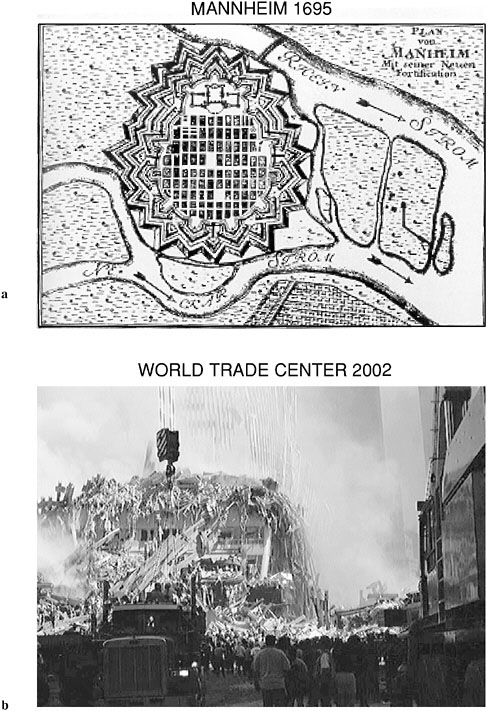
THE CHALLENGE
For cities to be environmentally and socially sustainable, we must rethink our ideas about them. For a long time, the design of the city of the future has been the focus of passionate debate, focused on utopias, ideologies, theories, and experiments. In fact, this debate has been going on for centuries. Leonardo da Vinci’s plan for separating pedestrian and vehicular traffic (Figure 2) and the garden city proposed a century ago (Perry, 1929; Relph, 1987) are two ideas that are still relevant; many other concepts have not stood the test of time. We are now at a moment of great urgency and great opportunity. On the one hand, we are faced with the urgent problems of explosive urban growth. On the other hand, new technologies are now available that offer hope for the future of cities, from information technology to new capacities for designing and constructing infrastructure. The time is right for us to use these new technologies and to press for the development of new ones to help us realize our goal of enhancing the positive attributes and reducing the dysfunctional attributes of our cities.
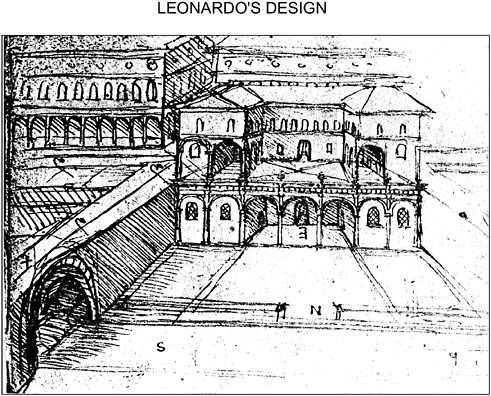
FIGURE 2 Leonardo’s sixteenth-century design for separating pedestrian and vehicular traffic. Source: Istituto e Museo di Storia della Scienza, 2001.
PRAGMATIC IMPERATIVES
Cities are extremely complex organisms, and their future forms cannot be projected in detail or prescribed in advance. We can, however, identify some essential characteristics of viable future cities. Regardless of ideology, most would agree that cities of the future, in America and elsewhere, must respond to certain pragmatic imperatives: hazards to inhabitants must be reduced, livability improved, and sustainability ensured. Also, cities must be capable of existing indefinitely in time without causing irreparable damage to the environment.
The city of tomorrow must be a caring and emotionally satisfying place to live; it must be ecologically sound; it must make intelligent use of its resources and technology; and it must be manageable (Figure 3). These characteristics should interact synergistically in response to the imperatives (Figure 4). Thus, to improve livability, a city should be caring and emotionally satisfying, which, in turn, implies that a city must be intelligent, manageable, and ecologically sound. To be sustainable, a city must be ecologically sound. To reduce hazards to its inhabitants, it must be intelligent and manageable. The elimination of slums will require synergy between the “city ecological,” the “city manageable,” and the “city caring and emotionally satisfying.” Similarly, reductions in consumption will require synergy between the “city efficient” and the “city manageable.” These synergies will not be easy to achieve, but the problems of today’s dysfunctional cities cannot be remedied without them.
The City Caring and Emotionally Satisfying
The city caring and emotionally satisfying will provide jobs, housing, health care, and educational opportunities, give its citizens a sense of protection, and recognize poverty as an urgent problem. Poverty threatens a city’s physical and emotional health, and many consider eliminating it essential to sustainability (Perlman, 2000). But eliminating poverty will not be enough. A sense of belonging, a sense of pride, and a sense of adventure are also essential ingredients of the city caring and emotionally satisfying. Such a city must also ensure stability (changing the current policy of constant tearing down or reconstructing, making cities architectural palimpsets), be aesthetically pleasing, and be well managed—in other words, it must be not only functional but also beautiful. To satisfy a sense of adventure, the grid layouts we inherited from the ancient Greeks and Romans and the extreme segregation of functions in separate quarters of a city must be avoided. Today, for example, impersonal gleaming towers of the business district often leave no room for diverse, small-scale activities.
The City Ecological and Sustainable
A future city that does not cause irreparable ecological damage and is sustainable must limit, or even reduce, its geographical and resource footprints. The
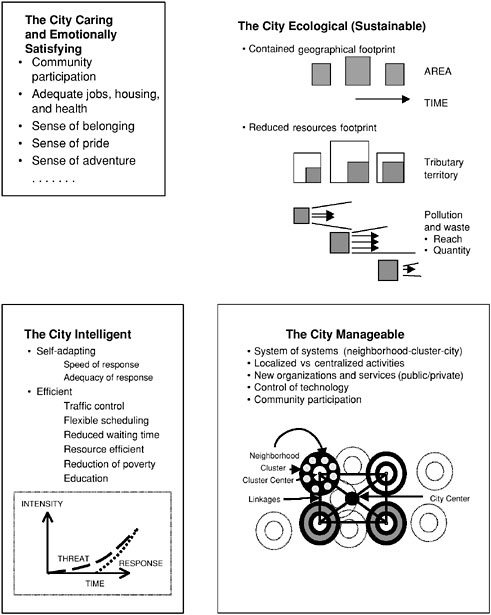
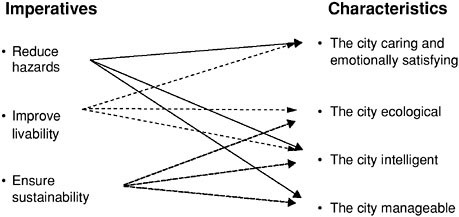
FIGURE 4 Pragmatic imperatives and the necessary synergies.
area occupied by a city and the tributary territory necessary to feed and otherwise support it cannot continue to grow proportionally to the city’s population or affluence. Reducing the resource footprint will also mean reducing the size and intensity of the plume of pollution and waste emanating from the city. Because the city is an accumulator of substances, recycling and “mining” those substances must become important sources of materials for the city of the future, thereby reducing the city’s resource footprint (Graedel, 1999). The city ecological will rely, as much as possible, on natural means, both biological and energetic (Lewis, 1998). Wetlands can be used to reduce wastewater treatment, and renewable, conservative energy sources, such as wind and solar radiation, can be used to reduce energy demands. Today’s conservative energy sources may not be sufficient to satisfy the needs of cities, however. We must be aware of the risks of their overdevelopment, which could create some new ecological stresses.
The City Intelligent
A city intelligent must have the ability to adapt to change. The new capabilities that enhance a city’s ability to adapt will include sensors, geographic information systems, improved telecommunications, the ability to simulate and assess trends, and a nimble management structure. A city intelligent must also be efficient in its use of all kinds of resources, including human resources. For example, it could take advantage of advanced traffic control systems and flexible scheduling of city activities to reduce congestion. Education is essential to the city intelligent and efficient, not only traditional education, but also an education in living appropriately in the city—learning how to behave in crowded situations and in traffic, how to reduce pollution through changes in behavior, and how to participate effectively in community decisions.
The City Manageable
A manageable city will balance localized and centralized city activities. No matter how large or small the population of a city, information and telecommunications technologies have become essential to making a city manageable and to enhancing community participation. The city manageable will also endeavor to guide the use of its technologies and encourage the creation of technologies that respond to its needs, rather than merely reacting to new technologies. A good example is the misuse of the automobile, which has a very large footprint, demands that a large portion of the city be devoted to parking, and causes congestion. The city manageable will stimulate the development of new technologies to address the problems caused by automobiles, including environmental problems and parking.
Regardless of its physical configuration, the city manageable must be governed as an organic whole that cannot be rigidly planned but can be guided in desirable directions. Approaching a city as a complex “system of systems” would be a useful guide for organizing services, transportation, utilities, and other aspects of the urban environment and identifying relationships among individual neighborhoods, larger neighborhood clusters, and the city as a whole (Gallopin et al., 2001).
Considering neighborhoods as the organizing units of the city is not a new idea, but it continues to make sense for the city of the future. Walkable neighborhoods, for instance, reduce congestion by encouraging the creation of a hierarchy of transportation hubs connecting the city’s components. With wise public planning, suburban sprawl can be stayed in American cities, discouraged in the more concentrated European cities, and avoided in many exploding cities of the developing world. In principle, it should be easier to devise entirely new organizations and systems for cities in the developing world, many of which are expected to double in population in the next 15 to 20 years. Unfortunately, these cities often lack the resources to make those changes. It will be even more difficult to make radical changes in the mature cities of the developed world, however, even though they have the necessary resources.
Other challenges for the manageable city are the role of self-help and sweat equity in housing poorer segments of the population, the development of financial instruments, such as public-private partnerships, to encourage entrepreneurship, home ownership, and economic development, and the pooling of resources and markets with other cities. The relationship between city policies and national policies—including policies that encourage alternatives to concentrating growth in larger cities—is an important challenge.
Another aspect of the challenge of making a city manageable is dealing with unrealistic expectations in an era of burgeoning technological possibilities. Overly high expectations can affect the stability of a city and may even have a global impact. The problem is particularly acute in the developing world. The city
manageable must think in terms of reaching rapidly growing areas with essential services by devising “good enough” solutions as opposed to constructing the kind of costly traditional infrastructures that were developed in affluent, older cities.
THE BIOSOMIC CITY
Fundamentally, a city is a complex bio-socio-machine that I call a “biosoma” for short (Bugliarello, 1998, 2000). The biosoma is an entity created by the interaction of: a biological component (human inhabitants, as well as other forms of life, such as vegetation and microorganisms); a social component (the ensemble of collective activities, ideas, and organizations of the inhabitants); and a machine component (the tangible and intangible artifacts that support the life of the city). Each component of the biosoma has distinctive influences on the function and design of the city. The biological component can self-replicate and can be recycled by nature (e.g., through microbiological processes); these capabilities are essential to the sustainability of the city. In addition, human emotions and feelings play a crucial role in the creation of a city caring and emotionally satisfying. The characteristics of the machine component include reliability, precision, and power, but also inflexibility. The characteristics of the social component fall somewhere in between. Like the machine component, the social component increases the reach of the individual and may also embody reliability, precision, and power (e.g., in social organizations, such as bureaucracies), but it also harbors collective feelings and emotions that can erupt with unforeseeable consequences.
Striking a balance among the three biosomic components is important to maintaining a city’s positive characteristics and reducing its dysfunctions. The key to an effective balance is to ensure that the human biological component is not overwhelmed and made to feel powerless by the infrastructure or by the social organization of the city. For example, there must be a balance between bioremediation and traditional methods of water and wastewater treatment or between tasks performed by humans and those performed by machines (e.g., a policeman directing traffic versus the use of traffic control devices). Finding a balance has far-reaching implications for making a city caring or a city manageable. Thus, a totally automated city, which is technically possible, would also be an inhuman city. The balance between humans and other species will determine the extent to which a city favors biological diversity—the plants and animals that enrich the human environment.
Within the biosoma paradigm, trade-offs among information, materials, and energy are central to the concept of “intelligent” infrastructure, such as intelligent highways that can accommodate more traffic without the construction of new roadways. Trade-offs between materials and energy range from a simple, but ecologically significant, trade-off between using insulation instead of active
heating and cooling to the utopian concept of a domed city, which uses material structures to control climate and, therefore, energy expenditures, but is unworkable for a variety of reasons. The trade-offs between biological and machine energy affect the extent to which walking or bicycling replaces motorized means of transportation, an important consideration in the design of cities as clusters of neighborhoods.
Biosomic cities based on balances and trade-offs will continually evolve. Society will continue to be transformed by the push and pull of innovations; and the machine component will continue to change with advances in information and telecommunications technology and the development of new materials, energy technologies, and methods of construction, reconstruction, and recycling. As each component of the biosoma changes, the balance among them must also change.
The emerging knowledge city and ecoindustrial city are embryonic manifestations of the biosomic city of the future (Figure 5). In the knowledge city, the emphasis for each component of the biosoma is on knowledge and information: in the biological component, on learning and biotechnology; in the social component, on education and e-business; and in the machine component, on computers, telecommunications, and nanotechnology.
One instrument of the knowledge city, the knowledge park, is congruent with the concept of neighborhoods and clusters. The knowledge park coalesces socioeconomic activities around institutions that generate knowledge (e.g., universities or research centers), transmit knowledge (e.g., schools), and use knowledge (e.g., business or industry and government). Knowledge parks will be increasingly important to the socioeconomic development of a knowledge society and will attract other elements of the city’s organization and infrastructure (Figure 6).
The knowledge park provides a new organizing principle for the knowledge city by transforming the urban environment and providing an enormous economic boost. A case in point is Metrotech, catalyzed in Brooklyn, New York, by Polytechnic University, which has attracted some 20,000 jobs around the university, mostly in information technology and telecommunications, and has revitalized a significant part of downtown Brooklyn (Bugliarello, 1996). Although the need for face-to-face interactions will continue, an increasingly important aspect of the evolving knowledge city is virtuality—the ability to conduct business transactions and other social interactions at a distance.
In the ecoindustrial city, the waste created by one industry becomes the input for another. In addition, the biological and machine components are integrated and support each other (e.g., bioremediation of polluted areas). A pioneering example of this integration is the Danish city of Kalundborg (Graedel, 1999). Whatever shape the city of the future assumes, the challenge to planners, managers, and citizens will be to determine consciously the most desirable biological-social-machine balance.
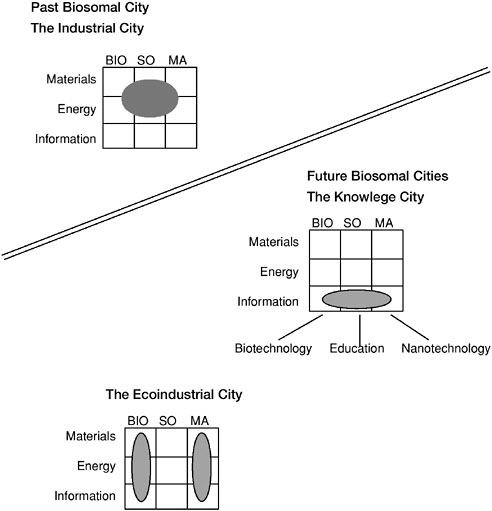
FIGURE 5 Comparison of past and future biosomic cities.
ENGINEERING CHALLENGES
The city of the future will present unprecedented engineering challenges, such as maintaining internal conditions within acceptable limits as the city is exposed to changes in temperature, winds, floods, and earthquakes, as well as to anthropogenic disasters, such as war and terrorism. The overall engineering challenge will be to limit the effects of these changes through design and operational decisions. For instance, although a city totally covered by a dome is unrealistic, a skyline—the location and configuration of structures—engineered to affect temperature and wind patterns is entirely feasible. A second challenge will be to
minimize the effects of the city—its wastes and noxious emissions—on its surroundings, such as watersheds. A third challenge will be to develop technologies that address problems at the microscale of the neighborhood or the individual home, such as in-house energy transformers, waste disposal and recycling systems, and virtual offices. In appropriate situations, these technologies could provide alternatives to macroscale technologies, such as trunk utilities and other centralized services.
MOVING FORWARD
Transforming today’s dysfunctional cities into tomorrow’s less dysfunctional ones will, of course, require resources. But the will to transform the city will be even more important and generally more difficult to mobilize. The fundamental
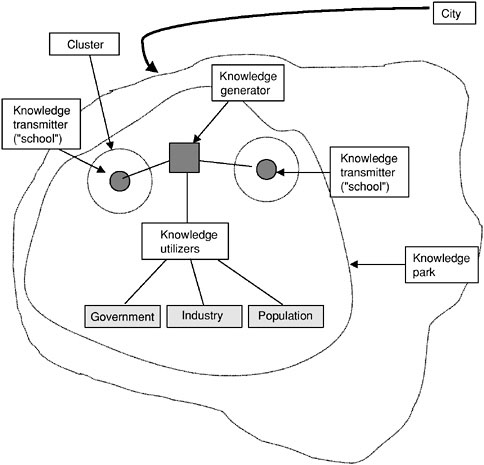
FIGURE 6 The knowledge city.
instrument for generating the will to change will be education that promotes reasonable expectations and explores ways they can be realized. Education must also encourage citizen participation in decision making and a willingness to make short-term sacrifices for the sake of long-term benefits. The city as a whole must be willing, when necessary, to accept temporary economic losses to ensure a more sustainable future.
Current trends strongly suggest that cities of the future will be home to an increasing share of the world population. We do not know, however, when the saturation point will be reached or whether urban populations will eventually decline. Nor do we know if cities of the future will be more dense and compact or more spread out than cities today. Despite these uncertainties, we already have much of the knowledge and technology we need to make future cities more effective, less dysfunctional instruments of human advancement, and we can expect new technologies to strengthen this capability (Ausubel and Herman, 1988). These technologies must be developed and applied in the context of a vision of the city that is caring and emotionally satisfying, ecologically sound, intelligent, and manageable. Given the rapid pace of urbanization and the level of dysfunction of many cities today, we must begin to address these problems immediately.
REFERENCES
Ausubel, J.H., and R. Herman, eds. 1988. Cities and Their Vital Systems: Infrastructure Past, Present, and Future. Washington, D.C.: National Academy Press.
Brennan-Galvin, E. 2000. What are the demographic trends? Presentation at the Megacities Workshop, National Research Council, Washington, D.C., September 26, 2000.
Bugliarello, G. 1996. Urban knowledge parks and economic and social development strategies. Journal of Urban Planning and Development 122(2): 33–45.
Bugliarello, G. 1998. Macroscope: Biology, society and machines. American Scientist 86(3): 230–232.
Bugliarello, G. 2000. The biosoma: the synthesis of biology, machines, and society. Bulletin of Science, Technology and Society 20(6): 452–464.
Craig, T. 1988. Air traffic congestion: problems and prospects. Pp. 222–231 in Cities and Their Vital Systems: Infrastructure Past, Present, and Future, J. H. Ausubel and R. Herman, eds. Washington, D.C.: National Academy Press.
Gallopin, G. C., S. Funtowicz, M. O’Connor, and J. Ravetz. 2001. Science for the 21st century: From social contract to the scientific core. International Journal of Social Science 54(168): 219–229.
Graedel, T.E. 1999. Industrial ecology and the ecocity. The Bridge 29(4): 10–14.
Groat, C. 2000. Crosscutting issue #1: Can we measure the urban footprint? What is the influence of the megacity beyond its official boundary? Presentation at the Megacities Workshop, National Research Council, Washington, D.C., September 26, 2000.
Huntley, E. 2001. Ground Zero. Photos available online at <http://www.geocities.com/cas43.geo/page2.html>.
Istituto e Museo di Storia della Scienza. 2001. Studies of Sforzinda, the ideal city projected by Leonardo for Ludovico il moro. Leonardo da Vinci Ms. B. Available online at <http://galileo.imss.firenze.it/news/mostra/6/e62msb5.html> (April 18, 2001)
Lewis, P.H. 1998. Tomorrow by Design. New York: John Wiley.
Moss, M. 1998. Technology and cities. Cityscape: A Journal of Policy Development and Research 3(3): 107–127.
Perlman, J. 2000. Comment made during a discussion at Megacities Workshop, National Research Council, Washington, D.C., September 26, 2000.
Perry, C.A. 1929. The neighborhood unit: a scheme of arrangement for the family-life community. Pp. 2–140 in Neighborhood and Community Planning, Vol. VII of the Regional Study of New York and Its Environs. New York: Port of New York Authority.
Relph, E. 1987. The Modern Urban Landscape: 1880 to the Present. Baltimore: Johns Hopkins University Press.
Rowland, S.F. 2000. Can megacities be green? environmental issues in megacities. Presentation at the Megacities Workshop, National Research Council, Washington, D.C., September 26, 2000.
Rykwert, J. 2000. The Seduction of Place: The City in the Twenty-First Century. New York: Pantheon Books.


