
Page 139
Steps Taken by the Zarechny City Administration to Support Small Innovative Companies
Yury I.Kvachev *
Zarechny City Administration
The Zarechny City Administration launched its efforts to support small business, especially innovation-oriented small business, immediately after the city government was created and the city was reassigned to normal status within the oblast where it is located. At first, this activity was viewed as a way of diversifying the city's economy, a measure aimed at making the city less dependent on the monopolism of the nuclear power complex enterprises located in Zarechny.
The Russian economic situation at that time (1992–1994) facilitated support for and active development of small innovation-related businesses. As a result of liberalization, people gained opportunities for conducting independent business activity, which was previously forbidden by law and entailed criminal punishments. At the same time, the industrial crisis was just beginning. Enterprises were operating, the results of innovation activity were in demand, and customers were able to pay. Finally, the third important factor at that time was found in the practically complete absence (or nonenforcement) of laws dealing with intellectual property. For this reason, private individuals could make risk-free use of technologies as if they were their own property. These technologies had been developed at a real cost, often a very high one at that, and were owned by the enterprises and, in the end, by the state.
All of these factors brought about an innovation activity boom in cities with a high degree of technological potential. This was the case in the city of Zarechny in 1992–1994. The number of companies engaged
* Translated from the Russian by Kelly Robbins.
Page 140
in innovation activity in the years at the peak of this phenomenon reached 300 in Zarechny. For instance, there were 10 small enterprises in the field of medical laser device manufacturing alone.
At that time, there appeared a multitude of intermediary promotional firms, firms that became involved in technology transfer and firms that offered engineering services. A long list of such firms could be compiled. However, the main point is that only a few of them survived. In his report on innovative firms, Yevgeny Loguntsev discussed the most illustrative individual cases and cited specific examples. The goal of my report is to provide more detailed information on the current situation regarding support for small business and especially innovation-oriented small business. Table 1 presents some basic information regarding business conditions in Zarechny in recent years.
The mid-1993 establishment of the Technopark, which was created to provide favorable conditions for entrepreneurial development and small business, can be considered to mark the beginning of business support
|
|
Year |
||||
|
|
1995 |
1996 |
1997 |
1998 |
1999 |
|
Population |
32,000 |
32,900 |
32,400 |
33,000 |
33,100 |
|
Working population |
19,200 |
19,400 |
19,800 |
19,800 |
19,900 |
|
Persons registered as involved in business activity, of which: |
1,684 |
1,520 |
2,043 |
2,145 |
2,195 |
|
Individual entrepreneurs |
1,260 |
1,081 |
1,611 |
1,708 |
1,750 |
|
Incorporated entities |
424 |
439 |
432 |
437 |
445 |
|
Persons actively involved in operating small entreprises, of which: |
419 |
462 |
510 |
516 |
545 |
|
Individual entrepreneurs |
310 |
350 |
400 |
420 |
445 |
|
Incorporated entities, by industry: |
109 |
112 |
110 |
96 |
100 |
|
Manufacturing |
|
|
22 |
20 |
22 |
|
Construction |
|
|
21 |
12 |
12 |
|
Retail trade |
|
|
36 |
31 |
32 |
|
Other |
|
|
31 |
33 |
34 |
|
Proportional share of small business in the municipal economy (in percentages) |
|
||||
|
Workers employed |
|
|
6.2 |
6.2 |
6.7 |
|
Volume of goods and services produced |
|
|
1.5 |
2.5 |
2.75 |
Page 141
efforts in Zarechny. Already in 1993 the first investment project competition was held, with the winners receiving preferential loans and tax benefits (specifically regarding local taxes). A small business support program is currently in operation at the Technopark. The rationale for the program is based on giving top priority to creating a favorable socioeconomic environment, constantly monitoring employment problems, and promoting the development of competitive high-tech business projects that will provide a rapid return on investment and facilitate the utilization of accumulated scientific-technical potential. The Technopark is the entity responsible for implementing the program, while the finance mechanism is provided by the Zarechny Technopolis Fund for the Support of Entrepreneur ship and Small Business.
The closed joint-stock company Technopark is an organization with a branched structure that allows it to react efficiently to the needs of business structures. Figure 1 illustrates the structure for business support that had developed by late 1999.
FIGURE 1 Business support structure in Zarechny. 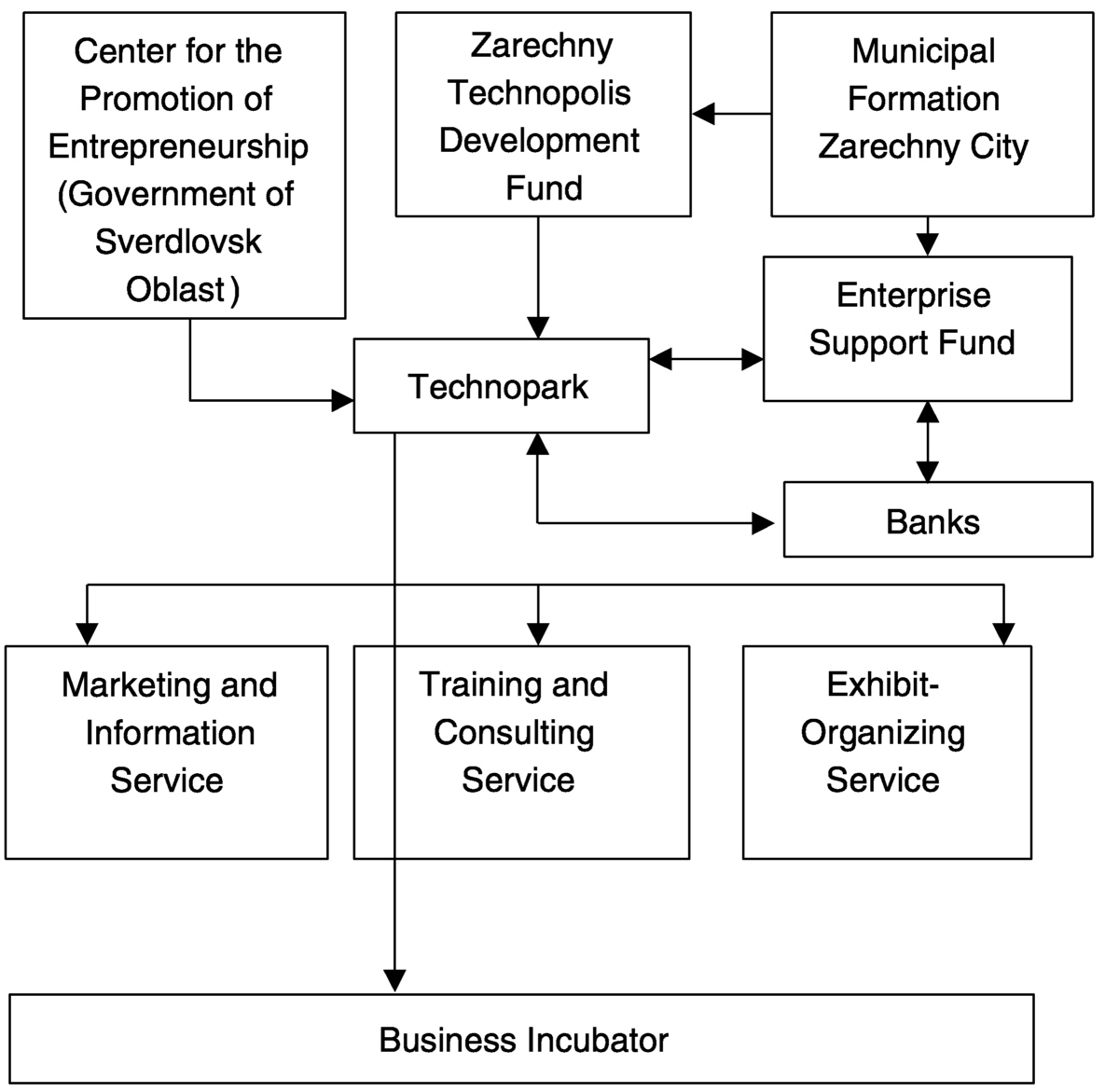
~ enlarge ~
Page 142
This support structure and the activities it carries out cover the majority of fields involved in the support of business activity in Zarechny. Since the Technopark was established, volumes of investments attracted have grown from 105,000 rubles (1993) to 2.66 million rubles (1999) (see Table 2). These financing sources include the municipal budget, bank loans, funds from the employment center, the Sverdlovsk Oblast budget, reinvestments, local and outside nonbudget funds, and the federal budget. For the past two years, no funds have come from the federal budget or the employment center, as the share of private and nonbudgetary funds has sharply increased. To aid in strategic planning of business support activities, the market for services needed by entrepreneurs is constantly analyzed. Whereas financial and marketing services were in greatest demand at the initial stage of the support effort, entrepreneurs now also need engineering services, business incubators, venture capital advice, and consulting services.
Small business support activities are financed using various sources, including municipal and oblast budgets, grants from foreign foundations, repayable resources from commercial banks, the federal budget (federal investment tax credits), profits from the operational activities of the Technopark, and funds from the city and oblast employment centers.
All in all, the following results have been achieved through the implementation of business support measures:
-
More than 600 individuals or entities were newly registered as being involved in small business.
-
Some 3.7 million rubles in funding was attracted from various sources to support the program of actions.
-
More than 30 business plans were financed.
-
Favorable leasing terms and tax privileges were provided to 35 small businesses in accordance with existing regulations and based on Technopark agreements.
-
A guarantee fund of 410,000 rubles was formed, which provided loan guarantees for 14 small businesses in the total amount of 2.03 million rubles.
-
A micro-credit program is in operation and has granted 20 loans for a total of 150,000 rubles.
-
A total of 3,000 hours of consulting services has been provided to entrepreneurs.
|
|
1993 |
1994 |
1995 |
1996 |
1997 |
1998 |
1999 |
|
Volume of investments (thousands of rubles) |
105 |
220 |
365 |
450 |
660 |
1,005 |
2,660 |
Page 143
-
Fifteen short-term seminars have been conducted on various aspects of business activity, with more than 180 people taking part.
At the current stage of Zarechny's development, entrepreneurial structures have embraced all fields of activity, from services and retail trade to high-tech. Some of the brightest and most stable examples are the following:
-
PGS works in the high-tech field. It manufactures test gas mixtures and ships them to industrial enterprises in the Siberian Urals region. The enterprise employs seven people, and its sales volume reached 2 million rubles in 1999. It was ranked among Russia's best enterprises in a competition marking the 10th anniversary of the rebirth of entrepreneur ship in Russia.
-
Diteks produces consumer goods, including creams and dyes for shoes and other leather goods. Today it is one of the leading manufacturers of these types of products in Russia.
-
The Region-Spectrum Group successfully operates in the gasoline business, including various related services such as retail gasoline sales, food sales, and automotive service.
Despite the significant amount of work that has been done to support business development, conditions in the small business sector remain difficult because of the crisis situation in the Russian economy. Programmatic measures aimed at supporting small business should be aimed at minimizing negative external influences and reducing and smoothing over unfavorable factors that hinder business development.
Special attention needs to be paid to the development of small business, as it is this group of enterprises that is the most numerous. Furthermore, small business enterprises are the quickest both to react to changing economic conditions and to produce a return on investment. In addition, these enterprises do not require large financial investments inasmuch as they largely use their own funds or funds they have attracted themselves, thus taking all risks on themselves.
Two main aspects of stimulation for the development of small business may be highlighted: support for already existing private enterprises and creation of conditions for the creation of new ones. These two objectives are interconnected, as the successful functioning of small business enterprises is in and of itself a factor that stimulates the expansion of the ranks of such enterprises.
Measures to support private entrepreneurs and provide incentive for their participation in the city's development must take into account the special characteristics of this group of enterprises. Such firms are primarily characterized by the small volume of resources they possess. This state
Page 144
ment refers not only and not primarily to their financial resources. Small enterprises have few or no material resources and are always short of trained personnel.
Given this situation, measures to stimulate small business enterprises must compensate for these characteristics. This means that stimulus measures must include the following three components:
- 1. financial support
- 2. infrastructure support
- 3. personnel support
In each of these areas, plans must include actions that cannot be taken by the enterprises themselves but fall within the functions of the Technopark. Measures required for more successful operation in this sphere will be determined by the enterprises themselves.
Specific efforts to create favorable conditions for business development may be categorized as follows:
-
financial support
-
provision of a necessary range of services
-
a system of benefits and preferences that can be customized as needed
-
assistance with conversion and support for the development of science-intensive small business
-
business incubation services
-
management services
-
engineering services
An analysis of the needs of business structures shows that primary needs are in the areas of consulting and marketing services, then financial services, and finally all other types of services (engineering, business incubators, venture capital advice, lobbying for business interests, information centers, exhibit centers).
In addition to various types of preferential lending and financing schemes, support for business also requires that the local authorities facilitate interactions with regulatory and monitoring agencies, such as the sanitary-epidemiological service, fire department, retail trade department, and sanitation inspectorate. Furthermore, consulting services by lawyers, accountants, and business incorporation specialists would also be useful (to be provided on preferential terms).
The specific nature of small business in the innovation sphere is reflected in more active support in the special selection of just such types of projects and organizations. For this purpose, special efforts were made in 1999–2000 to create a city business incubator. The incubator was assigned
Page 145
unused space belonging to the Zarechny branch of the Research and Development Institute of Power Engineering (NIKIET). This space was a separate building with auxiliary facilities, which by joint decision of Minatom and the Zarechny City Administration was officially declared city property for the purpose of creating an incubator for small innovative businesses. The administration leased the space (about 3,000 square meters) to the Technopark to provide for the city innovation infrastructure. Small enterprises are currently being settled in the incubator, and the city administration has established favorable terms for the leasing of these premises.
The administration has made serious efforts to support small science-intensive businesses by using the investment tax credit mechanism. The administration received this credit against budget funds in 1996 and 1997. A portion of the credit amounting to 500,000 rubles was specially designated for the support of small enterprises. In particular, the credit was used to support the previously mentioned enterprises PGS and Diteks. At present, all of these projects have been successfully completed, and the funds are being repaid in accordance with the agreed terms.
The administration has recently launched another form of support for small innovative businesses. Entitled Business Incubator 2, this project is aimed at preparing a well-equipped site for new manufacturing facilities. In cooperation with the organization that will carry out the project, the administration is grading the site and doing preliminary design work on putting in the necessary infrastructure. A competition will subsequently be held to select the small enterprises who will have their production facilities constructed on the site, with these firms to cooperate in the design, construction, and operation of the facilities. The organization implementing the project (the board of directors of Incubator 2) is providing services related to the operation of the entire complex and is working to attract new partners to locate their facilities at the site.
Incubator 2 differs from the existing incubator in that it assists enterprises that have already gained strength and are capable of furthering their own development but lack the resources to do it alone. The role of the city administration in this project is limited to coordinating and initiating the joining together of those involved. The Incubator 2 project essentially represents the continuation of the Incubator project, as it will support entrepreneurs who have outgrown the conditions provided by the small-scale initial incubator.
Two things made it possible for this project to be carried out in Zarechny. First, there has been a certain improvement in the economic situation, including in Zarechny, which has led to the appearance of wholly successful small businesses that are experiencing a need to develop. This is true not only in retail trade-related spheres of activity, but also in the manufacturing sector. Second, the experience gained through
Page 146
the operation of the existing incubator has been positive, as have the results of many years of effort aimed at supporting small business.
Another area where the administration is working in cooperation with the development fund involves the establishment of wide-scale venture capital activity in conjunction with the creation of a regional innovation center to serve the research institutions of the Urals Branch of the Russian Academy of Sciences and Minatom enterprises operating in the Urals region. The government of Sverdlovsk Oblast is actively participating in this effort through the involvement of its Science and Technology Administration. This entire effort is included as a project in the proposed Program for the Development of Zarechny as a Science City. The regional innovation center project is already being carried out and will continue regardless of the decision on granting Zarechny the status of a Russian Science City. Zarechny has a great need for this project, as the center will allow and is now allowing the city to become the site for promising science-intensive production facilities. The oblast government and the institutes of the Urals Branch of the Academy of Sciences also have a great need for it, as it will allow them to use a ready-made innovation infrastructure at minimal cost to themselves.
Experience in working with the small business sector has been taken into account in the current operating strategy of the administration. The first conclusion made as a result of many years of experience concerns the effectiveness of supporting powerful people and projects and the ineffectiveness of supporting weak ones. In accordance with this conclusion, the decision was made to implement the Incubator 2 project. The need for uncovering potentially powerful people and projects and revealing their potential to the maximum possible extent represent the strategic consequences of this conclusion. Therefore, plans for the Program for the Development of Zarechny as a Science City include the Personnel Bank project, which is aimed at finding potentially promising entrepreneurs and managers and providing them with additional training. This project is now being prepared for implementation. In addition to these strategic objectives, our traditional small business support efforts remain in effect, as discussed previously.
Regarding additional measures that would be effective at the oblast and federal levels, the most important point to highlight would be the creation of conditions for providing municipalities with incentives for the economically efficient activities of small business. To achieve this, it would be sufficient to include in the Law on the Budget a provision by which all tax revenues from small- and medium-sized businesses would go directly to local government budgets. At the oblast level the government should adopt documents defining the development of the innovation infrastructure. It would be ideal if the oblast would pass a law on innovation activ
Page 147
ity and adopt an oblast-level program for developing innovation activity, including a special component on infrastructure development.
The experience amassed in the creation of science cities requires separate consideration. It appears that the effective utilization of science cities as innovation centers requires more active involvement of cities in this effort, as well as stricter monitoring of the results and effectiveness of investments.


