
1
Introduction
Every year there are approximately 30,000 suicides in the United States (NCIPC, 2000), and one million worldwide (WHO, 1999). Approximately 650,000 people per year in the United States are seen in emergency rooms after attempting suicide (PHS, 2001). It is the third leading cause of death among American youths and among the top 12 for Americans of all ages. For the past hundred years, the number of reported suicides has been higher than the number of homicides, by approximately three to two. The rates of suicide among some populations are exceptionally high, for example, white males over 75 years of age and Native American Indians. Unfortunately, the rate of suicide has held relatively steady in the United States for the past 50 years (Bureau of the Census, 1976; Hoyert et al., 2001; Minino and Smith, 2001; NCHS, 2001; NCIPC, 2000).
To put this in perspective: between 1964 and 1973 (between the Gulf of Tonkin Resolution and the Paris Peace Accords) approximately 58,000 U.S. servicemen and women lost their lives in the Vietnam War (Center for Electronic Records, 1998). During this same period, approximately 220,000 citizens died by suicide (Bureau of the Census, 1976; NCHS, 2001). From 1979 to 1999, 448,060 people in the United States died from AIDS and HIV-related diseases; over this same 20 years, 626,226 people died by suicide (Figure 1-1). The suicide crisis continues unabated.
PERSONAL SUFFERING
Suicide is ultimately a private act. It is difficult to put into words the suffering and agonized state of mind of those who kill themselves. But
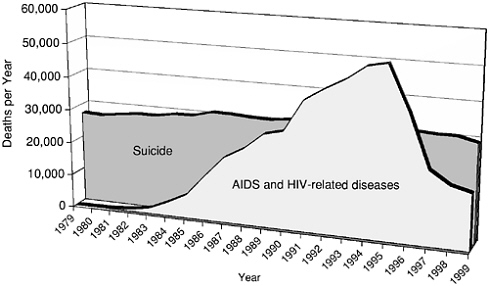
FIGURE 1-1 Deaths from Suicide and AIDS and HIV-related Diseases. Based on data from the CDC (2001), NCHS (2001), and NCIPC (2000).
personal accounts of those who have completed or attempted suicide provide a glimpse of the psychological pain that culminates in a desperate act. A minority of those who kill themselves actually write suicide notes, and these only infrequently try to communicate the complex reasons for the act. Still, some consistent psychological themes emerge. Clearest of these is the presence of an unendurable heartache, captured in the simple phrase, “I can’t stand the pain any longer,” a phrase often seen in suicide notes or heard by clinicians after an attempt. One woman expressed it this way in her suicide note:
I wish I could explain it so someone could understand it. I’m afraid it’s something I can’t put into words.
There’s just this heavy, overwhelming despair—dreading everything. Dreading life. Empty inside, to the point of numbness. It’s like there’s something already dead inside. My whole being has been pulling back into that void for months.
Everyone has been so good to me—has tried so hard. I truly wish that I could be different, for the sake of my family. Hurting my family is the worst of it, and that guilt has been wrestling with the part of me that wanted only to disappear.
But there’s some core-level spark of life that just isn’t there. Despite what’s been said about my having “gotten better” lately—the voice in
my head that’s driving me crazy is louder than ever. It’s way beyond being reached by anyone or anything it seems. I can’t bear it any more. I think there’s something psychologically—twisted—reversed that has taken over, that I can’t fight any more. I wish that I could disappear without hurting anyone. I’m sorry. (Jamison, 1999:81-82)
One young journalist, only 20 years old at the time of her suicide, described in her journals the pain, abject hopelessness, and numbing exhaustion brought about by her depression. “I am,” she wrote, “growing more and more tired, more and more desperate …The fog keeps rolling in…” The night before she died she wrote, “the pain has become excruciating, constant and endless.” The next morning she drowned herself (unpublished journals of Dawn Renee Befano, quoted in Jamison, 1999:94-97).
|
Ten years after the family tragedy that nearly destroyed his life, Les Franklin is haunted by memories. “It’s the gray eyes,” he says, describing a vision that comes to him at night as he struggles to find sleep. They are the eyes of his late son Shaka, a 16-year-old high school football star who fatally shot himself in the family’s Denver home one day in 1990. “It’s seeing him lying on the table in the hospital with plastic gloves on his hands and a sheet up over him, a bullet hole through his head,” says Franklin, 61. “I see his mother laying her head on his chest and just sobbing, sobbing her heart out.”… [Years later] Franklin has suffered a second tragedy…. Franklin and his second wife … found the decomposing body of his only other child, Jamon, 31, who had killed himself, possibly a week earlier by inhaling carbon monoxide fumes…. Jamon Franklin, who was living at home at the time of his death, had apparently never recovered from his brother’s suicide, which was followed just five months later by the death of the boys’ mother … from cancer…. Since [then], Franklin’s mood has swung between guilt and anger, self-doubt and despair. “I’m just trying to hang on,” he says … (Rogers and Bane, 2000:166). |
THE FEDERAL RESPONSE
For decades, the federal government of the United States has been concerned about the high suicide rates. In 1966, the Center for Studies of Suicide Prevention (later the Suicide Research Unit) was established at the National Institute of Mental Health. The Centers for Disease Control
and Prevention’s efforts in violence prevention in the mid-1980s highlighted the high rates of suicide among youth and led to a task force on youth suicide. Suicide became a central issue worldwide in the mid-1990s. At this time, several private foundations and public-private partnerships became active in the United States. A seminal conference was held in Reno, Nevada in 1998 that summarized recommendations for action. In 1999, the Surgeon General of the United States issued a “Call to Action to Prevent Suicide” (PHS, 1999), and soon after presented a comprehensive assessment of future goals and objectives to combat suicide (PHS, 2001). The federal commitment to reducing suicide rate is further illustrated by the goals of Healthy People 2010 to reduce the overall suicide rate to 6 per 100,000 by the year 2010 and to reduce adolescent suicide attempts by one percent each year (US DHHS, 2000).
STATEMENT OF TASK
Despite its long history and the deep suffering it causes, despite the increased understanding that has come with research over the past decades, suicide continues to claim tens of thousands of lives each year. While the National Strategy presents 11 goals and multiple objectives, specific actions still need to be designed. In 2000, several federal agencies (the National Institute of Mental Health, the National Institute of Drug Abuse, the Veterans Administration, the Centers for Disease Control and Prevention, Substance Abuse and Mental Health Services Administration, and the National Institute on Alcohol Abuse and Alcoholism) joined together to fund an Institute of Medicine study in an effort to explore new directions for the field. In the autumn of 2000, the Committee on Pathophysiology and Prevention of Adolescent and Adult Suicide was formed to examine the state of the science base, gaps in our knowledge, strategies for prevention, and research designs for the study of suicide. A committee was constituted with a broad range of expertise, including neuroscience, genetics, epidemiology, sociology, anthropology, psychology, psychiatry, and community interventions. While some members of the committee were experts in suicidology, the committee also included many who were not suicidologists but whose relevant expertise could contribute to a fresh view of the subject. The committee was asked to address the following tasks:
-
An assessment of the science base of suicide etiology, including cognitive, affective, behavioral, sociological, epidemiological, genetic, epigenetic, and neurobiological components. This will include an examina-
-
tion of the vulnerability of specific populations (e.g., American Indians) and age groups (e.g., adolescents and aged).
-
An evaluation of the current status of primary and secondary prevention including risk, protective factors, and issues of contagion. Access to methods of suicide and the availability of emergency interventions will be considered. The committee will consider strategies for prevention of suicide, including an examination of the efficacy of national and international intervention and prevention efforts.
-
Strategies for studying suicide. This effort will consider the ethics of incorporating suicidal patients into drug trials, the current classifications of suicide and suicidal behavior, behavioral measures to evaluate suicide risk and outcomes, and statistical methods.
-
Conclusions concerning gaps in knowledge, research opportunities, and strategies for prevention of suicide.
The committee decided that it would focus on suicide and suicide attempts that were self-inflicted with an intent to die. Although important subjects in their own right, three types of self-destructive behavior were beyond the scope of this report. They are:
-
Self-destructive behaviors with high immediate or long-term physical risk and that may be motivated by a wish to die (Poussaint and Alexander, 2000)
-
Assisted suicide
-
Suicides in the face of terminal illness and/or suffering.
It should also be noted that this study is not intended as an all-inclusive review of the field. For such a review, we refer readers to a number of recent excellent books (e.g., Hawton and van Heeringen, 2000; Jacobs, 1999; Lester, 2001; Wasserman, 2001). Rather, this report aims to identify the next steps necessary to significantly reduce suicide, and within this task, discuss the most relevant information.
SUICIDE THROUGH HISTORY
Suicide is not a new phenomenon. Strikingly, accounts of suicide across the last millennium catalog the same factors associated with suicide as those revealed by modern scientific study in western cultures: serious mental illness, alcohol and substance abuse, co-morbidity, childhood abuse, loss of a loved one, fear of humiliation, and economic dislocation and insecurity. In Box 1.1, accounts of suicides in Europe across several centuries are presented.
|
BOX 1.1 1293. Adam Le Yep, a freeholder in Worcestershire, was reclassified a serf because of his extreme poverty. Rejecting the social demotion, he drowned himself in the Severn. 1302. Raoul de Nesles rushed headlong into the melee during the Battle of the Golden Spurs at Courtrai, preferring certain death to the humiliation of defeat. 1394. After several days of illness, Jean Masstoier decided to drown himself in the river. Saved in time but still suffering from “melancholy of the head,” he threw himself down a well. 1418. When his wife fell ill, Pierre le Vachier, a retired butcher from Sarcelles who had been ruined by the civil war and had lost two of his children, not only was left destitute but also felt totally abandoned. He “went to hang himself from a tree, where he died and strangled himself.” 1426. Jeannette Mayard, a shoemaker’s wife and a good Catholic but given to drink and jealousy, hanged herself. 1447. A woman known to be insane got up in the middle of the night. “Her husband asked her where she was going and she answered that she wanted to go relieve herself. Thus the said woman went about the house stark naked, then threw herself into a well a good thirteen arm-widths deep.” 1728. Joseph Castille, a peasant, hanged himself from an apple tree near Domagné. Alcohol had clearly affected his mental faculties. Witnesses were unanimous: “He drank continually”; “he was perturbed.” He had hallucinations, danced about in nothing but his chemise, talked to the birds, washed himself at the holy water font, and had become morbidly jealous…. 1769. A young girl of fifteen, François Royer, drowned herself at Fougères. She had for some time been abused by her mother, who sent her out to beg, gave her hardly enough to eat, threw her out into the street in the middle of the night calling her a whore, and beat her with a stick…. 1787. Yves Barguil, a known drunkard thirty years of age who had already attempted to kill himself on several occasions, hanged himself near Quimperlé. He had long declared his intention and was considered mad, as his mother had been. Alcohol aggravated his condition; his wife had hidden all the ropes and locked up the barn. SOURCE: Minois, 1999:8-9, 278-280. © 1999. Reprinted by permission of the Johns Hopkins University Press. |
Most but not all current societies and religious traditions ban suicide. Some traditions sanction suicide under certain conditions, such as acts perceived in some Islamic sects as martyrdom in war against an enemy (Dale, 1988), and suicide deaths of widowed women in Hinduism (Inamdar et al., 1983). In Japan, for example, homicide–suicide may be a culturally acceptable response to disgrace and dishonor, or untenable circumstances (Iga, 1996; Sakuta, 1995). In traditional Chinese society, suicide was seen as an available option for coping with humilation and also as a means for upright officials to criticize immoral and corrupt times. Examples are given in Box 1.2 below.
In western, Judeo-Christian culture, prohibition of suicide came after much-heated debate by the Church leaders during the first three centuries of the Common Era. These leaders were concerned by what they observed as unacceptably high suicide rates, which they related to increasing acts of martyrdom, following the example of Christ (Minois, 1999). This early struggle by governing leadership on how to reduce suicide rates culminated with St. Augustine’s clear proscription in his City of God:
This we declare and affirm and emphatically accept as true: No man may inflict death upon himself at will merely to escape from temporal difficulties—for this is but to plunge into those which are everlasting; no man may do so even on account of another’s sins, fearing they may lead to a sin of one’s own—for we are not sullied by others’ sins; no man may do so on account of past sins—for to expiate them by penance we need life all the more; no one may end his own life out of a desire to attain a better life which he hopes for after death, because a better life after death is not for those who perish by their own hand (St. Augustine, ca. 426 CE/1950).
The prohibition in canon law was reinforced by changes in law of the Roman Empire during the same period. Plagues, famine, and war continually took their toll on the population, and both the Catholic Church and the Roman Empire needed to sustain their population. The Romans outlawed all manners of reducing the population including contraception, abortion, infanticide, and suicide by the end of the fourth century, and instituted forfeiture of worldly goods of suicides by the government. This contrasted with the earlier social acceptance of suicide.
These perspectives continued to pervade the thinking about suicide in early modern England and colonial United States. In 967 King Edgar decreed that the goods of a person who completed suicide were to be forfeit—based on the earlier canon laws. Henry de Bracton, a mid-thirteenth-century jurist, stated that suicide was a crime: “Just as a man commit felony by slaying another, so he may do so by slaying himself, the
|
BOX 1.2 295 B.C. The Chinese poet, Qu Yuan (332–295 B.C.) drowned himself as a protest against official persecution. His act has traditionally symbolized the loss of legitimacy of an unjust social order through an act of moral courage (Kleinman, 1995). 1944. [Prior to his kamikaze mission] “… Second Lieutenant Shigeyuki Suzuki wrote: ‘People say that our feeling is of resignation, but that does not know at all how we feel, and think of us as a fish about to be cooked … Young blood does flow in us… There are persons we love, we think of, and many unforgettable memories. However, with those, we cannot win the war’” (Sasaki, 1996:186). 1976. Lao She, a famous Chinese writer, drowned himself in the Lake of Peace in Beijing during the Cultural Revolution (1966–1976) because he could not bear the great social suffering (Ji et al., 2001). 1996. “After an accident and cover-up at a nuclear-power plant, a manager in charge of an in-house investigation faced the press. Hours later, he went up to the roof of a Tokyo hotel and jumped off. ‘I feel grave responsibility for my poorly considered actions,’ he wrote.” (Lev, 1998). 1998. With his arrest on corruption charges imminent, a member of the Japanese parliament Shokei Arai hanged himself with the belt from a bathrobe in a hotel room in Tokyo. A Japanese sword and several notes were found in the room (Lev, 1998). 2001. Volodymr Oleksandrenko, chief of city construction in the Crimean capital city Simferopol, poured a flammable liquid over himself in an attempt at self-immolation during a session of the municipal council. He told council members he was being persecuted by bureaucrats in Kiev, and made the apparent suicide attempt as a protest against these corrupt officials (Tulubiev, 2001). 2001. New Delhi. Jangarh Singh Shyam, India’s most prominent tribal artist, completed suicide in Japan by hanging himself from the ceiling of his room. Shyam was at the Mithila Museum in Niigata as an artist in residence and reportedly felt depressed after being denied permission to return home (Sinha, 2001). |
felony is said to be done to himself.” In seventeenth-century colonial America, suicides were brought to trial where they were considered criminal (even if there was evidence of mental illness). This history provides the backdrop for our modern perspectives on suicide. It continues to negatively impact accurate identification of patients at risk and the reporting of suicides and suicide attempts.
SUICIDE AS AN INTERDISCIPLINARY EFFORT
The approaches and findings of sociology, psychology, medicine, and public health are all critical components of our current understanding of suicide. To understand the current status of the field, the development of thought within each discipline is worth exploring.
Two schools of thought provided the foundation for present-day sociological study of suicide: the work of Emile Durkheim, the pre-eminent French sociologist in suicidology who lived at the turn of the twentieth century; and the “Chicago School” of sociology founded in the 1920s at the University of Chicago. Durkheim (1897/1951) purported that suicide was an index of societal well-being and that suicide could be divided into four categories based on individual motivation and the balance of individual and society. These categories are:
-
egoistic, focus on individual functioning and lack of social integration;
-
altruistic, insufficient independence and over-identification with a group or cults;
-
anomic, abrupt disruptions of normative restraint as in wartime or after the stock market crash;
-
fatalistic, excessive constraints such as in incarcerated populations.
Durkheim contrasted higher suicide in Northern European Protestant societies with lower suicide in Southern European Catholic societies, which he attributed to religion. This line of cross-cultural comparison continues in contemporary anthropological research. The “Chicago School” of sociology, led by William I. Thomas, was responsible for the establishment of statistical analysis as the foundation for scientific objectivity. Although a contribution to the field in terms of population-based risk, the statistical approach was limited in its ability to provide predictions at an individual level, as evidenced by the work of Cavan (1965).
In contrast, psychological approaches to suicide address changes at the individual level. The basic tenet of all psychological and psychoana-
lytic theories is that personal psychological conflict, related to individual history, is responsible for suicide (Freud, 1957b), and that prevention and intervention occurs through resolving these conflicts and learning more adaptive coping strategies for dealing with stressors and conflicts (Freud, 1957a). Three types of psychological study inform the current understanding of suicide: psychoanalysis, developmental psychology, and cognitive-behavioral psychology. Psychoanalysis stems from Freud and focuses on the links between suicide and mourning a loss due to death or other separation. Developmental psychological efforts of Bowlby (1953; 1970; 1978) led to the formulation of attachment theory.1 This approach served as the basis for neurobiological research in attachment that revealed disruptions in the hypothalamic-pituitary-adrenal stress-response system, and changes in the serotonin system associated with suicide (see Chapter 4). Cognitive-behavioral psychology, developed by Aaron T. Beck (1987), suggests that an individual’s distress can be reduced by teaching them how to change their behavioral and thought habits. The measurement scales that evolved from this approach (e.g., the Beck Hopelessness Scale) are widely used in clinical settings to assess suicidality.
A third school of thought, starting with Emil Kraepelin in the nineteenth century, is a medical approach with the premise that there are physical causes for mental illnesses. Current research on suicide reveals alterations in neurotransmitters and other biological markers specific in those who have completed or attempted suicide.
The old boundaries of scientific disciplines have faded, and many new interdisciplinary fields in behavior (e.g., medical anthropology, psychoneuroimmunology, the behavioral neurosciences) are blossoming. Cross-disciplinary fields burgeoning over the last 20 years have now demonstrated that psychological and social changes can also lead to alterations of the physiological systems. Almost all states of health and disease result from interactions between individual and environmental factors (IOM, 2001). Suicide is a clear example of the interaction of multiple factors including individual biological and psychological factors, life-stressors, and cultural and social factors. Suicide is a consequence of complex interactions among biological, psychological, cultural, and sociological factors. Mental disorders and substance abuse, childhood and adult trauma, social isolation, economic hardship, relationship loss, and indi-
vidual psychological traits such as hopelessness and impulsiveness all increase the risk. The presence of multiple risk factors further increases the risk. Yet, simply identifying the risk factors is not adequate for the development of effective interventions.
The Surgeon General’s 1999 Call to Action (PHS, 1999) and subsequent reports on mental illness in the United States (US DHHS, 1999; US DHHS, 2001) raised public awareness of the complexity of the issue and the need for multifaceted approaches.
DEFINITIONS
The lack of universally accepted definitions for suicide and suicidal behaviors hampers progress. Comparisons across studies that are critical for a low-base rate behavior such as suicide are critical but difficult with the use of variable terminology. The Committee consensus was that universally accepted definitions of suicide, suicide attempts, suicidal ideation, and suicidal communications are needed to facilitate efforts in the field. Early classifications of suicidal behavior were typologies with implied causal relationships, but were not evidence-based. These efforts incorporate useful clinical and sociological observations, but do not serve the need for a classification system. For the purpose of this study, the Committee chose a classification system that does not speak to causal hypotheses. Rather, it selected the system initiated at the National Institute of Mental Health Center for the Studies of Suicidal Prevention meeting in 1972–1973 that has been refined through subsequent research (O’Carroll et al., 1996). These definitions, listed below, best described how the committee chose to think about the terms used throughout the report. This choice allowed them to move forward with their task but is not meant as a recommendation for the field. The terms are defined here to provide guidance to the reader in understanding what is meant in the report when this terminology is used.
Suicide: Fatal self-inflicted destructive act with explicit or inferred intent to die. Multiaxial description includes: Method, Location, Intent, Diagnoses, and Demographics.
Suicide attempt: A non-fatal, self-inflicted destructive act with explicit or inferred intent to die. (Note: important aspects include the frequency and recency of attempt(s), and the person’s perception of the likelihood of death from the method used, or intended for use, medical lethality and/or damage resulting from method used, diagnoses, and demographics.)
Suicidal ideation: Thoughts of harming or killing oneself. (Frequency, intensity, and duration of these thoughts are all posited as important to determining the severity of ideation.)
Suicidal communications: Direct or indirect expressions of suicidal ideation or of intent to harm or kill self, expressed verbally or through writing, artwork, or other means. The more concrete and explicit the plan is and the more lethal the intended method, the greater the seriousness of suicidal communications. Suicidal threats are a special case of suicidal communications, used with the intent to change the behavior of other people.
High-risk groups: Those that are known to have a higher than average suicide rate.
Suicidality: All suicide-related behaviors and thoughts including completing or attempting suicide, suicidal ideation or communications.
ORGANIZATION OF THE REPORT
The report explores what is known about the epidemiology, risk factors, and interventions for suicide and suicide attempts. Overarching recommendations are presented at the end of the report, but each chapter provides some new directions that might help us advance our battle against suicide.
Chapter 2 reviews the epidemiology and explores the magnitude of the problem.
Chapter 3 describes the psychiatric and psychologic factors contributing to risk of suicide.
Chapter 4 explores the biological changes that are associated with suicide.
Chapter 5 reviews the links between childhood trauma and suicide.
Chapter 6 examines the impact of societal and cultural influences.
Chapter 7 explores the medical and psychosocial interventions for suicide.
Chapter 8 looks at programs for suicide prevention.
Chapter 9 explores the barriers to treatment.
Chapter 10 looks at the barriers in research.
Chapter 11 presents the overarching recommendations of the committee for new directions.
Through the evaluation of the currently available scientific information on suicide, this study aimed to identify the best approaches to reducing suicide now, as well as the best paths for the future: what must be done if we as a nation are committed to reducing suicide significantly.
REFERENCES
Beck AT. 1987. Cognitive models of depression. Journal of Cognitive Psychotherapy, 1(1): 5-37.
Bowlby J. 1953. Critical phases in the development of social responses in man and other animals. New Biology, 14: 25-32.
Bowlby J. 1970. Disruption of affectional bonds and its effects on behavior. Journal of Contemporary Psychotherapy, 2(2): 75-86.
Bowlby J. 1978. Attachment theory and its therapeutic implications. Adolescent Psychiatry, 6: 5-33.
Bureau of the Census. 1976. Historical Statistics of the United States: Colonial Times to 1970, Part 1. Washington, DC: U.S. Department of Commerce.
Cavan RS. 1965. Suicide. New York: Russell & Russell. The University of Chicago Sociological Series.
CDC (Centers for Disease Control and Prevention). 2001. CDC Wonder: Scientific Data. [Online]. Available: http://wonde.cdc.gov/wonder/sci_data.asp [accessed October 15, 2001].
Center for Electronic Records. 1998. Statistical Information About Casualities of the Vietnam Conflict. Reference Report #18. College Park, MD: National Archives and Records Administration. [Online]. Available: http://www.nara.gov/nara/electronic/vnstat.html [accessed December 2001].
Dale SF. 1988. Religious suicide in Islamic Asia: Anticolonial terrorism in India, Indonesia, and the Philippines. Journal of Conflict Resolution, 32(1): 37-59.
Durkheim E. 1897/1951. Translated by JA Spaulding and G Simpson. Suicide: A Study in Sociology. New York: Free Press.
Freud S. 1957a. Freud’s psychoanalytic procedure. 1904. Reprint. Strachey J, Editor and Translator. Standard Edition of the Complete Psychological Works of Sigmund Freud. Vol. 7, No. 249-256. London: The Hogarth Press.
Freud S. 1957b. Mourning and melancholia. 1917. Reprint. Strachey J, Editor and Translator. Standard Edition of the Complete Psychological Works of Sigmund Freud. Vol. 14. (pp. 239-258). London: The Hogarth Press.
Hawton K, van Heeringen K, Editors. 2000. The International Handbook of Suicide and Attempted Suicide. Chichester, UK: John Wiley and Sons.
Hoyert DL, Arias E, Smith BL, Murphy SL, Kochanek KD. 2001. Deaths: Final data for 1999. National Vital Statistics Reports, 49(8): 1-113.
Iga M. 1996. Cultural aspects of suicide: The case of Japanese oyako shinju (parent-child suicide). Archives of Suicide Research, 2: 87-102.
Inamdar SC, Oberfield RA, Darrell EB. 1983. A suicide by self-immolation: Psychosocial perspectives. International Journal of Social Psychiatry, 29(2): 130-133.
IOM (Institute of Medicine). 2001. Health and Behavior: The Interplay of Biological, Behavioral, and Societal Influences. Washington, DC: National Academy Press.
Jacobs DG, Editor. 1999. The Harvard Medical School Guide to Suicide Assessment and Intervention. San Francisco: Jossey-Bass Publishers.
Jamison KR. 1999. Night Falls Fast: Understanding Suicide. New York: Alfred A Knopf.
Ji J, Kleinman A, Becker AE. 2001. Suicide in contemporary China: A review of China’s distinctive suicide demographics in their sociocultural context. Harvard Review of Psychiatry, 9(1): 1-12.
Kleinman A. 1995. Writing at the Margin: Discourse Between Anthropology and Medicine. Berkeley, CA: University of California Press.
Lester D, Editor. 2001. Suicide Prevention: Resources for the Millennium. Philadelphia: Brunner-Routledge. Neimeyer RA, Editor. Series in Death, Dying, and Bereavement.
Lev MA. 1998, February 27. Suicide imbedded in Japan’s culture. Seattle Times. [Online]. Available: http://seattletimes.nwsource.com/news/nation-world/html98/altjpan_022798 [accessed January 4, 2002].
Minino AM, Smith BL. 2001. Deaths: Preliminary data for 2000. National Vital Statistics Reports, 49(12): 1-40.
Minois G. 1999. Translated by LG Cochrane. History of Suicide: Voluntary Death in Western Culture. Baltimore: Johns Hopkins University Press.
NCHS (National Center for Health Statistics). 2001. Data From the National Vital Statistics System. Hyattsville, MD: Centers for Disease Control and Prevention. [Online]. Available: http://www.cdc.gov/nchs/nvss.htm [accessed September 2001].
NCIPC (National Center for Injury Prevention and Control). 2000. Web-Based Injury Statistics Query and Reporting System. [Online]. Available: http://www.cdc.gov/ncipc/wisqars/ [accessed December 13, 2001].
O’Carroll PW, Berman AL, Maris RW, Moscicki EK, Tanney BL, Silverman MM. 1996. Beyond the Tower of Babel: A nomenclature for suicidology. Suicide and Life-Threatening Behavior, 26(3): 237-252.
PHS (Public Health Service). 1999. The Surgeon General’s Call to Action to Prevent Suicide. Rockville, MD: U.S. Department of Health and Human Services.
PHS (Public Health Service). 2001. National Strategy for Suicide Prevention: Goals and Objectives for Action. Rockville, MD: U.S. Department of Health and Human Services.
Poussaint AF, Alexander A. 2000. Lay My Burden Down: Unraveling Suicide and the Mental Health Crisis Among African-Americans. Boston: Beacon Press.
Rogers P, Bane V. 2000, December 4. The cruelest blow. People. p. 165-173.
Sakuta T. 1995. A study of murder followed by suicide. Medicine and Law, 14(1-2): 141-153.
Sasaki M. 1996. Who became kamikaze pilots, and how did they feel towards their suicide mission? The Concord Review, 7: 175-209.
Sinha G. 2001, July 7. Indian artist commits suicide in Japan. The Hindu. [Online]. Available: http://www.hinduonnet.com/thehindu/2001/07/07/stories/02070003.htm [accessed January 4, 2002].
St. Augustine. ca. 426 CE/1950. Translated by GG Walsh and DB Zema. The City of God: Books I-VII. New York: Fathers of the Church.
Tulubiev Y. 2001, February 16. News from Ukraine. Ukrinform. [Online]. Available: http://www.ukremb.com/news/Ukrinform/2001/february/160201UI1.htm [accessed January 4, 2002].
US DHHS (U.S. Department of Health and Human Services). 1999. Mental Health: A Report of the Surgeon General. Rockville, MD: U.S. Department of Health and Human Services, Substance Abuse and Mental Health Services Administration, Center for Mental Health Services, National Institutes of Health, National Institute of Mental Health.
US DHHS (U.S. Department of Health and Human Services). 2000. Healthy People 2010. Washington, DC: U.S. Department of Health and Human Services.
US DHHS (U.S. Department of Health and Human Services). 2001. Mental Health: Culture, Race and Ethnicity—A Supplement to Mental Health: A Report of the Surgeon General. Rockville, MD: U.S. Department of Health and Human Services, Substance Abuse and Mental Health Services Administration, Center for Mental Health Services, National Institutes of Health, National Institute of Mental Health.
Wasserman D, Editor. 2001. Suicide: An Unnecessary Death. London: Martin Dunitz.
WHO (World Health Organization), Department of Mental Health. 1999. Mental and Behavioural Disorders: Figures and Facts About Suicide. Geneva.
After great pain, a formal feeling comes—
The Nerves sit ceremonious, like Tombs—
The stiff Heart questions was it He, that bore,
And Yesterday, or Centuries before?
The Feet, mechanical, go round—
Of Ground, or Air, or Ought—
A wooden way
Regardless grown,
A quartz contentment, like a stone—
This is the Hour of Lead—
Remembered, if outlived,
As Freezing persons, recollect the Snow—
First—Chill—then Stupor—then the letting go—
—EMILY DICKINSON
Reprinted by permission of the publishers and the Trustees of Amherst College from The Poems of Emily Dickinson, Thomas H. Johnson, editor, Cambridge, Massachusetts: The Belknap Press of Harvard University Press, Copyright © 1951, 1955, 1979 by the President and Fellows of Harvard College.


