

How Does School Mathematics Need to Change for All Students to Become Mathematically Proficient?
To achieve the goal of mathematical proficiency for all, many components of U.S. school mathematics must be changed. In particular, instruction, instructional materials, assessments, teacher education and professional development, and the broader educational system must work together to ensure that all students become engaged with mathematics throughout their elementary and middle school years. The following sections address each of these five areas of needed change.
Instruction Needs to Support the Development of Mathematical Proficiency for All
Whether students will become proficient in mathematics depends in large part on the instruction they receive. Teaching that builds proficiency can take many forms; although there is no best way to teach, not all ways of teaching are equally effective. The key question to ask about any instance of instruction is: Does it provide opportunities for students to develop all five strands of mathematical proficiency?12
Teaching for proficiency requires thoughtful planning, careful execution, and continual improvement of instruction. Lessons need to be designed with specific mathematical learning goals in mind. Teachers must ask: How will this lesson help students develop and integrate the strands of proficiency? How will students’ learning in this lesson build on past lessons and set the stage for later lessons? What knowledge do students bring with them to this lesson, and how are they likely to respond to the mathematical tasks it contains? What materials and activities can help students achieve the goals for the lesson?
Proficiency is much more likely to develop when a mathematics classroom is a community of learners rather than a collection of isolated individuals. In such a classroom, students are encouraged to generate and share solution methods, mistakes are valued as opportunities for everyone to learn, and correctness is determined by the logic and structure of the problem, rather than by the teacher. Questioning and discussion that elicit students’ thinking and solution strategies and build on those strategies lead to greater clarity and precision. A significant amount of class time is spent developing mathematical ideas, not just practicing skills.13
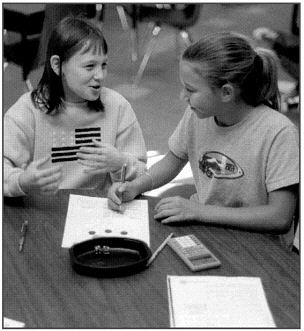
In addition to working as members of the classroom community, students also need to become independent learners, both inside and outside the classroom. Students should have opportunities to work independently of the teacher, individually and in pairs or groups. When homework is assigned for the purpose of developing skills, students should be sufficiently familiar with the skills so that they do not practice incorrect procedures. Only by becoming independent learners can students come to see mathematics as doable and useful.
One of the strongest findings from research is that time and opportunity to learn are essential for successful learning. For all students to develop mathematical proficiency, schools should devote a substantial and regular amount of time to mathematics instruction. As an overall guideline, an hour each school day should be devoted to mathematics instruction from kindergarten through eighth grade. This time should be apportioned so that all the strands of mathematical proficiency receive adequate attention.
|
Does working in small groups help students to develop math proficiency? It depends. Students in groups—sometimes called cooperative groups—of three, four, or five can work on a math task together and thereby increase their proficiency. But if the task does not allow each student to contribute, and if students are not sure what they are supposed to do, precious learning time is wasted. When used appropriately, small groups can both increase achievement and promote positive social interactions among students.14 But for groups to be effective, tasks must be well chosen and students must be taught how to work in this mode. |
|
Don’t students have to be grouped by ability to develop math proficiency? “Ability grouping” in elementary and middle school, in which students are separated into classes based on test scores or math grades, is really grouping by achievement, and it tends to be self-perpetuating. Students placed in lower groups receive fewer opportunities to develop all the strands of math proficiency. Their classes typically have a less demanding curriculum, less capable teachers, and few or no strong peer models. As a result, achievement gaps grow rather than diminish, and socioeconomic, racial, and ethnic disparities widen.15 These observations suggest that the wiser course in elementary and middle school grades is not to group students into classes by ability or achievement. Accelerated classes are not necessary to help high-achieving students learn more; this can be accomplished within mixed groups. Some countries with impressive math achievement scores do not separate high achievers from low achievers. Effective teaching methods can help all students in mixed-ability classes to develop proficiency, and teachers can be supported to acquire and use these methods. |
Instructional Materials Need to Integrate the Strands of Mathematical Proficiency
Textbooks and other instructional materials in the United States need to support the learning of all five strands of mathematical proficiency. They should develop the core content of mathematics in a focused way and with continuity within and across grades. More time should be spent developing fewer topics in each grade, as is done in many countries where mathematics achievement is strong.16 Textbooks should move on to new, more advanced topics and should develop those in depth rather than repeating many topics every year.
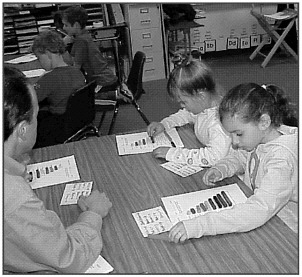
Instructional materials need to have teacher notes that support teachers’ understanding of mathematical concepts, student thinking and student errors, and effective pedagogical supports and techniques. Instructional materials should incorporate activities and strategies that assist teachers in helping all students become proficient in mathematics, including students low in socioeconomic status, English-language learners, special education students, and students with special interests or talents in mathematics.
Assessments Need to Contribute to the Goal of Mathematical Proficiency
In recent years, many states and districts have mandated a variety of assessments to measure the mathematics performance of students. Some of these assessments have serious consequences for students, teachers, and schools, such as determining whether a student will graduate or whether a school will avoid state sanctions. In some cases, the assessment aims at what students have mastered, and all students should be able to demonstrate mastery. In many other cases, however, the assessment ranks students, schools, or districts; this means that half of those being assessed are necessarily below par. Such assessments typically do not provide information that can be used to improve instruction.
The goal of mathematical proficiency for all requires as one of its first tasks a rethinking of what assessments are measuring. Large-scale comparisons are seldom aligned with the curriculum and often focus on only one or two aspects of
|
Why are students playing with blocks, sticks, and beans in math classes? Reflecting on the use of physical objects—such as blocks, sticks, and beans—can help students to develop understanding by linking their informal knowledge and experiences to school math.17 However, much depends on how these objects are used. Physical materials should not be used simply as tools to calculate answers. Students need to be able to move from using physical objects to finding solutions numerically. Teachers must provide opportunities for students to make explicit connections between activities with the objects and the math concepts and procedures that the objects are intended to help teach. The math is in the connections, not the objects. |
|
Should all students study algebra? Yes. Algebra is the gateway to higher math. Proficiency in algebra helps students solidify their proficiency in numbers and integrate their knowledge of math. Algebra provides the concepts and language to move from individual numerical calculations to general relationships. The study of algebra, however, need not begin with a formal course in the subject. The elementary and middle school curriculum can support the development of algebraic ways of thinking and thereby avoid the difficulties many students now experience in making the transition from arithmetic to algebra. The basic ideas of algebra can be learned by the end of middle school if they are taught in ways that draw on and develop all strands of math proficiency. |
performance.18 Preparing for and taking tests that do not measure the five strands of proficiency consume time that could be devoted to teaching and learning mathematics.
All assessments need to support the development of mathematical proficiency. They need to measure the five strands of proficiency and their integration. By doing so, they will provide opportunities for students to become proficient rather than taking time away from this goal. Teachers’ informal assessments of student progress provide valuable information as they adjust their instruction to help their students become proficient. More formal assessments also can help to track students’ progress and identify areas in which they need help.
As large-scale formal assessments become increasingly popular, the goal of supporting the development of students’ mathematical proficiency could be furthered if a government agency were to fund an independent group to analyze these assessment programs for the extent to which they promote mathematical proficiency. This group could recommend how such programs might be modified to promote the goal of proficiency.
Teachers Need Support That Will Enable Them to Teach All Students to Be Mathematically Proficient
Like any complex task, effective mathematics teaching must be learned. Teachers need a special kind of knowledge. To teach mathematics well, they must themselves be proficient in mathematics, at a much deeper level than their students. They also must understand how students develop mathematical proficiency, and they must have a repertoire of teaching practices that can promote proficiency. Unfortunately, very few teachers have the specialized knowledge needed to teach mathematics in the ways envisioned in this report.19 The view of mathematical proficiency presented here requires that teachers act in new ways and have knowledge and understanding they once were not expected to have.
Like learning in any profession, learning to teach for mathematical proficiency is a career-long challenge. Acquiring this knowledge and learning how to use it effectively in the classroom will take not only time but resources. Professional development must become a continuing part of the teacher’s workweek rather than taking the form of an occasional workshop.20 Teachers need extensive opportunities to learn, to observe models of effective practice, and to have access to expertise in mathematics teaching. It is not reasonable in the short term to expect all teachers to acquire the knowledge they need to teach for mathematical proficiency. To further promote effective teaching and learning, mathematics specialists—teachers who have special training and interest in mathematics— should be available in every elementary school.
The undergraduate years of teacher training must provide significant and continuing opportunities, linked closely to classroom practice, for prospective teachers to develop the knowledge needed to teach for mathematical proficiency. Prospective teachers must study students’ thinking and relate that thinking to the kinds of mathematical knowledge that students bring with them to school. People intending to be teachers must continue developing their own mathematical proficiency and learn how to use that proficiency to guide discussions, modify problems, and make decisions about what to pursue in class. They cannot wait until they enter the profession to learn to teach effectively.
|
Does improving students’ math proficiency require new types of tests? Yes. New tests may be needed, and old tests may need to be changed. Most current math tests, whether standardized achievement tests or classroom quizzes, address only a fraction of math proficiency—usually just the computing strand and simple parts of the understanding and applying strands. Teachers need tests and other assessment procedures that let them gauge how far students have come along in all five proficiency strands. Furthermore, instead of taking time away from learning, these instruments should allow students simultaneously to build and exhibit their proficiency. |
Efforts to Achieve Mathematical Proficiency Must Be Coordinated, Comprehensive, and Informed by Scientific Evidence
Many people have worked very hard in recent years to change the ways in which mathematics is taught and learned. However, the problem requires greater and different efforts than those made so far. Complex systems like school mathematics are what social scientists call overdetermined. A large number of pressures exert forces on these systems, making them remarkably stable and resistant to change. Altering such a system requires the coordinated efforts of everyone involved.
Mathematical proficiency for all is an ambitious objective. In fact, in no country—not even those that have performed better than the United States on international comparisons of mathematics achievement—do all students display mathematical proficiency as defined in this book. Reaching this goal will require fundamental changes in many areas of school mathematics.
The only way to achieve long-term improvement is through a coherent and systematic approach. This will require that all aspects of the system be reformed simultaneously. We therefore conclude with a list of actions that the individuals and groups to whom this book is addressed must take to achieve the goal of mathematical proficiency for all. By pursuing these actions in a coordinated and resolute fashion, those people involved in mathematics education in the United States can drive changes that will have substantial and lasting benefits for all students and for the nation as a whole.


