
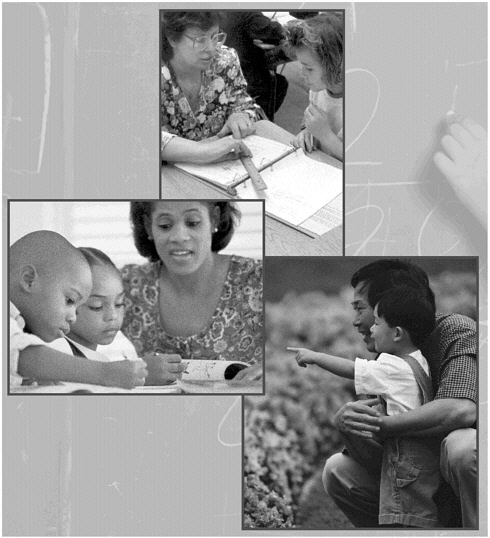
What Can Parents and Caregivers Do?
Before Children Enter School
Just as parents can help their children be ready to learn to read, they can give children a good start in learning math by helping them develop proficiency with informal math concepts and skills.
-
Play games such as dominoes and board games.
-
Find natural opportunities to count, to sort objects, to match collections of objects, to identify shapes (while reading bedtime stories, going up stairs, setting the table, etc.).
-
Count a collection of objects and use number words to identify very small collections.
-
Talk with your child about simple math problems and ideas. (How many spoons do we need to set the table? Give me the cup with the two flowers on it. Find the other circle on this page. Sort the blocks by shape.)
After Children Enter School
-
Have high expectations. Children’s math achievement is shaped—and limited—by what is expected of them.
-
Expect some confusion to be part of the learning process but emphasize that effort, not ability, is what counts. Math is understandable and can be figured out.
-
Avoid conveying negative attitudes toward math. Never tell children to not worry about a certain kind of math because it will never be used.
-
Ask your child what he or she did in math class today. Ask him or her to give details and to explain.
-
Expect your child’s homework to include more than simple computation worksheets.
-
Give your child meaningful problems that use numbers or shapes while you are going about everyday life. Ask the child to explain what he or she did.
-
Be an advocate for the theme of math proficiency in textbooks, assessments, and instruction.
-
Advocate allocating and using a regular time each school day for instruction to develop math proficiency.
-
Support professional development activities for teachers and administrators.


