




Below is the uncorrected machine-read text of this chapter, intended to provide our own search engines and external engines with highly rich, chapter-representative searchable text of each book. Because it is UNCORRECTED material, please consider the following text as a useful but insufficient proxy for the authoritative book pages.
Summary Tables, Dietary Reference Intakes Recommended Intakes for Individuals, Vitamins 1320 Recommended Intakes for Individuals, Elements 1322 Recommended Intakes for Individuals, Total Water and Macronutrients 1324 Acceptable Macronutrient Distribution Ranges 1325 Additional Macronutrient Recommendations 1325 Tolerable Upper Intake Levels (UL), Vitamins 1326 Tolerable Upper Intake Levels (UL), Elements 1328 Estimated Average Requirements for Groups 1330 1319
Dietary Reference Intakes (DRIs): Recommended Intakes for Individuals, Vitamins Food and Nutrition Board, Institute of Medicine, National Academies Life Stage Vitamin A Vitamin C Vitamin D Vitamin E Vitamin K Thiamin (µg/d)a (µg/d)b,c (mg/d)d Group (mg/d) (µg/d) (mg/d) Infants 0â6 mo 400* 40* 5* 4* 2.0* 0.2* 7â12 mo 500* 50* 5* 5* 2.5* 0.3* Children 1â3 y 5* 30* 300 15 6 0.5 4â8 y 5* 55* 400 25 7 0.6 Males 9â13 y 5* 60* 600 45 11 0.9 14â18 y 5* 75* 900 75 15 1.2 19â30 y 5* 120* 900 90 15 1.2 31â50 y 5* 120* 900 90 15 1.2 51â70 y 10* 120* 900 90 15 1.2 > 70 y 15* 120* 900 90 15 1.2 Females 9â13 y 5* 60* 600 45 11 0.9 14â18 y 5* 75* 700 65 15 1.0 19â30 y 5* 90* 700 75 15 1.1 31â50 y 5* 90* 700 75 15 1.1 51â70 y 10* 90* 700 75 15 1.1 > 70 y 15* 90* 700 75 15 1.1 Pregnancy 14â18 y 5* 75* 750 80 15 1.4 19â30 y 5* 90* 770 85 15 1.4 31â50 y 5* 90* 770 85 15 1.4 Lactation 14â18 y 5* 75* 1,200 115 19 1.4 19â30 y 5* 90* 1,300 120 19 1.4 31â50 y 5* 90* 1,300 120 19 1.4 NOTE: This table (taken from the DRI reports, see www.nap.edu) presents Recom- mended Dietary Allowances (RDAs) in bold type and Adequate Intakes (AIs) in ordi- nary type followed by an asterisk (*). RDAs and AIs may both be used as goals for individual intake. RDAs are set to meet the needs of almost all (97 to 98 percent) individuals in a group. For healthy breastfed infants, the AI is the mean intake. The AI for other life stage and gender groups is believed to cover needs of all individuals in the group, but lack of data or uncertainty in the data prevent being able to specify with confidence the percentage of individuals covered by this intake. a As retinol activity equivalents (RAEs). 1 RAE = 1 µg retinol, 12 µg β-carotene, 24 µg α-carotene, or 24 µg β-cryptoxanthin. The RAE for dietary provitamin A carotenoids is twofold greater than retinol equivalents (RE), whereas the RAE for preformed vitamin A is the same as RE. b As cholecalciferol. 1 µg cholecalciferol = 40 IU vitamin D. c In the absence of adequate exposure to sunlight. d As α -tocopherol. α -Tocopherol includes R RR - α -tocopherol, the only form of α -tocopherol that occurs naturally in foods, and the 2 R-stereoisomeric forms of α-tocopherol (RRR-, RSR-, RRS-, and RSS-α-tocopherol) that occur in fortified foods and supplements. It does not include the 2S-stereoisomeric forms of α-tocopherol (SRR-, SSR-, SRS-, and SSS-α-tocopherol), also found in fortified foods and supplements. e As niacin equivalents (NE). 1 mg of niacin = 60 mg of tryptophan; 0â6 months = preformed niacin (not NE). f As dietary folate equivalents (DFE). 1 DFE = 1 µg food folate = 0.6 µg of folic acid 1320
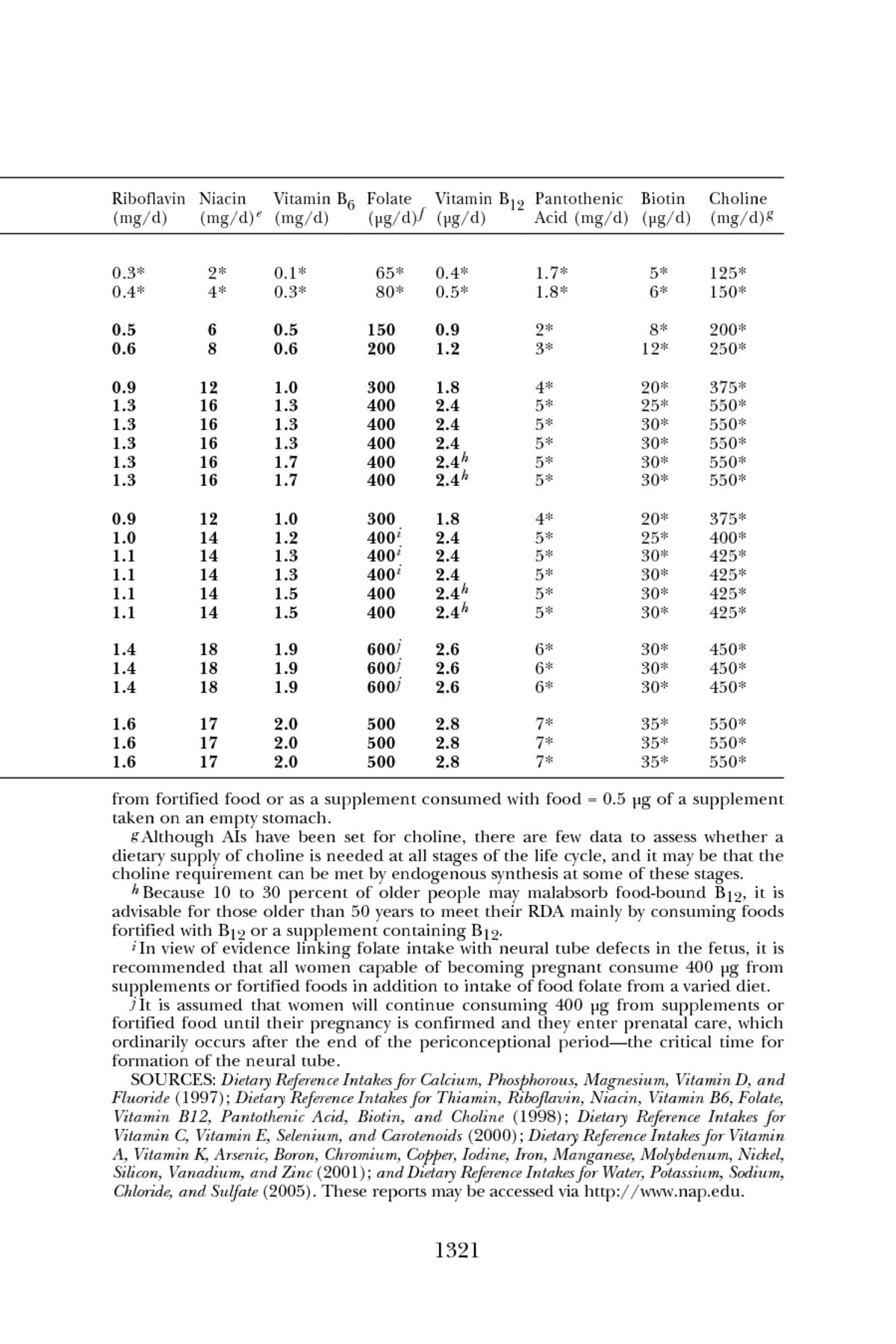
Riboflavin Niacin Vitamin B6 Folate Vitamin B12 Pantothenic Biotin Choline (mg/d)e (mg/d) (µg/d)f (µg/d) Acid (mg/d) (µg/d) (mg/d)g (mg/d) 0.3* 2* 0.1* 65* 0.4* 1.7* 5* 125* 0.4* 4* 0.3* 80* 0.5* 1.8* 6* 150* 2* 8* 200* 0.5 6 0.5 150 0.9 3* 12* 250* 0.6 8 0.6 200 1.2 4* 20* 375* 0.9 12 1.0 300 1.8 5* 25* 550* 1.3 16 1.3 400 2.4 5* 30* 550* 1.3 16 1.3 400 2.4 5* 30* 550* 1.3 16 1.3 400 2.4 2.4h 5* 30* 550* 1.3 16 1.7 400 2.4h 5* 30* 550* 1.3 16 1.7 400 4* 20* 375* 0.9 12 1.0 300 1.8 400i 5* 25* 400* 1.0 14 1.2 2.4 400i 5* 30* 425* 1.1 14 1.3 2.4 400i 5* 30* 425* 1.1 14 1.3 2.4 2.4h 5* 30* 425* 1.1 14 1.5 400 2.4h 5* 30* 425* 1.1 14 1.5 400 600j 6* 30* 450* 1.4 18 1.9 2.6 600j 6* 30* 450* 1.4 18 1.9 2.6 600j 6* 30* 450* 1.4 18 1.9 2.6 7* 35* 550* 1.6 17 2.0 500 2.8 7* 35* 550* 1.6 17 2.0 500 2.8 7* 35* 550* 1.6 17 2.0 500 2.8 from fortified food or as a supplement consumed with food = 0.5 µg of a supplement taken on an empty stomach. g Although AIs have been set for choline, there are few data to assess whether a dietary supply of choline is needed at all stages of the life cycle, and it may be that the choline requirement can be met by endogenous synthesis at some of these stages. h Because 10 to 30 percent of older people may malabsorb food-bound B12, it is advisable for those older than 50 years to meet their RDA mainly by consuming foods fortified with B12 or a supplement containing B12. i In view of evidence linking folate intake with neural tube defects in the fetus, it is recommended that all women capable of becoming pregnant consume 400 µg from supplements or fortified foods in addition to intake of food folate from a varied diet. j It is assumed that women will continue consuming 400 µg from supplements or fortified food until their pregnancy is confirmed and they enter prenatal care, which ordinarily occurs after the end of the periconceptional periodâthe critical time for formation of the neural tube. SOURCES: Dietary Reference Intakes for Calcium, Phosphorous, Magnesium, Vitamin D, and Fluoride (1997); Dietary Reference Intakes for Thiamin, Riboflavin, Niacin, Vitamin B6, Folate, Vitamin B12, Pantothenic Acid, Biotin, and Choline (1998); Dietary Reference Intakes for Vitamin C, Vitamin E, Selenium, and Carotenoids (2000); Dietary Reference Intakes for Vitamin A, Vitamin K, Arsenic, Boron, Chromium, Copper, Iodine, Iron, Manganese, Molybdenum, Nickel, Silicon, Vanadium, and Zinc (2001); and Dietary Reference Intakes for Water, Potassium, Sodium, Chloride, and Sulfate (2005). These reports may be accessed via http://www.nap.edu. 1321
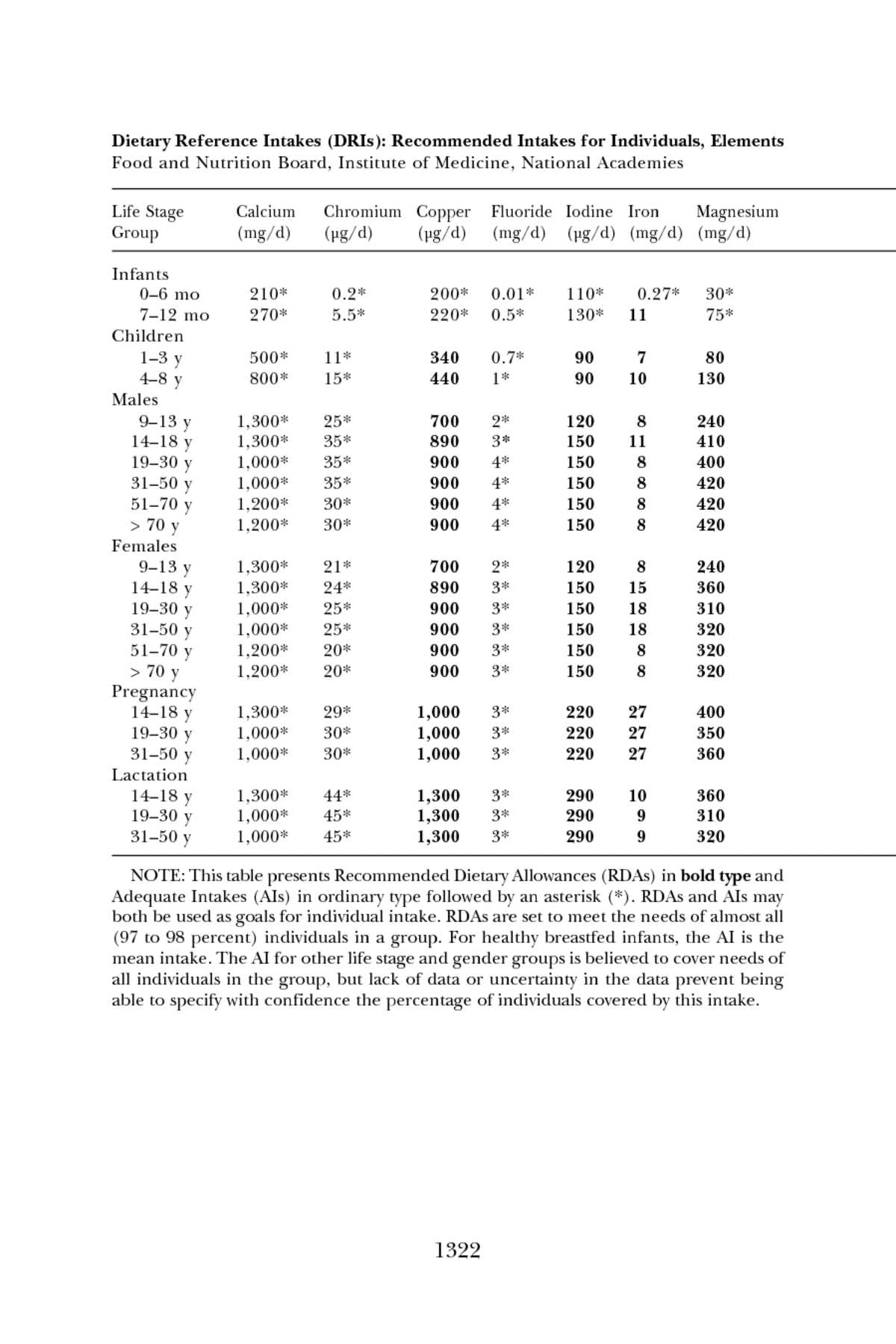
Dietary Reference Intakes (DRIs): Recommended Intakes for Individuals, Elements Food and Nutrition Board, Institute of Medicine, National Academies Life Stage Calcium Chromium Copper Fluoride Iodine Iron Magnesium Group (mg/d) (µg/d) (µg/d) (mg/d) (µg/d) (mg/d) (mg/d) Infants 0â6 mo 210* 0.2* 200* 0.01* 110* 0.27* 30* 7â12 mo 270* 5.5* 220* 0.5* 130* 75* 11 Children 1â3 y 500* 11* 0.7* 340 90 7 80 4â8 y 800* 15* 1* 440 90 10 130 Males 9â13 y 1,300* 25* 2* 700 120 8 240 14â18 y 1,300* 35* 3* 890 150 11 410 19â30 y 1,000* 35* 4* 900 150 8 400 31â50 y 1,000* 35* 4* 900 150 8 420 51â70 y 1,200* 30* 4* 900 150 8 420 > 70 y 1,200* 30* 4* 900 150 8 420 Females 9â13 y 1,300* 21* 2* 700 120 8 240 14â18 y 1,300* 24* 3* 890 150 15 360 19â30 y 1,000* 25* 3* 900 150 18 310 31â50 y 1,000* 25* 3* 900 150 18 320 51â70 y 1,200* 20* 3* 900 150 8 320 > 70 y 1,200* 20* 3* 900 150 8 320 Pregnancy 14â18 y 1,300* 29* 3* 1,000 220 27 400 19â30 y 1,000* 30* 3* 1,000 220 27 350 31â50 y 1,000* 30* 3* 1,000 220 27 360 Lactation 14â18 y 1,300* 44* 3* 1,300 290 10 360 19â30 y 1,000* 45* 3* 1,300 290 9 310 31â50 y 1,000* 45* 3* 1,300 290 9 320 NOTE: This table presents Recommended Dietary Allowances (RDAs) in bold type and Adequate Intakes (AIs) in ordinary type followed by an asterisk (*). RDAs and AIs may both be used as goals for individual intake. RDAs are set to meet the needs of almost all (97 to 98 percent) individuals in a group. For healthy breastfed infants, the AI is the mean intake. The AI for other life stage and gender groups is believed to cover needs of all individuals in the group, but lack of data or uncertainty in the data prevent being able to specify with confidence the percentage of individuals covered by this intake. 1322
Manganese Molybdenum Phosphorus Selenium Zinc Potassium Sodium Chloride (mg/d) (µg/d) (mg/d) (µg/d) (mg/d) (g/d) (g/d) (g/d) 0.003* 2* 100* 15* 2* 0.4* 0.12* 0.18* 0.6* 3* 275* 20* 0.7* 0.37* 0.57* 3 1.2* 3.0* 1.0* 1.5* 17 460 20 3 1.5* 3.8* 1.2* 1.9* 22 500 30 5 1.9* 4.5* 1.5* 2.3* 34 1,250 40 8 2.2* 4.7* 1.5* 2.3* 43 1,250 55 11 2.3* 4.7* 1.5* 2.3* 45 700 55 11 2.3* 4.7* 1.5* 2.3* 45 700 55 11 2.3* 4.7* 1.3* 2.0* 45 700 55 11 2.3* 4.7* 1.2* 1.8* 45 700 55 11 1.6* 4.5* 1.5* 2.3* 34 1,250 40 8 1.6* 4.7* 1.5* 2.3* 43 1,250 55 9 1.8* 4.7* 1.5* 2.3* 45 700 55 8 1.8* 4.7* 1.5* 2.3* 45 700 55 8 1.8* 4.7* 1.3* 2.0* 45 700 55 8 1.8* 4.7* 1.2* 1.8* 45 700 55 8 2.0* 4.7* 1.5* 2.3* 50 1,250 60 12 2.0* 4.7* 1.5* 2.3* 50 700 60 11 2.0* 4.7* 1.5* 2.3* 50 700 60 11 2.6* 5.1* 1.5* 2.3* 50 1,250 70 13 2.6* 5.1* 1.5* 2.3* 50 700 70 12 2.6* 5.1* 1.5* 2.3* 50 700 70 12 SOURCES: Dietary Reference Intakes for Calcium, Phosphorous, Magnesium, Vitamin D, and Fluoride (1997); Dietary Reference Intakes for Thiamin, Riboflavin, Niacin, Vitamin B6, Folate, Vitamin B12, Pantothenic Acid, Biotin, and Choline (1998); Dietary Reference Intakes for Vitamin C, Vitamin E, Selenium, and Carotenoids (2000); Dietary Reference Intakes for Vitamin A, Vitamin K, Arsenic, Boron, Chromium, Copper, Iodine, Iron, Manganese, Molybdenum, Nickel, Silicon, Vanadium, and Zinc (2001); and Dietary Reference Intakes for Water, Potassium, Sodium, Chloride, and Sulfate (2005). These reports may be accessed via http://www.nap.edu. 1323
Dietary Reference Intakes (DRIs): Recommended Intakes for Individuals, Total Water and Macronutrients Food and Nutrition Board, Institute of Medicine, National Academies Linoleic α-Linolenic Total Carbo- Total Watera Proteinb Life Stage hydrate Fiber Fat Acid Acid Group (L/d) (g/d) (g/d) (g/d) (g/d) (g/d) (g/d) Infants 0â6 mo 0.7* 60* ND 31* 4.4* 0.5* 9.1* 7â12 mo 0.8* 95* ND 30* 4.6* 0.5* 11.0+ Children ND c 1â3 y 1.3* 19* 7* 0.7* 130 13 4â8 y 1.7* 25* ND 10* 0.9* 130 19 Males 9â13 y 2.4* 31* ND 12* 1.2* 130 34 14â18 y 3.3* 38* ND 16* 1.6* 130 52 19â30 y 3.7* 38* ND 17* 1.6* 130 56 31â50 y 3.7* 38* ND 17* 1.6* 130 56 51â70 y 3.7* 30* ND 14* 1.6* 130 56 > 70 y 3.7* 30* ND 14* 1.6* 130 56 Females 9â13 y 2.1* 26* ND 10* 1.0* 130 34 14â18 y 2.3* 26* ND 11* 1.1* 130 46 19â30 y 2.7* 25* ND 12* 1.1* 130 46 31â50 y 2.7* 25* ND 12* 1.1* 130 46 51â70 y 2.7* 21* ND 11* 1.1* 130 46 > 70 y 2.7* 21* ND 11* 1.1* 130 46 Pregnancy 14â18 y 3.0* 28* ND 13* 1.4* 175 71 19â30 y 3.0* 28* ND 13* 1.4* 175 71 31â50 y 3.0* 28* ND 13* 1.4* 175 71 Lactation 14â18 y 3.8* 29* ND 13* 1.3* 210 71 19â30 y 3.8* 29* ND 13* 1.3* 210 71 31â50 y 3.8* 29* ND 13* 1.3* 210 71 NOTE: This table presents Recommended Dietary Allowances (RDAs) in bold type and Adequate Intakes (AIs) in ordinary type followed by an asterisk (*). RDAs and AIs may both be used as goals for individual intake. RDAs are set to meet the needs of almost all (97 to 98 percent) individuals in a group. For healthy breastfed infants, the AI is the mean intake. The AI for other life stage and gender groups is believed to cover the needs of all individuals in the group, but lack of data or uncertainty in the data prevent being able to specify with confidence the percentage of individuals covered by this intake. The plus (+) symbol indicates a change from the prepublication copy due to a calculation error. a Total water includes all water contained in food, beverages, and drinking water. b Based on g protein per kg of body weight for the reference body weight, e.g., for adults 0.8 g/kg body weight for the reference body weight. c Not determined. SOURCES: Dietary Reference Intakes for Energy, Carbohydrate, Fiber, Fat, Fatty Acids, Cholesterol, Protein, and Amino Acids (2002/2005); Dietary Reference Intakes for Water, Potassium, Sodium, Chloride, and Sulfate (2005). These reports may be accessed via http://www.nap.edu. 1324
Dietary Reference Intakes (DRIs): Acceptable Macronutrient Distribution Ranges Food and Nutrition Board, Institute of Medicine, National Academies Range (percent of energy) Children, Children, Macronutrient 1â3 y 4â18 y Adults Fat 30â40 25â35 20â35 n -6 Polyunsaturated fatty acidsa (linoleic acid) 5â10 5â10 5â10 n -3 Polyunsaturated fatty acidsa (α-linolenic acid) 0.6â1.2 0.6â1.2 0.6â1.2 Carbohydrate 45â65 45â65 45â65 Protein 5â20 10â30 10â35 a Approximately 10 percent of the total can come from longer-chain n-3 or n-6 fatty acids. SOURCE: Dietary Reference Intakes for Energy, Carbohydrate, Fiber, Fat, Fatty Acids, Cholesterol, Protein, and Amino Acids (2002/2005). Dietary Reference Intakes (DRIs): Additional Macronutrient Recommendations Food and Nutrition Board, Institute of Medicine, National Academies Macronutrient Recommendation Dietary cholesterol As low as possible while consuming a nutritionally adequate diet Trans fatty acids As low as possible while consuming a nutritionally adequate diet Saturated fatty acids As low as possible while consuming a nutritionally adequate diet Added sugars Limit to no more than 25% of total energy SOURCE: Dietary Reference Intakes for Energy, Carbohydrate, Fiber, Fat, Fatty Acids, Cholesterol, Protein, and Amino Acids (2002/2005). 1325
Dietary Reference Intakes (DRIs): Tolerable Upper Intake Levels (ULa), Vitamins Food and Nutrition Board, Institute of Medicine, National Academies Life Stage Vitamin A Vitamin C Vitamin D Vitamin E (µg/d)b (mg/d)c,d Group (mg/d) (µg/d) Vitamin K Thiamin Infants NDf 0â6 mo 600 25 ND ND ND 7â12 mo 600 ND 25 ND ND ND Children 1â3 y 600 400 50 200 ND ND 4â8 y 900 650 50 300 ND ND Males, Females 9â13 y 1,700 1,200 50 600 ND ND 14â18 y 2,800 1,800 50 800 ND ND 19â70 y 3,000 2,000 50 1,000 ND ND > 70 y 3,000 2,000 50 1,000 ND ND Pregnancy 14â18 y 2,800 1,800 50 800 ND ND 19â50 y 3,000 2,000 50 1,000 ND ND Lactation 14â18 y 2,800 1,800 50 800 ND ND 19â50 y 3,000 2,000 50 1,000 ND ND a UL = The highest level of daily nutrient intake that is likely to pose no risk of adverse health effects to almost all individuals in the general population. Unless other- wise specified, the UL represents total intake from food, water, and supplements. Due to lack of suitable data, ULs could not be established for vitamin K, thiamin, riboflavin, vitamin B12, pantothenic acid, biotin, and carotenoids. In the absence of ULs, extra caution may be warranted in consuming levels above recommended intakes. b As preformed vitamin A only. c As α-tocopherol; applies to any form of supplemental α-tocopherol. d The ULs for vitamin E, niacin, and folate apply to synthetic forms obtained from supplements, fortified foods, or a combination of the two. e β-Carotene supplements are advised only to serve as a provitamin A source for individuals at risk of vitamin A deficiency. 1326
Ribo- Niacin Vitamin B6 Folate Vitamin Pantothenic Choline Carote- flavin (mg/d)d (mg/d) (µg/d)d B12 Biotin (g/d) noidse Acid ND ND ND ND ND ND ND ND ND ND ND ND ND ND ND ND ND ND ND 10 30 300 ND ND ND 1.0 ND ND 15 40 400 ND ND ND 1.0 ND ND 20 60 600 ND ND ND 2.0 ND ND 30 80 800 ND ND ND 3.0 ND ND 35 100 1,000 ND ND ND 3.5 ND ND 35 100 1,000 ND ND ND 3.5 ND ND 30 80 800 ND ND ND 3.0 ND ND 35 100 1,000 ND ND ND 3.5 ND ND 30 80 800 ND ND ND 3.0 ND ND 35 100 1,000 ND ND ND 3.5 ND f ND = Not determinable due to lack of data of adverse effects in this age group and concern with regard to lack of ability to handle excess amounts. Source of intake should be from food only to prevent high levels of intake. SOURCES: Dietary Reference Intakes for Calcium, Phosphorous, Magnesium, Vitamin D, and Fluoride (1997); Dietary Reference Intakes for Thiamin, Riboflavin, Niacin, Vitamin B6, Folate, Vitamin B12, Pantothenic Acid, Biotin, and Choline (1998); Dietary Reference Intakes for Vitamin C, Vitamin E, Selenium, and Carotenoids (2000); and Dietary Reference Intakes for Vitamin A, Vitamin K, Arsenic, Boron, Chromium, Copper, Iodine, Iron, Manganese, Molybdenum, Nickel, Silicon, Vanadium, and Zinc (2001). These reports may be accessed via http:// www.nap.edu. 1327
Dietary Reference Intakes (DRIs): Tolerable Upper Intake Levels (ULa), Elements Food and Nutrition Board, Institute of Medicine, National Academies Calci- Fluo- Magne- Life Stage Arse- Boron um Chro- Copper ride Iodine Iron sium nicb (mg/d) (µg/d) (mg/d) (mg/d)c Group (mg/d) (g/d) mium (µg/d) Infants 0â6 mo NDf ND ND ND ND 0.7 ND 40 ND 7â12 mo ND ND ND ND ND 0.9 ND 40 ND Children 1â3 y ND 3 2.5 ND 1,000 1.3 200 40 65 4â8 y ND 6 2.5 ND 3,000 2.2 300 40 110 Males, Females 9â13 y ND 11 2.5 ND 5,000 10 600 40 350 14â18 y ND 17 2.5 ND 8,000 10 900 45 350 19â70 y ND 20 2.5 ND 10,000 10 1,100 45 350 > 70 y ND 20 2.5 ND 10,000 10 1,100 45 350 Pregnancy 14â18 y ND 17 2.5 ND 8,000 10 900 45 350 19â50 y ND 20 2.5 ND 10,000 10 1,100 45 350 Lactation 14â18 y ND 17 2.5 ND 8,000 10 900 45 350 19â50 y ND 20 2.5 ND 10,000 10 1,100 45 350 a UL = The highest level of daily nutrient intake that is likely to pose no risk of adverse health effects to almost all individuals in the general population. Unless other- wise specified, the UL represents total intake from food, water, and supplements. Due to lack of suitable data, ULs could not be established for arsenic, chromium, silicon, potassium, and sulfate. In the absence of ULs, extra caution may be warranted in consuming levels above recommended intakes. b Although the UL was not determined for arsenic, there is no justification for adding arsenic to food or supplements. c The ULs for magnesium represent intake from a pharmacological agent only and do not include intake from food and water. d Although silicon has not been shown to cause adverse effects in humans, there is no justification for adding silicon to supplements. e Although vanadium in food has not been shown to cause adverse effects in humans, 1328
Manga- Molyb- Phos- Sele- Vana- Sodi- Chlo- nese denum Nickel phorus Potas- nium Sili- Sul- dium Zinc um ride (mg/d) (g/d) sium (µg/d) cond (mg/d)e (mg/d) (g/d) (g/d) (mg/d) (µg/d) fate ND ND ND ND ND 45 ND ND ND 4 ND ND ND ND ND ND ND 60 ND ND ND 5 ND ND 2 300 0.2 3.0 ND 90 ND ND ND 7 1.5 2.3 3 600 0.3 3.0 ND 150 ND ND ND 12 1.9 2.9 6 1,100 0.6 4.0 ND 280 ND ND ND 23 2.2 3.4 9 1,700 1.0 4.0 ND 400 ND ND ND 34 2.3 3.6 11 2,000 1.0 4.0 ND 400 ND ND 1.8 40 2.3 3.6 11 2,000 1.0 3.0 ND 400 ND ND 1.8 40 2.3 3.6 9 1,700 1.0 3.5 ND 400 ND ND ND 34 2.3 3.6 11 2,000 1.0 3.5 ND 400 ND ND ND 40 2.3 3.6 9 1,700 1.0 4.0 ND 400 ND ND ND 34 2.3 3.6 11 2,000 1.0 4.0 ND 400 ND ND ND 40 2.3 3.6 there is no justification for adding vanadium to food and vanadium supplements should be used with caution. The UL is based on adverse effects in laboratory animals and this data could be used to set a UL for adults but not children and adolescents. f ND = Not determinable due to lack of data of adverse effects in this age group and concern with regard to lack of ability to handle excess amounts. Source of intake should be from food only to prevent high levels of intake. SOURCES: Dietary Reference Intakes for Calcium, Phosphorous, Magnesium, Vitamin D, and Fluoride (1997); Dietary Reference Intakes for Thiamin, Riboflavin, Niacin, Vitamin B6, Folate, Vitamin B12, Pantothenic Acid, Biotin, and Choline (1998); Dietary Reference Intakes for Vita- min C, Vitamin E, Selenium, and Carotenoids (2000); Dietary Reference Intakes for Vitamin A, Vitamin K, Arsenic, Boron, Chromium, Copper, Iodine, Iron, Manganese, Molybdenum, Nickel, Silicon, Vanadium, and Zinc (2001); and Dietary Reference Intakes for Water, Potassium, Sodium, Chloride, and Sulfate (2005). These reports may be accessed via http://www.nap.edu. 1329
Dietary Reference Intakes (DRIs): Estimated Average Requirements for Groups Food and Nutrition Board, Institute of Medicine, National Academies Ribo- Life Stage CHO Protein Vit A Vit C Vit E Thiamin flavin Niacin Vit B6 (g/kg/d)(µg/d)a (mg/d) (mg/d)b (mg/d) (mg/d) (mg/d)c (mg/d) Group (g/d) Infants 7â12 mo 1.0 Children 1â3 y 100 0.87 210 13 5 0.4 0.4 5 0.4 4â8 y 100 0.76 275 22 6 0.5 0.5 6 0.5 Males 9â13 y 100 0.76 445 39 9 0.7 0.8 9 0.8 14â18 y 100 0.73 630 63 12 1.0 1.1 12 1.1 19â30 y 100 0.66 625 75 12 1.0 1.1 12 1.1 31â50 y 100 0.66 625 75 12 1.0 1.1 12 1.1 51â70 y 100 0.66 625 75 12 1.0 1.1 12 1.4 > 70 y 100 0.66 625 75 12 1.0 1.1 12 1.4 Females 9â13 y 100 0.76 420 39 9 0.7 0.8 9 0.8 14â18 y 100 0.71 485 56 12 0.9 0.9 11 1.0 19â30 y 100 0.66 500 60 12 0.9 0.9 11 1.1 31â50 y 100 0.66 500 60 12 0.9 0.9 11 1.1 51â70 y 100 0.66 500 60 12 0.9 0.9 11 1.3 > 70 y 100 0.66 500 60 12 0.9 0.9 11 1.3 Pregnancy 14â18 y 135 0.88 530 66 12 1.2 1.2 14 1.6 19â30 y 135 0.88 550 70 12 1.2 1.2 14 1.6 31â50 y 135 0.88 550 70 12 1.2 1.2 14 1.6 Lactation 14â18 y 160 1.05 885 96 16 1.2 1.3 13 1.7 19â30 y 160 1.05 900 100 16 1.2 1.3 13 1.7 31â50 y 160 1.05 900 100 16 1.2 1.3 13 1.7 NOTE: This table presents Estimated Average Requirements (EARs), which serve two purposes: for assessing adequacy of population intakes and as the basis for calculating Recommended Dietary Allowances (RDAs) for individuals. EARs have not been estab- lished for vitamin D, vitamin K, pantothenic acid, biotin, choline, calcium, chromium, fluoride, manganese, or other nutrients not yet evaluated via the DRI process. a As retinol activity equivalents (RAEs). 1 RAE = 1 µg retinol, 12 µg β-carotene, 24 µg α-carotene, or 24 µg β-cryptoxanthin. The RAE for dietary provitamin A carotenoids is twofold greater than retinol equivalents (RE), whereas the RAE for preformed vitamin A is the same as RE. b As α -tocopherol. α -Tocopherol includes R RR - α-tocopherol, the only form of α -tocopherol that occurs naturally in foods, and the 2 R-stereoisomeric forms of α-tocopherol (RRR-, RSR-, RRS-, and RSS-α-tocopherol) that occur in fortified foods and supplements. It does not include the 2S-stereoisomeric forms of α-tocopherol (SRR-, SSR-, SRS-, and SSS-α-tocopherol), also found in fortified foods and supplements. 1330
Magnes- Molyb- Phos- Sele- Folate Vit B12 Copper Iodine Iron ium denum phorus nium Zinc (µg/d)a (µg/d) (µg/d) (µg/d) (mg/d) (mg/d) (µg/d) (mg/d) (µg/d) (mg/d) 6.9 2.5 120 0.7 260 65 3.0 65 13 380 17 2.5 160 1.0 340 65 4.1 110 17 405 23 4.0 250 1.5 540 73 5.9 200 26 1,055 35 7.0 330 2.0 685 95 7.7 340 33 1,055 45 8.5 320 2.0 700 95 6 330 34 580 45 9.4 320 2.0 700 95 6 350 34 580 45 9.4 320 2.0 700 95 6 350 34 580 45 9.4 320 2.0 700 95 6 350 34 580 45 9.4 250 1.5 540 73 5.7 200 26 1,055 35 7.0 330 2.0 685 95 7.9 300 33 1,055 45 7.3 320 2.0 700 95 8.1 255 34 580 45 6.8 320 2.0 700 95 8.1 265 34 580 45 6.8 320 2.0 700 95 5 265 34 580 45 6.8 320 2.0 700 95 5 265 34 580 45 6.8 520 2.2 785 160 23 335 40 1,055 49 10.5 520 2.2 800 160 22 290 40 580 49 9.5 520 2.2 800 160 22 300 40 580 49 9.5 450 2.4 985 209 7 300 35 1,055 59 10.9 450 2.4 1,000 209 6.5 255 36 580 59 10.4 450 2.4 1,000 209 6.5 265 36 580 59 10.4 c As niacin equivalents (NE). 1 mg of niacin = 60 mg of tryptophan. d As dietary folate equivalents (DFE). 1 DFE = 1 µg food folate = 0.6 µg of folic acid from fortified food or as a supplement consumed with food = 0.5 µg of a supplement taken on an empty stomach. SOURCES: Dietary Reference Intakes for Calcium, Phosphorous, Magnesium, Vitamin D, and Fluoride (1997); Dietary Reference Intakes for Thiamin, Riboflavin, Niacin, Vitamin B6, Folate, Vitamin B12, Pantothenic Acid, Biotin, and Choline (1998); Dietary Reference Intakes for Vita- min C, Vitamin E, Selenium, and Carotenoids (2000); Dietary Reference Intakes for Vitamin A, Vitamin K, Arsenic, Boron, Chromium, Copper, Iodine, Iron, Manganese, Molybdenum, Nickel, Silicon, Vanadium, and Zinc (2001), and Dietary Reference Intakes for Energy, Carbohydrate, Fiber, Fat, Fatty Acids, Cholesterol, Protein, and Amino Acids (2002/2005). These reports may be accessed via www.nap.edu. 1331
