
2
Remote-Handled Transuranic Waste
This chapter provides the context of RH-TRU waste characterization. The information presented on isotopic composition, life cycle, generator sites, and inventories for RH-TRU waste is provided on the basis of the knowledge gathered during committee meetings and has not been verified. DOE’s inventories have been updated since the committee’s interim report (released in December 2001).
2.1 Technical Context of Remote-Handled Transuranic Waste Characterization
The radiation-related health hazard associated with TRU waste is due primarily to alpha and gamma radiation. Alpha radiation cannot penetrate human skin but poses a potential health hazard if particles containing alpha-emitting radionuclides are inhaled or ingested. Contact-handled TRU waste typically emits relatively little gamma radiation; therefore, when properly packaged, it can be handled directly by workers.
Remote handled-TRU waste also contains activation and fission products (half-lives are indicated in parenthesis), such as cobalt-60 (5.3 years), plutonium-241 (14.4 years), strontium-901 (29 years), cesium-137 (30 years), and their progenies. Some of these products emit gamma radiation, which can penetrate human skin and even the walls of waste containers. Therefore, RH-TRU waste requires heavy shielding and remote-handling equipment. Gamma rays represent the main radiological health hazard to workers during normal RH-TRU waste handling operations.2 Although alpha-radiation exposure has a greater health risk per unit of energy deposited, the likelihood that workers will be exposed to alpha radiation while handling RH-TRU waste is lower compared to the likelihood for exposure to gamma radiation, because alpha radiation is stopped by the container’s walls.
In summary, RH-TRU waste presents a long-term (i.e., 10,000 years) radiological hazard associated with TRU radionuclides (related to the presence of long-lived alpha-emitting isotopes) and a short-term (less than 300 years) radiological hazard associated with short-lived gamma-emitting radionuclides (related to the presence of fission and activation products). Today, most of the radioactivity in DOE’s inventory of RH-TRU waste is due to the short-lived non-TRU radionuclides listed above. Nearly all of this activity will decay in 300 years, corresponding to approximately 10 half-lives of the
gamma-emitting radionuclides. Therefore, the long-term activity of RH-TRU waste is due to the remaining long-lived alpha-emitting (i.e., TRU) radionuclides.
2.2 Life Cycle of Remote-Handled Transuranic Waste
The life cycle of RH-TRU waste, from its generation to its designated final disposal at WIPP, generally consists of the following:
-
waste generation or recovery from its current storage location;
-
processing;
-
characterization;
-
packaging or repackaging;3
-
storage on site or off site prior to shipment to WIPP;
-
road transportation to WIPP;
-
receipt, handling, surface interim storage; and
-
underground emplacement at WIPP.
Remote-handled waste is generated during deactivation and decommissioning activities of DOE sites or it is already stored at generator sites and must be recovered for shipment to WIPP. Recovery activities can be complex if containers are difficult to access, if their integrity has been compromised with time, or if storage records are not available. For instance, part of the RH-TRU waste stored at Oak Ridge National Laboratory consists of a sludge that must be processed before shipment to WIPP (see Appendix E).
Waste processing activities consist of converting waste to a form suitable for disposal in WIPP. For instance, wet sludge must be dried because liquids are considered prohibited items (if more than 1 percent by waste volume) in WIPP’s RCRA Permit. Waste characterization is necessary prior to waste shipment to WIPP. Waste characterization may be performed at the time of packaging or repackaging of the waste. Packaging is necessary for waste that has not yet been generated. Repackaging is necessary for stored waste that is packaged in a container that does not meet transportation requirements; or for waste that needs processing to remove hazardous material (see Section 2.4). Solid RH-TRU waste will be repackaged in shielded facilities, such as hot cells.4 During this step, waste can be inspected by visual examination. As the waste is removed from an old container and sorted into new containers, a video camera records the operations on tape while an operator describes the various items. This inspection method requires skilled operators since it is done entirely by remote methods (see Finding 2D in Chapter 5). Volume-reducing operations, such as mechanical waste compacting, are also performed during the repackaging process.
Once a waste stream5 is characterized and packaged, it must be certified by EPA and NMED and stored on site prior to shipment to WIPP. Selected waste streams may
|
3 |
For most of the RH-TRU waste inventory, characterization will be performed at the time of packaging or repackaging of waste (see Chapters 4 and 5). |
|
4 |
A hot cell is a large chamber for handling highly radioactive materials. It is usually equipped with thick walls with shielding and viewing windows, remote-operated overhead cranes, closed-circuit televisions, and a variety of specialized tools and measuring devices. Throughout DOE complex other shielded facilities may be used with the same purpose as hot cells. |
|
5 |
A waste stream is defined as waste material generated from a single process or activity or as waste in multiple containers having similar physical, chemical, or radiological characteristics. |
not need certification if they are shipped to other major DOE sites for interim storage. Prior to shipment to WIPP, these interim storage sites will ensure certification of all their waste, including that received from other sites.
Finally, RH-TRU waste must be loaded into transportation casks, transported by road6 to WIPP, received, temporarily stored at the surface, and finally emplaced underground.
2.3 Generation of Remote-Handled Transuranic Waste
According to DOE’s latest inventory, there are approximately 3,800 cubic meters of RH-TRU waste to be removed from DOE sites across the nation. Figure 2.1 shows the geographic locations of the major RH-TRU waste generator sites. These sites are the following:
-
Hanford Site, Washington;
-
Idaho National Engineering and Environment Laboratory;
-
Los Alamos National Laboratory, New Mexico; and
-
Oak Ridge National Laboratory, Tennessee.
There are also nine smaller RH-TRU waste generator sites, not shown in Figure 2.1. Tables 2.1 and 2.2 show DOE’s RH-TRU waste inventories in terms of volume and radioactivity. Additional information about the nature and history of RH-TRU waste at selected generator sites is provided in Appendix E.
Tables 2.1 and 2.2 show the substantial variability among generator sites concerning waste volumes and radioactivity contents. These tables show that 60 percent of the stored volume of RH-TRU waste and about 89 percent of the total curie activity is located at Oak Ridge National Laboratory. About two-thirds of the Oak Ridge RH-TRU waste consists of wet sludge, stored in Melton Valley storage tanks, and the rest is debris waste. Debris waste consists of debris from hot cells and glove boxes packaged in shielded concrete casks. This wet sludge and debris waste contains significant sources of neutrons, due to the spontaneous fission of californium-252 and from (alpha, n) reactions (see Appendix E). These reactions involve the capture of highly energetic alpha particles, such as those emitted from curium-244, by nuclei of low-atomic-number elements, such as oxygen and fluorine, and the subsequent emission of neutrons. The neutron emission is primarily a handling, processing, and particularly a characterization issue in the near term for this site. The waste containers that will be used to ship RH-TRU waste from Oak Ridge to WIPP are specially designed to shield neutrons.
To meet the milestones set in the Federal Facility Compliance Act between DOE and the state of Tennessee, the Oak Ridge National Laboratory (through its contractor Foster Wheeler) is building a treatment facility to process, characterize, and package its RH-TRU waste (EPA, 1992). The current plan is to characterize RH-TRU waste following a plan similar to that for CH-TRU waste characterization. Homogeneous samples of wet sludge would be characterized by radiochemical assays performed in a laboratory on site. The sludge would then be dewatered and dried in preparation for shipment. Debris would be characterized by visual and non-destructive examination7 inside a hot cell
|
6 |
The U.S. Nuclear Regulatory Commission certifies the design of transportation casks. Currently, these containers are designed for road transportation only. |
|
7 |
The definition of non-destructive examination can be found in the glossary, Appendix I. |
during repackaging. Debris waste would undergo volume-reduction operations during packaging. Oak Ridge records show that there is considerable historical information available on debris waste (ORNL, 1989).
The processing of RH-TRU waste sludge had been scheduled to begin in December 2002 with shipments to WIPP beginning in January 2003. Debris RH-TRU waste would have been processed and shipped to WIPP between 2004 and 2008. Because of the recent submission of DOE’s characterization plan to EPA and NMED (June 28, 2002), the characterization plan will likely not be finalized in time to meet this schedule. Oak Ridge is now organizing waste processing and on-site storage as it waits for authorization to ship RH-TRU waste to WIPP (Forrester et al., 2002).
While most of the stored RH-TRU waste volume is located at Oak Ridge National Laboratory, most of the RH-TRU waste to be emplaced in WIPP has yet to be generated. This waste will come from the Hanford Site cleanup activities. The RH-TRU waste at this site consists mostly of sludge at the bottom of the fuel pools, or equipment inside waste tanks (such as pumps, mixers, and pipelines) or is buried in caissons and drums. Because this waste has yet to be generated and packaged, the Hanford Site has less detailed knowledge of its RH-TRU waste inventory than the other major generator sites.
At the Idaho National Engineering and Environmental Laboratory, the stored RH-TRU waste consists mostly of solids generated during the destructive examination of irradiated experimental fuel pins in a hot cell. The RH-TRU waste stored at this site was generated at Argonne National Laboratory-East from defense-related experiments on nuclear fuel. The destructive examination and testing operations of spent fuel pins involved cutting, grinding, and polishing for subsequent examination.
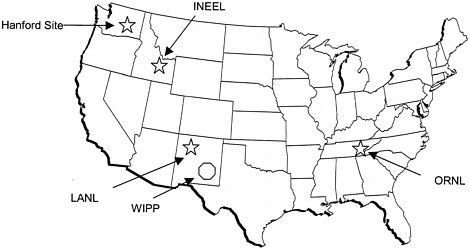
FIGURE 2.1 Geographic locations of the Waste Isolation Pilot Plant (WIPP) and the four major RH-TRU waste sites: Hanford Site, Idaho National Engineering and Environmental Laboratory (INEEL), Oak Ridge National Laboratory (ORNL), and Los Alamos National Laboratory (LANL). There are nine other smaller RH-TRU waste generator sites and several other sites throughout the nation that store CH-TRU waste. SOURCE: DOE (DOE-CBFO, 2001c).
TABLE 2.1 DOE’s Inventory of Stored, Projected, Total, and Planned Volumes of RH-TRU Waste
|
Site Name |
RH TRU Waste Volume (cubic meters) |
Estimated Range of Concentration of CPR5 (average kg per cubic meter) |
Reported Estimates of Dose Rates6 (rem per hour) |
|||
|
Stored1 |
Projected2 |
Total3 |
Planned Disposal4 |
|||
|
Hanford Site |
207 |
944 |
1,151 |
1,048 |
0–477 (24) |
0.2–1,000 |
|
Idaho National Engineering and Environmental Laboratory |
84 |
52 |
136 |
279 |
0–439(41) |
0.2–100 |
|
Los Alamos National Laboratory |
98 |
24 |
122 |
122 |
0–980 (95) |
1–100 |
|
Oak Ridge National Laboratory |
1,308 |
534 |
1,841 |
453 |
0–902 (74) |
0.2–1,000 |
|
Total |
1,697 |
1,554 |
3,250 |
1,902 |
|
|
|
Small-Quantity Sites |
||||||
|
Argonne National Laboratory-East8 |
2 |
8 |
10 |
10 |
NA |
0.2–10 |
|
Argonne National Laboratory-West |
1.1 |
5 |
6.1 |
|
0–1,350(110) |
1–100 |
|
Battelle Columbus Laboratories8 |
0 |
20.8 |
20.8 |
20.8 |
0–1,430(117) |
0.2–150 |
|
Bettis Atomic Power Laboratory |
2 |
0 |
2 |
2 |
0–1,430(117) |
1–100 |
|
Energy Technology Engineering Center8 |
8 |
0 |
8.7 |
5.5 |
0–74 (5.2) |
0.2–1 |
|
General Electric-Vallecitos Nuclear Center |
11.8 |
0 |
11.8 |
11.8 |
NA |
1–100 |
|
Knolls Atomic Power Laboratory |
3.1 |
6.8 |
9.9 |
10.5 |
NA |
1–100 |
|
Sandia National Laboratories8 |
1.5 |
22 |
23.5 |
|
NA |
NA |
|
West Valley Demonstration Project9 |
470.5 |
8.4 |
478.9 |
|
NA |
NA |
|
Total Waste Volumes |
2,197.7 |
1,625 |
3,821.7 |
1,962.6 |
|
|
|
NOTE: The committee did not verify the information in this table. 1Stored=waste awaiting treatment or disposal capability, in such a manner as to constitute disposal of the waste. 2Projected=the part of the inventory that has not been generated but is currently estimated to be generated at some time in the future. 3Total=sum of the stored plus projected volumes. 4Planned Disposal=volume expected to be disposed at WIPP. The quantities reflect any volumetric change that would occur during waste processing. 5Dose Rate Ranges=the dose rates estimated for as-packaged containers. Dose rates are measured at the container’s surface. 6CPR=cellulosics, plastics, and rubber. A zero in the average CPR concentration indicates a container including other materials, such as metals or sludge. 7It is estimated that about 896 cubic meters of waste will be shipped from Idaho Nuclear Technology and Engineering Center for disposal at WIPP. This waste is expected to be categorized as “Waste Incidental to Reprocessing” and has not yet been approved for disposal at WIPP. Therefore, it is not included in the table. 8Current plans are to send the RH-TRU waste at this site to an interim site. Los Alamos National Laboratory’s inventory includes Sandia’s RH-TRU waste disposal volume. Argonne National Laboratory-East, Battelle Columbus Laboratories, and Energy Technology and Engineering Center are also expected to go to interim sites, but the specific interim sites have not yet been determined. Therefore, the waste volume is included here for completeness. 9The West Valley Demonstration Project is not a DOE site, even though it stores some RH-TRU waste. This waste has not yet been determined to be a defenserelated waste. It is believed to be commercially derived and therefore not disposable at WIPP in accordance with the Land Withdrawal Act. However, for completeness, this waste is included in the RH-TRU waste inventory. SOURCE: Document 1, Supplemental Information, Attachment 3, Table 1 (DOE-CBFO, 2002a; page 5). |
||||||
TABLE 2.2 DOE’s Summary Activity Estimates for the RH-TRU Waste Inventory
A fine fuel participate adhered to the tools required for these operations and contaminated them with TRU elements. These tools (e.g., grinding and cutting wheels, glassware, light bulbs, rags) have been sent to the Idaho National Engineering and Environmental Laboratory. A formal determination of the defense origin for this waste stream will be submitted for approval to DOE prior to disposal at WIPP (Bhatt, 2001). The fuel pin segments, integral fuel pins, and the fuel dust are still stored at Argonne National Laboratory-East, as high level waste or spent nuclear fuel.
Most of the RH-TRU waste stored at Los Alamos National Laboratory was characterized and packaged between 1989 and 1994. The waste was characterized using a similar approach to that approved for CH-TRU waste characterization. Visual examination, non-destructive assay methods, radiography, and radiochemical analyses were used. Characterization operations were performed in a hot cell, except for small quantities of waste analyzed in a laboratory for radiochemical composition.
Among the nine smaller generator sites, the Battelle Columbus Laboratories in Ohio is the only site that is actively characterizing RH-TRU waste. This site is the first originally scheduled to ship RH-TRU waste to WIPP (January 2003). The agreement between Battelle Columbus Laboratories and the state of Ohio requires RH-TRU waste removal from the site by 2002 to meet a 2006 decontamination and decommissioning-completion milestone (Biedscheid et al., 2002).
Battelle Columbus Laboratories began RH-TRU waste characterization activities in October 2001 following a characterization program similar to that used for CH-TRU waste. This characterization program relies on visual examination, performed during
waste repackaging, and previous knowledge of the waste, also called “acceptable knowledge” (AK). Acceptable knowledge is discussed in Sidebar 2.1. The repackaging phase, which occurs in a shielded facility, is necessary because RH-TRU waste containers at this site do not meet transportation requirements. Visual examination is used to estimate physical waste parameters, including weight percentages of metals, cellulosics, plastics, and rubber in the waste, and to determine the absence of prohibited items, including free liquids (see Chapter 3). Acceptable knowledge combined with computer modeling is used to estimate radiological waste parameters, including total activity on a waste container basis (see Appendix G). Acceptable knowledge combined with radiochemical analysis is also used on a fraction of RH-TRU waste for confirmation purposes. For a detailed description of the Battelle Columbus Laboratories’ characterization program see Biedscheid et al. (2002).
This site is now seeking interim storage for its RH-TRU waste at the Hanford Site until shipments to WIPP are authorized. Work on a memorandum of agreement among DOE offices in Ohio, Carlsbad, and Richland is in progress (DOE-BCL, 2002) as part of the Hanford Site cleanup acceleration program. One element of this program is a proposal to transform the Hanford Site into a TRU waste-processing center for small generator sites, including Battelle Columbus Laboratories.
2.3.1 Remote-Handled Transuranic Waste Volume Inventory
Table 2.1 shows that the projected total volume inventory of RH-TRU waste in WIPP is 3,821 cubic meters, of which 2,197 cubic meters are currently stored at DOE sites and 1,625 cubic meters are yet to be generated (see the column “Projected”). For reference, the total volume of RH-TRU waste would correspond to approximately 20,000 RH-TRU waste containers (assuming they are all 55-gallon drums). Further volume-reducing8 operations (mainly at Oak Ridge National Laboratory) may decrease the waste volume to be emplaced in WIPP to 1,963 cubic meters, as shown in the “Planned Disposal” column. According to these data, RH-TRU waste volume inventory represents between 1 and 2 percent of the total TRU (CH-TRU plus RH-TRU) volume allowed in the WIPP facility (175,564 cubic meters). The volume of RH-TRU waste to be emplaced in WIPP is also well below the regulatory limit of 7,080 cubic meters set by the Land Withdrawal Act.
There have been substantial variations in the estimated volumes of RH-TRU waste in DOE weapons complex, as also observed by the New Mexico Environmental Evaluation Group (EEG, 1994). These variations arise mostly from changes in the RH-TRU waste management or treatment plans. For example, DOE’s earlier data for the Savannah River Site, in South Carolina, originally indicated a large RH-TRU waste inventory, reflecting disposal of materials stored in the separations canyons as TRU waste. However, the Savannah River Site now plans to send this material to the high-level waste tanks and process it (i.e., transform it into a glass waste form) with other high-level wastes for eventual disposal in a federal high-level waste repository. DOE also indicated that other potential sources of RH-TRU waste at the Idaho National Engineering and Environmental Laboratory are currently being reviewed (DOE-CBFO, 2002b; Supplement 1; page 2). Other potential changes in the RH-TRU waste inventory are noted in Table 2.1. The uncertainties in the estimated volumes can also be significant for the sites that have yet to generate their RH-TRU waste, such as Hanford.
|
8 |
Packaging of Idaho National Engineering and Environmental Laboratory RH-TRU waste will actually increase its total volume, as indicated in Table 2.1. |
|
SIDEBAR 2.1 Acceptable Knowledge The Environmental Protection Agency’s (EPA’s) interpretation of acceptable knowledge (AK) is associated with historical information about the waste. The following is an excerpt of the guidance manual for waste analysis at facilities that generate, treat, store, and dispose of hazardous wastes (EPA, 1994): “Wherever feasible, the preferred method to meet the waste analysis requirements is to conduct sampling and laboratory analysis because it is more accurate and defensible than other options. […] However, generators and TSDFs [treatment, storage, or disposal facilities] also can meet waste analysis requirements by applying AK. Acceptable knowledge can be used to meet all or part of the waste analysis requirements. Acceptable knowledge can be broadly defined to include:
Generators and treatment, storage, or disposal facilities may use AK alone or in conjunction with sampling and laboratory analysis. […] However, there are situations where it may be appropriate to apply AK, including:
For remote-handled waste characterization, the Department of Energy adopts a broader definition of AK, based on historical and new information, as explained in Chapter 4. |
2.3.2 Remote-Handled Transuranic Waste Radioactivity Inventory
Table 2.2 (see above) shows that the activity of RH-TRU waste currently in storage is approximately 660,000 curies. DOE calculated the total activity of the RH-TRU (stored plus projected) waste inventory to be approximately 1 million curies (DOE-CAO, 1996a; Appendix BIR). According to this estimate, the amount of RH-TRU curies to be emplaced in WIPP is about 20 percent of the total amount of curies from RH-TRU waste allowed by the Land Withdrawal Act (5.1 million curies). For comparison, the total activity to be emplaced in WIPP from CH- and RH-TRU waste is estimated to be 7.4 million curies, of which 6.4 million come from CH-TRU waste (DOE-CAO, 1996c; Appendix BIR).
Table 2.3 shows a comparison between the principal TRU and non-TRU radionuclides in CH and RH-TRU waste to be emplaced in WIPP. In 1995, the total activity of RH-TRU waste represented approximately 14 percent of the total activity of the TRU inventory (from CH-TRU and RH-TRU waste). However, the activity due to TRU radionuclides in RH-TRU waste corresponds only to 0.5 percent of the total TRU activity expected in WIPP. Table 2.3 also shows a comparison of the isotopic characteristics of CH- and RH-TRU waste expected inventories in WIPP. The total curie inventory in RH-TRU waste represents roughly 16 percent of the total curie inventory in CH-TRU waste but the number of TRU curies in the latter is two orders of magnitude higher than in RH-TRU waste. Only TRU radionuclides (i.e., radionuclides with a half-life greater than 20 years) have an impact on the long-term9 performance of WIPP since non-TRU radio
TABLE 2.3 Principal TRU and Non-TRU Radionuclides in WIPP Disposal Inventory
|
9 |
Long-term refers to the 10,000 years of regulatory compliance with radionuclide release limits established by the EPA in Title 40 Code of Federal Regulations Part 191 (see Chapter 3). |
nuclides will decay away in approximately 300 years.10
Therefore, RH-TRU waste has a negligible impact on the long-term performance of WIPP compared to CH-TRU waste because of the small volume to be emplaced in WIPP. However, RH-TRU waste presents a significant short-term potential for radiation exposure to workers during the waste characterization, handling, and emplacement period because of the short-lived gamma-emitting radionuclides.
2.4 Packaging Status of Remote-Handled Transuranic Waste
A different way of sorting the RH-TRU waste inventory (other than the four categories in Table 2.1) is to consider its packaging status. As previously mentioned, before TRU waste is shipped to WIPP, it must be packaged in a suitable form for transport and underground emplacement.
In the March 2002 draft of DOE’s characterization plan, the RH-TRU waste inventory is divided into four categories:
-
“Packaged - Waste is packaged in a final form suitable for transport to and disposal at WIPP (i.e., the waste is either canisterized [Los Alamos National Laboratory RH-TRU waste] or in a package that may be transported for canisterization at another facility without repackaging).
-
To Be Generated - Future waste generation, includes projected generation due to new activities and planned environmental restoration activities (i.e., retrieval from burial grounds, such as the 618 area at Hanford).
-
To Be Repackaged - Waste is currently packaged in some form, but is not suitable for transport and disposal as packaged, possibly due to package size, package condition, or knowledge of contents. It will be repackaged into containers suitable for transport and disposal at WIPP. If a decision has already been made to package the waste for disposal at WIPP [i.e., the Oak Ridge National Laboratory RH-TRU waste debris], then this waste volume has been included in the To Be Packaged estimates.
-
To Be Packaged - Waste is either not yet packaged (i.e., tank sludges) or the decision has been made to package the current form differently [i.e., RH-TRU waste debris waste at Oak Ridge National Laboratory]” (DOE-CBFO, 2002b; Supplement 1; page 2).
The current RH-TRU inventory of stored and projected waste is distributed among these four categories as shown in Figure 2.2. For comparison with Table 2.1, “Projected Waste” corresponds to the “To Be Generated” column. All other packaging situations correspond to the “Stored” column. The four packaging categories add up to the total number of cubic meters in Table 2.1. In its characterization plan, DOE also indicated that the inclusion of the Idaho Nuclear Technology and Engineering Center waste will further increase the “To Be Packaged” component by increasing the amount of waste in this category by approximately 900 cubic meters.
The committee’s interim report discussed the RH-TRU waste inventory using DOE’s initial distinction between “Retrievably Stored Waste” and “Newly Generated Waste”
|
10 |
Short-lived radionuclides in RH-TRU waste are included in the calculation of the regulatory release limits. The scenario that would mostly affect release limits from RH-TRU waste is a drilling intrusion in WIPP occurring less than 300 years after closure. This scenario is taken into account in the performance assessment calculation (see Chapter 3, Section 3.2.1). |
The committee’s interim report discussed the RH-TRU waste inventory using DOE’s initial distinction between “Retrievably Stored Waste” and “Newly Generated Waste” (NRC, 2001 b). Retrievably stored waste is any waste produced after 197011 but prior to implementation of an approved RH-TRU waste characterization plan (as of July 2002, no plan has been approved by EPA and NMED). Newly generated waste is waste produced after the development, approval, and implementation of a waste characterization plan and meets the requirements set forth by the regulatory agencies. In this report the committee adopts DOE’s new classification system, as shown in Figure 2.2.
Earlier inventory information recorded that 80 percent of the waste was to be repackaged or generated, as cited in the committee’s interim report (NRC, 2001 b). Updated information in the March 2002 draft indicated that 98 percent of the waste is to be generated or packaged (see Figure 2.2). However, in several other instances, Documents 1 and 2 report that the fraction of waste to be generated, packaged, or repackaged is 95 percent. In this report, the committee uses a conservative estimate of 95 (rather than 98) percent of waste to be packaged (for the first time or repackaged).
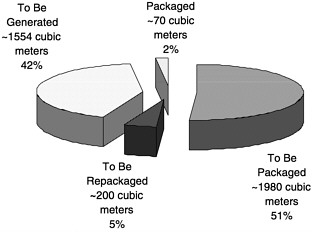
FIGURE 2.2 Packaging status of the RH-TRU inventory. SOURCE: DOE (DOE-CBFO, 2002a).
The RH-TRU packaged waste consists of waste from three sites: Hanford, Los Alamos National Laboratory, and Battelle Columbus Laboratories. Waste at Hanford and Battelle is stored in 55-gallon drums. At Los Alamos, waste is stored in 17 canisters, of which 16 were generated during program activities and 1 from hot cell cleanup after the work was completed. Though these canisters are packaged, they are not ready for shipment to WIPP because they have not been characterized in accordance with the current characterization requirements in the EPA Certification and RCRA Permit.12 Nevertheless, thorough records of process knowledge, visual examination, and prohibited items determination (see Chapter 3, Section 3.3) were kept during the packaging of the 17 canisters stored at Los Alamos.


