
3
Major Areas of Opportunity
INFORMATION TECHNOLOGY
Introduction
The dramatic improvements in information technology over the last 50 years have led to a revolutionary change in the conduct of warfare. Information superiority is identified by the Air Force as a Core Competency, critical to modern warfare. The Critical Future Capability statement demands that “continuous, tailored information be provided within minutes of tasking with sufficient accuracy to engage any target in any battle space worldwide.”1 Information superiority is a critical component of other Core Competencies, including Aerospace Superiority, Global Attack, and Precision Engagement. Each of these is critically dependent on accurate and timely information.
Several pieces must come together to satisfy the Air Force’s requirements. Sensors, discussed in the next section, provide the raw data. Electronic signal processing is applied to the sensor outputs to interface with the larger-scale information processing and communication systems. Communication at many levels is necessary to gather the information. Information processing, including fusion of data from multiple sensors, distills the sensor data into the information necessary for decision making. At each step there are requirements for data storage and display as well as for computation. Ultimately this must be a robust, redundant system tolerant of the failure of individual segments and self-reconfigurable to adjust to changing conditions and demands.
Research and development (R&D) investments by the Air Force in these areas must be considered in context with other worldwide efforts, especially
those of industry. Because the DoD is today a relatively small customer for information technology, industrial R&D programs are considerably larger than those affordable by the Air Force. Clearly, the commercial sector provides immense incentive for going after scientific and technological advances in this field. However, some technologies that are unique to the military or that are not yet commercially viable require military investment:
. . . For example, many sensor applications are unique to government requirements and hence are funded solely by the government. Similarly, there are additional technologies that are essential for government missions but which may have or develop commercial application as well; however, the cost of their development is usually so high that industry cannot make a business case for maturing them commercially. Examples include the Global Positioning System, or development of new propulsion concepts.2
Assessing the appropriate R&D investment by the Air Force in light of the ongoing revolution in information technology in the commercial sector is challenging. In this section the committee examines some of the specific sectors of information technology (IT) to draw distinctions for the Air Force.
This section starts with computing devices. Transistors, switches, and integrated circuits are covered; a separate section on space electronics is included because of the unique environmental requirements of space and its importance to the Air Force. Also covered are storage and display technologies. Computing architectures explores alternative paradigms for computing. Under communications, a number of areas are explored: optical materials and devices, radio frequency (RF) materials and devices; and RF and optical MEMS. Finally, information and signal processing and data fusion requirements are discussed.
Computing Capabilities—Devices
Scaled Complementary Metal Oxide Semiconductors
Advances in information technology are a result of the ever-shrinking transistor, applied to almost every aspect of gathering and treating information. Continuing increases in information technology capabilities are dependent on continuing advances in the fabrication of ever more powerful computational hardware. Moore’s law, the exponential increase in integrated circuit functionality, continues today. Although there are potential limitations on the horizon, the semiconductor industry roadmap, ITRS,3 which is based on the scaling from larger devices that has served us so well for the last 40 years, foresees a continuation of the current rate of Moore’s law to the present roadmap horizon of 2016, corresponding to a 32-fold improvement in device density. Barriers to reaching and surpassing this density include the following, among others: lithography, gate oxide current leakage, interconnect requirements, and thermal issues. These challenges have spurred many research efforts, both to address the
issues within the context of traditional scaled-silicon systems and to find alternatives that circumvent the approaching barriers. Of great interest has been the field of nanotechnology, where multiple materials are innovatively positioned with nanometer precision.
The ITRS, discussed in Chapter 2, is industry’s best analysis of all factors (fabrication, interconnects, thermal management, cross talk, cost, packaging, etc.) that must be considered in order to continue the miniaturization progress. The ITRS identifies a number of “brick walls”—major technology issues for which there is no known solution—as well other important technological challenges for which promising approaches have been identified. Given the current state of knowledge of CMOS and of the alternatives as they are now understood, the best guess for the next 10-15 years is that silicon CMOS technology will continue to provide the fastest switching time at the lowest cost in the smallest gate with the most cost-effective system integration.
The continuing hegemony of CMOS devices and circuits is based on substantial improvements and the introduction of highly innovative ideas. At the 2001 International Electron Devices Meeting, Intel announced a transistor operating at 3.3 terahertz.4 At this same meeting, Advanced Micro Devices (AMD) announced that variations on CMOS transistors operate with 15-nm feature sizes. A November 26, 2001, announcement by Intel disclosed a “depleted substrate transistor” having a leakage current 100 times smaller than present transistors and, therefore, a 104 smaller gate leakage power.5 This innovation could contribute substantially to the alleviation of heat dissipation that currently looms as a major issue. Other conventional approaches promote the use of asynchronous design or self-timed circuits operating without a single, chipwide clock speed orchestrating the tempo of each transistor.6 CMOS and its many variations represent opportunities for vast improvements as nanoscale dimensions are reached.
Nonetheless, there are ultimate barriers to continued CMOS scaling, and new approaches for new devices and functions are being explored. Quantum interference effects, for example, may provide opportunities for new devices and functions. Some of the new approaches are based on alternative designs for transistors, while others represent entirely new ideas for logic operations. It is clear that the current architecture for digital computers is not unique, nor does it provide the greatest capability for some operations. The brain is able to process information for operations such as image recognition with far greater speed and efficacy than current computational approaches. Just how alternative architectures may operate, and which ones are likely to provide substantial improvement for certain operations, remains a frontier of current research.
There have been many attempts to think outside the box. Radically different approaches are being investigated that, in most cases, attack only one small element of what, ultimately, must be an integrated effort tying together many factors that must be satisfied simultaneously for such a system to be of practical use (in a manner similar to the ITRS). These new approaches, some of which
stem from frontier scientific discoveries, illuminate aspects of the difficult terrain ahead. Reviews of many of these approaches and observations on their performance are available.7,8,9
Enthusiasm for fabricating logic circuits from molecules is currently high. Tour-de-force feats with carbon nanotubes (see next section) and molecular-layer transistors have succeeded in actually fabricating transistors and even simple logic circuits. The progress made in 2001 was recognized as the breakthrough of the year by the magazine Science.10
With such significant progress, it may appear that technological developments are imminent. However, there appears to be no single approach with a clear path to competitive products. Integration of these individual elements into a highly dense fabric with functionality approaching today’s integrated circuits remains a formidable challenge, particularly in the face of our relatively rudimentary fabrication capabilities at the nanoscale (see Chapter 4). A number of approaches are being pursued with the goal of revealing additional scientific information that might improve prospects. These limitations have been discussed in articles by Meindl11,12,13 and Thompson, Packan and Bohr.14 The challenge presented by the appropriate design of interconnects has also been investigated extensively.15,16,17,18 In this context, it is important to acknowledge the extreme sophistication of the current integrated circuit paradigm and to recognize that the most likely early adoptions of these new technologies will be as adjuncts to, rather than replacements for, the manufacturing technology that currently dominates the marketplace.
A recent paper attempts to introduce some logic to the plethora of current research directions.19 Of great importance is the observation that the transistor, the basis for such tremendous gains in information technology, has features that are critically important to its success: (1) it offers high gain, which allows a single transistor to reset logic levels after each stage and to drive multiple following transistors (fan-out) and (2) it isolates the output of the device from the input. These features allow the signal for a bit, with inevitably irregular amplitudes and features, to be combined with signals for other bits, yielding reliable logical functions and the accumulation of a result that maintains its integrity in a noisy environment. Other devices, such as resonant tunneling diodes (RTDs), can be used to generate gain; but because they are two terminal diode devices, they lack the isolation required for robust accumulation of logic operations. The advantages of RTDs with respect to switching speed have been known for years, but no uses for these devices have been found for logical operations in computers.
The author of the above-mentioned paper, Keyes, concludes with the following paragraph:
The fact that transistors have had no competitor in digital electronics for 40 years does not imply that no alternatives should be sought and studied. However, a search for a new concept must include an awareness of what digital means:
a well-defined value for a digit and a way of maintaining and setting a signal to that value in a noisy environment, with mass-produced imprecise components. Alternatively it should be perfectly clear that digital representation is being abandoned if that is indeed the case, and that there is another way to cope with the inevitable uncertainty in the parameters of devices and the distortion of signals propagated in a large system.
With this caveat in mind, the committee surveyed the various technologies that are currently under investigation as possible successors to the silicon CMOS mantle.
Single-Electron Transistors
The operation of a single-electron device, discussed in detail in a recent review,20 is based on the fact that the charging energy to add an additional electron to a small island, generally through a tunneling barrier, becomes significant if the island is of nanoscale dimensions. Initial research was performed at low temperatures, where thermal fluctuations remain negligible for nanostructures in a readily achievable size range. However, fabrication of structures in the 1-nm range will allow stable room temperature operation.
Likharev points out two major unsolved challenges that face developers of single-electron transistor logic.21 First, there is the deleterious effect of random stray charges embedded in nearby insulators. These stray charges produce random, time-varying background charge levels, which impact device thresholds.22 Second, subnanometer structures will be needed at the heart of the single-electron device to allow room temperature operation. They will need to be very regular in size and shape to assure uniform device performance. If self-assembly fabrication methods (see Chapter 4) are used to generate perfectly regular nanostructures, they must necessarily be incorporated into a larger microstructure. The precise placement and interconnection of these subnanometer structures, including the placement of suitable tunneling barriers, present a formidable challenge to schemes for nanoassembly. Since these devices operate at the level of individual electrons, there is a fundamental issue with gain and fan-out (the ability to drive multiple following stages from a single device output) that poses a significant architectural problem for large systems.
Spin-Based Electronics
Following the development of the very successful giant magnetoresistive read heads for magnetic storage and magnetic field sensors, a new area of spin-based electronics is emerging.23 The concept is to use the spin of the electron in suitably designed devices to perform logic operations. One can imagine that information now stored as the presence or absence of charge could alternatively
be stored as spin-up or spin-down. This might be particularly attractive if the spin information can be communicated from one point in the circuit to another without moving the corresponding charges, which would eliminate the accompanying dissipation mechanisms. This research is in its initial phases, asking basic questions about the distances over which spin can be transported without depolarization, the characteristics of sources and detectors of electron polarization, the effects of interfaces between ferromagnets and semiconductors, and the feasibility of ferromagnetic semiconductors in such applications.
Domains in ferromagnets, which are formed by spins coupled together by the exchange interaction, are also being explored for use in computing. The propagation of the orientation direction of a magnetic domain through a series of nanoscale dots has been recently demonstrated.24 Further, using domain orientation to represent logic states, it has been possible to experimentally demonstrate the functionality of both a NOT gate and a shift register using continuous nanoscale magnetic “wires.”25
Molecular Electronics
In its present incarnation, the term “molecular electronics” was coined shortly after the discovery of conducting organic polymers in the late 1970s in recognition of the significant electrical conduction properties of many organic materials. A second driving factor was the clear recognition that the brain of a living species represented a logical device with the ability to recognize an image much more rapidly that digital computers. This was the proof of theorem for a “molecular computer,” and the vision grew. Today molecular electronics has come to mean the use of molecules in electronic devices.
Initial visions of molecular electronics focused on how the arrangement of chemical bonds in these molecules might function as circuits and switches. A significant number of researchers are exploring this area, although even after two decades it has not been possible to experimentally verify many of the initial hypotheses. Some direct measurements of electrical conductivity across single molecules have verified the magnitude of the electrical conduction found in single-molecule layers and illuminated possible mechanisms for conductivity in bulk molecular materials. Many of the experimental observations involving molecular conductivity behavior are puzzling and have not been explained fully.
As the behavior of molecular units becomes better understood, it must be emphasized that a wide range of issues faces their practical application. The many considerations and challenges in the ITRS indicate the complexity of designing, fabricating, testing, and packaging chips with 0.13-micrometer feature sizes today. All of these issues are likely to be considerably more complex as dimensions are further reduced. This suggests that the first uses of molecular electronics are likely to be as adjuncts to, rather than replacements for, the integrated circuit.
As activity in molecular electronics expanded, it was recognized that molecular materials might provide significant advantages for many other electronics applications. Organic thin-film transistors (the bulk organic material) demonstrate significant gain with reasonable characteristics for some electronic devices.26,27 The mobility of charge carriers in these materials is about three orders of magnitude lower than for commonly used semiconductors. This is fundamentally due to the hopping mechanism for conduction in disordered materials (as compared with band conduction in crystalline materials, which relegates such devices to speeds much slower than those currently achieved with today’s CMOS devices). But organic transistors fabricated by a variety of methods offer advantages such as low temperature, low-cost formation of large-area arrays, with particular potential for applications involving flexible structures (e.g., products such as credit cards and displays).28 Ink jet printers have been used to achieve transistor gate lengths of 5 micrometers and also to fabricate arrays of organic light-emitting diodes.29 Ink jet techniques have been also extended to such unconventional areas as deposition of suspended alloys and metallic or magnetic nanoparticles offering advantages for electronic applications.30 Organic transistors are envisioned for use as switching devices for active matrix flat panel displays (liquid crystal, organic light-emitting diodes, and “electronic paper”).31 In addition, organic and semiconductor white-light-emitting structures are anticipated to come into use in the future and to have a significant impact on energy use. All-polymer integrated circuits for use as radio frequency identification tags and for various sensors have been proposed. A variety of materials and methods are under examination with the purpose of developing low-cost, continuous-feed or reel-to-reel production methods for these low-end applications.
Carbon Nanotube Electronics
Carbon nanotubes (CNTs) are a unique material (see Box 3-1) with remarkable electronic, mechanical, and chemical properties. CNT electrical behavior is different from that of ordinary conductors. Depending on the application, the difference in behavior might be an advantage, a disadvantage, or an opportunity. Electrical conduction within a perfect nanotube is ballistic, with low thermal dissipation, an advantage for computer chips if the tubes can be seamlessly interconnected. Perturbations such as electrical connections modify this behavior substantially. For slower signal speed for analog processing, nanotubes surrounding buckyball molecules acting as transmitters have been experimentally demonstrated. Individual multiwalled CNTs at room temperature exhibit quantized conductance at values of G = 2e2/h (= 12.9 kΩ–1), a remarkable observation. The current density for these experiments was 107 A/cm2, a value two orders of magnitude greater than current densities normally available for superconductors.
Field-effect molecular transistors32 have been demonstrated using a back gate with a carbon nanotube33 settled across two gold conductors. The challenge
|
BOX 3.1 The Ubiquitous Carbon Nanotube Discovered in 1991, tubular structures of carbon had been predicted since the discovery of soccer-ball-shaped 60-carbon molecules (buckminsterfullerenes, or “buckyballs”) in 1985 at Rice University. Each carbon atom in a nanotube is positioned in a lattice that wraps into a hollow pipe ranging from a few to tens of nanometers in diameter. Figure 3-1-1 shows various carbon nanotube structures, including multiwalled and metal-atom-filled nanotubes. Because of their unique self-assembled and atomically perfect structures, carbon nanotubes exhibit unusual electrical, mechanical, and chemical properties. These special properties, such as the ability to carry exceptionally high current densities in long molecularly perfect “wires” and unusually high mechanical strength at the limit of small ‘fiber’ diameters, have generated much interest in the potential applications of nanotubes. Displays Depending on their diameter and chirality, nanotubes exhibit either metallic (like copper) or semiconducting behavior. Metallic nanotubes can emit electrons from their extremely fine tips at quite low-voltages. The possibility of fabricating 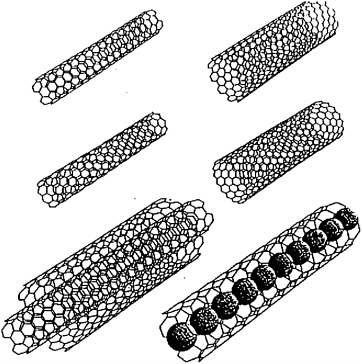
FIGURE 3-1-1 Carbon nanotube structures. |
|
nanotube arrays on surfaces for efficient current emitting elements is of great interest for low-power field emission displays, and a number of companies are racing to develop flat panel displays for next generation television and computer screens. Computing Further down the road, computer memory and logic concepts based on carbon nanotubes are being explored. Transistors made from carbon nanotubes a few nanometers in diameter—a hundred times smaller than the 130-nanometer transistor gates now found on computer chips—have been demonstrated.1 Also demonstrated are collections of nanotube transistors working together as simple logic gates, the fundamental computer component that transforms electrical signals into meaningful ones and zeros. If nanotubes or related nanowires could be used as tiny electronic switches or transistors, computer designers could, in principle, cram billions of devices onto a chip (the Pentium 4 has only 55 million transistors).2 The real challenge in this or any other alternative nanotechnology approach to fabricating computer chips is to design and connect up many millions or billions of such components in a highly manufacturable and reliable architecture. Mechanical Properties As a result of their seamless cylindrical structure, carbon nanotubes have low density, high stiffness, and high axial strength. Theoretical studies and recent experimental measurements suggest that the Young’s modulus and breaking strength of single-wall carbon nanotubes are exceptionally high.3 Carbon fibers with a tensile strength up to 6 GPa are commercially available, while initial experimental measurements on 4-mm-long single-wall carbon nanotube (SWNT) “ropes” consisting of tens to hundreds of individual SWNTs have yielded values up to 45 GPa.4 The hope is that millimeter-long SWNTs can be formed into longer fibers or dispersed into a composite matrix while still maintaining a significant fraction of this observed improvement over conventional carbon fibers. The major challenge is retaining the strength of nanofibers and assemblies of nanofibers in conjunction with a matrix material so these properties can be controlled, optimized, and made practical. Energy Storage Carbon nanotubes could be used to improve batteries. They can in principle store twice as much energy density as graphite, the form of carbon currently used as an electrode in many rechargeable lithium batteries. Conventional graphite electrodes can reversibly store one lithium ion for every six carbon atoms. Tiny straws of carbon tubes reversibly store one charged ion for every three carbon atoms, double the capacity of graphite.5 Carbon nanotubes are also being investigated for hydrogen storage. They may be capable of storing amounts comparable to or exceeding the U.S. Department of Energy target of 6.5 percent of their own weight in hydrogen, a level considered necessary to be practical for fuel cell electric vehicles.6 The carbon nanotube is a now-classic example of a well-defined nanostructure, and exploring ways to exploit its unique properties for possible nanotechnology-based applications remains a subject of intense interest. A general issue is the ability to reproducibly obtain large quantities of selective configurations of single-or multiple-wall nanotubes. Methods for synthesizing nanotubes, controlling orien- |
|
tation, and producing macroscopic quantities of these nanostructures are advancing but still are at an early stage of development. Integrating these materials into, for example, a composite matrix or an interconnected electrical structure, where their nanoscale properties translate into macroscale effects, remains a key challenge.
|
of demonstrating logic circuits was met recently with electrostatically doped CNTs. Doping of CNTs may be accomplished chemically;34 CMOS-type inverters have been demonstrated with both p- and n-type doping. This work experimentally demonstrated the performance of an inverter and a NOR circuit using transistor-resistor logic with an on-off ratio of 105 and high gain.35 It is clear that by arranging these CNT transistors appropriately, the functions AND, OR, NAND, and XOR can be realized. While these results represent a tremendous achievement, many questions remain.
Even if all goes well, most experts predict it will be at least a decade before nanotubes become a significant part of computers. Challenging the supremacy of silicon is an enormous technical and financial task that will take far more than some promising scientific advances. It will take equally impressive advances in manufacturing and computer design. “Nanotubes can be used as transistors, logic and memory; all that has been demonstrated now,” says Hongjie Dai, a chemist and nanotube researcher at Stanford University. “The question now is, how practical can these [nanotube] devices be?”36
Quantum Interference Devices
The term “quantum devices” refers to devices dominated by nonclassical effects arising from the discrete nature of matter at atomic dimensions and the resulting wave interference effects. The RTD is a device exhibiting negative differential resistance (NDR) owing to interference effects (or, equivalently, owing to resonant energy transfer across quantum levels). It is already well accepted as a device capable of enhancing the speed of field-effect transistor logic devices by factors of 2 to 5, allowing a significant increase in processing speed for digital signal processors (DSPs).37
Conductance through a medium having lateral dimensions smaller than an electron wavelength is quantized in units of 2e2/h, where e is the charge on the electron and h is Planck’s constant,38 as a consequence of the discrete energy levels along with the Fermi velocity and electron density of states at the Fermi level. Geometric imperfections and impurities in the conduction medium give rise to many kinds of variations in the conduction behavior of nanostructures.
Interference effects have been the subject of extensive research (see, for example, Agranovich).39 The Aharonov-Bohm effect occurs when charge carriers are passed through a ring, where two separate paths of almost equal length are possible for these carriers. As they meet at the other side of the ring, if the distance traversed is less than the coherence length, interference effects appear as a function of magnetic field. This magnetoresistive behavior is fairly straightforward for regular geometric features. In more irregular shapes, however, the prediction becomes increasingly difficult owing to the complexity of the wave equation solutions in the presence of more complex boundary conditions. Magnetoresistive measurements of most objects with dimensions smaller than a coherence length demonstrate these “conductance fluctuations,” which have been examined extensively. This serves to alert investigators to the sensitivity such nanostructured devices are likely to have to the presence of geometric irregularities. These wave effects form the basis of quantum computing approaches (see section on computing architectures) that might vastly increase the ability to solve certain important classes of problems, such as prime number factorization.
Solid Electrochemical Switching
A new method of switching using a nanoscale device was recently described.40 A tip made of a solid electrolyte, silver sulfide, is positioned a few nanometers above a flat platinum surface. When a bias voltage as low as 10 mV is applied across the gap, atoms come out of solution and extend the tip toward the surface, eventually making contact. Quantized conductance is observed with conductance values of n(2e2/h), where n = 0 through 5, depending on the voltage applied. It is expected that this reversible process can be controlled with switching rates of 100 megahertz and on-off impedance ratios of 1:1,000 in air at room temperature. Simple logic gates have been constructed, which may have applications in information storage.
Vacuum Microelectronics: Back to the Future
Before transistors, vacuum tubes provided gain for electronic circuits. Today, vacuum tubes are still used as high-power radio frequency generators and amplifiers and as display devices (most televisions and computer monitors are still based on cathode ray tubes). Vacuum tubes utilize the free-space transmission of electrons from cathode to anode and are inherently radiation-hard and
capable of handling kilowatts to megawatts of power. Figure 3.1 shows historical power and frequency limits for various vacuum RF generators.41 With the exception of the free-electron laser (FEL), these devices rely on space-charge waves. As frequencies increase beyond 300 gigahertz and free-space wavelengths drop below 1 mm, characteristic lengths for modulation elements will drop below hundreds of micrometers. Micromachining of some type will be required. Novel high-power millimeter and submillimeter wave sources may be possible through batch fabrication of parallel oscillators or amplifiers with appropriate phase-locking techniques.
In traditional vacuum electronic devices, free electrons are extracted from thermionic cathodes by applying an electric field. These cathodes must operate at temperatures in excess of 700°C, thus requiring a heat source and a thermally isolated mounting. Vacuum tubes and their cathodes have limited lifetimes; vacuum tube-based computers in the 1950s were limited in their complexity by the failure rate of individual tubes.
Micro- and nanotechnology offer more robust cathodes, based on field emission, that can operate at room temperature and below. This enables new vacuum electron devices such as flat cathode ray tubes, smaller and more robust x-ray tubes for inspection and sterilization, and vacuum microelectronic integrated circuits for extreme temperature and radiation environments. Vacuum microelectronic flat panel displays utilize tens to thousands of active emitters per pixel,
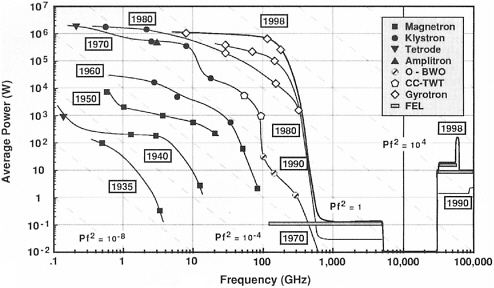
FIGURE 3-1 Power versus frequency for high-frequency microwave devices. SOURCE: Granatstein, V.L., R. Parker, and C.M. Armstrong. 1999. Vacuum electronics at the dawn of the twenty-first century. Proceedings of the IEEE 87(5): 702–716. © 1999 IEEE.
operating in parallel, instead of the conventional one (monochrome displays) or three (color displays) electron sources that are used to irradiate all of the pixels in traditional cathode ray tubes. Each pixel has its own electron source, eliminating the need for electron beam steering and an associated beam “lever arm” (deflected flight path). The net result is a micrometer- to millimeter-long electron flight path (instead of tens of centimeters) and flat vacuum tubes. The shorter flight paths minimize space-charge effects in the electron beamlets, and the parallel irradiation of pixels reduces the required current per electron beam. Overall, this translates into electron beam energies significantly below a kilovolt, with corresponding increases in operational safety and power supply simplicity. More detail on the performance of these cathodes is presented in the section “Aerodynamics, Propulsion, and Power,” along with a discussion of their application to propulsion.
Space Electronics
The Air Force’s space mission has unique electronics requirements that are not a concern for the dominant terrestrial industry base. This means that the Air Force, along with other appropriate mission agencies, must sustain a long-term research program for adapting advances in electronics and computing to the space environment.
Man-made satellites orbit Earth at altitudes from 200 kilometers to more than 36,000 kilometers. The region from 200 kilometers to 1,500 kilometers altitude is called low Earth orbit (LEO), and in this regime Earth’s atmosphere is still present, but at exceedingly low densities. Earth’s atmosphere and magnetic field together protect terrestrial dwellers from the cosmic rays, high-energy protons, and high-energy electrons normally present in the space environment. High-energy particle radiation is many orders of magnitude greater on-orbit than on Earth’s surface. Commercial CMOS electronics are designed to operate in our low-radiation biosphere (roughly 0.3 rad/year, where a rad is the amount of particle radiation that deposits 100 ergs of energy per gram of target material), but they can usually tolerate total radiation doses as high as 10 kilorads.
Particle radiation damages electronic circuits; it creates single-event upsets (SEUs), latchups, and a gradual change in semiconductor current vs. voltage characteristics. The first effect causes erratic operation, the second effect can cause instant device destruction, and the last effect causes an inexorable increase in power consumption until the device ceases to function. SEUs are generated by a particle-induced transfer of charge to or from an active device. SEUs are minimized by increasing gate size and power requirements, by spot shielding of sensitive components, by using error detection and control (EDAC) circuitry or software, or by using silicon-on-insulator designs that decouple the substrate from the active regions.
Latchup occurs when an ionizing trail creates a high-conductivity path between a current source and a current sink, generating a temporary electric short. Latchups are minimized by adding guard bands to transistors and by using silicon-on-insulator designs. The latter approach is used in fabricating radiation-hardened electronics for space applications. If latchup occurs, it may be corrected by momentarily removing power to the affected circuit. Latchup conditions are detected by monitoring power consumption to individual chips, or by adding “watchdog” timers.
Table 3-1 gives approximate radiation hardness levels for different types of semiconductor devices that were available in 1990. The actual radiation tolerance varies widely from design to design and is also fabrication-process-dependent, so radiation testing should be performed on selected components. Transistor-transistor logic (TTL) and emitter-coupled logic (ECL) circuits are inherently more radiation hard than CMOS, but they require more power. Metal-oxide (n-type) silicon (NMOS), metal-oxide (p-type) silicon (PMOS), current-current logic (I2L), and silicon-on-insulator metal oxide semiconductor (MOS) circuits can be fully immune to latchup. CMOS circuitry fabricated onto silicon-on-insulator substrates has traditionally provided radiation-tolerant electronics for space applications. The use of thin silicon over an insulator reduces the volume for charge collection along an ionizing particle track, thus reducing the amount of charge introduced into individual gates. Thin-film silicon-on-insulator (TFSOI) technology is now being considered for commercial electronics because it can provide enhanced low-voltage operation, simplified circuit fabrication, and reduced circuit sizes relative to bulk silicon counterparts.42 TFSOI would be particularly
TABLE 3-1 Approximate Radiation Hardness Levels for Semiconductor Devices
|
Technology |
Total Dose (rads) (silicon) |
|
CMOS (soft) |
103-104 |
|
CMOS (hardened) |
5 × 10⁴-106 |
|
CMOS (silicon-on-sapphire: soft) |
103-104 |
|
CMOS (silicon-on-sapphire: hardened) |
>105 |
|
ECL |
107 |
|
I2L |
105-4 × 10⁶ |
|
Linear integrated circuits |
5 × 10³-107 |
|
MNOS |
103-105 |
|
MNOS (hardened) |
5 × 10⁵-106 |
|
NMOS |
7 × 10²-7 × 10³ |
|
PMOS |
4 × 10³-105 |
|
TTL/STTL |
>106 |
|
SOURCE: Adapted from Griffin, M.D., and J.R. French. 1991. Space Vehicle Design. Washington, D.C.: American Institute of Aeronautics and Astronautics. |
|
interesting for MEMS space applications because of its inherent radiation tolerance and its built-in etch stop for bulk silicon etching.
Can commercial electronics be used on-orbit with appropriate radiation shielding? Figure 3-2 shows the yearly total radiation dose in silicon electronics as a function of aluminum shield thickness for an 800-kilometer altitude Sun-synchronous orbit. Contributions due to trapped protons and electrons are shown; contributions due to solar protons and bremsstrahlung were not plotted for clarity. This graph was generated using data supplied by the on-line Space Environment Information System (SPENVIS).43 Figure 3-2 indicates that commercial CMOS devices should have at least several millimeters of shielding to survive a year in LEO orbit.
Figure 3-3 shows radiation dose rate dependence as a function of circular equatorial orbit altitude for aluminum shielding with thicknesses of 0.18 and 1.1 centimeters (densities of 0.5 g/cm2 and 3.0 g/cm2, respectively). Note the rapid rise in dose rate with altitude above about 2,000 kilometers and below 20,000 kilometers. The hard-to-shield proton belt peaks at ~4,000 kilometers, and the easier-to-shield electron belt peaks at ~20,000 kilometers. At geostationary Earth orbit (GEO; 35,786 kilometers altitude and 0 degrees inclination) with a maximum dose of 3,000 rads, 0.5 g/cm2 (0.22-centimeter silicon) and 3.0 g/cm2 (1.3-
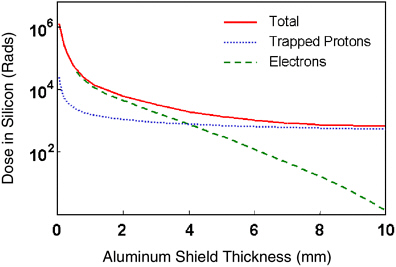
FIGURE 3-2 Yearly radiation dose in silicon. Adapted from data at European Space Agency, Space Environment Information System. Available online at <http://www.spenvis.oma.be/spenvis/> [April 24, 2002].
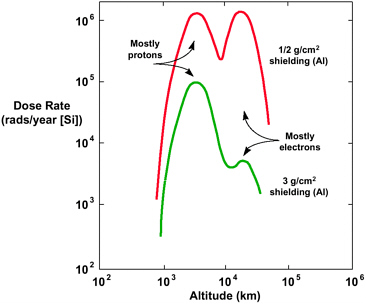
FIGURE 3-3 Radiation environment for circular equatorial orbits. SOURCE: Helvajian, H., and S.W. Janson. 1999. Microengineering space systems. Pp. 29–72 in Microengineering Aerospace Systems, H. Helvajian, ed. Reston, Va.: American Institute of Aeronautics and Astronautics, Inc. Figure reprinted with permission of the Aerospace Corporation.
centimeter silicon) shielding give lifetimes of roughly 11 days and 3 years, respectively. The significance of Figures 3-2 and 3-3 is that while CMOS circuitry can be used for low-altitude LEO missions, more radiation-resistant technologies may be necessary for other orbits.
Specialized radiation-hard devices are available, but they are expensive and are about two to three technology generations behind their commercial counterparts.44 Fortunately, commercial CMOS foundry processes, in general, have increasing total dose hardness as device feature sizes decrease. The increased hardness apparently results from decreased gate oxide thickness.45 One commercially available 0.25-micrometer process has an apparent total dose limit of greater than 100 kilorads without design changes and greater than 500 kilorads with the addition of guard bands, etc.46 Latchup and SEUs must still be dealt with, however.
Finally, another back-to-the-future approach may prove useful for radiation-hard electronics. Fifty years ago, magnetic core memory composed of small (about 1/30 inch in diameter) ferrite toroids was used to provide non-volatile memory.47 Information was stored as a magnetization state of the ferrite core, resulting in an inherently radiation-hard system that could also withstand high current transients. Variants of this technology were used to create simple logic circuits, which were integrated into B-52 bombers, Minuteman launch control
systems, and some satellites. Today, giant magnetoresistance is being exploited by IBM, Motorola, and others to develop low-power nonvolatile memory, called magnetic RAM or MRAM (see the subsection “Magnetic Storage” in the section after next) that has the potential to replace Flash memory in consumer applications. Unlike Flash memory, magnetic memory would have an unlimited number of read/write cycles. Radiation hardness is not the driver for these applications, so the on-chip driver circuits will probably be standard CMOS. For radiation hardness, silicon-on-sapphire CMOS could be integrated with magnetic memory elements. A radiation-hardened all-magnetic solution would require replacing well-established CMOS circuits with less mature magnetic logic circuits. Near- to midterm devices will probably consist of CMOS/magnetic hybrids, while long-term devices could be all-magnetic if the technology proves practical.
The future of space micro- and nanoelectronics lies with a combination of commercial and radiation-hardened CMOS for digital and analog circuits. Radiation-hard fabrication houses must continue to be supported for non-LEO missions unless TFSOI technology becomes a commercial process. Vacuum integrated circuits are one possibility for radiation hardness over an extremely wide operating temperature range; this would be ideal for ultrasmall or essentially two-dimensional spacecraft with minimal mass for radiation shielding or thermal inertia. Total dose hardness of commercial CMOS may continue to increase with time, but latchup and SEU prevention will necessitate the use of specialized gate designs and additional on-chip protection circuitry. Scalable CMOS libraries with these attributes must continue to be supported.
For the mid- to far-term with even higher device densities and lower power operation, SEUs may become MEUs (multiple-event upsets) as particle radiation tracks impact more than one gate at a time. The charge required to change a digital one to a zero will ultimately drop to one electron. Spacecraft radiation tolerance will result from a combination of device (gate) hardness, on-chip mitigation techniques (EDAC circuitry, watchdogs, and fault-tolerant architectures), and system-level fault control (voting processors, field reprogrammable gate arrays, adaptive networks, and intelligent power control). As systems become more complex, more attention to fault detection and correction will be required.
Computing Capabilities—Architectures
Computing today is dominated by a von Neumann architecture with a central processing unit (CPU) as the focal point. Massively parallel architectures are becoming available, but generally with a coordination between processing units that derives from this centralized architecture. Two themes are resulting in the exploration of changes in this paradigm. The first is the new functions that may be possible, or even required, as the array of new devices being explored and discussed above becomes reality. The limits of interconnections and communications between devices are being reached with current architectures, driving an
investigation of alternative schemes such as cellular automata. Quantum computing provides a tantalizing hint of orders-of-magnitude increases in computing power for some important operations such as factoring large numbers, but today it remains beyond reach and is the subject of intense worldwide investigation. The second theme is the evident superiority of the human brain over even the most advanced computers for some computational tasks such as image recognition. Biomimetic investigations have long sought to capture the processing of the brain, which involves analog functions and massive storage. In general it may be anticipated that alternative approaches to computing involving analog or other yet-to-be-invented methods may someday have an impact on computing.
Cellular Automata
The term “cellular automata” (CA) generally refers to a group or population of interacting cells in which each cell (automaton) behaves according to a well-defined rule set. Each cell has a limited number of well-defined states. The cells are dynamic, and the properties of each cell evolve with time in a manner dependent on the states of neighboring cells. Complex phenomena may be simulated with an appropriate set of criteria, much as fluid behavior “solves” the Navier-Stokes equation for interacting fluid “cells” or for population behavior by means of interactions among individual members of a group.
Quantum-dot cellular automata (QDCA) represent one such implementation of this basic idea. They consist of arrays of quantum dots in which the state of an array exists in various electronic configurations. The array evolves in time depending on the states of the interacting cells. A group at the University of Notre Dame has theoretically and experimentally investigated one such model extensively.48,49 A recent review provides an excellent overview of this and related work.50 The fundamental cell is a square array of four quantum dots (each dot at a corner of a square) and two electrons. The preferred locations of the two electrons are at opposite corners of the square. Since there are two ways to arrange these electrons, each having the same energy, this basic unit may represent a bit (one or zero) depending on the arrangement taken by the two electrons. By judicious placement of these cells, the behavior of wires and conventional logic gates may be mimicked. QDCA evolve with time in a continuous manner rather than in discrete time steps. Logical operations may be demonstrated; more complex behavior depends on the array geometry and size.
Input to a QDCA consists of initiating the state of several cells with neighboring charged wires. The circuit then relaxes with time to the lowest ground state. The output is read by measuring the polarities at output cells; this represents the solution to the problem (as defined by the geometry of the array). The behavior of these arrays has been simulated and demonstrated at the micrometer level with lithographically fabricated metallic islands, and logical operations have been demonstrated. Because of the large size of the dots, these arrays must be cooled to
about 0.1 K to operate.51 Smaller versions could operate at higher temperatures. Miniaturized versions of these arrays are envisioned to be suitably constructed molecules. One limit that appears for these systems is thermodynamic in nature. As the number of cells in the array increases to mimic more complex logical operations, the energy levels are necessarily closer together. If the energy level spacing approaches thermal energies (kT), the solution (the ground state) becomes mixed with higher energy states. By reducing the dimensions to about 2 nanometers, room-temperature operation appears feasible. This may be enabled by designing special-purpose molecules.52 Alternatively, introducing multiple layers gives a greater separation of energy levels and is another approach to extending this behavior to room temperature. For the molecular implementation, leads, clocking arrangements, etc. must be introduced—all major challenges.
The use of coulombically coupled quantum-dot cellular arrays for quantum computing (see following section) has been suggested.53 The various qubit operations may be stimulated by raising and lowering the interdot tunneling barriers with electric, magnetic, or optical fields. The nature of coherence for the overall system must be understood. A very significant issue is that the decoherence time for solid-state quantum media is significantly shorter than for isolated atomic or molecular systems.
An understanding of how to utilize QDCA effectively in solving a problem must be developed. QDCA are one approach to parallel device operations. In addition to providing a compact approach to complex logical operations, they may have widespread application in image processing and other highly parallelizable problems. Research is continuing to gain an understanding of the dynamic properties of these systems. It is clear that much needs to be learned before the feasibility of fabricating and implementing such devices, and their standing relative to competing architectures, can be understood.
Quantum Computing
Although quantum computation holds the promise of an exponential increase in computation speed and therefore application to important problems of greatly increased complexity, so far only a few specific algorithms that gain this advantage are known,54 and hardware systems that are scalable to a sufficient number of qubits (quantum bits) for useful application have yet to be demonstrated. The primary problem is that quantum wave functions are notoriously fragile and susceptible to disturbances that restrict the coherence time of the system. The initial state must be definable, the quantum states must be uniquely addressable during execution of the algorithm, and the final state of the system must be observable. Additional algorithms must be discovered and a useful quantum computation must be demonstrated before thought can be given to practical applications.
The basic quantum computer consists of a loosely coupled array of binary quantum states, each of which represents a single qubit. For such a linear system,
the ideal initial state consists of the ground state, which is then addressed by a series of unitary transformations in the form of energy pulses, addressing each qubit in a unique fashion in a sequence to execute the desired algorithm. This is followed by observation of the final state of the assembly to determine the “answer.” The system must be coherent throughout the entire process. Quantum computers are in some sense more like analog computers than digital computers. Existing algorithms take advantage of hidden resonances in the problem, exploiting them to obtain the exponential increase in performance.
There is great interest in developing quantum computation. Numerous approaches are currently being investigated: various schemes employing trapped ions, cavity quantum electrodynamics, nuclear magnetic resonance, neutral ions in an optical lattice, superconducting circuits, electrons floating on liquid helium, photon exchange interactions, and spintronics and quantum dots in solid-state systems. Although no solid state quantum computer implementation has yet been demonstrated, even for the simplest quantum gate execution, solid-state systems are thought to be most readily scalable to the required number of qubits, provided that the coherence time can be made sufficiently long. Quantum computer demonstrations based on magnetic resonance of J-coupled spin-½ nuclei within molecules in solution at room temperature have shown sufficiently long coherence times to be interesting. However, lack of an initial pure state at room temperature for these systems, because of the small nuclear Zeeman splitting, limits the scalability of this system. It has been proposed that similar systems employing electron spins isolated in solids at low temperature would have even longer coherence times while overcoming the pure initial state preparation issue. Although no demonstrations have been reported, this remains a promising approach to a useful and scalable quantum computer.
Artificial Brains with Natural Intelligence
Human brain function emerges from a complex network of more than a billion cooperating neurons whose activity is generated by nanoscale circuit elements. In other words, the brain is a massively parallel nanocomputer. For the first time, nanotechnology is revealing approaches to the design and construction of computational systems based more precisely upon the natural principles of biological nervous systems that include (1) enormous numbers of elementary nonlinear computational components, (2) extensive and interwoven networks of modifiable connectivity patterns, and (3) neurointeractive sensory and motor behavior.
A simple nanoelectronic component, the RTD, possesses the nonlinear characteristics that resemble the channel proteins responsible for much of the human neuron’s complex behavior. At this time, such a direct nano-neuro analogy is most severely hampered by the truly difficult problem of interconnecting enormous networks of these nanocomponents. But as a beginning, this permits a consideration of the much greater density that is possible using nanoelectronic
neurons than has so far been possible using microelectronic solutions, where equivalent chip architectures would need to be millions of times larger. Given their inherent nonlinearities, nanoelectronics may be better suited for such an artificial brain than for extension of today’s digital applications.
Decades of neuroscience research have revealed the complexity of our brain’s neuroarchitecture.55 Despite this complexity, fundamental principles of organization have been established that permit a comprehensive sketch of our brain’s functional neuroarchitecture. In addition, neuroscience has characterized many of the principles by which the network’s connections are constantly changing and self-organizing throughout a lifetime of experience.56 Indeed, the minute details of these trillions of connections cannot be specified uniquely, because they provide the basis whereby the unique qualities of each individual are structured by experience.
Until now, constrained by the limits of microtechnology, attempts to mimic human brain functions have dealt with the brain’s extreme complexity by using mathematical simplifications (i.e., neural networks) or by carefully analyzing intelligent behavior (i.e., artificial intelligence). By opening doors to the design and construction of realistic brain-scale architectures, nanotechnology is allowing us to rethink approaches to humanlike brain function without eliminating the very complexity that makes this function possible in the first place. The tools of nonlinear dynamical mechanics provide the most suitable framework for describing and managing this extreme complexity.57,58
Instead, higher functions of the brain are emergent properties of its neurointeractivity with the environment. Resorting to the notion of “emergence” always leaves an unsatisfying gap in any attempt to provide a complete explanation, but nature is full of examples, and classical descriptions of human nature have depended strongly on the concept of emergence (see Jean Piaget).59 Specific functionality is not installed into the design of the system or programmed by a supervising algorithm, just as children, born with the natural intelligence for language, learn to communicate only by interacting with communicators. Generalizing, higher functions of a naturally intelligent complex system emerge as a result of mentored development within nurturing environments.
From this perspective, function is entirely self-organized and can only be interpreted with respect to the interactive behavior of the organism within meaningful contexts. For instance, speech communication develops by first listening to one’s own speech sounds, learning to predict the sensory consequence of vocalization, and then extending those predictions to include the response of other speakers to one’s own speech. At the core of this process is an active testing behavior that acts first and learns to predict the sensory consequences of each action within the context that generated the action.60,61 Unfortunately, until we have a working model of such a natural intelligence, promises of humanlike intelligence remain speculative. But the potential flexibility and value of such an autonomous agent with a natural intelligence for communication, navigation, or exploration is worth the effort.
The possible applications of this new generation of humanlike machine intelligence are far-reaching, and it is difficult to imagine the ultimate impact. The obvious applications include (1) personal assistants and universal interpreters that communicate with natural language (e.g., speaking copilots interpreting complex situational data) and (2) autonomous human surrogates (e.g., unmanned vehicles that do not require telemetric control). In all such cases, an extended period of training would be necessary for the acquisition of such advanced humanlike abilities, but artificial brains might be copied, and since they are immortal, they might continue to improve. Also, optimization might employ evolutionary principles by copying the best into the rest and then reemploying the training to gain more improvements and so on.
Storage
The future of information storage is driven by the need for larger data volumes (and hence increased storage density), higher access speed, and lower cost. The eventual application of nanotechnology seems obvious because of the decreasing bit size of the stored information, the advantage of short interconnect distances, and the economy of parallel fabrication methods such as lithography being developed for computing hardware.
The quest for higher-capacity memories with faster access time will continue unabated for decades, as the capabilities of all operations associated with computers benefit. Cost, reliability, weight, and other characteristics continue to be important metrics. Besides the use of transistors in electronic circuits, material transformations such as melting or other phase change and magnetization are the most frequently used phenomena today. Current electronic memories (e.g., dynamic random-access memory (DRAM) and static random-access memory (SRAM)) use transistors. DRAM uses only one transistor and capacitor and requires refreshing many times a second to compensate for leakage, whereas SRAM uses more transistors (typically five) and does not require frequent refreshing. Both are fast, yet SRAM is considerably more expensive as a result of its larger size and number of components. Large amounts of data are stored on magnetic or optical disks, requiring moving parts that are subject to friction, wear, and the usual degradation associated with mechanical motion.
Magnetic Storage
Magnetic storage includes magnetic disks, tapes, and a new class of magnetic memory, random access nonvolatile memory (MRAM), with disks providing vast high-speed data storage, tapes providing archival storage of huge data sets, and MRAM providing a radiation-hardened, nonvolatile substitute for conventional electronic random access memory. Magnetic storage research and technology are related to nanotechnology in many ways. First, the increase in storage
density has correspondingly reduced the magnetic bit size into the nanometer range. Perhaps more importantly, however, many of the length scales for magnetic interactions are characteristically on the nanoscale. For iron, for example, a domain wall width is 40 nanometers; an iron ferromagnet becomes a superparamagnet for particles less than 8 nanometers in radius at room temperature. In an iron-chromium-iron multilayer structure, exchange coupling reverses the relative magnetization of successive magnetic layers each time the chromium spacer layer thickness increases by 0.14 nanometers. Indeed, spin transport phenomena that occur on the nanoscale are responsible for the commercial success of giant magnetoresistive (GMR) magnetic read heads and magnetic field sensors. Historically, the aerial density of magnetic storage has increased exponentially at a rate roughly twice as fast as Moore’s law for IC scaling. The aerial storage density, currently about 30 Gbit/in.2, is expected to improve by a factor of 10 or more in the next 5 years.62
Research and technology development on nanotechnology applied to increasing the density of information storage on magnetic disks should be of importance in applications dealing with enormous data sets, such as may be obtained with multispectral imaging. Such work could involve improvements in GMR head sensitivity, the development of patterned magnetic media, finding ways to avoid or minimize the effect of bit sizes approaching the superparamagnetic size limit, and understanding tribology at the disk-head interface for nanoscale fly heights.
Magnetic random-access memories (MRAM) have been developed that typically employ a permanently magnetized pad, an electrically switchable magnetic pad to store the information, and a nanoscale, nonmagnetic interlayer. The value of the bit is read out by applying a voltage across the three-layer structure to determine the resistance. The resistance depends on the relative orientation of the two magnetic layers and is due to either the GMR effect, if the interlayer is a metal, or the tunneling magnetoresistance (TMR), if the interlayer is an insulator. The combination of a nonvolatile storage medium—that is, the magnetically aligned pad—and the ability to fabricate the entire structure by modest extensions of conventional semiconductor fabrication methods has led to the development of MRAM chips of modest storage capacity. Further development should lead to greater storage capacity and speed. Such memory devices would be useful in satellites, for example, or wherever nonvolatility, i.e., zero standby power consumption, is important. The technology is now being commercialized.
Physical Storage
Imagine having the ability to place atoms where you want them, one at a time. Think of the enormous storage capacity you would have if you could read and write atoms at specific sites separated by atomic scale distances on atomically flat surfaces. Such speculation notwithstanding, recent developments in nanotechnology point to the use of nanostructures, as opposed to single atoms, to
store and read information. In one scheme, an atomic force microscope (AFM) is used to modify a surface as well as to sense the modification. Because each process would be relatively slow, a practical device would have to employ arrays of AFMs acting in parallel. One implementation of this idea, being pursued by IBM,63 uses 1,024 cantilevers to impress 30- to 40-nanometer indentations in a PMMA layer, which corresponds to a storage capacity of 400-500 Gbit/in.2
Molecular Memories
The smallest bit of matter that can retain a memory is an atom. Although it is possible to read and write information by placement of individual atoms, the time required to do so is prohibitively long. The possibility of using molecular bits of matter along with chemical transformations could be an attractive alternative. Electrical conductivity and optical density of a polymer or other material change significantly with chemical changes. Such changes may be induced photochemically, electrically, physically (pressure, temperature), or by other means of “switching,” and these means have been examined extensively. With the increased interest in nanotechnology, the scaling of these effects to nanometer dimensions is being explored. Access speed, serial or random access, reliability, and volatility are current issues. While the fundamental properties of these alternative memory systems are being investigated, progress continues with conventional DRAM and SRAM approaches as miniaturization advances.
Single-molecule conductivity exhibits fascinating negative differential resistance current–voltage characteristics.64 The origins of this behavior are not yet well understood. Negative differential resistance does form the basis for memory functions. Methods to access large numbers of single molecules (or even nanostructures), speed, retention times, etc. must be explored before molecular memory can become a viable hardware approach.
Another example of a molecular memory device is worth noting. A recent patent by researchers at Hewlett-Packard65 makes use of hysteresis in the current–voltage curve observed for certain molecular materials sandwiched between two crossed conducting wires. This structure can be made arbitrarily (within the dimensions of a molecule) small. With such phenomena, a memory can be readily envisioned whereby the conductivity between two wires in a crossbar architecture can store and retrieve a bit of information. The retention time of this behavior is sufficiently long (many seconds, or even minutes for some materials) that such a device could have advantages over nonvolatile memories involving magnetic storage. The exact nature of the hysteresis observed is not yet understood. The ease of manufacture and the competitive nature of such a device compared with magnetic memory crossbar structures and with conventional magnetic disks have yet to be determined.
Yet another process using molecular memory is holographic information storage, where data are stored in a volume that retains optical phase information
through a material transformation (typically an absorption changing the electronic state of a dye such as bacteriorhodopsin.66 Although the information density for holographic storage is often quoted in Gbit/cm2 for comparison with conventional storage, holography is inherently a volumetric technique with intrinsic units of Gbit/cm3. Holographic storage is inherently analog and requires extensive electronics to retrieve digital information. Intensive research efforts to develop holographic information storage have yet to produce a commercial result.
Communications
Communications are a critical aspect of information technology. The Air Force’s requirements are for very large aggregate bandwidths between large numbers of time-varying platforms with free-space optical, microwave, or RF connectivity. The overall system must be both dynamic and reconfigurable. Platforms will continuously move into and out of the system as a result of operations. The total amount of data will become staggering as large numbers of complex sensors (e.g., multispectral focal plane arrays) are fielded. Two consequences are immediately evident: (1) it will be necessary to provide a hierarchical structure to ensure that time- and command-critical messages are prioritized and (2) the sensors must be intelligent, with the capability of drawing inferences from raw data and transmitting condensed information and of switching to a more voluminous raw data stream as critical data fusion requirements demand. Discussion of these systems aspects is deferred to the next section, “Signal and Information Processing and Data Fusion.” Here, the hardware aspects of communications are discussed.
Secure Communications
An emerging benefit of some of the physics of nanotechnology is communications security and secrecy. The application of certain quantum principles allows communications to be made perfectly secure in the sense of not allowing a message to be listened to without detection. One can prepare the quantum states of individual photons, e.g., polarization, in such a way that the “no cloning theorem” prohibits their being read without detection yet allows a “quantum repeater” to relay the signal to a distant source. Since such a scheme can be jammed, it does not seem attractive for general secure communications. However, it may have considerable value in periodically distributing the keys needed to decode encrypted messages sent by more conventional means. Of particular interest to the Air Force would be the use of such a secure form of communication to send encryption keys to satellites. Research on sources of single photons on demand and single photon detectors might be valuable.
Hardware aspects of communication will be enhanced by miniaturization trends in general simply through the introduction of denser and faster digital electronics. Advances in miniaturization will directly affect hardware design for
military communication systems. Secure communications will take place through hardware and software designed for the purpose. Compressing the essential data in order to transmit with minimum bandwidth requires knowledge of the data being transmitted and is largely a software development.
Optical materials and devices are used in many communications operations. These include photonic switches and waveguides that may be fabricated with greater precision and smaller size using materials and processes emerging from research in nanotechnology, such as vertical cavity surface-emitting lasers (VCSELs), quantum dot lasers, and photonic bandgap materials.
New materials for both optical and RF applications are emerging from continuing investigations of semiconductors. Two examples are self-assembled quantum dots for laser systems and gallium nitride (GaN) and related materials for both optical (and ultraviolet) emission and high-power RF devices. These materials are discussed in Chapter 4.
Both optical and RF MEMS devices are of growing importance for communications and are discussed below.
Optical Devices
Micro- and nanotechnologies have already had significant impact on III-V, fiber, and nonlinear optoelectronic devices. For III-V devices, control of growth thickness using modern epitaxial growth techniques such as molecular beam epitaxy (MBE) and metal-organic chemical vapor deposition (MOCVD, also known as organometallic vapor-phase epitaxy, OMVPE) has progressed to the point that individual atomic layers (~0.5 nanometer thick) are routinely grown with differing material compositions. Figure 3-4 shows the evolution of the lowest threshold current for cw diode lasers.67 It gives some perspective on the impact of improved growth capabilities and the advantages of nanostructures for optical devices. The first diode lasers, demonstrated in 1962,68 were composed of homojunction materials (p-n junctions in a single material, GaAs). They were pulsed devices that were incapable of cw operation because of the power dissipation associated with inefficiencies inherent in this simple structure. The first cw lasers employed double heterostructures, where an index step was built in by varying material composition to confine the optical field to the junction region and dramatically lower the optical losses. The first data point on the double heterostructure curve is due to Alferov and was part of the work for which he was awarded the Nobel Prize in Physics in 2000. The scale, in the growth direction, of the double heterostructure waveguide is on the order of several hundred nanometers. The next major breakthrough was the addition of quantum wells to confine the carriers in the center of the optical mode and modify the electronic wave function and density of states as a consequence of the confinement. These quantum wells are on the scale of the de Broglie wavelength of the electrons and are typically tens of nanometers thick in the growth direction. The most recent curve
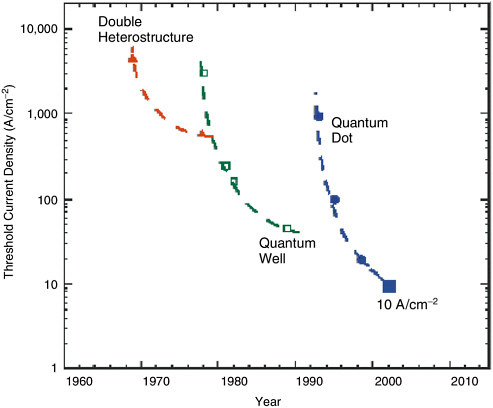
FIGURE 3-4 Diode laser thresholds. SOURCE: Adapted from Ledentsov, N.N., M. Grundmann, F. Heinrichsdorff, D. Bimberg, V.M. Ustinov, A.E. Zhukov, M.V. Maximov, Z.I. Alferov, and J.A. Lott. 2000. Quantum dot heterostructure lasers. IEEE Journal of Selected Topics in Quantum Electronics 6(3): 439–451. © 2000 IEEE.
corresponds to three-dimensional confinement of the electrons in quantum dots for which all three dimensions are on the nanometer scale. Quantum dots will be discussed in more detail below; for the nonce it is sufficient to appreciate that nanoscale confinement in three dimensions serves to further modify the electronic wavefunctions and density of states, now to an atomic-like discreteness, and to increase the local electronic density of states.
As is clear from this brief overview, micro- and nanotechnologies are already having dramatic effects on optoelectronics. Modern telecommunications is based on quantum-well lasers, optical fibers and waveguides, modulators, detectors, wavelength- and time-division multiplexers, etc.—all of which are based on structures that provide for careful control of electronic and optical wavefunctions, and all of which are on the nanometer scale.
Electronic Confinement. Quantum wells have been investigated since the early development of epitaxial growth capabilities. Nonetheless, new innovations con-
tinue to show that we have not yet fully exploited this capability. There is, for example, active research on mid-infrared diode lasers using both Sb-based III-Vs mixing type I (both electrons and holes confined) and type II (electrons confined, holes not) band alignments,69 and intraband quantum cascade configurations.70 These sources have direct application to Air Force countermeasure needs as well as (potentially) to free-space optical communications (free-space transmission distances are much longer in the 8-12 atmospheric window than in conventional 1.3- and 1.55-micrometer telecommunications bands) and to both commercial and military needs for remote sensing of gases.
Digital alloy growths composed of multiple layers of alternating material composition, typically ≲10 nanometer thick, provide another planar (growth direction) nanostructuring approach that is increasing in importance. Using digital alloys it is possible to create materials that mimic quaternary or even more complex III-V materials while only growing binary and ternary compounds where the growth control is much improved. It is even possible to synthesize material layers that are inaccessible to conventional multielement growth because of growth kinetic limitations such as miscibility gaps. These layers are certain to find applications in both optical and electronic devices.
As noted above, two-dimensional (quantum wire) and three-dimensional (quantum dot, or QD) confinement, requiring small dimensions in the growth plane as well as in the growth direction, are exciting areas of very active research. For the most part, the fabrication of these materials is based on self-assembly, specifically the Stransky Krastanov growth71 mode, where the interplay between lattice mismatch stress and surface tension of the growing film leads to the formation of isolated islands or quantum dots. Figure 3-5 shows an atomic-force microscope image of an array of InAs quantum dashes on InP with a photoluminescence peak at 1.6 mm, matching the long-haul telecommunications band.72 As in all electronic devices, the material demands are very exacting. In particular for quantum dots, the interface between the quantum dot material (often InAs) and the surrounding semiconductor (InGaAs or GaAs) has a strong impact on the optical and electronic properties. To date, attempts to use top-down lithographic patterning have resulted in defects leading to nonradiative recombination and an optically “dead” device. However, the advantages of a monodisperse QD size distribution along with a well-defined positional arrangement would be dramatic, and many different approaches are being pursued. Achievement of this goal would result in significant improvement in many optical devices, specifically, a dramatic reduction in the threshold current density and vastly narrowed spectrum. Spatially tuning the dot size would give a distribution of sources for wavelength division multiplex applications. Quantum dots are also being explored as qubits for quantum computing applications; they would require a coupled dot system with the ability to electronically tune the coupling. This is far from today’s reality, but not unreasonable to envision given the continuing advances in both lithography and crystal growth discussed elsewhere in this report. Quantum dot
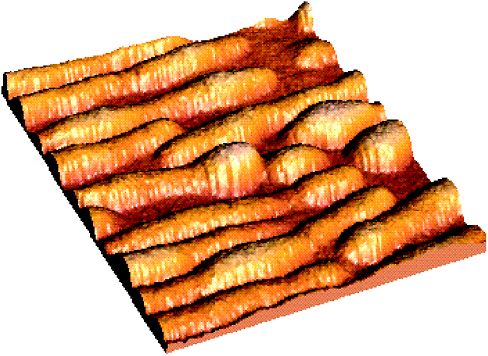
FIGURE 3-5 InAs quantum dashes grown on InP. SOURCE: Wang, R.H., A. Stintz, P.M. Varangis, T.C. Newell, H. Li, K.J. Malloy, and L.F. Lester. 2001. Room-temperature operation of InAs quantum-dash lasers on InP. IEEE Photonics Technology Letters 13(8): 767–769. © 2001 IEEE.
lasers have exhibited relatively high power; the inherently low linewidth enhancement factor, or alpha-parameter, suggests that they may be suitable for scaling to much higher powers than conventional diode lasers while still retaining coherence (e.g., improved brightness and power).
The science and technology of three-dimensional nanostructured semiconductors is just at its beginnings. Looking backwards, improvements in control of semiconductor materials always have led to improvements in electronic and optical devices and to new and improved systems applications of those improvements. There is every reason to expect that today’s developments will lead to tomorrow’s devices—with vastly improved characteristics that will enable new applications for both military and commercial markets.
Optical Confinement. The characteristic length for optical confinement is  where λ is the optical wavelength and Δε is the index difference between the guiding and cladding regions. For semiconductor/air interfaces, this reduces to ~λ/2n (n is the semiconductor refractive index) well into the nanometer regime for typical values (λ ~ 1 micrometer, n ~ 4). The history of optical
confinement structures parallels that of electronic confinement. The earliest structures were planar waveguides (one-dimensional) and channel waveguides (two-dimensional) where the second dimension was well in the micrometer regime owing to the use of low index contrast in the plane and accessible by conventional lithography. Optical fibers are a ubiquitous example of two-dimensional waveguides that have had a major impact on communications and sensing technologies.
One-dimensional Bragg gratings (layered structures where the reflection is built up by the in-phase addition of many small amplitude reflections) have long been used for frequency control of semiconductor lasers. Distributed feedback and distributed Bragg reflector lasers are two examples of the use of Bragg gratings.73 The discovery of photosensitive writing of Bragg gratings directly into telecommunications fibers has found many uses,74 especially with the rapid development of wavelength division multiplexing (WDM) technologies to increase the information-carrying capability of telecommunications fibers. Another use of Bragg reflectors arose with the development of vertical-cavity surface-emitting lasers (VCSELs).75 VCSELs have many advantages over conventional edge-emitting lasers and are rapidly becoming a dominant technology for data communications applications.
An emerging application related to Bragg gratings is periodic poling of materials (to date mainly LiNbNO3 and related ferroelectrics).76 The motivation in this case is the requirement for phase matching in nonlinear optical processes, the goal is a variation in the nonlinear optical properties (e.g., the ferroelectric polarization) rather than in the linear (index) response, and the scale of the structure is set by the coherence length between the various optical waves (typically this scale is larger than the wavelength and easier to fabricate with conventional methods). Periodically poled materials are now being investigated for systems applications such as optical mixers, analogous to the RF mixers that have found extensive application in communications.
Research is now moving to higher dimensionality structures known as photonic crystals as a result of the strong analogy between the behavior of photons in a periodic dielectric lattice and electrons in a periodic potential lattice.77 There are both fully three-dimensional versions of photonic lattices78 and two-dimensional versions where the in-plane confinement is provided by a two-dimensional dielectric array (often, holes in a semiconductor) and the out-of-plane confinement by a conventional dielectric discontinuity (waveguide slab). The two-dimensional variety is easier to fabricate, and so it is attracting much attention. As fabrication skills improve, there will be increasing interest in three-dimensional photonic crystals. By building nanocircuit elements (e.g., small tank circuits with both capacitive and inductive components), it has recently been predicted79 and demonstrated80 (with millimeter waves) that truly novel materials are possible— for example, materials that exhibit negative refraction, in which light focuses rather than diverges and for which diffractionless imaging is theoretically pos-
sible. With history as a guide, there is little doubt that the development of photonic crystal materials will have a major impact on optical applications.
Microelectromechanical Systems (MEMS)
MEMS are structures, devices, or systems having some parts on the scale of micrometers that are produced by any of several techniques collectively termed “micromachining.” They are generally called microsystems in Europe and, sometimes, micromechatronics in Japan. In broad terms, there are four classes of MEMS. The first involves micromachined structures that have no moving parts. Included here are channels and nozzles for fluids and guides for optical and RF signals. The second class of MEMS is sensors that transduce some aspect of the world into electronic data. Many MEMS sensors have been commercialized, notably pressure sensors, microphones, accelerometers, and angular rate sensors. The third class of MEMS includes mostly actuators, essentially the inverse of sensors, because they transduce information into some physical, chemical, or biological effect. They are now being made into products, primarily for communications. The last class of MEMS includes systems that involve both sensors and actuators. Microfluidic systems already on the market, data storage systems that promise terabit per square centimeter densities, and micro-energy systems now under development are in this class.
Optical MEMS. Optical MEMS, sometimes called MOEMS, involve light in the visible, infrared, or ultraviolet spectral regions. There is a natural aspect to the interaction of light with MEMS, because the dimensions of MEMS, even though small by ordinary standards, are large compared to the wavelength of optical radiation. Hence, micro-optical systems can manipulate light in a diffraction-limit regime. Further, light exerts negligible pressure on MEMS components, so that only small forces are required for moving and holding mirrors and other optical structures. Optical MEMS are poised to have a dramatic impact on the optical networks that are the backbone of the Internet. In fact, they could be an enabling element for the “all-optical” network that would eliminate the need to convert from optical to electronic and back to optical at switching nodes. Micromirrors will reflect signals from an incoming optical fiber, whatever their wavelength, to the proper outgoing fiber. There is still electronics involved in reading the headers on the incoming optical signals and powering the MEMS devices; this network is not based on all-optical nonlinearities, which are generally too weak for practical use. Other approaches to optical switching include microfluidics and attenuated total internal reflection, both of which are alternative MEMS techniques, and electrooptic switches based on either inorganic (e.g., LiNbO3) or polymer organic electro-optic materials. Given the wide range of requirements and applications—from high-speed modulation to individual wave-
length provisioning and long-haul to local-area networks—it is likely roles will be found for multiple technologies.
A convenient way to classify optical MEMS is according to their involvement in the birth or life or death of photons—that is, as sources, optical transmission and switching, or detectors. Figure 3-6 shows examples of MEMS from each of these classes, including two types of MEMS mirrors. The adjustable end mirror of a vertical-emitting-cavity, solid-state laser source is on the upper left. In the upper-right image, the needle is resting on an array of mirrors for fiberoptic signal routing made by Lucent Technologies. One of the mirrors is shown in a
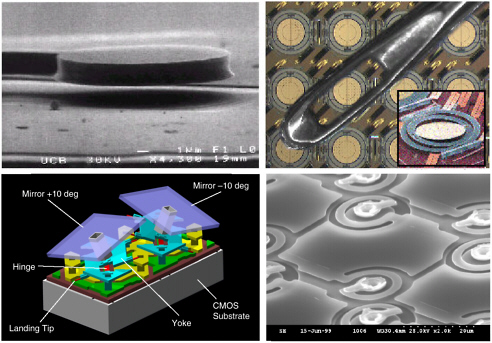
FIGURE 3-6 Optical MEMS examples. SOURCE: Top left: Chang-Hasnain, C., E. Vail, and M. Wu. 1996. Widely tunable micromechanical vertical cavity lasers and detectors. Proceedings of the IEEE/LEOS Summer Topical Meetings on Optical MEMS and Their Applications. New York, N.Y.: Institute of Electrical and Electronics Engineers, Inc. © 1996 IEEE. Top right: Bishop, D.J., C.R. Giles, and S.R. Das. 2001. The Rise of Optical Switching. Scientific American 284(1): 88–95; image courtesy of Lucent Technologies’ Bell Labs. Bottom left: Available online at <http://www.dlp.com/about_dlp/about_dlp_images_dlpcinema.asp> [July 30, 2002]; Bottom right: Schimert, T.R., J.F. Brady, S.J. Ropson, R.W. Gooch, B. Ritchey, P. McCardel, A.J. Syllaios, J. Tregilgas, K. Rachels, M. Weinstein, and J. Wynn. 2000. Low power uncooled 120 × 160 a-Si-based micro infrared camera for unattended ground sensor applications. Pp. 23–30 in Unattended Ground Sensor Technologies and Applications II, Proceedings of SPIE, Vol. 4040, E.M. Carapezza and T.M. Mintz, eds. Bellingham, Wash.: The International Society for Optical Engineering; image courtesy of Raytheon.
tilted position in the inset. The drawing on the left shows two of the 16-μm2 pixels from the digital mirror device sold by Texas Instruments (more detail on the fabrication of this device is given in Chapter 4). A micrograph of part of an array of thermoresistive pixels from a Honeywell uncooled infrared imager is also shown (lower right).
The source is a VCSEL in which the cavity length, and hence the output wavelength, can be tuned by moving a micromirror on a cantilever with a voltage-determined electrostatic force.81 VCSELs are becoming the source of choice for optical fiber networks, and the tunability of such devices is useful for wavelength agility.
Micromirrors have been made in many different configurations individually and in arrays. The round mirrors in Figure 3-6 were developed by Lucent Technologies for switching signals from one optical fiber to another.82 They are 500 micrometers in diameter and can be tilted controllably in two directions. Such mirrors have been made into arrays for switching optical pulses between 1,024 incoming fibers to the same number of exit fibers. The system containing the MEMS mirror array, termed a lambda router, is capable of passing all the current Internet and telephone traffic in the world.
Alternative MEMS optical switches based on switchable gratings and on fluidic devices (bubbles) are also under development. Small as well as large companies are involved in developing MEMS for network switching. In 2000, four start-up companies making optical MEMS mirrors were sold for a total of almost $6 billion in stock; in the spring of 2002, their value was much less. The decline in the stock market and in the pace of telecommunications infrastructure development has delayed the introduction of MEMS switches into the long-haul communications grid, but they are now beginning to be used. MEMS mirror arrays are proving important not only for the communication of information but also for its display. A digital mirror device (DMD)83 is the display engine for conference room projectors and, soon, for digitally fed movie theaters and home entertainment centers. The micromirrors in the DMD flip ±10 degrees to pass the incident light to the screen or into a beam dump. The device consists of three layers, the lower being electronic, the middle having the mechanics, and the top being the optical mirror. The torsional hinges supporting the mirrors are 5 × 1 × 0.1 micrometers, and they last for over 10 billion cycles. Each of the mirrors is 16 mm on a side. DMDs now on the market contain millions of mirrors. Of all the systems ever produced by humankind, these devices have the most moving parts. It has been reported that 100,000 of these devices have been sold in the past few years, so there are over 50 billion MEMS mirrors already in use for this single optical MEMS display technology (see Chapter 4 for a discussion of the manufacturing challenges that had to be surmounted).
The last type of optical MEMS is detectors, which are generally found in arrays to form imagers. They are particularly important for the imaging of objects in the infrared (IR) region, where the heat from people and ordinary objects is
especially useful. IR detector arrays are made by Raytheon and other companies. They cost about one tenth of the cost of the military IR detector arrays based on narrow bandgap semiconductors, which require cooling to low temperatures. The uncooled MEMS IR arrays are expected to find widespread civilian uses—for example, in automobiles to provide images of people and animals in the road beyond the range of normal headlights.
Optical MEMS, especially those for the transmission of information and display of images, have come on the scene as the Internet has become an indispensable part of modern life for individuals, schools, businesses, organizations, and governments. In a similar fashion, RF MEMS are emerging from laboratories into commercial use right in the middle of the wireless revolution. Soon, one in six people on Earth will have a cell phone (in a world where half the people have never made a phone call!). It is projected that one in twenty people will soon have wireless internet connectivity.84
Radio frequency MEMS. Many types of RF MEMS components have been demonstrated in recent years. They include waveguides, detectors, and inductors, which do not have moving parts, and capacitors, switches, and resonators, which are micromechanical devices. There are many kinds of micromechanical RF MEMS capacitors; two are shown in Figure 3-7. The three-dimensional interdigitated structure on the left shows a capacitor developed by the Rockwell Science Center for tuning an RF circuit, made by bulk micromachining.85 The “bowtie”
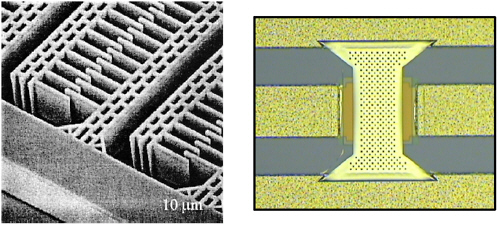
FIGURE 3-7 RF MEMS capacitors. SOURCES: Left: Yao, J.J., S. Park, and J. DeNatale. 1998. High tuning-ratio MEMS-based tunable capacitors for RF communications applications. Technical Digest of the Sensors and Actuators Workshop. Cleveland Heights, Ohio: The Transducer Research Foundation, Inc. Right: Yao, Z.J., S. Chen, S. Eshelman, D. Denniston, and C. Goldsmith. 1999. Micromachined low-loss microwave switches. IEEE Journal of Microelectromechanical Systems 8(2): 129–134. © 1999 IEEE.
device on the right, shown in a top view, made by Raytheon to shunt RF signals from the center conductor to the upper and lower grounds when it is pulled down, was produced by surface micromachining.86 The center strip is about 50 mm wide. Micromechanical capacitors perform two basic functions. The first is simply to provide voltage-controllable capacitance changes in an RF circuit. The second is to switch RF signals in tunable filters and other subsystems. The devices in Figure 3-7 serve these two functions.
RF signals can also be switched by MEMS devices that provide metal-to-metal contact. Several such switches have also been prototyped. These devices involve challenging materials problems. The reliability of RF MEMS switches is an issue key to their commercial utility. Raytheon has operated the capacitive switch shown in Figure 3-7 for over 100 million cycles.87 Motorola has run an RF MEMS switch with metal-to-metal contacts for 4 billion cycles.88 The most demanding applications of micromechanical switches for RF and microwave applications will require performance to 100 billion cycles.
Microresonators are another promising type of RF MEMS. They provide frequency standards in transmitters and receivers, similar to the quartz crystals now used in RF and microwave systems. The great promise of micromachined resonators is the possibility of integrating them on the same chip with CMOS electronics, thus reducing the parts count and the shock susceptibility of systems. Such integration is one of the main challenges facing the utilization of these resonators. They must also be vacuum packaged without any atmosphere, which would degrade their performance. Such packaging must protect the resonators for as much as a decade in use. Cleanliness within the package to defeat desorption of molecules onto the microresonators, which would cause frequency shifts, is another requirement.
MEMS pressure and acceleration sensors were sold by the tens of millions in the 1990s. It is likely that MEMS actuators for optical and RF applications will enjoy similar success in the current decade. Optical MEMS will find greatest use for the fiber-optic communication of information and for the display of images.89 RF MEMS will be widely used in cell phones and other wireless communications equipment.90
Signal and Information Processing and Data Fusion
Without intelligent processing of data, the Air Force will not be able to take advantage of the advances in sensing and communications. Indeed, there is danger of being buried in data, of all of the communications pipes being fully engaged in transmitting reams of bits—mostly of low value—and of a severely restricted ability to respond.
The functions of communication and data fusion represent aspects of information technology that are user unique. These functions demand considerable attention by the Air Force simply because of the highly specialized nature of its
mission. The development of more capable digital systems will be driven by their widespread commercial applications, while specialized hardware and software for communication and data fusion will be highly dependent on the specific nature of the sensors and the missions to be performed.
It is clear that miniaturization will proceed for at least several orders of magnitude in computing power with continuing advances in scaled CMOS. As the other electronic systems being investigated come to fruition, this advance is likely to continue and—perhaps—even accelerate. Using all of this power to sense, to communicate, and to compute to maximum advantage is a systems challenge of the highest order.
Figure 3-8 is a schematic representation of the components of a situational awareness system. All of the computation requirements (at the sensors, at the distributed command and control nodes, and at the response platforms) will need to be exceptionally robust and resistant to enemy attempts at disrupting information. The communications links will have to be exceptionally robust. Large amounts of data will have to be transmitted securely and reliably over a complex
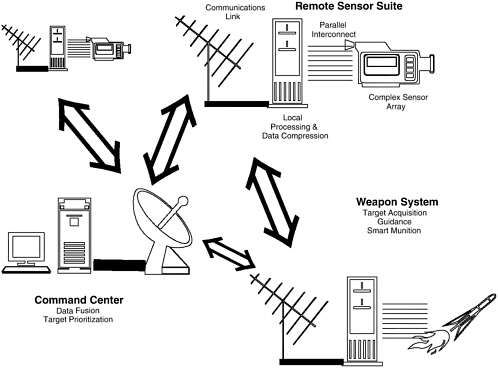
FIGURE 3-8 Schematic of a situational awareness system. SOURCE: National Research Council. 1999. Reducing the Logistics Burden for The Army After Next: Doing More with Less. Washington, D.C.: National Academy Press.
and rapidly changing network in the face of enemy attempts at dis-information and disruption.
The communication network will include many sources of very large amounts of data, many nodes trying to access information, many redundant communications channels (e.g., radio frequency, microwave, optical, earthbound, UAV, manned flight, and satellite platforms) to ensure connectivity, and many protocols (e.g., encryption, spread spectrum, frequency hopping, code division multiplex, and ultrabroadband) to ensure authenticity and increase aggregate bandwidth. Network management in such a complex environment will require robust software to ensure that the system can operate reliably under highly stressful conditions. Commercial systems are based on the very democratic Internet protocol (i.e., the system slows down as more users demand access). A military system must have a more hierarchical structure based on dynamic prioritization. The commander needs a continuous overview. A sensor that detects an imminent threat must be able to get its message across. This is a complex networking problem that will be difficult to solve.
The committee was not presented with any information on activities in software and systems along these lines during several meetings with AFRL and Air Force Office of Scientific Research (AFOSR) personnel. The Air Force must develop a strong capability in software and embedded systems integrating software and hardware if it is to be able to capitalize on the dramatic advances in hardware discussed elsewhere in this report.
Data Fusion
Data fusion is largely a software development, although it also requires display devices that maximize the transmission of key concepts and ideas to a decision maker. The ability to gather data from multiple sensors and to manipulate the data to get the best information will increase along with the capabilities of computers.
To reduce the communication demands of increasingly capable sensors, local intelligence will be required at the sensor to preprocess the data and reduce the bandwidth requirements for transmission. A single multispectral (5 bands), real-time (60 frames/sec), high-resolution (10 megapixels; 10 bits/pixel) video signal requires as much as 30 Gbit/sec bandwidth before compression. Multiply this demand by perhaps thousands of such sensors and the problem becomes clear. The volume of data to be processed will require sophisticated computation for automated analysis and semiautomated or even autonomous decision making and rapid response. There must be a dynamic allocation of the information burden between local and centralized computing and communications. The optimal admixture is clearly situation dependent and must be dynamically allocated by the software. After target acquisition, decisions must be communicated to the
appropriate weapons platform. Sensor feedback on battle damage must be assessed and intelligence data updated.
Software and Codesign
Software and integration with hardware are serious and growing problems. There are significant issues related to software complexity, stability, reliability, security, and adaptability. The Air Force will require a very complex software overlay for assimilating terabits of data from a large number of sensors in a rapidly changing environment and intelligently distilling the resulting information for users as varied as commanders and autonomous platforms. Fundamental questions must be answered about the limits of robustness and stability in such a system.
Future embedded systems will be software-dominated. “Our technological environment will become, step by step, more and more networked, more and more autonomous, and more and more self-organizing.”91 The industry perspective on the migration of software technologies is illustrated in Figure 3-9.
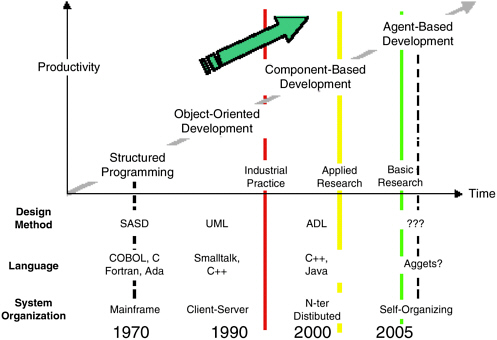
FIGURE 3-9 Paradigm shifts in software. SOURCE: ITEA Office Association. 2001. Technology Roadmap on Software Intensive Systems: The Vision of ITEA (SOFTEC Project), March. Available online at <http://www.itea-office.org> [July 31, 2002]. © 2001, ITEA Office Association. All rights reserved.
The engineering process will require new methodologies, models, and implementation techniques to support the efficient implementation of end-to-end services. Engineering technology will require techniques to master complexity and capture end-to-end specification of a distributed system. Implementation tools that guarantee a cost efficient, resource-limited implementation on a wide variety of platforms are required. A design flow that supports the development process in a multidisciplinary environment will be necessary. The move to component-based systems (e.g., to increased software reuse) will lead to new opportunities and to new demands on the Air Force software system.
Findings and Recommendations
The findings and recommendations considered by the committee to be critical appear in the Executive Summary. They are designated T (for technical) or P (for policy). More specific findings and recommendations, which are not included in the Executive Summary, are numbered to reflect their order within the report’s chapters. All the findings and recommendations are collected in Chapter 7.
Finding T1. Further miniaturization of digital electronics with increased density (~128×) is projected by the integrated circuit industry over the next 15 years based on continued scaling of current technology. The most recent ITRS forecasts the accelerated introduction of smaller dimensions and greater computational power than were forecast by the Information Technology Roadmap for Semiconductors of 2 years ago.
Recommendation T1. The Air Force should position itself to take advantage of the advances predicted by the Information Technology Roadmap for Semiconductors. Dramatic advances are predicted for device technology. Software, application-specific integrated circuits (ASICs), embedded computers integrating software and hardware for specialized applications, and radiation-hardening and packaging for hostile environments must be designed by, and for, the military, to take advantage of these advances.
Finding T2. In anticipation of an ultimate end to the historical scaling of today’s integrated circuit technology, many new and alternative concepts involving nanometer-dimensioned structures are being examined. As yet, none of these concepts had demonstrated the necessary functionality and integrability to be a clear choice for “beyond silicon.” Many different material and device technologies will need to be explored well into the future. Two facts seem clear. First, it is not possible to make reliable, long-term predictions of breakthrough capabilities emerging from the rich frontier of discovery, fabrication, and material properties at nanometer dimensions. The numerous avenues of research investigation are likely to uncover unexpected
processes and/or material properties that will have an impact at the fundamental level of information processing. Second, it seems likely that the initial applications of any of these technologies will build on and enhance the very strong base of existing integrated circuit technology, which will provide the necessary backbone of functionality and integrability until an entirely new computation paradigm emerges.
Recommendation T2. Exploration of the scientific frontiers involving new procedures for fabrication at nanodimensions and new nanoscale materials, properties, and phenomena should be supported. The Air Force should track, assimilate, and exploit the basic ideas emerging from the research community and continue to support both intra- and extramural activities. The focus should be on understanding the fundamental processes for fabrication, and on the unique properties of materials and devices structures at nanometer dimensions. Extremely dense arrays of devices capable of manipulating bits rapidly and reliably should be a dominant aspect of these investigations. Individual devices with nanometer or molecular dimensions are demonstrating logical functions on a small scale with a limited number of examples. Molecular electronics appears promising at present. There is potential for new device innovations and for progress in computing architectures and strategies. Quantum computing and quantum cryptography are examples of the applications that may be enabled by further progress in micro- and nanotechnology. The technology may develop rapidly once the scientific principles and technological advantages are discovered and understood.
Finding 3-1. Space electronics is vital to the Air Force mission. The unique characteristics of the exoatmospheric environment place special demands on electronics that are outside the mainstream developments of the integrated circuit industry.
Recommendation 3-1. The Air Force must maintain a research and development effort in radiation-hardened electronics and must evaluate the continuing developments of micro- and nanotechnology for their applicability to space. Some commercial developments, such as the move to silicon-on-insulator (SOI) materials, have clear radiation hardness benefits; others, such as molecular electronics, have yet to be evaluated in this context but are likely to exacerbate the problems.
Finding 3-2. Communication is a critical aspect of information superiority. The continuing trend to miniaturization is evident in this area as well as in computation. Traditionally, communication has been dependent on a wider materials base than computation as a result of the need for optical interactions and for high-speed analog functions at microwave and RF frequencies.
The Air Force has unique communications requirements, different from those of the commercial sector, demanding sustained effort and the overlay of scientific advances with Air Force requirements.
Recommendation 3-2. The Air Force should maintain a strong research program in both the optical and microwave/RF regimes. MEMS technology is having a strong impact. Nanotechnology is already leading to advances in these areas as well as in computation.
Finding T6. The Air Force strategic nanotechnology R&D plan, as presented to the committee, is focused on hardware concepts without appropriate consideration of total systems solutions. It is well known that over the past 15 years the commercial sector has made increasing investments in architecture and software concepts to design advanced systems. The tendency has been toward codesign of the hardware and software aspects of a system. One implication of nanotechnology is that this approach will be even more essential as device capabilities continue to expand. New algorithms, architectures, and software design methods will need to be developed and employed in concert with new nanotechnology-based hardware. Investment in this strategy will enable autonomous, intelligent, self-configuring Air Force systems. The Air Force strategic plan contains many future scenarios where such systems would be the ideal, if not the only, solution.
Recommendation T6. The Air Force should take seriously the importance of co-system design as a critical consequence of continued miniaturization and should invest in the algorithm, architecture, and software R&D that will enable the codesign of hardware and software systems. This should be undertaken along with a projection of the advances that will be made in hardware.
SENSORS
Introduction
Sensors are the eyes, ears, and nose of military systems, acquiring and processing data to enable decision making and actions by war fighters. Information from sensors is collected from U.S. Air Force and other sources, analyzed, compiled, and disseminated to other military branches and to our allies. Militarily useful categories of sensors are familiar: They include electromagnetic spectrum sensors and imagers, acoustic and seismic sensors, inertial and position sensors, and sensors of specific chemicals and compounds. The effectiveness of a military information system depends crucially on the intelligent integration of sensor
systems with the signal processing, computing, and communications systems discussed in the previous section.
The current trend toward integrating data into a total battlespace “infosphere” consisting of a common operating picture, interoperability of systems, seamless integration of space, air, and ground assets, and knowledge management leading to decision superiority will in many respects require further developments in sensor systems. To achieve this necessary state, we need to have robust, sensitive, high-resolution, broadband detection, as well as appropriate preprocessing and instantaneous secure transmission of the important results for further processing. Nearly instantaneous decision-making capabilities and secure dispersal of the results of this process to the correct recipients no matter what platform or nation are also mandatory. And we need to maintain this overall capability all of the time, 24/7. Sensing clearly is key to our warfighting capability, before, during, and after the battle.
Discrete Versus Distributed Sensors
The U.S. Air Force desires “an AFRL NANO S&T Program providing revolutionary Air Force war fighting capabilities and preempting technology surprise.”92 Most sensors are designed to obtain narrowly defined information; examples include strain gages, thermometers, and accelerometers. These discrete sensors, when appropriately chosen, installed, and interrogated, provide a wealth of useful information. Recent developments allow different kinds of data taken from the same location to be combined into a sum of information greater than its constituent data. This is sufficiently important that the term “data fusion” has been coined to describe this combining of data from multiple sensors into one cohesive package. When this notion of multiple sensors is taken to extremes spatially, i.e., hundreds to thousands of sensors dispersed throughout an area of interest, the picture becomes more complete and nothing of interest goes undetected. One important direction for distributed sensor research is “smart dust,”93 where large numbers of millimeter-scale, MEMS-based sensors communicating by wireless RF or optical links are dispersed over an area of interest. Clearly, networks such as these call for research into the size, functionality, and power consumption of individual nodes and into the communications and network architectures and hierarchy necessary to optimize their usefulness, especially in uncooperative environments.
Projected Impact
Near-term advances in sensor systems will lower the cost of the overall sensor systems, lighten the packages we fly, and eventually make some sensor types ubiquitous. Many of these near-term gains will come from the MEMS community as it improves its designs, fabrication processes, and materials.94 In
the medium term, we can expect that higher performance will be achieved from advances in nanomaterials and from increases in computing capacity, data storage, and secure communications, much of which will also be derived from the nanosciences. MEMS will allow us to produce large numbers of sensors more cheaply, but nanoscience will enhance the performance of these relatively inexpensive sensors.
A bit further out, perhaps by about 2020, we should see the successful mating of these improved performance sensors into systems of sensors and a resulting dramatic increase in useful understanding of the battlespace. Much of this expansion of sensor information will have been apparent earlier, but by 2020, we will begin taking this volume of information for granted.
Impact of MEMS
Within the scope of semiconductor-based devices, but outside the range of nanotechnologies and squarely in the range of microtechnologies, are MEMS-based sensors, including MEMS inertial sensors, magnetometers, room-temperature IR focal-plane arrays, acoustic and seismic sensors, and chemical and biological threat sensors. Of these, the MEMS pressure sensors and inertial sensors (accelerometers, angular rate sensors, and combinations of these) are by far the most mature. Pressure and inertial sensors were perhaps the major driving force for MEMS development at its earliest stages.
There is great motivation within the military for acoustic, seismic, magnetic, chemical, and inertial sensing capability in very small packages. The driving applications for this include unmanned air vehicles (UAVs), man-portable systems, compact and lower cost missiles, smart munitions, systems for detecting underground and hardened targets, smaller and lighter satellites and other spacecraft, and more highly integrated and generally capable avionics. In summary, all the pervasive motivations for smaller, more compact, more cost-effective, but still highly capable defense systems lead to MEMS sensors.
Impact of Nanotechnology
Many types of sensors are made using semiconductor materials, especially compound semiconductors. Thus, these sensors are a subcategory of microelectronics and optoelectronics. The impact of nanotechnologies on semiconductor-based sensors will be much like its impact on semiconductor-based information technologies. That is, nanometer-scale devices will offer significantly better performance in smaller and less expensive units.
The impacts of nanoscience on sensor technologies include improved materials, more precise monolayer-scale control of growth, novel heterostructures, and new device concepts such as quantum wires and dots or other quantum-effect
designs. These are potentially at least as important for sensors as for the rest of the technologies based on micro- and nanoelectronics.
Nanometer control of epitaxial compound semiconductor multilayers used in complex semiconductor device structures is an area of technology that has made extraordinary advances in the last 20 years. In addition, in recent years, the development of heterogeneous integration techniques that combine multiple semiconductor families has greatly expanded the versatility and adaptability of less mature semiconductor materials and devices.
The heterogeneous integration of semiconductors, based on nanoscale control of fabrication processes, is beginning to impact sensors. One example is the self-assembly of large numbers of IR detector pixels into an array format on a curved substrate. Such schemes offer the potential for focal-plane arrays with extremely large fields of view and high resolution, which are required for effective, space-based operation.
Payload Sensors
Many sensing systems are an integral part of the mission payload. A large fraction of these payload sensors are imaging systems, where electric components will benefit—in reduced weight and volume and increased functionality— from developments in micro- and nanotechnologies as discussed in the previous section.
Electromagnetic Spectrum Sensors
The Air Force’s role in space requires space-based smart sensors for battlespace surveillance,95 including imagery and various modes of sensing. The goal is to exploit the spatially varying spectral, polarimetric, and temporal aspects of images. The insatiable demand for wide area coverage and increased resolution, as well as wide spectral coverage, is forcing the development of numerous sensor elements and systems across much of the electromagnetic spectrum. Both MEMS and nanotechnology will play a significant role in the overall systems that answer these needs.
Ultraviolet Light Sensors
Imaging for the ultraviolet portion of the spectrum is not as well developed as imaging in the visible and infrared regions. More efficient UV laser sources96 and detectors that are solar blind are being developed for biodetection, missile threat warning, and UV communication.97 These sensors are not covered in depth, as the findings and recommendations are not significantly different from those for the infrared, discussed below.
Visible Light Sensors
Most of the current sensing in the visible spectrum is performed using silicon semiconductor devices, either singly, in linear arrays for spectrometers, or as two-dimensional arrays in camera systems. Beyond the improvements in electronics discussed elsewhere, micro- and nanotechnologies are impacting visible spectrum sensing dramatically and will continue to do so over the next couple of decades. Recent advances in visible spectrum sensing have been primarily cost improvements in focal plane arrays. Current state-of-the-art uses for microtechnology include micro- and nanoscale particles in suspension for rapid polishing of lenses. Medium-term advances include mostly ancillary system improvements in antennas and electronics, especially jam resistance. The greatest improvements in visible sensors will come in the form of smart, multispectral sensor systems capable of robust target identification and able to withstand laser blinding and other countermeasures.98
Another area that may well provide value for the U.S. Air Force involves enhancing the visible light sensor system that comes with the human body, the eye. The visual function of eyes of pilots or other decision makers will eventually be modified for special purposes. Advances in vision correction99 are leading to the ability to surgically alter a person’s vision to suit specific needs, perhaps improving contrast sensitivity while trading depth perception for monochromatic vision,100 as needed in IR viewing. It is possible to give the sniper or even a general crewman 20:10 vision. Successful long-term modification of the cornea of the human eye will require a better understanding of the long-term consequences of damage we cause to the functioning and physiology of the human eye as we perform invasive surgery like LASIK. Much of the physiology of the cornea is rooted in the ordered distribution of its 65-nm-diameter fibrils and fluid flow.
Infrared Sensors
Infrared sensors are used for night vision, for reconnaissance and surveillance from aircraft and space, and for homing of optically guided missiles. Current efforts aim to reduce the need for active cooling and to increase the spectral coverage. Space-based surveillance specifically requires improvements in power consumption, cost, and size in far-infrared sensors.101 The ongoing revolution in nanomaterials may also provide better infrared-transmitting materials for windows and seeker domes.
Reduced cooling needs for IR detector arrays are being explored in several ways, including biomimetic sensors,102 quantum dots and carbon nanotubes,103 and micromachined bolometers104 and bolometer arrays. Uncooled micromachined bolometer arrays now cost less than 10 percent of cooled military
infrared images. Their size will increase and cost will plummet further as they are adopted for use in consumer electronics.
Advances in nanotechnology for monolayer-level control of epitaxial semiconductor layer growth are having a significant impact on cooled IR sensor systems. Improvements are being made to molecular beam epitaxial (MBE) precision growth of complex, multilayer IR detector arrays based on HgCdTe and related compounds in the difficult II-VI semiconductor family. Extraordinary advances in the capabilities of IR imaging systems, missile seekers, and space surveillance IR systems have been achieved and are continuing. Especially significant is the realization of multispectral IR sensors (requiring three or more photovoltaic junctions). Larger format, higher resolution IR imaging arrays based on the use of silicon substrates with II-VI IR sensor arrays, including the direct growth of high-quality HgCdTe on silicon, as well as HgCdTe on CdZnTe, are under development.105 Integration with silicon technology also provides the potential for lower costs at higher volumes by adopting some of the silicon microelectronics industry’s fabrication tools and approaches. However, this will remain an elusive goal until volumes of any one design are sufficient to warrant a concerted process development effort.
The development of novel avalanche photodetectors (APDs) and arrays of detectors is key to active Ladar (IR) sensor systems. These new devices make use of complex multilayer structures grown by MBE from II-VI or III-V materials. The II-VI material is usually HgCdTe or a related alloy. Similar novel devices using the InAs/GaSb-related family of III-Vs have also been reported.
The design and realization of entirely new types of IR sensing devices, such as the InAs/GaInSb “Type II” superlattice IR detector,106,107,108 are clearly of interest to the Air Force. Proper operation of this particular device depends on the precise control and periodic replication of very thin (a few to tens of monolayers) alternating layers in a superlattice structure. Theoretical models for this type of detector indicate high IR sensitivity at substantially higher operating temperatures than in conventional photovoltaic devices. It is hoped that this will improve upon current detectors based on extrinsic silicon that must operate at below 20 K to reduce dark current.
RF Sensors
Nanotechnology has the potential to significantly improve the performance of RF sensors. These devices serve as the “eyes” of electronic systems that operate in the RF to millimeter-wave regions. Generally, these devices are nonlinear elements, such as diodes, that receive RF energy and convert it to electrical signals, which are then detected and further processed. Either direct detection or heterodyne detection techniques can be employed. Direct detection systems are simpler and easy to implement but have limited sensitivity. Heterodyne systems
are more complex, requiring local oscillators, but have inherently greater sensitivity. Both systems require a nonlinear element in the front end as the interface between the RF and electronic environments. Although diodes are generally used, it is also possible to make use of active devices such as field-effect transistors, or high electron mobility transistors (HEMTs).
The fundamental limitation to the frequency performance of a rectifying front-end element can be described by the cutoff frequency, which can be expressed as

where Rj is the resistance of the diode junction and Cj is the diode capacitance. For optimum performance these devices are designed so that the maximum amount of RF energy is coupled into the diode junction area and directed across Rj. The diode capacitance is a parasitic parameter that acts to shunt RF energy around the diode junction, thereby degrading conversion efficiency. For this reason, it is desirable to minimize the device capacitance. This can be accomplished by scaling the diode area to very small dimensions. Diodes with cutoff frequencies in the terahertz regime can be produced. For example, GaAs Schottky barrier diodes with diameters of 0.15 micrometer have a cutoff frequency of 3.4 terahertz.109 Nanotechnology scaling can push these cutoff frequencies to over 10 terahertz.
Nanotechnology offers the potential for significant improvements in RF sensor performance. Improvements will come from two directions. First, nanotechnology advances will result in improved technology for material growth that will permit ultrasmall devices to be produced with atomic-level control of the semiconductor layer thickness. For example, Schulman et al.110 have demonstrated a Sb-heterostructure diode that can provide temperature-insensitive performance at frequencies exceeding W-band. These diodes were fabricated using an InAs/AlSb/GaAlSb heterostructure in a lattice matched configuration grown by MBE and had an area of 4 square micrometers. These devices can be used as backward and zero-bias diodes with both high sensitivity and low direct current power requirements.111 RTD designs can push frequency performance well into the terahertz region and still maintain good detection sensitivity. Second, nanotechnology offers the potential to integrate intelligence into structures at the system front end. That is, a certain amount of processing can be integrated into the nonlinear element right at the point of RF to electronic conversion. At this location, the process of extracting useful information from the RF signal can be performed with high efficiency, thereby avoiding losses associated with transferring the signal further into the system. This paradigm would also permit simplification of the processing circuitry. Nanotechnology offers the potential to build intelligent processes into the semiconductor devices structure. These approaches are in their infancy but are likely to provide advances for numerous applications of interest to the Air Force.
Multispectral Sensing
Combining two wavelength regimes into one sensor housing conserves space and weight. Early attempts at this included simply applying a single InSb detector element on top of a single HgCdTe detector element. Beyond about 5.5 micrometers, the InSb element became transparent, allowing longer infrared wavelength to pass to the HgCdTe device. The advantage of this was an improved signal-to-noise ratio over the range of the InSb device (1-5.5 microns) and optimized HgCdTe detector element performance tuned to the longer wavelengths. The result was very good performance for 1-25 micron detection. A developing example of multispectral sensing is the combining of mid-wave IR (3-5 microns) detectors based on HgCdTe with wide bandgap III-V-based UV detectors along with silicon-based visible and near-IR detectors.
Sensors for Ultrasonics
Ultrasonic sensing uses MEMS devices for three-dimensional detection and tracking of sound. This work is aimed at detection and classification of underground facilities, ground vehicles, and missile launchers.112
Sensors for Physical Properties
Navigation Sensors. Spacecraft rely on sensors to determine their orientation with respect to the Sun (for power), Earth (for sensing and communication), and the stars. Many sensor types are used to determine this orientation, including optical sensors for the Sun and stars and magnetic field sensors for determining their orientation with respect to Earth. More recently, monitoring the phase shift in the signal from different GPS satellites has become useful.
Microoptoelectromechanical systems (MOEMS) can significantly decrease the mass, volume, and power requirements of optical navigation sensors, while MEMS could have a similar effect on inertial navigation sensors. A conceptual design for a small, lightweight, low-power, single-chip, micromachined, single-axis Sun sensor with 64 small interdigital detectors, is given in Figure 3-10. Coarse position is determined in digital mode by locating which element has the highest output; fine position is determined by ratioing the output powers from neighboring detectors.
Recent emphasis in the commercial market on E911, a concept consisting of various methods for providing geolocation services for stranded cell phone users, may lead to improved miniature GPS systems. As GPS systems shrink to fit into cell phones, the military counterparts can also be expected to shrink. The impact of tiny GPS systems on inertial measurement units (IMUs) and guidance systems in general will be tremendous.
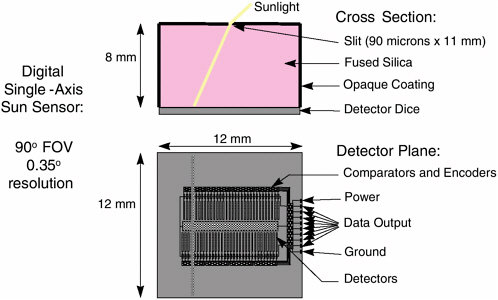
FIGURE 3-10 Micromachined Sun sensor. SOURCE: Helvajian, H., and S.W. Janson. 1999. Microengineering space systems. Pp. 29-72 in Microengineering Space Systems. H. Helvajian, ed. El Segundo, Calif.: The Aerospace Press. © The Aerospace Corporation, used by permission.
Inertial Sensors. Spacecraft IMUs use micromachined accelerometers,113,114 gyroscopes, and other angular sensors to monitor their own forces and track their position and orientation. Gyroscopes are used to monitor spacecraft attitude, with optical sensors for absolute calibration. These gyroscopes and angular rate sensors are typically based on a rotating mass, a vibrating fork, or the circulation of light around a closed loop. Micromachined angle rate sensors monitor Coriolis forces, which are proportional to the angular rotation rate.
Inertial sensors consist primarily of accelerometers and gyroscopes. The current trend is to make these in silicon using MEMS, which allows dramatic reductions in weight, size, and power while also improving robustness. MEMS accelerometers are commonly used as impact sensors in automotive airbag systems.115 New silicon micromachined microgyroscopes will soon be available. In addition, an even newer angle rate sensor design that uses quantum tunneling for the transduction mechanism is being tested.116 This design may allow yet smaller (hence cheaper and lower power) angle rate sensors to be produced. Smaller angle rate sensors with accuracies similar to fiber-optic gyroscopes would allow more precise control of smaller vehicles, including arrays of nanosatellites, missiles, and UAVs.
When the IMU loses track of its star or the Sun, it must search rather broadly to regain lock. The addition of a very fast GPS could reduce the search area dramatically, providing a much faster lock. However, for reasons of weight and
package, most IMUs do not have GPS capability. Micro GPS units, possibly drawing upon e911 cell phone technologies and MEMS, might play a part in bringing this capability into IMUs.
Magnetic Field Sensors. Low earth orbit (LEO) spacecraft typically use flux-gate magnetometers to measure local magnetic field strength and direction for control of orientation. Flux-gate, magnetoresistive, and Hall-effect sensors are all suitable for developing microengineered magnetometers. Honeywell has a three-axis magnetic sensor hybrid based on magnetoresistive transducers,117 Nonvolatile Electronics, Inc., manufactures application-specific magnetic sensors based on the giant magnetoresistive (GMR) effect,118 and another magnetometer concept is being developed at Johns Hopkins University119 using the Lorentz force to measure vector magnetic fields.
Sensors for Chemical and Biological Agents
Chemical and biological sensors are of great importance, particularly in light of recent events. The Army, with much greater concentrations of troops than the Air Force, has taken a leading role in developing sensors for chemical and biological detection. Only a brief overview is presented here. A recent NRC report covered this topic in much more detail.120
Numerous approaches are being developed to detect chemical and biological attack on personnel, with nanoscience rapidly being recognized as a major contributor. Miniaturization of electronics and the concomitant ability to measure the behavior and properties of nanometer-size bits of matter introduce remarkable advances in sensing and detection. Microfabricated sensors provide a sensitive measure of nanometer (e.g., molecular) interactions with a high degree of specificity. These sensors are able to detect minute traces of chemical and biological agents as well as explosive vapors. Fabrication of sensor arrays and devices by the usual parallel processing methods, similar to chip fabrication, will mean inexpensive sensors for a wide variety of substances. MEMS production methods further expand the horizon of new devices used for these purposes. Such point sensors will be effective for environmental monitoring, security (buildings, transportation platforms, and points of embarkation), and battlefield protection. The impact of research in this area on mine detection could also be significant. This aspect of nanotechnology will probably lead to marketable products in the near future.121
The sensitivity of these sensors is due to the nature of the instrumentation developed to observe small changes at nanometer dimensions. Tools such as scanning local probes (tunneling microscopy and many related techniques) are just one of the many tools that may be used for sensing the presence of a specific molecular species. The fabrication of tools able to measure minuscule changes in mass, along with changes in optical, electric, and magnetic properties at nanom-
eter dimensions, enables detecting the presence of submicron bits of matter held in place with the forces between single (or a few) molecules. With appropriately designed transduction, a single molecular unit (or nanoparticle) may be detected. A variety of methods for such measurements is becoming available. The issue then becomes how to bring the occasional nanoparticle into contact with the sensing unit. Such sensitivity is attracting great interest in light of the need to rapidly detect trace amounts of materials used not only on the battlefield but also by terrorists, such as anthrax, botulism, or ricin-toxins that are fatal in microgram doses.
Selectivity of these sensors is obtained through the forces that depend on the nature of molecular interactions and the method used for detection. By using biological specificity with polypeptide or DNA-type interactions, highly specific identification is possible. Antibody-antigen interactions result in highly selective binding at the nanometer scale. Attractive forces between molecular species vary, as evidenced through solubility or adsorption characteristics, and these forces may be quite specific for properly chosen molecular structures. By comparing the changes in response of an array of different materials exposed to an agent, a characteristic pattern can reveal the agent’s identity.
Examples of the phenomena currently being considered for sensors illustrate a few of the approaches being considered. The mass of a nanostructure changes with events that bind additional nanostructures to it. Miniature oscillators, such as a quartz crystal microbalance, may be used to measure a resonant vibration frequency for a given structure. A vibrating cantilever is reported to be sensitive enough to detect the presence of a single E. coli bacterium in air with a mass of less than 1 nanogram.122 The selectivity depends on the complementary nature of the two species interacting. It is estimated that the sensitivity can be improved by as much as four orders of magnitude. Another novel approach measures the amplitude of a transverse vibration as a function of increasing amplitude. When bonds between an adsorbed species and a surface rupture, the amplitude changes, enabling sensitive detection of selective components adhering to a surface.123
Changes in electrical conduction represent another approach to nanosensors. One such recent effort reveals changes in the conductivity of carbon nanotubes (CNTs) on exposure to various gases.124 The conductivity of CNTs changes by three orders of magnitude in 2 to 10 seconds when 200 ppm of a gas such as NO2 is introduced. The rapid response time is a direct result of the small dimensions of the CNTs; semiconductors used for this purpose typically take minutes to respond. The change in conductivity is probably due to a hole doping mechanism in the CNT induced by the presence of the NO2 gas. An alternative approach that operates in solution involves nanopores in a membrane designed to bind complementary molecular units. Electrical conductivity through a nanopore continues until a complementary unit is attracted to the site and binds, blocking the passage of ions through the nanopore. The change in conductivity registers a selective binding event and the presence of a nanoparticle or large molecule.125 An alterna-
tive approach uses small pores between electrodes coated with materials complementary to a desired molecular unit. An analyte that contains gold particles and a suspected DNA sequence will attach the gold between the electrodes, registering a significant change in the conductivity between the electrodes after suitable treatment. This scheme has been reported to give sub-picomolar sensitivities.126
Magnetic fields from submicron beads are used to detect forces between nanoparticles with the Bead Array Counter (BARC).127 In this method, carefully designed target DNA materials are first patterned on top of a chip containing an array of micron-scale GMR strips. These strips are configured to electronically sense very small magnetic fields. When a solution containing DNA from unidentified pathogens flows over the corresponding area containing complementary target DNA on the chip, this pathogen DNA is captured on the surface. Micron-size magnetic beads, especially designed to bind only to the pathogen DNA molecules, are then injected into the solution and are bound to the selected site. The GMR sensors detect these beads, and the intensity and location of the signals indicate the concentration and identity of any pathogens present. The current BARC chip contains a 64-element sensor array; however, with recent advances in magnetoresistive technology developed for computer memory, chips with millions of GMR sensors will soon be commercially available. This advance will speed the development of a chip capable of screening for thousands of analytes simultaneously. Because each GMR sensor is capable of detecting a single magnetic bead, in theory, the BARC biosensor should be able to detect the presence of a single pathogen DNA molecule.
Optical indicators are successful sensors using well-known coalescence phenomena. Nanoparticle-based colorimetric detection is an effective sensing technology already in the marketplace for pregnancy detection. The principle involves antibodies attached to gold nanoparticles. The presence of an antigen or other complementary interacting agent binds the gold nanoparticles into clusters having modified optical properties (due to the larger cluster dimension), causing a change in color.128 Surface plasmon detection, sensitive to local refractive index changes, provides an important technique for monitoring analyte adsorption.
Advances in chemical, biological, and explosives sensors are expected to be rapid, paralleling the increasing activity in nanotechnology in general. Bionanotechnology is even being studied as a means of destroying chemical and biological agents.
Self-Sensing
To ensure that the mission is completed, every part of the sensing system can and sometimes should be monitored for performance. In the case of manned aircraft, this includes the pilot, the crew, and their environment (e.g., CO2 levels in the pilot’s G-suit and cockpit). In the case of satellites, the environment of the
payload, the structure, the launch site (hydrazine on the tarmac) and the payload itself are candidates for monitoring.
Load Monitoring
Load monitoring has historically been achieved primarily by individual strain gages (a typical F-18 has seven). However, owing to system weight penalties and the difficulties of installation and repair, they have been used infrequently in aircraft and space applications. Recent developments in optical fiber sensors129 and wireless transponders130,131 have helped solve some of these difficulties. However, there has not been much successful commercialization of these technologies, primarily because of limitations on the availability of power and very small antenna elements, both of which may have micro- and nanotechnology solutions, and overall lack of maturity of the embedment process and its associated egress and embedding issues.
Air Pressure Monitoring
MEMS-based flow monitoring has been pursued for underwater vehicles, but the most notable effort in monitoring the local environment of an aerostructure was developed by the Boeing Company and Endevco. Their pressure belt132 (Figure 3-11) contains silicon-based multichip modules (MCMs), each of which contains a MEMS pressure sensor, a temperature sensor, and data acquisition and
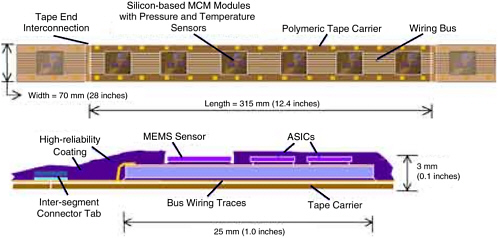
FIGURE 3-11 Boeing/Endevco pressure belt. SOURCE: North Atlantic Treaty Organization Advisory Group for Aerospace Research & Development (NATO/AGARD). 1996. Smart Structures and Materials: Implications for Military Aircraft of New Generation, AGARD-LS-205. Ottawa, Canada: Canadian Aeronautics and Space Institute.
signal-conditioning circuitry on a flexible belt. Installed on an aircraft’s wing, the pressure belt provides data during the aerostructure’s design stage.
While the MEMS pressure belt described above is intended for measuring the pressure distribution on a wing in flight, nanoscience has provided an alternative solution for wind tunnel measurements. When fluorescent dye molecules are applied as paint they act as tiny oxygen probes, reacting by altering the fluorescent intensity in response to the local oxygen concentration. This pressure-sensitive paint (PSP) is illuminated with light to excite the fluorescence. As the pressure of the airflow across the surface changes, the intensity of the light generated is monitored, as shown in Figure 3-12, clearly indicating pressure gradients. The temperature sensitivity of the thin-film coating is corrected using infrared measurement.
Condition-Based and Prognostic Health Monitoring
Status sensing is done for both routine operation of systems—for example, as part of control loops—and for determining when routine or critical mainte
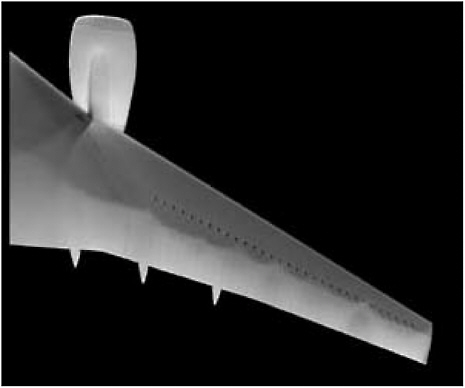
FIGURE 3-12 A typical pressure-sensitive paint result for a wind tunnel model of a transonic transport airplane. Courtesy of Boeing.
nance is needed. The components here are (1) the system being monitored and (2) the sensor system that is providing data on the status of the system of interest.
The list of functional systems of interest to the military, and to many industries, is long. Power generation, distribution, and use systems are many and varied. The same can be said of communications systems. Weapon systems are also remarkably diverse. The numerous installations and mobile platforms in and on which various systems are used further complicate monitoring possibilities. It would be necessary to make a list of systems of interest for monitoring in order to define a sensor architecture.
Sensors require a nontrivial set of related hardware and software. Smart sensors capable of turning data into information at the system, logging and analyzing it, and forwarding routine and emergency information require micro-controllers as well as associated electronics such as amplifiers. The entire sensor system needs power, the provision of which is usually the limiting factor in the lifetime and performance of a sensor system. Wired or wireless communications are needed. Finally, the entire system must be packaged in a housing.
The hardware items will have different susceptibilities to the employment of micro- and nanotechnologies. Sensors are first-rate candidates for exploitation of new technologies. Advances in microcontrollers and other ICs are driven by market forces in the semiconductor industry. Nanomaterials should have an impact on batteries and, possibly, solar cells.
Prognostic Health Monitoring from Satellites and On-Orbit Manned Vehicles
Many space-system operations occur on the ground, and micro- and nanotechnologies will probably be inserted into these operations before they are inserted into space operations as a result of the more benign environmental and reliability constraints. Miniaturized, multiparameter, MEMS-based sensors with integrated data loggers and wireless (optical or RF) communications will become important in production and ground operation. Relatively low bandwidth devices on the market that have peak-sensing capabilities (a.k.a., telltales) to sense transportation or to handle stress variables can ensure that maximum limits have not been exceeded during production, transportation, and storage operations. MEMS sensors for these parameters already exist and can be mass-produced for inexpensive environmental monitoring packs. Knowing what, when, where, and how a limit was exceeded is critical during the spacecraft flight readiness review.
Micro- and nanotechnologies can also be used to instrument launch vehicles. Current launch vehicles like the Titan IV are often instrumented to measure the liftoff and ascent flight environments. However, these vehicles often have a limited number of channels to characterize the dynamic acoustic and vibration environments. By proliferating sensor units on the launch vehicle, a better characterization of the environment is possible. Similarly, there is a need to instrument the launch site. Ground-based measurement of rocket ignition overpressure
and toxic chemical release (e.g., HCl from a solid booster) are needed in conjunction with the launch vehicle monitoring system to dramatically increase the awareness of vehicle status and the launch site environment. MEMS sensors coupled to data transceivers can be used in a wireless network system onboard the vehicle and on the launch site. The telemetry data can channel real-time or near-real-time information to a ground-based data storage system for postlaunch review.
Another important role for micro- and nanotechnology in both satellite and on-orbit manned vehicle operations is in condition-based maintenance (CBM) status and health monitoring systems. These systems could save future costs by fault detection and isolation and by enabling automated self-test and repair actions to take place. The CBM protocol also enables safer operations as well as increased system availability in contrast to a failure-based maintenance protocol scheme. Reuseable launch vehicles are prime candidates for CBM. One relatively common malfunction in spacecraft is the failure of a high-speed bearing, reaction wheel (i.e., momentum wheel), or gyro bearing. Bearing degradation can often be anticipated by monitoring vibration signatures; this would be an excellent application for a micromachined accelerometer coupled to a digital signal processor or microprocessor in an application-specific integrated microinstrument (ASIM). Corrective action could consist of the metered release of lubricant via a fluidic ASIM. Smart bearings, smart structures, and multifunction structures are already being considered by space engineers. These ideas have also been considered in the aerospace community for developing adaptive structures that have embedded sensors, actuators, controllers, and processors.
Distributed Sensor Systems
Swarms of sensors can provide additional value by simply providing sufficient coverage. One obvious example is dense sensor arrays for space weather forecasting.133 However, swarms of sensor suites can also provide a more complete information space for other purposes, including building a spaceborne equivalent of the Very Large Array (VLA) (Figure 3-13). The VLA consists of 27 radio antennas in a Y-shaped pattern just west of Socorro, New Mexico. A spaceborne VLA could be sized to aim not out into space but at Earth’s surface.
FIGURE 3-13 The Very Large Array. SOURCE: Photo by Dave Finley, NRAO/AUI.
An array of coherent, precisely controlled cameras could dramatically increase resolution. The data from VLA are combined to give the resolution of an equivalent antenna 22 miles across, but the array has the sensitivity of a single dish 422 feet in diameter.
How does one achieve this coherent, ordered array of cameras? Orienting and positioning perhaps hundreds of cameras, each perhaps miles apart, would require tremendously accurate relative positioning, which, in turn, requires very fine timing units. While timing comes under the purely electronic aspect of sensors, which is generally not covered in this chapter, a short mention of work in this area might be of benefit to the reader owing to the scarcity of information in the literature. Recent work on terahertz timing has been aimed at what is now called a chip-scale atomic clock.134 An alternative approach for achieving this timing is being explored wherein a 10-megahertz spacing frequency comb extending across more than an octave in the visible is achieved by spectral broadening of a femtosecond laser pulse train in a photonic crystal fiber.135 The upper limit of the uncertainty of this approach has been measured to be less than 5.1 × 10⁻¹⁶. For use with VLA nanosatellites, this laser clock would have to be miniaturized, the province of MOEMS. One revolutionary implication of having large arrays of spaceborne sensors is an operational Discovery II vehicle, a JSTARS in space. Twenty-four satellites could cover instantaneously one-eighth of the planet’s surface and track every vehicle.
Sensors composed of smart dust would also qualify as distributed sensors. These devices are distributed to the wind in an area of interest and perform their task without actively controlling their arrangement. Smart dust networks136,137 are massively distributed sensor networks, consisting of hundreds to thousands of autonomous sensor system nodes and interrogators to query the network. The enabling technologies for these devices come predominantly from MEMS.
How does the Air Force assimilate all of the data provided by myriad arrays of sensors from all parts of the spectrum, especially when it is combined with data from weather reports, troop movements, telltale sensors, news reports, and other sources of intelligence, and then display it in a usable manner? Data fusion is the field that addresses appropriately combining massive quantities of data. Micro- and nanotechnologies will play a role in data fusion by providing faster and smaller high-performance computing and information processing.
An important concept arising from systems designs for large numbers of dispersed sensors acting in coordination is that of emergent behavior. This refers to new capabilities and characteristics of the group that emerge from the cooperation between elements and that are not present for single or small numbers of sensors. This concept has numerous biological analogs (see Box 3-2).
Swarms of sensors or platforms are enabled by embedded intelligence and communications channels. Sensor networks can be relatively simple if they respond only to preset stimuli, do not move, and do not accept commands once activated. Reprogrammable devices such as Flash RAM and field-programmable
|
BOX 3-2 Emergent Behavior of Swarms of Microplatforms A swarm is a collection of a large number of relatively simple components. Ants in a colony, termites in a mound, and bees in a hive are examples provided by nature. Each individual has limited capabilities, but the group can perform large-scale feats that ensure its survival. The swarm, not the individual ant, termite, or bee, is the important entity. The swarm can do things that go far beyond the capabilities of the individuals. Foremost, the swarm exhibits behaviors and performance that “emerge” from the individual activities but are vastly more complex. Also, the group can function for many times the lifetime of the individual. Swarm intelligence is an active area in science that has yet to become technologically useful. In fields ranging from etymology to computer science, the study of actual and simulated swarms is of great interest. The growing capabilities of microelectronics, -mechanics, and -optics may enable the practical use of the collective emergent behavior of many interacting miniature systems by the military. Numerous small but cheap and sufficiently capable terrestrial robots could be of use to the Army and the Marine Corps, especially in urban warfare. All Services might benefit from the availability and behavior of large numbers of small air vehicles that are enabled by microtechnologies. Large arrays of picosatellites also offer the possibility of overall performance that is substantially greater than the product of their individual abilities and their number (Figure 3-2-1). In all cases, the tight integration of sensing, signal-processing, computation, and communication functions that is possible because of parallel mass fabrication of microsystems increases performance and keeps down unit costs. Future sensor systems-on-a-chip will be required for the cost-effective production of swarms of useful microplatforms. 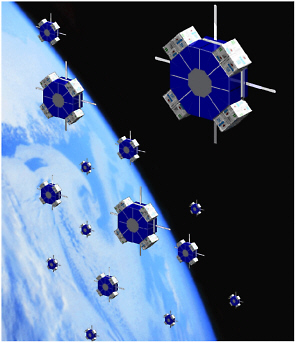
FIGURE 3-2-1 Swarm of nanosatellites. SOURCE: Lewis, D., S.W. Janson, R.B. Cohen, and E.K. Antonsson. 1999. Digital micropropulsion. Pp. 517–522 in Proceedings of the 12th IEEE International Conference on Micro Electro Mechanical Systems (MEMS ’99). Piscataway, N.J.: Institute of Electrical and Electronics Engineers, Inc. © 1999 IEEE. |
gate arrays enable real-time reprogramming of sensor networks to respond to different stimuli, to self-configure communications channels or sensor gains for the current environment, and to adaptively coordinate data transfer to a given user as the RF and power environment change. This programmable flexibility should allow mass production of standardized, highly integrated systems that can be used in a wide variety of environments for different applications.
Initially, these systems will be user-preprogrammed before deployment. As the numbers of individual units grow into the thousands for a single application, custom programming of each unit will become excessively tedious. Some degree of intelligent self-configuration and autonomous system optimization will be required. More autonomy, such as adaptive coordination, can be included in new systems as the theoretical modeling of system behavior and operational experience improves. An enhanced understanding of distributed adaptive systems will be required as these systems become smarter and self-reprogrammability improves. A challenge to the future warfighter will be to maintain enough control over distributed self-adaptive systems to ensure that they perform the desired function.
Finally, consider the additional complexity of having intelligent distributed platforms that move on the ground, in the air, or in space. Geometric configuration can change on demand to send groups of units to individual targets, to avoid mechanical or electromagnetic attack, to provide variable effective aperture for radio frequency reception or transmission, or to maintain system functionality as individual units fail or are eliminated. Techniques for distributed real-time optimization for specific functions with changing system geometry and network connectivity will have to be developed.
Findings and Recommendations
Finding 3-3. In sensors, especially for remote sensing applications of importance to the Air Force, there are a large number of high-performance requirements and military-specific functions that are clearly beyond the scope of commercial interests.
Recommendation 3-3. The Air Force should support in a sustained manner the research, development, and manufacturing infrastructure for military sensor systems.
Finding 3-4. The resurgence of the commercial MEMS sensor industry represents an opportunity for the U.S. Air Force to harvest improvements in military-specific MEMS devices. The maturing of the overall MEMS industry and increased MEMS activity in the telecommunications market have
dramatically increased the performance of design tools and the availability of complex space-qualified MEMS devices.
Recommendation 3-4. The Air Force should actively pursue improvements and/or adaptations of commercial efforts for military needs and be prepared for a larger investment at the 6.2 through 6.4 levels. This recommendation is not meant to imply total reliance on commercial sources. Commercial interests may drive the market in a different direction than is needed by the military, and commercial interests may interfere with military interests in the MEMS-based community.
Finding T4. Large, distributed fixed arrays and moving swarms of multispectral, multifunctional sensors will be made possible by emerging micro-and nanotechnology, and these will lead to significant fundamental changes in sensing architectures. Concepts such as smart dust and distributed communication networks actively exploit the technological capabilities of emerging micro- and nanotechnologies. The fusion of data from large numbers of sensors as well as large numbers of sensor types will drive research in new networking concepts.
Recommendation T4. The Air Force should develop balanced research strategies for not only the hardware but also the requisite software and software architectures for fixed arrays and moving swarms of multispectral, multifunctional sensors.
BIOLOGICALLY INSPIRED MATERIALS AND SYSTEMS
Most natural materials exhibit a combination of desirable properties—for example, strength, flexibility, and light weight—that are not usually found in synthetic systems. Examples include spider silk and a bird’s bone structure. The unique properties and performance of these natural substances arise from a precise hierarchical organization at the micro- and nanoscales, coupled with nature’s use of composite materials incorporating inorganic components alongside biological materials, e.g., bone or tooth enamel. Therefore, it is important to investigate, understand, and ultimately reproduce nature’s ability to precisely integrate organization at the atomic and molecular levels. Using the molecular forces of nature to create materials templates and/or to solve nanoscale assembly problems, e.g., self-assembled monolayers,138,139 nanotubes, molecular motors,140 biotin-avidin binding,141 and hydrophobic/hydrophilic surfaces,142,143,144 has already been demonstrated. Bioorganisms may one day be employed to perform directed nanomanufacturing of complex structures. Already, genetically engi
neered bacteria and plants are in use to produce drugs and other chemical compounds. There are biological organisms, e.g., radiolarians, that manufacture silica exoskeletons with highly complex geometric shapes. Given the rapid emergence of genetic engineering, it may soon be feasible to bioengineer radiolarians that can manufacture specific shapes on the surface of silicon chips to create the two-dimensional templates for integrated circuit fabrication, a task now accomplished with photolithography. Similarly, such organisms could be used to manufacture three-dimensional micromechanical scaffolding for MEMS and NEMS (nanoelectromechanical systems). Alternatively, it may be possible to synthetically re-create their handiwork. Mesoporous silica has already been implemented in forming self-assembled, three-dimensional, porous layers with porosity that is controlled by the wavelength of light to which it is exposed.145,146
The interconnection between specific types of circuit elements, e.g., transistor gates, may also be achieved by self-assembling biosynthesized materials that are attracted by specific mechanical or chemical signatures to specific sites. Biological systems utilize highly elaborate and often dynamic self-assembled interconnection. Neurons are known to emanate from one type of cell and to search out, find, and attach to another cell by some sort of (presumably) chemical sensing mechanism. This neural wiring occurs, for example, during all stages of development, and during recovery from neural injury. Guidance of cell growth by grooves etched in silicon surfaces147 was a recent demonstration of directed self-assembly using microscopic topographic effects.
Biomimetics for Improved Sensing, Communications, and Signal Processing
New sensing, communications, and electronic signal processing ideas might be drawn from an understanding of the “intelligent” behavior of neurons and cells. Cells are known to sense and respond to thermal, optical, chemical, mechanical, and electrical stimuli, e.g., elongation due to shear stress,148,149,150 and galvanotaxis,151,152 but the underlying mechanisms are not well understood. For example, what is the electric field sensor in an epithelial cell or the shear sensor in an endothelial cell? Communication between adjacent cells is also evident but largely unexplained. In large neural networks, the mechanisms by which the frequency of oscillation is produced and controlled and by which the phase relationships among oscillatory neurons are maintained are generally not understood. Yet, oscillatory dynamics within neural networks, such as those associated with simple rhythmic behaviors, motor control, sensory perception, and sleep, are found at all levels of the nervous system in both invertebrate and vertebrates. For example, central pattern generators, which control rhythmic motor behaviors,153 are networks of neurons which by themselves can generate a motor pattern associated with a particular behavior, in the absence of sensory feedback or descending control from
higher centers. The study and understanding of these and similar biological networks154 may produce new directions for communications theory and practice.
As our understanding of cell membranes expands, the idea of creating artificial cell membranes as sensing elements will become a reality. Bilipid membranes with selective transport elements, e.g., ion channels, that respond by opening or closing in response to a target biotoxin have already been demonstrated.155,156 This device is a synthetic mimic of a nerve-cell membrane. The very large difference in open versus closed ion-channel conduction provides built-in amplification for this sensing mechanism, promising single-molecule detection sensitivity. Integration of this technology with integrated circuits is an obvious next step to provide the necessary high-density signal acquisition and processing.
Biocomputing is a new term that refers to the use of highly specific binding of molecules in sequence, e.g., the hybridization of DNA molecules, to perform mathematical or computing functions. Modest examples of biocomputing have already been demonstrated.157 However, since biological systems are less than perfect, a synthetic system based on the same scheme is envisioned to achieve reliability. Nature relies on imperfections to evolve and on redundancy and adaptation to survive. Synthetic systems design could also benefit from these features, which could allow them to achieve autonomy, self-repair, and adaptation to new environments or situations.
Biological macromolecules, cells, and sensory organ systems utilize energy transduction mechanisms that often are not primarily electronic in nature. The primary response to a stimulus often begins with a chemical release, conformational change, or mechanical deformation, followed by secondary transduction events. MEMS and NEMS now enable the use of mechanical reaction to stimuli as a means of sensing. Examples include microbridges with chemabsorbing layers158 that change mass, which in turn changes their resonant frequency, and microcantilevers that deflect when DNA hybridization takes place on their surface.159,160 Some MEMS sensors have been demonstrated that mimic the mechanical transduction of specific biological sensory organs, including a directional acoustic resonator based on the fly’s ear161 and an accelerometer with fluid mass162 based on the human inner ear.
Many animals possess exceptional sensing capabilities for which artificial replicas have yet to be demonstrated—for example, the heat-sensing capabilities of snakes, the nighttime visual acuity of owls, pheromone detection by moths, odor detection by kiwi birds and dogs, and vibration detection by spiders. New and improved methods of detection, location, tracking, and identification of human life signs and ground-based vehicles are needed for the Air Force as well as other branches of the military. Currently, much focus is placed on electromagnetic means, e.g., infrared detection. However, improved sensitivity to specific gases and molecules, e.g., CO2, pheromones, and NO, would enhance the ability to detect the presence of enemy troops. Vibration detection and identification
through frequency signatures could be used to detect and track ground vehicles. It has been observed that many animals can detect approaching or faint earthquake tremors before humans and seismic instruments. What is being sensed and how are yet to be discovered. Reconnaissance mission capability could be expanded by using drones to deliver gas- and vibration-sensing systems to ground locations, where they autonomously set up and begin intercommunication and then proceed to perform, for example, triangulating methods of detection and tracking and to transmit the information to airborne vehicles.
The actuation mechanisms and signal generation capabilities of biological systems also have relevance to the development of autonomous microsystems. Bioluminenscence of fireflies and many fish, electric-shock-generating organs of eels, water-powered actuators of jellyfish, and the jumping ability of fleas are all examples of highly developed biological actuators. Applications to micro- and nanosystems are many, including energy conversion for power generation, mechanical amplification, and optical readout.
Enhanced Human Performance—The Machine as Part of the Man
Micro- and nanotechnology offer new inspiration for an old concept, the bionic man (or cyborg). Implanted sensors, neural interfaces, and muscle-controlling devices have appeared in science fiction novels and movies for many decades. In recent years, biomedical engineering has made numerous, significant advances in this arena, including the artificial heart, artificial joints and limbs, and muscle-stimulating electrodes. Micro- and nanotechnologies make these devices less invasive by reducing size and increasing “smarts” through the integration of high-speed signal processing and control circuitry and through advances in biocompatible materials. These advances reduce the problems associated with implant surgery and rejection and improve the lifetime, capability, and performance of biointerfacing devices. For the Air Force, improved human performance could mean better vision, enhanced by IR detectors interfaced to the optical cortex, or monitoring of pilot brain function to intervene in the case of high-G blackout or falling asleep during any machine operation. Another application is in self-diagnosis, medication, and accelerated healing of personnel in the field. Intelligent bandages that use electrical stimulation to accelerate healing and detect and treat bacterial infections are currently in the research stages. Microneedles for drug delivery and for biofluid sampling are in product development today. It appears that the “hypospray” and “tricorder” of Star Trek fame are not that far away from reality. Other enhancements of human performance may come from a reduction in sleep and food requirements. Transdermal feeding and regeneration devices are quite possibly next-generation developments of microneedles and electronic bandages. Wearable computers and electronic clothing that monitor the wearer’s vital signs are already in development. Enhanced capabilities for these “garments” are foreseen—for example, elec-
tronic camouflage, body temperature control, hydration control, and proximity and environmental monitoring are all feasible. The Air Force could apply self-reliance advances to enhance the survival of downed pilots and prolong the endurance of personnel in space. In all instances involving implanted devices, research will require FDA approval as well as the federally required oversight by the local institutional review board as a safeguard for any research involving human subjects.
Findings and Recommendations
Finding T3. Biological science offers new opportunities in nanotechnology systems, especially for sensors, materials, communications, computing, intelligent systems, human performance, and self-reliance. Millions of years of evolution have produced highly specialized sensing and communication capabilities in nature. Understanding of how these sensors work is growing but is still very limited. As the fundamental mechanisms are discovered and studied, applications rapidly follow. Advances in micro- and nanotechnology have enabled discovery in biological systems, which in turn has provided new means of sensing and communicating. Clearly, advances in technology and in the biological sciences go hand in hand in developing new capabilities.
Recommendation T3. The Air Force should closely monitor the biological sciences for new discoveries and selectively invest in those that show a potential for making revolutionary advances or realizing new capabilities in Air Force-specific areas.
STRUCTURAL MATERIALS
Introduction
The range of operational requirements for the most visible parts of military systems—the physical structures and platforms—is exceptionally broad and often extreme. Structures of special military importance include satellites and other spacecraft along with their specialized structural components, aircraft, land vehicles, water vehicles, missile systems and other weaponry, and warfighter support and protective equipment. In general these structures and platforms need to be lightweight; exceptionally strong, tough, and durable; tolerant of extreme temperatures (especially very high temperatures); and suitable for use in extraordinary environments such as high altitudes, space, saltwater, desert, arctic, and other extreme climates.
Future systems may be given enhanced capability by endowing structures with multifunctional attributes. In addition to housing and protecting its contents, a structure may be required to alter shape, actively provide cooling, reduce flammability, sense its environment, repair itself or change its dielectric or other properties.
A structural materials topic that is especially relevant to this study but generally overlooked when considering nanoscience’s importance to macromilitary systems is structural materials for microelectromechanical devices. Since the miniaturization of electronic and sensor systems by way of MEMS technologies is essential for future defense systems, it is important to consider the technical issues and opportunities associated with the nanoscale materials needed to construct MEMS components.
Four areas projected to have major impacts on emerging nanoscale structural materials for Air Force systems and missions are discussed in this chapter. These areas are the following:
-
Lightweight materials. Tough, strong, and durable lightweight structures and structural materials would enable lighter and faster aircraft and weaponry, with lower associated logistics costs. Such technology would also allow the launching of satellites and other spacecraft at less cost both because the structures on the satellites themselves are lighter and because subsystems used in the launch, like hydrogen fuel tanks, could be made more durable, more resistant to damage, and reusable.
-
Improved coatings. Wear-resistant and corrosion-resistant surface coatings and tribological surface treatments would improve the durability and function of structure surfaces. Improvements in surface coatings and treatments for aircraft can reduce maintenance costs and extend the useful life of airplanes and other systems.
-
Multifunctional structures. Multifunctional structures combine other functional features with purely structural uses such as thermal management functions, sensing, movement or shape change, energy storage, and self-inspection and self-repair. Such capabilities would improve thermal designs for supersonic aircraft and missiles and for spacecraft entering or leaving Earth’s atmosphere, augment systems sensing capabilities, improve power and guidance systems, or simplify repair and maintenance processes.
-
Materials for MEMS. Microstructural materials with reduced fatigue or creep and surfaces with suitable friction, stiction, and wear properties are essential to the successful transitioning of MEMS device technologies into their target applications. MEMS technologies will revolutionize Air Force system and subsystem designs by allowing the radical miniaturization of electronic, optical, mechanical, and sensing components.
Lightweight Materials
The quest to develop lighter structural materials with all the necessary mechanical properties normally found only in heavier materials (conventional metals, ceramics, etc.) is being pursued on several fronts. These include the strengthening of conventional materials, the development of lighter metal alloys, and the creation of novel composites or hybrids of a number of different material types combined to create a structural material by design.
Long before the term “nanotechnology” became commonplace, the benefits of manipulating the grain structure of materials on the nanoscale were known and exploited. Increased strength and reduced creep (or other irreversible, detrimental mechanical property changes over time) in finely grained, nanostructured materials is not well established in many polycrystalline materials systems. These nanoscale materials can provide for stronger, more durable, and more stable structures. The classic model for how the strength of metals increases as grain size decreases163 describes the pileup of dislocations at grain boundaries, producing stress, which when added to applied stress results in slippage across the boundary. Smaller grains result in a smaller pileup of dislocations and less stress, with a larger external force needed to create slippage (and therefore a stronger material).
The goal of developing manufacturing methods and processes that produce materials with ever-smaller grain size has been pursued in metallurgy for decades. Nanoscale control of the grain structure of lightweight aluminum and aluminum alloys could be of value especially for aerospace structures. In addition, improvements in mechanical properties and the allowed operating temperature of titanium and titanium alloys are being pursued using nanoscience approaches. Large increases in the yield strength of metal alloys are well documented for nanoscale-grain materials relative to conventional microscale grain alloys. Methods of refining the grain structure of metal to the 50-nanometer (or so) scale have been reported.164 In addition to greater yield strengths, combinations of desirable features such as improved ductility and strength can be designed in, as can hardness for metals and metal alloys composed of nanostructured materials. However, it can be difficult to avoid grain growth when metals with such fine grain sizes are subsequently heated. Researchers at AFRL and elsewhere are working on methods to increase the thermal stability of nanophase metals and alloys so that they retain their superior mechanical properties at elevated temperatures.
For ceramic materials, a goal has been to enable net-shape manufacturing of consolidated ceramic nanoparticles (such as titania or alumina) with a shape and dimensional precision beyond that possible with conventional processes. The role of nanoscience here is to aid in understanding the behavior of the nanosize grain boundaries, which can slide under stress without breaking bonds as a result diffusional healing, an atom transport mechanism that can take place over very
short distances characteristic of nanoparticle-formed grains.165 Ceramic structures can be made more easily and much less expensively if such net shape-forming processes are made more capable.
The subject of structural nanomaterials was given a comprehensive review at a recent Army-sponsored NRC Workshop on June 20-21, 2001.166 The workshop dealt with the synthesis, assembly, processing, fabrication, and manufacturing of a variety of nanomaterials along with structure characterization and the modeling, simulation, and application of these materials. Methods for producing grain sizes of less than 50 nanometers for ceramics, metals, polymers, and composites were discussed. Most of the workshop participants, dealing with nanosize particles as basic building blocks, concluded that while progress is being made, challenges remain on virtually every front in developing processes to consolidate nanosize powders into useful and stable forms at useful manufacturing scales. Also discussed at the workshop were severe plastic deformation processes that “work” materials to produce ultrafine grain sizes and increased strength. The equal-channel angular pressing type of severe plastic deformation is reported to be especially promising for Air Force applications such as lightweight aerospace structures.167
The mechanical strength of nanosize, superstrong fibers such as carbon nanotubes and perhaps other materials such as boron nitride nanofibers, coupled with the lower density of these materials, offers the potential for much lighter composite structures that are stronger and tougher than conventional structural materials. This is a key advantage sought in the aerospace world for spacecraft, aircraft, and military systems. Theoretical studies suggest that the Young’s modulus and the breaking strength of single-wall carbon nanotubes, for example, should be exceptionally high. Recent experimental measurement of breaking strength and Young’s modulus tends to support the theory.168 However, the mechanical properties of such nanowires, -tubes, or -ribbons must be not only probed and characterized but also manipulated and optimized at the scale of individual tubes and assemblies of tubes if these concepts are to be made practical.
The mechanical properties of assemblies of these wires or fibers must be understood as must be their properties in conjunction with the matrix material with which they are to be hybridized. Carbon fibers with a tensile strength up to 6 GPa are commercially available. Initial experimental measurements on 4-micron-long, single-wall carbon nanotube (SWNT) “ropes” consisting of tens to hundreds of individual SWNTs bound in van der Waals contact have yielded values up to 45 GPa.169 The hope is that millimeter-long SWNTs can be formed into longer fibers or dispersed into a composite matrix while still maintaining a significant fraction of this observed order-of-magnitude improvement in strength over conventional carbon fibers.
Very large yield strengths (a measure of how much the material can stretch without breaking) of 5 to 10 percent have been observed for carbon nanotubes. This perhaps excessive ability to stretch may make this type of material imprac-
tical for aerodynamic structures, or, alternatively, it might be looked upon as an opportunity to incorporate a morphing material to produce something akin to flapping wings.
Methods for synthesizing nanotubes, controlling their orientation and bonding character, and producing them in macroscopic quantities are at an early stage of development. Also at an early stage are methods for fully characterizing the basic properties, especially the mechanical properties, of assemblies of structures,170 and for using them in practical structures.
The superior aerodynamic performance enabled by use of lightweight structural materials of suitable yield strengths would be of particular value to the Air Force. Improvements in strength-to-weight and stiffness-to-weight ratios are sought. Subsonic aerodynamic performance at all altitudes improves with wing aspect ratio (span to chord ratio); this ratio is constrained in many applications by the structural weight penalties associated with very long, thin wings. Nanoscience innovations such as carbon nanotube composites offer the possibility of reducing the weight penalties sufficiently to allow aerodynamic performance to dominate the design.
Improved Coatings
Hard, durable surfaces with suitable aerodynamic features are essential to all aircraft, spacecraft, and other vehicles. The tribological properties of coatings are the key to wear resistance of radomes, windows, and many other components of military systems used in extreme conditions. It has been suggested by numerous studies that the design of super-hard, wear-resistant composite coatings is feasible using nanocrystalline constituents having the mechanical properties associated with the fine-grain structure such as resistance to classical dislocation formation and slip.171 Coatings that can withstand extreme temperatures, abrasion, and wear are especially important for advanced aircraft and space vehicles.
For materials used as coatings or surface treatments, including composite materials, multilayer structures, and materials with unusual elastic properties, the relationship between grain size and orientation and material mechanical properties is complex. In general, the crucial mechanical properties of material structures are controlled by the size and nature of grain boundaries, and those properties may get better as the constituent particles comprising the structure get smaller. At sufficiently small grain size (smaller than several tens of nanometers), the classical relations may break down and more complex behavior take over, such as saturation of strength increase at levels well below the theoretical yield stress maximum derived from basic mechanical properties such as shear modulus. The real benefits that can be derived from implementation of nanostructured materials will therefore depend on a detailed understanding of controlling mechanisms (grain boundary formation; dislocation formation, annihilation, pinning, and movement) at the nanoscale regime.
A major practical limitation on the implementation of hard coatings, generally, is that there is inevitably residual stress in the films, which limits the thickness that can be applied and therefore the overall protective capacity of the coating. Some techniques are being explored to allow deposition of coatings that have grain sizes less than 100 nanometers. This not only can increase the hardness and toughness, as noted before, but also can dramatically reduce the residual stress state of the nanostructured coatings and increase by a factor of as much as four the coating thickness that can be applied.172 Such thick, hard protective coatings would clearly be a substantial advantage for Air Force systems.
Nanotechnology is also employed in multiple dimensions in searching for ways to improve surface coatings. In addition to controlling the grain size of the basic materials in order to improve mechanical properties, novel schemes are being explored to use complex multilayers that are themselves constructed on the nanoscale at a few monolayers in thickness. In this regime, the mechanical properties of the composite films do not follow the same deformation mechanisms as micron-scale materials. For example, periodically structured multilayers of selected metal layers that are relatively soft on the macroscale can exhibit ultrahigh strengths in nanostructured layers.173 Moving to the regime of interface- rather than bulk-dominated mechanical properties as we move to the nanoscale from the microscale is the key to constructing durable, hard coatings and thermal barriers on the surface of structures.
Multifunctional Structures
Incorporation of active material layers, fibers, or particles to produce movement, exert force, or permit alteration of mechanical shape under stimulus (e.g., for self-repair, or for deployment of mechanical structures) is an area just at the beginning of exploration. The development and application of active or smart materials (such as shape memory alloys and polymers, piezoelectrics, electro-elastomers, and magnetorestrictive materials) and composites using these materials have advanced dramatically in recent years. The incorporation of nanotechnologies in the design of such materials is in the concept stage. Compelling military and aerospace applications include ultracompact actuators for navigation of missiles and aircraft, morphing structures such as antenna reflectors that can change shape or reconfigure, robotic structures, and structures that can reestablish their original shape after damage or use.
Important here is the prospect of using materials such as carbon nanotubes as part of the architecture. For example, the extremely high thermal conductivity of carbon nanotubes is cited as a property that could be incorporated into thermal management components on surfaces or embedded in system structures, along with the favorable mechanical properties for lightweight structures.174 More generally, it is envisioned that nanocomposites specifically tailored for their thermal
properties may someday add a useful dimension, thermal management, to complex structures operating in extreme temperature environments.
Another area of multifunctionality that is being pursued at NRL, for example, is the use of structures that also store or provide energy. This includes concepts such as structures with embedded, conformally shaped batteries. Another example is self-consuming structures with solid fuel elements that provide structural stiffness until they are consumed, so that as the stiffness is reduced, so is the mass of the structure.175 Some of these concepts involve the science of nanoscale materials.
Other connections of multifunction structures to the nanoworld are the ways being explored to improve smart or active materials (such as shape memory alloys and piezoelectrics) by manipulating their properties on the nanoscale or using nanoscale layers and multilayers in the designs. Similarly, schemes to incorporate low-observable, stealthy characteristics to structures are looking to materials science control on the nanoscale to achieve these goals.
A different application area associated with multifunctional structures is self-healing structures. One such concept is the use of self-assembled monolayers and multilayers of organic materials that exhibit inherent self-healing from scratches and similar damage as protective coatings, corrosion inhibitors, or adhesion promoters.176
The AFRL is investigating the self-passivating and self-healing properties of polymeric nanocomposites used in connection with the well-known practice of using organic or inorganic fillers to reinforce polymers. Examples of nanoelements used for this purpose are layered silicates and carbon nanotubes. These can be dispersed in resins and processed to produce materials with tailored glassy and/or rubbery moduli. For applications such as thermal protection, polymer-layered silicate materials act as ceramic precursors that form protective ceramic coatings when exposed to high temperatures, effectively self-healing and self-protecting the underlying structures in elevated-temperature environments.
At the University of Illinois, work is reported on the use of composites embedded with fluid-filled particles that break when the structure is damaged and release a reactive polymer that is catalyzed by dispersed catalytic particles within the matrix resin. A substantial fraction of the fracture toughness of woven composites can be recovered in structures that have suffered microcracking using this self-healing method.
In general, multifunctionality in structures will be further enabled by the miniaturization of sensors, electronics, and energy storage and generation devices—a major theme of this report. Owing to their smallness these devices can be more readily embedded and integrated into the framework and structures of systems.
Materials for MEMS
The fact that the mechanical properties of structures of microdimensions can be very different from those of analogous macrostructures has been recognized for some time, but the real practical implications are just now being explored comprehensively. For example, the Materials Research Society has devoted a symposium to the topic of materials science for MEMS every year for 3 or 4 years. It stands to reason that if the mechanical structures themselves are on the order of microns, then the grain structure of mechanical materials is very important and must be understood and controlled precisely at the submicron scale in order to optimize the MEMS mechanical function.
The magnitude and nature of built-in strain in the MEMS structures is extremely important to their practical applications. The grain size and deposition and annealing history are among the important factors in determining residual strain and the effect that this will have on the overall MEMS process. To date, MEMS mechanical properties have been studied most thoroughly in polysilicon177 and in the sacrificial layers most often used in the MEMS process flows, such as silicon dioxide and silicon oxynitride films.178 Also being investigated are the effects of metal fatigue and anelastic creep on metal MEMS mechanical structures produced by various processes and involving such materials as Au, Ni, and Ni alloys. Just as for macrosize metal structures discussed previously, the nanostructure of metallic materials resulting from the deposition or forming process used will clearly affect the mechanical properties of MEMS devices. However, in the MEMS size world, these effects will dominate.
Also very important at the micron scale (but not usually on the macroscale) are the effects of surface roughness and surface morphology on the mechanical integrity and strength of MEMS devices. The surface character of the top, bottom, and sidewalls of MEMS structures plays a profound role in mechanical quality factors and other mechanical figures of merit. The control and optimization of all the surfaces of relatively complex mechanical structures throughout the fabrication and packaging processes have been among the most challenging of the technical obstacles to MEMS developers to date.179
Many types of materials have been investigated for MEMS applications, including variously doped polysilicon, amorphous Si, single-crystal Si, SiC and other Si alloys, III-V semiconductors, quartz, diamond, and various types of metals and metal alloys. In a number of applications, the limited durability of the MEMS mechanical structure is a severe issue for practical applications. Finding harder, more durable materials than the pervasive silicon and polysilicon is one avenue that is being pursued. Another is to find ways to apply hard coatings to MEMS structures that permit them to withstand surface sliding and mechanical contact.180 The technical issues involved in hard coatings for MEMS are analogous to those involved in depositing hard coatings on macroscopic structures, but are even more intertwined with material science at the nanoscale.
It is well known that on the microscale, where capillary forces can dominate, surface effects are dramatically different from effects on the macroscale. For this reason, the MEMS developers wage a constant struggle with stiction, the sticking of MEMS surfaces that are meant to be mechanically free, during fabrication, processing, or use of MEMS devices. This phenomenon is significant only at MEMS scales and is a major constraint on yield and operability. In recent years, there has been considerable work toward understanding the forces that cause stiction and toward devising approaches to reduce or eliminate it.181 Methods for avoiding liquid phase interactions during fabrication such as supercritical drying and dry etching have been developed, and commercial fabrication equipment makers have followed with tools to use in manufacturing of MEMS devices. Hydrophobic coatings have been employed and various surfactant treatments employed to avoid mechanical collapse of the MEMS structures and their pinning to surfaces. This has been a critical technical obstacle to overcome in the application of MEMS and is an example of why the road to mass-manufacturable, high-performance MEMS components has been so long.
Technical Issues and Areas for Development
Although for structural applications it is the mechanical and thermal properties evoked by nanotechnology rather than the electronic and photonic properties used for information and sensor applications, many of the technical issues are similar. The primary areas of technical development supporting improved structural materials include these:
-
modeling and simulation
-
deposition, fabrication, consolidation or assembly processes for forming the materials
-
characterization, testing, and analysis at the nanoscale
-
scale-up and manufacturing issues
Some very specific technical issues relating to nanocrystalline materials include the following:
-
There is a lack of understanding of the controlling mechanisms as grain size gets below about 50 nanometers for most materials, including thin films and coatings of various types. Viable models, reliable simulations, and quantitative experimental guidelines will have to be developed if materials by design are to be realized for Air Force systems. In addition, effective methods for measuring, classifying, and sorting nanoparticles will have to be developed for use in practical manufacturing processes.
-
The instability of the nanosize grain structure at elevated temperatures182 is the limiting issue in synthesis and manufacturing processes as well as
-
in structure fabrication and implementation strategies. Grain size growth or subgrain growth may occur at higher processing temperatures or during use at higher temperatures. Clearly, nanoscale-structured materials can be useful only if the nanosize can be maintained.
-
The inherent reactivity of very tiny nanoparticles (such as carbon- or aluminum-containing particles) makes producing, handling, and using such materials difficult and potentially explosive. Although this reactivity is the basis for developing nano-scale energetic materials for propulsion or explosives, in the realm of applications for structural materials it is a serious manufacturing problem. In addition to the pyrophoric nature of metallic nanoparticles, in large-scale manufacturing settings there may be health and safety issues associated with handling nanopowder raw materials. Issues like these would have to be addressed when developing manufacturing strategies and implementations.
-
The characterization and experimental analysis methods for dealing with nanosize particles, wires, tubes, and ribbons require new tools and new approaches. Measuring the Young’s modulus of such a tiny structure as a nanotube would clearly be unlike a conventional measurement. Tools to “see” and manipulate structures on the nanoscale are essential, but their development is still at early stages. The quality control and process monitoring tools that will be needed for full-scale manufacturing using nanomaterials are still further away from realization at this time.
-
The myriad of structural materials issues involved in the design, process flow, and assembly of MEMS devices are the key obstacles to deployment of high-performance MEMS components in military systems.
Findings and Recommendations
Finding 3-5. The application of nanoscience to structural materials is a promising area with important implications for Air Force systems. Such materials could be used for lightweight structures, improved coatings, multifunctional structures, and micromachined structures. Military-specific structural materials applications need special attention by the Air Force. Many of the emerging nanoscience developments will march ahead without regard to potential Air Force needs or imperatives, and some will find their way into commercial products. However, some military structural materials needs will never be addressed by commercial industry. These include stealthy structures, thermal management structures for spacecraft, lighter-weight military aircraft, and structures for reduced logistics and maintenance costs. However, if the Air Force is to exploit and implement the most compelling advances, even those from the commercial world, then aerospace system designers and manufacturers and their suppliers as well as the Air Force users
must constantly be aware of those advances. There need to be mechanisms to link technical developments to military system applications throughout the entire supply chain.
Recommendation 3-5. The AFRL should continue its strong efforts in structural materials to capitalize on research and development advances. The Air Force should invest in establishing capability on the part of contractors to supply selected military-specific products at the same time as it invests at AFRL to encourage collaboration with cutting-edge researchers and the comprehensive tracking, where possible, of research and development and steering it toward Air Force needs.
Finding 3-6. Nanoscience as applied to the structural materials used for MEMS components is key to the successful deployment of MEMS technology. Unresolved issues such as stiction prevention, sidewall morphology, and durability and stability of micromechanical structures are obstacles to the deployment of reliable MEMS sensors and actuators in military systems.
Recommendation 3-6. The Air Force should focus development resources on materials issues that currently limit MEMS deployment for the military. These include structural stability, surface durability, manufacturable fabrication processes, and packaging.
AERODYNAMICS, PROPULSION, AND POWER
Warfare has always required the transport of troops and materials to and across the battlefield. Modern warfare adds the transport of information and energy and extends the range of the battlefield across the globe and out to geosynchronous orbit. Although transatmospheric transport using ballistic missiles and rockets can provide the fastest transfer of personnel and materials across continental distances, air-breathing aerodynamic vehicles will continue to provide the lion’s share of rapid transport for the foreseeable future.
Multiple challenges exist for maintaining air and space superiority over the next 50 years. The major challenges will be these:
-
to maintain air vehicle survivability—for instance, by means of better IR sensors and flight control—against ground and air-launched threats that incorporate ever-increasing technological sophistication
-
to maintain cost-effective, long-range rapid transport capability with increasing fuel prices
-
to reverse the trend of significantly increased cost per vehicle for each new generation
-
to provide less-expensive, faster-response launch systems
-
to protect space-based assets from man-made threats—for example, antisatellite weapons and space debris
Propulsion is at the heart of aerospace vehicle design since the propulsion system and its fuel account for between 40 and 95 percent of the initial system mass. Propulsion is needed to power vehicles ranging in size from grams (for unobtrusive airborne and spaceborne sensors) to hundreds of tons (for large aircraft and launch vehicles). Modern warfare also requires energy—energy in modest quantities for C3I (watts to kilowatts) and in very much larger quantities for weapons (megawatts and above). Micro- and nanotechnology applied to propulsion and power may offer the opportunity for significant evolutionary improvements to current systems and may enable revolutionary new systems and capabilities.
The technical challenges may be met by utilizing a combination of micro-and nanoelectronics for communications and information processing, MEMS and NEMS for sensors and distributed actuators, and molecularly engineered materials for ultralightweight structures. Batch fabrication, self-assembly, and high levels of functional integration during the fabrication process will be required to make these highly sophisticated systems and subsystems affordable.
Flight Vehicle Aerodynamics
Micro- and nanotechnologies offer the possibility of dramatically improving the aerodynamics of flight vehicles in two principal ways. The first is through direction modification of the aerodynamics by microdevices and the second is through materials changes that achieve more favorable fluid mechanics behavior.
Although the lift and drag of large aircraft is tens or hundreds of tons, the aerodynamics within a few millimeters of the vehicle surface has a profound impact on vehicle performance. This so-called boundary layer is the result of the viscous nature of air and the high characteristic speeds and length scales of man-made vehicles. It has long been known that local manipulation of the boundary layer can radically alter first-order vehicle performance parameters such as drag and stability. A relatively recent research field is the active control of fluid mechanics, which uses high-frequency, dynamical control of aerodynamic surfaces to alter the mean aerodynamic behavior. Subscale experiments have demonstrated that such active control can be used to alter the turbulent nature of the flow, perhaps leading to laminar flow vehicles with dramatically increased range and payload compared with existing aircraft. A second flow control application uses unsteady manipulation of the boundary layers to generate large forces and moments to achieve control and maneuverability of the flight vehicle. These controllers would supplement or replace conventional large-scale control surfaces, their actuators, and hydraulic lines and valves. This would alter the steady-
state performance versus controllability design trades, bringing advantages such as reduced drag, weight, and observability.
Most approaches to active fluid control require large numbers of sensors and actuators distributed over the aerodynamic surfaces to locally influence the flow. The sensing and actuating frequencies required are generally on the order of 1,000 Hz. For this reason, MEMS approaches appear very attractive since they could allow low-cost manufacturing of large numbers of thin-film systems containing sensors, actuators, and local computation. Also, while the sensing requirements may be met with multiple technology approaches, the high actuation frequencies require very small, low-mass machines—in a word, MEMS.
MEMS-based control of aerodynamic surfaces has been demonstrated by researchers at the University of California at Los Angeles and at the California Institute of Technology under a DARPA-sponsored program. In the case of a delta wing under flight, the naturally occurring pair of primary vortices provides a mechanism for amplified distributed control. These vortices start near the leading edge and convect down the wing. The genesis location of these vortices determines the overall characteristics of the resulting large primary flow structures, and all six components of forces about an aircraft can be controlled.183 Wind tunnel experiments using a 56.5 degree sweepback delta wing with a 31.8-centimeter root chord have shown that distributed 2-millimeter MEMS “bubble” actuators on the leading edge can provide positive roll control comparable to that obtained using conventional trailing edge flaps that are two orders of magnitude larger.184 MEMS fabrication techniques also enabled the development of distributed shear stress sensor arrays for high-speed measurement of two-dimensional shear stress patterns on wing surfaces. Current research is focused on determining control laws for unsteady flight control. The goal is to make a delta-wing aircraft maneuver without using a rudder or any other macroscopic control surfaces.
Technical issues for MEMS-based aerodynamic control include scalability to full-size flight vehicles, suitability for supersonic and transonic vehicles, and robustness of flight control under real-world dust and icing conditions. These issues must be addressed by full-scale flight-testing programs.
Vehicle Health Monitoring
As mentioned in a previous section on sensors, distributed MEMS-based sensors can be used to measure pressure, velocity, and shear stress distributions on aerodynamic surfaces to aid in flight vehicle development and qualification. In the longer term, similar sensor arrays could be permanently integrated into flight hardware to provide continuous health and status monitoring. Distributed stress sensors could provide stress cycle information that would be used to determine when and if airframe components need to be replaced. During battle, distributed stress and vibration sensors would provide real-time assessment of im-
pact damage and distribution. Note that this technology would be applicable to both air vehicles and launch systems and could be readily integrated with MEMS-based aerodynamic control. Technical issues include the robustness of individual sensors to real-world flight conditions (the Boeing pressure sensors had to be redesigned to withstand particle impacts), the real cost of add-on or integrated sensor networks, and definition of a standard sensor network protocol for future air vehicles.
Air-Breathing Vehicle Propulsion and Power
Aerospace dominance is one mission of the Air Force—that is, to command the sky from the troposphere to interplanetary space. Current air-breathing, turbomachinery-based propulsion systems operate mostly in the troposphere and occasionally in the stratosphere. The promise of micro- and nanotechnology can be considered in terms of evolutionary improvements to current gas turbine approaches and as an enabler of new, very small propulsion and power systems. These very small propulsion and power systems could be used singly in very small aerospace vehicles or arrayed to provide scalable thrust and power for larger vehicles.
Modern gas turbine engines require parts and subsystems that must operate reliably for thousands or tens of thousands of hours in highly erosive, oxidizing, very-high-temperature conditions, over 2000 K in the main gas path and above 700 K even in the nacelle outside the engine. This extraordinarily harsh environment severely restricts the range of materials and designs that can be considered. Thus, most engine materials have been specifically developed with propulsion system applications in mind. Development of micro- and nanomaterials is likely to follow a similar path.
Evolutionary Improvements
One class of evolutionary improvements to gas turbines is MEMS-based flow control concepts, which are in many ways similar to those discussed for air vehicle aerodynamics. Improvements to the steady-state aerodynamics through flow control of gas turbine propulsion systems could include inlet and compressor end wall aerodynamics. Several projects are currently investigating unsteady control of inlet and nozzle flows. Should they be successful, these approaches would offer such benefits as reduced weight, signature, and fuel consumption, with range–payload system improvements of 5 to 10 percent. Another concept uses flow control actuators mounted above the compressor and turbine rotor tips to dynamically synthesize a flowfield resembling that of a much tighter tip clearance, offering significant efficiency and life improvements. Such flow control is more difficult in the turbine due to the much harsher environment.
A somewhat different application of MEMS technology offers new approaches to old gas turbine problems, namely the dynamic system instabilities that plague gas turbines, including rotating stall and surge, combustor instabilities, airfoil flutter, and inlet instabilities. The control or suppression of these instabilities offers improved range payload (by 10-15 percent for surge and stall), reduced emissions, and reduced maintenance. Although the underlying physics and implementation details may vary, the control implementations for these instabilities share the common elements of distributed sensing and actuation. While there are no specific requirements for a MEMS-scale device, the actuation frequencies needed are difficult to achieve with other technologies. Also, technology solutions using large numbers of sensors and actuators are usually quite sensitive to unit cost, which could be low with micro- and nano-approaches.
Micro- and nanotechnologies may also have much to contribute in the area of engine controls and accessories. The control system of a modern aircraft engine now accounts for over 15 percent of the acquisition cost and 40 percent of the maintenance and overhaul costs. One major engineering challenge for these systems is the high temperature, which currently requires that many of the sensors and electronics be located remotely in a cooled environment, thus increasing complexity and cost and discouraging redundancy. High-temperature microsensors and accompanying electronics would be very attractive from a systems viewpoint and might be an enabling technology for some of the flow control schemes discussed above. SiC- and GaN-based, high-temperature micro-electronics and MEMS is the most common research direction aimed at solving this problem. Another approach might use lower temperature electronics locally packaged with chip-level MEMS-based coolers.
Gas turbine fuel controls consist of two principal elements: a computer and a fuel-metering unit controlled by the computer, which consists of redundant transducers, valves, and actuators. These units are now custom engineered for each application, so that many different models are manufactured in small quantities and at great cost. MEMS offers the possibility of developing a standard (albeit very small capacity) integrated fuel management unit, numbers of which operating in parallel would provide the fuel flow required for different size engines. This approach could offer the benefits of lower cost and higher reliability (since the multiple units operate in parallel). Fuel pumps might also be amenable to a similar approach (at least for small engines).
Technical issues for these evolutionary improvements to air-breathing turbomachinery include the integration of MEMS sensors and actuators onto curved surfaces, the transmission of data across rotating surfaces, the development of instability control algorithms and active control for specific applications, and the ability of MEMS sensors and actuators to survive high-temperature chemically reacting flows without fouling. Testing and diagnostic efforts using relevant turbomachinery need to be initiated.
Revolutionary Opportunities
Micro- and nanotechnologies may enable air vehicle propulsion and power systems orders of magnitude smaller than today’s engines. A MEMS approach to propulsion systems on the millimeter or centimeter scale offers several tantalizing advantages. First, the power-to-weight ratio can improve dramatically as size is reduced since engine power scales with the intake area while mass scales with volume. Thus, all else being equal, power-to-weight increases linearly as size is reduced. In other words, this scaling maintains the propulsion system diameter per unit thrust (since the same air must be ingested per unit thrust) but shrinks the length to a few millimeters. Also, the small size facilitates the use of materials with high-temperature properties similar to those of conventional superalloys, such as single-crystal silicon and silicon carbide. Second, the adoption of semiconductor industry wafer-level micromachining approaches means that complex, high-precision parts and assemblies can be realized at very low unit costs.
One example now in laboratory development is a 4-millimeter-thick, 1-cubic-centimeter MEMS-based gas turbine engine, illustrated in Figure 3-14. Figure 3-15 shows a scanning electron micrograph of the batch-fabricated silicon turbine. Initial units are designed to produce about 100 millinewtons of thrust; later units may provide up to 10 times more in similar packages (this is equivalent to 10-100 watts of shaft power). The first units are expected to have quite poor fuel efficiency, on a par with early jet engines, but quite high thrust-to-weight ratios. At our current level of understanding, it seems unlikely that MEMS power systems will achieve fuel consumption equivalent or superior to the best current large systems, but power-to-weight or thrust-to-weight ratios 10-100 times that of the best large systems may indeed be achievable.
Many applications for these microscale propulsion systems can be envisioned. One of the first might be the micro air vehicles (MAVs) under development by DARPA for surveillance and reconnaissance applications. AeroVironment, Inc., has flown the 6-inch wingspan Black Widow MAV for 30 minutes using an electric motor powered by batteries.185 It has a loiter velocity of 25 mph
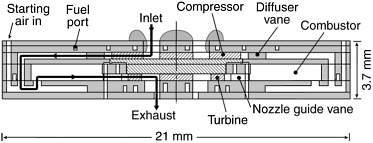
FIGURE 3-14 Micromachined gas turbine engine. Courtesy Massachusetts Institute of Technology.
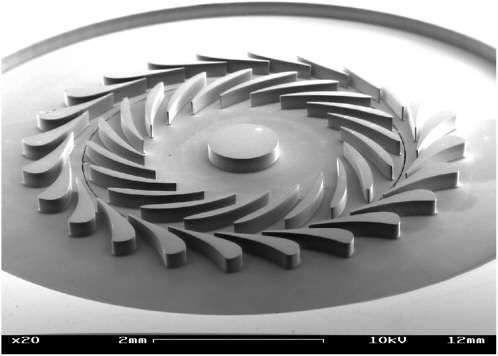
FIGURE 3-15 Silicon turbine from the micromachined gas turbine engine. SOURCE: Epstein, A.H., S.D. Senturia, O. Al-Midani, G. Anathasuresh, A. Ayon, K. Breuer, K-S. Chen, F.F. Ehrich, E. Esteve, L. Frechette, G. Gauba, R. Ghodssi, C. Groshenry, S.A. Jacobson, J.L. Kerrebrock, J.H. Lang, C-C. Lin, A. London, J. Lopata, A. Mehra, J.O. Mur Miranda, S. Nagle, D.J. Orr, E. Piekos, M.A. Schmidt, G. Shirley, S.M. Spearing, C.S. Tan, Y-S. Tzeng, and I.A. Waitz. 1997. Micro-heat engines, gas turbines, and rocket engines—The MIT microengine project, AIAA Paper 1997-1773. Reston, Va.: American Institute of Aeronautics and Astronautics.
and a total mass of 57 grams, and it transmits live color images to a ground-based operator. An order-of-magnitude increase in cruising time is required, indicating the need for micro-combustion engines or generators. A single 100-millinewton thrust engine is sufficient to power a 50-gram gross takeoff weight vehicle (about 6-inch characteristic length) with a 50-kilometer range at 60 knots flight speed. More advanced MAVs could use five to ten engines to generate vertical lift directly, thus enabling both 60-knot standard flight using efficient wing-generated lift plus hovering and low-speed capability for maneuvering within buildings and caves. Insect-sized flyers, an order of magnitude or more smaller than the MAVs currently under development may be feasible within the next two decades.
Batch-fabricated micro-turbine engines can be used on larger vehicles as well since multiple engines can be used as vehicle size increases. Several thou-
sand engines would be needed for a cruise-missile-size vehicle. The high power-density microengine approach is particularly attractive for volume-limited applications such as air-launched munitions. At this scale, thrust would become a commodity in that a common engine design would be used in variable numbers as demanded by the particular vehicle design. This is in contrast to the current practice, which requires a custom engine design for each application with relatively small numbers made of each engine model. The new approach could facilitate more rapid vehicle development and might dramatically reduce propulsion system costs. Longer-term applications would entail the use of very large numbers of microengines (tens of thousands or more) as lift engines for larger aerospace vehicles such as unmanned combat air vehicles (UCAVs). Advanced engine arrays may develop thrust densities of 100 pounds per square foot, levels comparable to the steady-state aerodynamic lift on the wings. This approach offers the advantages of extraordinary redundancy and reduced weight at the cost of installation, interconnection, and control challenges.
The use of MEMS for aerodynamic control, propulsion, and power requires new technologies for packaging and installation. Some of those needed on an individual chip level are now being pursued in conjunction with development of the microdevices. Additional integration issues arise if such chips are to be used in large numbers. The design for installation of large chip arrays is just being considered by airframe and system designers. Such studies will most likely identify new R&D requirements in this area. For example, DARPA has recently held workshops on the future of MEMS, in which research on “MEMS by the yard” (i.e., low-cost manufacture of large areas) was called for.
Air Vehicle Electrical Power and Auxiliary Systems
In addition to improving the propulsion system, advances in micro- and nanotechnologies may also dramatically alter the nature of other air vehicle subsystems. As an example, boundary-layer flow control as an effectuator of vehicle control (discussed above) could obviate the need for aircraft hydraulics, a subsystem that is very complex and maintenance-intensive, becoming a nontraditional enabling technology for an all-electric aircraft.
Large air vehicles use shaft power takeoff from the propulsion system to generate electric power for onboard needs. If sufficiently efficient, microscale power generators such as the gas microturbine engine generator discussed above could locally provide the needed power, thus reducing weight, simplifying the aircraft electrical system, and adding redundancy. Key electronic systems such as receivers, high-accuracy clocks, and GPS receivers could remain active even in parked aircraft; this would eliminate warm-up periods and resynchronization of onboard systems. For missiles and munitions, the fuelled micropower generators would replace batteries (hydrocarbon fuels have 20 times the energy density of the best battery chemistry) with significant weight savings. DARPA has a num-
ber of ongoing micropower (milliwatt-to-watt) development projects that include (1) gasdynamic (microturbines, micro Wankel engines, etc.) and thermoelectric energy conversion that use hot gas from microcombustors, and (2) hydrocarbon fuel reformers that would enable fuel cells to operate using normal liquid fuels. Participants in the micro power generator (MPG) program include the Massachusetts Institute of Technology, California Institute of Technology, Princeton, University of California at Berkeley, Case Western Reserve University, Georgia Institute of Technology, the University of Southern California, Pacific Northwest National Laboratory, Honeywell, and the Aerospace Corporation.
High-efficiency MEMS-based refrigerators, packaged within microelectronics chips, may reduce the scope of, or even eliminate the need for, the complex avionics cooling systems now used on high-performance military aircraft. This technology would also reduce the weight and cost and improve the operability of sensor coolers on aircraft, ordnance, and spacecraft.
Launch Vehicle Propulsion
Solid Propellant Rocket Motors
Solid rockets use a pressure vessel that surrounds a combusting solid to direct the emerging hot gas through a converging/diverging nozzle. Each pound of mass that can be removed from the pressure vessel, or casing, allows an extra pound of payload to be delivered. Metal casings have given way to composite casings made of carbon or glass fibers, which have higher strength-to-weight ratios. Since solid rockets burn for a limited time once ignited, a layer of internal insulation is used to shield the casing from high-temperature exhaust; this allows composites with polymer binders to be used. An obvious application of micro-and nanoengineering to solid rockets might be the use of carbon nanotube composites if significantly improved strength-to-weight ratios are achievable; this could significantly decrease casing mass. The technical challenge is to fabricate carbon nanotubes of suitable length (millimeters or even centimeters) in large enough quantities at reasonable cost (see the preceding section).
The propellant in solid rockets is a mechanical mixture of oxidizer, fuel, and binder solids. When the local temperature gets sufficiently high, an exothermic chemical reaction takes place. The key is to create a sufficient activation barrier between highly energetic components so that both species can coexist at typical storage and handling temperatures. Micro- and nanoengineered coatings may enable more energetic species with overall higher performance to coexist under normal conditions.
High-performance solid rocket propellants usually include aluminum powder as fuel. Typical large solid rocket engines contain 14 to 18 percent aluminum powder by weight. Nanopowder aluminum provides more rapid combustion owing to its increased surface-area-to-volume ratio, which results in faster linear
burn rates. Burn rates for operational rocket propellants are typically between 0.3 and 0.8 inches per second, which would generate unacceptably long burn times (~40 minutes for the 110-foot-long solid rocket motor units (SRMUs) used on the Titan IV booster if the propellant burned from bottom-to-top—like, for instance, a cigarette). Large, solid rocket engines have propellant cores cast with convoluted openings to provide radial burning with larger surface areas; this leads to higher gas generation rates and shorter burn times (about 2 minutes for the Titan IV solid boosters). Nanopowder propellants offer much higher burn rates, so simplified core designs with higher average propellant density could be used. Technical issues include determination of nanopowder oxidation rates in contact with the fuel/oxidizer to establish propellant storage lifetimes, control of engine instabilities with faster-burning propellants, and the possible use of coatings on the nanopowders to chemically stabilize them.
Liquid Propellant Rocket Motors
Liquid propellant rocket engines offer higher exhaust velocities than solid rockets in return for increased complexity and cost. Higher specific impulse translates into reduced propellant mass requirements for any particular mission. Liquid hydrogen and oxygen provide the highest practical specific impulse (about 450 seconds), while liquid hydrazine (or its derivatives) and nitrogen tetroxide offer noncryogenic storage with hypergolic ignition for increased reliability at reduced specific impulse (about 320 seconds). Payload delivery performance is a function of specific impulse, wet/dry mass fractions, and the number of stages used. Micro- and nanoengineered materials with increased strength-to-weight ratios, when realized, will improve the wet/dry mass fractions and result in more delivered payload per unit launch weight.
A complete liquid propulsion system consists of a thrust chamber and nozzle, propellant piping and controls, and pumps or a high-pressure gas system (to pressurize the propellant tanks), which feeds propellants to the combustion chamber. With current MEMS technology it is now feasible to micromachine all of these components at the millimeter scale. The first MEMS dime-sized, 3-pound-thrust bipropellant rocket engine has been tested. This device, developed at the Massachusetts Institute of Technology with NASA funding, was fabricated out of six bonded, micromachined silicon layers; it uses oxygen and methane as propellants. Owing to its small size and favorable scaling relationships, its thrust-to-weight ratio is far greater than that for traditional bipropellant thrusters. Future engines may be developed at larger or smaller thrusts as the system requirements and technology allow. Another example of a smaller, less ambitious bipropellant thruster is the “microjet” developed in the United Kingdom at the Defence Establishment Research Agency. This 13-millimeter-long, 2-gram-mass thruster produces 63 millinewtons of thrust using hydrogen peroxide and kerosene. Obviously, multiple units can be used in parallel to achieve higher thrusts.
A revolutionary application enabled by MEMS liquid rocket engines would be microlaunch vehicles and ballistic, multistage missiles in the size range between 15 and 800 kilogram gross liftoff weight (GLOW). Design studies suggest, for example, that a 60-kilogram GLOW two-stage rocket could deliver a kilogram or two to low Earth orbit or twice that as a ballistic payload to a 4,500-nautical-mile range. Except for the seeker, these vehicles would be about the size and complexity of a tactical missile and thus should cost about the same. They could be ground or air launched. As a launch vehicle, the microrocket redefines the concept of low-cost access to space as cost per mission rather than cost per pound of payload (these are about the same for large rockets). Thus, it will be possible to place a payload (albeit a small one) into orbit for $10,000 to $50,000 rather than the $10 million to $50 million cost today. This cost is low enough that launchers can be stockpiled for on-demand launch access to space and deployed across the planet for tactical missions. Aggressive orbital applications might include such military missions as visual and IR inspection of space objects, jamming of communications satellites, electronic intelligence gathering, and antisatellite operations. More peaceful military applications could include distributed space weather monitoring during geomagnetic storms and low-resolution (>50-meter ground resolution) Earth observation. Presumably, scientific and commercial users of space would adapt their missions to take advantage of this very low cost as well. Suborbital uses might include ultralong-range micro tactical ballistic missiles with sensor or nonnuclear munitions payloads, ballistic imaging or electronic intelligence payloads that loiter for 10 minutes above a battlefield, and very small antiballistic missile interceptor missiles. Micro- and nanoelectronics and MEMS can provide ultrasmall intelligent payloads that are ideally suited to micro launch vehicles.
Spacecraft Propulsion
Chemical Propulsion
MEMS-scale liquid propellant rocket engines offer significant evolutionary advantages over conventional engines and also enable new space systems concepts. MEMS-based thrusters with ultrasmall micro- to millinewton thrust levels are needed for emerging micro-, nano-, and picosatellites. Thrusts of 1 to 5 pounds (4.5 to 23 newtons) are currently used for station-keeping by large geosynchronous satellites, while hundreds of pounds of thrust are needed for impulsive orbital maneuvers such as the apogee kick burn required to transfer a satellite from geosynchronous transfer orbit (GTO) to final GEO. Thrusters for kinetic-kill vehicles can fall in between. Cube-square scaling implies that a MEMS machine will have at least an order of magnitude higher thrust-to-weight ratio than a large rocket engine. The reduced weight can be used for increased payload or for redundancy to improve reliability. MEMS also facilitates the commoditi-
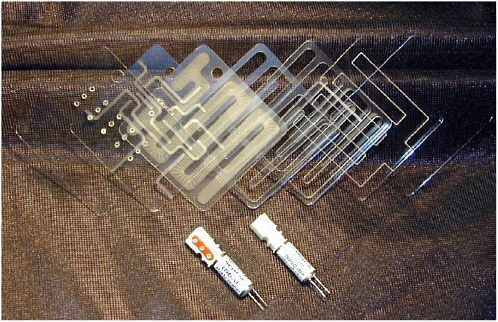
FIGURE 3-16 Planar glass layers for a batch-producible cold gas propulsion module. SOURCE: Huang, A., W.W. Hansen, S.W. Janson, and H. Helvajian. 2002. Development of a 100-gm-class inspector satellite using photostructurable glass/ceramic materials. Pp. 297–304 in Photon Processing in Microelectronics and Photonics, Proceedings of SPIE Volume 4637. K. Sugioka, M.C. Gower, R.F. Haglund, Jr., A. Pique, F. Traeger, J.J. Dubowski, and W. Hoving, eds. Bellingham, Wash.: The International Society for Optical Engineering.
zation of thrust. Significant system advantage can accrue if a standard microrocket module—well developed, well characterized, and manufactured in quantity inexpensively—is adopted for multiple applications, with different numbers of engine modules utilized, depending on the mission. This has the potential to dramatically reduce the cost of space propulsion. Also, the very small size of individual motors yields very fast start-up and shutdown times, which allow a highly precise impulse increment to be imparted to a vehicle.
An example of prototype thruster system components that could be produced by batch-fabrication techniques is shown in Figure 3-16. Six micromachined glass layers form a liquid storage tank, gas/liquid separator, gas plenum, gas distribution plumbing, and nozzles for a cold gas propulsion system. While this set of glass wafers was fabricated using direct-write laser-patterning of Foturan™ glass, mass production would utilize Foturan™, planar masks, and UV exposure much like the photopatterning step in the fabrication of semiconductor wafers. The layers could also be fabricated out of silicon using photolithography and deep reactive ion etching. This stack utilizes five miniature solenoid valves with six nozzles to provide translational thrust along two axes and rotation about the
third axis. MEMS valves would be preferred for batch-fabrication capability, but miniature solenoid valves currently provide lower-power operation with lower leak rates than MEMS valves. The 10-millinewton thrusters are appropriate for translational and rotational control of a ~1 kilogram mass co-orbital satellite assistant.
A revolutionary thruster approach enabled by MEMS is digital propulsion, which consists of an array of single-shot thrusters that individually produce only one impulse each; spacecraft maneuvers are performed by firing unused thrusters at specific locations at the right times. Microfabrication enables the creation of large arrays of addressable thrusters, e.g., 10,000 on a 10-centimeter-square surface using 1-millimeter center-to-center spacing. This digital thruster system is planar, is scalable in area, does not require separate propellant tanks or plumbing, does not require microvalves, and can function as a structure. Solid rocket, water electrolysis, and subliming solid thruster arrays consisting of micromachined glass and silicon layers have been fabricated and tested under a DARPA program.186 Measured impulse bits are 0.1 millinewtons for the solid rockets. A 3 × 5 thruster array flew on the space shuttle Columbia during the STS-93 mission. Similar digital thruster efforts have been funded by AFOSR and the French national space agency.187,188
Electric Propulsion
Electric thrusters use electric power to accelerate propellant molecules, atoms, or ions. The advantage of this approach is that the specific impulse can be more than an order of magnitude greater (600 to 5,000 seconds) than that of chemical thrusters (50 to 450 seconds). This translates into significantly reduced propellant requirements for a given mission if sufficient electric power is available. Power requirements can range from tens of milliwatts for attitude control of a 1-kilogram-mass spacecraft to tens of kilowatts for orbital maneuvering of ~3000-kilogram-class spacecraft. Power requirements scale with thrust and the square of specific impulse.
Figure 3-17 shows a plot of spacecraft power levels versus first year of launch for different series of Intelsat communications satellites over the last 20 years. The spin-stabilized VI series was not included since its configuration was different from that of the other three-axis stabilized series. Note that the trend is toward increased power with time and that the trend appears to be accelerating. Commercial spacecraft with 11-kilowatt power levels, e.g., the Thuraya communications satellite,189 are now routine, and spacecraft with 15- to 20-kilowatt power levels are being designed. Note that spacecraft power levels of 1 to 10 kilowatts are becoming available for electric thrusters. Air Force communications satellites, e.g., the flagship MILSTAR, with ~5 kilowatts of solar power, typically operate at lower power levels and lower power-to-weight ratios than commercial communications spacecraft. Nevertheless, they follow similar trends
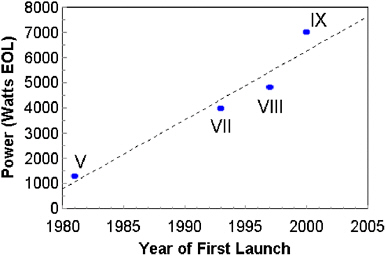
FIGURE 3-17 Spacecraft power for INTELSAT satellites. Data from Martin, D.H. 2000. Communications Satellites, 4th ed. Reston, Va.: American Institute of Aeronautics and Astronautics, Inc.
and are expected to more closely match their commercial counterparts as mission needs, e.g., radar and direct broadcast of video data, converge.
Micro- and nanofabrication enables a radically new form of high-specific-impulse electric propulsion that uses field ionization or field evaporation to ionize propellant atoms or molecules, which are subsequently accelerated by an applied electric field to generate thrust. Field ionization and emission are electron tunneling phenomena that require electric fields of 107 to 108 watts per centimeter, which can be generated using 100 to 1,000 volts across a 0.1-micron gap. If the emitting surface has a radius of curvature of ~30 nanometers or less, local electric field enhancement occurs, dropping the required voltages to the 10- to 100-volt range. Micro- and nanofabrication enables field emission and ionization using tens of volts instead of kilovolts. Conventional ion engine design requires magnetic plasma confinement, multiple power supplies, and roughly a hundred piece parts such as accelerator grids and capacitors, while a field-ionization-based ion engine would require no magnetic field, only two power supplies, and fewer than 10 piece parts. This approach creates an essentially two-dimensional ion engine that is scalable in area and thrust, thus commoditizing high-specific-impulse thrust for spacecraft.
Field emission sources are currently under development as an enabling technology for flat panel displays, simplified microwave tubes, and vacuum microelectronics.190,191,192 Examples of field emission sources include Spindt cathodes, diamond like carbon coatings, and carbon nanotubes.193,194,195 Field emission
sources are simple and robust because they do not require a heating element or a plasma discharge to function. Field emitters will find use in electric propulsion systems as an electron source for neutralizing ion beams that generate thrust. Microfabrication offers similar structures for the efficient production of ions.
Liquid metal ion sources exploit the instability of conducting liquid surfaces when electric fields of 105 to 106 volts per centimeter are applied.196 Electrodynamic forces cause the liquid surface to form one or more Taylor197 cones that have sharp tips with radii of curvature between 5 and 50 nanometers, thus generating local electric fields in excess of 107 volts per centimeter through field enhancement. Johannes Mitterauer proposed miniaturized liquid metal ion sources that could be fabricated using microfabrication technology in the early 1990s.198,199 These revolutionary devices were based on the Spindt microvolcano, which is basically a reverse-polarity Spindt cathode with a hole drilled through the emitter to feed gas or liquid to the high-field region near the gate.200 The advantage of this microfabrication approach is that gross electric fields of 106 volts per centimeter may be readily generated by applying 100 volts across a 1-micron-wide gap. Since the field evaporation/ionization process is fairly efficient (less than 10 eV loss per ion), ion engines with high thrust efficiency at low specific impulse, e.g., 1,300 seconds for indium, become possible. A planar, scalable electric propulsion system that can used for picosatellites through 5,000-kilogram-mass satellites appears to be possible.
Tether Propulsion
A tether connecting two masses in orbit will always try to line up with the radial gravity vector. This effect, called gravity-gradient stabilization, is used to create passive Earth-pointing stabilization for many microsatellites. Electrodynamic tethers exploit Earth’s magnetic field and the local space plasma environment in LEO to generate either power or thrust; they can operate either as motors or electric generators. In the power generation mode, the v × B Lorentz force drives a current in an Earth-pointing conducting tether when the tether velocity has a component perpendicular to the local magnetic field. Electrons are emitted at one end of the tether and collected at the other; the space plasma provides the return current. Orbital kinetic energy is converted into electric power; this can be used to provide emergency power, to provide primary power for short-duration missions, to provide intermittent power to charge laser or microwave weapons, or to provide active deorbit capability. In the thrust generating mode, a current is forced through the tether to generate a j × B force perpendicular to the local magnetic field direction. This is an electric propulsion system with infinite specific impulse.
Tethers can also operate as momentum exchange systems to provide momentum and energy transfer between attached masses. Proposed systems essentially catch a payload at one end and throw it away at higher velocity, as shown in
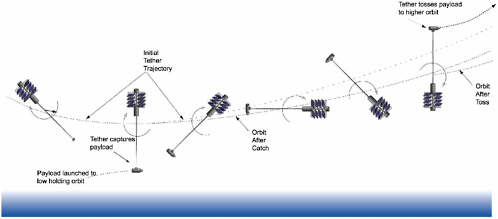
FIGURE 3-18 Use of a momentum-exchange tether to perform an orbit transfer. SOURCE: Tethers Unlimited, available online at: <http://www.tethers.com/MXTethers.html> [May 22, 2002].
Figure 3-18. The tether system loses energy and drops into a lower orbit, while the payload gains energy. Note that a momentum and electrodynamic tether can be combined into a single entity to enable rapid transfer of a payload into another orbit, followed by slower electrodynamic orbital maneuvering of the tether system to return it to its original orbit.
A number of tether-based momentum-exchange concepts such as the LEO-to-GTO tether boost facility have been studied as possible long-term space transportation systems that would efficiently transfer spacecraft between orbits without using propellant.201 Applications in the 20- to 50-year time frame include payload capture from hypersonic air-breathing vehicles with subsequent transfer into LEO, transfer of payloads from LEO to a variety of orbits, and transfer from LEO to Earth escape trajectories, e.g., to lunar transfer orbit. A key feature of these systems is the need for tethers with tens to hundreds of kilometer lengths. The LEO-to-GTO tether boost facility mentioned above would require a 100-km-long tether of several millimeters diameter and a mass of 8,300 kilograms. The tether material was Spectra 2000™, a highly oriented polyethelyne with a tensile strength of 4 gigapascals and a density of 0.97 grams per cubic centimeter.202 A carbon nanotube-based composite could cut this mass by more than an order of magnitude, resulting in lower system launch masses or increased tether lengths for higher energy transfers.
Conductive carbon nanotubes might be ideal for electrodynamic tethers, while semiconductor carbon nanotubes could be ideal for momentum exchange tethers. A carbon nanotube-based structure that could switch conductivity on demand would be even better. Owing to the degrading effects of the space environment, e.g., radiation damage and micrometeor impact, self-healing or repair would also be helpful.
Space Power Generation
Power for avionics, electric actuators, and electric propulsion systems is produced by shaft-driven generators, photovoltaic cells, thermocouple arrays, thermionic arrays, fuel cells, or batteries. Output power levels can range from microwatts to tens of megawatts. Micro- and nanotechnology can be applied to all of these systems to produce miniature (microwatts to watts) power systems and to improve the performance of fuel cells, thermionic converters, and batteries.
The greater part of electric power generation in space is done by solar cells. The principal exceptions have been nuclear thermoelectric generators (mainly for spacecraft operating beyond Jovian orbit) and nuclear reactors on a few large Soviet military satellites. Electrodynamic tethers are a possible challenger for future mission applications that can tolerate, or benefit from, rapidly decreasing orbital energy (altitude). For a 500-kilometer altitude orbit, the change in total energy is about 4.2 kJ/kg-km; dropping 1 kilometer in altitude per hour would release 4,200 joules of energy per kilogram of spacecraft at an average power level of 1.2 watts per kilogram, assuming 100 percent efficiency for the conversion of potential energy to electric energy. Orbit lifetime from this altitude at this energy production rate would be about 2 weeks. Longer missions will clearly benefit from solar cells.
Solar Cells
Solar cell technology currently provides sunlight-to-direct-current conversion efficiencies of 15 percent for silicon cells and 18 percent for gallium-arsenide cells. Photons with energies below the semiconductor bandgap energy are not absorbed, photons with energies just above the bandgap energy are converted to free electrons with near 100 percent efficiency, and photons with even higher energy dump their excess energy as heat. Multiple-junction cells with 40 percent conversion efficiency are possible, but this approach results in a complicated stack of three or more cells with totally different substrates (these provide multiple bandgap energies for efficient conversion at multiple places in the solar spectrum) and mechanical stress-matching layers. Nanoengineered materials may provide better conversion efficiencies by allowing the use of multiple quantum well absorbers.
Solar Dynamic Electric Power Generation
MEMS opens up other possibilities that might be attractive for some applications. Solar dynamic systems had been considered unfeasible below 50 or 100 kilowatts, considerably larger than any current applications except for the International Space Station. In the long term (20 to 50 years), however, 50- to 100-kilowatt communications or radar satellites may be commonplace. For micro-,
nano-, and picosatellites, the system mass advantages inherent in MEMS devices such as micro turbogenerators suggest that solar dynamic systems may be feasible down to a few watts in size. Given the high conversion efficiencies of the best solar cells, however, the solar dynamic generation may be most attractive when used in a hybrid system with solar cells.
A different space power application would combine the MEMS bipropellant rocket engine technology with MEMS turbine generators to construct a fueled power unit. Running on station-keeping fuel, a unit such as this might be useful as an emergency power source when there is a problem with solar array deployment, providing sufficient time for ground operations to diagnose and perhaps fix the problem before the onboard batteries run out. A nonmilitary application would be use in planetary missions if nuclear power systems prove politically unattractive.
Batteries
MEMS and microtechnology enable miniaturized combustion systems and turbomachinery, while nanotechnology enables improved performance for individual components, particularly those that rely on electrochemistry. Nanostructured electrodes for fuel cells, batteries, and supercapacitors are an ongoing research area. Decreased anode-cathode gaps enable faster ion and electron transfer with reduced internal impedance and increased power handling capability. Nanostructured electrodes and electrolytes should enable more efficient charge transfer and storage, resulting in improved capacity.
The ubiquitous carbon nanotube has appeared as a possible improved anode material for lithium-ion batteries. Graphite is currently used as the lithium-storage anode; it has a storage capacity of one lithium ion for six carbon atoms. Recent research by Otto Zhou and colleagues at the University of North Carolina has shown that carbon nanotubes apparently have twice the lithium storage capacity per carbon atom. However, the actual performance limits and cost of lithium-ion batteries using carbon nanotubes have yet to be determined.
Rechargeable batteries are essential for spacecraft with multiyear lifetimes. Current space-qualified technologies include nickel-cadmium and nickel-hydrogen batteries with energy storage densities of ~30 and 50 W-hr/kg, respectively. Lithium-ion batteries for terrestrial applications have energy storage densities of ~100 W-hr/kg, but they do not function well at temperatures below −20°C. The theoretical energy density of lithium-ion batteries is ~300 W-hr/kg, a sixfold improvement over existing space-qualified batteries. Nanotechnology in the form of carbon nanotube anodes may help to reach this goal, but more research is needed.
Findings and Recommendations
Finding T5. Emerging microtechnology offers new opportunities in propulsion and aerodynamic control, in particular in (1) distributed sensors and actuators on both macro-aerodynamic surfaces and macro-aeropropulsion units and (2) new, scalable, miniaturized and distributed aero- and space-propulsion systems. Emerging microtechnology has achieved preliminary success in sensing and controlling the boundary layer on full-size, subsonic airfoils. New devices for controlling gas and liquid flow, fabricated using microtechnology, promise to increase the power and reliability of air-breathing, full-size propulsion units. Several new aeropropulsion and space propulsion systems, such as micro-turbine engines and micro-rocket engines, have been fabricated and are in the early test phase.
Recommendation T5. The Air Force should move decisively to develop new research and development programs to bring microtechnology to both macro- and microscale propulsion and aerodynamic control systems.
REFERENCES AND NOTES
1. United States Air Force. 2000. Air Force Strategic Plan, Volume 3: Long-Range Planning Guidance. Washington, D.C.: United States Air Force.
2. Office of the Secretary of Defense. 2000. Space Technology Guide FY 2000–2001. Washington, D.C.: Office of the Secretary of Defense, Assistant Secretary of Defense (Command, Control, Communications, and Intelligence); Director, Defense Research and Engineering.
3. International Technology Roadmap for Semiconductors. 2001. Available online at <http://public.itrs.net/> [July 1, 2002].
4. Smith, T. 2001. IBM, AMD unveil terahertz transistor breakthroughs. Available online at <http://www.theregister.co.uk/content/3/23163.html> [July 2, 2002].
5. Intel. 2001. Intel announces breakthrough in chip transistor design. Available online at <http://www.intel.com/pressroom/archive/releases/20011126tech.htm> [July 2, 2002].
6. Tristram, C. 2001. It’s time for clockless chips. Available online at <http://www.technologyreview.com/articles/tristram1001.asp> [July 2, 2002].
7. Reed, M.A. 1999. Molecular-scale electronics. Proceedings of the IEEE 87(4): 652–658.
8. Ellenbogen, J.C., and J.C. Love. 2000. Architectures for molecular electronic computers: 1. Logic structures and an adder designed from molecular electronic diodes. Proceedings of the IEEE 88(3): 386–426.
9. Wada, Y. 2001. Prospects for single molecule information processing devices. Proceedings of the IEEE 89(8): 1147–1171.
10. Service, R.F. 2001. Molecules get wired. Science 294(5551): 2442–2443.
11. Meindl, J.D. 1995. Low power microelectronics: Retrospect and prospect. Proceedings of the IEEE 83(4): 619–635.
12. Meindl, J.D. 1996. Physical limits on gigascale integration. Journal of Vacuum Science and Technology B 14(1): 192–195.
13. Meindl, J.D., Q.Chen, and J.A. Davis. 2001. Limits on silicon nanoelectronics for terascale integration. Science 293(5537): 2044–2049.
14. Thompson, S., P. Packan, and M. Bohr. 1998. MOS scaling: Transistor challenges for the 21st century. Intel Technology Journal, 3rd quarter. Available online at <http://developer.intel.com/technology/itj/q31998/articles/art_3.htm> [September 25, 2002].
15. Davis, J.A., V.K. De, and J.D. Meindl. 1998. I. A stochastic wire-length distribution for gigascale integration (GSI)—Part I: Derivation and validation. IEEE Transactions on Electron Devices 45(3): 580–589.
16. Davis, J.A., V.K. De, and J.D. Meindl. 1998. II. A stochastic wire-length distribution for gigascale integration (GSI)—Part II: Application to clock frequency, power dissipation, and chip size estimation. IEEE Transactions on Electron Devices 45(3): 590–597.
17. Davis, J.A., and J.D. Meindl. 1998. Is interconnect the weak link? IEEE Circuits and Devices 14(2): 30–36.
18. Davis, J.A., R. Venkatesan, A. Kaloyeros, M. Beylansky, S.J. Souri, K. Banerjee, K.C. Saraswat, A. Rahman, R. Reif, and J.D. Meindl. 2001. Interconnect limits on gigascale integration (GSI) in the 21st century. Proceedings of the IEEE 89(3): 305–324.
19. Keyes, R.W. 2001. The cloudy crystal ball: Electronic devices for logic. Philosophical Magazine B—Physics of Condensed Matter Statistical Mechanics Electronic Optical and Magnetic Properties 81(9): 1315–1330.
20. Likharev, K.K. 1999. Single-electron devices and their applications. Proceedings of the IEEE 87(4): 606–632.
21. Likharev, K.K. 1999. Single-electron devices and their applications. Proceedings of the IEEE 87(4): 606–632.
22. There is recent evidence that the background charge distributions may be stable for extended lengths of time, Zimmerman, N.M., W.H. Huber, A. Fujiwara, and Y. Takahashi. 2001. Excellent charge offset stability in a Si-based single-electron tunneling transistor. Applied Physics Letters 79(19): 3188–3190.
23. Wolf, S.A., D.D. Awschalom, R.A. Buhrman, J.M. Daughton, S. von Molnár, M.L. Roukes, A.Y. Chtchelkanova, and D.M. Treger, 2001. Spintronics: A spin-based electronics vision for the future. Science 294(5546): 1488–1495.
24. Cowburn, R.P., and M.E. Welland. 2000. Room temperature magnetic quantum cellular automata. Science 287(5457): 1466–1468.
25. Allwood, D.A., G. Xiong, M.D. Cooke, C.C. Faulkner, D. Atkinson, N. Vernier, and R.P. Cowburn. 2002. Submicrometer ferromagnetic NOT gate and shift register. Science 296(5575): 2003–2006.
26. Dimitrakopoulos, C.D., and D.J. Mascaro. 2001. Organic thin-film transistors: A review of recent advances. IBM Journal of Research and Development 45(1): 11–27.
27. Gelinck, G.H., T.C.T. Geuns, and D.M. de Leeuw. 2000. High-performance all-polymer integrated circuits. Applied Physics Letters 77(10): 1487–1489.
28. Allwood, D.A., G. Xiong, M.D. Cooke, C.C. Faulkner, D. Atkinson, N. Vernier, and R.P. Cowburn. 2002. Submicrometer ferromagnetic NOT gate and shift register. Science 296(5575): 2003–2006.
29. Sirringhaus, H., T. Kawase, R.H. Friend, T. Shimoda, M. Inbasekaran, W. Wu, and E.P Woo. 2000. High-resolution inkjet printing of all-polymer transistor circuits. Science 290(5499): 2123–2126.
30. Calvert, P. 2001. Inkjet printing for materials and devices. Chemical Materials 13(10): 3299– 3305.
31. Dimitrakopoulos, C.D., and P.R.L. Malenfant. 2002. Organic thin film transistors for large area electronics. Advanced Materials 14(2): 99–117.
32. Tanaka, T., S. Doi, H. Koezuka, A. Tsumura, and H. Fuchigami. 2000. Tanaka, T., S. Doi, H. Koezuka, A. Tsumura, and H. Fuchigami, inventors. Mitsubishi Denki Kabushiki Kaisha and Sumitomo Chemical Company, Limited, assignees. Method of making a field effect transistor. U.S. Patent 6,060,338, May 9.
33. Postma, H.W.Ch., T. Teepen, Z. Yao, M. Grifoni, and C. Dekker. 2001. Carbon nanotube single-electron transistors at room temperature. Science 293(5527): 76–79.
34. Liu, X., C. Lee, C. Zhou, and J. Han. 2001. Carbon nanotube field-effect inverters. Applied Physics Letters 79(20): 3329–3331.
35. Bachtold, A., P. Hadley, T. Nakanishi, and C. Dekker. 2001. Logic circuits with carbon nanotube transistors. Science 294(5545): 1317–1320.
36. Rotman, D. 2002. The nanotube computer. Available online at <http://www.technologyreview.com/articles/rotman0302.asp> [July 2, 2002].
37. Mathews, R.H, J.P. Sage, T.C.L.G. Sollner, S.D. Calawa, C.L. Chen, L.J. Mahoney, P.A. Maki, and K.M. Molvar. 1999. A new RTD-FET logic family. Proceedings of the IEEE 87(4): 596– 605.
38. Van Wees, B.J. 1989. Quantum Ballistic and Adiabatic Electron Transport, Studied with Quantum Point Contacts. Thesis, Technische Universiteit Delft, The Netherlands.
39. Altshuler, B.L., P.A. Lee, and R.A. Webb. 1991. Mesoscopic Phenomena in Solids. New York, N.Y.: Elsevier Science.
40. Terabe, K., T. Hasegawa, T. Nakayama, and M. Aono. 2001. Quantum point contact switch realized by solid electrochemical reaction. RIKEN Review 37, Nanotechnology in RIKEN I: 7–8.
41. Granatstein, V.L., R. Parker, and C.M. Armstrong. 1999. Vacuum electronics at the dawn of the twenty-first century. Proceedings of the IEEE 87(5): 702–716.
42. Alles, M., and S. Wilson. 1997. Thin film silicon on insulator: An enabling technology. Semiconductor International 20(4): 67–68.
43. European Space Agency, Space Environment Information System. Available online at <http://www.spenvis.oma.be/spenvis/> [July 2, 2002].
44. Lacoe, R.C., J.V. Osborn, R. Koga, S. Brown, and D.C. Mayer. 2000. Application of hardness-by-design methodology to radiation-tolerant ASIC technologies. IEEE Transactions on Nuclear Science 47(6): 2334–2341.
45. Osborn, J.V., R.C. Lacoe, D.C. Mayer, and G. Yabiku. 1998. Total dose hardness of three commercial CMOS microelectronics foundries. IEEE Transactions on Nuclear Science 45(3): 1458–1463.
46. Lacoe, R.C., J.V. Osborn, R. Koga, S. Brown, and D.C. Mayer. 2000. Application of hardness-by-design methodology to radiation-tolerant ASIC technologies. IEEE Transactions on Nuclear Science 47(6): 2334–2341.
47. Rajchman, J.A. 1961. Computer memories, a survey of the state-of-the-art. Proceedings of the Institute of Radio Engineers 49(1): 104–127.
48. Snider, G.L., A.O. Orlov, I. Amlani, X. Zuo, G.H. Bernstein, C.S. Lent, J.L. Merz, and W. Porod. 1999. Quantum-dot cellular automata: Review and recent experiments. Journal of Applied Physics 85(8): 4283–4285.
49. Snider, G.L., A.O. Orlov, I. Amlani, G.H. Bernstein, C.S. Lent, J.L. Merz, and W. Porod. 1999. Quantum-dot cellular automata. Microelectronic Engineering 47(1–4): 261–263.
50. Cole, T., and J.C. Lusth. 2001. Quantum-dot cellular automata. Progress in Quantum Electronics 25(4): 165–189.
51. Lent, C.S. 2000. Molecular electronics—bypassing the transistor paradigm. Science 288(5471): 1597–1599.
52. Lent, C.S. 2000. Molecular electronics—bypassing the transistor paradigm. Science 288(5471): 1597–1599.
53. Tóth, G., and C.S. Lent. 2001. Quantum computing with quantum-dot cellular automata. Physical Review A 63(5): article number 052315 (9 pages).
54. Two useful algorithms are known, Shor’s algorithm for factoring large numbers and Grover’s algorithm for searching a database.
55. Felleman, D.J., and D.C. Van Essen. 1991. Distributed hierarchical processing in the primate cerebral cortex . Cerebral Cortex 1(1): 1–47.
56. Abbott, L.F., and S.B. Nelson. 2000. Synaptic plasticity: Taming the beast. Nature Neuroscience Supplement 3(Supp):1178–1183.
57. Kelso, I.A. 1995. Dynamic Patterns: The Self-Organization of Brain and Behavior. Cambridge, Mass.: MIT Press.
58. Freeman, W.J. 2000. Neurodynamics: An Exploration in Mesoscopic Brain Dynamics. New York, N.Y.: Springer.
59. Elman, J.L., E.A. Bates, M.H. Johnson, and A. Karmiloff-Smith. 1996. Rethinking Innateness: A Connectionist Perspective on Development. Cambridge, Mass.: MIT Press.
60. Cauller, L.J. In press. The neurointeractive paradigm: dynamical mechanics and the emergence of higher cortical function. In Theories of Cerebral Cortex, R. Hecht-Neilsen and T. McKenna, eds. San Diego, Calif.: Academic Press.
61. Edelman, G.M., and G. Tononi, G. 2001. A Universe of Consciousness: How Matter Becomes Imagination. New York, N.Y.: Basic Books.
62. Thompson, D.A., and J.S. Best. 2000. The future of magnetic data storage. IBM Journal of Research and Development 44 (3): 311–322.
63. Vettiger, P., M. Despont, U. Drechsler, U. Dürig, W. Häberle, M.I. Lutwyche, H.E. Rothuizen, R. Stutz, R. Widmer, and G.K. Binnig. 2000. The ‘Millipede’—more than one thousand tips for future AFM data storage. IBM Journal of Research and Development 44 (3): 323–340.
64. Chen, J., W. Wang, M.A. Reed, A.M. Rawlett, D.W. Price, and J.M. Tour. 2000 Room-temperature negative differential resistance in nanoscale molecular junctions. Applied Physics Letters 77(8): 1224–1226.
65. Kuekes, P.J., R.S. Williams, and J.R. Heath. 2000. Kuekes, P.J., R.S. Williams, and J.R. Heath, inventors. Hewlett-Packard, assignee. Molecular wire crossbar memory. U.S. Patent No. 6.128,214, October 3.
66. Birge, R.R., N.B. Gillespie, E.W. Izaguirre, A. Kusnetzow, A.F. Lawrence, D. Singh, Q.W. Song, E. Schmidt, J.A. Stuart, S. Seetharaman, and K.J. Wise. 1999. Biomolecular electronics: Protein-based associative processors and volumetric memories. Journal of Physical Chemistry 103B(49): 10746–10766.
67. Ledentsov, N.N., M. Grundmann, F. Heinrichsdorff, D. Bimberg, V.M. Ustinov, A.E. Zhukov, M.V. Maximov, Z.I. Alferov, and J.A. Lott. 2000. Quantum dot heterostructure lasers. IEEE Journal of Selected Topics in Quantum Electronics 6(3): 439–451.
68. See, for example, N. Holonyak. 1997. The semiconductor laser: A thirty-five year perspective. Proceedings of the IEEE 85(11): 1678–1693.
69. Felix, C.L., W.W. Bewley, I. Vurgarfman, R.E. Bartolo, D.W. Stokes, J.R. Meyer, M.J. Yang, H. Lee, R.J. Menna, R.U. Martinelli, D.Z. Garbuzov, J.C. Connolly, M. Maiorov, A.R. Sugg, and G.H. Olsen. 2001. Mid-infrared W quantum-well lasers for noncryogenic continuous-wave operation. Applied Optics 40(6): 806–811.
70. Capasso, F., C. Gmachl, R. Paiella, A. Tredicucci, A.L. Hutchinson, D.L. Sivco, J.N. Baillargeon, A.Y. Cho, and H.C. Liu. 2000. New frontiers in quantum cascade lasers and applications. IEEE Journal of Selected Topics in Quantum Electronics 6(6): 931–947.
71. Gao, H., and W.D. Nix. 1999. Surface roughening of heteroepitaxial thin films. Annual Review of Materials Science 29: 173–209; A. Shchukin and D. Bimberg. 1999. Spontaneous ordering of nanostructures on crystal surfaces. Reviews in Modern Physics 71(4): 1125–1171.
72. Wang, R.H., A. Stintz, P.M. Varangis, T.C. Newell, H. Li, K.J. Malloy, and L.F. Lester. 2001. Room-temperature operation of InAs quantum-dash lasers on InP (001). IEEE Photonics Technology Letters 13(8): 767–769.
73. Coldren, L.A. 2000. Monolithic tunable diode lasers. IEEE Journal of Selected Topics in Quantum Electronics 6(6): 988–999.
74. See, for example, Erdogan, T., E.J. Friebele, and R. Kashyap. 2000. Bragg Gratings, Photosensitivity, and Poling in Glass Waveguides. Presented at the Topical Meeting on Bragg Grating, Photosensitivity, and Poling in Glass Waveguides, September 23–25, 1999, at Stuart, Fla. Washington, D.C.: Optical Society of America.
75. Towe, E., R.F. Leheney, and A. Yang. 2000. A historical perspective of the development of the vertical-cavity surface-emitting laser. IEEE Journal of Selected Topics in Quantum Electronics 6(6): 1458–1464.
76. Chou, M.H., I. Brener, M.M. Fejer, E.E. Chaban, and S.B. Christman. 1999. 1.5 mm m-band wavelength conversion based on cascaded second-order nonlinearity in LiNbO3 waveguides. IEEE Photonics Technology Letters 11(6): 653–655.
77. Painter, O., K. Srinivasan, J.D. O’Brien, A. Scherer, and P.D. Dapkus. 2001. Tailoring of the resonant mode properties of optical nanocavities in two-dimensional photonic crystal slab waveguides. Journal of Optics A: Pure and Applied Optics 3(6): S161–S170.
78. Yablonovitch, E. 2001. Photonic crystals: Semiconductors of light. Scientific American 285(6): 46–55.
79. Pendry, J.B., A.J. Holden, W.J. Stewart, and I. Youngs. 1996. Extremely low frequency plasmons in metallic mesostructures. Physical Review Letters 76(25): 4773–4776.
80. Shelby, R.A., D.A. Smith, and S. Schultz. 2001. Experimental verification of a negative index of refraction. Science 292(5514): 77–79.
81. Chang-Hasnain, C., E. Vail, and M. Wu. 1996. Widely-tunable micro-mechanical vertical cavity lasers and detectors. Pp. C43–44 in Digest of the IEEE/LEOS 1996 Summer Topical Meetings – Advanced Applications of Lasers in Materials and Processing. New York, N.Y.: Institute of Electrical and Electronics Engineers, Inc.
82. Bishop, D., P. Gammel, and C.R. Gile. 2001. The little machines that are making it big. Physics Today 54(10): 38–44.
83. Hornbeck, L. 1995. Digital Light Processing and MEMS: Timely Convergence for a Bright Future. Available online at <http://www.dlp.com/dlp_technology/images/dynamic/white_papers/107_DLP_MEMS_Overview.pdf> [July 2, 2002].
84. Johnson, C. 2002. The wireless monster. The Industry Standard, January 10. Available online at <http://www.thestandard.com/article/0,1902,8551,00.html> [July 2, 2002].
85. Yao, J.J., S.T. Park, and J. DeNatale. 1998. High tuning-ratio MEMS-based tunable capacitors for RF communications applications. Technical Digest: Solid-State Sensor and Actuator Workshop. Cleveland, Ohio: Transducer Research Foundation.
86. Yao, Z.J., S. Chen, S. Eshelman, D. Denniston, and C. Goldsmith. 1999. Micromachined low-loss microwave switches. Journal of Microelectromechanical Systems 8(2): 129–34.
87. Goldsmith, C. 2001. RF MEMS. Paper presented to the 7th World Micromachine Summit, Frieburg, Germany, April 30–May2.
88. Vaughan, C.R. 2001. Defining specifications for consumer focused MEMS and the cost performance trade-offs. Paper presented at the 2nd International Conference COTS MEMS 2001— Advances in Application of Integrated Commercial Off-The-Shelf MicroElectroMechanical Systems. Boston, Mass., November 30.
89. John Wiley & Sons. 2000. Technical Insights, R-263: Optical MEMS: Worldwide Markets For a Strategic and Convergent Technology. New York, N.Y.: John Wiley & Sons, Inc.
90. Wicht Technologie Consulting. 2002. The Market for RF MEMS 2002–2007: Market Analysis and Technology Roadmap for RF MEMS Components and Applications (Draft). Available online at <http://www.wtc-consult.de/download/rfmems/rfabstra.PDF> [July 2, 2002].
91. National Research Council. 2001. Embedded, Everywhere: A Research Agenda for Networked Systems of Embedded Computers. Washington, D.C.: National Academy Press.
92. Agee, F. 2001. AFRL Overview to the NRC on Nano Technologies. Briefing by Forrest (Jack) Agee, Air Force Office of Scientific Research, to the Committee on Implications of Emerging Micro and Nano Technologies, Holiday Inn, Fairborn, Ohio, October 2.
93. Kahn, J.M., R.H. Katz, and K.S.J. Pister. 1999. Next century challenges: Mobile networking for smart dust. Available online at <http://robotics.eecs.berkeley.edu/~pister/publications/1999/mobicom_99.pdf> [August 22,2002].
94. National Research Council. 1997. Microelectromechanical Systems: Advanced Materials and Fabrication Methods. Washington, D.C.: National Academy Press.
95. Agee, F. 2001. AFRL Overview to the NRC on Nano Technologies. Briefing by Forrest (Jack) Agee, Air Force Office of Scientific Research, to the Committee on Implications of Emerging Micro and Nano Technologies, Holiday Inn, Fairborn, Ohio, October 2.
96. Huang, M.H., S. Mao, H. Feick, H.Q. Yan, Y.Y. Wu, H. Kind, E. Weber, R. Russo, and P.D. Yang. 2001. Room-temperature ultraviolet nanowire nanolasers. Science 292(5523): 1897– 1899. Crystalline zinc oxide (ZnO) nanowires were demonstrated in the ultraviolet at 385 nm with a linewidth of less than 0.3 nm.
97. Agee, F. 2001. AFRL Overview to the NRC on Nano Technologies. Briefing by Forrest (Jack) Agee, Air Force Office of Scientific Research, to the Committee on Implications of Emerging Micro and Nano Technologies, Holiday Inn, Fairborn, Ohio, October 2.
98. Guenther, R.D. 2001. NRC Committee on Implications of Emerging Micro and Nano Technologies. Briefing by Robert D. Guenther, Army Research Office-IPA/Duke University, to the Committee on Implications of Emerging Micro and Nano Technologies, National Academy of Sciences, Washington, D.C., August 16, 2001.
99. Specifically, wavefront measurement advances have resulted in improved characterization of human vision, including the aberrations of the entire human optical path. This development of integrated adaptive optics (AO) and sodium-layer laser guide star (LGS) systems for use on large astronomical telescopes has been a boon to this effort. See Max, C.E., S.S. Olivier, H.W. Friedman, K. An, K. Avicola, B.V. Beeman, H.D. Bissinger, J.M. Brase, G.V. Erbert, D.T. Gavel, K. Kanz, M.C. Liu, B. Macintosh, K.P. Neeb, J. Patience, and K.E. Waltjen. 1997. Image improvement from a sodium-layer laser guide star adaptive optics system. Science 277(5332): 1649–1652; and Avicola, K., J.T. Salmon, J. Brase, K. Waltjen, R. Presta, and K.S. Bach. 1992. High frame-rate large field wavefront sensor. Proceedings of the Laser Guide Star Adaptive Optics Workshop. Livermore, Calif.: Lawrence Livermore National Laboratory.
100. Yoon, G.Y., and D.R. Williams. 2002. Visual performance after correcting the monochromatic and chromatic aberrations of the eye. Journal of the Optical Society of America A: Optics Image Science and Vision 19(2): 266–275.
101. Agee, F. 2001. AFRL Overview to the NRC on Micro and Nano Technologies. Briefing by Forrest (Jack) Agee, Air Force Office of Scientific Research, to the Committee on Implications of Emerging Micro and Nano Technologies, National Academy of Sciences, Washington, D.C., August 16.
102. Daniel, D. 2001. Air Force Science and Technology Overview. Briefing by Don Daniel, Deputy Assistant Secretary of the Air Force (Science, Technology, and Engineering), to the Committee on Implications of Emerging Micro and Nano Technologies, National Academy of Sciences, Washington, D.C., August 15.
103. Brown, G.J. 2001. Nanoelectronics and Nanomaterials for Sensors. Briefing by Gail J. Brown, Air Force Research Laboratory, Materials and Manufacturing Directorate, to the Committee on Implications of Emerging Micro and Nano Technologies, Holiday Inn, Fairborn, Ohio, October 2.
104. Sobolewski, R., D. P. Butler, and Z. Celik-Butler. 2001. Cooled and uncooled infrared detectors based on yttrium barium copper oxide. Pp. 204–214 in Smart Optical Inorganic Structures and Devices, Proceedings of SPIE Volume 4318. S.P. Asmontas and J. Gradauskas, eds. Bellingham, Wash.: The International Society for Optical Engineering.
105. Maranowski, K.D., J.M. Peterson, S.M. Johnson, J.B. Varesi, A.C. Childs, R.E. Bornfreund, A.A. Buell, W.A. Radford, T.J. de Lyon, and J.E. Jensen. 2001. MBE growth of HgCdTe on silicon substrates for large format MWIR focal plane arrays. Journal of Electronic Materials 30(6): 619–622.
106. AFOSR has been funding this work. Brown, G.J. 2001. Nanoelectronics and Nanomaterials for Sensors. Briefing by Gail J. Brown, Air Force Research Laboratory, Materials and Manufacturing Directorate, to the Committee on Implications of Emerging Micro and Nano Technologies, Holiday Inn, Fairborn, Ohio, October 2. A superlattice in this context consists of alternating layers of different semiconductor materials, each several nanometers thick.
107. Mohseni, H., M. Razeghi, G.J. Brown, and Y.S. Park. 2001. High-performance InAs/GaSb superlattice photodiodes for the very long wavelength infrared range. Applied Physics Letters 78(15): 2107–2109.
108. Klappenberger, F., A.A. Ignatov, S. Winnerl, E. Schomburg, W. Wegscheider, K.F. Renk, and M. Bichler. 2001. Broadband semiconductor superlattice detector for THz radiation. Applied Physics Letters 78(12): 1673–1675.
109. Bahl, I.J., and P. Bhartia. 1988. Microwave Solid State Circuit Design. New York, N.Y.: John Wiley & Sons.
110. Schulman, J.N., K.S. Holabird, D.H. Chow, H.L. Dunlap, S. Thomas, and E.T. Croke. 2002. Temperature dependence of Sb-heterostructure millimetre-wave diodes. Electronics Letters 38(2): 94–95.
111. Schulman, J.N., and D.H. Chow. 2000. Sb-heterostructure interband backward diodes. IEEE Electron Device Letters 21(7): 353–355.
112. Leheny, R., 2001. Implications of Emerging Micro and Nano Technologies. Briefing by Robert Leheny, Director, DARPA, to the Committee on Implications of Emerging Micro and Nano Technologies, National Academy of Sciences, Washington, D.C., on August 16, 2001.
113. Centre Suisse d’Electronique et de Microtechnique SA. 1994. Data sheets ASEM02-S and ASEM02-T/6. Neuchatel, Switzerland: Centre Suisse d’Electronique et de Microtechnique SA.
114. Kukkonen, C.A. 1995. NASA Vision and Implementation Approach for Advanced Technologies in Space. Presentation by Carl A. Kukkonen, Jet Propulsion Laboratory, Presentation to the 2nd Round Table on Micro and Nano Technologies for Space, European Space Agency ESTEC, Nordwijk, The Netherlands, October 15–17, 2002.
115. For a broad review of many automotive sensors, see Fleming, W.J. 2001. Overview of automotive sensors. IEEE Sensors Journal 1(4): 296–308.
116. Kubena, R.L., D.J. Vickers-Kirby, R.J. Joyce, and F.P. Stratton. 1999. A new tunneling-based sensor for inertial rotation rate measurement. Journal of Micromechanical Systems 8(4): 439– 447.
117. Honeywell. 1995. HMC2003 Three-Axis Magnetic Sensor Hybrid Data Sheet, Rev. C 10/99. Available online at <http://www.ssec.honeywell.com/magnetic/datasheets/hmc2003.pdf> [July 2, 2002].
118. Nonvolatile Electronics. 1995. Rapid Prototype Integrated GMR Magnetic Sensors Data Sheet, GMR Magnetic Bridge Sensor—NVSB Data Sheet, and Integrated GMR Magnetic Sensors— NVSI Data Sheet. Eden Prairie, Minn.: Nonvolatile Electronics, Inc.
119. Wickenden, D.K., T.J. Kistenmacher, R. Osiander, S.A. Ecelberger, R.B. Givens, and J.C. Murphy. 1997. Development of Miniature Micromagnets. Johns Hopkins APL Technology Digest 18(2): 271–278.
120. National Research Council. 2001. Opportunities in Biotechnology for Future Army Applications. Washington, D.C.: National Academy Press.
121. Thayer, A.M. 2001. Nanotech offers some there, there. Chemical & Engineering News 79(48): 13–16.
122. Ilic, B., D. Czaplewski, M. Zalalutdinov, H.G. Craighead, P. Neuzil, C. Campagnolo, and C. Batt. 2001. Single cell detection with micromechanical oscillators. Journal of Vacuum Science and Technology B 19(6): 2825–2828.
123. Cooper, M.A., F.N. Dultsev, T. Minson, V.P. Ostanin, C. Abell, and D. Klenerman. 2001. Direct and sensitive detection of a human virus by rupture event scanning. Nature Biotechnology 19(9): 833–837.
124. Kong, J., N.R. Franklin, C.W. Zhou, M.G. Chapline, S. Peng, K.J. Cho, and H.J. Dai. 2000. Nanotube molecular wires as chemical sensors. Science 287(5453): 622–625.
125. Horworka, S., S. Cheley, and H. Bayley. 2001. Sequence-specific detection of individual DNA strands using engineered nanopores. Nature Biotechnology 19(7): 636–639.
126. Park, S.J., T.A. Taton, and C.A. Mirkin. 2002. Array-based electrical detection of DNA with nanoparticle probes. Science 295(5559): 1503–1506.
127. Edelstein, R.L., C.R. Tamanaha, P.E. Sheehan, M.M. Miller, D.R. Baselt, L.J. Whitman, and R.J. Colton. 2000. The BARC biosensor applied to the detection of biological warfare agents. Biosensors and Bioelectronics 14(10–11): 805–813.
128. Guenther, R.D. 2001. NRC Committee on Implications of Emerging Micro and Nano Technologies. Briefing by Robert D. Guenther, Army Research Office-IPA/Duke University, to the Committee on Implications of Emerging Micro and Nano Technologies, National Academy of Sciences, Washington, D.C., August 16.
129. Udd, E., W.L. Schulz, J.M. Seim, A. Trego, E. Haugse, and P.E. Johnson. 2000. Transversely loaded fiber optic grating strain sensors for aerospace applications. Pp. 96–104 in Nondestructive Evaluation of Aging Aircraft, Airports, and Aerospace Hardware IV, Proceedings of SPIE Volume 3994. A.K. Mal, ed. Bellingham, Wash.: The International Society for Optical Engineering.
130. Belk, J.H., and E.V. White. 1999. Belk, J.H., and E.V. White, inventors. McDonnell Douglas Corporation, assignee. Remotely Interrogatable Apparatus and Method for Detecting Defects in Structural Members. U.S. Patent 5,969,260, October 19.
131. Krantz, D.G., J. Belk, P.J. Biermann, and P. Troyk. 2000. Project summary: applied research on remotely-queried embedded microsensors. Pp. 110–121 in Smart Structures and Materials 2000: Smart Electronics and MEMS, Proceedings of SPIE Volume 3990. V.K. Varadan, ed. Bellingham, Wash.: The International Society for Optical Engineering.
132. Kim, N.P., M.J. Holland, M.H. Tanielian, and R. Poff. 2000. MEMS sensor multi-chip module assembly with TAB carrier—Pressure belt for aircraft flight testing. Pp. 689–696 in Proceedings of the Electronic Components and Technology Conference 2000. New York, N.Y.: IEEE.
133. Agee, F. 2001. AFRL Overview to the NRC on Nano Technologies. Briefing by Forrest (Jack) Agee, Air Force Office of Scientific Research, to the Committee on Implications of Emerging Micro and Nano Technologies, Holiday Inn, Fairborn, Ohio, October 2.
134. Defense Advanced Research Projects Agency. 2002. Chip Scale Atomic Clock Overview. Available online at <http://www.darpa.mil/mto/csac/overview/index.html> [July 2, 2002].
135. Holzwarth, R., T. Udem, T.W. Hänsch, J.C. Knight, W.J. Wadsworth, and P.S.J. Russell. 2000. Optical frequency synthesizer for precision spectroscopy. Physical Review Letters 85(11): 2264–2267.
136. Kahn, J.M., R.H. Katz, and K.S.J. Pister. 1999. Next century challenges: Mobile networking for Smart Dust. Available online at <http://robotics.eecs.berkeley.edu/~pister/publications/1999/mobicom_99.pdf> [August 22,2002].
137. Defense Advanced Research Projects Agency. 2002. Smart Dust Project Summary. Available online at <http://www.darpa.mil/mto/mems/summaries/projects/individual_57.html> [July 2, 2002].
138. Nyquist, R.M., A.S. Eberhardt, L.A. Silks, Z. Li, X. Yang, and B.I. Swanson. 2000. Characterization of self-assembled monolayers for biosensor applications. Langmuir 16(4): 1793–1800.
139. Hou, Z.Z, S. Dante, N.L. Abbott, and P. Stroeve. 1999. Self-assembled monolayers on (111) textured electroless gold. Langmuir 15(8): 3011–3014.
140. Bachand, G.D., R.K. Soong, H.P. Neves, A. Olkhovets, H.G. Craighead, and C.D. Montemagno. 2001. Precision attachment of individual F-1-ATPase biomolecular motors on nanofabricated substrates. Nano Letters 1(1): 42–44.
141. Mann, S., W. Shenton, M. Li, S. Connolly, and D. Fitzmaurice. 2000. Biologically programmed nanoparticle assembly. Advanced Materials 12(2): 147–150.
142. Lee, K.B., S.J. Park, C.A. Mirkin, J.C. Smith, and M. Mrksich. 2002. Protein nanoarrays generated by dip-pen nanolithography. Science 295(5560): 1702–1705.
143. Guzman-Jimenez, I.Y., K.H. Whitmire, K. Umezama-Vizzini, R. Colorado, J.W. Do, A. Jacobson, T.R. Lee, S.H. Hong, and C.A. Mirkin. 2001. Self-assembly of organometallic clusters onto the surface of gold. Thin Solid Films 401(1–2): 131–137.
144. Weinberger, D.A., S.G. Hong, C.A. Mirkin, B.W. Wessels, and T.B. Higgins. 2000. Combinatorial generation and analysis of nanometer- and micrometer-scale silicon features via “dippen” nanolithography and wet chemical etching. Advanced Materials 12(21): 1600–1603.
145. Doshi, D.A., N.K. Huesing, M.C. Lu, H.Y. Fan,Y.F. Lu, K. Simmons-Potter, B.G. Potter, A.J. Hurd, and C.J. Brinker. 2000. Optically, defined multifunctional patterning of photosensitive thin-film silica mesophases. Science 290(5489): 107–111.
146. Lu, Y., Y. Yang, A. Sellinger, M. Lu, J. Huang, H. Fan, R. Haddad, G. Lopez, A.R. Burns, D.Y. Sasaki, J. Shelnutt, and C.J. Brinker. 2001. Self-assembly of mesoscopically ordered chromatic polydiacetylene/silica nanocomposites. Nature 410(6831): 913–917.
147. Oakley, C., N.A.F. Jaeger, and D.M. Brunette. 1997. Sensitivity of fibroblasts and their cytoskeletons to substratum topographies: Topographic guidance and topographic compensation by micromachined grooves of different dimensions. Experimental Cell Research 234(2): 413–424.
148. Fisher, A.B., S. Chien, A.I. Barakat, and R.M. Nerem. 2001. Endothelial cellular response to altered shear stress. American Journal of Physiology—Lung Cellular and Molecular Physiology 281(3): L529–L533.
149. Girard, P.R., and R.M. Nerem. 1995. Shear stress modulates endothelial-cell morphology and F-actin organization through the regulation of focal adhesion-associated proteins. Journal of Cellular Physiology 163(1): 179–193.
150. Gray, B.L., D.K. Lieu, S.D. Collins, R.L. Smith, and A.I. Barakat. 2002. Microchannel platform for the study of endothelial cell shape and function. Biomedical Microdevices 4(1): 9–16.
151. Pullar, C.E., R.R. Isseroff, and R. Nuccitelli. 2001. Cyclic AMP-dependent protein kinase A plays a role in the directed migration of human keratinocytes in a DC electric field. Cell Motility and the Cytoskeleton 50(4): 207–217.
152. Farboud, B., R. Nuccitelli, I.R. Schwab, and R.R. Isseroff. 2000. DC electric fields induce rapid directional migration in cultured human corneal epithelial cells. Experimental Eye Research 70(5): 667–673.
153. Marder, E., and R. L. Calabrese. 1996. Principles of rhythmic motor pattern generation. Physiological Reviews 76(3): 687–717.
154. Kiehn, O., O. Kjaerulff, M.C. Tresch, and R.M. Harris-Warrick. 2000. Contributions of intrinsic motor neuron properties to the production of rhythmic motor output in the mammalian spinal cord. Brain Research Bulletin 53(5): 649–659.
155. Woodhouse, G., L. King, L. Wieczorek, P. Osman, and B. Cornell. 1999. The ion channel switch biosensor. Journal of Molecular Recognition 12(5): 328–334.
156. Pace, R.J., V.L. Braach-Maksvytis, L.G. King, P.D. Osman, B. Raguse, L. Wieczorek, and B.A. Cornell. 1998. The gated ion channel biosensor—a functioning nanomachine. Pp. 50–59 in Methods for Ultrasensitive Detection, Proceedings of SPIE Volume 3270. B.L. Fearey, ed. Bellingham, Wash.: The International Society for Optical Engineering.
157. Adleman, L.M. 1998. Computing with DNA. Scientific American 279(2): 54–61.
158. Howe, R.T., and R.S. Muller. 1986. Resonant-microbridge vapor sensor. IEEE Transactions on Electron Devices 33(4): 499–506.
159. Fritz, J., M.K. Baller, H.P. Lang, H. Rothuizen, P. Vettiger, E. Meyer, H.J. Guntherodt, C. Gerber, and J.K. Gimzewski. 2000. Translating biomolecular recognition into nanomechanics. Science 288(5464): 316–318.
160. Baller, M.K., H.P. Lang, J. Fritz, C. Gerber, J.K. Gimzewski, U. Drechsler, H. Rothuizen, M. Despont, P. Vettiger, F.M. Battiston, J.P. Ramseyer, P. Fornaro, E. Meyer, H.J. Guntherodt. 2000. A cantilever array-based artificial nose. Ultramicroscopy 82(1–4): 1–9.
161. Yoo, K., J.-L.A. Yeh, N.C. Tien, C. Gibbons, Q. Su, W. Cui, and R.N. Miles. 2001. Fabrication of a biomimetic corrugated polysilicon diaphragm with attached single crystal silicon proof masses. Available online at <http://www.me.binghamton.edu/miles/current%20research/Trans01final.pdf> [July 3, 2002].
162. Byl, C., D.W. Howard, S.D. Collins, and R.L. Smith. 1999. Micromachined, Multi-Axis Accelerometer with Liquid Proof Mass, Final Report 1998–99 for MICRO Project 98-145. Available online at <http://www.ucop.edu/research/micro/98_99/98reports.html> [July 2, 2002].
163. Petch, N.J. 1953. The cleavage strength of polycrystals. Journal of the Iron and Steel Institute 173: 25–28.
164. Lowe, T., 2001. Nanometals and Air Force Technology Development. Briefing by Terry C. Lowe, CEO, Metallicum, LLC, to the Committee on Implications of Emerging Micro and Nano Technologies, National Academy of Sciences, Irvine, Calif., December 19, 2001.
165. National Science and Technology Council. 1999. Nanotechnology Research Directions: IWGN Workshop Report, September. Available online at <http://itri.loyola.edu/nano/IWGN.Research.Directions/> [July 3, 2002].
166. National Research Council. 2001. A Summary of the Workshop on Structural Nanomaterials, June 20–21. Washington, D.C.: National Academy Press.
167. Lowe, T. 2001. Nanometals and Air Force Technology Development. Briefing by Terry C. Lowe, CEO, Metallicum, LLC, to the Committee on Implications of Emerging Micro and Nano Technologies, National Academy of Sciences, Irvine, Calif., December 19, 2001.
168. Yu, M.F, B.S. Files, S. Arepalli, and R.S. Ruoff. 2000. Tensile loading of ropes of single wall carbon nanotubes and their mechanical properties. Physical Review Letters 84(24): 5552–5555.
169. Walters, D.A., L.M. Ericson, M.J. Casavant, J. Liu, D.T. Colbert, K.A. Smith, and R.E. Smalley. 1999. Elastic strain of freely suspended single-wall carbon nanotube ropes. Applied Physics Letters 74(25): 3803–3805.
170. Wang, Z.L., R.P. Gao, Z.W. Pan, and Z.R. Dai. 2001. Nano-scale mechanics of nanotubes, nanowires, and nanobelts. Advanced Engineering Materials 3(9): 657–661.
171. See, for example, Girshick, S.L., W.W. Gerberich, J.V.R. Heberlein, and P.H. McMurry. 2001. Nanotechnology Highlight: Microfabrication with focused beams of nanoparticles. Available online at <http://www-unix.oit.umass.edu/~nano/NewFiles/FN15_Minn_NH.pdf> [July 3, 2002].
172. National Science and Technology Council. 1999. Nanotechnology Research Directions: IWGN Workshop Report, September. Available online at <http://itri.loyola.edu/nano/IWGN.Research.Directions/> [July 3, 2002].
173. Misra, A. and H. Kung. 2001. Deformation behavior of nanostructured metallic multilayers. Advanced Engineering Materials 3(4): 217–222.
174. Berber, S., Y.K Kwon, and D. Tománek. 2000. Unusually high thermal conductivity of carbon nanotubes. Physical Review Letters 84(20): 4613–4616.
175. Naval Research Laboratory Multifunctional Materials Branch; see <http://mstd.nrl.navy.mil/6350/6350.html> [July 3, 2002].
176. Neves, B.R.A., M.E. Salmon, E.B. Troughton, and P.E. Russell. 2001. Self-healing on OPA self-assembled monolayers. Nanotechnology 12(3): 285–289.
177. See, for example, Guckel, H. 2000. Built-in strain in polysilicon: Measurement and application to sensor fabrication. Pp. 3–12 in Materials Science of Microelectromechanical Systems (MEMS) Devices II, MRS Symposium Proceedings Volume 605. M.P. DeBoer, A.H. Heuer, S.J. Jacobs, and E. Peeters, eds. Warrendale, Pa.: Materials Research Society.
178. Habermehl, S., A.K. Glenzinski, W.M. Halliburton, and J.J. Sniegowski. 2000. Properties of low residual stress silicon oxynitrides used as a sacrificial layer. Pp. 49–54 in Materials Science of Microelectromechanical Systems (MEMS) Devices II, MRS Symposium Proceedings Volume 605. M.P. DeBoer, A.H. Heuer, S.J. Jacobs, and E. Peeters, eds. Warrendale, Pa.: Materials Research Society.
179. See, for example, Chasiotis, I., and W.G. Knauss. 2001. The influence of fabrication governed by surface conditions on the mechanical strength of thin film materials. Pp. EE2.2.1–EE2.2.6 in Materials Science of Microelectromechanical Systems (MEMS) Devices III, MRS Symposium Proceedings Volume 657. M. DeBoer, M. Judy, H. Kahn, and S.M. Spearing, eds. Warrendale, Pa.: Materials Research Society.
180. See, for example, Adams, P.M., R.E. Robertson, R.C. Cole, D. Hinkley, and G. Radhakrishnan. 2000. Investigation of the deposition and integration of hard coatings for moving MEMS applications. Pp. 123–128 in Materials Science of Microelectromechanical Systems (MEMS) Devices II, MRS Symposium Proceedings Volume 605. M.P. DeBoer, A.H. Heuer, S.J. Jacobs, and E. Peeters, eds. Warrendale, Pa.: Materials Research Society.
181. Mastrangelo, C.H. 2000. Suppression of stiction in MEMS. Pp. 105–116 in Materials Science of Microelectromechanical Systems (MEMS) Devices II, MRS Symposium Proceedings Volume 605. M.P. de Boer, A.H. Heuer, S.J. Jacobs, and E. Peeters, eds. Warrendale, Pa.: Materials Research Society.
182. See, for example, Louchet, F., J.J. Blandin, and M. Véron. 2001. In situ transmission electron microscopy study of the strength and stability of nanoscaled structural materials. Advanced Engineering Materials 3(8): 608–612.
183. Huang, A., C. Folk, C.M. Ho, Z. Liu, W.W. Chu, Y. Xu, and Y.C. Tai. 2001. Gryphon M3 system: Integration of MEMS for flight control. Pp. 85–94 in MEMS Components and Applications for Industry, Automobiles, Aerospace, and Communication, Proceedings of the SPIE Volume 4559. H. Helvajian, S.W. Janson, and F. Larmer, eds. Bellingham, Wash.: The International Society for Optical Engineering.
184. Huang, A., C. Folk, C.M. Ho, Z. Liu, W.W. Chu, Y. Xu, and Y.C. Tai. 2001. Gryphon M3 system: Integration of MEMS for flight control. Pp. 85–94 in MEMS Components and Applications for Industry, Automobiles, Aerospace, and Communication, Proceedings of the SPIE Volume 4559. H. Helvajian, S.W. Janson, and F. Larmer, eds. Bellingham, Wash.: The International Society for Optical Engineering.
185. Grasmeyer, J.M. and M.T. Keennon. 2001. Development of the Black Widow Micro Air Vehicle, AIAA Technical Paper 2001-0127. Reston, Va.: American Institute of Aeronautics and Astronautics.
186. Lewis, D.H., S.W. Janson, R.B. Cohen, and E.K. Antonsson. 1999. Digital micropropulsion. Pp. 517–522 in Technical Digest of MEMS ’99: Twelfth IEEE International Conference on Micro Electro Mechanical Systems. New York, N.Y.: IEEE.
187. Youngner, D.W., S.T. Lu, E. Choueiri, J.B. Neidert, R.E. Black, K.J. Graham, D. Fahey, R. Lucus, and X. Zhu. 2000. MEMS Mega-pixel Micro-thruster Arrays for Small Satellite Station-keeping. Available online at <http://www.sdl.usu.edu/conferences/smallsat/proceedings/14/tsx/x-2.pdf> [July 3, 2002].
188. Rossi, C., D. Esteve, N. Fabre, T. Do Conto, V. Conedera, D. Dilhan, and Y. Guelou. 1999. A new generation of MEMS based microthrusters for microspacecraft applications. Pp. 201–209 in Proceedings of the 2nd International Conference on Integrated Micro/Nanotechnology for Space Applications, Volume 1. Los Angeles, Calif.: The Aerospace Corporation.
189. Martin, D.H. 2000. Communication Satellites, 4th Edition. Reston, Va.: American Institute of Aeronautics and Astronautics.
190. Iannazzo, S. 1993. A survey of the present status of vacuum microelectronics. Solid State Electronics 36(3): 301–320.
191. Jensen, K.L., R.H. Abrams, and R.K. Parker. 1998. Field emitter array development for high frequency applications. Journal of Vacuum Science Technology B 16(2): 749–753.
192. Spindt, C.A., C.E. Holland, P.R. Schwoebel, and I. Brodie. 1998. Field emitter array development for microwave applications: II. Journal of Vacuum Science & Technology B 16(2): 758– 761.
193. Jo, S.H., K.W. Jung, Y.J. Kim, S.H. Ahn, J.H. Kang, H.S. Han, B.G. Lee, J.C. Cha, S.J. Lee, S.Y. Park, C.G. Lee, J.H. You, N.S. Lee, and J.M. Kim. 2001. Carbon nanotube cathode with low operating voltage. Pp. 31–32 in IVMC 2000: Proceedings of the 14th International Vacuum Microelectronics Conference. New York, N.Y.: IEEE.
194. Spindt, C.A. 1992. Microfabricated field-emission and field-ionization sources. Surface Science 266(1–3 ): 145–154.
195. Kwon, S.J., Y.H. Shin, D.M. Aslam, and J.D. Lee. 1998. Field emission properties of the polycrystalline diamond film prepared by microwave-assisted plasma chemical vapor deposition . Journal of Vacuum Science & Technology B 16(2): 712–715.
196. Fursey, G.N., L.A. Shirochin, and L.M. Baskin. 1997. Field-emission processes from a liquid-metal surface. Journal of Vacuum Science & Technology B 15(2): 410–421.
197. Taylor, G. 1964. Disintegration of water drops in electric field. Proceedings of the Royal Society of London Series A—Mathematical and Physical Sciences 280(138): 383–397.
198. Mitterauer, J. 1991. Miniaturized liquid-metal ion sources (MILMIS). IEEE Transactions on Plasma Science 19(5): 790–799.
199. Mitterauer, J. 1992. Prospects of liquid metal ion thrusters for electric propulsion. Paper 105 in Proceedings of the AIDAA/AIAA/DGLR/JSASS 22nd International Electric Propulsion Conference, Volume 2. Pisa, Italy: Centrospazio.
200. Spindt, C.A. 1992. Microfabricated field-emission and field-ionization sources. Surface Science 266(1–3 ): 145–154.
201. Hoyt, R.P. 2000. Design and Simulation of a Tether Boost Facility for LEO to GTO Transport, AIAA paper 2000-3866. Reston, Va.: American Institute of Aeronautics and Astronautics.
202. Hoyt, R.P., and C. Uphoff. 1999. Cislunar Tether Transport System, AIAA paper 99-2690. Reston, Va.: American Institute of Aeronautics and Astronautics.


