
6
Opportunities in Micro- and Nanotechnologies
OVERARCHING THEMES
In this chapter the committee explores the implications of the emerging micro and nanotechnologies for future Air Force systems applications. As discussed in Chapter 5, four overarching themes emerge from this study of micro and nano technologies:
-
increased information capabilities
-
miniaturization of systems
-
new materials resulting from new science at these scales
-
increased functionality and autonomy
These trends are pervasive throughout the advances in micro- and nanotechnologies, and the new capabilities they provide will have far-reaching consequences for Air Force missions. The committee now discusses the implications of each of these trends.
Increased Information Capabilities
The committee sees a continued scaling of microelectronic, magnetic, and optical devices to smaller size and higher densities at ever-higher speeds. The result will be the ability to store, process, and communicate an ever-increasing amount of information. Quoting from Joint Vision 2020:
Information, information processing, and communications networks are at the core of every military activity. Throughout history, military leaders have re-
garded information superiority as a key enabler of victory. However, the ongoing “information revolution” is creating not only a quantitative, but a qualitative change in the information environment that by 2020 will result in profound changes in the conduct of military operations. In fact, advances in information capabilities are proceeding so rapidly that there is a risk of outstripping our ability to capture ideas, formulate operational concepts, and develop the capacity to assess results. While the goal of achieving information superiority will not change, the nature, scope, and “rules” of the quest are changing radically.1
From the analysis in Chapter 3 it is apparent that the current rapid increase in the ability to handle information will continue at least for the next decade and beyond. The doubling of computing power every 18 months and the even more rapid increase in information transmission rate and storage capacity will lead to an increase of at least 128× in the amount of information that can be gathered and processed. Today’s smart weapons will seem “mentally challenged” 10 years from now.
The trend in information density is important because so many information technologies are foreseen to have a significant impact on future military operations. Examples include these:2
-
Autonomous and adaptive algorithms for resource scheduling, mission planning, and mission execution
-
Artificial/virtual intelligence (AI/VI), self-awareness, intuitiveness, automated recognition
-
Human-machine interfaces and robotics
-
Heterogeneous databases, software, integration, modeling and processing techniques
-
Advanced tools and algorithms for modeling and simulation (M&S)
-
Satellite onboard data processing and storage
-
Nonvolatile random access memory
-
Mass storage memory (including optical storage technologies)
-
Radiation hardening and shielding of components
-
Plug-and-play hardware and software technologies
Beyond this relatively near-term trend, the committee anticipates that emerging nanotechnologies will enable even more revolutionary long-term changes in how we obtain and use information. Exploiting these advances will be an important and challenging task for the Air Force.
Miniaturization
The reduction in size of systems from computers to cell phones is a continuing evolution for electronic systems. The significance of this miniaturization goes well beyond just the smaller size and reduced weight. Batch fabrication, the
parallel manufacturing of many integrated components, has been a key driver in the miniaturization of microelectronics because it reduces cost and increases reliability. Another significant trend is the integration of components and sub-systems into fewer and fewer chips, enabling increased functionality in ever-smaller packages. These trends are extending to include microelectromechanical systems (MEMS) and other technologies for sensors and actuators, thus allowing the possibility of miniaturizing entire systems and platforms. The combination of reduced size, weight, and cost per unit function has significant implications for Air Force missions, from global reach to situational awareness. Examples may include the rapid low-cost global deployment of sensors, launch-on-demand tactical satellites, distributed sensor networks, and affordable UAVs.
New Engineered Materials
Advances in micro- and nanofabrication technologies are enabling the engineering of materials down to the atomic level. While design and fabrication capabilities are still primitive from an applications perspective, there is great potential for improving the properties and functionality of materials. Examples of recent advances in materials range from carbon nanotubes with great strength and novel electronic properties, to quantum dot communication lasers, to giant magnetoresistive materials for high-density magnetic memories. Theory and simulation will play an increasingly important role in guiding the development of new nanostructured materials and of systems based on such materials. By combining materials at the micro- and nanoscales to form smart composite structures, additional increases in functionality can be achieved. New materials are an underlying enabling capability. They will be used to expand the performance envelope of electronics, sensors, communications systems, avionics, air and space frames, and propulsion systems. Theory and modeling of materials are advancing significantly, as is our understanding of the relationships between material composition, properties, and structure. Over time, these advances may reduce the long lead time for developing new materials and may also help in the design of new, more functional materials with impact on Air Force systems.
Increased Autonomy and Functionality
The advances in information density, miniaturization, and materials functionality will enable a degree of autonomous operation for systems that cannot be fully envisioned today. Enhanced functionality and increased autonomy based on micro- and nanotechnologies have many systems benefits:
-
lower risk for humans
-
higher performance
-
lower cost platforms
-
reduced communication requirements with a correspondingly lower probability of detection
Initially, this autonomy will be seen simply as an evolutionary extension of the capabilities of current systems such as cruise missiles or UCAVs, providing increased accuracy and range or other performance advantages. Over the longer term, however, the dramatic increases in local information awareness and computational power will enable independent decision making and will have a dramatic impact on the conduct of warfare. Systems may also be able to power, self-repair, and reconfigure themselves to extend the scope of their missions. The lowered cost and increased functionality will lead to swarms of intelligent agents with emergent behavior that differs from that of any single entity. Integrating these advances into the Air Force concept of operations (CONOPS) will be challenging and will raise important global political and societal issues as well, such as the acceptable bounds of future warfare—for example, specifying the roles of autonomous decision-making machines in war fighting.
AIR FORCE MISSIONS AS DRIVERS FOR MICRO- AND NANOTECHNOLOGIES
Micro- and nanotechnology’s potential for reducing weight and size while enhancing performance has particular relevance to the Air Force mission of defending the United States through control and exploitation of air and space. The benefits of significant miniaturization, reduced cost, and increasing performance, if they can be achieved, would be particularly significant. The advance of information technologies provides the clearest demonstration of this promise (one place where it was especially influential is avionics). Emerging areas such as MEMS and integrated sensor systems point the way to new opportunities. Miniaturization of systems, combined with batch fabrication and integration of components, may lead to significant improvements in affordability, enabling more densely distributed systems. Further, improved performance of materials through nanostructuring and other advances in nanoscience and technology could enable systems opportunities of a more revolutionary nature, so that such advances merit careful tracking by the Air Force.
Future opportunities of micro- and nanotechnologies are relevant to all six of the core competencies in the Air Force strategic plan:
-
aerospace superiority
-
information superiority
-
global attack
-
precision engagement
-
rapid global mobility
-
agile combat support
Increased functionality in smaller packages will enable greater reach, more precise engagement, greater global awareness and knowledge, and more agility in the control of air and space. Understanding how the capabilities of advancing micro- and nanotechnologies can be exploited in new systems that will enhance missions is a major challenge worthy of significant attention when planning. Changes are likely to be required not only in specific platforms but also in the organization of the Air Force to fully exploit the game-changing advances that are likely to flow from the application of micro- and nanotechnologies to its missions. These are well beyond the scope of the present report but should not be ignored as these technologies advance into systems and platforms.
The Air Force will be challenged to use the advances in micro- and nanotechnologies in its hardware and systems. There is a long and wide gap between the discovery of a technology and its commercialization to the point where it can be incorporated into military hardware. Coordination of S&T investments while considering both Air Force mission planning and external advances in science, technology, and commercial development will be critical. Although it is impossible to predict with certainty the systems implications, mission impact, and commercial viability of these emerging advances, it is important to consider their possible benefits. The continually changing competitive environment with respect to threats from adversaries underlines the need for alternative approaches to some of the most daunting threats. Based on the technologies discussed in Chapters 3 and 4, the committee now discusses some specific opportunities that could emerge from Air Force investments in micro- and nanotechnology S&T in these areas.
AREAS OF OPPORTUNITY
In this section the committee identifies selected opportunities for linking micro- and nanotechnologies to Air Force mission platforms. While pursuit of any of the specific systems opportunities depends on considerations well beyond the scope of the present study, it would be beneficial to examine these or related opportunities to determine their fit with Air Force needs. As appropriate, key issues should be further examined through focused S&T projects within the AFRL, support to the broader R&D community through focused AFOSR grants and AF contracts, and related program strategies.
An overview of several opportunity areas is given in Table 6-1, which couples the opportunities to the micro- and nanotechnology S&T areas discussed in Chapters 3 and 4 (left side). Also shown is the relationship of these opportunities to the Air Force core competencies (right side). The approximate time frame in which these technologies could have an impact on Air Force missions is near term (0-10 years), medium term (10-20 years), or long term (20-50 years). The technologies are grouped by use: space vehicles and systems, weapon systems, and air vehicles and systems.
Space Vehicles and Systems
The miniaturization of systems enabled by micro- and nanotechnologies while maintaining or increasing capabilities provides an important opportunity for space systems. These advances will enable satellites to carry out more functions consistent with increased information superiority and to employ lighter vehicles or arrays of satellites, providing new options for launch vehicles and for distributed sensing or communications from space. Because of their reduced weight and cost, nano- or picosatellites may enable new functions (see Box 6-1 for a current example).
At the same time, adopting the manufacturing advances pioneered in the microelectronics industry—batch processing and increased quality control— along with anticipated future advances in nanotechnologies such as self-repair and reconfigurability will significantly expand the range of possible applications. Low-power systems in combination with more efficient space power and energy storage systems will enable long lifetimes. Future ultrahigh-resolution sensor systems will be enabled by microarray technology for imaging sensors, on-board digital image processing, and wide band communications. Large arrays, made possible by miniaturization and the associated reduced weight and cost, and phased arrays will enable continuous surveillance. The ability to monitor with high spatial resolution over essentially all wavelengths will allow truly realizing continuous total information systems. Specific areas suggested for further consideration are distributed satellites, integrated spacecraft, and micro-launch vehicles.
Distributed Satellites (Medium to Long Term)
Two or more satellites with suitable coherent signal combining can have the resolving power of a much larger spacecraft. The angular resolving capability is roughly equal to λ/D, where λ is wavelength (about 0.5 micrometers for visible light and anywhere from millimeters to a meter for radio frequencies) and D is the separation between spacecraft. Distributed spacecraft are the only practical way to generate milliradian-wide beam widths in space at UHF frequencies (300-1,000 MHz); the required kilometer-scale antenna diameters are impossible using a single antenna structure. Possible applications include battlefield cellular communications systems, where the cells are generated by extremely narrow spot beams from satellites, and geolocation of UHF jammers. Geolocation can be accomplished using two spacecraft, while synthesis of a narrow beam antenna for communications will require hundreds of individual spacecraft swarms in a sparse aperture array. Mass-produced micro-, nano-, and picosatellites with orbit and attitude control capability make the latter scenario possible. The key technology development that is still needed for such arrays to work is handling the phase of the signal from this multitude of separate transmitters and receivers. Technology
TABLE 6-1 Selected Mission and Platform Opportunity Areas
|
|
Science and Technology Area |
|
Air Force Critical Future Capability |
||||||||||
|
System Type |
Information Technology |
Sensors |
Bioinspired Materials and Systems |
Structural Materials |
Aerodynamics, Propulsion, and Power |
Selected Mission and Platform Opportunities |
Time Scalea |
Aerospace Superiority |
Information Superiority |
Global Attack |
Precision Engagement |
Rapid Global Mobility |
Agile Combat Support |
|
Space vehicles and systems |
X |
X |
X |
X |
X |
Distributed satellite. Self-sustaining nano-satellite arrays/swarms to monitor, report status, and take action |
M-L |
X |
X |
X |
|
X |
X |
|
|
X |
X |
X |
X |
X |
Integrated spacecraft. Highly integrated, reprogrammable, reconfigurable systems |
M |
X |
X |
X |
X |
|
X |
|
|
X |
X |
Micro launch vehicles. Low-cost, launch-on-demand tactical space systems |
M-L |
X |
X |
X |
X |
X |
|
|||
|
Weapon systems |
X |
X |
|
X |
X |
Miniaturized ballistic missiles. Rapid global-reach system enabled by microtechnologies |
M |
X |
X |
X |
X |
|
X |
|
|
X |
X |
|
X |
X |
UAV-launched ABM boost-phase interceptors. Micro- and nano-enabled small missile interceptors |
M |
X |
|
X |
X |
|
|
|
X |
X |
|
X |
X |
Air-to-air and air-to-ground weapons. Missiles and bombs with significantly reduced weight, size, and cost through miniaturization with better performance |
M |
X |
|
X |
X |
|
X |
|
|
Air vehicles and systems |
X |
X |
X |
X |
X |
Micro air vehicles. Low-cost, ubiquitous, autonomous surveillance and reconnaissance systems and microdecoys; cooperative behavior of swarms of vehicles |
N-M-L |
X |
X |
X |
X |
|
X |
|
|
X |
X |
X |
X |
X |
MEMS-based active aerodynamic flight control. Microsensing and control of air flow combined with new materials for enhanced flight efficiency |
M-L |
X |
|
X |
|
X |
X |
|
NOTE: Also indicated is their relation to micro- and nanotechnology S&T areas, as discussed in Chapter 3, and to Air Force–defined critical future capabilities. aN, near term; M, medium term; L, long term. |
|||||||||||||
|
BOX 6-1 Nano- and Picosatellites Satellite system and subsystem technology has evolved to the point where nanosatellites and picosatellites can perform complex scientific, communications, Earth observation, and satellite assistance missions. Great Britain’s first nanosatellite, the 6.5-kilogram mass SNAP-1, was launched along with the Tsinghua-1 microsatellite on June 28, 2000, to attempt a rendezvous and on-orbit inspection of a target spacecraft (Tsinghua-1). The ~30-centimeter-scale SNAP-1 had four ultra-miniature CMOS active pixel array video cameras and a 12-channel GPS navigation system to enable autonomous orbit maneuvers using a simple 50-millinewton cold gas thruster.1 Although SNAP-1 failed to rendezvous with Tsinghua due to differential air drag between the two spacecraft, it demonstrated that nanosatellites with autonomous navigation and propulsion systems capable of formation flying could be readily fabricated using existing technology. Figure 6-1-1 shows a pair of 260-gram-mass picosatellites developed by the Aerospace Corporation with assistance from Rockwell Scientific under DARPA support. These 4 × 3 × 1-inch battery-powered spacecraft were orbited on Janu- 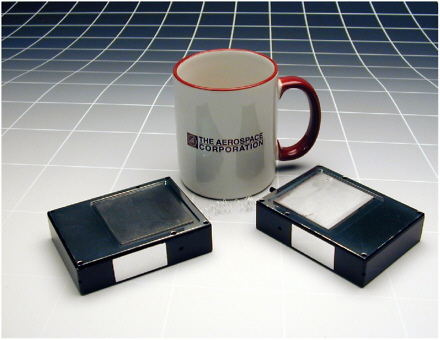 FIGURE 6-1-1 DARPA/Aerospace Corp. picosatellites. Photograph reprinted with the permission of the Aerospace Corporation. |
|
ary 26, 2000, followed by two more on July 29, 2000. They served as inexpensive on-orbit testbeds for DARPA-sponsored MEMS RF switches and low-power RF networking technologies. Nano- and picosatellites are ideal for inexpensive, fast turnaround missions; the DARPA picosatellites were designed, fabricated, and tested within 6 months. Picosatellite development in the United States is sponsored by DARPA and AFRL under the MEMS-based Picosat Inspector program. A number of flight demonstrations with increasing sophistication (MEMS inertial navigation and propulsion) will evolve into a picosatellite inspector that can be ejected from a host satellite. CMOS, MEMS, and related fabrication techniques have provided small, low-power sensors and imaging arrays on silicon dice that can be utilized for attitude determination. The Honeywell HMC1023 three-axis magnetic sensor, for example, can fit on a U.S. dime yet has a minimum detectable field of 85 microgauss, which is more than sufficient to provide spacecraft orientation to within a degree with respect to the Earth’s local magnetic field. CMOS imagers such as the Agilent HDCS-1020 active pixel imaging chip could readily be adapted for use in an imaging Sun sensor with 352 × 288 pixel resolution; it could provide better than 1/3-degree resolution over a 90-degree field of view. Swapping the CMOS photodiode structure with polysilicon-aluminum micro-thermocouples, also available in the basic CMOS process, would result in a thermal imaging system that could detect the 300 K Earth against the 3 K background of space for use in an Earth horizon sensor.2 Nanosatellites can be fabricated using current techniques, but capable picosatellites and smaller spacecraft will require higher levels of integration. System-on-a-chip technologies, high-speed serial interfaces and networking, and increased device density due to better packaging (e.g., flip chip-on-a-board) will enable current-generation microsatellite electronics to fit within a cubic inch. Related attitude sensors, MEMS inertial sensors, and propulsion systems could fit within a similar volume for some applications, like the satellite inspector. Even smaller volumes will be possible as IC device densities continue to improve. AFRL currently has an exploratory program with three universities (Arizona State University, the University of Colorado, and New Mexico State University) to develop and test a cluster of three next-generation, toaster-sized nanosatellites for launch from the space shuttle for operation in a distributed mode. Potential advantages for such nanosatellite distributed arrays include reduced launch costs, increased reliability (losing one satellite would not preclude use of the array), and more rapid system development cycles. The really significant surveillance game-changer would be a cluster of nanosatellites functioning in a manner that mimics an antenna miles in diameter. |
developments in low-power, space-hardened digital and radio-frequency electronics, microthrusters, and low-mass, low-power, short-range (kilometer-scale), free-space optical transmission systems are required. Collective arrays of satellites that function in a synchronized fashion promise significant new opportunities in capabilities and robustness of satellite systems.
Integrated Spacecraft (Medium Term)
Semiconductor batch-fabrication techniques allow cost-effective production of million-transistor digital circuits, analog circuits, radio-frequency and microwave circuits, and microelectromechanical systems (MEMS). Current trends in semiconductor and MEMS fabrication, e.g., continually increasing functionality per square millimeter of silicon, argue for the development of system-on-a-chip (SOC) technology for various spacecraft systems. Increased electronic functionality, coupled with nonvolatile memory technologies such as FLASHRAM and MRAM, enable intelligent micro- and nanosystems that can be reprogrammed or reconfigured on orbit. Possible examples of spacecraft SOCs include Sun and horizon sensors, inertial measurement units (IMUs) composed of MEMS accelerometers and rate gyros, GPS receivers for navigation and attitude determination, and MEMS-based microthruster systems. SOC interconnection can use high-speed serial lines to allow plug-and-play assembly much like the USB bus used for personal computer peripherals. The challenge will be to migrate commercial technologies into radiation-hard or radiation-tolerant technologies for use in space. The benefit will be decreased parts count per spacecraft, increased functionality per unit spacecraft mass, and the ability to mass produce micro-, nano-, and picosatellites for launch-on-demand tactical applications (e.g., inspector spacecraft) and distributed space systems.
Micro Launch Vehicles (Medium Term)
Enabled by subsystems and components such as MEMS liquid rocket engines, valves, gyros, and accelerometers, microlaunch vehicles are feasible in the size range 15 to 800 kilograms gross liftoff weight (GLOW). The payloads would make extensive use of micro- and nanotechnology as well. As an example, a 170-pound GLOW, two-stage rocket (the weight of an AIM-9) could deliver one or two kilograms to low Earth orbit. Such vehicles would be about the size and complexity (less the seeker) of a small tactical missile and thus should cost about the same. Launched from the ground or the air, the micro launch vehicle redefines the concept of low-cost access to space as cost per mission rather than cost per pound of payload (which is about the same as for larger launchers). Thus, it will be possible to place a payload (albeit a small one) into orbit for $10,000 to $50,000 rather than the $10 million to $50 million required today. This cost is sufficiently low that launchers can be stockpiled for launch-on-demand access to
space, encouraging routine tactical space operations. Air launch (from a tactical aircraft for example) offers the added advantages of launch site flexibility, elimination of the requirement for a launch range with its attendant costs, and covertness (a liquid-fuelled vehicle this small might be very difficult to observe from space; also, there need be no fixed launch location). Orbital applications might include visual and IR inspection of space objects, ELINT, jamming of satellites, and antisatellite operations.
Weapon Systems
Miniaturized Ballistic Missiles (Medium Term)
The same MEMS technologies (propulsion, guidance, control, etc.) required for microlaunch vehicles enable intercontinental tactical ballistic missiles with sensor or nonnuclear munitions payloads. A 170-pound GLOW, two-stage rocket (about the weight of an AIM-9) could deliver about 10 pounds to 4,500 nautical miles or 30 pounds to 1,000 nautical miles (the reentry vehicle might account for 25 to 40 percent of this weight). The advantages of the ballistic approach compared with the air-breathing cruise missiles approach are very high speed and immunity to interception. Global, rapid deployment of sensors (and even micro air vehicles) is one obvious application. Another is weapons delivery. Enhanced effectiveness warheads pack sufficient lethality into a small package that these small missiles may be effective against relatively soft targets such as radar sites and armored vehicles. Now that much of the target detection and acquisition is done off-board the shooter platform, the long range and high speed suggest that this may be an effective approach to the now-difficult problem of attacking rapidly redeployable or moving targets, such as missile launchers in Iraq. The ultralong range eliminates the “tyranny of distance” that plagues operations in places like Afghanistan, since any target in the world is within practical range. This is truly a global reach system.
UAV-Launched Antiballistic Missile Boost Phase Interceptors (Medium Term)
Air-launched boost-phase intercept schemes could greatly increase the payload and endurance capabilities of launch platforms. Ground-launched missile interceptors are now sized according to the sensor and propulsion systems, since a direct-hit, kinetic-kill vehicle need not carry a warhead. Advanced sensors, propulsion, and other subsystems enabled by micro- and nanotechnologies will permit dramatically reduced missile mass (perhaps well below 100 kilograms), with several profound system-level impacts. One impact is that microinterceptors will have unit costs at least one and possibly two orders of magnitude lower than current designs. The miniaturization could enable UAV-launched missile boost-phase interceptors. Multiple, simultaneous launches against a single target could
increase reliability, reduce the performance requirement relative to that needed for target-decoy discrimination, and permit new, more flexible system architectures. This may, for the first time, shift the economics of missile offense versus defense in favor of the defender.
Air-to-Air and Air-to-Ground Weapons (Medium Term)
Advances in micro- and nanoscale technologies offer the opportunity to explore designs for air-to-air missiles and air-to-ground bombs with significantly better performance. It may be possible to reduce weight, size, and cost by miniaturizing of sensors, avionics, and inertial measurement units in both the near and the far term. Recent improvements in long-range missile accuracy have resulted in significantly reduced loss of expensive missile-carrying aircraft in combat situations. Adoption of the next generations of MEMS-based IMUs, providing further improvements in missile reliability and accuracy, will be accelerated to further improve aircraft combat survivability. Reductions in guidance system cost and package size will translate into system savings for short-range air-to-ground and air-to-air missiles. Coupled with enhanced explosives under development and further evolutionary cost and accuracy improvements in MEMS IMUs and seekers, further reductions in size and cost may be realized, allowing significantly larger numbers of missiles or smart bombs to be carried by an aircraft. This payload quantity extension can be traded for range or logistics support size and cost as overall systems requirements dictate.
Air Vehicles and Systems
Micro Air Vehicles (Near, Medium, and Long Term)
The acronym MAV generally refers to 6-inch or smaller flying platforms, which are under development for local surveillance and reconnaissance applications. Given micro- or nano-enabled or -enhanced sensors and subsystem technologies, MAVs can grow dramatically in capability, achieving autonomy and the functionality of systems that are currently many times larger, or can shrink in size to insectlike dimensions. Current MAVs fly at 10 meters per second for 5 kilometers, but future systems could fly transonically for 1,000 kilometers or endure for tens of hours (see Box 6-2 for a current example).
In addition to performing sensing, surveillance, and reconnaissance, enhanced capability systems might function as microdecoys or carry jammers (which need not radiate much power if they are very close to the receiving antenna) or even be weaponized. Replacing larger air vehicles with MAVs promises to greatly reduce cost. The affordability of MAVs could allow large swarms of vehicles with cooperative behavior and could herald new and more robust systems approaches to reconnaissance and surveillance. Also, the lower overall
|
BOX 6-2 The Black Widow Micro Air Vehicle Figure 6-2-1 shows a 6-inch wingspan, 80-gram-mass Black Widow fabricated by AeroVironment of Monrovia, California. Funded by DARPA’s Tactical Technology Office, these first-generation MAVs are intended to provide local reconnaissance for soldiers at the platoon level.1 Air Force applications could include local reconnaissance and communications relay for downed pilots, delivery of microwar-heads (10 grams of explosive) with ultrahigh precision, and delivery of covert unattended ground sensors. Their small size (less than 15 centimeters, in any dimension) gives MAVs a degree of stealth.  FIGURE 6-2-1 The AeroVironment Black Widow micro air vehicle. SOURCE: Grasmeyer, J.M., and M.T. Keennon. 2001. Development of the Black Widow Micro Air Vehicle, AIAA Paper 2001-0127. Reston, Va.: American Institute of Aeronautics and Astronautics, Inc.
|
|
Commercially available micro- and nanotechnology in the form of two microprocessors, stamp-size 433-megahertz command receivers, and 2.4 gigahertz data transmitters, two-axis magnetic attitude sensors, MEMS pressure sensors, and a piezoelectric rate gyro make the avionics suite for this 6-inch MAV possible. Figure 6-2-2 shows the relative sizes and masses of these systems with respect to the airframe. Primary mass drivers are the batteries, the electric motor, and the power and propulsion system. Primary power loads are the electric motor (about 5 watts) and the video transmitter (0.55 watts). Microturbojets with ~10 grams of thrust would offer at least an order-of-magnitude increase in flight time from the current limit of ~30 minutes. 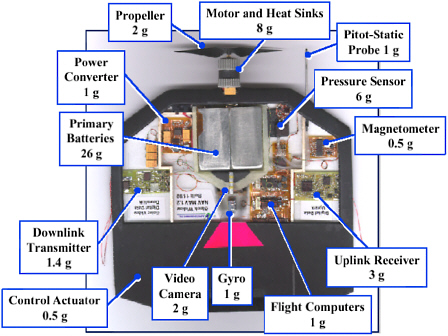 FIGURE 6-2-2 Subsystem layout, size, and mass of the Black Widow. SOURCE: Wilson, S.B. 2000. Palm Power Workshop for Micro Air Vehicles, November 15. Available online at <http://www.darpa.mil/dso/thrust/md/palmpower/presentations/wilson_part1.pdf> [April 8, 2002]. |
mass of a system-level solution implies a dramatically reduced logistics tail. Low cost might be traded for area coverage (by using more vehicles) or operation in very high risk environments. Large numbers flying under the tree canopy or perching in cities may be one solution to finding hidden targets.
MEMS-Based Active Aerodynamic Flight Control (Medium to Long Term)
Microsensing and control of airflow over vehicle surfaces, combined with new ultrastrong, lightweight materials, could lead to a new generation of aircraft
providing enhanced flight efficiency and maneuverability without conventional rudders or other macroscopic control surfaces. These MEMS-based active aerodynamic flight control vehicles (MACs) could exploit advances in microscale sensors and actuators in combination with information technologies to provide local feedback control. Vehicle surfaces would rapidly sense and change airflow boundary layer conditions, a capability now possible with micromechanical devices and continuously increasing computing power. Such control strategies might reduce, on average, the turbulent nature of aerodynamic flow, leading to laminar flow vehicles with dramatically greater range-payload capabilities than those of current aircraft. The implications for air combat support, global reach, and reduced overseas footprint could be significant. A second aspect would be the ability to manipulate boundary layers to generate large forces and moments for flight control, possibly supplementing or replacing large-scale control surfaces while reducing weight and increasing maneuverability. The possible mission implications of MACs would appear to be worth exploring in concert with the advancement of micro- and nanotechnologies.
FINDING AND RECOMMENDATION
Finding T8. Four overarching themes emerge from the advance of micro-and nanotechnologies—increased information capabilities, miniaturization, new engineered materials, and increased functionality/autonomy. These themes could have a significant military impact by enabling new systems approaches to Air Force missions.
Recommendation T8. The Air Force should continue to study new systems opportunities that may emerge from the successful development of micro-and nanotechnologies and use these studies to help focus its applied research and development investments in these technologies.
REFERENCES
1. Joint Chiefs of Staff. 2000. Joint Vision 2020. Washington, D.C.: Government Printing Office.
2. Office of the Secretary of Defense. 2000. Space Technology Guide FY 2000–2001. Washington, D.C.: Office of the Secretary of Defense, Assistant Secretary of Defense (Command, Control, Communications, and Intelligence); Director, Defense Research and Engineering.


