
1
Background and Overview
INTRODUCTION
The U.S. Army envisions that many of its future combat vehicles will feature a hybrid electric power system containing a diesel or turbine generator that will supply electric power to operate the vehicle subsystems, including electric drive and weapons systems. The hybrid electric power system will enhance the warfighting capability of Army vehicles in many ways, including improved acceleration, stealth capabilities for silent mobility/silent watch, energy weapons for increased lethality, and enhanced armor protection for increased survivability.
Because military requirements for hybrid vehicles (e.g., pulsed power requirements) differ significantly from the requirements for civilian commercial hybrid vehicles, the power system architectures are very different. For example, all military systems currently under study use a series hybrid topology, whereas all civilian vehicles use a parallel hybrid technology. In military hybrids, pulsed power and continuous power must operate together without interference. Pulsed power is required for high-power lasers, an electrothermal chemical (ETC) gun, high-power microwave weapons, electromagnetic armor, and other systems. Elements of the continuous power system include prime power (diesel or turbine), generator, motors, converters, power distribution systems, storage, fault protection, safety systems, and auxiliary power connections (see Figure 1-1).
In 1997, the Defense Advanced Research Projects Agency (DARPA) initiated the Combat Hybrid Power System (CHPS) program, whose goal is to develop and test a full-scale hybrid electric power system for advanced combat vehicles. To achieve that goal, the program has developed a 100 percent hardware-in-the-loop System Integration Laboratory (SIL)—a reconfigurable laboratory using state-of-the-art hardware and software to simulate a 15-ton, six-wheeled Notional Concept Vehicle (NCV) (see Figure 1-2). The Army’s proposed specifications for the NCV are shown in Table 1-1.
STATEMENT OF TASK
While some of the technologies required to support combat hybrid vehicle power systems are in hand, many technical challenges remain. Accordingly, DARPA requested that the National Research Council (NRC) convene a committee of experts to undertake the following task:
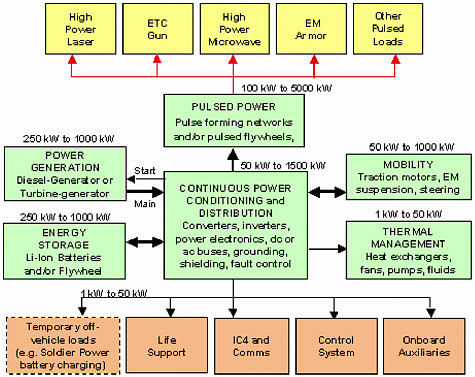
FIGURE 1-1 Basic CHPS/FCS power flow diagram. SOURCE: Courtesy of George Frazier, Science Applications International Corporation.
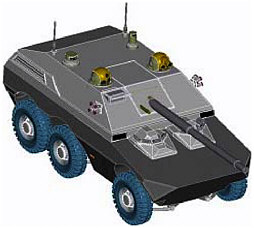
FIGURE 1-2 One version of the CHPS Notional Concept Vehicle. SOURCE: Courtesy of George Frazier, Science Applications International Corporation.
Address the key issues for emerging technologies in the development of the combat hybrid power system components. The technologies to be addressed include permanent magnet technology for hub motors, Li-ion batteries, and high-temperature, wide band gap materials. Other such emerging technologies may also be addressed.
TABLE 1-1 Notional Specifications for an FCS-like Combat Vehicle Established in 1997
|
Metric |
Measure |
NCV Capability |
|
Acceleration |
0-60 mph |
15 seconds |
|
Gradability |
60% slope |
6 mph |
|
Tractive effort |
Relative to gross vehicle weight |
0.7 TE/GVW |
|
Speed |
Continuous road speed Cross-country speed |
70 mph > 40 mph, 3” rms terrain |
|
Silent/stealth operations |
Silent mobility |
< 70 dbA @ 20 yards for 20 miles @ 20 mph |
|
Silent/stealth operations |
Silent watch |
6 hours |
|
Lethality |
Energy on target (ground) |
3 MJ @ 10 km (3 rpm) |
|
Lethality |
Energy on target (air) |
150 kJ @ 3 km (1 Hz) |
|
Endurance |
Cross-country range |
400 miles (30 mph) |
|
Survivability |
Armor protection |
TOW equivalent ATGM 40 mm AP @ 1000 yards |
|
Environment |
Operating temperature extremes |
−40 °F to 140 °F |
|
SOURCE: Courtesy of George Frazier, Science Applications International Corporation. |
||
COMMITTEE APPROACH
On August 26 and 27, 2002, the NRC Committee on Assessment of Combat Hybrid Power Systems convened a data-gathering workshop in San Jose, California, in accordance with the statement of work. The agenda for the workshop is shown in Appendix A and the list of participants in Appendix B. The committee targeted the three emerging technology areas specified in the statement of work:
-
Advanced electric motor drives and power electronics,
-
Battery technologies for military electric and hybrid vehicle applications, and
-
High-temperature, wideband gap materials for high-power electrical systems.
In addition, the committee determined that three additional emerging technologies should also be addressed:
-
High-power switching technologies,
-
Capacitor technologies, and
-
Computer simulation for storage system design and integration.
This report, which presents the committee’s analysis of the information gathered in the workshop, devotes a chapter to each of these six emerging technology areas. In each case, the committee attempted to identify the key technical challenges in each area, performance metrics for the technologies, and research priorities for the future.


