
Executive Summary1
The Clean Air Act (CAA) provides a legal framework for promoting public health and public welfare2 by pursuing five major air quality goals (see Box 1). For the first goal, the CAA authorizes the U.S. Environmental Protection Agency (EPA) to set maximum allowable atmospheric concentrations of six major “criteria” pollutants by establishing National Ambient Air Quality Standards (NAAQS). Individual states then develop state implementation plans (SIPs) that show how, with the assistance of national control programs, they will meet these standards. Such efforts, as well as those in pursuit of the other CAA goals, seek to regulate emissions from a variety of stationary and mobile sources through the nation’s air quality management (AQM) system (see Figure ES-1). Since passage of the CAA Amendments of 1970, the nation has devoted significant efforts and resources to AQM, and substantial progress has been made.
The Committee on Air Quality Management was formed by the National Research Council to examine the role of science and technology in the implementation of the CAA and to recommend ways in which the scientific and technical foundations for AQM in the United States can be enhanced. Over a 2-year period, the committee heard briefings from experts
|
BOX 1
|
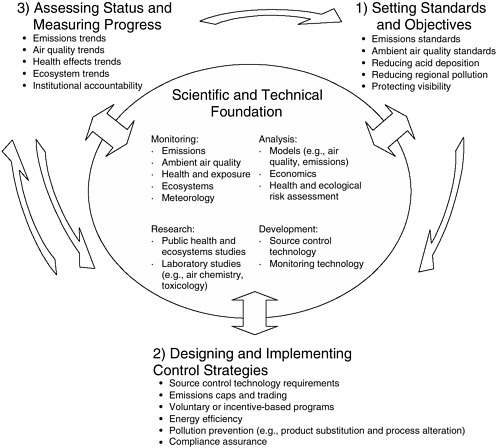
FIGURE ES-1 Idealized schematic showing the iterative nature of air quality management. Bullets under each heading provide examples.
and stakeholders and examined the operation, successes, and limitations of the many components of the nation’s AQM system.
PROGRESS
The committee concluded that implementation of the CAA has contributed to substantial decreases in emissions of several pollutants. Regulations for light-duty vehicles, light-duty trucks, and fuel properties have greatly reduced emissions per mile traveled. Programs for stationary sources, such as power plants and large factories, have also achieved substantial reductions of pollutant emissions. However, most of the reductions have been accomplished through regulations on new facilities, while many older, often higher-emitting facilities can be a substantial source of emissions. Emission “cap and trade” has also provided a mechanism for achieving emission reductions at reduced costs. Air quality monitoring networks have confirmed that ambient pollutant concentrations, especially in urban areas, have decreased over the past three decades, and monitoring has documented a reduction in sulfate deposition in the eastern United States. Economic assessments of the overall costs and benefits of AQM in the United States indicate, despite uncertainties, that implementation of the CAA has had and will probably continue to have substantial net economic benefits.
CHALLENGES AHEAD
Despite the progress, the committee identified scientific and technical limitations in the current AQM system that will hinder future progress, especially as the nation attempts to meet the following key challenges in the coming decade:
-
Meeting new standards for ozone, particulate matter, and regional haze.
-
Understanding and addressing the human health risks from exposure to air toxics.
-
Responding to the evidence that, for some pollutants, there may be no identifiable threshold exposure below which harmful effects cease to occur.
-
Mitigating pollution effects that might disproportionately occur in minority and low-income communities in densely populated urban areas.
-
Enhancing understanding and protection of ecosystems affected by air pollution.
-
Understanding and addressing multistate and international transport of pollutants.
-
Adapting the AQM system to a changing (and most likely warmer) climate.
MEETING THE CHALLENGES: THE COMMITTEE RECOMMENDATIONS
To meet these challenges and remedy current limitations, the committee identified a set of overarching long-term objectives that should guide future improvement of the AQM system. In the committee’s view, AQM should
-
Strive to identify and assess more clearly the most significant exposures, risks, and uncertainties.
-
Strive to take an integrated multipollutant approach to controlling emissions of pollutants posing the most significant risks.
-
Strive to take an airshed3-based approach by assessing and controlling emissions of important pollutants arising from local, multistate, national, and international sources.
-
Strive to emphasize results over process, create accountability for the results, and dynamically adjust and correct the system as data on progress are assessed.
Immediate attainment of these objectives is unrealistic. It would require a level of scientific understanding that has yet to be developed, a commitment of new resources that would be difficult to obtain in the short term, and a rapid transformation of the AQM system that is undesirable in light of the system’s past successes. The committee proposes, therefore, that the AQM system be enhanced so that it steadily evolves toward meeting these objectives. In that spirit, the committee makes five interrelated recommendations to be implemented through specific actions:
-
Strengthen the scientific and technical capacity of the AQM system to assess risk and track progress. Recommended actions include enhancing assessments of air quality and health, ecosystem monitoring, emissions tracking, exposure assessment (both outdoors and indoors), and other components of the scientific and technical foundation of AQM.
-
Expand national and multistate performance-oriented control strategies to support local, state, and tribal efforts. Recommended actions include controlling currently unregulated and underregulated sources; expanding use of performance-oriented, market-based (where appropriate) multipollutant control strategies; and enhancing authority to identify and address multistate and international air pollutant transport.
-
Transform the SIP process into a more dynamic and collaborative performance-oriented, multipollutant air quality management plan (AQMP)
-
process. Recommended actions include enhancing the effectiveness and innovation of state and local air quality planning, while maintaining federal oversight and retaining requirements for conformity with regional transportation planning.
-
Develop an integrated program for criteria pollutants and hazardous air pollutants (HAPs). Recommended actions include establishing a more unified assessment of criteria and hazardous air pollutants, setting priorities for those pollutants, establishing a more dynamic process for considering new pollutants, and considering multiple pollutants in forming the scientific basis for NAAQS.
-
Enhance protection of ecosystems and other aspects of public welfare. Recommended actions include better tracking of ecosystem effects and building an improved basis for implementing secondary or alternative standards to protect ecosystems.
Implementation of these recommendations will still require substantial resources, but they should not be overwhelming, especially when compared with current expenditures for CAA compliance and costs resulting from harmful effects of air pollution on human health and welfare. Implementing these recommendations will also require a commitment by all parties to adjust and change; it may also require new legislation from Congress. As the transition occurs, however, it is imperative that ongoing programs to reduce emissions continue so that progress toward cleaner air is maintained.


