
12
Alcohol Advertising and Promotion
David Jernigan and James O’Hara
The supply of alcohol, including its production, marketing, and retail sale, can play a significant role in alcohol consumption and problems (Holder, 2000). In the United States, marketing is a crucial part of the alcohol supply chain. Alcohol companies spent at least $4 billion to advertise and promote their products to Americans in 2001. Of this amount, $1.57 billion was in the traditional measured media (television, radio, print, and outdoor) (Impact Databank, 2002b). According to the Federal Trade Commission (FTC) (1999), alcohol producers spend two to three times their measured media expenditures in unmeasured promotions such as sponsorships, Internet advertising, point-of-sale materials, product placement, items with brand logos, and other means. Growth in measured alcohol advertising has outstripped inflation by 20 percent since 1975 (Impact Databank, 2002a; Taylor Nelson Sofres, 2002; U.S. Department of Labor, 2002).
One effect of this marketing is to create high barriers to entry (Jain, 1994), which in turn contributes to the concentration of market share in the hands of a small number of companies. These companies face a market that, until recently, essentially had been declining or flat for most of the past two decades. To maintain their markets, alcohol companies must continue to invest heavily in advertising and promotion; to expand the market, they must encourage drinkers to switch brands or increase their consumption, or persuade nondrinkers to begin drinking. Young people are one audience for their efforts. Although the precise effects of this marketing on individuals are difficult to calibrate, it is increasingly ubiquitous, and ben-
efits from technologies that are at the cutting edge of information societies. The regulatory frameworks for alcohol marketing, in contrast, were developed in the first part of the previous century and have changed little in the interim.
This chapter will begin with a brief summary of the shape of and trends in the alcohol market in the United States, with particular attention to youth consumption. It will then describe the nature of and trends in alcohol marketing, particularly as these pertain to young people; the structure of the alcohol industry and key players in it; and the shape and effectiveness of regulatory and self-regulatory frameworks within which those players operate. The paper will conclude with a discussion of needs for further developments both in research and in public policies.
THE UNITED STATES ALCOHOL MARKET
In 2001, Americans paid more than $135 billion for alcoholic beverages (Impact Databank, 2002a). Per capita alcohol consumption among Americans peaked in 1980. It is now 16 percent lower than it was in 1980 (see Figure 12-1), although it has begun to increase again in recent years.
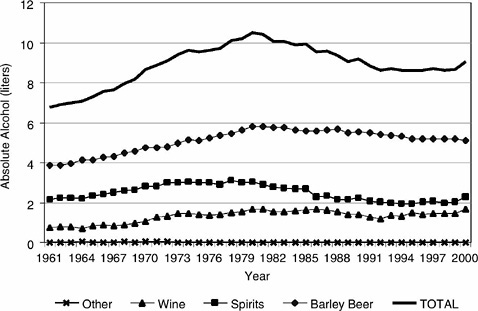
FIGURE 12-1 Adult (15+) per capita alcohol consumption in the United States, 1961-2000.
SOURCE: World Health Organization, 2002.
Per capita consumption of alcohol has also fallen relative to other consumer beverages: from 21 percent of the total in 1980 to 15 percent in 1997 (Putnam and Allshouse, 1999).
According to the National Household Survey, fewer than half of Americans age 12 or older are current drinkers (had a drink in the past 30 days), and fewer than 5.7 percent drink heavily (five or more drinks on an occasion on at least five different days in the past month) (Substance Abuse and Mental Health Services Administration [SAMHSA], 2002). Of United States drinkers, the heaviest drinking 5 percent (those who average 4.2 drinks or more per day over the course of a year) consume 42 percent of the alcohol (Greenfield and Rogers, 1999), while the top 15 percent drinks 73 percent of the alcohol. More than half of all alcoholic beverages in the United States (and 76 percent of beer) are consumed at high-risk levels, that is, when drinkers had five or more drinks on a single occasion (Rogers and Greenfield, 1999).
Consumption among young people is even more concentrated in a small group of heavy users. Young people (under age 21) account for an estimated 12 percent of the total market (U.S. Department of Justice, 2002), and the majority of young people who drink report binge drinking1 (SAMHSA, 2002). These binge drinkers consume the vast majority of the alcohol drunk by young people: 92 percent for 12- to 14-year-olds, and 96 percent for 15- to 17-year-olds and 18- to 20-year-olds (U.S. Department of Justice, 2002).
The number of new teenage drinkers appears to be increasing. According to the National Household Survey on Drug Abuse (NHSDA), between 1995 and 1999 (the latest year for which data are available), the total number of people who began drinking alcohol increased significantly from 3.5 million to 5 million. The majority of those initiates were teens: between 1995 and 2000, the number of persons aged 12 to 17 who started drinking alcohol grew from 2.2 million to 3.1 million. At the same time, the average age of initiation of alcohol use has generally decreased since 1965 (National Institute on Drug Abuse, 2002).
Growing the Alcohol Market: “Total Marketing”
In modern alcohol markets, the advertising and promotion of alcohol are central to the product itself. Whereas in earlier eras, alcohol may have been marketed based on the quality, purity, and price of the product, now the identity of the brand is paramount (Jernigan, 2001). As the Chief Ex-
ecutive Office of a leading Asian brewer remarked, “A beer is a beer is a beer … so therefore it is all about brands … We are not selling beer, we are selling image” (quoted in Jernigan, 1997:9).
Marketing is what creates brands and brand images. In the past 20 years, viewing alcohol marketing as confined to advertising has become more inaccurate. A total marketing strategy has five steps: product development, pricing, market segmentation and targeting, advertising and promotion campaigns, and physical availability (Cowan and Mosher, 1985). Pricing the product so that it is affordable to the target consumer and making it available wherever those consumers may be are important parts of the marketing mix that are beyond the scope of this chapter. Following a brief discussion of market segmentation and targeting, this chapter will focus on the areas of new product development and advertising and promotion.
Market segmentation and target marketing are standard business practices that assist in expanding the number of consumers in the population (Kotler, 1992). The NHSDA shows that nonwhites drink less than whites (National Institute on Drug Abuse, 2002). Nonwhites and other lower consuming groups are thus particularly important to the growth of the market (Scott et al., 1992). Notably, recent research suggests that alcohol availability and advertising, particularly billboard and point-of-purchase advertising, are becoming significantly more prevalent in African-American and Latino communities (Altman et al., 1991; Alaniz, 1998; Alaniz and Wilkes, 1998). Women are also a critical area for market growth because prevalence of alcohol use is lower among women for all groups except 12-to 17-year-olds, and heavy use is more common in all age groups among males. Finally, evidence shows that young people are also a target audience for the marketers. This will be discussed in greater detail.
Product Development
New product development has been a particularly active area in recent years. Alcohol producers have pursued product differentiation through variations such as ice beer and dry beer, line extensions such as flavored vodkas, creation of new categories such as “malternatives” (to be discussed), and expansion of existing categories, such as premixed drinks. Of particular interest to the prevention of youth alcohol problems have been several categories with apparent (and some demonstrated) appeal to youth.
Following their introduction to Australia and the United Kingdom in 1994 and 1995, alcoholic lemonades, or “alcopops,” made their debut in the United States and were followed by the so-called “malternatives,” maltbased products with spirits brand names. Like the wine cooler craze of the 1980s, sales of malternatives at least initially took off rapidly: a national survey of retail sales during a 12-week period in the spring of 2001 esti-
mated sales at $129 million, a 90 percent increase over the same period a year earlier (Nielsen, 2002).
Wine coolers, alcopops, and malternatives share certain product attributes, resembling soft drinks in their fruity, sweet flavoring and their colorful single-serving sized packaging. According to Monitoring the Future, the federal government’s annual survey of drinking and drug use in a sample of 50,000 students across the country, wine coolers are the only alcoholic beverage category more popular with girls than boys (Flewelling et al., 2002). Their bright colors, cartoon spokes-characters, and confusing labels have drawn criticism from others in the industry and from government regulators for having youth appeal and for being misleading to consumers (Blackwell, 1996; Bureau of Alcohol Tobacco and Firearms, 2002). Their sweet flavorings may also be particularly suited to convincing nondrinkers to drink. Since the late 1980s, a substantial body of studies on rats has found that the use of sweeteners can affect rates of initiation of alcohol use. Sweeteners have been used in laboratory experiments to induce alcohol initiation in rat strains bred both to prefer and not to prefer alcohol (see, e.g., Samson, 1986; Tolliver et al., 1988; Samson et al., 1989).
Epidemiological research on underage drinking in the United States has not, for the most part, broken out these drinks as a separate category. Monitoring the Future asks about wine cooler consumption, but only in a subsample of high school seniors. The PRIDE survey also asks about wine cooler consumption by students in grades 6 through 12. PRIDE’s findings show that both annual and monthly prevalence of cooler consumption fell slightly in 2001 relative to prior years. Annual prevalence figures range from 33.8 percent for eighth graders to 53.6 percent for twelfth graders. Ten percent of eighth graders and 24 percent of twelfth graders reported drinking coolers monthly (Parents’ Resource Institute for Drug Education [PRIDE], 2002). However, given the confusion in the marketplace because of new product introductions—such as malternatives, alcopops, ready-to-drink mixed distilled spirits drinks such as “Kahlua Mudslide Cocktail,” and so on—it is unclear at this point what the “wine cooler” category is measuring.
The only data available on alcopop consumption is anecdotal, from a national poll conducted in the United States in the spring of 2001. The poll found teens and adults in agreement that alcopops were more popular among teens than adults. According to self-reports, teens were three times as likely to be aware of alcopops and nearly twice as likely to have tried them (Center for Science in the Public Interest, 2001).
Research from other western countries may shed some light on the impact of these products on youthful alcohol consumption. Research done on a sample of 1,078 Canadian teens between the ages of 12 and 18 in 1989, during the heyday of wine coolers, found that wine coolers were the
alcoholic beverage of choice in general and for initiation into alcohol use for all teens and more markedly so in the case of the younger teens (Goldberg et al., 1994).
Alcopops were introduced into the United Kingdom in 1995. The Welsh Youth Survey, developed in collaboration with the World Health Organization-sponsored Health Behavior in School-aged Children study, was conducted every other year from 1988 to 1996. The Welsh survey added questions about alcopops consumption to its 1996 questionnaire. Results showed that 17 percent of 11- to 16-year-olds in Wales in 1996 drank alcopops at least weekly. Many of these appeared to be new drinkers. Researchers found that alcopops consumption matched the entire increase in weekly drinking of alcohol between 1994 and 1996 among 11- and 12-year-olds, half the increase for 13- and 14-year-olds, and most of the increase for 15- and 16-year-old girls (Roberts et al., 1999).
Swedish surveys have found that alcopops and sweet ciders accounted for more than half the recorded increase in alcohol consumption among 15-and 16-year-old boys between 1996 and 1999, and two-thirds of the increase in consumption among girls, at a time when alcohol consumption among Swedish adults remained stable while youth consumption was increasing (Romanus, 2000).
Alcopops and malternatives tend to have an alcohol content of approximately 5 percent, as opposed to 4.5 percent or slightly less for most popular beers. According to Scottish researchers, this increased alcohol content in sweet, colorful drinks targeted at young drinkers is attributable to a change in alcohol marketers’ view of their market: “ … drinks manufacturers no longer think of themselves as in the alcohol business, but the mood-altering substance business” in competition with the illicit drugs popular in the youth clubbing scene (Jackson et al., 2000:S599).
Advertising and Promotion
In 1985 August Busch III, now Chairman of the Board and President of the Anheuser-Busch Companies, described the marketing strategy of what has become the world’s largest brewer: “Advertising is joined by sales promotion, merchandising, field sales, sales training, and sports programming, enabling us to market not only on a national plane, but also at the grass-roots level” (McBride and Mosher, 1985:143). The ability of the industry to market at the grass-roots level has increased in recent years through the use of technologies such as the Internet; the adoption of racial, ethnic, and other holidays and celebrations, such as Cinco de Mayo and Halloween, as alcohol marketing opportunities (Alaniz and Wilkes, 1998); and the expansion of sponsorship from sporting events to popular music
concerts to events in which alcohol is often a central part of the activities such as the recent “Mardi Gras” celebrations put on by Diageo in Seattle and Philadelphia.
This growth in the importance of nonmeasured marketing expenditures and activities is in keeping with a trend among consumer product producers in the United States in general. Corporations as diverse as Nike, Kraft, and Intel have demonstrated to the business world the value of brands, as opposed to manufacturing facilities or processes or other hard assets. According to the 1998 United Nations Human Development Report, global advertising spending is now outpacing the growth of the world economy by a third (Klein, 1999). Among U.S. brand names, the ratio spent on direct advertising as opposed to other promotional activities flipped between the years 1983 and 1993. By the latter year, only 25 percent of total spending went to direct advertising, while 75 percent went to other promotional activities, such as sponsorships, product tie-ins and placements, contests and sweepstakes, and special promotions. The FTC (1999) estimate that the costs of non-measured alcohol marketing activities are two to three times the costs of measured expenses suggests that alcohol companies are not an exception to this trend.
These kinds of marketing practices have the potential to embed brands in the lives and lifestyles of consumers, creating an intimate relationship and sense of kinship between the brand and the user, to the point that “ … the brand becomes an extension or an integral part of the self” (Aaker, 1996:156). Alcohol marketers themselves speak in the language of intimacy and relationships when they describe what they are doing. Diageo’s director of global commercial strategy, Ivan Menezes, described the company’s approach to marketing Johnnie Walker whisky:
We’ve got to own the emotional heartland of the category and connect with the consumer in a way that goes beyond the rational aspects of the brand … The emotional high ground we believe Johnnie Walker [whisky] can hold surrounds the area of inspiring personal progress. That whole area carries a set of values that works extremely well across borders (quoted in Fleming and Zwiebach, 1999:18).
Thus it is not a whisky but a set of values that is being marketed. In Malaysia, this led to a Johnnie Walker-sponsored and branded campaign where consumers were asked to choose their favorite role model from among six major world figures. The list included Martin Luther King, Jr., Nelson Mandela, Mother Theresa, and, to the dismay of the local Indian community, the abstaining and temperance-advocating Mahatma Gandhi (Assunta, 2001).
This example illustrates the new form that marketing is increasingly taking. As described by Canadian journalist Naomi Klein (1999:21):
The old paradigm had it that all marketing was selling a product. In the new model, however, the product always takes a back seat to the real product, the brand, and the selling of the brand acquires an extra component that can only be described as spiritual. Advertising is about hawking product. Branding, in its truest and most advanced incarnations, is about corporate transcendence … the products that will flourish in the future will be the ones present not as “commodities” but as concepts: The brand as experience, as lifestyle.
As described, these marketing techniques seek to create a unique experience that consumers identify with the product. For many products, including beer, this experience is also quintessentially a youth experience. Across products, the ubiquity of the global mass media has contributed to the emergence of a global mass youth culture, or rather, a set of youth subcultures. Seabrook (2000:163) describes the relationship of these subcultures to brands:
The branding is done by combining a commercial trademark with one or another subcultural motif, a subculture the buyer belongs to or wants to join … The brand is the price of your admission to this subculture. The brand is neither quite marketing nor culture; it’s like the catalyst, the filament of platinum that makes culture and marketing combine.
Successful youth brands not only attach themselves to the subculture, but as Seabrook indicates, position themselves to be among its defining features. Some of the newest alcohol products attach themselves to the all-night clubbing scene. Energy drinks, loaded with caffeine, help young people to stay awake through all-night activities such as clubbing. Premixed energy drinks were a natural successor to the common practice of mixing nonalcoholic energy drinks such as Red Bull with vodka or other distilled spirits. In 1998, a U.K. start-up company called GBL International introduced a premixed vodka and energy drink called “Vodka Kick.” Now imported into the United States and Asia as well as the rest of Europe, the product comes in a range of fruity flavors and bright colors. The company’s total revenue grew 154-fold between 1998 and 2001 (GBL International, 2002). Virgin, the firm that broke a longstanding self-imposed ban on broadcast advertising by spirits marketers in the United Kingdom, introduced two new “energy drinks,” one alcoholic and one nonalcoholic, in that country in the spring of 2000. Months later, the makers of the hypercaffeinated Jolt Cola in the United States introduced another new category, alcoholic spring water. DNA Alcoholic Spring Water is dubbed the “pure water that’s lost its innocence,” and contains spring water, fruit flavors, and 5 percent alcohol (Food Management, 2000). Finally, the popularity of premixed cocktails such as the Kahlua drinks Mudslide and B-52 prompted Brown-Forman Beverages to introduce Jack Daniels Hard Cola in the summer of 2002, with a Web site that includes online games, music samples, and free downloads.
The marketing of these beverages provides a case study in embedding products in young people’s lifestyles and daily practices. Although the alcoholic beverage industry is not the only industry to develop and employ such marketing strategies, some brewers have been early adopters of these strategies. For example the Internet has become an important channel for alcohol companies. Marketing beer to young people via the Internet made headlines in the United States in 1998, when a media watchdog group charged that 82 percent of beer industry sites were using marketing tactics attractive to youth, such as contests, games, slang, and cartoons (Center for Media Education, 1998). Internet sites seek out “sticky content,” that is, activities that will keep users at the site for long periods of time and cause them to return frequently. Anheuser-Busch has also used “viral marketing” techniques on its site to encourage users to bring their friends to the site, including features that permit users to send e-mail and mobile phone text messages to friends using the “Whassup” phrase made popular in the company’s television ads (Cooke et al., 2002). Little research has been done to date on the impact of such marketing on young people. However, according to Marketing Week, young people are the heaviest Internet users in developed countries (Buckley, 1998).
Paid placements of products in films, television, books, and video games is another way to embed alcoholic beverages in the daily lives of young people. Anheuser-Busch established its own placement firm in 1988, becoming the first company and the first brewery to do so. Anheuser-Busch products have appeared in films and on such television shows as Survivor. Heineken has been very active in this area in recent years, with paid placements in and merchandising tie-ins with Austin Powers and James Bond movies. Godzilla has promoted Kirin beer, with an accompanying sweepstakes offering 6-foot inflatable Godzillas. Carlsberg was prominently featured in the recent Spiderman film.
Identifying the product with popular music is also standard marketing practice. After an advertising agency survey found that the Budweiser frogs and lizards were the most popular out of 240 commercials ranked by children, including spots for McDonalds and Barbie, an Advertising Age editorial complained about a new CD compiled and released by Anheuser-Busch. Titled “Wrong Gig for Bud Ads,” the editorial charged that the CD compilation of its controversial cartoon lizards’ favorite hits from the 1960s, ’70s and ’80s was an instance of inappropriate marketing to young people (Advertising Age, 1999).
There is a two-decade history of beer and other alcohol sponsorships of rock concerts. Latino groups charged Bacardi with targeting young Latinas by using Gloria Estefan’s comeback tour in the early 1990s as an opportunity to promote the Bacardi Breezer wine cooler (Jernigan and Wright, 1994). Miller and Molson’s “Blind Date” concerts in North America have
paved new ground by featuring the Miller brand far more prominently than the bands involved. The concerts were held in clubs much smaller than the usual venues, and the identity of the band was kept a secret until patrons had already arrived. Thus the name people associated with the event was Miller rather than the performers’—as one concert promoter put it, “In a funny way the beer is bigger than the band” (Klein, 1999:48).
Spirits marketers are increasingly copying the techniques of the beer companies. This may be in part to counter falling consumption among their older consumers. One trade journal reported that the entire scotch category was bent on reinventing itself, targeting young people with pin-up girls, “cool” graphics, irreverence, and rock concert sponsorships (Furlotte, 2000). For example, Cutty Sark scotch whisky reversed its decline in U.S sales by taking on a new, beer-like theme: “Booze, Babes and Bands.” Three rock-and-roll tours promoted the brand, while outlets offered free playing cards, t-shirts, and caps (Kane’s Beverage Week, 2000), and the www.cuttysarkusa.com Web site offered sexually explicit downloadable movies of a Cutty Sark party at Mardi Gras. Smirnoff billboards took on beer directly as a competitor, through billboards depicting a Smirnoff vodka bottle lying on its side against a red background with the caption, “Beer doesn’t mix well with cranberries.”
While overall vodka sales were dropping, Skyy Vodka sales increased by 21 percent as the company focused on promotions and advertisements in hip clubs and in media outlets such as Spin magazine, with substantial overrepresentation of young people in its readership (Fulmer, 1999; Center on Alcohol Marketing and Youth, 2002). Courvoisier brandy spent $5 million to target young African Americans in the hip-hop culture, using event sponsorships, billboards, and print advertising (Stamler, 2000). The brand achieved double-digit sales increases when hip-hop stars Busta Rhymes and Sean (“P. Diddy”) Combs released the single “Pass the Courvoisier.” Although Rhymes and Combs did not receive compensation from Courvoisier for featuring the brand, their demonstration of the selling power of hip-hop prompted leading hip-hop label Island Def Jam records to purchase and take over the marketing of Armadale Vodka (Holloway, 2002).
THE UNITED STATES ALCOHOL INDUSTRY
Behind this marketing is a small group of companies. Looking at the overall market, in 2000 four companies sold more than half of the alcohol in the United States, measured in pure alcohol: Anheuser-Busch (28.4 percent), Miller Brewing (12.1 percent), Diageo (6.2 percent), and Coors Brewing (6.1 percent) (calculated from Impact Databank, 2001a,b; Impact Databank, 2002a,b). Breaking the figures out into the three principal mar-
ket sectors—beer, distilled spirits, and wine—the leading five companies in each sector account for more than half of U.S. sales in that sector. Table 12-1 shows the leading companies in each category.
There is considerable overlap in ownership, particularly in the wine and spirits segments. In addition to Constellation Brands, which ranks among the top five in both spirits and wine, Brown-Forman Beverages Worldwide (the sixth largest distiller), UDV/Diageo, Allied-Domecq, and Bacardi-Martini all have substantial interests in both segments. The advent of the “malternatives” category has brought about new collaboration among spirits and beer companies: Miller produces malternatives with Allied-Domecq and Gruppo Campari brand names, while Anheuser-Busch makes Bacardi Silver for the eponymous spirits maker.
TABLE 12-1 Leading U.S. Alcohol Marketers
|
Company |
% Share of Marketa |
|
Beer |
|
|
Anheuser-Busch, Inc. |
49.7 |
|
Miller Brewing Co. (Philip Morris)b |
19.9 |
|
Coors Brewing Co. |
10.4 |
|
Pabst Brewing Co. |
4.4 |
|
Heineken USA, Inc. |
2.4 |
|
Total top five |
86.8 |
|
Distilled Spirits |
|
|
Guinness-UDV (Diageo) |
21.5 |
|
Future Brands LLCc |
13.2 |
|
Constellation Brands, Inc. |
10.0 |
|
Bacardi-Martini USA, Inc. |
7.7 |
|
Allied-Domecq Spirits, USA |
6.6 |
|
Total top five |
59.0 |
|
Wine |
|
|
E. & J. Gallo Winery |
22.3 |
|
Constellation Brands, Inc. |
14.9 |
|
The Wine Group |
12.0 |
|
Robert Mondavi Winery |
3.6 |
|
Trinchero Family Estates |
3.5 |
|
Total top five |
56.3 |
|
a2001 figures for beer; 2000 figures for distilled spirits and wine. bMajority sold to South African Breweries in 2002; Philip Morris retains 20 percent interest. cJoint venture between Jim Beam Brands and Vin and Sprit to market both companies’ brands in the United States. SOURCES: Impact Databank (2001a); Impact Databank (2001b); Impact Databank (2002a). |
|
The remainder of the industry is less concentrated and is required by law to be independent of the alcohol producers. In the pre-Prohibition era, the saloon was seen as a center of excessive drinking, political patronage, and working-class organization and social life (Aaron and Musto, 1981; Levine, 1983). After the repeal of Prohibition, the federal government sought to undercut the saloon’s social and economic role by banning vertical integration in the alcohol industry. “Tied-house” laws introduced in 1933 mandated three independent tiers in the alcohol industry: producers, wholesalers and distributors, and retailers. Companies in one tier are forbidden to hold interests in either of the other tiers.
However, some alcohol producers have recently moved to enhance loyalty in the wholesaling sector. Anheuser-Busch has mandated that its distributors may only carry its products. Because the company sells nearly a third of the alcohol in the United States, this mandate created a national distribution network that, although made up of independent operators, is closely aligned with a single company. The company has generated controversy and legal action in Florida for placing control of its distributorships in the hands of relatives, former executives, and family friends (Associated Press, 2001; Barnett, 2001). Diageo and its venture partner Moët Hennessy, meanwhile, contributed to the concentration of spirits distribution in fewer hands by awarding exclusive distribution rights for their spirits brands to a single distributor per state in five key states, and announced plans to do the same elsewhere (Press Diageo plc, 2002).
Regarding the retail level, following the repeal of Prohibition the framers of alcohol legislation took as a high priority the removal of profit from alcohol sales (Levine, 1983). Upon repeal, states were offered two choices for alcohol control regimes: a monopoly system, based on the Nordic model in which states fulfilled the functions of wholesaling and/or retailing alcohol; or a license system, modeled on the British system of licensing private businesses to distribute and sell alcohol. Eighteen states elected some form of monopoly. These states vary in the level at which they exert monopoly control, from wholesale to retail. They also vary in how they treat the various beverages, such as exercising monopoly control over distilled spirits, or over spirits and sales of liquor by the drink, or over all beverages above a certain level of alcohol content, regardless of beverage type. Those states that elected to adopt licensing systems usually began with limits on the number, placement, and hours of sale permitted to alcohol retailers. In addition, some states gave jurisdictions at the county level (and in some cases, at the precinct level) the option of remaining dry. However, over time, the general trend in the physical availability of alcohol at the retail level has been toward fewer restrictions and greater and more widespread availability (Moore and Gerstein, 1981).
THE REGULATORY AND SELF-REGULATORY ENVIRONMENT
Alcohol companies conduct their marketing activities within the context of a complex array of standards, including federal and state regulations as well as voluntary codes of good practice promulgated by trade associations, broadcasters and the companies themselves. This section will review the principal features of that array, drawing in particular on federal government studies of the regulatory framework and its effectiveness. Finally, the standards will be viewed from the perspective of recent empirical research on youth exposure to alcohol marketing.
1991 DHHS OIG Review
In 1991, in response to a request from then, Surgeon General Antonia Novella, the Office of the Inspector General (OIG) of the U.S. Department of Health and Human Services (DHHS) issued a report reviewing federal and state laws and regulations regarding alcohol industry advertising and marketing standards and practices (Office of Inspector General, 1991). Because this regulatory system has changed little since 1991, the OIG’s findings remain relevant. In addition to reviewing the government’s role, the OIG also surveyed the voluntary codes of the alcohol industry and television networks.
The main findings of the OIG review were as follows:
-
Federal jurisdiction was “fragmented” and lacked specific prohibitions against advertising appealing to youth, and the enforcement authority of the Bureau of Alcohol, Tobacco and Firearms (BATF) was “limited.”
-
State regulatory power was limited, and states had “difficulty” passing legislation in this area.
-
Alcohol industry standards were “unenforceable” and did “not effectively restrict” advertising appealing to youth.
-
Network standards had little effect because they were “based on negotiation with advertisers” (Office of Inspector General, 1991:ii)
Federal regulation. The OIG inspection found federal jurisdiction split among three principal agencies: BATF, housed in the Treasury Department; the U.S. Food and Drug Administration (FDA), part of DHHS; and the Federal Trade Commission, an independent regulatory agency. For wines with 7 percent or more alcohol, distilled spirits, and malt beverages to a degree, BATF has primary authority over advertising and labeling. For wines with less than 7 percent alcohol content, the FDA has jurisdiction over labeling. The FTC has broad powers to prohibit “deceptive and unfair advertising” and, while it has concurrent jurisdiction with BATF, it “generally defers to BATF’s decisions” (Office of Inspector General, 1991:6). The
end result of this jurisdictional splintering was “confusion,” in the opinion of the OIG (Office of Inspector General, 1991:7).
For all three federal agencies, the OIG found that regulatory authority was aimed at ensuring “that consumers receive truthful and accurate information about products” (Office of Inspector General, 1991:7). No federal regulations specifically prohibit alcohol advertisements appealing to youth—any protections that accrue to this arena arise out of BATF’s mandate to prevent deceptive, unfair, or misleading advertising.
A major limitation for BATF in enforcing its alcohol advertising regulations stemmed from its underlying statute, the Federal Alcohol Administration Act. Specifically, the OIG pointed to the statute’s failure to require brewers to have BATF permits. As a result, BATF cannot use administrative sanctions against brewers and has to “resort to criminal prosecution” (Office of Inspector General, 1991:8). As examples of the limitations on BATF, the OIG pointed to an enforcement action against Coors that took 2 years, and to BATF’s inability to act against an ad for St. Ides malt liquor in the state of California.
State regulation. In the course of its work, the OIG staff interviewed state Alcoholic Beverage Commissions (ABCs) across the country and found that 17 states believed they had regulations that prohibited advertising that appeals to youth. However, they also reported that state officials faced many hurdles either in enforcing existing rules or in seeking new authority. The OIG cited as the main obstacles to effective state action lobbying by the alcohol industry, disagreements within state ABCs, narrow or vague wording in state regulations, and the cumbersome nature of state regulatory processes.
Alcohol industry standards. The OIG reviewed the voluntary codes then in effect under the auspices of the Beer Institute, the Wine Institute, the Distilled Spirits Council of the United States (DISCUS), and an alcohol industry umbrella group, the Century Council. In particular, the review looked at the elements of the voluntary codes that were related to “youth appeal” (Office of Inspector General, 1991:13). The OIG concluded: “While the industry advertising standards purport to guide alcohol advertisers towards responsible behavior, they fail to prevent advertising considered to have youth appeal” (Office of Inspector General, 1991:14).
The review focused its criticisms of the industry standards on four areas:
-
A vagueness of standards without specific examples.
-
A narrowness of standards that allows for misleading ads or appeals to youth.
-
An inconsistency in how youth appeal was defined.
-
A failure by the industry to address its marketing and promotional activities.
This last element caused the OIG to conclude: “Alcohol industry standards are unenforceable” (Office of Inspector General, 1991:15). In response, the industry pointed to positions taken by the FTC and the United States Department of Justice, which, the industry said, required it to maintain voluntary standards without penalties or risk antitrust action.
Current Industry Standards
A review of the current industry codes shows many similarities to the codes reviewed by the OIG, with a few individual differences.
The Beer Institute. Each of the trade groups begins its advertising guidelines with a statement of broad principles. For The Beer Institute these are that:
-
Advertising cannot “suggest” that any alcohol laws be broken.
-
The standards of “candor and good taste” expected of any other advertising should be followed by brewers.
-
Advertising should reflect that brewers recognize “the problems of the society” and act as good corporate citizens (all quotations in this section are from The Beer Institute, 2002).
Flowing from each of the principles is a number of specific prohibitions. For example any beer advertising should not in any way condone drunk driving, excessive drinking, or any other illegal activity.
With regard to youth exposure to beer advertising, the Institute’s code first calls on companies to review regularly (“at least semi-annually”) the placement of television ads, using “Nielsen or other recognized TV viewer composition data,” and then lists a number of specific prohibitions. The code prohibits placement of ads (in television, radio, and print media) “where most of the audience is reasonably expected to be below the legal purchase age.” In addition to placement, the code also calls on companies to use in their ads models and actors who are at least 25 years old and “reasonably appear to be over 21 years of age.”
Prohibitions on content include symbols, language, music, gestures, cartoon characters, or an entertainment figure or group with “primary appeal” to persons under the legal purchase age. That appeal is defined as “special attractiveness to such persons above and beyond the general attractiveness it has for persons above the legal purchase age, including young adults above the legal purchase age.” There is a specific prohibition against
the use of Santa Claus, and beer logos, trademarks, and names are not to be used on “clothing, toys, games or game equipment … intended for use primarily by persons below the legal purchase age.” Finally, the Institute’s code calls on beer companies not to use “lewd or indecent language or images,” portrayals of “sexual passion … as a result of consuming beer,” or religious themes.
As for beer advertising on the Internet, the Institute’s code puts the responsibility on parents, but offers that it “will provide manufacturers of parental control software the names and Web site addresses of all member-company Web sites” and that companies “will post reminders” on their sites of the legal purchase age.
Enforcement of the code is left up to the individual companies.
Distilled Spirits Council of the United States. In the DISCUS Code of Good Practice, the two starting principles call for:
-
“Responsible, tasteful, and dignified” advertising to legal age adults.
-
Avoiding the “targeting (of) advertising and marketing of distilled spirits to individuals below the legal purchase age” (except as otherwise noted, all quotations in this section are from Distilled Spirits Council of the United States, 1998).
Like The Beer Institute, the DISCUS code calls for advertising not to be placed “where most of audience is reasonably expected to be below the legal purchase age.” In addition, distilled spirits companies are told not to advertise on “college or university campuses,” including their newspapers; however, marketing activities are allowed if they are “in licensed retail establishments located on such campuses.” The DISCUS code also prohibits billboards within 500 feet “of an established place of worship or an elementary school or a secondary school except on a licensed premise.” In a particularly significant development regarding advertising placements, in 1996 DISCUS lifted its self-imposed ban on distilled spirits advertising on the broadcast airwaves by removing this prohibition from its code (Roman, 1996).
The content restrictions of the DISCUS code are, like The Beer Institute’s, a mix of general and specific provisions. The general admonitions are that advertising content be intended for adults and not “appeal primarily” to persons under the legal purchase age. Specific prohibitions include the portrayal of a child or objects, images or cartoon figures that are popular predominantly with children; the depiction of Santa Claus or any religious figure; and advertisements on comic pages.
Youth exposure to distilled spirits advertising on the Internet is to be restricted by companies’ placement of a “reminder of the legal purchase
age” on Web sites and by DISCUS providing parents and makers of parental control software with the Web site addresses of each member company.
The DISCUS code also calls on its member companies to portray “responsible” consumption, “not imply illegal activity of any kind,” “not portray, encourage or condone drunk driving,” and only use advertising copy and illustration that is “dignified, modest, and in good taste.” Specifically, companies should not “claim or depict sexual prowess” because of alcohol consumption and should not “degrade the image, form, or status of women, men, or of any ethnic, minority, sexually-oriented, religious, or other group.”
The DISCUS code provides for a five-member board to hear complaints, make findings, and forward those findings to advertisers, and in some instances, to all DISCUS board members.
The Wine Institute. The Wine Institute’s Code of Advertising Standards was last amended in 2000 and is most noteworthy for the number of provisions that are different from those of the Beer Institute and DISCUS.
For example, the wine code calls on companies not to advertise in any media if the audience is “more than 30 percent” underage, using standard audience composition data (all quotations in this section are from Wine Institute, 2000). In addition, this set of guidelines calls for models in ads to “appear to be 25 years of age or older.” Besides the standard prohibition against the use of the image of Santa Claus, the Wine Institute also calls for its members not to use the Easter Bunny (Wine Institute, 2000). Lacking in the Wine Institute’s code is the other codes’ concern for avoiding “sexual passion” or “sexual prowess,” although it does call for not using “provocative or enticing poses.” With regard to the Internet, the wine code says that companies should realize Web advertising may be seen by underage individuals and therefore that companies should ensure that Web content “remains consistent with provisions of this code.”
Coors Brewing Company. Coors follows not only The Beer Institute guidelines, but also more restrictive ad placement guidelines of its own. To ensure that it follows both sets of guidelines, Coors now participates in the Better Business Bureau Advertising Pledge Program (BBB APP). The company’s participation in the BBB program is, at least in part, its attempt to respond to an FTC recommendation in 1999 (to be discussed) for third-party monitoring (Alexander, 2002). The BBB APP provides for complaints about participating companies’ ads to be resolved by a process managed by the Council of Better Business Bureaus (Better Business Bureau, 2002).
The Coors Pledge calls for ad placements only in media venues where the audience composition is at least 60 percent individuals ages 21 and older, or in other words, where the underage audience is 40 percent or less.
Coors billboards are not to be placed “within 1,000 feet of elementary or secondary schools, established places of worship, or public playgrounds” (Coors Inc., 2002).
The content restrictions of the Coors Pledge basically mirror those of The Beer Institute and mandate that the company not use “any symbol, language, music, gesture, entertainment figure or group, cartoon character, or animal” with “primary appeal” to persons under 21; that the Coors logo not be used on “toys, games, game equipment, clothing or other materials used primarily by those under 21”; that illegal activity not be “condoned” or “encouraged”; and that “sexual passion, promiscuity or other amorous activity” not be portrayed as a result of consumption of Coors products (Coors Inc., 2002).
Federal Trade Commission
Beginning in 1997, the congressional appropriations committees requested that the Federal Trade Commission review the adequacy of the alcohol industry’s self-regulation of advertising and marketing as they relate to underage youth. The FTC responded in September 1999 with a report titled, Self-Regulation in the Alcohol Industry: A Review of Industry Efforts to Avoid Promoting Alcohol to Underage Consumers (Federal Trade Commission, 1999). To gather information and data for its report, the FTC sought and received “special reports” from eight companies, estimated to account for 80 percent of the advertising in traditional measured media, such as television, radio, and print publications. FTC staff also interviewed industry trade associations and government and consumer groups, and reviewed company Web sites. Because the alcohol companies expressed concerns about confidentiality to the Commission, the data were publicly presented either in the aggregate or anonymously.
Underlying the FTC’s analysis were two public policy concerns. The first was the public health issue of underage drinking. The Commission recognized that “underage alcohol use is a significant national concern” and cited a number of statistics about prevalence and trends in underage drinking (Federal Trade Commission, 1999:i). The Commission stated that, although many factors may influence a young person’s drinking decisions, “there is reason to believe that advertising also plays a role” (Federal Trade Commission, 1999:4). The second public policy concern was the regulatory principle that industry self-regulation of its promotional efforts is the preferred course. The Commission called self-regulation a “realistic, responsive and responsible approach” that also avoided First Amendment concerns (Federal Trade Commission, 1999:i).
In the Commission’s analysis, companies were found “for the most part” to be abiding by their voluntary codes and in some instances to be
following stricter company standards. However, in an implicit recognition that the codes themselves had weaknesses, the FTC called on the industry to strengthen the codes and their implementation (Federal Trade Commission, 1999:iii).
The FTC’s recommendations fell into three broad categories:
-
A call for an independent, third-party monitoring system with “responsibility and authority” to address complaints about companies’ practices (Federal Trade Commission, 1999:ii). The FTC called this reform necessary to show an industry commitment. It also noted that the industry’s then-current enforcement procedures “fall short of the advertising industry’s model for effective self-regulation” (Federal Trade Commission, 1999:15). As mentioned earlier, one company, Coors, currently participates in an evaluation program run by the Better Business Bureau (Alexander, 2002).
-
A call for the industry to raise significantly the standard for the placement of advertising because the then-current standard “permits alcohol advertising to reach large numbers of underage consumers” (Federal Trade Commission, 1999:iii). In contrast to a 50 percent threshold for underage audience composition in vehicles in which ads are placed, the Commission pointed out that some companies used a more stringent 25 percent threshold.
-
A call for the industry to adopt a number of “best practices” with regard to ad placement, ad content, product placement in movies and television, online advertising, and marketing on college and university campuses.
In looking at each of the areas where the Commission called for the alcohol companies to adopt “best practices,” the FTC analysis based its recommendations on what it found companies actually to be doing at the time.
Regarding the placement of advertising, the FTC found “mixed compliance” with the voluntary codes, pointing out that four of the eight companies providing data could show they met the 50 percent standard, but that two others had no data to show compliance, and the remaining two had “weeks when a large portion of ads (for one, 25 percent of its TV ads, for another, 11 percent of its radio ads) were delivered to a majority underage audience” (Federal Trade Commission, 1999:9). To limit the exposure of underage audiences to alcohol ads, the Commission pointed to three “best practices”: lowering the percentage of an underage audience that is acceptable; regularly reviewing audience composition data; and maintaining “no buy” lists for programs and magazines “popular with underage audiences” (Federal Trade Commission, 1999:10).
In the area of ad content, the Commission discerned “a significant effort” to comply with the voluntary codes but also found substantial marketing to 21-year-olds, in part because of industry research on “the importance of attracting new drinkers, noting that many consumers continue to drink, at least occasionally, the brands with which they started” (Federal Trade Commission, 1999:10-11). Industry reports to the Commission showed at least one instance where focus groups had told companies that an advertisement was likely to appeal more to underage consumers than young adults, but the advertisement was still broadcast. The Commission wrote that this on-the-line advertising could have the effect of appealing to underage youth as well as to legal-age consumers. The Commission also found that some of the brands targeted to 21-year-olds “may not comply” with prohibitions on promoting irresponsible drinking. According to the report,
Some marketing materials alert consumers to the usefulness of a brand for heavy drinking occasions—for example, promoting new or existing drinking rituals, or using ad language designed to communicate subtly the potency of the product. One company’s market planning report noted that the top objective of 21-26 year old drinks was “to get wild, blitzed and be crazy” (Federal Trade Commission, 1999:11).
To limit the possibility of appeal to underage youth, the Commission named as “best practices” some companies’ policies of setting 25 years old as a minimum target age for advertising and avoiding “‘wild’ party” themes (Federal Trade Commission, 1999:11).
The Commission also reported that company documents indicated that intent to target underage drinkers with advertising content was often not considered by the companies as necessary to demonstrate a violation of the codes. The Commission recommended clarification of the codes’ intent language, “to convey that intent is not required for a violation” (Federal Trade Commission, 1999:23).
In terms of placements of alcohol products in films and television, the Commission found that the 8 reporting companies had made product placements in 233 motion pictures and in one or more episodes of 181 different television series in 1997-98. These included placements in “PG” and “PG-13” films and “on eight of the 15 TV shows most popular with teens” (Federal Trade Commission, 1999:12). To limit underage audience exposure through this advertising technique, the Commission pointed out as best practices some companies’ restriction of product placement to “R” movies, and one company’s total avoidance of movies that “deal strictly with college life” (Federal Trade Commission, 1999:12). It recommended further that companies prohibit placements in films where an underage person is a primary character, and that they apply standards for placing traditional commercials to product placement on television.
Looking at online advertising, the Commission found that most company Web sites did, in fact, have “reminders” that a person should be of legal age, and that the Beer Institute and DISCUS were providing information about company Web sites to companies that produce parental control software. The Commission also concluded there are “no foolproof measures” to prevent underage access on the Web (Federal Trade Commission, 1999:12). As “best practices,” the Commission pointed to some companies’ revisions of Web site content, asking visitors for date of birth, and adding “responsibility” messages to company sites.
In the area of college marketing, the Commission found inherent tensions between the significant underage audience and the high incidence of abusive drinking on college campuses on the one hand, and the reliance of colleges and universities on the revenue produced by alcohol company sponsorship of teams and athletic events on the other. The Commission also found a growing unease about alcohol marketing on college and university campuses on the part of the academic institutions, the United States Congress, and DHHS. As “best practices,” the Commission pointed to the DISCUS prohibition on marketing activities on campus, as well as many companies’ termination of promotions of spring break activities, and efforts to limit advertising and marketing activities to bars and other licensed retail establishments where the audience is assumed to be of legal age.
Regarding enforcement of the voluntary codes, the Commission noted that even where, as in the case of DISCUS, a trade association has a panel charged with handling complaints under the code, this raised “concerns that the responsibility of the association to represent its members in the best light might conflict with its responsibility under the code to criticize member behavior” (Federal Trade Commission, 1999:15). The Commission also recognized that none of the codes provided for any public notice either of complaints or of their resolution. A common justification used by the trade associations for not enforcing their codes is the argument that such actions would run afoul of antitrust statutes. The FTC disagreed, finding that antitrust laws “ … do not bar reasonable self-regulation designed to prevent alcohol advertising from being targeted to underage persons” (Federal Trade Commission, 1999:16).
NBC Proposed Guidelines
Negotiations between the NBC television network and Diageo, the leading spirits marketer in the world and in the United States, to permit Diageo to advertise on NBC broadcasts produced another set of guidelines in 2001. These guidelines were ultimately not implemented because NBC withdrew from the negotiations in the face of public pressure. However, they offer an interesting alternative set of voluntary standards.
These guidelines had a number of provisions that differed from the existing industry guidelines:
-
Product ads were to be limited to the hours of 9 to 11 p.m. Eastern Standard Time and to whatever time the Tonight Show was broadcast.
-
If a product ad was to be aired outside this time slot, NBC would consider it only if the program had a minimum audience of 85 percent adults ages 21 and older.
-
Distilled spirits manufacturers would have to commit to a minimum of 4 months of “100 percent paid branded social responsibility messages” before product ads could be aired, and after that at least 20 percent of the companies’ ads had to continue to be “branded social responsibility messages” (NBC Corporation, 2001).
-
The models and actors in the ads had to be 30 years or older.
With regard to content restrictions, the NBC guidelines paralleled the standard elements found in the codes of the three alcohol trade associations.
Empirical Research on Youth Exposure to Alcohol Advertising
Numerous attempts have been made to assess the influence of the content of alcohol advertising on young people, and these will be covered in other chapters prepared for this panel. Another set of important decisions made by alcohol marketers, however, has received far less research attention. Media placement decisions are the result of extensive market research and the use of standard market research databases to assess the demographic profiles of the audiences for various media vehicles, as well as the effectiveness of such vehicles in delivering target audiences to firms interested in placing advertising in them. The FTC was able to audit alcohol industry compliance with voluntary code provisions regarding placement through its ability to require the industry to provide, on a confidential basis, detailed demographic information about its advertising placements. However, for the most part and until recently, such data have been unavailable to researchers seeking to assess the effectiveness of the industry’s advertising placement standards.
Although demographic information is available for broadcast and print, magazines are the most tightly targeted of the measured media. Two studies to date have looked at alcohol advertising in this medium. Following on research suggesting that cigarette brands popular among youth ages 12 to 17 were more likely than other brands to be advertised in magazines (King et al., 1998), Sanchez et al. (2000) selected a convenience sample of 15 magazines—11 with the highest youth readership (greater than 1.9 million
readers) and 4 with the lowest youth readership (less than 0.8 million)—and assessed the volume of influence by counting advertising pages for alcohol and tobacco in each magazine. Rolling Stone had the highest number of alcohol ad pages in the sample, while Sports Illustrated had the most alcohol and tobacco ads. The authors suggested there was a bimodal relationship between alcohol and tobacco advertisements and youth readership in their sample, with magazines with fewer youth readers delivering fewer alcohol and tobacco ads. They compared Time and Sports Illustrated and found that although the two magazines had identical adult audiences, Sports Illustrated had five times more alcohol ads and twice the audience under age 18. This buttressed their conclusion that alcohol advertisers target youth (Sanchez et al., 2000).
The Center on Alcohol Marketing and Youth at Georgetown University extended this work on youth exposure to alcohol advertising in magazines. The Center used advertising industry databases, standards, and techniques, going beyond analysis of ad placement and audience composition to measure exposure in terms of the standard market research measures of reach, frequency, gross ratings points, and impressions (Center on Alcohol Marketing and Youth, 2002a). Looking at all available data on beer, distilled spirits, wine, and “low alcohol refresher” (e.g., malternatives, alcopops) advertising in United States magazines in 2001, the Center’s analysis ultimately reviewed $320 million in product advertising, representing 80 percent of the expenditure on alcohol product advertising in magazines that have measured audiences.
The Center found that magazine advertising placements exposed youth, ages 12 to 20, to 45 percent more beer advertising, 27 percent more spirits advertising, and 58 percent less wine advertising than adults of legal drinking age. The primary demographic target for the placements was clearly those ages 21 to 34. However, the ages 12-to-20 demographic received only 16 percent less exposure for beer advertising and 26 percent less in the case of distilled spirits, but 95 percent greater coverage in beer advertising and 63 percent greater exposure in spirits advertising than adults aged 35 and over.
The Center also conducted the more traditional analysis of ad placement and audience composition. Its analysis confirmed and extended the findings of Sanchez et al. (2000): 10 magazines with a youth (ages 12 to 20) readership of 25 percent or more, each delivering audiences of 1 million or more youth readers, accounted for nearly one-third of alcohol magazine expenditures in 2001. These magazines ranged from Vibe with a 12-to-20 audience of 41 percent to In Style and Sports Illustrated with 12-to-20 audiences of 25 percent. The Center also found that although alcohol advertising was not being placed in magazines with an underage audience of greater than 50 percent, the FTC’s “best practice” threshold of 25 percent
was not being met. Furthermore, with 15.8 percent as the threshold, representing the proportion of youth ages 12 to 20 in the general population 12 and over as measured by the leading magazine market research firms, more than half the industry’s advertising was in magazines with disproportionate numbers of young readers, and 25 brands placed all their advertising in such magazines.
The Center assessed the effectiveness of the industry’s voluntary code provisions again in its study of alcohol advertising on television in 2001, released in December 2002 (Center on Alcohol Marketing and Youth, 2002b). Analyzing 208,909 ad placements, costing $811.1 million, the report had three principal findings. First, the DISCUS and Beer Institute standards for television advertising placements, barring advertisements on programs with majority youth audiences, leave nearly all of the television landscape open for alcohol ads. If youth audiences are defined as persons between the ages of 12 and 20, this standard places only 1 percent of programs (187 out of 14,359) off limits. If youth are defined as ages 2 to 20, the standard still leaves 94 percent of television programs permissible for alcohol advertising. Furthermore, alcohol companies violated even the 50 percent benchmark with 3,262 ads that were placed in 2001 on programs with majority youth audiences.
Second, the result of such a lax standard is that young people see nearly as much alcohol advertising on television as adults. Young people are more likely to see ads for alcoholic beverages than for many obviously youth-oriented products. For example, youth had a greater likelihood of seeing ads for beer and ale than for commercials selling fruit juices and fruit-flavored drinks, gum, skin care products, sneakers, or noncarbonated soft drinks. Overall in 2001, alcohol advertising reached 88 percent of the youth audience, who on average saw 245 alcohol ads. But the 30 percent of youth who were most likely to see alcohol advertising on TV saw at least 780 ads. In programming categories such as situation comedies, youth were exposed to 9 ads for every 10 seen by adults. On music video and entertainment programs, youth saw 48 percent more ads than adults; in variety programming, such as MADtv and Saturday Night Live, youth were exposed to 26 percent more advertising than adults.
Third, this pattern of youth overexposure to alcohol advertising was true of nearly a quarter (51,084) of the ads on television in 2001, representing $119 million in spending. Youth ages 12 to 20 make up 15 percent of Nielsen’s national television audience. Ads were judged to be overexposing youth in the Center’s report if they aired on programs with disproportionate youth audiences, that is, where the percentage of viewers ages 12 to 20 exceeded 15 percent. In addition to the programming categories already mentioned, several networks—WB, UPN, Comedy Central, BET, and
VH1—systematically exposed more youth to alcohol advertising than adults.
CONCLUSION: THE NEED FOR RESEARCH AND STANDARDS
As alcohol marketing has increased in intensity (as measured by expenditures ahead of inflation), complexity (in terms of venues and strategies employed), and use of cutting-edge information technologies, both research and standards have lagged far behind. Saffer (1997) has suggested that the intensity of alcohol advertising can have important public health consequences, but it needs to be studied with an understanding that advertising occurs in a pulsed fashion and that studies using annual and national data will offer insufficient variation to show these effects. Research on the effects of alcohol advertising has focused primarily on traditional measured outlets such as broadcast and print, and has lagged far behind in looking at effects of the venues and strategies now employing the majority of the industry’s resources. Although research on tobacco marketing has looked at the relationship between youth initiation and use of tobacco, and nontraditional and unmeasured marketing such as merchandising of clothing with tobacco logos (Biener and Siegel, 2000), there is no such research yet on alcohol marketing. The effects of sponsorships, whether sports or musical, as well as the effects of product placements, remain unexamined as well. There is also no research to date on the impact on young people of alcohol promotions that use Internet advertising, company-sponsored sites, and techniques building on e-mail and instant-messaging/chat technologies such as viral marketing.
Research into the brand preferences of young people is also needed. Such research provides one indicator of the appeal of alcohol industry marketing campaigns to underage youth. Without such research into the preferences of young people who have recently initiated alcohol use, it is also difficult to assess the public health impact of new product introductions that at least appear to be designed to appeal to young consumers unaccustomed to and not inclined toward the taste of traditional alcoholic beverages.
Finally, in assessing the degree of health harm from exposure to alcohol advertising, research on overall exposure to the harmful agent would seem an obvious public health priority. However, little such research has been done, and what exists suggests that disproportionate levels of exposure exist. Although Coors, Miller, the Wine Institute, and Diageo did make some changes to their marketing guidelines, the FTC’s recommendations for regular monitoring and third-party review of alcohol placements have, for the most part, not been implemented. No baseline measures are avail-
able for assessing youth exposure or trends in television or radio advertising. Although numerous individual communities have attempted to inventory outdoor advertising (Alaniz and Wilkes, 1998), no comprehensive effort has been made to assess youth exposure to this form of promotion. There is a need for ongoing independent monitoring of youth exposure to alcohol advertising and promotion.
Although the analysis of the industry’s own guidelines and practices points to inconsistent adherence to the FTC’s 1999 recommendations, the FTC itself has not conducted any systematic review of implementation. It is critical that such a review be supplemented by research assessments of whether the FTC’s proposed standards will be sufficient to protect young people from possible harmful effects of alcohol advertising and promotion. Based on the Center on Alcohol Marketing and Youth’s research, tighter standards will likely be required. In addition, given the generally positive normative environment surrounding alcohol use in most areas of society (including, for example, in G-rated children’s films) (Goldstein et al., 1999; Thompson and Yokota, 2001), any such standards will likely need to be supplemented by public health messages and counteradvertising (Saffer, 2000).
REFERENCES
Aaker, D.A. (1996). Building strong brands. New York: The Free Press.
Aaron, P., and Musto, D. (1981). Temperance and prohibition in America: An historical overview. In M.H. Moore and D. Gerstein, (Ed.), Alcohol and public policy: Beyond the shadow of Prohibition, pp.127-181. Washington, DC: National Academy Press.
Advertising Age. (1999). Wrong gig for Bud ads. Advertising Age, 70, 20.
Alaniz, M.L (1998). Alcohol availability and targeted advertising in racial/ethnic communities. Alcohol Health and Research World, 22(4), 286-289.
Alaniz, M.L., and Wilkes, C. (1998). Pro-drinking messages and message environments for young adults: The case of alcohol industry advertising in African American, Latino, and Native American communities. Journal of Public Health Policy, 19(4), 447-471.
Altman, D.G., Schooler, C., and Basil, M.D. (1991). Alcohol and cigarette advertising on billboards. Health Education Research, 6(4), 487-490.
Associated Press. (2001, August). Fla. jury: Maris family owed $50M. Associated Press.
Assunta, M. (2001). Marketing alcohol in Asia. Globe: International Journal of Alcohol and Drug Problems, 1, 20-22.
Barnett, C. (2001). Beer bully. Florida Trend. Available: www.fsu.edu/~par/Media/1_06_02.htm [September 29, 2002].
Better Business Bureau. (2002). Better Business Bureau advertising pledge program. Available: www.bbb.org/app [August 3, 2002].
Biener, L., and Siegel, M. (2000). Tobacco marketing and adolescent smoking: More support for a causal inference. American Journal of Public Health, 90, 407-411.
Blackwell, D. (1996). Alcopop goes the UK cider market: David Blackwell looks at the effects of these new drinks on the industry. Financial Times London Edition, September 12, 32.
Buckley, M. (1998, September). Why Web is the perfect zone for youth marketing. Marketing Week, 21(38), 43.
Bureau of Alcohol Tobacco and Firearms. (2002). Industry circular: Labeling and advertising of flavored malt beverages. Washington, DC: Department of the Treasury.
Center for Media Education. (1998). Alcohol advertising targeted at youth on the Internet: An update. Available: www.cme.org/publications/alcohol_tobacco/alcrep.html [September 30, 2002].
Center for Science in the Public Interest. (2001). Summary of findings: What teens and adults are saying about “alcopops”. Available: http://www.cspinet.org/booze/alcopops_summary.htm [September 29, 2002].
Center on Alcohol Marketing and Youth. (2002a). Overexposed: Youth a target of alcohol advertising in magazines. Washington, DC: Institute for Health Care Research and Policy, Georgetown University.
Center on Alcohol Marketing and Youth. (2002b). Television: Alcohol’s vast adland. Washington, DC: Institute for Health Care Research and Policy, Georgetown University.
Cooke, E., Hastings, G., and Anderson, S. (2002). Desk research to examine the influence of marketing and advertising by the alcohol industry on young people’s alcohol consumption: Research prepared for the World Health Organization. Glasgow: Centre for Social Marketing at the University of Strathclyde.
Coors Inc. (2002). Available: http://www.coors.com/community/ace.asp [August 3, 2002].
Cowan, R., and Mosher, J.F. (1985). Public health implications of beverage marketing: Alcohol as an ordinary consumer product. Contemporary Drug Problems, 12(4), 621-657.
Distilled Spirits Council of the United States, I. (1998). Code of good practice for distilled spirits advertising and marketing (1998). Available: http://www.discus.org/industry/code/ [July 19, 2002].
Federal Trade Commission. (1999). Self-regulation in the alcohol industry: A review of industry efforts to avoid promoting alcohol to underage consumers. Washington, DC: Author.
Fleming, D., and Zwiebach, P. (1999). UDV unveils global campaign for Johnnie Walker, its first ever. Impact, 29(23), 1, 18-19.
Flewelling, R.L., Paschall, M.J., and Ringwalt, C. (2002). The epidemiology of underage drinking in the United States: An overview. Washington, DC, paper prepared for the National Academy of Sciences Committee on Developing a Strategy to Reduce and Prevent Underage Drinking.
Food Management. (2000). Fire water. Food management, 35, 104.
Fulmer, M. (1999). Skyy vodka shoots for the hip: Brand makes a pitch for the youth market via trendy venues. Los Angeles, Los Angeles Times, 17 April, C1.
Furlotte, N. (2000). Reinventing scotch. Beverage Dynamics, 111, 18.
GBL International. (2002). Company introduction. Available: http://www.vkuk.co.uk/trade/companyintro.htm [November 27, 2002].
Goldberg, M.E., Gorn, G.J., and Lavack, A.M. (1994). Product innovation and teenage alcohol consumption: The case of wine coolers. Journal of Public Policy and Marketing, 13(2), 218-227.
Goldstein, A.O., Sobel, R.A., and Newman, G.R. (1999). Tobacco and alcohol use in G-rated children’s animated films. Journal of the American Medical Association, 281(12), 1131-1136.
Greenfield, T., and Rogers, J.D. (1999). Who drinks most of the alcohol in the U.S.? The policy implications. Journal of Studies on Alcohol, 60(1), 78-89.
Holder, H. (2000). The supply side initiative as an international collaboration to study alcohol supply, drinking, and consequences: Current knowledge, policy issues, and research opportunities. Addiction, 95(Supplement 4), S461-S463.
Holloway, L. (2002). Media: Hip-Hop sales pop: Pass the Courvoisier and count the cash. New York Times, September 2, C1.
Impact Databank. (2001a). The U.S. distilled spirits market: Impact databank review and forecast. New York: M. Shanken Communications.
Impact Databank. (2001b). The U.S. wine market: Impact databank review and forecast. New York: M. Shanken Communications.
Impact Databank. (2002a). The U.S. beer market: Impact databank review and forecast. New York: M. Shanken Communications.
Impact Databank. (2002b). The U.S. distilled spirits market 2001. New York: M. Shanken Communications.
Jackson, M.C., Hastings, G., Wheeler, C., Eadie, D., and MacKintosh, A.M. (2000). Marketing alcohol to young people: Implications for industry regulation and research policy. Addiction, 95(Supplement 4), S597-S608.
Jain, S.C. (1994). Global competitiveness in the beer industry: A case study. Storrs: University of Connecticut, Department of Agriculture and Resource Economics, Food Marketing Policy Center (Research Report No. 28).
Jernigan, D., and Wright, P.A. (1994). Making news, changing policy: Case studies of media advocacy on alcohol and tobacco issues. Rockville, MD: University Research Corporation, Marin Institute, Center for Substance Abuse Prevention.
Jernigan, D.H. (1997). Thirsting for markets: The global impact of corporate alcohol. San Rafael: The Marin Institute for the Prevention of Alcohol and Other Drug Problems.
Jernigan, D.H. (2001). Cultural vessels: Alcohol and the evolution of the marketing-driven commodity chain. Dissertation Abstracts International, 62, 349-350-A.
Kane’s Beverage Week. (2000). Cutty Sark reverses decline with focus on capturing young “ordinary” guys. Kane’s Beverage Week, 61(23), 1-2.
King, C., Siegel, M., and Celebucki, C. (1998). Adolescent exposure to cigarette advertising in magazines: An evaluation of brand-specific advertising in relationship to youth advertising. Journal of the American Medical Association, 279, 516-520.
Klein, N. (1999). No logo: Taking on the brand bullies. New York: Picador.
Kotler, P. (1992). Marketing management: Analysis, planning, implementation, and control (7th edition). Englewood Cliffs, NJ: Prentice Hall.
Levine, H.G. (1983). Regulating daily life: Prohibition, alcohol control, and the legitimacy of law. Berkeley: Alcohol Research Group.
McBride, R., and Mosher, J.F. (1985). Public health implications of the international alcohol industry: Issues raised by a World Health Organization project. British Journal of Addiction, 80, 141-147.
Moore, M., and Gerstein, D. (1981). Alcohol and public policy: Beyond the shadow of Prohibition. Washington DC: National Academy Press.
National Institute on Drug Abuse. (2002). Results from the 2001 National Household Survey on Drug Abuse: Volume 1. Summary of national findings. Rockville, MD: SAMHSA, Office of Applied Studies.
NBC Corporation. (2001). NBC advertising guidelines for alcohol products. Available: www.nbcmv.com/pw2/corporate/dnr.v25.cgi?cmd=detail&query_id=55735 [July 26].
Nielsen, A.C. (2002). Trendwatch: Malternatives. Available: www.acnielson.com/pubs/ci/2002/q2/features/malternatives.htm [September 29, 2002].
Office of Inspector General. (1991). Youth and alcohol: Controlling alcohol advertising that appeals to youth. Washington, DC: Department of Health and Human Services, 1.
Parents’ Resource Institute for Drug Education. (2002). PRIDE questionnaire report: 2001-02 national summary grades 6 through 12. Bowling Green, KY: Pride Surveys.
Press Diageo plc. (2002). Diageo and Moet Hennessy announce agreement of new distributor relationships in five states. Available: www.industrypages.com/artman/publish/Industry_News_1414.stm [October 1, 2002].
Putnam, J.J., and Allshouse, J.E. (1999). Food consumption, prices, and expenditures 1970-1997. Washington, DC: Food and Rural Economics Division, Economics Research Services, U.S. Department of Agriculture.
Roberts, C., Blakey, V., and Tudor-Smith, C. (1999). Impact of “alcopops” on regular drinking by young people in Wales. Drugs: Education, Prevention and Policy, 6(1), 7-15.
Rogers, J.D., and Greenfield, T. (1999). Beer drinking accounts for most of the hazardous alcohol consumption reported in the United States. Journal of Studies on Alcohol, 60(6), 732-739.
Roman, L.A. (1996). Liquor industry’s decision to pursue broadcast ads won’t mix in Tennessee. Memphis Business Journal, December 9, 1-2.
Romanus, G. (2000). Alcopops in Sweden: A supply side initiative. Addiction, 95(Supplement 4), S609-S619.
Saffer, H. (2000). Alcohol advertising and youth. New York: National Bureau of Economic Research.
Samson, H.H. (1986). Initiation of ethanol reinforcement using a sucrose-substitution procedure in food and water-sated rats. Alcoholism: Clinical and Experimental Research, 10(4), 436-442.
Samson, H.H., Tolliver, G.A., Lumeng, L., and Li, T.K. (1989). Ethanol reinforcement in the alcohol nonpreferring rat: Initiation using behavioral techniques without food restriction. Alcoholism: Clinical and Experimental Research, 13(3), 378-385.
Sanchez, L., Sanchez, S., Goldberg, A., and Goldberg, A. (2000). Tobacco and alcohol advertisements in magazines: Are young readers being targeted? Journal of the American Medical Association, 283(16), 2106-2107.
Scott, B.M., Denniston, R., and Magruder, K.M. (1992). Alcohol advertising in the African-American community. Journal of Drug Issues, 22(2), 455-469.
Stamler, B. (2000). A new campaign for Courvoisier, brand of Napoleon, looks for younger, hipper customers. New York Times, 29 August, C8.
Substance Abuse and Mental Health Services Administration (SAMHSA). (2002). National household survey on drug abuse. Rockville, MD: Office of Applied Studies.
Taylor Nelson Sofres. (2002). TNS Media Intelligence/CMR. New York: Author.
The Beer Institute. (2002). Beer Institute advertising and marketing code. Available: http://www.beerinstitute.org/admarkcode.htm [July 19, 2002].
Thompson, K.M., and Yokota, M.S. (2001). Depiction of alcohol, tobacco, and other substances in G-rated animated feature films. Pediatrics, 107(6), 1369-1374.
Tolliver, G.A., Sadeghi, K.G., and Samson, H.H. (1988). Ethanol preference following the sucrose-fading initiation procedure. Alcohol, 5(1), 9-13.
U.S. Department of Justice. (2002). Drinking in America: Myths, realities, and prevention policy . Calverton, MD: Pacific Institute for Research and Evaluation.
U.S. Department of Labor. (2002). Inflation calculator. Available: http://data.bls.gov/cgi-bin/cpicalc.pl [September 29, 2002].
Wine Institute. (2000). Code of advertising atandards. Available: http://www.wineinstitute.org/communications/statistics/Code_of_Advertising.htm [July 17, 2002].
World Health Organization. (2002). Global alcohol database. Available: www.who.int/alcohol.


