Information and Literature Use in a Research and Development Organization
I.H.HOGG and J.ROLAND SMITH
ABSTRACT. A uniform sample drawn from three arbitrary status grades of applied scientists (Research Managers, Senior staff, and Junior staff), totalling 157 persons, were interviewed using standard questionnaires, and also were given 14-day reading diaries to complete. Chief information sought was: (a) how they obtained their scientific and technological information and how they valued the different sources; (b) how many abstracts, periodicals, research reports and textbooks they read during 14 consecutive days, and where they read them; (c) whether they considered they had adequate time for reading at work; (d) where they obtained the literature read during the 14 days, how they got references to it, and how much literature they bought themselves; (e) their criticisms of the various library lists as reference sources; (f) how they used the information gained during their 14 days’ reading, and what reference-sources led to the most useful reading; (g) the value they placed upon periodicals according to age and language, and their use of those of British and foreign origin; (h) whether they kept personal data records; (i) their suggestions for new, and criticisms of existing library services; together with the formal qualifications and field of research of those interviewed. All the sample were interviewed, and 92% of the diaries were returned.
The first analysis of results showed that: (a) The prime information sources were informal contacts and the literature, of which reports were valued most and periodicals least by those answering. (b) Less than one abstract-consultation was made per head during the 14 days’ reading; less than one-third of the sample read any abstracts during this period. Two-thirds of the consultations were for keeping up with the literature, one-third for locating past literature. All except one of the diarists read some periodicals, reports and textbooks, an average of 4 per head. Three-quarters of the reading was in working-hours, the rest at home. These figures are, however, statistically suspect, (c) Three-quarters of those interviewed said that for some part of the past working year they had no time to read in working
I.H.HOGG and J.ROLAND SMITH Industrial Group, United Kingdom Atomic Energy Authority, Risley, Warrington, Lancashire, England.
hours [cf. (b)]. (d) Over half the diarists’ literature was from the Group libraries, one-quarter, mainly reports, was sent direct by authors or colleagues, one-seventh was the diarists’ property, and a small amount was borrowed from colleagues. Less than half the sample bought their own books, one-third bought their own journals: average spending per head in the past year was £4 on books, £2 on journals. Of the 14 days’ reading, no references were required for 40% of it; of the remainder, colleagues recommended 18%, the diarists’ memory or knowledge accounted for 18%, the library provided references for 14%, references in other publications were 6%, and abstract journals (and the library catalogue for books) provided 4%. (e) Of those interviewed 25% criticised the library bulletin (of selected journal references), 13% book accessions list, and 17% the report list. All lists were used by about three-quarters of the sample. The main tendency was to ask for more selective lists for individuals or their immediate departments, and for more abstracts or annotations in the lists, (f) Half the diarists’ reading was in aid of their research work, one-third for general interest, and only about 3% was discarded as of no use. The highest percentage of “discarded” per reference-source occurred when the least-used source, abstract journals, was used (about 14%). (g) With a maximum usefulness-score of 6, among those who used them current periodicals of research scored 4.6, falling after 10 years to 2.9; current periodicals of technology scored about the same. Decline of interest in both types of periodical was heaviest among engineers, least among chemists and metallurgists. Of foreign-language periodicals, among those who used them the “face-value” (including the effect of the language-bar) was lowest for the Japanese periodicals; the potential value (assuming no language-bar) was highest for the German; and the difference between face-value and potential value was highest for the Russian. Of periodicals of British and foreign origin, 57% of the scientists’ information came from the former, and 42% from the latter, (h) Personal records of data or useful references were kept by two-thirds of the sample, and another one-tenth of them used records kept by others in their section, (i) Two-thirds of the sample offered criticisms of or suggestions for improvement of the library service: only those of wider interest are mentioned. Major comments were: (a) the libraries should publicise their services, (b) more or better qualified library staff are needed, (c) librarians should notify users individually of literature of interest, (d) better copying (reprint) facilities should be provided.
1. Introductory
This paper records the major part of a survey of which the prime object was to provide information for use within the United Kingdom Atomic Energy Authority. In consequence, not all the data obtained is presented, but that judged to be of fairly wide interest has been included. It is not proposed here to review the surveys of the use of literature and information by scientists which have been conducted by others in the field: this has already been ex-
cellently done up to 1956 by R.R.Shaw (1). Nevertheless, in planning the present investigation and in writing this report due regard has been paid to the surveys of other workers, chief among them being those of J.D.Bernal (2), S.Herner (3), and R.G.Thorne (4), from which valuable help was obtained both in assessing fruitful areas for enquiry and in the actual design of the questionnaires.
The subject of the survey was the applied scientists and technologists in the Research and Development Branch of the U.K.A.E.A.’s Industrial Group establishments, who work at five laboratories and at the Group’s headquarters. The Research and Development Branch is comparable with similar organisations in large-scale industry. It assists the Engineering (design) and Operations (management) Branches by (a) developing existing processes, (b) removing production difficulties, and (c) providing information for the design of new plant, or prototype nuclear reactors. Four of its laboratories are sited with large industrial plants scattered over the northern part of Great Britain; the fifth is near the Group headquarters at Risley. These laboratories have their own programmes of research and development, coordinated from Risley, where there is an advisory service. The works which they adjoin have, apart from wide geographic scattering, a common characteristic in their very recent origin (the first establishment dates only from 1946, and elsewhere construction still continues), and the highly sophisticated nature of the plant, in which technological progress is very rapid. There are, therefore, acute information communication problems to be met, on the score of (a) evolving technology, (b) lack of tradition, and (c) geography and partial autonomy. The method mainly employed is through technical liaison, design, and management committees on which R. & D. representatives sit, and to which reports are submitted for discussion. Report-writing is consequently a major R. & D. activity, and presents a major documentation problem, exacerbated to some extent by the access restrictions imposed by military security.
In addition to the internal communication problem, there is the more familiar one of efficiently communicating to R. & D. scientists the results of research by outside workers. This was recognised and dealt with from the beginning by establishing libraries, controlled by the R. & D. Branch, at each laboratory and at Risley (the libraries also serve the works staff), with coordination and certain common services to all the libraries by a chief officer at Risley, where the most highly developed library is situated. In recent years, however, the libraries have played an increasingly large auxiliary part in internal communication by receiving, publicising (subject to security), retrieving and lending internal reports. By virtue of their control by their principal users—the R. & D. Branch—and their decentralization, the libraries ought to
be in a most favourable position to fulfil their role of getting the right information at the right time to the right person. Whether in fact they were successful in this was one of the main purposes of the present survey to find out. At the same time, it was plain that the investigation should try to discover what were the scientists’ real needs in the sphere of communication and documentation, to gain a sound basis for library and other reforms. It was thought that this part of our survey could well be of interest to workers outside the Industrial Group, and that belief gave encouragement to a wider investigation than had originally been planned.
The main heads of information sought in the survey were as follows:
-
How the scientists obtained their scientific and technological information and how they valued the different sources.
-
How many abstracts, periodicals, research reports, and textbooks they read during 14 consecutive days, and where they read them.
-
Whether they considered they had adequate time for reading at work.
-
Where they obtained the literature read during the 14 days, how they got references to it, and how much literature they bought themselves.
-
Their criticisms of the various library lists as reference sources.
-
How they used the information gained during their 14 days’ reading, and what reference-sources led to the most useful reading.
-
The value they placed upon periodicals according to age and language, and their use of those of British and foreign origin.
-
Whether they kept personal data records.
-
Their suggestions for new, and criticisms of existing library services; together with their formal qualifications and field of research.
The method of survey was a combination of personal interviews based upon a standard questionnaire, and pro-forma “diaries.” This was decided upon because, first, there was little time and no special staff available for the application of refined techniques (such as R.R.Shaw’s suggested supervised diaries (op. cit.) or for the application of operational research to the problem), and secondly, because much of the required data was of a detailed quantitative nature. It seemed plain that while interviews were a convenient and, for the interviewed person, a relatively agreeable and quick means of getting to know about their general practices and preferences, if interview questions were to be asked about, for example, from what sources they got the literature-references to what they had read during a specified period, their answers would probably be no more than inspired guesses. For this purpose a diary, or similar record, appeared more likely to yield realistic results, though it was known that it would not be 100% reliable. As, however, the survey was con-
ducted under official auspices it was expected that cooperation would tend to be greater than under truly voluntary conditions.
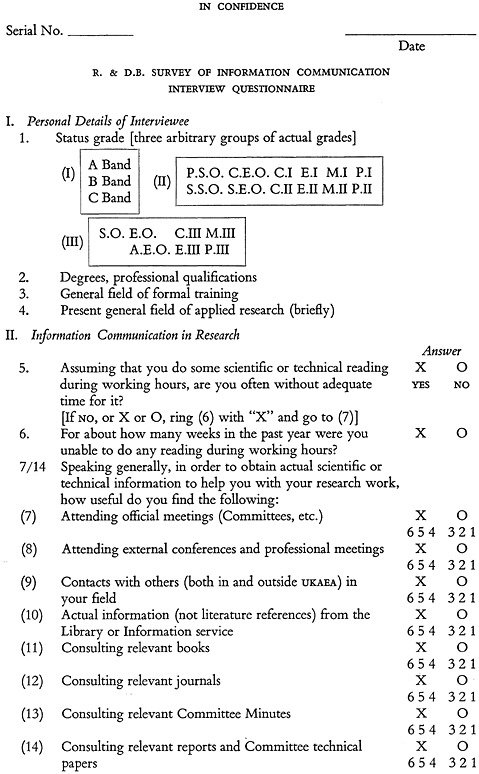
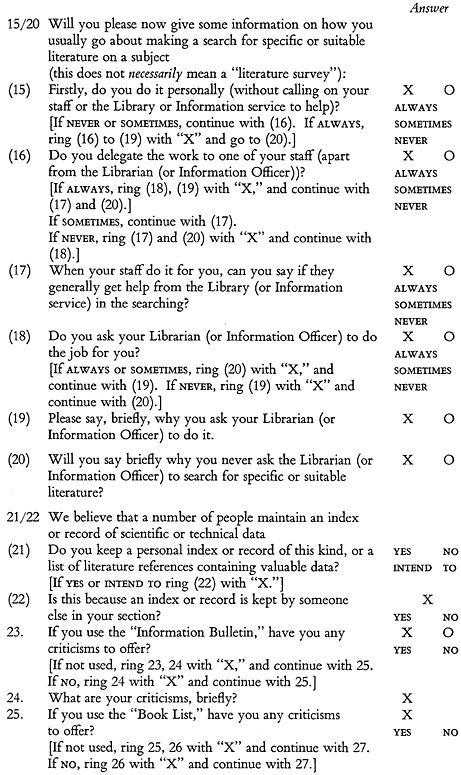
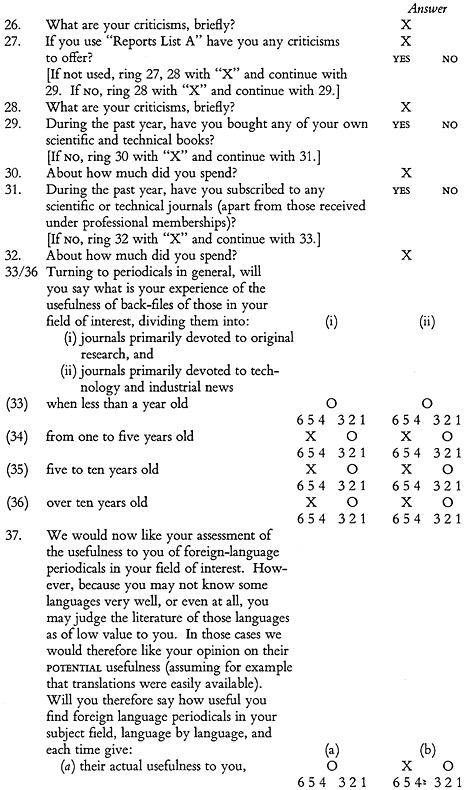
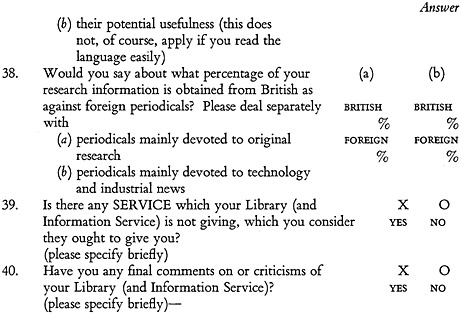
Before beginning the main survey, a pilot survey was made of 21 scientists at two of the laboratories during September and October 1957. Only staff actually engaged upon or responsible for supervising research were considered; administrative or quasi-administrative personnel were excluded. One individual was selected at random from each of the U.K.A.E.A. staff status grades, in each of the two laboratory staff nominal rolls. A personal letter from one of the present authors was sent to each of those selected, explaining the purpose of the pilot and the main survey which would follow, asking for criticisms of both interview and diary, and guaranteeing that all records would be treated as entirely confidential (this promise has been kept). Response to the pilot was 100% and some useful suggestions were received: questionnaires and diaries were therefore amended, mainly by way of simplification, or by transfer of questions from interview to diary, and the final versions printed. That part of the final questionnaire which has been analysed for this paper, and the whole of the diary, are reproduced in Appendices I and II.
2. Main survey: Composition of the sample
For the main survey, which took place between November 1957 and March 1958, several hundred individuals were available for investigation, distributed over the six Industrial Group establishments. From these, as in the pilot, those doing administrative or quasi-administrative work were deducted, together with those who took part in the pilot. The scientists on the six establishments’ nominal rolls were then separately sorted into three arbitrary status grades: Grade 1 represented the Research Management, Grade 2 the Senior scientific, technological, and experimental personnel, and Grade 3 the Junior scientific, technological, and experimental staff. Names within each grade were then alphabetised and a random sample was taken within each grade (the proportion being the same in each grade), totalling 157 persons, for participation in the survey. Almost all those so selected took part, but where any individual was not available (e.g., because of illness or absence), the next name on the nominal roll was selected. The analysis of the results was done manually, the number involved hardly warranting the use of punched cards.
The composition of the whole sample according to status grade was as follows:
|
Grade 1 |
Grade 2 |
Grade 3 |
Total |
|
Research Management |
Senior staff |
Junior staff |
|
|
6 (3.8% of whole sample) |
57 (36.3%) |
94 (59.9%) |
157 (100%) |
At each interview the scientists were asked to state the general field of applied research in which they were working (vide Question 4, Appendix I). Their answers were divided into five main classes, and the number of persons in each class was: biology, 2 (1.3% of sample); metallurgy (and metal physics), 32 (20.4%); engineering, including electrical engineering, 35 (22.3%); physics and mathematics, 39 (24.8%); chemistry and chemical engineering, 49 (31.2%). The total was 157 (100%).
The samples were then asked the type of formal qualifications they possessed (vide Question 2, Appendix I). Their answers were divided into (a) those with university degrees, (b) those without degrees but with a professional qualification of a senior institution, and (c) those without either of the foregoing. The result showed 62.4% with degrees, 15.3% with professional qualifications, and 22.3% with neither (but not necessarily no qualifications). It was intended to analyse part of the answers to questions according to the formal qualifications of the scientists, to discover whether a university education influenced their information habits and wants. A specimen analysis was made of Questions 7/14 of the questionnaire, but the results in that case were almost exactly typical of the whole sample, and analysis by formal qualifications was therefore abandoned.
3. Analysis of interview questions
3.01. QUESTIONNAIRES
Interviews (of about 45 minutes’ duration) were conducted by a single interviewer, chosen from the junior scientific staff of Risley Library by the Group Training Department. The same interviewer was used for both the pilot and main surveys, and he was thoroughly briefed on both occasions by one of the present authors. The questionnaires used were provided with pre-coded answers to the majority of questions, partly to speed up marking by the interviewer, and also (in the case of Questions 7/14, 33/36, and 37 vide Appendix I) to standardise the scoring when the scientists were asked to evaluate various sources of information according to usefulness. When asking these evaluative questions, the interviewer handed the scientist a list from which to choose his answer. All those taking part were asked if this method gave them adequate expression, and so far as concerns that part of the survey reported here, it was considered satisfactory. These answers which ranged from “No use” to “Essential,” were given numerical scores from 1 to 6. The average score was then calculated for each question, resulting in an average value for each information source. Sources could then be arranged in an order of usefulness. Herner
(op. cit.) had a similar objective, but originally asked his subjects simply to arrange the sources in order (which would appear to have the effect of discouraging, if not actually preventing scientists indicating sources of equal usefulness). Because of this lack of independent evaluation, he evolved a corrective weighting based upon the amount of use they made of the literature. This proved to have substantially the same result as asking the scientists simply to say whether they used a source or not, counting “yes” as 1 and “no” as 0, and then totalling the scores for each source. He therefore abandoned the first in favour of the second method. The evaluation scoring used in the present survey appears to have secured fine gradation of usefulness among those using a source of information, i.e., when the scoring was not weighted to account for those not using the source. The validity of the results does however depend upon consistency of each individual in his use of the evaluation scale. Nevertheless, it must be admitted that when the scores were weighted to account for those not answering (i.e., answers “Does not apply” and “Don’t know” were included in the score) and were compared with the results of simple additive scoring as used by Herner, there was little difference between them. Both unweighted evaluation scoring and additive scoring have therefore been adopted, the former having its own special value.
3.02. QUESTIONS 5, 6: ADEQUACY OF TIME FOR READING AT WORK
Because the largest part of the survey concerned the use of literature (and in the diaries actually took note of what reading was done during a fourteen-day period), those taking part were asked whether they considered they had adequate time for reading during working hours. 73% said there was insufficient time; the remaining 27% found the time adequate. Significantly, 100% of the Research Managers said they had insufficient time, as did 81% of the Senior grade; even 67% of the Juniors felt the same. The 73% with inadequate reading time during working hours were then asked for how many weeks in the past year (excluding vacation leave) they were unable to read at work. 17% of them did not know, but the remaining 83% gave the following average figures, which, if any great value is placed upon the reading of scientific and technical literature, reveal a very unhealthy situation, most serious in the higher status grades:
|
Research Managers |
35 weeks (76% of working year of 46 weeks) |
|
Senior grade |
29 weeks (63% of working year of 46 weeks) |
|
Junior grade |
25.5 weeks (55% of working year of 46 weeks) |
The average was 27 weeks (58% of the working year).
3.03. QUESTIONS 7–14: EVALUATION OF SOURCES OF INFORMATION
It could be argued that lack of time for reading in working hours need not necessarily be a hindrance, if the scientists obtained their information by other means. They were therefore asked independently to evaluate a series of information sources, according to the usefulness of each for their research work. The average values placed upon each source by those who used it were obtained as described in 3.01 above. The results are given in Table 1, with the sources placed in order of usefulness to those who used them. For comparison, the numbers of those who offered a valuation of each of the sources of information are also given as percentages of the sample, from which their usefulness to the whole sample may be deduced.
TABLE 1
|
Source of information |
Average score of those answering |
Per cent answering the question |
|
Consulting relevant reports, etc. |
(5.1) Very useful |
96 |
|
Contacts with others in your field |
(5.0) “ |
98 |
|
Consulting relevant books |
(4.9) “ |
99 |
|
Consulting relevant journals |
(4.6) “ |
96 |
|
Attending official meetings of committees, etc. |
(4.0) Useful |
52 |
|
Consulting relevant committee minutes |
(3.9) “ |
68 |
|
Actual information (not literature references) from the Library |
(3.8) “ |
70 |
|
Attending external conferences and professional meetings |
(3.8) “ |
47 |
All the questionnaires were then analysed according to the formal qualifications of the sample, but these were found to have no effect upon the answers given. Analysis according to the status grade showed that this had little influence upon the answers, except that 100% of the Research Managers rated “Contacts with others,” “Books,” “Reports,” and “Committee Minutes” higher than the other two Grades, and the two-thirds of them who answered rated “Information from the Library” lower than did the other two Grades.
To sum up, therefore, it was conclusively demonstrated that the literature occupied a virtually preeminent place as source of applied research information, regardless of either the status or formal training of those in the sample, a place shared only by the personal contacts with other workers in their field.
3.04. QUESTIONS 15/20: LITERATURE SEARCHING HABITS
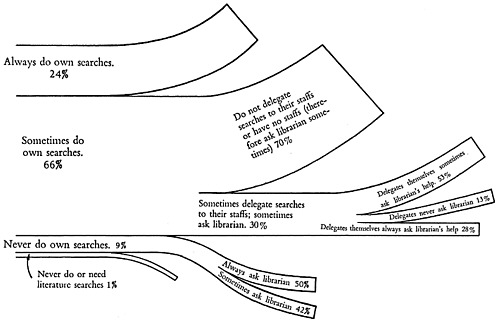
The scientists were next asked how they usually obtained their references to the literature they read—whether for a particular paper, or for a collection of references on some particular subject. The main object was to discover how far the library services were releasing the scientists from this work, and if they were not, what requirements were not being met by the libraries. Asked whether they always personally carried out a search without the help of others, 24% said they always searched personally, 8% never searched personally, and 66% said they sometimes did their own searches. Only 1% did not do searches or find them necessary. These replies were analysed according to the status grade of the scientists (Table 2).
TABLE 2
|
Per cent of status grade who: |
Research Management grade, % |
Senior grade, % |
Junior grade, % |
|
Always do their own literature searches |
0 |
14 |
31 |
|
Sometimes do their own literature searches |
33 |
75 |
64 |
|
Never do their own literature searches |
67 |
9 |
3 |
|
Never do or need literature searches |
0 |
2 |
2 |
Those who sometimes did their own searches (66%) were asked if they delegated the work to their staff; 70% of them said either that they had no staff or that they never delegated searches (and must therefore ask the Librarian occasionally); 30% of them did delegate to their staff, but (except for a small number) they also approached the Librarian themselves on occasion. Asked if, when their staff were delegated the searches, they sought library help, 28% replied “always,” 53% said “sometimes,” 13% “never,” and 6% “don’t know.”
The scientists who always conducted their own searches (24%) were then asked why they did not call upon library assistance; 47% of their answers were definitely critical of the library or contained implied criticisms of it; 2% did not know of this library service, and the remaining 50% either preferred to do searches themselves or said they had their own indexes.
Of those who never did their own literature searches (8%), 50% said they always asked the Librarian, 42% sometimes asked the Librarian, sometimes delegated searches to their staff.
Finally, those who made use of their Librarian at all for literature searching (about 70%) were asked why they did so. 42% of them said the Librarian knew the sources better, or was best qualified to search; 40% of them said
the library saved their time; and 14% said “because the Librarian had the sources at hand.”
Summarizing and referring to Fig. 1, it would appear, therefore, that, apart from (a) 24% of the scientists who for one reason or another always found their own literature references, (b) 4% who sometimes found their own but never asked the Librarian to help, (c) 1% who did not do literature searches or find them necessary, the Librarian is consulted by all scientists on some occasions, and generally also by their staffs when the work of literature searching is delegated to them. The people who always did their own literature searching (24%) included no Research Managers, and consisted almost wholly of Junior grade staff: only 21% of them (8 persons) were at Senior grade level.
3.05. QUESTIONS 21, 22: PERSONAL INDEXES
Enquiry having been made into their literature searching habits, it seemed worth discovering how systematic the sample were in using data obtained. They were therefore asked whether they attempted to keep their own indexes or notes of data supported by references, or of useful references; or whether they depended on someone else’s index. Sixty-six per cent of the sample said they maintained their own, 5% intended to do so, 10% did not keep their own but depended on someone else in their section, and 19% neither kept their own nor depended on one in their section. An analysis of those who kept their own indexes is given here. According to their status grade the percentages were: of Research Management grade, 33%; of Senior grade, 83%; of Junior grade, 59%. The percentage for the whole sample was 66%. According to the general field of their applied research work the percentages were: of biology, (2 persons), 100%; of metallurgy and metal physics, 69%; of engineering (including electrical engineering), 46%; of physics and mathematics, 72%; of chemistry and chemical engineering, 74%. The percentage for the whole sample was 66%.
The low figure for the engineers suggests that either such data as they need can readily be obtained from a few handbooks, or that they carry more of it in their heads than do their colleagues.
3.06. QUESTIONS 23/28: CRITICISMS OF LIBRARY LISTS
Because the Headquarters Library of the Industrial Group compiles and regularly issues three kinds of literature lists (accessions or selections) as aids to the choice of literature references by staff throughout the Group, the scientists who either received personal copies or used office copies of these library lists were invited to comment critically upon them. The lists concerned are fairly typical of the “comprehensive” type used in large organisations, and the present
writers felt that at least some of the users’ criticisms would have interest outside the Group. They consist of (a) a weekly bulletin of articles selected by the H.Q. library (with contributions from the outstation libraries) from journals, etc., arranged under broad subject headings, for the most part without abstracts (to delay publication as little as possible), together with news of meetings, etc., and a list of press releases; (b) a fortnightly accessions list of books received, also under broad subject headings, without abstracts; (c) a weekly accessions list of British reports, listed in groups under their originators, with an appendix of U.S.A. reports listed under broad subject headings. Only the Reports List contains “classified” information, but it is fairly readily available to Industrial Group scientific and technological staff.
It was found that the usership of the three publications ranged from 69% to 76%. Criticisms of the “Bulletin” were offered by 25% of its users, of the Books Accessions List by 13%, and of the Reports List by 17%. The major critics were the metallurgists, followed in order by the biologists, the chemists, the engineers, and lastly the physicists.
Although the small number of critics might be said to indicate that on the whole there is nothing much wrong with these publications, some of the comments made below deserve consideration.
All publications:
Abstracts (or short reviews) should be provided. [Occasional abstracts, or annotations, are already given.]
A more specialized, less general, arrangement of the contents is wanted. [Some critics wanted a selection specially for their departments.]
Does not adequately cover his subject-field. [Mainly the chemists said this.]
The Bulletin:
Insufficient coverage of foreign periodicals. [One metallurgist and one chemist.]
His copy should be marked specially to show articles of interest to him. [Two engineers.]
Straightforward contents-lists under each journal title are preferred to the present individual-article arrangement under subject-headings. [Two metallurgists.]
The Books Accessions List:
Should also list new books of interest, which have not been added to the Library. [One engineer and one metallurgist.]
A cumulative index should be published. [One engineer. In fact the libraries’ union card catalogues provide this.]
The Reports List:
The reports should be listed under subject headings rather than collected under names of originating bodies. [Two metallurgists and one physicist. In fact, when
the number of reports warrants it, i.e., in the case of U.S.A. reports, subject headings are already provided.]
From the above it is plain that there are some conflicting requirements, the small number of which suggests that they should be ignored. The desire for more abstracts, and the requests for more specialized lists, or lists specially marked for individuals, all point to the need still further to sharpen selection and thereby to save the time of users.
3.07. QUESTIONS 39, 40: CRITICISMS OF THE LIBRARY SERVICE
Further criticisms of and suggestions on the library service as a whole were asked for from the sample. Sixty-five percent (102 persons) offered some comments, many of which were of purely domestic interest, but the more significant of which are given below:
The Library should issue a list of their various services. [17 persons.]
His Library has insufficient, or insufficient qualified Library staff. [16 persons.]
The Library should notify him of current reports and periodical articles in his field, as they are received. [14 persons.]
A better and quicker photocopying service [for production of reprints] is necessary. [10 persons.]
The translation service should be improved. [Russian, 2 persons; other languages, 4 persons.]
The Library should compile technical and design-data manuals on U.K.A.E.A. subjects. [4 persons.]
A list of Library bibliographies should be circulated periodically. [4 persons.]
More, and more up-to-date bibliographies should be compiled by the Library. [4 persons.]
Literature surveys ought to be produced by the Library. [3 persons.]
The Library should record the work done by individuals, for reference by others. [1 person.]
Instruction ought to be given on the most efficient method of putting enquiries to library staff. [1 person.]
3.08. QUESTIONS 29/32: PRIVATE PROVISION OF LITERATURE
The sample were next asked if in the past year they (1) bought any of their own books, and if so, how much they spent, (2) subscribed (other than through professional membership) to any journals, and if so, how much these cost. It was found that 48% bought their own books, and 32% subscribed to their
own journals. Average expenditure per head by these people was £4.3 on books and £2.4 on journals (after neglecting the answer of one Research Manager who spent £125 on books.) A further analysis by status grades is tabulated in Table 3.
TABLE 3
|
|
Books bought |
Journals subscribed |
||
|
Status grade |
Bought own, % |
Expenditure per head |
Subscribed, % |
Expenditure per head |
|
Research Managers |
50 |
£14a |
50 |
£6.3 |
|
Seniors |
45.6 |
£3.7 |
40.3 |
£2.6 |
|
Juniors |
50 |
£4.2 |
25.5 |
£1.8 |
|
a Neglecting one Research Manager who spent £125. |
||||
Though it is evident, and not surprising, that the Research Managers spent per head considerably more than the other two grades together, it is interesting that the Senior and Junior grades spent about the same, with much the same proportions, i.e., about 50%, doing the spending.
3.09. QUESTIONS 33/36: VALUE OF PERIODICALS ACCORDING TO AGE
The value of current and older periodicals as a source of information was next enquired. The sample were asked to assess the usefulness, according to their age, of journals in their spheres of interest devoted (a) to research and (b) to technology and industrial news. The evaluation of usefulness was made and scored by the same means as that used for Questions 7/14 (vide 3.03) resulting in independent scores for each case. The percentages of those answering are shown together with these, in Table 4.
TABLE 4 Usefulness of periodicals by age
|
|
Journals of research |
Journals of technology and industrial news |
||
|
Age, years |
Average evaluation score of those answering |
Per cent of sample answering |
Average evaluation score of those answering |
Per cent of sample answering |
|
Less than 1 |
(4.6) Very useful |
82 |
(4.7) Very useful |
84 |
|
From 1–5 |
(4.4) Useful |
81 |
(4.2) Useful |
80 |
|
From 5–10 |
(3.5) Fairly useful/useful |
81 |
(3.1) Fairly useful |
81 |
|
Over 10 |
(2.9) Fairly useful |
79 |
(2.5) Little use/fairly useful |
79 |
The questionnaires were further analysed according to the field of research of those answering the questions; this analysis is set out in Fig. 2.
If the biologists are excepted, as unlikely to have much concern with technological journals, it is apparent that the aggregate decline of interest in jour-
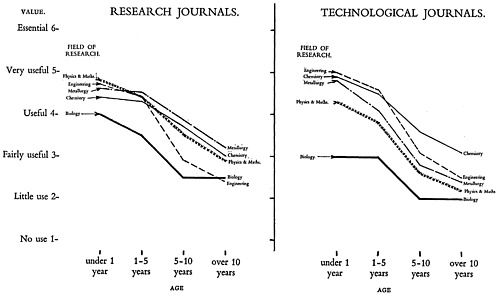
nals of technology was least among the chemists (1.8 difference) followed, by the physicists and mathematicians (2.1 difference), the metallurgists (with 2.4 difference), and the engineers (2.5 difference). Of the journals devoted to research, the least aggregate decline of interest was shown to be shared between the chemists and the metallurgists (each with 1.4 difference), followed by the biologists (1.5), physicists and mathematicians (1.9) and again, lastly, by the engineers (2.3 difference).
3.10. QUESTION 38: DOMESTIC AND FOREIGN PERIODICALS, PROPORTIONATE USE
The foregoing enquiry was followed up with one about the percentage of research information obtained from British as against foreign periodicals, again dividing them into journals of research and those of technology and industrial news. The question was answered by 83% of the Research Managers, 86% of the Seniors, and 76% of the Juniors, or 80% of the whole sample. Again the replies were analysed according to the field of research of those concerned (Table 5).
TABLE 5 Percentage of information obtained from British and Foreign periodicals
|
|
Journals of research |
Journals of technology |
||
|
Field of research of those answering |
British, % |
Foreign, % |
British, % |
Foreign, % |
|
Biology |
40 |
60 |
Don’t know |
Don’t know |
|
Chemistry and chemical engineering |
54 |
46 |
46 |
54 |
|
Engineering |
61 |
39 |
67 |
33 |
|
Metallurgy |
57 |
43 |
57 |
43 |
|
Physics and mathematics |
61 |
39 |
60 |
40 |
|
All fields |
57.5 |
42.5 |
57.2 |
42.8 |
It is apparent that according to the average opinion there is only a slightly greater usage of British as against foreign journals, with a ratio of 1.3:1, and no significant difference in this ratio as between research and technological periodicals. The greatest use of British research periodicals was made equally by the engineers, and the physicists and mathematicians; the greatest use of the foreign ones by the biologists. Of technological journals, the engineers made most use of the British, and the chemists made most use of the foreign ones.
3.11. QUESTION 37: VALUE OF PERIODICALS ACCORDING TO LANGUAGE
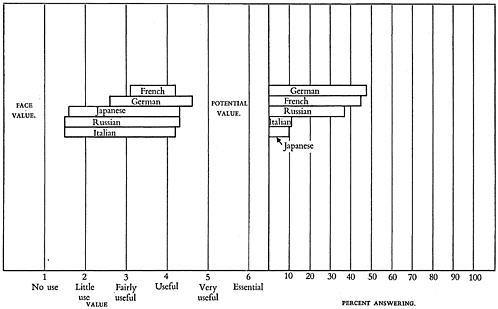
Probing more deeply into their use of periodicals, the sample were asked to assess the usefulness of those in their field of research, independently according to the language in which they were published. It was realised that the language-barrier would probably introduce an undesirable bias into an individ-
ual’s valuation of the literature of certain languages, and the question was consequently designed to take account of this and to illustrate the effect of the language-barrier. The sample were therefore asked to state: (a) the face-value (including the effect of language-barrier), (b) the potential value (assuming no language difficulty, or easily available translations). All answers were volunteered, that is, a list of languages was not recited by the interviewer, in the hope that the scientists’ views would be from their experience. Fifty-eight per cent of the sample offered a valuation in one or more foreign languages, having either opinions or experience, the 42% remaining having either no opinions or making no use of foreign-language periodicals. These 42% were made up of one-quarter of the whole Senior status grade and over half of the Junior grade, a somewhat disquieting state of affairs.
Scoring of the scientists’ evaluations was as in Questions 7/14 (vide 3.03), i.e., as averages of those answering (because so few people evaluated some languages, any attempt to account for those not answering would have concealed the usefulness to those who did value them). In the case of individuals who said they experienced no difficulty with particular languages, this fact was recorded in lieu of the potential valuation they should otherwise have given, and the latter was assumed to be the same as the face-value. The only cases of this sort occurred with the French, German, and Russian language periodicals where, respectively, 14%, 5%, and 1% of all the answers were that there was no language difficulty. This, again, gives cause for considerable concern over the apparent narrowness of the scientists’ reading.
The analysis of results is shown in Fig. 3. It will be noted that the evaluation scores here show considerable differences compared with the percentage of the sample answering. The differences between face-value and potential value are shown to be lowest for the French literature (one point), and highest for the Russian (2.8 points). German literature is rated as the highest in potential value, followed jointly by Russian and Japanese.
In an analysis of potential value according to the field of research of those answering the question, there were variations of only one point up or down from the average score with the single exception of one engineer who rated Japanese literature as potentially (2) “Little use.” The remainder of these results were therefore discarded.
4. Analysis of reading diaries
4.01. CONDITIONS OF THE TEST
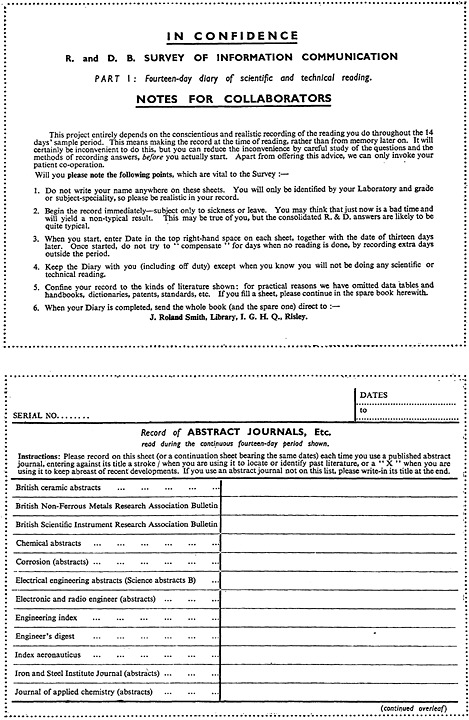
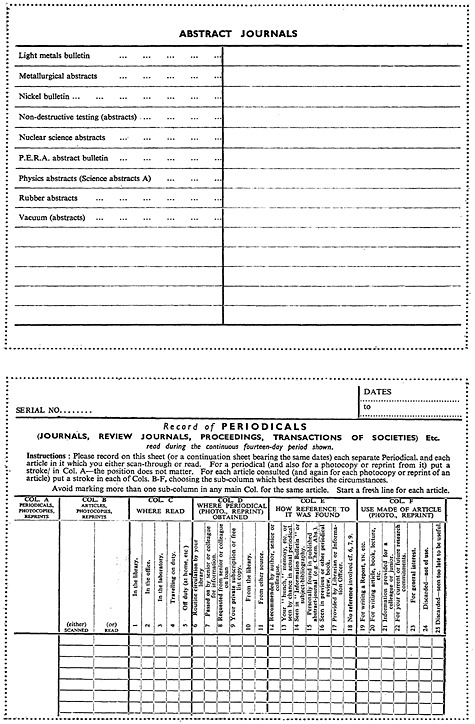
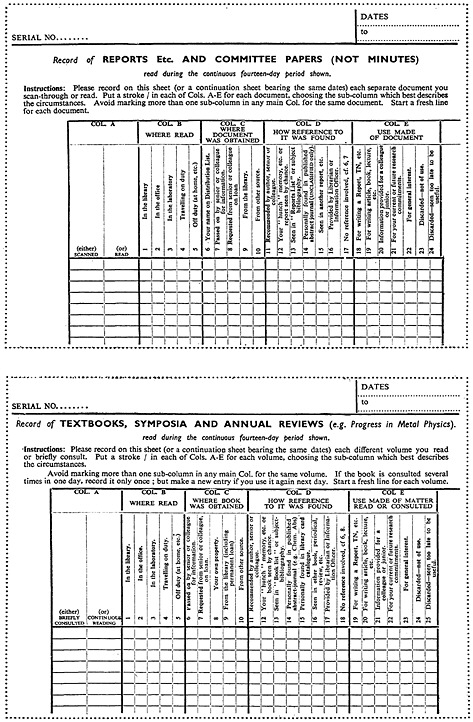
The diary provided for a consecutive fourteen-day record (i.e., both in and outside working hours) of the amount and kind of scientific or technological literature read, to be indicated at the time of reading (see Appendix II for com-
plete diary). Four types of literature were provided for: abstracts, periodicals, research reports, and textbooks, with a separate diary sheet for each, made up into pocketable booklets 5 by 7 inches. As in the diaries used by Bernal (op. cit.), distinction was made between “scanning” and “reading” each kind of literature (abstracts excepted), but the reader was asked to indicate which applied by checking the appropriate column on the diary sheet. Unlike Bernal’s diaries, provision for identifying the literature by name was only made for abstracts (by checking a printed list of titles). Here two check marks could be used: one to show that the abstract journal was being used to locate or identify-past literature, the other when it was being used to keep abreast of recent developments. The use of periodicals, reports and books was shown by checking horizontally in a series of vertical columns: the first divided into “scanned” or “read,” and the remainder labelled “Where read,” “Where obtained,” “How reference to it was found,” and “Use made of it,” within each of which there were pre-printed answers. An additional column (on the periodicals sheet only) showed the number of actual issues of periodicals as well as the number of articles in them which were scanned or read (reprints or photocopies of articles were checked in both columns.)
Return of the completed diaries for analysis was prolonged much beyond the estimated period, and in fact the last were received only in early March. They had been sent out in batches at different times to different establishments to obtain a “spread” of reading period, but perhaps because participants were not given a fixed date on which to begin their record, they tended to put it off. They were, however, specially warned to start recording immediately, subject only to sickness or vacation leave, and regardless of whether they were able to do any reading or not. Despite this, only 1 individual recorded no reading at all, and it was evident from remarks made during some of the interviews, that many had postponed diary records until they were free to do some reading. 144 diaries (92%) were returned in time for analysis and found to be usable, though in a small number of cases either directions had been misunderstood or some records were incomplete; these scientists were therefore asked to undertake a second test. It was noted that the incomplete records usually featured “How reference to it was found,” and indeed it is possible that many of the other scientists’ answers in this column are inaccurate because of the difficulty of remembering. The overall accuracy depended largely upon the diarists completing their records at the time of reading (which they were specially asked to do), but the neatness of many records gave rise to suspicions that they were marked up afterwards, or that scientists are tidier workers than is often supposed!
Because of the late receipt of the diaries for analysis and inclusion in the present paper, only the preliminary results are given.
4.02. AMOUNT OF LITERATURE READ, AND WHERE READ
Because of the apparent deliberate choice by many of those taking part of a period when some reading was possible (and the natural tendency for this to be during working hours), the amount of reading and the place where it was done cannot be taken as typical. All those who took part in the test read some periodicals, some reports and some textbooks. (Abstracts are dealt with in 4.03.) In the total of 579 periodicals, of 750 articles, 48.5% were scanned and 51.5% were read. This was 4.0 periodicals and 5.2 articles per head. Of 756 reports, 41% were scanned and 59% read to make 5.3 reports per head. Of 569 textbooks, 67% were scanned and 33% read—4.0 textbooks per head.
The usage of the three kinds of literature per head is seen to be about the same, but though the number of periodical articles scanned was virtually the same as the number read, reports were more carefully read, by comparison. Only consultation of textbooks showed a preponderance of scanning, suggesting that these were used mainly for checking facts or references.
The places where reading was done, with the proportion of reading in each place of each kind of literature are given in Table 6. From the table it is plain
TABLE 6
|
Category |
Library, % |
Office or laboratory, % |
Travelling on duty, % |
At home, etc., % |
|
Periodicals |
26 |
48 |
2 |
24 |
|
Reports |
5 |
72 |
3 |
20 |
|
Textbooks |
12 |
52 |
2 |
34 |
|
All literature |
14 |
58 |
2 |
26 |
that the claim (vide 3.02) that for an average of 58% of the past working year no time for reading was available in working hours cannot be reconciled with the conditions established from the diary analysis, but as has already been pointed out, the latter are believed to be unreliable as to quantity of reading and place where reading was done.
4.03. READING OF ABSTRACT JOURNALS
One of the most striking features of this survey was the evidence of the small amount of use of abstract journals, amounting to only 0.9 consultations per head. Only 32% of the scientists consulted any abstract journal at all. In the absence of further information it is not possible to reach firm conclusions on why this should be so, but it may be because few of the libraries circulate abstracts (keeping them principally for use in the library), or alternatively that the Group libraries’ own (selected) weekly bulletin, and book and report
accession lists are found easier to scan for current reading references, and much more up to date than any abstract journal known. It is possible to find confirmation of the latter in the check of source of literature references in 4.05 below. The additional fact that of the 129 abstract consultations made, 64% were for keeping up with the current literature (the remainder were for locating past literature) nevertheless points to their continued usefulness to some people for this purpose. An examination of the use of abstracts by people in the five fields of applied research showed the biologists (two persons only) as greatest users with 3.5 consultations per head; the chemists and the metallurgists both with 1 per head, followed by the engineers with 0.9, and the physicists and mathematicians with 0.7. Largest use of abstracts as a means of keeping up with current literature came from the physicists and mathematicians (85% of their use) and the engineers (83%); followed by the biologists (71%), the metallurgists (58%) and the chemists (with 45%).
Table 7 shows the titles of Abstract journals consulted, with the number of consultations according to the fields of research of the diarists.
4.04. WHERE THE LITERATURE WAS OBTAINED
Those taking part in the survey were asked where they obtained each item they read. The possible answers were pre-printed in the diary, but have been compressed for the analysis to show four sources: the library (by circulation, direct, or on permanent loan), the initiative of a senior or colleague (passed on, lent, or circulated), requested from a senior or colleague (on loan), or his own property. A fifth column was headed “From other source.”
As can be seen from Fig. 4, the library was, as expected, the major source.
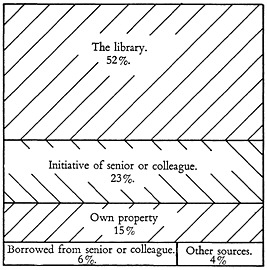
FIGURE 4. Reading diaries—where the literature was obtained.
TABLE 7
|
|
|
Biology |
Chemistry an chemical engineering |
Engineering |
Metallurgy |
Physics and mathematics |
Total |
|
Analytical abstracts |
|
|
11 |
|
|
|
11 |
|
Annual review of metals literature |
|
|
|
1 |
|
1 |
|
|
Bibliography of industrial diamond applications [Industrial diamond abstracts] |
|
|
|
1 |
|
1 |
|
|
Biological Abstracts |
1 |
|
|
|
|
1 |
|
|
British ceramic abstracts |
|
|
1 |
|
|
1 |
|
|
British Hydromechanics Research Assn. bulletin |
 |
|
|
2 |
|
|
2 |
|
British Non-Ferrous Metals Research Assoc., Bulletin |
 |
|
|
1 |
3 |
1 |
5 |
|
Ceramic Abstracts |
|
|
1 |
|
|
|
1 |
|
Chemical Abstracts |
3 |
11 |
|
1 |
1 |
16 |
|
|
Corrosion |
|
2 |
|
1 |
|
3 |
|
|
Electronic and Radio Engineer |
|
|
2 |
|
|
2 |
|
|
Engineering Index |
|
|
2 |
|
|
2 |
|
|
Engineer’s Digest |
|
1 |
1 |
2 |
|
4 |
|
|
Index to literature on spectrochemical analysis |
|
1 |
|
|
|
1 |
|
|
Iron and Steel Institute, Journal |
|
3 |
1 |
4 |
2 |
10 |
|
|
Journal of Applied Chemistry |
1 |
|
|
|
|
1 |
|
|
Light Metals Bulletin |
|
|
1 |
|
|
1 |
|
|
Metallurgical Abstracts |
|
|
|
9 |
4 |
13 |
|
|
Nickel Bulletin |
|
|
4 |
3 |
1 |
8 |
|
|
Nuclear Science Abstracts |
2 |
8 |
5 |
1 |
6 |
22 |
|
|
Production Engineering Research Assoc. Bulletin |
|
|
5 |
2 |
3 |
10 |
|
|
Physics Abstracts |
|
3 |
1 |
2 |
2 |
8 |
|
|
Titanium Abstracts |
|
|
2 |
1 |
|
3 |
|
|
Vacuum |
|
|
2 |
|
|
2 |
The large figure for “initiative of seniors or colleagues” is mainly attributable to reports, of which a very large number are normally sent by authors direct to all those concerned in a project (quite independently of the library): these did, in fact, amount to 19% of all the literature read.
4.05. HOW THE REFERENCE TO IT WAS FOUND
Following the source of the literature itself, the diarists were asked how they obtained the reference to it (this order was adopted because some literature was received by routes, involving no actual “reference”). Some of the pre-printed answers are again compressed for this analysis as follows: recommendation to read, by author, senior, or colleague; memory, chance, or inside knowl-
edge of the diarist; the library, either through its various lists or on the librarian’s initiative; reference found in another book, journal, etc.; found in abstract journal or (textbooks only) in the library card catalogue; or no reference involved. As will be seen by reference to Fig. 5, the greatest proportion of
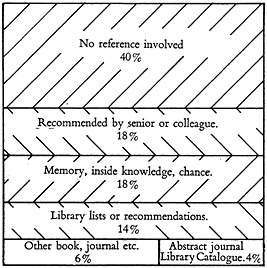
FIGURE 5. Reading diaries—how the literature reference was found.
reading did in fact appear in the “No reference involved” column, to which 40% of the literature was attributed. As, however, 44% of the literature itself was sent either on seniors’ or colleagues’ initiative or came from the library (periodicals by circulation), or was the diarist’s private property (23%, 6%, and 15% respectively, vide 4.04), it would appear that the “no reference involved” figure should have been even higher: allowance must, however, be made for some confusion of marking between the two columns “Where literature obtained” and “How reference to it was found.”
The small proportion of references obtained from abstract journals (sharing lowest place with the library card catalogue) confirms the record of abstracts used, already described in 4.03 above. The library as source of reference appears remarkably insignificant, though its influence is likely to be a concealed factor in the case of “memory” of the diarist and “recommendation” by the diarist’s colleagues.
4.06. USE MADE OF THE LITERATURE
The last record to be made by diarists concerned the use they were making, or intended to make, of what they were reading. The seven pre-printed answers have been compressed to five: (a) for your current or future research
commitments, 48% of answers; (b) for general interest, 33% of answers; (c) for writing a report, article, book, lecture, 12% of answers; (d) information provided for a colleague or junior, 4% of answers; (e) discarded—not of use, or seen too late to be useful, 3% of answers.
The authors appreciated, when drawing up these pre-printed answers, that some of the diarists would not find it easy consistently to observe the distinction between answers (a) and (b) when actually recording what they read, however clearly they had established what that distinction was. It was considered that both the practical and the semantic difficulties of the two answers, particularly (b), were likely to produce a considerable degree of randomness in the aggregate results, and though as answers they seemed quite valid, it was nevertheless decided that it would be rash to draw firm conclusions, based on distinction between them. It was, however, noted that of the 33% reading “for general interest,” two-thirds of it consisted of articles from periodicals, the reading of which, by the very nature of a periodical, would be likely to bring more incidental or extraneous matter under notice than is the case with other forms of publication. Of the 48% reading “for your current or future research commitments,” (1003 literature items) the highest proportion was of reports (41%), followed by textbooks (36%) and periodicals (23%). It remains only to point to the very small amount of reading-matter discarded (e) as “not of use” (3%, or 70 items). Here again, views differ as to what is “useful,” and it might be taking too sanguine a view to conclude, for instance, that the scientists’ reading-habits were remarkably well-directed. Without, therefore, necessarily implying that answers (e) were interpreted by diarists as “absolutely irrelevant or useless reading,” it was found that the highest percentage of (e) per reference-source occurred when the least-used source applied, i.e., abstract journals. These percentages were: textbooks, 17% discarded; reports, 14% discarded; periodicals, 11% discarded.
ACKNOWLEDGMENTS
The authors are indebted to Miss Kathleen Gales, of the Statistical Research Unit, University of London School of Economics, for valuable advice both in phrasing of the questionnaire and for suggesting the diary method for obtaining certain of the information; to Mr. R.O.Hughes, an operational research worker at the Springfields Laboratories of the Industrial Group, for statistical advice.on scoring of the questionnaire and phrasing of the questionnaire and the diary, and for undertaking a large part of the laborious work of analysis of completed results; to Mr. P.B.Woods of the authors’ staff, who conducted all the interviews and collaborated in the analysis of results; to the Chief Scientists at the Risley headquarters for sanction to undertake the survey, together with the Heads of the five Research and Development Labora-
tories of the Industrial Group for permission for their staffs to be anonymously selected for collaboration in the survey (and particularly to Head of Laboratories, Springfields, for releasing Mr. Hughes and his staff to assist); to the 157 scientists and technologists who took part in the survey; and to the Managing Director, Industrial Group, and the Director of Research and Development for permission to publish it.
REFERENCES
1. SHAW, R.R. Pilot study on the use of scientific literature by scientists. U.S. Department of Agriculture, Washington, 1956 (unpublished).
2. BERNAL, J.D. Preliminary analysis of pilot questionnaire on the use of scientific literature. In Royal Society Scientific Information Conference, 1948. Report and papers submitted, paper no. 46, pp. 589–637.
3. HERNER, S. Information gathering habits of workers in pure and applied science. In Industrial and Engineering Chemistry, 46, 228–236 (1954).
4. THORNE, R.G. A survey of the reading habits of scientific and technical staff at the Royal Aircraft Establishment. Farnborough, R.A.E., 1954. 10pp. (Library Memorandum no. 16) (unpublished).
APPENDIX I Scoring scale for questionnaire
Apply to any question
X=does not apply (not used, etc.)
O=don’t know
In Question 37
X=“potential” value does not differ (because of no difficulty with the language)
O=no comment (foreign language periodicals not used)
Apply only to questions 7/14, 33/36, and 37
6=essential
5=very useful
4=useful
3=fairly useful
2=little use
1=no use