
3
Synthesis of Research Progress On Particulate Matter
INTRODUCTION
The committee’s first report set out the sources-to-health-effects framework (see Figure 1-1 in Chapter 1) that has been integral to the development of the particulate matter (PM) research portfolio and to tracking progress with the agenda (NRC 1998). The framework has proved useful for identifying needed elements of the research portfolio and for addressing integration of research findings in support of implementation of evidence-based control strategies. In this chapter, the committee reviews progress on each of the 10 original research topics (see Box 1-1 in Chapter 1), summarizing the gains in scientific knowledge for each from 1998 until the middle of 2002 with some additional updating over the next year as this report was written and particularly relevant contributions were made. The committee also considered the remaining uncertainties, and what remains to be done. In addition, the committee assessed the studies related to each topic quantitatively and qualitatively according to the five criteria listed in Chapter 2. The committee’s more extended evaluations of the progress are provided in Appendix C. The focus of the committee’s evaluation has been research funded by the U.S. Environmental Protection Agency (EPA) with additional consideration of research funded by other organizations in the United States and abroad.
RESEARCH TOPIC 1. OUTDOOR MEASURES VERSUS ACTUAL HUMAN EXPOSURES
What are the quantitative relationships between concentrations of particulate matter and gaseous copollutants measured at stationary outdoor air monitoring sites and the contributions of these concentrations to actual personal exposures, especially for potentially susceptible subpopulations and individuals?
Introduction
Compliance with the National Ambient Air Quality Standards (NAAQS) for PM is ascertained by measuring ambient concentrations of PM at monitoring sites. With regard to the health effects of air pollution, the risks depend on personal exposure—that is, the exposures received by people in the various specific places, conceptualized as microenvironments, where they spend time. Total personal exposure represents the time-weighted average of particle concentrations in the microenvironments where people spend their time. Exposures to particles generated by outdoor sources take place not only outside but also in indoor environments where the particles penetrate. Indoor particle sources, such as cigarette smoking, insects, molds, and cooking, may thus contribute substantially to total personal exposure to particles. Research carried out in regard to this topic addresses the relationship of monitoring data for ambient air with personal exposures to PM and gaseous copollutants. Data on this relationship are needed not only for healthy people but also for those persons who are particularly susceptible to air pollution and at greatest risk for experiencing adverse effects. Such persons are referred to collectively as a “susceptible subpopulation” and are further addressed under topic 8 later in this chapter.
What Has Been Learned?
Research findings on topic 1 are relevant to interpreting the findings of the epidemiological studies of PM and to furthering the understanding of the relevance of monitored ambient concentrations for public health protection. Before 1997, the majority of time-series studies of morbidity and mortality associated with PM had relied on ambient air measurements taken for regulatory and tracking purposes. In using these measurement data in
the time-series studies, the researchers assumed that outdoor particle concentrations serve as a valid surrogate of personal exposures to ambient particles. Previous findings from monitoring studies had suggested that personal exposures differ from ambient concentrations because of particle sources in key indoor microenvironments (Dockery and Spengler 1981; Ozkaynak et al. 1993; Ozkaynak et al. 1996). In addition, most of these investigations found weak associations, often not statistically significant, between personal exposure and ambient concentrations when assessed cross-sectionally (at different locations for different people). However, these conclusions were based on a relatively small number of studies, which were originally designed to determine population exposure distributions rather than to examine the degree of association between personal exposures and ambient concentrations. For interpreting the time-series studies of air pollution and health, an understanding of the pattern of association between ambient concentrations and personal exposures over time was needed.
To address this knowledge gap, the committee recommended that longitudinal panel studies of personal exposure to PM be conducted (NRC 1998). In such studies, particle and gaseous copollutant exposures of groups of individuals would be measured at successive points in time to examine the relationship between personal exposures and the corresponding ambient concentrations. Further, these studies would attempt to identify factors influencing the observed relationships. The recommended exposure assessment studies would include not only healthy individuals but also emphasize individuals susceptible to the effects of particle exposures, including persons with chronic obstruction pulmonary disease (COPD), cardiovascular disease, and asthma, as well as children and older adults. As a result of the committee’s recommendations, a large number of particle exposure studies were conducted in several cities in the United States with different climatic conditions and air pollution mixtures. Studies were also conducted in Europe and South America. Below we summarize the major findings that have emerged from either the initial or the completed analyses of the collected data.
Relationship Between Personal Exposures and Ambient Concentrations
Results from the recent panel studies support the hypothesis that ambient PM2.5 concentrations are significant predictors of corresponding personal exposures, over time, for the investigated cohorts (Ebelt et al.
2000; Evans et al. 2000; Rojas-Bracho et al. 2000; Sarnat et al. 2000, 2001; Williams et al. 2000a,b; Rodes et al. 2001). Stronger associations were observed as the number of repeated measures per individual increased from a few up to 15 days and were substantially higher than those determined when including all panel data (cross-sectional analysis). Most of the panel studies found little spatial variability of ambient PM2.5, thus suggesting that spatial variation is not a strong determinant of the level of correlation within the areas studied. Collectively, the results from the panel studies, performed on several hundred individuals across various cities and different seasons, showed that there were varying degrees of association between personal exposures and ambient concentrations for the measured individuals, with almost half of the associations being non significant. For those individuals and for PM2.5, the correlation coefficients were in the range of 0.4 to 0.9.
Impact of Nonambient Sources
Near-real-time PM2.5 indoor measurements have underlined the importance of nearby sources (such as cooking stoves) that are within the various microenvironments in which people spend their time (referred to as microenvironmental sources) (Abt et al. 2000; Howard-Reed et al. 2000; Long et al. 2000; Rea et al. 2001; Vette et al. 2001). However, exposures in specific microenvironments have not been shown to have a strong effect on the relationship of personal exposures with ambient concentrations over time. This generally weak relationship may be explained by the fact that indoor source uses and associated emissions are intermittent and, when averaged over 24-hr sampling periods, contribute to a small fraction of the total PM2.5 exposure variability for a particular person over time. This may not be true for certain exposure situations, for instance, when ambient concentrations measured at stationary outdoor air-monitoring sites are low and individuals are exposed to strong sources in specific microenvironments (such as cigarette smoking, wood burning, and motor vehicle traffic).
Impact of Ambient Concentrations on Personal Exposures
The fraction of ambient particles that penetrates indoors varies considerably (from approximately 0.3 to 1.0), and it increases with the home air-exchange rate (Sarnat et al. 2002). Air conditioning and patterns of home
activities, such as opening windows and doors, which influence home air-exchange rates, are factors determining the rate of particle penetration from outdoor into indoor air. Consequently, individuals residing in homes with higher air-exchange rates tend to be exposed to higher fractions of ambient particles, and their personal exposures tend to be more strongly associated with ambient concentrations (Sarnat et al. 2002; Liu et al. 2003; Wallace et al. 2002). In addition, fine-particle penetration from outdoor air into indoor air depends on particle size; the penetration of the accumulation mode (aerodynamic diameter, approximately 0.3 < da < 1 μm) is higher than that of the ultrafine mode and larger particles (Long et al. 2001; Vette at al. 2001). Until recently, the variability in a person in particle exposures was thought to be primarily from microenvironmental sources. However, there is now strong evidence that a great fraction of this variability is due to the varying impact of ambient sources on the indoor environments and therefore on personal exposures (Landis et al. 2001; Williams et al. 2002). Sulfate is associated mostly with outdoor particle sources and has been used to determine the contributions of outdoor and indoor sources to personal exposures (Wilson and Suh 1997; Ebelt et al. 2000; Oglesby et al. 2000; Sarnat et al. 2000; Landis et al. 2001). Sulfate is a suitable tracer for the accumulation mode; however, it may overestimate the penetration of ambient ultrafine and coarse particles indoors. As suggested by both fine-particle sulfate and mass measurements, the fraction of ambient particles to which populations are exposed may depend on climatic conditions and home characteristics among other factors and may vary from 0.2 to 0.9 (Brown et al. 2003; Rodes et al. 2001).
Cohort Effect
When the longitudinal exposure studies were initiated, it was hypothesized that personal exposures may differ for different groups within a population because of time-activity differences among the investigated cohorts. To date, available evidence has not indicated intergroup difference, as hypothesized. Findings in a panel study of nonsmoking hypertensive African-Americans were compared with those in a multiracial cohort of individuals with implanted cardiac defibrillators (Wallace et al, unpublished material, 2003). Time-activity patterns exhibited considerable intracohort variability; however, statistically significant intercohort differences in PM2.5 exposures were not found. In another study, personal PM2.5 exposures were measured for healthy nonsmoking senior citizens, school children, and
individuals with COPD in two cities (Brown et al. 2003). No significant differences among the groups were found in the relationship between personal exposures and ambient concentrations.
Exposures to Gaseous Copollutants
In several cohort studies, simultaneous 24-hr personal PM2.5, ozone (O3), sulfur dioxide (SO2) and nitrogen dioxide (NO2) exposures and corresponding ambient concentrations were measured using a personal multipollutant sampler. The findings of these studies suggested that PM2.5 personal exposures and ambient concentrations were correlated over time, and personal exposures to O3, SO2, and NO2 were not correlated with their respective ambient concentrations (Sarnat et al. 2001). In contrast, PM2.5 personal exposures were also correlated with O3 and NO2 ambient concentrations. Similar findings in other locations would imply that using ambient gaseous concentrations in multipollutant health-effects models along with PM2.5 might not be appropriate, because the ambient gaseous and PM2.5 concentrations are serving as surrogates for PM2.5 exposures (Williams et al. 2000c; Vette et al. 2002). No results are available, however, for carbon monoxide (CO) because short-term or continuous personal exposure measures have not been made for this pollutant gas.
What Remains To Be Done?
Substantial progress has been made in answering the research questions related to topic 1. The committee was able to identify a large number of studies conducted in various locations, such as Baltimore, Boston, and Research Triangle Park, NC, that had been initiated following the first report. For most, the field work is now complete, and results are being published in the peer-reviewed literature. Advances have been made in personal monitoring, and data can be feasibly collected, not only from healthy adults but also from children and persons with chronic heart and lung diseases. The monitoring studies provide the important and generally consistent finding that ambient particle concentrations are a key determinant of the longitudinal variation in personal exposure to particles for those groups studied to date. This finding is critical for interpreting the time-series analyses as well as other epidemiological studies of particles and health.
Although substantial data have been collected, they are not sufficient to develop a national perspective on the relationship between ambient PM
concentrations and personal exposure, because data are lacking for fully representative persons and locations. Also, there is still little information about the exposures of susceptible individuals to particles and other air pollutants. Further studies are needed, particularly on those persons at the highest risk for illness or death.
RESEARCH TOPIC 2. EXPOSURES OF SUSCEPTIBLE SUBPOPULATIONS TO TOXIC PARTICULATE MATTER COMPONENTS
What are the exposures to biologically important constituents and specific characteristics of particulate matter that cause responses in potentially susceptible subpopulations and the general population?
Introduction
Research topic 2 extends research topic 1, shifting the emphasis on exposures to specific types of particles that have been found to be associated with greater risk for health effects. In the committee’s portfolio, research related to topic 2 would be implemented only after the work under topic 5 sufficiently advanced understanding of particle characteristics that determine their toxicity, as discussed below.
What Has Been Learned?
Before 1997, very little information existed on particle exposures and chemical composition and size characteristics of the particles. Therefore, the database on exposures to particles in relation to the characteristics of the particles, particularly those considered to convey toxicity, needed to be expanded. The committee highlighted the need to characterize the physical and chemical properties of exposure particles for both the general public and susceptible subpopulations. Specifically, population-based field studies would provide information on the distribution and intensity of exposure for defined components and specific size fractions. In addition, longitudinal studies would investigate the relationship between personal exposures and ambient concentrations for specific components and particle size fractions. Toward that end, the committee suggested that state-of-the-art personal exposure measurement methods be developed and implemented. Subse-
quently, comprehensive and cost-effective field studies would be designed to determine population exposures, building on the results from the longitudinal panel studies (topic 1).
To date, the research conducted on exposures to the toxic components of PM (such as metals and organics) in a limited number of exposure studies focused on methods development and applications of speciation techniques. Those efforts will be useful in the initial chemical characterizations of exposure particles and in the design of future exposure studies. However, the techniques can only be fully implemented in exposure studies after ongoing and future toxicological studies identify components of biological relevance. Specific progress is detailed below.
Personal sampling devices have been developed and field tested. These methods make it possible to obtain information on personal exposures to different particle fractions and their components. More specifically, new methods have been developed for PM10 and PM2.5, ionic species, elements, elemental and organic carbon, and organic compounds (Demokritou et al. 2002). In addition, new personal sampling devices allow for the simultaneous collection of gaseous copollutants, PM2.5 and PM10, and particle composition (Chang et al. 1999; Demokritou et al. 2001). The development of new sampling and analysis protocols in conjunction with the use of more sensitive analytical techniques makes it possible to improve measurement precision and accuracy. One of these advances is a decrease in the flow rates of air into sampling devices, making smaller personal sampling devices possible.
Real-time personal exposure measurements of fine mass and ultrafine particles have been conducted and have demonstrated the importance of nearby (microenvironmental) sources in determining total personal exposures (Fischer et al. 2000). These measurements will be critical to efforts in identifying sources that contribute to personal exposures and link exposures to specific activities or events. Furthermore, state-of-the-art exposure health effects studies have conducted simultaneous real-time personal exposure and biological monitoring (Liao et al. 1999; Howard-Reed at al. 2000). This was done to link magnitude and duration of exposures to biologically relevant events. Specifically, studies have examined the relationships between real-time fine particles and adverse cardiac functions.
A limited number of studies have conducted measurements of personal exposures to various particulate constituents, including sulfate, nitrate, ammonium, elemental and organic carbon, and elements (Ebelt et al. 2000; Sarnat et al 2000; Williams et al. 2000a,b). Such studies enable the investigation of relationships between personal exposures to specific particle constituents and the corresponding ambient concentrations.
What Remains To Be Done?
Although monitoring methods are being developed for the goals of topic 2, the uncertainties associated with the topic remain largely unaddressed. The committee’s sequence of research calls for more substantial advances under topic 5 before fully implementing topic 2. Exposure studies will be necessary for components of biological relevance. These investigations should examine relationships among personal exposures to particle components of biological relevance and corresponding ambient concentrations for susceptible subpopulations and the general public. Some of these studies should characterize exposure distributions for a variety of microenvironments, such as work, school, and transportation environments. The data from EPA’s Speciation Trends Network may provide a useful starting point for designing exposure studies that will give a national perspective and explore geographic differences in patterns of exposure.
RESEARCH TOPIC 3. CHARACTERIZATION OF EMISSION SOURCES
What are the size distribution, chemical composition, and mass emission rates of particulate matter emitted from the collection of primary-particle sources in the United States, and what are the emissions of reactive gases that lead to secondary-particle formation through atmospheric chemical reactions?
Introduction
A large variety of anthropogenic and natural emission sources contribute to airborne PM (see Box 3-1 and Table 3-1). Emissions from these sources need to be characterized for several purposes, including health effects research and implementation of PM standards. The development of laboratory exposures that assess the toxicity of emissions from specific sources (topic 5) requires knowledge of the characteristics of emitted and secondary particles. Emissions from critical sources need to be well-characterized for confidence to be placed in the source- and receptor-oriented air quality models (topic 4), particularly as they are used to develop emission-control strategies for achieving the PM NAAQS. In its second report (NRC 1999), the committee noted that traditional emission inventories have
|
BOX 3-1 Particulate matter is produced by a diverse array of emission sources. Some emissions emerge directly in the liquid or solid phase, as “primary” particles, such as combustion nuclei or mechanically generated dusts. Additional particulate species, such as sulfuric acid and its ammonium salts, ammonium nitrate, and a diverse array of organic compounds, are produced in the atmosphere by reactions that involve precursors emitted as gases. This “secondary” PM can condense on existing particles, form new particles through homogeneous nucleation, or be left as the residue of evaporated cloud droplets. An emissions inventory is an accounting of emissions. It is typically based on a census of source types (for example, number of automobiles and powerplants), their activity (number of kilometers traveled, British thermal units generated from burning fuel), and average emission factors (grams of emissions per kilometer, kilograms of emissions per million British thermal units). Emissions from a class of sources are expressed as a rate (kilogram per day) that are typically estimated as the product of source activity (for example, kilometer per day for motor vehicles or British thermal units per day for boilers) and an emissions factor (for example, kilogram per kilometer or kilogram per British thermal unit). All emission inventories involve uncertainties arising from the use of a single emissions factor to characterize all the individual elements in a broad class of sources. Inventories of primary-particle emissions present a number of special challenges. One is that direct comparisons with observed ambient concentrations are confounded by the possible contributions of secondary material. For example, particulate ratios of organic carbon to elemental carbon may be higher in ambient observations than in emission inventories because either (1) the inventories underestimate important sources of primary organic particles (such as oil-burning vehicles or vegetative combustion), or (2) the ambient particles contain secondary organics formed in the atmosphere from hydrocarbons (such as biogenics) emitted as gases and thus not covered by the particle inventory. Similarly, semivolatile species might be gases in the hot effluent sampled at a combustion source, but they condense as PM at ambient temperatures. Some of the most important sources of primary PM are “fugitive” in the sense that their emissions enter the atmosphere as puffs of indeterminate extent released at unpredictable times rather than as well-defined flows through a chimney or tailpipe. Fugitive particle sources, which include wild and prescribed fires, open trash burning, construction activities, agricultural tillage, and unpaved road use, are particularly hard to characterize in terms of activity concentrations and emission factors. All the difficulties are |
|
heightened when interest extends beyond mass emission rates to include particle composition and size, as needed for health effects studies. Emission inventories merit scrutiny because they are critical and inherently uncertain inputs to air quality management. A crucial cross-check is provided by comparisons with observed ambient concentrations, receptor models, and inverse applications of source models. |
focused on representing PM mass emissions, and it recommended the adaptation of realistic source-test methods and their widespread application to measure mass emissions, chemical composition, and size distributions of PM. The committee also emphasized the characterization of the emission rates of reactive precursor gases (SO2, oxides of nitrogen [NOx], ammonia, and volatile and semivolatile organic compounds). The committee’s final recommendation was the construction of comprehensive national emissions modeling systems and resulting inventories that are size and chemically resolved. Because particle toxicological studies are ongoing, and air quality simulation models for state implementation plans (SIPs) are currently being developed and tested, the committee called attention to the need for immediately starting research to improve the characterization of PM emission sources.
What Has Been Learned?
Substantial improvements have been made since 1997 in estimates of on-road mobile-source emissions, particularly from heavy-duty diesel trucks and buses, though significant uncertainties remain even for this source category. A national, multisponsor effort, involving EPA, was made to implement standardized test methods (Gautam et al. 2002) and conduct an intercomparison study of mobile-source emissions testing facilities in the United States (Traver 2002). Effects on emissions of changes in fuels (for example, low sulfur diesel and compressed natural gas), after-treatment devices (for example, catalyzed particle trap), and operating conditions have also been characterized; the findings have informed recent regulatory decisions by EPA and California’s Air Resources Board (CARB)—among
TABLE 3-1 General Descriptions of Particulate Matter Emissions and Source Types
|
Emissions |
General Source Types |
|
|
Primary |
Crustal, soil dust, and road dust |
Paved and unpaved roads, vehicle tire and brake wear, construction, agricultural and forestry operations, hi gh wind events, and fires |
|
Salt (NaCl) |
Oceans, road salt, and salt pans/dry lake beds |
|
|
Biogenic material |
Pollen, spores, and plant waxes |
|
|
Metals |
Industrial processes and transportation |
|
|
Black carbon |
Fossil fuel combustion (especially diesel engines) |
|
|
Semivolatile organic compounds (direct condensation of organic vapors at ambient conditions) and nonvolatile organic compounds |
Contemporary and fossil fuel combustion, surface coatings and solvents, and industrial processes, forest fires, and biomass burning |
|
|
Secondary |
Semivolatile and volatile organic compounds (forming secondary organic aerosols) |
|
|
Sulfur dioxide (forming sulfate particles |
Electrical utilities, transportation, mining, smelting, and other industrial processes |
|
|
Ammonia (contributing to formation of ammonium sulfate and ammonium nitrate) |
Agriculture and animal husbandry, with minimal contributions from transportation and industrial processes |
|
|
Nitrogen oxides (forming ammonium nitrate with ammonia) |
All types of fossil fuel combustion and, to minor degree, microbial processes in soils |
|
|
Source: NARSTO 2003. Reprinted with permission; copyright 2003; EPRI, Palo Alto, CA. |
||
them, the adoption by CARB of emission standards for 2007 and subsequent model-year on-road heavy-duty (diesel) engine designs that are expected to yield a 90% reduction of NOx emissions, 72% reduction of nonmethane hydrocarbon (NMHC) emissions, and 90% reduction of PM emissions, as compared with previously adopted 2004 model-year emission standards (Lloyd and Cackette 2001). The finding that catalytically controlled gasoline vehicles are a major source of ammonia emissions in urban areas is leading to much improved ammonia emission inventories and research on catalyst formulations to minimize these emissions. Another significant advance has been made in understanding the composition and growth in size of ultrafine particles (less than 0.1 micrometer [μm] in aerodynamic diameter) emitted by heavy-duty diesel trucks and, to a lesser extent, light-duty gasoline vehicles. The data contribute to an understanding of emissions according to vehicle size, engine type, fuel type, and operating conditions. In addition, such data are informing the design of exposure studies (topic 1) and toxicological research (topic 5) on ultrafine particles (for example, in the roadside exposures of animals being carried out in Los Angeles). Little or no information exists, however, to characterize emissions from nonroad engines.
EPA published a national PM2.5 emissions inventory using simplistic adjustments to its existing PM10 inventory (EPA 2000) but has not yet developed the chemically speciated inventories necessary for understanding relationships between emission sources and airborne PM. EPA has also developed a national emissions inventory for ammonia, but several key sources (for example, natural sources, open burning, humans) are not included (Pace 2002). Such data are needed for developing emission-control strategies for implementation of the PM2.5 NAAQS. In addition, the first-ever ultrafine PM emissions inventory was constructed for the Los Angeles air basin (Cass et al. 2000). An EPA-sponsored research program has also quantified the uncertainty in emission inventories for several source types (Frey and Bammi 2002; Frey and Zheng 2002). However, there is still a need for improving the characterization of emission-inventory uncertainties.
What Remains To Be Done?
Although the committee could identify some specific advances in relation to characterization of emission sources, a comprehensive, cohesive emission-characterization research program, as recommended by the committee in its second report (NRC 1999), has not yet been implemented by
EPA and other research sponsors, including the states. A greater leadership role by EPA is needed in relation to this research topic, as some of the needed emissions characterizations will be carried out by the states, industry, and other stakeholders. So far, EPA has assumed this responsibility in a few important areas. EPA-led programs are updating speciation profiles for receptor-oriented models, assessing particle emissions from on-road light-duty gasoline vehicles, and assessing the state of the science and needed research for emission inventories. However, additional test methods that are comparable and representative of the atmosphere need to be developed for sources other than on-road motor vehicles that contribute major fractions of ambient PM (for example, residential wood combustion, wildfires, cooking, and nonroad engines). These methods should be defined in terms of performance rather than design specification to encourage application and innovation to enhance the value of these tests for multiple purposes, including research and regulatory decisionmaking.
PM10 emission-source testing methods overestimate mass emissions from stationary sources by adding mass condensed in impingers to the mass collected on a hot in-stack filter. The impinger mass is dominated by dissolved gases instead of captured particles, while the hot filter allows condensable material to pass through it. A new standard method for PM2.5 emissions testing method is needed that dilutes samples to ambient temperature conditions and allows for the addition of multiple filters and particle sizing instruments. This method will supply more realistic estimates of primary-particle emission rates, as well as options for obtaining source size distributions and chemical profiles.
Continuous emission monitors (CEMs) on major stationary sources provide the best emission estimates for SO2 and sometimes for NOx, but better interfaces are needed to facilitate effective use of this information. Studies are also needed of the comparability of CEM and earlier fuel-based estimates to establish the reality of reported SO2 emissions declines during the mid-1990s transition period. CEMs for primary-particle emissions should be added when possible.
Methods also need to be developed and applied to better quantify PM and precursor emission rates from in-use engines operating in on-road and nonroad environments. Emission factors based on the CO2 concentration in exhaust streams can be measured by on-board, in-plume, or remote-sensing analyzers for NOx, CO, and hydrocarbons. Analogous systems to measure particle mass emissions and size distributions have been demonstrated, but they need to be further developed, tested, and applied. Deviations between engine compliance tests of a few vehicles on dynamometers
and real-world engines, fuels, and operating conditions need to be characterized and their basis understood. High-emitting vehicles and cold starts, off-cycle, and nonroad engine emissions may have PM characteristics that differ substantially from those of federal test certification tests.
Emissions from nonanthropogenic sources are poorly estimated. These are typically fugitive and intermittent with particle characteristics that temporally vary and are accordingly difficult to characterize directly. In many situations, their contributions to ambient loadings may be more reliably determined from detailed ambient measurements and simple source-receptor modeling of the tracer/mass-balance variety. As the committee has recommended previously, the three activities—emissions tracking, air quality modeling, and ambient monitoring—need to be viewed as complementary and yielding reinforcing evidence.
Static emission inventories, typical of those used for tracking annual trends, are insufficient for estimating the variability in aerosol properties using air quality models. In addition, emissions from other than anthropogenic sources are poorly estimated.
Common geographic information system (GIS) land-use maps for soil types, land use, vegetation, and roadways need to be assembled for easy access and common usage. Because many emissions are meteorologically dependent, time-specific estimates of temperature, relative humidity, and wind need to be developed for input to emission-generation models. The same meteorological fields used to drive air quality models can be employed, if needed, to support emission simulations. Another approach is to use temperature fields developed more directly from observations. Source profiles of PM and volatile organic compounds need to be identified, evaluated, documented, and compiled into databases that can be used to provide emission rates for specific substances and for receptor model source apportionment. In general, the committee concurs with the conclusion of NARSTO (2003) that both direct and precusor sources of carbon emissions are the most poorly characterized of the emissions contributing to PM.
As the committee emphasized in its third report (NRC 2001), EPA should develop a comprehensive plan for systematically applying new source-test methods to develop a complete, comprehensive national emissions inventory based on contemporary source tests of comparable quality. The timeline for this testing must allow for the incorporation of revised and updated data into an overall emissions inventory of predetermined quality and completeness by the time the next round of state implementation plans for PM must be drafted. The emission factors developed from source testing should also be used to more frequently update AP-42 (EPA 1995), which
is a widely used compilation of emission factors. There is also a need for more efforts to estimate the uncertainties in emission inventories.
RESEARCH TOPIC 4. AIR QUALITY MODEL DEVELOPMENT AND TESTING
What are the linkages between emission sources and ambient concentrations of the biologically important components of particulate matter?
Introduction
Regulators’ actions to limit pollutant exposures have direct effects on emissions from sources rather than on concentrations in ambient air. An understanding of the relationship between emissions and atmospheric concentrations is thus a key input to regulatory decisionmaking. To understand the effects on human health, such concentration changes need to be linked to changes in human exposure.
Source emissions can be linked to ambient concentrations either prognostically, through mechanistic modeling and numerical simulation, or diagnostically, through inferential analysis and mathematical inversion. The prognostic approach, known as source-oriented or chemical-transport modeling, uses measured or estimated emission rates, chemical-reaction schemes, meteorological data, and numerical algorithms to simulate the concentrations expected to result in the ambient air for a given set of emissions. Regulators have historically tended to favor this approach because it takes emissions, the physical parameter most directly affected by their policy decisions, as an explicit model input variable whose effects on air quality can be directly explored under any desired scenario. The diagnostic approach, known as receptor-oriented analysis or receptor modeling, begins instead with ambient samples of pollutants and uses various forensic techniques to trace them back to their sources. Although the source-oriented approach is naturally suited to “what-if” analyses, receptor-oriented tools can offer relatively more direct and persuasive evidence of what is.
To be operationally useful, models must be able to interface with routinely available data on emissions and ambient concentrations. NRC (1999) stressed the need to view the three activities of emissions tracking, source-receptor modeling, and ambient monitoring as integrated processes that continually cross-check and feed back on one another, each component supporting the others. Source-receptor modeling and the evaluation of
prognostic models rests essentially on EPA’s “nonresearch” monitoring activities in much the same way that epidemiology rests on an infrastructure of routine public health reporting and environmental monitoring. Thus, the committee, in its second and third reports, recognized a significant need for funding technical activities necessary to support emissions characterization and model development.
What Has Been Accomplished?
Atmospheric Processes
EPA is continuing to carry out research on the processes on which models are based. There has been some support of the following specific atmospheric processes:
-
Nucleation
-
Uptake of water and thermodynamic properties of aerosols, especially organics
-
Secondary organic aerosol formation
-
Representation of aqueous chemistry
-
Dry deposition
-
Sub-grid scale processes and vertical mixing
-
Inclusion of the effects of particles on radiation
-
Methods to determine the effect of large-scale meteorological processes on long-term particle concentration
Data Infrastructure
EPA established a speciation trends network (STN) of 54 sites to quantify ambient PM2.5 chemical composition in urban areas and encouraged and supported local and state agencies to enhance these with additional sites. EPA also increased continuous hourly PM2.5 monitoring from 50 sites in 1997 to about 200 sites in 2002. It supported the near-doubling of the number of monitors to 160 sites in the IMPROVE network at national parks and wilderness areas to provide nonurban PM2.5 mass and composition. Eight EPA PM “Supersites” were established, emphasizing method testing and evaluation and continuous monitoring of precursor gases, mass, sulfate, nitrate, carbon, and size distributions with a variety of established and
emerging technologies. The Supersite in Atlanta operated for one month, August 1999, to evaluate new and emerging technologies for characterizing ambient PM.
An improved understanding of the composition and variability of airborne PM is expected to be obtained from increased monitoring efforts. For example, the composition of PM2.5 mass at representative urban and rural locations in North America is shown in Figure 3-1. Sulfate-containing particles make up a major fraction of airborne PM2.5 in the eastern United States. In parts of the western United States, nitrate-containing particles are a substantial component. Carbonaceous material contributes a substantial fraction in all the measured locations. Measured data for black carbon and organic carbon are relatively imprecise because the results are method-dependent although their total is fairly consistent among methods (Chow et al 2001).
Source-Oriented Models
In 1998, when the committee’s first report was released, the scientific community had air quality models incorporating the atmospheric processing of particles. However, little systematic testing had been carried out against appropriate field data, and a number of important processes were not mechanistically represented. A limited number of research projects were funded from 1997 to mid-2001 related to improving the representation of processes in atmospheric particulate models.
Surveys have since appeared that critically review the models’ strengths, limitations, and uncertainties as applied to air quality management (Seigneur, 2003; NARSTO, 2003). Most model applications are limited with respect to evaluation due to lack of (1) standardized evaluation methods and software to implement them, (2) appropriate ambient and source measurements, (3) human resources, and (4) transparency and detailed documentation for model evaluation. An additional critical need is to develop and evaluate approaches for estimation of annual averages, as the most sophisticated models are designed to run limited duration simulations of specific episodic periods. Seigneur et al. (2000) recommended that models not be used until completion of an exhaustive performance evaluation including the following: (1) operational testing that demonstrates an ability to estimate PM and its chemical components; (2) diagnostic testing that examines the degree to which precursor and intermediate concentrations are reproduced; (3) mechanistic testing that determines the effects of
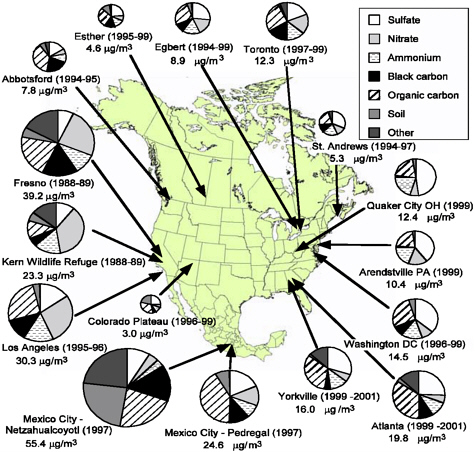
FIGURE 3-1 Composition of PM2.5 at representative urban and rural locations. The urban sites are Toronto; Washington, DC; Atlanta; Mexico City; Los Angeles; and Fresno. Averaging periods and average PM2.5 mass are indicated. All sites have at least 1 year of sampling except Mexico City, for which the average was determined for 14 days in 1 month. More recent short-term measurements from December 1995 and January 1996 at Fresno and Kern Wildlife refuge show lower PM2.5 mass concentrations but similar composition to the data displayed here. The Colorado Plateau data are the averages of the IMPROVE sites located at Bryce Canyon, Canyonlands, Grand Canyon, Petrified Forest, Mesa Verde, and Zion National Parks. Source: NARSTO 2003. Reprinted with permission; copyright 2003, EPRI, Palo Alto, CA.
emission and meteorological changes on estimated concentrations; and (4) probabilistic testing that quantifies uncertainties in model results. Roth (1999) specified issues that should be addressed in writing prior to the application of a model by the end user community. However, the commit-
tee recognizes that, in most cases, the time and cost required for rigorous validation of an air quality model application exceeds available resources.
From 1998 to 2002, EPA released both the new modeling framework, Models-3, and upgraded versions of the Community Multiscale Air Quality (CMAQ) Program, the chemical-transport modeling component intended for modeling gas-phase and particulate pollutants. The work on Models-3/CMAQ has been done intramurally at EPA with some interaction with other model developers. Concerns about difficulty in setting up Models-3 provided impetus for developing the new Java-language-based graphical framework now used for its implementation, the multimedia integrated modeling system (MIMS). Although publicity of Models-3 as a potentially widely used tool has been substantial, considerable additional review and effort are needed to make it easily transferable to an end-user community. However, significantly more use of Models-3/CMAQ is underway by various research groups as well as regional planning organizations (RPOs).
Models-3 was run on a few air pollution episodes from the early 1990s within the eastern United States, and the results were compared with ambient monitoring data without accounting for sampling artifacts (see Kirchstetter et al. 2001) and analytical distinctions (Chow et al. 2001) that are known to affect the data. In addition, the lack of sufficiently accurate emission inventories (whose improvement is related to Research Topic 3) hampers the implementation and evaluation of any air quality model. As of March, 2002, it used a thermodynamic equilibrium model to calculate the concentrations of volatile species, an assumption that may not be valid. Much more effort is needed to test the model and to ensure its accurate operation over the entire spatial domain of the United States. The committee had suggested the need for a series of major field studies that would provide suitable test data. There was an effort to coordinate monitoring done across the eastern United States during two months in 2001 and 2002 as part of the Supersites Program, but these data cover a limited temporal and spatial domain. Substantial additional monitoring data will be needed for model evaluation to provide adequate confidence in Models-3’s ability to adequately predict the PM and PM component concentrations. The Western Regional Air Partnership (WRAP) is testing and applying CMAQ in the west. The California Air Resources Board plans to use CMAQ to model air pollution episodes. There are some data sets available for model evaluations that represent different combinations of emissions, meteorology, and transformation properties than those encountered in the eastern United States, but these are not being fully exploited for model evaluation. Some of these field studies are briefly described in the discussion on special monitoring studies in Appendix C.
Efforts inside and outside EPA are under way to link and integrate air quality models with exposure and dose models (Burke et al. 2001; Glen 2002; Rosenbaum 2002). The committee recognizes that source-oriented air quality models are primarily used to determine how area-wide emission reductions will affect the ambient concentrations used for compliance purposes. However, the issues of health exposure lie clearly in the finest grid to subgrid scale of urban modeling (less than 4 km). The committee recognized the need to improve the bridge between the scales typically used for PM source-oriented modeling and those needed to conduct exposure assessment. Examples of such approaches are described in the references above as well as in Georgopoulos et al (in press). In addition, while large spatial scales may be acceptable for estimating certain PM components, simulation of ambient concentrations for other primary emissions and for ultrafine particles will require sub-4-km grid scale estimations. Further work is needed to improve the simulation of processes on such scales to match with exposure models and to provide appropriate data for the testing of models across scales.
Chemical-specific modeling and normalization to measured chemical concentrations are major advances in using models to demonstrate an area’s plans for attaining the PM NAAQS. These improvements enable a shift away from modeling PM2.5 or PM10 mass regardless of its composition, as has been the case in the past when SO2 emissions and fugitive dust would both be assessed on a similar basis regarding their contributions to total mass. Reductions in SO2 emissions can now be assessed on the basis of changes in sulfate mass rather than the entire PM mass. Evaluations of CMAQ indicate that the model performs best in representing sulfate mass, and less well in representing nitrate and overall PM2.5 mass. A key to improving the performance of CMAQ and other source-oriented air quality models is enhancing their treatment of the carbonaceous component. NARSTO (2003) contains a detailed summary of the strengths and weakness of current source-oriented air quality models.
Receptor-Oriented Models
There has been some progress in receptor-oriented analysis since 1997, albeit much remains to be done. A refinement of conventional factor analysis has been developed, known as positive matrix factorization (PMF), that allows for analyses to include data for species that are undetectable in some samples (Paatero and Tapper 1994; Paatero 1997; Hopke 2000). EPA has supported the development and testing of UNMIX, another multi-
variate approach to extracting the compositions of sources’ emissions from observed correlations between chemical species’ concentrations in multiple samples (Henry 2000; Henry and Norris 2002). Chemical mass balance (CMB) modeling (Watson et al. 1998a), which uses knowledge of speciated emissions to apportion source contributions in individual samples, is increasingly incorporating speciated organic measurements or operationally defined organic fractions (Jeon et al. 2001) to distinguish source categories with similar elemental compositions (Watson et al. 1998b; White and Gunst 2001; Schauer et al. 2002).
Several collaborations between proponents of different receptor-oriented tools have taken place since 1997, significantly clarifying the capabilities and limitations of the overall approach (Pitchford et al. 1999; Poirot et al. 2001; Willis 2001). In various combinations, the speciation-based methods CMB, UNMIX, and PMF have been compared with each other and with other methods that are based on spatial correlation and estimated air-mass trajectories. A conclusion that emerges from these exercises is that analysts using different methods benefit from interacting with each other and comparing results. Any single approach leaves some ambiguities unresolved, and a second approach, with its own but different limitations, can provide additional insights. Moreover, investigators regularly discovered previously overlooked data issues while searching for the causes of disagreements, highlighting the need for characterization of data quality as an important issue for the new monitoring networks.
What Remains To Be Done?
EPA’s ultimate goal should be to have integrated, flexible, and well-tested particle models available on a timely basis for distribution and use in PM management strategy development. These models need to be evaluated with ambient measurements along with emission rates, source profiles, and meteorological measurements. It is still not clear that EPA is making the appropriate commitment needed to have the best models available for ready use at the local air quality management levels. Coupled with little progress on emissions characterization for emission rates and source profiles, the committee has substantial concerns about the air quality management community’s access to fully operational tools and databases needed for NAAQS implementation.
Although the instruments needed to monitor air quality are largely in place, much remains to be done if the data they produce are to be used effectively for both research and NAAQS implementation. At the most
basic level, the data must first be made less difficult for researchers and other potential users outside EPA to access. The web portal that once served this function has since 2001 been replaced by AirData 2003. “Hourly and daily air monitoring values (raw data) are not available. To obtain hourly or daily monitoring values, submit a Freedom of Information Act request to EPA.” There are substantial sampling and analytical uncertainties to be addressed in the measurement of major particle species, most critically organic material. More generally, EPA needs to articulate a plan for continuing comparisons that systematically test its emissions data, source and receptor models, and ambient data against each other.
EPA must now provide the leadership for a coordinated effort to compare various models and their implementations with one another and to incorporate refinements developed in academic and other research institutions to improve those models earmarked for regulatory applications. This task will require greater attention to characterizing emissions and the development of the large-scale, three-dimensional field studies that are necessary for rigorous evaluation of source-oriented models. Although EPA may not have substantial resources for model evaluation, it can participate in and help to shape efforts involving other government agencies and private institutions with substantial field programs, synergistically enhancing the value of the resulting data for its own applications. Moreover, coordination among the research activities directed at topics 3 and 4 could help speed progress in development of accurate methods for control of toxic particles. For example, a systematic effort to examine whether the results of air quality models are consistent with the emissions and models in a variety of different regions would aid in improving sources and in expending funds for source inventory work in the most critical areas. Examining whether the extent to which models and emissions can inform epidemiological studies could speed progress on understanding the toxicity determining characteristics of particles.
U.S. EPA (2001) recognizes that air quality models have inherent uncertainties due to limitations in scientific understanding of source-receptor relationships as well as insufficient model input data. A weight of evidence approach is described that includes a core set of analyses consisting of (1) several (not a single) air quality models, (2) descriptive analysis of observed air quality and estimated emission trends, and (3) observational models. Limited science and measurements “make the ability of a model to accurately predict concentrations of PM2.5 and its components at a given time and location doubtful.” Rather than provide absolute end products (such as PM2.5 mass or light extinction) for comparison with a standard,
relative contributions to each of the PM2.5 components—sulfate (SO42–), nitrate (NO3–), organic carbon (OC), elementary carbon (EC), primary inorganic material, and unidentified mass (difference between measured mass and components)—are modeled. Emission reductions are chemical-specific (that is, SO2 reductions for SO42–, vehicle exhaust and vegetative burning reductions for carbon), and their effects are normalized to the total amount of each material in ambient samples.
Steps in EPA’s guidance are to: (1) form a conceptual model of the emissions, meteorology, and chemical transformations that are likely to affect haze; (2) develop a modeling/data analysis protocol with stakeholders that is consistent with available science, measurements, and the conceptual model; (3) construct and evaluate an emissions inventory for the domain that might affect haze as indicated by the conceptual model; (4) assemble and evaluate meteorological measurements for the domain; (5) apply the specified air quality models and data analyses and compare with ambient concentrations; (6) apply diagnostic tests and justify discarding results that are not physically reasonable; (7) modify the inventory to reflect different emission reduction strategies in consultation with stakeholders, and evaluate the effects of reductions at receptors; (8) make models, input data, and results available to others for external review; and (9) judge the weight of evidence supporting or opposing the selected emission reduction strategy prior to implementation. These ideas are further developed by NARSTO (2003), which made numerous specific recommendations that EPA and other sponsoring agencies should seriously consider when planning further modeling efforts.
Simpler, more user-friendly software is also needed to explore and understand such concepts as (1) which subregions contribute most often and contain the highest emissions; (2) how fast or slow precursor pollutants turn into particles when injected into polluted and unpolluted environments; (3) where and when different precursors limit or enhance particle formation; (4) how pollutants might be removed in the gas phase much faster than in the particle phase; and (5) what the multiple effects of NOx and VOC emissions are on O3, SO42–, NO3–), and secondary organic aerosol. Such information would help decisionmakers decide what is knowable and what can be better known with a modest investment.
This nation is proceeding to implement the NAAQS without properly evaluated models to confirm their accuracy. There is a critical need to develop field programs that can provide a full set of validation data so that air quality particulate models can be tested for their ability to estimate ambient concentrations. These programs should proceed in a variety of air
quality settings so that the capability of the model to represent particles across a range of pollutant and natural concentrations can be evaluated. These field programs should include the development of an accurate inventory of particles and their precursors in the regions selected for study. The assumptions currently made in Models-3/CMAQS should also be examined to develop a proper understanding of whether these assumptions affect control strategies. Models-3/CMAQ should be documented and made easily available to the academic community so that its expertise can be deployed by helping to make model improvements and so that the model can be made available to the end-user community, who will need to devise control strategies. EPA has taken a step in this direction with its Community Modeling and Analysis System, which is intended to facilitate development and application by the user comments.
The adequacy of air quality models used to target specific types of emission sources will have to be evaluated within the evolving context of determining which features of particle exposures are most relevant to health risks. At the same time, the interpretation of health-effects findings will have to reflect an understanding of source-ambient relationships in the atmosphere. Therefore, health-effects and atmospheric scientists must enhance interdisciplinary collaboration through a continuous exchange of information.
RESEARCH TOPIC 5. ASSESS HAZARDOUS PARTICULATE MATTER COMPONENTS
What is the role of physicochemical characteristics of particulate matter in eliciting adverse health effects?
Introduction
Particulate matter in ambient air is a mixture of different types of particles, having different sizes and chemical composition, and originating from many different sources, both primary and secondary. In urban air, particle numbers and mass concentrations vary across the size spectrum from the tiniest particles sized in nanometers, equivalent to molecular clusters, to very large particles, such as pollen grains and windblown sand. With current measurement methods, a rich set of elements and chemical compounds can be identified in particles, revealing wide variations in composition even among particles of the same size.
In spite of the complexity of airborne particles, mass-based standards for particle concentrations in air (for example, the PM2.5 NAAQS) implicitly assume the same risk to health from all particles, regardless of specific physicochemical characteristics. Mass-based standards have been maintained, even though there has long been evidence from laboratory experiments that specific characteristics may be relevant to determining health effects. However, the evidence has not led to alternative standards that also incorporate composition. A better understanding of these characteristics of particles that modulate toxicity could result in targeted control strategies that would specifically address these sources having the most significant effects on public health. Some of the physicochemical characteristics that may influence toxicity are presented in Table 3-2. However, it is unlikely that any single characteristic is predictive of risk for all health effects associated with exposure to ambient PM.
What Has Been Learned?
Despite the large number of research projects directed at topic 5, research progress has been limited over the last 5 years, reflecting the challenging question that is being asked. The diversity of PM characteristics and the array of possible health effects, as well as the potential for different features of particles to be relevant to different health outcomes, define a potentially large matrix for investigation. Thus, research directed at topic 5 should provide insight into how particle characteristics determine toxicity and into the health impacts associated with the different characteristics. Research on this topic has appropriately involved both epidemiological and toxicological approaches.
Epidemiological studies have been substantially hampered by the lack of air quality monitoring data that characterize particles using parameters other than mass. Large-scale studies will need to build from a monitoring platform that can be used to estimate exposures for study participants and communities. Monitoring for PM10 continues, and the network for PM2.5 is now in place and the methods are being developed for monitoring PM10-2.5. The Supersites Program has provided insights into the complexity of PM covered by this initiative, and the Speciation Trends Network should provide a platform for epidemiological studies directed at assessing particle characteristics and public health. However, these programs still fall far short of encompassing the full range of particle characteristics that may influence health. For example, measurements of ultrafine particles have been made at only a few locations, measurements of organic compounds are
TABLE 3-2 Examples of Particulate Matter Characteristics Potentially Important to Health Responses
|
Physical Characteristics |
|
|
Size |
Coarse, fine, ultrafine |
|
Surface |
Surface and mass ratio, physical vs. functional surface, biological absorption characteristics |
|
Morphology |
Spherical, aggregate, fibrous |
|
Mass concentration |
Total mass, size-specific mass, airborne PM mass vs. filter-derived mass |
|
Number concentration |
|
|
Charge |
|
|
Physical Chemistry |
|
|
Hygroscopicity, lipophilicity, hydrophilicity |
|
|
Bioavailability |
Solubility in biological media, penetrance, and distribution |
|
Acidity |
|
|
Oxidant potential |
|
|
Surface vs. core chemistry |
Surface reactions, adsorbed materials |
|
Chemical Components |
|
|
Metals |
Transition vs. other valence state |
|
Carbon |
Elemental, temperature-resolved fractions, organic (by class and species), semivolatile (particle and vapor partitioning), adsorbed volatile organic compounds |
|
Biogenic |
Antigens, microorganisms, toxins (endotoxin and other), plant and animal debris |
|
Secondary inorganic aerosols |
Sulfates, nitrates |
|
Dusts |
Crustal minerals (crystalline state), street dust (tire brake and road wear) |
|
PM as a component of air pollution |
Interactions with other pollutants (other than additive) and with other environmental variables (such as weather) |
sparse, and metals are measured as total metallic species rather than as soluble metals, which are thought to be more biologically relevant.
Although specific research projects have measured some of the components of PM in ambient air, few have made a comprehensive set of measurements. Several studies have examined both the fine (PM2.5) and coarse (PM10-2.5, particles between 2.5 and 10 µm) fraction of PM10; these studies indicate that both fractions can be associated with health responses, although the relevant outcome indicators may not be the same for both fractions. Epidemiological studies have considered the ultrafine fraction of PM; the results are decidedly mixed, with positive and negative associations with health measures (for example, Peters et al. 1997; Tolbert et al. 2000a; Osunsanya et al. 2001). Of the studies that have examined specific chemical fractions of PM, differences have been found in the toxicities associated with the different fractions; however, only a few studies provide relevant data, and overall inferences cannot as yet be made about those chemical fractions of PM that may be of greater or lesser health concern.
The body of evidence from toxicological studies is more substantial. However, interpretation of the results from many of the studies is constrained by the high exposure or dose concentrations that have been used, often well beyond the range of human exposures to ambient air pollution. Although some evidence for toxicity has been found in relation to virtually all the fractions of PM examined, the relevance of these findings to human responses at ambient concentrations is uncertain, given the high exposure concentrations used.
Toxicological research on PM components has not been coordinated to systematically address the array of components and associated health outcomes. Instead, investigators have examined the toxicity of different sets of components using different protocols and toxicological outcomes. As a consequence, comparisons across studies to assess relative toxicity of PM from different sources and of different components cannot be readily made. Nevertheless, evidence from toxicological studies directed at PM has provided some insights about various PM fractions that may be associated with adverse health outcomes, and the extent of this evidence has increased over the past 5 years.
Research has indicated that particle surface area, especially for ultrafine particles, may play a role in some adverse effects, such as pulmonary inflammation. Some responses are related more strongly to that metric than particle mass for this size mode (Oberdörster 1996). Data also indicate that greater pulmonary response appears to be consistently produced by ultrafine particles than by fine particles that have the same chemical composition (Oberdörster et al. 1992; Li et al. 1999). On the other hand, some studies
suggest that specific chemical composition rather than particle size predicts biological response (Wellenius et al. 2003). Thus, the relative roles of size and composition in determining toxicity of ambient PM have not been definitively clarified.
Over the past 5 years, certain chemical components of PM have received more research attention than others, not necessarily in proportion to the relative abundance of these components in ambient PM. For example, considerable emphasis has been given to the role of transition metals in determining responses in toxicological models. Several studies have found that metals, especially the water-soluble fractions, are associated with health-response indicators (Frampton et al. 1999; Campen et al 2002). These components have been associated with various effects, including production of reactive oxygen species, pulmonary inflammation, enhanced sensitization to antigens, and increased susceptibility to respiratory tract infection. There is also some indication that these species play a role in cardiac effects as well.
Organic components of PM have received little emphasis. For example, although bioaerosols can affect toxicity, study results are too limited to reach any overall conclusions. Among the many organic components of PM, those associated with diesel particles have received the most attention. Results to date suggest that greater emphasis on PM-borne organics from many sources is warranted.
Although research related to topic 5 has not provided substantial new evidence for directing regulatory policies and source control, the accumulating literature has begun to steer researchers toward the more promising PM characteristics. For example, there has been a shift in emphasis to metals particularly those that are water soluble; such emphasis had previously been placed on sulfates as a major toxicity-determining component of ambient PM. However, current knowledge from toxicological studies suggests that the health impacts of sulfates per se are less than proportional to their contribution to ambient PM mass (Heyder et al. 1999; Schlesinger and Cassee 2003). Despite these advances, research attention has not been given to the full range of particle characteristics that may be important, and it is not evident that a coordinated strategy is in place to ensure that the most promising hypotheses are targeted and given priority and that screening approaches are continued across the array of PM characteristics.
What Remains To Be Done?
Since the committee’s first report in 1998, an increasing number of
studies have examined a widening range of particulate chemical and size characteristics. The results of these studies have not been consistent; thus, the array of particle characteristics that modulate the toxicity of ambient PM cannot be greatly narrowed down to bring greater focus to research on topic 5. Neither have these efforts provided much insight into how specific PM characteristics play into interactions between PM and other pollutants.
Few conclusions regarding the health significance of particle characteristics have resulted from epidemiological research, because monitoring data in most locations have not been sufficient to support epidemiological research relevant to topic 5. The small number of published epidemiological studies that have examined particle characteristics in addition to mass do not lead to any certain conclusions on the characteristics that are predictive of risk to populations. Some characteristics, such as carbon content, warrant further investigation (for example, Tolbert et al. 2000b, Metzger et al. 2004). Toxicological and epidemiological studies also need to be better integrated to ensure complementary findings, thus building a solid platform of evidence on particle characteristics. Parallel evidence from these two areas of investigation, along with greater understanding of mechanisms, will reduce uncertainty in making extrapolations from high-exposure subjects to those experienced more widely by the general population.
The committee’s review concludes that, despite the increased research effort, the uncertainties related to topic 5 generally remain comparable to those described in the committee’s first report, although some evidence indicates that toxicity may be related to specific characteristics, such as metals. The studies conducted over the past 5 years indicate the difficulty of the scientific questions and the need for new research approaches, whether toxicological or epidemiological. Although some progress has been made, suggesting links of some physical and chemical characteristics of particles to toxicity, research on topic 5 remains incomplete.
A strategy is needed to ensure that toxicological and epidemiological research is directed toward a greater range of particle characteristics than studied to date, including bio-derived components of PM. Such a strategy might incorporate both the application of uniform protocols to multiple characteristics and the use of a wider range of investigator-initiated approaches. The goal would be to ensure that no potentially important characteristic is overlooked and that the totality of potential health outcomes is considered for each characteristic. Differences in the spatial homogeneity and measurement error associated with different components of PM need to be addressed in the design and analysis of epidemiological studies to ensure that all components are appropriately considered. Finally, the health significance of specific particle characteristics must be considered in rela-
tion to their modulating effects on interactions with other particles or nonparticulate pollutants.
To date, toxicological studies of PM characteristics have been largely designed to determine whether a single physical (such as PM size) or chemical (such as soluble transition metal) characteristic could be linked to adverse health responses. Future work needs to extend these investigations in four key dimensions: (1) addressing those characteristics that have received little attention; (2) defining exposure-dose-response relationships at realistic exposures; (3) making direct comparisons between PM with different characteristics using identical protocols; and (4) evaluating the importance and role of the characteristic in question as it exists as a component of realistically complex exposures.
Work to date predicated on the hypotheses of individual investigators has addressed several but certainly not all of the physicochemical characteristics outlined in Table 3-2. For example, work on ultrafine PM has focused almost entirely on solid particles, despite the fact that much of the ultrafine PM mass consists of nonsolid condensed organic matter (Sakurai et al. 2003). Similarly, a substantial effort has been directed toward the oxidative-driven inflammatory and cytotoxic responses to water-soluble transition metals (Donaldson et al. 1997; Ghio et al. 2000a), but very little emphasis has been placed on the inflammatory and cytotoxic effects of PM-bound organic compounds, despite the evidence that this fraction can also operate through oxidative reactions (Li et al. 2002; Yu et al 2002; Reed et al. 2003).
Only a few attempts have been made to directly compare responses and dose-response relationships for different types of particles. Although it is understandable that different protocols would be used to explore effects and mechanisms for different PM characteristics and initial explorations may begin at high doses, an understanding of the relative importance of these characteristics also requires using the same experimental protocol related to a particular health outcome directly compare the exposure-dose-response relationships (that is, relative toxicity and no-effects levels) of different types of particles. Finally, to complete understanding of the risks of PM, as modified by its characteristics, studies will be needed that further characterize the toxicity of PM as it exists within the urban atmosphere, along with many other injurious pollutants. The increase in toxicity of diesel soot after exposure to ozone (Madden et al. 2000), for example, suggests the importance of interactions between particles and other pollutants.
Investigation of multiple PM characteristics will present a challenge for epidemiological studies. Many of the measures of particle components and characteristics are highly correlated, making it difficult to separately
characterize the risks associated with some particular characteristics. Using multivariate approaches, clustering of characteristics can be identified and measures of exposure developed for particular PM groups, as defined by multiple characteristics. It may also be possible to address the risks associated with particles that can be traced back to particular source groups, such as mobile sources. Epidemiological studies related to topic 5 will probably need larger numbers of observations, given the multiplicity of characteristics of interest, their clustering, and the relatively weak associations that have been observed with PM mass indexes. Cross-sectional studies may not be adequate for this topic, as variation in exposure is defined geographically, implying the need for many locations. Once the proper monitoring systems are established, time-series studies may be informative for topic 5, but substantial data sets will probably be needed to have sufficient spatial and temporal heterogeneity of exposures to test hypotheses related to PM characteristics.
An alternative to the consideration of components themselves is the consideration of source categories or source indices. For example, studies have been undertaken in which risks to health of individuals living near busy roadways have been addressed by comparison with persons living farther from the roadways. These studies have addressed one particular source, vehicular traffic, but assessments of the pollutants contributing to the increased risk associated with traffic exposure have not yet been made. There will be a need to address tailpipe emissions of gases and particles, as well as particles tied to the mechanical force of road traffic and particles generated by brake use and tire wear.
Another approach is to use a multivariable method—principal components or factor analysis of the various PM characteristics—in an effort to reduce the PM characteristics to clustered and uncorrelated sets (see topic 10). The difficulties with this approach are that (1) the resulting set of variables might not be readily interpreted; and (2) it might not be consistent over time and for different locations. The task remains to identify the most predictive characteristics within the cluster.
RESEARCH TOPIC 6. DOSIMETRY: DEPOSITION AND FATE OF PARTICLES IN THE RESPIRATORY TRACT
What are the deposition patterns and fate of particles in the respiratory tract of individuals belonging to presumed susceptible subpopulations?
Introduction
Dosimetry provides a critical link between particle exposures and the doses of particles reaching critical sites in the respiratory tract, the clearance of particles from those sites, and the movement of particles from the respiratory tract to other organs. Particle dosimetry is largely accomplished using mathematical models of the lung that are based on understanding of its anatomic structure and physiological functioning. Although relatively refined models have been developed over the past 40 years, largely for the purpose of radiation protection, limited emphasis has been given to particle dosimetry in the susceptible subpopulations of greatest concern with regard to airborne particles, particularly persons with underlying heart or lung disease. It is important to understand that the site of concern for deposition or translocation varies among the different health effects, such as nasal deposition for allergic rhinitis, airway deposition for asthma, or alveolar deposition for reduced resistance to pneumonia.
What Has Been Learned?
The greatest policy-relevant advance in the understanding of PM dosimetry since the committee’s first report has been the convergence of evidence from multiple studies in multiple laboratories demonstrating an increase in the portion of inhaled PM2.5 depositing in the respiratory tract of people having common respiratory abnormalities compared with people having normal lungs. It now appears that as a general principle, any abnormality of airway structure or intrapulmonary gas distribution is likely to increase the total deposited dose for a given exposure concentration (Kim and Kang 1997; Kohlhäufl et al. 1999). The increase in deposition can be substantial; for example, 2-fold increases have been measured in people with COPD (Bennett et al. 1997; Kim and Kang 1997). In addition, increasingly sophisticated deposition models indicate that abnormalities of respiratory structure and airway function also tend to decrease the homogeneity of PM deposition and increase deposition at localized “hot spots” within the lung, which might even further increase doses in localized areas. This growing body of evidence suggests that the increased susceptibility of subpopulations having respiratory abnormalities could be due to a greater dose of PM, to a greater responsiveness per dose unit, or to a combination of those two factors. This knowledge has implications for evaluating the mechanisms of susceptibility and for understanding the relationships among
exposure, dose, and response. It is still uncertain whether deposition might be altered with aging in normal individuals. Unfortunately, there also remains a dearth of information on deposition or clearance in animal models of human diseases associated with increased susceptibility.
Knowledge of the impacts of other host factors on PM deposition has also advanced. There is a better understanding of differences in total and regional deposition between men and women and between adults and children and with variations in breathing pattern (Jaques and Kim 2000). For example, children appear to receive higher doses per unit of respiratory tract surface than adults (Musante and Martonen 2000). There has been less work on clearance; indeed, knowledge of PM clearance in subjects with respiratory tract abnormalities has not advanced substantially in recent years.
There have been substantial refinements of mathematical models for estimating PM deposition, taking into account an expanded range of variables having to do with differences in age and gender, variations in the physical structure of the airways, ventilation rate, respiratory pattern, and PM characteristics (Musante and Martonen 2000; Segal et al. 2000, 2002). These refinements purport to improve the accuracy of estimates of total and regional dose in different subpopulations, although the estimates have not been validated sufficiently by actual measurements, and it is not clear whether the magnitude of differences in deposition attributable to the refinements are significant compared with the substantial magnitude of variability among subjects having similar characteristics. Models for extrapolating PM deposition and clearance between humans and rats have been refined (Miller, 2000; Winter-Sorkina and Cassee 2002), but extrapolation models for other species have advanced little.
Understanding of the deposition and fate of ultrafine PM has improved but is still inadequate. Even within the ultrafine size range (nominally 100 nanometers [nm] and less in diameter), there are size-related variations in alveolar deposition. Particles up to of 20 nm, however, are deposited with a much greater efficiency in the alveolar region than are fine and coarse particles (ICRP 1994). Although ultrafine PM can reach the deep lung, the alveolar deposition fraction is dependent on specific PM size and breathing pattern, and the ultrafine PM fraction is not always greater than that of fine PM. An understanding of the behavior of ultrafine PM after deposition, especially its transport to blood and other organs, has been enhanced somewhat. There is increased evidence for systemic transport of poorly soluble ultrafine PM (Oberdörster et al. 2002), but the lack of quantitative data does not yet allow the modeling of organ doses received by transport.
There have been no reports of the fate of the nonsolid organic condensate ultrafine PM, which constitutes a significant portion of the ultrafine population near combustion sources, particularly motor vehicle sources.
What Remains To Be Done?
Although expenditures related to dosimetry have been small, progress has been made in understanding particle deposition in the respiratory tracts of persons with preexisting respiratory disease. The greater deposition and the heterogeneity of deposition in abnormal lungs suggest one possible mechanistic basis for an increased susceptibility of persons with underlying lung disease to inhaled particles. Uncertainties remain on potential differences in fractional and regional deposition between older subjects and young adults and on the rates of translocation of PM to non-respiratory organs. Clearance has been less well-studied than deposition, and the effects of gender, age, and respiratory abnormalities on clearance remain largely uncharacterized. The committee’s review showed numerous remaining gaps related to specific fractions of particles, especially ultrafine particles. More information on dosimetry in animal models of human disease is needed to facilitate extrapolation of findings from these models to humans.
RESEARCH TOPIC 7. COMBINED EFFECTS OF PARTICULATE MATTER AND GASEOUS COPOLLUTANTS
How can the effects of particulate matter be disentangled from the effects of other pollutants? How can the effects of long-term exposure to particulate matter and other pollutants be better understood?
Introduction
This research topic addresses the independence of the effects of PM on health—that is, whether the effects of PM depend on or are modulated by the presence of other pollutants, particularly the gaseous copollutants widely present in ambient air. The current approach to regulating the six criteria pollutants assumes that causal effects of each pollutant on health are
independent and that reductions of the concentrations of each will have a benefit for public health. To the degree that interactions among components of mixtures play a role in determining risk, policy implications of such interactions could be substantial. To establish the evidence base needed for the PM NAAQS, whether using experimental (for example, toxicological) or observational (epidemiological) approaches, researchers attempt to estimate an independent effect of PM on health, even though particles are part of a complex pollution mixture. The committee acknowledges that such approaches are likely to oversimplify the underlying biological processes and how the mixture of air pollutants that is inhaled adversely affects health. A finding that the effect of particles depends on the concentration of another pollutant—that is, “effect modification”—would have implications for setting NAAQS independently for the various criteria pollutants.
What Has Been Learned?
The more recent epidemiological and toxicological studies of PM and health provide clear evidence for an independent effect of PM in increasing risk for several adverse health outcomes. The evidence is less certain as to whether the effect of PM on these health outcomes depends on other pollutants. The subject is complicated by the possibility that there are different patterns of risk modification for different health outcomes. At the population level, time-series studies link levels of particles to mortality and hospitalization rates, after adjustment for other pollutants, particularly for cardiovascular diseases and COPD. In the multicity studies, other pollutants were explored as one determinant of the geographic heterogeneity in the risks associated with PM.
Researchers have assessed effect modification in a number of the time-series studies, including the U.S. National Morbidity, Mortality, and Air Pollution Study (NMMAPS) (Samet et al. 2000a, b) and the European (APHEA) study (Katsouyanni et al. 2001). The introduction of multiple pollutants into models beyond the index of PM tends to reduce the effect of PM, reflecting the intercorrelations of the other pollutants with PM (Samet et al. 2000c). In general, inclusion of interaction terms in models has not provided strong evidence for effect modification, aside from the occasional finding of a statistically significant interaction term, which may represent a type I statistical error resulting in a false rejection of the null hypothesis (Moolgavkar 2000). Unfortunately, the tests for interaction generally have
low statistical power, and their interpretation is further complicated by measurement error, which differs across pollutants.
Cardiovascular effects that might be considered as precursors of coronary events, albeit at high exposure concentrations, have been seen in animals (Godleski et al 2000). In these studies, particles with different characteristics appear to have different effects; however, there has been no clear indication of effect modification by other pollutants in animal studies in those few instances in which measurements of pollutant gases were also made.
Another approach to addressing the combined effects of PM and other pollutants is to relate health risks to indicators of source contributions to ambient air pollution, rather than using specific pollutant concentrations. The purpose of such studies is to identify sources, which might be of interest from a control strategy, but without specific consideration of the concentrations of specific components. That approach would not allow the disentanglement of effects to the various pollution components. For example, a number of recent investigations of childhood respiratory health used proximity to a major roadway as the principal exposure measure, focusing these studies on vehicle exhaust rather than its specific components. Those that assessed long-term effects suggested that both particles and gases appear to be related to excess morbidity, but few of these studies actually measured the components of the mixtures being assessed. In more recent analyses of acute morbidity and mortality, European and Canadian studies suggested that the effects of mobile-source pollutants are dominant over those of stationary-source pollutants; however, the pollutants measured (CO and NO2) have been interpreted as potential surrogates for motor vehicle emissions (Touloumi et al. 1997; Roorda-Knape et al. 1998; Burnett et al. 2000). In other studies in areas where diesel exhaust is not dominant (such as Los Angeles), traffic-related pollution was associated with symptoms and respiratory effects in children, (Peters et al. 1999a,b).
The committee identified few studies that assessed long-term effects of particulate pollutants and modification of these effects by other pollutants. Those that were reported included cross-sectional assessments of symptoms and pulmonary function attributed to current or recent exposures and assumed to be applicable to lifetime exposure, actual measures of change in pulmonary function over a relative short term (3 years) of monitored exposure (Frischer et al. 1999), and detailed repeated evaluations for up to 20 years (Abbey et al. 1999). Most of these studies found excess rates of health-related parameters among people exposed to higher concentrations of particles. As part of mixtures, the other pollutants were not consistently measured or tested for their specific or combined effects. In humans ex-
posed to concentrated ambient particles (CAPs) plus O3, high-resolution vascular ultrasonography showed increased brachial artery vasoconstriction as compared with that from filtered air (Brook et al. 2002). However, the partitioning of effects into those caused by components of the mixture has been difficult.
In carrying out experimental studies intended to replicate exposures to the complex mixtures that are found outdoors, replicating and characterizing the mixtures are difficult, as in epidemiological studies directed at exposures to outdoor air pollution. Most of the studies involved only PM and another pollutant and thus do not replicate the typical exposures of people. Experiments have been carried out that use ambient particles to which specific concentrations of an additional pollutant were added (Brook et al. 2002). Generally, exposures to particles and gases are given sequentially rather than simultaneously. Some of the more recent studies incorporated concentrated ambient particles (CAPs) (Kobzik et al. 2001). In older animals, greater effects were noted when O3 was combined with PM10. Exposures to diesel-generated particles with and without O3 exposure have been used in chronic exposure studies of rats. However, even in these studies the characterization of exposure remains incomplete. Mechanistic studies of complex mixtures in laboratory animal studies have yielded results consistent with the findings of epidemiological studies, particularly as related to cardiovascular and respiratory findings. Similar changes in heart rate variability have been noted in compromised animal models as in some of the human studies.
What Remains To Be Done?
The committee’s review found little new direct evidence related to topic 7, although the newer observational studies have continued to demonstrate an independent effect of particles that is robust to statistical adjustment for other pollutants. In its general review, the committee noted that assessments of effect modification in the epidemiological studies have provided little evidence that the effect of PM varies strongly with other major pollutants in ambient air. Interpretation of such analyses is complicated by the secondary nature of some PM, because both nitrogen oxides and sulfur oxides contribute to PM mass. Toxicological research, although limited, provides generally consistent findings. The committee considers that further research is needed to address topic 7, while acknowledging the challenges in carrying out such studies, whether based in observation or experiment. Effect modification of PM by other pollutants, particularly
ozone, can be more powerfully explored in planned larger studies, such as extensions of the NMMAPS approach. Better characterization of the mixtures contained in source-oriented exposure studies would make such studies more valuable. Ultimately, considering the entire mixture of air pollutants in the context of a multipollutant concept (see Chapter 5) will provide a fuller understanding of the contribution of the total atmosphere to adverse health effects. There may be undescribed synergisms among the mixture components that give the mixture greater risk than would be anticipated from the risks estimated for individual components.
RESEARCH TOPIC 8. SUSCEPTIBLE SUBPOPULATIONS
What subpopulations are at increased risk of adverse health outcomes from particulate matter?
Introduction
An understanding of susceptibility is critical to achieving the public health protection called for by the 1990 Amendments of the Clean Air Act, which extended protection against adverse health effects beyond the general population to especially susceptible subpopulations. The population as a whole is considered heterogeneous in its susceptibility to inhaled pollutants, including particles. However, diverse characteristics that may increase susceptibility to adverse health effects from inhaled PM include age (infants and older adults), the presence of underlying disease (chronic heart and lung diseases), altered deposition and clearance (morphological and physiological changes in the respiratory tract), activities that increase lung dose (for example, work or exercise outdoors), and exposures to other inhaled pollutants that might also adversely affect health (for example, airborne dust or fiber exposures in substandard housing). Research related to this topic addresses whether these or other factors increase susceptible individuals’ responses to PM.
What Has Been Learned?
New knowledge about PM health effects in susceptible subpopulations has been developed in the past 5 years. Results from animal models and
clinical studies have reinforced epidemiological findings for susceptible subpopulations, increasing the coherence of the body of available evidence. Many of the epidemiological studies conducted in this period focused on children or older adults. Other epidemiological studies focused on people with asthma, COPD, or cardiovascular disorders. Controlled clinical and experimental animal studies examined responses to PM in people with airway diseases and animal models with compromised pulmonary and cardiovascular systems. However, there is growing recognition that the subpopulations who are most susceptible to PM exposures and the factors related to increased health risks are more numerous and diverse than once thought.
Recent research has confirmed previously observed adverse health effects and identified new ones. Some of the results, particularly on cardiovascular health effects and for older adults and people with asthma, have increased confidence in the prior findings. Results that were reported include the following:
-
PM exacerbates existing asthma conditions among children and adults.
-
Acute respiratory infections appear to compound adverse cardiovascular effects following PM exposures.
-
Cardiovascular and respiratory effects in susceptible and general populations continue to be the health responses of greatest concern in relationship to PM exposures.
Since 1997, the number of studies examining the health effects of air pollution on children has increased substantially. The majority of these studies focused on the effects of PM and, in several cases, copollutants on the health of children with moderate to severe asthma. Taken as a whole, these studies confirm the findings of earlier studies regarding the adverse health effects of air pollution in general and of PM in particular on children’s respiratory health. The studies are particularly compelling regarding the adverse effects of fine particles and possibly coarse particles as well on the exacerbation of preexisting illness in children with asthma (Norris et al. 1999; Timonen and Pekkanen 1997; Vedal et al. 1998). These results are similar to those reported for adults with asthma (Burnett et al. 1999; Sheppard et al. 1999).
Studies in dogs and rodents have been consistent with human research results. Aged rodents have been found to be more susceptible than young rodents to PM exposures, and infections are additional risk factors for adverse health outcomes in these animals (Elder et al. 2000a, b). These
findings are consistent with recent research results for older adults with preexisting cardiovascular disease (Zanobetti et al. 2000).
Both epidemiological and toxicological studies have identified and confirmed cardiovascular and respiratory effects as outcomes of concern in susceptible individuals. Although study results are not always consistent for lung-function measures, hospitalization, or mortality, decreased heart rate variability (HRV) has been reported in association with changes in PM2.5 (Liao et al. 1999; Devlin et al. 2003). Similarly, cardiovascular effects, including changes in HRV following exposure of laboratory animals (dogs with coronary ischemia and hypertensive rats) to CAPs, have been reported (Godleski et al. 2000; Kodavanti et al. 2000).
There have been several new findings relevant to susceptible subpopulations. Research results show that following PM exposures, the following effects can occur:
-
Persons with diabetes might be at increased risk for adverse health effects, including increased mortality.
-
Intrauterine growth rates and newborn birth weights might be reduced by maternal PM exposures.
-
Patients with asthma or COPD have greater deposition of inhaled fine and ultrafine PM, resulting in higher doses and related risks.
-
Older adults experience adverse cardiac physiological changes.
-
Older adults show hematological changes (for example, changes in blood coagulation factors).
-
Dogs with coronary occlusion and hypertensive rats demonstrate adverse cardiac and vascular impacts.
One of the more surprising new findings is that persons with diabetes are at greater risk from PM exposures compared with the general population. The compromised cardiovascular condition of many with diabetes might be a key factor in this association. The studies that reported increased mortality among exposed persons with diabetes merit additional investigation (Goldberg et al. 2000; Zanobetti and Schwartz 2001).
Another major finding is the greater deposition of fine and ultrafine particles in the respiratory tracts of persons with asthma similar to what was earlier found in COPD patients (Anderson et al. 1990; Chalupa et al. 2002). Such increased deposition may contribute to the increased susceptibility of these subpopulations.
A few studies reported associations of maternal PM exposure and reduced intrauterine growth rates and low birth weight among the mothers’ newborns (Pereira et al. 1998; Rogers et al. 2000). However, studies of
infant health outcomes, especially related to maternal environmental exposures, are difficult to conduct and must address numerous sources of confounding and potential uncertainty. These initial findings deserve further study.
Increased hospitalization rates among older adults with underlying cardiovascular disease have been associated with PM exposures and acute respiratory infections (Zanobetti et al. 2000). These results are consistent with the findings of increased susceptibility of aged rodents with infections, as noted above (Elder et al. 2000b, 2002).
Socioeconomic status has also been shown to modify the association between particulate air pollution and mortality. Krewski et al. (2000) showed that mortality associated with long-term exposure to particulate air pollution decreases with increasing educational attainment. Limited evidence of a similar modifying effect of socioeconomic status was also shown in time-series studies of air pollution and mortality (Villeneuve et al. 2003).
What Remains To Be Done?
Despite the recent advances in knowledge, substantial uncertainties still need to be addressed concerning susceptible subpopulations. New methods have to be developed for this purpose, as described in Appendix C.
To create the knowledge needed to understand the adverse effects of PM on susceptible subpopulations, research should more effectively address different scales of exposure (from short-term, peak to chronic exposures), characteristics of exposure (for example, deposition and disposition of fine and ultrafine particles in the respiratory tract), cellular and molecular mechanisms, the range of potential adverse health effects (for example, development of disease and organ dysfunction, neurotoxic and extrapulmonary effects, and life-shortening), and potential effect modifiers (for example, preexisting disease including infections). Current concerns focus on whether chronic PM exposures relate to the development of disease and organ dysfunction, the extent to which ultrafine particles of approximately 20 nm induce adverse effects in patients with asthma or COPD and the magnitude of life-shortening from PM exposures.
In addition, study methodologies should be improved. Important needs include the validation of animal models and demonstration of the relevance of these models, especially for mimicking compromised organ functions found in susceptible human subpopulations. In epidemiological studies, groups of people studied often include individuals at very different
points of physiological development (such as children ages 0-14) (Snodgrass 1992; Mennella and Beauchamp 1992; Burri 1997; Pinkerton and and Joad 2000; Mathieu-Nolf 2002) or with a wide range of health conditions (especially adults over age 65). Typically, such data are handled at the group level, with relatively little consideration of characteristics of the group members that might further determine susceptibility. Although such aggregation may make a study more manageable or improve statistical power, opportunities to examine adverse health effects among more specific subpopulations are lost. With the number of large-scale studies now available, it may be possible to combine and analyze data for key subpopulations using meta-analysis or other techniques, thereby capturing insights that might otherwise be lost.
RESEARCH TOPIC 9. MECHANISMS OF INJURY
What are the underlying mechanisms (local pulmonary and systemic) that can explain the epidemiological findings of mortality and morbidity associated with exposure to ambient particulate matter?
Introduction
This topic refers broadly to research on mechanisms that underlie the associations of PM with health outcomes. The sweep of relevant research is broad and extends well beyond research on PM specifically. Of necessity, the committee’s review has been selective, focusing on some of the most relevant findings since its first report.
When the committee’s first report was published, little work could be cited that indicated potential mechanisms underlying the epidemiological findings of increased mortality and morbidity. The emphasis up until that time was on pulmonary mechanics and pulmonary defense mechanisms. The exposure materials were primarily secondary inorganic aerosols, including nitrates and sulfates with a few studies addressing carcinogenicity of diesel exhaust. The studies were largely negative in not showing effects except at high concentrations with some suggestion of increased susceptibility of adolescents with asthma. In addition, given the emerging findings from the epidemiological studies of increased risk for cardiovascular effects from PM exposure, there was a paucity of toxicological studies looking at possible mechanisms. Firmer conclusions for policy implications appeared
to be dependent on finding underlying mechanisms that would explain why cardiac effects could be anticipated. In response to the lack of a mechanistic underpinning in support of the epidemiological findings, the committee called for an ambitious agenda of carefully designed mechanistically based controlled exposure studies.
Several categories of studies were listed, using three approaches: (1) controlled clinical sites, (2) animal toxicological studies, and (3) in vitro studies.
What Has Been Learned?
These approaches have provided new insights into mechanisms. A major gain in mechanistic understanding since 1997 involves an expansion in focus to cardiovascular and subtler pulmonary responses. In the past, investigations tended to focus on the respiratory tract as both the portal of entry for particles and the site where effects were manifest. It is increasingly recognized that the respiratory tract may serve as the portal of entry of particles that are related to health effects manifest in organs and tissue remote from the respiratory tract. Using existing epidemiological and experimental data, an interdisciplinary workshop suggested that mechanistic considerations should focus on alterations in the autonomic nervous system; ischemic responses in the myocardium; chemical effects on ion channel function in myocardial cells; and inflammatory responses triggering endothelial dysfunction, atherosclerosis, and thrombosis (Utell et al. 2002). In fact, recent studies in humans and animals have demonstrated alterations in the autonomic nervous system, cardiac repolarization, and endothelial responses in response to particles (Utell et al. 2002). Descriptive findings of electrocardiogram changes and vascular end points confirmed a role of ambient PM and surrogate particles on extrapulmonary organ functions. As a basic mechanism for these effects, local and systemic oxidative stress responses were identified, as was a central role of oxidative stress in response using in vitro models.
Together with the shift in mechanistic focus, there were appreciable changes in the experimental systems used. For example, animal models used in recent years have changed appreciably, with more given to potentially susceptible animals defined both by age and disease conditions that more realistically reflect human disease. Chronic exposures of these animals have not been carried out mainly because of the practicality of sustaining colonies of animals for long periods. There has been an increased use of real-world particles, including CAPs and fine and ultrafine particles.
In contrast to earlier approaches involving exploration of mechanisms in highly focused studies, more integrative approaches are now being taken so that data from different disciplines can be integrated in a more cohesive consideration of biological plausibility. The result has been the development of hypotheses that focus on specific areas, including (1) inflammation, both pulmonary and systemic, with perhaps a key role played by reactive oxygen species (ROS); (2) alteration in immune competence; and (3) autonomic nervous system dysfunction. Although these mechanisms are often considered individually, they are undoubtedly interrelated. Reviews of each topic are presented below.
Inflammation and Immunity
The presence of an inflammatory response is an important issue, because inflammation may induce systemic effects, including an acutephase response with increased blood viscosity and coagulability, and possibly an increased risk for myocardial infarction in persons with coronary artery disease. In chronic respiratory diseases, such as asthma and COPD, inflammation is also a key pathophysiological feature. Chronic, repeated inflammatory changes of the airways may result in airway remodeling that leads to irreversible lung disease. Thus, inflammation may be involved in both acute and chronic effects.
Recent controlled-exposure studies in humans indicate that several types of particles can induce an inflammatory response. Studies using CAPs, laboratory-generated carbonaceous ultrafine particles, and diesel particles have all provided evidence for effects on pulmonary or systemic inflammatory markers. For example, levels of cytokines, chemokines, and adhesion molecules following particle exposures in healthy humans have been altered in blood (Salvi et al. 1999; Ghio et al. 2000a; Frampton et al. 2001). These soluble molecules play an important role in blood-cell recruitment to atherosclerotic lesions and inflamed airways, suggesting that exposure to either CAPs or ultrafine particles may initiate endothelial and leukocyte activation, a key initial step in leukocyte recruitment.
Similarly, studies in normal dogs exposed to CAPs from Boston’s air by inhalation showed increases in pulmonary inflammation measured by bronchoalveolar lavage and in circulating blood neutrophils related to increases in specific ambient particle components (Clarke et al. 2000). Another possible consequence of exposure is increased susceptibility to acute respiratory infection. Streptococcus pneumoniae-infected rats ex-
posed to PM demonstrated increased pulmonary burdens of bacteria, circulating white blood cells, extent of pneumococcal-associated lung lesions, and incidence of bacteremia (Zelikoff et al. 1999). Subsequent studies implicated the iron content in mediating these effects. These findings suggest that PM, especially the soluble iron component, affects the host immune response during pulmonary infection and helps to explain some epidemiological observations.
Cardiovascular Effects
There is growing clinical and epidemiological evidence that ambient air pollution can precipitate acute cardiac events, such as angina pectoris, cardiac arrhythmias, and myocardial infarction, with the majority of excess PM-related deaths attributable to cardiovascular disease. Clinical studies of young and older subjects exposed to CAPs have shown reductions in heart rate variability (HRV) and increases in blood fibrinogen levels (Devlin et al. 2000, 2003). In another study, cardiac repolarization and responses of the parasympathetic nervous system were blunted during recovery from exercise immediately after exposure to ultrafine particles (Frampton 2001; Frampton et al. 2002). Similarly, animal studies are linking exposure to PM with changes in cardiac function, including induction of arrhythmias and an increased incidence of myocardial infarction. Inhaled PM exacerbated ischemia in a model of coronary artery occlusion in conscious dogs. Exposure to CAPs significantly increased peak ST-segment elevation during a 5-minute coronary artery occlusion (Wellenius et al. 2003).
Investigators have focused on systemic inflammation and alterations in vascular endothelial function to explain these cardiac phenomena. Humans exposed to ambient particles showed increased blood levels of endothelins, which affect vascular tone and endothelial function (Vincent et al. 2001a,b), and altered vascular tone assessed by an ultrasound technique (Brook et al. 2002). In summary, an impressive array of findings from in vitro, animal, and human studies have provided a much more robust understanding of the potential mechanisms responsible for particle-induced cardiovascular events. Although a definitive mechanism has not been established to explain either increases in cardiac arrhythmias or myocardial ischemia, it has become clear that particles are capable of inducing many of the intermediate steps that are linked to adverse cardiac outcomes.
Oxidative Stress
Recent work has focused on oxidative stress as an underlying mechanism relevant to pulmonary, cardiovascular, and other systemic effects. PM generates ROS, which provide pro-inflammatory stimuli to bronchial epithelial cells and macrophages. These cellular targets release cytokines and chemokines, enhancing the response to allergens. PM might therefore act as an adjuvant that strengthens the response of the immune system to environmental allergens. Hallmarks of allergic inflammation include increased immunoglobulin E (IgE) production, eosinophilic bronchial inflammation, airway hyperresponsiveness, and increases of NO in exhaled air. Diesel exhaust particles (DEP) markedly enhanced the antibody response and lipid peroxidation in allergic animals, while pretreatment with an antioxidant minimized the response (Whitekus et al. 2002). These findings are consistent with human nasal challenge studies supporting the role of DEP as an adjuvant in an already established allergic response, as well as in an exposure to neo-allergens. More recent studies found that diesel exhaust inhalation increases inflammatory markers (such as lung neutrophils and eosinophils) in healthy volunteers, supporting the hypothesis that diesel exhaust can worsen respiratory symptoms. DEP alone might augment levels of IgE, trigger eosinophil degranulation, stimulate release of various cytokines and chemokines, and stimulate the TH2 pathway (Pandya et al. 2002). Taken together, these findings might be relevant in explaining the increased number and severity of asthma attacks related to acute or short-term increases in PM levels in an urban setting and could implicate
DEP and other types of PM as factors in asthma exacerbations. ROS associated with exposure to PM might play a role in cardiovascular effects. Quinones and other compounds that produce ROS might contribute to disease-related vascular dysfunction caused by PM exposure. That possibility could become particularly relevant as understanding of the role of PM in endothelial dysfunction expands and could further explain the mechanisms underlying cardiovascular events.
What Remains To Be Done?
Despite progress since 1997, uncertainties still exist in the scope and significance of experimental data in explaining the epidemiological findings on risks of PM. There are important limitations in the understanding of the relevance of mechanisms observed in animal and in in vitro systems for
humans. That is particularly the case in extrapolations from high-dose animal exposure to low-concentration human environmental exposure. Similar problems occur in understanding the relevance of mechanistic observations from nonphysiological exposure routes, such as instillation, to the normal inhalation route of pollutant exposure. The findings from the clinical, animal, and in vitro experimental work have often not included dose-response relationships. Such dose-response studies are an important element of confirming a mechanistic basis in support of the epidemiological findings. In addition, similar physiological, cellular, and molecular responses to PM in different species help to provide a mechanistic underpinning to the epidemiological observations.
To date, the mechanistic observations have been largely in the realm of physiological and cellular mechanisms. The molecular mechanistic basis for the observed health effects is yet to be explored but is a necessary approach in moving forward. This approach is likely to become increasingly important as the research community moves into the discipline of molecular epidemiology.
Another major uncertainty relates to the lack of the understanding of the relationships between the mechanisms responsible for acute versus chronic health effects. As focus shifts to findings from epidemiological studies on chronic health effects, a similar shift will be required of the mechanistic studies. At present, it is unclear how the mechanistic findings from acute health effects studies will relate to the mechanisms underlying chronic health effects.
Finally, much of the exploratory, hypothesis-generating research done to date has focused on identifying mechanisms. The next step is to more clearly understand mechanisms underlying exposure-response relationships, recognizing that it is likely that most mechanisms will have some element of exposure (dose) dependence. This issue is critical to understanding the relevance of the various mechanisms described in experimental systems to ambient PM concentrations typically encountered by people.
RESEARCH TOPIC 10. ANALYSIS AND MEASUREMENT
To what extent does the choice of statistical methods in the analysis of data from epidemiological studies influence estimates of health risks from exposures to particulate matter? Can existing methods be improved? What is the effect of measurement error and misclassification on estimates of the association between air pollution and health?
Statistical Analysis
Introduction
Statistical analysis of data is the basis for making inferences about the underlying relationship between health and air pollution from epidemiological data. The goal of this research topic is to develop appropriate methods to analyze collected data and to understand the potential influences of these methods on the inferences that are made. Rapid developments in computing hardware and in statistical software have fostered the development and application of increasingly sophisticated statistical methods for analysis of large and complex epidemiological databases.
What Has Been Learned?
At the time of the committee’s first report, several statistical models had been developed to analyze the relationship between daily health end points and daily air quality measures, which were widely used for analysis of time-series data related to morbidity and mortality. Other key issues, such as measurement error, harvesting,1 and spatial analytical methods, had not yet been addressed rigorously but were recognized as methodological concerns in interpreting the findings of time-series studies. To some extent, the statistical literature addressed these issues generically, but they had not yet been applied to the type of data collected in health and air pollution epidemiological studies.
Since 1997, several new statistical methods have been introduced to analyze the temporal association between air quality measures and health. Because approaches to analysis varied widely among researchers, comparisons of findings across locations were complicated by the possibility that methodological differences in analytical methods, rather than biological differences in the effects of particles, contributed to differing levels of association across locations. The National Morbidity, Mortality and Air Pollution Study (NMMAPS) (Samet et al. 2000a,b) was a major effort designed partly to overcome that problem by applying the same methods to
data from multiple locations. The NMMAPS approach used data from multiple cities across the United State. The cities were selected solely on the basis of size, thereby avoiding bias from picking a particular city and assuring representativeness of the findings. Work by the NMMAPS investigators led to the identification of a problem in the application of the SPlus software’s GAM (generalized additive model) function as applied to air pollution time-series data (Dominici et al. 2002). That finding, along with more detailed assessment of the methods applied to time-series data throughout the 1990s, indicated other methodological issues that had a potential impact on the effect estimates and their standard errors. The magnitude of the bias varied in a complex fashion with underlying modeling assumptions and the data structure of particular locations. Further examination of those estimates (Ramsay et al. 2003a,b) indicated that the standard errors of the measures of association were systematically underestimated, resulting in the potential to increase the level of statistical significance.
Given the implication of those new findings with regard to the time-series studies, EPA slowed closure of its criteria document for PM and organized a framework for reanalysis of key data sets. In November 2002, EPA convened a workshop at which several investigators presented their results after applying several methods to the same data sets. For some data sets, the results appeared to be robust across several alternative methods that were applied. In other cases, the results differed, sometimes to the point that results would be statistically significant under one method but not under another. The differences occurred not only within the widely used GAM framework but also between GAM and other approaches, such as the generalized linear model (GLM), and among assumptions used within the GLM framework (HEI 2003).
To date, there is no consensus about which analytical method is “correct.” Researchers are confronted with the need to estimate relatively small associations in the presence of potential confounding by weather and seasonality. Until the implications of the alternative analytical approaches are fully understood and until there is some scientific consensus about the appropriate method to use, researchers must explore the sensitivity of results to alternative modeling approaches (Sarnat et al. 2000). A further source of sensitivity has come with the increasing use of the case-crossover design, an alternative individual-level approach to assessing exposure-response on short time frames. The optimal uses of this design are still being explored. One recent report compared the results from a case-crossover
analysis with the more widely used time-series methods (Fung et al. 2003).
The time-series models inherently make assumptions about the appropriate time domain for air quality data to be related to health studies. Some recent studies considered continuous air quality data and suggested alternative exposure metrics (exposure lengths less than 1 day or peak exposures). Distributed lags have also been introduced to estimate the temporal relationship between exposure and response in more detail. Several studies considered the issue of mortality displacement or harvesting, using various analytical strategies. The majority of these studies found that a significant number of deaths cannot be attributed to harvesting alone (Zeger et al. 1999; Schwartz 2000; Dominici et al. 2000), and the findings of several others suggested that harvesting can be substantial (Smith et al. 1999; Murray and Nelson 2000).
Significant methodological improvements have been made in other areas as well. The identification and treatment of spatial autocorrelation (an interdependence between variables in different locations) have been addressed in studies that examined patterns in health and air quality indices in several geographic areas (Krewski et al. 2000; Burnett et al. 2001). However, the effects of concurvity noted in time-series studies (Ramsey et al. 2003a) are also apparent in spatial analyses (Ramsey et al. 2003b). New methods have been applied that allow the combinations of results across several studies, for example, in several cities in which a common methodology was applied.
What Remains To Be Done?
Although the committee’s previous reports had found substantial progress related to this topic, recent findings on the sensitivity of time-series results to modeling approaches are an indication that further methodological research is needed. Time-series studies are likely to remain important for estimating the health effects of air pollution on populations, and a more complete understanding of the implications of modeling approaches is needed. Additionally, the issue of harvesting or mortality displacement needs further investigation, and the seeming discrepancy between the strength of associations of PM with mortality in the daily time-series studies and the cohort studies needs explanation.
Measurement Error
Introduction
Measurement error is inherent in most studies of environmental factors and disease, potentially affecting exposures of interest, confounding and modifying factors, and outcomes. In epidemiological studies, the individual’s exposure to pollutants of concern cannot be known for all relevant time averages. The difference between the actual exposure and the measured exposure is known as measurement error. Generally, three components are in this measure: errors due to instrument error; errors due to the unrepresentativeness of an air quality monitor; errors due to differences between the monitored pollution measures and the average actual exposure. There is substantial statistical and epidemiological literature on measurement error, but the committee identified a number of issues specific to assessing exposures to PM and the health consequences of these exposures. A particular concern is the use of central-site monitoring data as an indicator of personal exposure in the time-series studies.
What Has Been Learned?
Zeger et al. (2000) developed a framework for measurement error in the context of air pollution epidemiological studies. They showed that under a wide range of circumstances, measurement error might result in underestimates of the association between air pollution variables and risk for adverse health effects. In recent years, more data have become available to examine the statistical properties of measurement error. They include data on the statistical distributions of the differences between personal exposures to a variety of pollutants and ambient measures for the same pollutants (Sarnat et al. 2001). Other studies (Ito et al. 2001) have tried to characterize the geographic variability in pollution measures. These data enable some validation of the statistical assumptions made in the developed frameworks and will provide input data for models that will estimate the impacts of measurement error. Because data will be available for several pollutants, it will be important to address this problem in a multipollutant context. These analyses might be limited by the lack of reliable data for short-term personal exposures to CO. Mallick et al. (2002) explored the use of methods for adjusting for exposure measurement error in the Cox regression model used to describe mortality associated with long-term exposure to PM air pollution.
There are many issues that influence an understanding of the health risks associated with particles. Research is continuing on these issues; however some of them are associated with considerable uncertainty. Some are addressed elsewhere in this section (for example, model selection, measurement error) and in this document (for example, differential toxicity of different particulate components, impacts of simultaneous exposure to copollutants); however, there have been no general framework and methodology to consider the quantitative impact of the totality of these uncertainties. Such a framework with corresponding methodology could not only prove useful in identifying the most critical uncertainties but could also be used to set priorities.
What Remains To Be Done?
The limited application of the framework developed for measurement error suggests that measurement error per se will not negate the positive associations found between air pollution and health effects. More precise estimates of the magnitudes and statistical distributions of measurement error need to be incorporated into multipollutant models to provide more reliable quantitative estimates of the impact of measurement error and of the relative importance of the various pollutants on health impacts. Greater consideration of this issue will give more credence to risk assessments used to support regulatory decisions.
Frameworks have been developed which consider many of the components which influence an understanding of the PM-health relationship, and sensitivity analyses have been undertaken for some of these components. A recent NRC report (Estimating the Public Health Benefits of Proposed Air Pollution Regulations [NRC 2002]) addressed this issue and recommended some possible approaches, including Monte Carlo analysis and decision analytic tools.
SUMMARY
To date, the greatest measurable gains have been made on the topics with a narrower scope, such as exposure assessment and dosimetry. Substantial new evidence on exposure to particles has been reported, and there is now an enhanced understanding of the determinants of personal exposures to particles in ambient air (topic 1). Substantial progress has been made in assessing PM exposures of healthy individuals as well as suscepti-
ble subpopulations. Equipment and protocols for this purpose were available before the committee’s first report, and the new funding made available for this topic led to a clear advance in the available evidence. Although monitoring methods are being developed to assess exposures of susceptible subpopulations to hazardous PM components (topic 2), more substantial advances are needed in assessing the components themselves (topic 5) before fully implementing topic 2.
Topic 6, dosimetry of particles, is of narrow scope, and an understanding of particle dosimetry in the lung had already been well-established. Dosimetry models have been enhanced in the past few years, although not yet sufficiently developed for those with chronic heart and lung disease.
Research methods have been further elaborated, and insights have been gained into the statistical modeling of data on air pollution and health (topic 10). Substantial methodological research has yielded new analytical strategies and an enhanced understanding of several issues, including measurement error and possibly mortality displacement. Methods have been described for combining large amounts of data to detect the effects of air pollution with greater sensitivity. In addition, new methodological issues in time-series analyses have been identified and solutions proposed.
Regarding the combined effects of PM and gaseous copollutants (topic 7), epidemiological and toxicological research has provided little indication that PM effects vary with levels of other major pollutants in ambient air; however, much research on topic 7 is needed. New knowledge about PM health effects in susceptible subpopulations (topic 8) has been developed in the past 5 years. Despite such advances in knowledge, substantial uncertainties still need to be addressed concerning those subpopulations.
Finally, a critical information gap, which is related to the characteristics of particles determining risks to health and the sources of more hazardous particles, remains largely unaddressed. An understanding of health risks in relation to particle characteristics lies largely in the domains of topics 5 and 9, and information on their sources and concentrations is the focus of topics 3 and 4. Progress on topic 5 has been slow, despite its central place in moving forward on the committee’s agenda. In the final chapters of this report, we offer recommendations on how to move forward more quickly on this topic.


