
A Pathways Model for Career Progression in Science
Pam Marino, Ph.D.
National Institute of General Medical Sciences
National Institutes of Health
SPEAKER INTRODUCTION
SALLY SHAYWITZ, M.D., CHAIR, AXXS STEERING COMMITTEE
It’s my pleasure to introduce Pam Marino, program director for the division of pharmacology, physiology, and biologic chemistry at the National Institute of General Medical Sciences, or NIGMS, at the National Institutes of Health. In this role, Dr. Marino is co-director of the NIGMS intramural Pharmacology Research Associate, or PRAT, program. She directs NIGMS extramural programs in glyco-biology and molecular immunology and serves as the NIGMS liaison to the Office of Research on Women’s Health at the NIH. She is a member of the American Association of Cancer Research and serves on the AACR education committee. Dr. Marino is also a member of Women in Cancer Research, in which she has served as co-chair and chair of the mentoring committee.
DR. MARINO:
I want to thank the National Academies’ Committee on Women in Science and Engineering and the Office of Research on Women’s Health at the NIH for inviting me to speak. Because I was trained as a pulmonary biochemist, I think in terms of biochemical pathways. Quite honestly, I don’t like pipelines. They are linear things in which something is put in on one end and something else is expected to come out of the other end. As for “leaking,” I can’t think of people in terms of applying tape. I think in terms of dynamic systems.
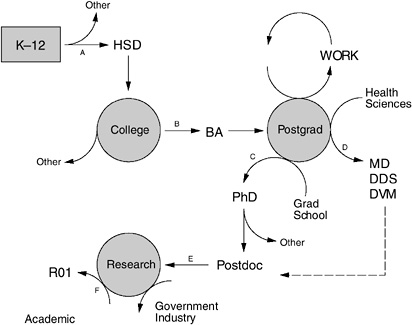
FIGURE 2 Pathways model.
SOURCE: National Institutes of Health, Office of Research on Women’s Health, AXXS ’99, Achieving XXcellence in Science, Advancing Women’s Contribution to Science through Professional Societies, Marino, “A Pathways Model for Career Progression in Science,” pp. 15-19.
I set up a pathways model for taking people from cradle to grave, using rate constants to describe how we get people through those steps (see Figure 2). But how do we keep people on the pathway and keep them moving forward through that progression? In this presentation I’m going to take each of these steps and talk a little bit about what happens at them in terms of national numbers and women.
Looking at the Numbers7
We send kids into schools and we spend lots of money telling them that they should go into science. When we look at the numbers we see that 52 percent of
the population is female. In the United States, we’re producing about 2.5 million high school graduates every year, of which 51–52 percent are female. We then send a percentage of them on to college, and we hope they go on to get a bachelor’s degree.
A very small percentage of those who do go on to college actually go into biology and chemistry—the major sciences that will supply medical school applicants. In 1981, 44.5 percent of the 44,000 B.A.’s awarded in biology went to women, and 30.1 percent of the some 11,500 B.A.’s awarded in chemistry went to women. By 1996, these numbers had gone up to 53 percent of 62,000 in biology for women and 41.5 percent of 11,000 in chemistry for women. The numbers in biology fluctuate from year to year, but they’re between 40,000 and 60,000 over about 20 years. For chemistry, the number of B.A.’s graduating every year is pretty consistent. In 2000, 59.5 percent of the B.A.’s awarded in biology went to women. Sixty percent is a pretty hefty number when you realize that is the pool from which medical school applicants will be drawn. Once the 60 percent is put into the postgraduate pool, they go to work or they go to graduate school or they go to professional schools. Most students seem to sit in this work pool for about two years before they go on to graduate school. Sixteen thousand of them go on to medical school. The percentages of women going in either of these directions are increasing over time.
In 1981, 15 percent of the Ph.D.’s earned in chemistry were earned by women. By 1996, 30 percent of about the same number of degrees went to women. In 2000, 31.4 percent of the chemistry Ph.D.’s went to women. In biology, 29.1 percent of the 3,400 Ph.D.’s produced in 1981 went to women. By 1996, the corresponding numbers were 44.5 percent of 4,000, the numbers increasingly slightly. In 2000, 44.8 percent of the 5,850 Ph.D.’s awarded in biology went to women. So we’re approaching parity.
As for the demographics, both men and women take about seven years to get their Ph.D. in biology and six years to get their degree in chemistry. The median age is approximately the same—32 years for a biology degree and 29 years for a chemistry degree. And the plans to undertake postdocs are basically the same—in biology, 54.4 percent of men and 50.6 percent of women; in chemistry, 49 percent of men and 44.6 percent of women. Although these data are from 1996, the numbers had not changed much as of 2000, except that now almost 70 percent of biologists want to go on and do postdoctoral work and about 50 percent of chemists go on to do postdoctoral work.
Now let’s look at the medical school picture. Of the 16,000 students enrolling in 1970, only 9 percent of the class was female. In 2001, 45 percent of the class was female. Just before coming to this meeting I visited my internist, a woman, for a throat culture because I have a cold. After I told her I was speaking at a meeting downtown, she asked me what I was speaking about. “I have to speak to a bunch of medical societies about the role of women in science and how we’re progressing,” I told her. She then said, “We’ve solved that problem, right?
When I went to medical school it was 5 percent. Now we’re almost half.” “That’s true,” I said, “60 percent of the biologists who are graduating are female, 52 percent of the population is female, but only 45 percent of the medical school class is female. So we’ve actually got more competition for fewer slots.” “Oh,” she said, “and we have made progress.” I told her that we have, but we have more to do.
Research and Teaching
At the NIH our interests are in research. Recent data from AAMC or from the Federation of American Societies for Experimental Biology [FASEB] show this is a tremendous time to move ahead in translational research. We need well-trained M.D.’s and M.D.-Ph.D.’s who can take science from the bench to the bedside, who can do the translational research needed to take advantage of all the advances we’re making right now. It’s a very exciting time in science.
Unfortunately, the number of M.D.’s who are going into research is falling. Even though medical scientist training programs are in place, producing well-trained M.D.-Ph.D.’s, we can’t compensate for the number of slots we’re losing in fellowships and training grants. We need to do something to encourage M.D.’s or M.D.-Ph.D.’s who want to go on and work in medical research careers. In fact, we need to look at this pathway to see how we can get M.D.’s, D.D.S.’s, and D.V.M.’s to move into clinical research. If we don’t have these folks, we’re not going to be able to take advantage of all the things going on right now. Considering that the growth in degrees in biology and chemistry, both at the B.A. and the Ph.D. level, is among women, the future and growth potential of the societies represented here rests in capturing that expanding portion of the market.
As for what’s happening to women at universities and medical colleges, the situation for women on the basic science faculty did not change much between 1990 and 1998 (Table 1). For the medical clinical faculty, the situation is even worse. Overall in 2001, for all faculty, only 12 percent of the full professors at medical schools were women. A slight increase (3.5 percent) is evident at the assistant professor level, and at the associate professor level there has been fairly
TABLE 1 Women Faculty in Basic Science Departments of Medical Schools, 1990 and 1998 (percent)
|
|
1990 |
1998 |
Change |
|
Full professor |
9.7 |
13.6 |
3.9 |
|
Associate |
19.2 |
25.4 |
6.2 |
|
Assistant |
29.3 |
32.8 |
3.5 |
|
Instructor |
40.9 |
41.9 |
1.0 |
|
SOURCE: Association of American Medical Colleges. |
|||
decent increase (6.2 percent), but if one compares the pool size, it’s not good. We’re actually losing people. There are places along the pathway where women seem to get “stuck.”
A look at total faculty at medical schools reveals that 28 percent are female and 12 percent are full professors. Thirty-six percent of eligible males make the transition from assistant to associate professor, while only 24 percent of eligible females make that transition. So for women, this appears to be the sticking point—from assistant professor to associate professor. Women’s attrition rates are slightly higher than those of men, 9.1 compared with 7.7. This then is where we need to focus if we’re going to look at that pathway. We have to decide what we need to do to break down the barriers and keep things moving.
Anyone who wants to succeed in biomedical science needs the imprimatur of the NIH in the form of a research grant. In the competition for NIH R-01 support between 1988 and 1997 by new investigators—that is, applying for the first time—there was no difference between men and women on average. They succeeded about 26 percent of the time. So the women are not less well trained, not less competitive in terms of R-01 funding initially.
In terms of new R-01 awards—that is, people applying for a new grant, not necessarily a new investigator—the rates were about the same for men and women, 18 percent and 17.8 percent. As for success rates for renewal of existing awards, again the rates for men and women were similar—35 and 36 percent. So women who get in the system compete equally with men. No better, no worse.
Overall, then, we move students through a system that has more women initially—completing high school degrees, outpacing men in biology B.A.’s, approaching parity in chemistry B.A.’s, but we still have sticking points. We have a lot to do in moving women into the faculty positions where they can act as mentors and role models, where they are competing with the men and moving science forward. Women are 52 percent of the population; they hold 60 percent of bachelor’s degrees and 45 percent of Ph.D.’s; they make up 40 percent of instructors and 10 percent of full professors. We can’t afford not to take advantage of a labor pool, but all along the way we’re losing women.
Some people think in terms of modeling. If in the model of a system there are very small differences in rates but multiple steps, very large differences appear over time. That’s essentially what we have here—a system with multiple steps and generally small differences in rates. But over time, when those differences multiply, very big differences occur in the end.
Sixty percent of the B.A.’s in biology are earned by women, but only 20 percent of NIH awards are going to female principal investigators. We must do something about this portion of the pathway in careers. We need to bring more women into the senior ranks.


