
5
Existing Detection Techniques and Potential Applications to Standoff Detection
INTRODUCTION
Detection of explosives is based on a wide variety of technologies that focus on either bulk explosives or traces of explosives. Bulk explosives can be detected indirectly by imaging characteristic shapes of the explosive charge, detonators, and wires or directly by detecting the chemical composition or dielectric properties of the explosive material. Trace detection relies on vapors emitted from the explosive or on explosive particles that are deposited on nearby surfaces. Explosive detection is a very challenging task, and combinations of the various techniques offer increased sensitivities and selectivities. There are numerous technologies for detecting explosives that have been proposed, are in the research stage, or are currently in use. A recent review of technologies and products being used today is available on the web.1 A more general review of explosives detection can be found in a government reports2 and in books cover
|
1 |
Burschini, C. Commercial Systems for the Direct Detection of Explosives (for Explosive Ordnance Disposal Tasks), ExploStudy, Final Report, 2001. Ecole Polytechnique Federale de Lausanne, Switzerland. http://diwww.epfl.ch/lami/detec/ExploStudyv1.0.pdf (pdf file) or http://diwww.epfl.ch/lami/detec/explostudy.html (html file). |
|
2 |
U.S. Congress, Office of Technology Assessment, Technology Against Terrorism, The Federal Effort; U.S. Government Printing Office: Washington, DC, 1991. http://www.wws.princeton.edu/~ota/disk1/1991/9139.html (html file) or http://www.wws.princeton.edu/cgi-bin/byteserv.prl/~ota/disk1/1991/9139/9139.PDF (pdf file). The National Institute of Justice, Survey of Commercially Available Explosives Detection Technologies and Equipment, NIJ Office of Science and Technology: Washington, DC, 1998. For an extensive bibliography of |
ing explosives detection.3 The existing technologies for explosives detection can be separated into two categories, bulk detection shown in Figure 5.1(a) and trace detection shown in Figure 5.1(b).
This report is concerned particularly with standoff detection, where the vital data collection apparatus for explosive detection is located far enough away from the explosive devices that it will not be damaged and personnel operating the apparatus will not be harmed. The amount of standoff distance that is required will depend on the size of the explosive device, but standoff distances are usually defined as 10 m or more. In Figure 5.1, technologies that have the potential to achieve standoff detection are distinguished by cross-hatching. In addition to the ideal standoff configuration, where the entire detection system is at a safe distance from the explosive, systems having remote components that are not “vital” to the detection device were also included. These nonvital components could include low-cost detectors or a distributed detector network that reports back to a central detection apparatus located at a standoff distance using either optical or wireless signaling. These nonvital components could easily be replaced if destroyed. These partially remote detection schemes are marked by cross-hatching in Figure 5.1(a) and (b).
Pointing toward research and development directions that can significantly advance the standoff detection of explosives is a major goal of this report. These R&D directions are highlighted in Figure 5.1 with a dotted pattern. The research directions described in this section are often extensions of existing technologies or combinations of existing research directions with the development of explosive detection devices. Novel detection techniques and their associated research directions are described in Chapter 7 of this report. Explosives detection is not easy or simple. Detection technologies vary with the scenario of the explosive situation. Each method and accompanying scenario has fundamental, practical, and even cultural limitations. Many explosive detection techniques are limited either by fundamental physical constraints (e.g., resolution limits for microwave imaging) or by the circumstances of a particular scenario (e.g., background explosive residue in embattled locations such as Iraq). The committee concentrates on standoff scenarios for both civilian and mili-
|
|
papers, reports, and presentations on the analysis and detection of explosives, see http://www.ncfs.ucf.edu/twgfex/Analysis%20and%20Detection%20of%20Explosives.pdf. |
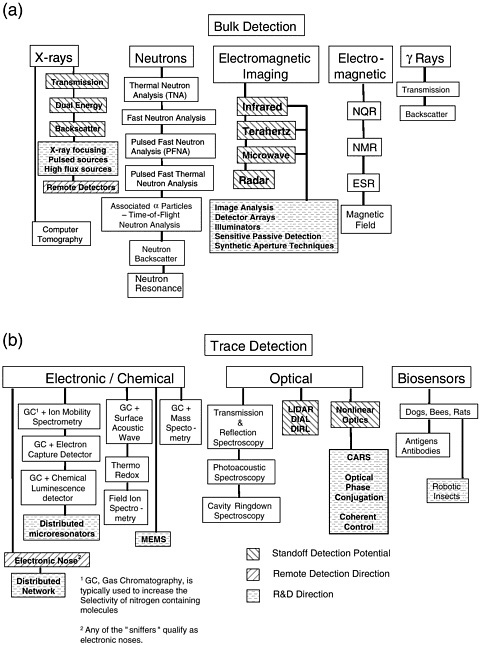
FIGURE 5.1 Chart showing many of the existing technologies for (a) bulk and (b) trace explosive detection, including those with potential for standoff detection, cross-hatched from left downwards to right. Research and development directions that would advance the sensitivity, selectivity, and standoff distance are marked with a dotted background. Specifically remote detection schemes are crosshatched from left upwards to right.
tary situations. Many of the existing techniques have been well described in the literature. This report describes in more detail the techniques that have potential for standoff and remote detection. Each topic includes (1) a technology overview, (2) scenarios of interest, (3) advantages of the technique, (4) limits and disadvantages of the technique, and (5) research directions that may be fruitful in advancing or expanding the applicability of the technique.
BULK DETECTION
Imaging is a primary technique for standoff detection scenarios. Most bombs have distinguishing spatial features and uniquely shaped metal components such as wires, detonators, and batteries. Explosive dielectric constants allow at least a limited discrimination from the background for X-ray and microwave imaging techniques. The reflection, absorption, and scattering for various explosives in a set of spectral bands can be categorized, and this information can be used as a data base for image analysis. This section describes several imaging techniques using radiation with wavelengths spanning the range from radio waves to gamma rays. Most of the bulk detection techniques that have potential for standoff detection involve imaging.
X-Rays
X-rays have been used for many years to search for explosives and other contraband in luggage and cargo containers.4 Since X-ray radiation is ionizing, there are health concerns when people are exposed to it. However, for imaging out to standoff distances of 10 to 20 meters, these health issues may not be prohibitive. Transmission X-ray imaging requires a detector on the opposite side of the target from the transmitter. The detector could be a low-cost plastic sheet monitored by an inexpensive camera with a wireless link to a data analysis base. Inexpensive detectors and cameras could be concealed and replaced if they are damaged. Transmission images give good resolution and detect shapes of objects shadowed as a result of their high X-ray absorption. More recent X-ray imaging uses backscattering where both detector and transmitter are colocated. Examples of backscatter X-ray images from a suitcase, several persons, and a vehicle are shown in Figures 5.2-5.4. The backscattered image is bright for organic materials since the incident and backscattered X-rays penetrate
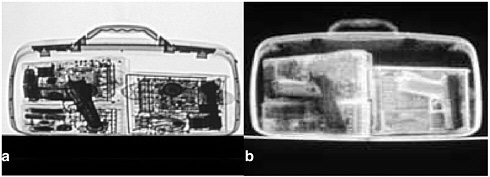
FIGURE 5.2 (a) Transmission and (b) backscatter X-ray images of a suitcase containing two guns, one plastic and one metal. The transmission image (a) shows a radio on the right in which a plastic Glock 17 automatic pistol is concealed. A metal gun is visible in image (a). The backscatter image of the same suitcase in (b) clearly shows the plastic gun on the right. (AS&E)
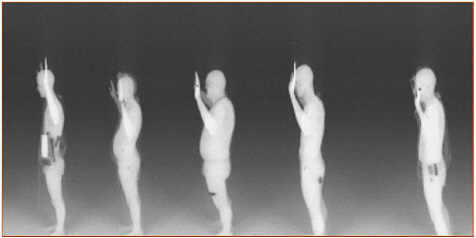
FIGURE 5.3 Standoff X-ray detection showing hidden explosives and other items on personnel. Images were taken from a van moving at 0.3 to 6 miles per hour using X-ray backscattering in “drive-by” mode. The mock suicide vest contained simulated C4 explosives and pipe bombs. Both the explosives and the pipe bombs are easy to see and are distinguishable from normal objects under clothing. (AS&E)
deep into the organic materials, where atoms contain fewer electrons than the atoms in materials (e.g., metals) made of heavier elements. As in the case of transmission imaging, the detectors for backscattering could be located closer to the target than the transmitter to enhance image resolution and decrease losses caused by absorption in air and the angular
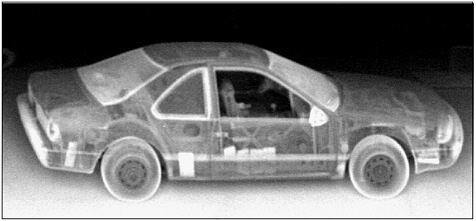
FIGURE 5.4 X-ray image of a car containing C4 explosive packages (just in front of the front wheel, to the rear of the door, in the roof just above the door, and in the back fender), drugs (in the door), and a 150 pound ANFO (ammonium nitrate-fuel oil) bomb with a grenade detonator (in the trunk). (AS&E)
spread of the beam. AS&E5 is building a backscatter X-ray imaging system with the potential to image objects 22 feet away. It also has systems in which the detector and video readout camera are located remotely.
A combination of both transmission and backscatter aids in detection since the transmission images have better resolution and the backscatter images have better discrimination between organic and nonorganic materials. Dual-energy X-ray sources further enhance the discrimination between organic and nonorganic compounds, specifically between explosives and background objects. Computer tomographic X-ray images give great detail but require appreciably longer times for scanning and data analysis. For scenarios calling for searches of cargo, trucks, and so forth, there are systems available6 that can image out to 20 feet through large trucks and cargo containers.
There is good potential for X-ray imaging at standoff distance of approximately 15 m. Research in the areas of high photon flux X-ray sources, pulsed X-ray sources, smaller focal spots for scanned beams, and focused X-ray beams7 can contribute to the successful development of standoff X-
|
5 |
American Science and Engineering (AS&E), Inc., Billerica, MA, personal communication. |
|
6 |
AS&E, personal communication. |
|
7 |
Windt, D. W/SiC X-Ray multilayers optimized for use above 100 keV, Applied Optics 2003 42, 2415; also see http://www.srl.caltech.edu/HEFT/. |
ray imagers. An alternative approach may be coded aperture imagers since they are able to achieve high sensitivities with practical devices. Lower-energy X-rays (<100 keV) may have potential for better discrimination between organic and inorganic materials. However, the lower-energy region has the disadvantage of higher absorption in air as well as in the explosive apparatus. Another important area for future research and development is computer image analysis of images such as those shown in Figure 5.2. This could allow better image interpretation and partially solve the privacy issues that arise with images of people in which private body parts appear. People may be less likely to object to image analysis if no one actually sees the images and if the images can be “deleted” immediately after analysis.
In summary, X-ray imaging has good potential for standoff detection for distances up to approximately 15 m. Its advantages are excellent image resolution along with limited discrimination between explosives and background items. The disadvantages of X-ray imaging are the perceived health concerns that arise with ionizing radiation as well as the cultural and legal issues that arise when imaging people through their clothing. The standoff distance for X-rays is a challenge; however, there is hope that it can be extended to at least 15 m. The cost and size of X-ray detection systems are also a concern. Size is especially a concern in military scenarios where portability is at a premium.
Infrared
In the infrared (IR) spectral range (wavelengths between 1 and 10 microns), clothing, explosive packages, and most other items are opaque to radiation. However the body or other objects near room temperature passively emit thermal IR radiation. This thermal radiation can be detected easily with simple, relatively inexpensive IR imaging cameras. Objects differing slightly in their surface temperature are easily distinguished, even for temperature differences beneath a surface. An example of detecting subsurface temperature abnormalities beneath the skin is shown in Figure 5.5.
Infrared imaging is of considerable interest for scenarios involving suicide bombers since the clothing covering the explosive pack should be at a slightly different temperature than clothing nearer the skin.However, outdoor settings present a challenge to infrared imaging because thermal differences are more difficult to detect due to air currents and other radiation sources (e.g. the sun).
The response time for detecting a suicide bomber must be less than 10 seconds since one must typically stop the bomber as he walks toward a
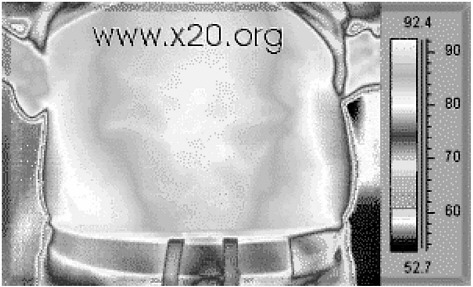
FIGURE 5.5 Infrared image of a person’s back reveals a healing spinal operation beneath the skin. Small temperature differences of less than a few tenths of a degree are detectable and can reveal anomalous temperature distributions on the surface of clothing caused by metal or plastic objects hidden beneath the clothing.
target area.8 The IR detection scheme can easily detect image patterns in this time frame. Real-time motion videos using multiple views (possibly filtered into various spectral windows) of the evolving scene could give this detection technique a major advantage in rapidly interpreting complex scenes.
Another important advantage of the thermal imaging technique is its simplicity and the well-developed imaging technology in the infrared. The disadvantage is the lack of selectivity for explosives. One must rely on identifying a unique shape from a thermal pattern of the outer surface of the target. The resulting image is blurred by the effects of thermal conduction and air convection in and around clothing. Items other than explosives (e.g., cell phones) might result in anomalous images similar to those produced by explosives. Simple countermeasures (e.g., uniform insulation under the clothing) might be used against this detection scheme.
Research in the IR spectral range is needed to study the spectroscopic properties (e.g., thermal emissivity versus wavelength) of human skin,
clothing, and other relevant materials. This information might lead to differential spectroscopic techniques that could improve IR imaging for explosive detection. To optimize standoff detection, other important areas for development include cooled detector arrays and advanced image processing techniques.
In summary, IR imaging is a very important technique for standoff detection. Its advantages are the readily accessible technology, real-time response, and sensitivity to the image patterns typical of suicide bomber scenarios. Its disadvantage is the lack of specificity for explosives or explosive type. One could use it as a preliminary screening process for sorting out potential explosive carriers.
Terahertz
Clothing and many other materials become nearly transparent as the radiation wavelength increases to the terahertz range, wavelengths longer than 300 microns corresponding to 1-THz frequencies. Imaging in this region allows detection of explosives hidden beneath clothing without the danger of ionizing radiation. There is hope that explosives will be found to have distinguishing spectral features in this spectral range so that one will have something more than simple shapes with small dielectric index contrasts to use as explosive identifiers. Explosives certainly have unique spectral features due to the bending and twisting modes of the explosive molecules. However, the sharp spectral lines associated with these modes in the gas phase will probably be broadened so much in the solid and liquid phases that they cannot be used for unique identification. There is also the possibility that the radiation scattering caused by the granularity or crystal structures of explosives could enhance image contrast.
Health hazards for terahertz and microwave radiation do not appear to be a major concern. The present limits9 are set at radiation levels less than 100 mW/cm2. This should allow for more than adequate active illumination of portal areas and even wide areas at sports events or travel terminals. Passive thermal radiation is another possibility for imaging; however detecting small differences in thermal radiation in this spectral region is very challenging and would probably require detectors cooled to very low temperatures.
|
9 |
Occupational Health and Safety Administration standards 1910.97, Non-ionizing radiation; see http://www.osha-slc.gov/SLTC/radiofrequencyradiation/. |
Technology is just beginning to be developed for the terahertz spectral region. Sources in use at present include gas lasers10 that are bulky and lack stability for field environments. Pulsed sources11 based on photocurrents induced by ultra-short laser pulses are inefficient sources that require large optical input powers and only achieve tens of microwatts average output power at present. High-power free electron laser sources12 are being developed, but they are far too large and expensive for applications to explosive detection. A very interesting potential, compact, low-cost source is the quantum cascade laser. These tiny semiconductor lasers have now been operated down to frequencies as low as 1.5 THz.13 Another interesting compact source14 is based on nonlinear mixing between closely spaced diode laser sources and Raman shifted laser lines in the infrared to form coherent beams in the terahertz range. Compact sources with output powers between 10 mW and 1 W would be very useful for illuminating potential explosive scenarios in the terahertz range.
At slightly lower frequencies in the range between 100 GHz and 1 THz, powerful gyrotron tube sources15 are being developed. These can generate up to megawatts of power in pulsed mode and kilowatts in continuous operating mode. These sources could be used to actively illuminate wide areas for explosive surveillance.
Enhanced image resolution is the advantage of the shorter-wavelength terahertz regime. For wavelengths longer than 100 microns, including the terahertz, microwave, and radio wave spectral bands, one encounters a fundamental limit to the image resolution, ΔL, at a distance L. This resolution limit is expressed as
ΔL/L > λ/D, (1)
where λ is the radiation wavelength and D is the aperture of the antenna that collects the radiation used for forming the image. For example, to resolve a metal component in an explosive package with a resolution of 1 cm at a distance of 20 m using terahertz or microwave radiation with a wavelength of l mm, a collecting antenna nearly 2 m in diameter is required. These large dimensions place constraints on the concealment and portability of the detection apparatus useful for standoff detection at distances greater than 10 m. This fundamental resolution limit indicates that one should choose the shortest wavelength possible in order to resolve objects at standoff distances in the terahertz regime.
Another important constraint is imposed by absorption of water vapor in the air. As shown in Figure 5.6, there is appreciable absorption from water vapor over path lengths greater than 10 m for radiation with wavelengths between 300 microns and 10 microns. The ideal frequency range for imaging is in the region from 100 GHz to 1 THz, where the atmosphere and clothing absorption limits are not limiting and moderately good resolution can be obtained at standoff distances.
Sensitive detectors16 and detector arrays17 are now being developed for the terahertz regime. For example, in the astrophysics community there are sensitive bolometer and superconductor-insulator-superconductor (SIS) mixer detectors. Detector arrays as large as 10,000 pixels are being planned; however at present the yield for fabricating detector arrays is quite low. The most sensitive detectors in the terahertz and subterahertz regime are cooled to low temperatures. Researchers at that National Institute of Standards and Technology18 are developing room-temperature bolometer detectors that are of great interest for explosive detection since they could be widely deployed at much more reasonable costs than the low-temperature detectors.
Microwaves
There is a fuzzy boundary between terahertz and microwaves. Both technologies claim the region between 100 and 300 GHz. Electronic am-
|
16 |
See review article: Carlstrom, J. E.; Zmuidzinas, J. Millimeter and Submillimeter Techniques, Reviews of Radio Science 1993-1995, W. Stone, Ed. Oxford University Press: Oxford, UK, 1996. |
|
17 |
See http://fcrao.astro.umass.edu/instrumentation/sequoia/seq.html. |
|
18 |
MacDonald, M. E.; Grossman, E. N. Niobium microbolometers for far-infrared detection, IEEE Transactions on Microwave Theory and Techniques 1995, 43, 893. Grossman, E. N.; Miller, A. J. Active millimeter-wave imaging for concealed weapons detection, SPIE 2003. Grossman E. N.; Bhupathiraju, A. K.; Miller, A. J.; Reintsema, C. D. Concealed weapons detection using an uncooled niobium microbolometer system, SPIE 2003. |
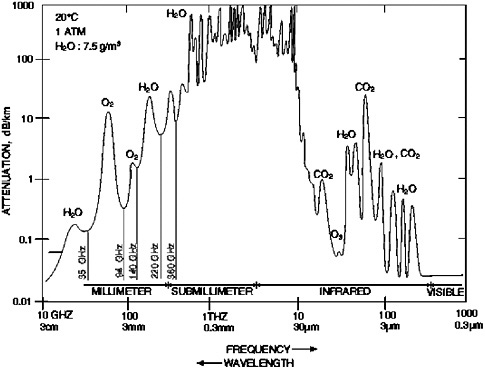
FIGURE 5.6 Absorption in air spanning the microwave to visible regions of the spectrum. Absorption greater than 500 dB/km or 0.5 dB/m causes problems for standoff detection. As shown in the graph, this limits the useful range for standoff imaging to the regions outside the range between 300 microns and 10 microns.
plifiers and sources are rapidly being developed19 for this frequency range since there are applications in the telecommunications industry where data rates are approaching 100 gigabytes per second. Arrays of low-noise amplifiers suitable for imaging arrays and sources with watts of output power are possible. These areas merit future research and development for imaging applications in the frequency range between 100 and 300 GHz.
At 300 GHz the water vapor absorption will allow imaging out to 50 m but the antenna required for 1-cm resolution at these distances is nearly 5 m according to Equation 1. This suggests that synthetic aperture techniques are another important research topic for terahertz imaging. Using both phase and amplitude information along with Doppler shifts of moving targets, there is hope that smaller antennas can be used and the required resolution still be achieved. Visible and terahertz images of a person carrying a gun and a knife are shown in Figure 5.7.
At frequencies below 50 GHz in the microwave regime, the resolution at standoff distances is fundamentally limited, according to Equation 1.
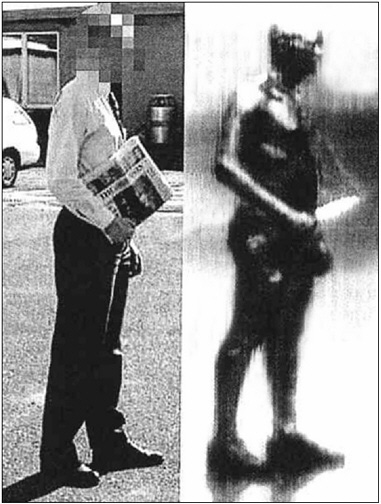
FIGURE 5.7 Visible and terahertz images of a man carrying a knife hidden in a newspaper and a gun in his pants. (QinetiQ.)
Good images20 have been obtained in this region but only at distances of a few meters. Microwave and radio-frequency radars also can give information about the anomalously large fractions of metal content in targets. Even though there is no resolution of the image, anomalously large reflection from explosive packages containing large amounts of metal (e.g., pipe bombs) could be an asset for detecting some forms of suicide bombers.
Neutrons, Gamma Rays, Magnetic Resonance, and Magnetic Fields
Neutron and γ-ray explosive detection both suffer from a combination of health hazards and limitations in sensitivity for standoff detection. Neutrons penetrate typical bulk explosives. Both fast neutrons21 and thermal neutrons have been proposed for detection. Thermal neutrons can be captured by 14N nuclei and result in γ-rays of a specific energy (10.8 MeV). The distribution and level of γ-rays at this energy can in principle be used to detect nitrogen-rich explosives. There are background problems from other activated nuclei and cosmic rays. Expensive cooled detectors can in principle give sufficient energy discrimination to reduce these backgrounds. Long counting times are typically required to get sufficient signal-to-noise ratio for good identification. In summary, neutron detection techniques do not appear to have good potential for standoff detection, because of both health hazards and insufficient sensitivity. They can play an important role in specific scenarios such as detection of explosives in trucks, boats, and other cargo situations.22
Gamma rays can be used to locate or image nitrogen-rich explosives.23 For example, resonance scattering techniques identify 14N using resonance gamma-ray scattering at 9.17 MeV γ-ray energies. A number of background problems could be circumvented by using detectors with sufficient energy resolution. Even without specific resonance interaction processes, γ-rays can be used in transmission and backscattering geometries
|
20 |
McMakin, D. L.; Sheen, D. M.; Hall, T. E. Millimeter wave imaging for concealed weapons detection, Proceeding SPIE 2003, 5048, 52-62. |
|
21 |
Lefevre, H. W.; Chmelik, M. S.; Rasmussen, R. J.; Schofield, R. M. S.; Sieger, G. E.; Overley, J. C. Using fast-neutron transmission spectroscopy (FNTS) to handle luggage for hidden explosives. Can it be made practical for first-line airport use?, Second FAA Explosives Conference, Atlantic City, November 1996. Rasmussen, R. J.; Fanselow, W. S.; Lefevre, H. W.; Chmelik, M. S.; Overley, J. C.; Brown, A. P.; Sieger, G. E; Schofield; R. M. S. Average atomic number of heterogeneous mixtures from the ratio of gamma to fast-neutron attenuations, Nucl. Instr. Meth. B 1997, 124, 611. |
|
22 |
Assessment of the Practicality of Pulsed Fast Neutron Analysis for Aviation Security, National Academy Press, Washington, DC (2002). |
|
23 |
See, for example, http://www.sc.doe.gov/henp/np/homeland/Posters/BNLWielopGamma.pdf. |
in a manner very similar to that used for X-rays. As with neutrons, health issues may limit the scenarios of interest. However, the major disadvantage of γ-ray techniques is that the sources used to generate the gamma-ray flux required for standoff scenarios are likely to be very large and costly. Research in this area appears to be much less promising for standoff detection than for other techniques.
Ships at docks and trucks on bridges that could be carrying tons of explosives in cargo containers are important scenarios for explosives detection. Gamma-ray and neutron beam explosive detection instruments can potentially screen these large cargo containers at ports of entry, although throughput rates may prohibit the screening of all cargo in some cases. Cargo vessels and trucks could be cleared of personnel to avoid health problems. Large, expensive, spatially fixed equipment may be worth considering for fixed facilities. These techniques still have the disadvantage that, at best, they detect explosives only through the high content of specific nuclei, not the specific molecular structure of an explosive. This can lead to false alarms for nitrogen-rich nonexplosive materials and also means that explosives that lack nitrogen, such as TATP, will not be detected.
Magnetic resonance techniques24 rely on exciting either the nuclear quadruple resonance (NQR) unique to the electric field gradients in explosive molecules or the nuclear magnetic resonance (NMR) of nuclei in explosive molecules (e.g., RDX or TNT) in a magnetic field. NQR identifies a specific explosive compound since the electric field gradients that produce the resonance are unique to a particular molecule. While NMR in the laboratory is an excellent analytical technique, in practice for finding explosives in the field it is the hydrogen NMR signal that is obtained. The hydrogen in most explosives exhibits very long T1 and very short T2 NMR relaxation times, and so the explosive can be distinguished from most other benign materials. These magnetic resonance techniques require close proximity (<1 m) to a large amount (>10 g) of bulk explosive. This limit makes magnetic resonance techniques ill suited to standoff detection.
Earth’s magnetic field is perturbed when a metal object moves through it. Since bombs often have metal parts, they will cause magnetic perturbations as the carrier moves. Extremely sensitive magnetometers25 have recently been developed, (e.g., those based on microelectromechanical [MEMS] technology). The sensitivity is impressive: a moving rifle can be detected at a distance of a kilometer. However, there will typically be
|
24 |
see references 1 and 3; also see http://www.qm.com/. |
|
25 |
S. Arney, Bell Laboratoroies, Lucent Technologies, Murray Hill, NJ, personal communication. |
many other moving metal components in explosive detection scenarios. This “clutter” of the area of interest for explosive detection probably eliminates metal detection at standoff distances from being a primary technique.
TRACE DETECTION
Trace detection at standoff distances is a particularly challenging task. Saturated vapor pressures for many of the common explosives are very low (approximately 10 parts per billion [ppb] for TNT and 10 parts per trillion [ppt] for cyclomethylenetrinitramine [RDX] and pentaerythritoltetranitrate [PETN], see Chapter 3). In many scenarios the air volume containing the explosive is large, at least the size of a large room. Diffusion of a gas in a large volume of air will eventually establish a saturation vapor pressure, but this will take many hours. In most explosives detection scenarios, air currents, charging of the explosive molecules, and adsorption onto nearby surfaces will determine the actual concentration of explosive molecules. Even though the probability of the molecules sticking to surfaces may be much less than 1, the surface area is huge. Many explosive molecules are strongly electronegative (i.e., they have a high probability of attaching an electron and becoming charged). Both air currents and large electric fields in the air will form plumes of explosive molecules in the localized airspace near the explosive, similar to smoke drifting from a cigarette or aroma from a rose. The actual concentration of molecules in these plumes can easily be 100 to 10,000 times lower than that predicted by the saturated vapor pressure. This makes detection of explosive vapors a monumental challenge. Griffy26 developed a semi-empirical theoretical model for the evaporation (sublimation) of such explosives and showed basically that it is better to sample surfaces for explosive residue than to probe the air for explosive vapors. This conclusion is confirmed by the common practices used in trace detection, where swiping of surfaces is usually preferred to vacuum collection of vapor. Consequently, sampling methodology is vital to the performance of any trace detection techniques.27
Many trace detection schemes rely on stimulating an increased flux of molecules or particles for the explosive device. For example, turbulent airstreams, “minicyclones,” and laser ablation or deflagration are used to
increase the trace material available for analysis. In the case of dogs, stirring the local environment with the dog’s body, head, and foot motion may contribute to sensitivity.
Concentrators are another common sampling technique for trace explosive detection. For example, a vacuum system near a portal can be used to accumulate a large air sample from which explosive molecules can be concentrated by filters. A dog’s nose works in part on this principle. The dog inhales and collects particles and molecules over a surprisingly large area in the nose, in the range of 10 m2.28 There is still hope that research will find a way to fabricate electronic, chemical, biological, or optical “noses” that will equal or exceed the dog’s nose.
Molecules of the explosive provide a unique identifier for each explosive since there are relatively sharp spectral absorption lines due to electronic transitions in the ultraviolet (UV) and vibrational absorption lines in the IR and terahertz ranges. As described above there is the problem of the very low concentrations available in the gas phase. If the molecules are incorporated into small granular particles or are absorbed on surfaces, the molecular absorption lines are dramatically broadened and their utility for unique identification using optical spectroscopy is diminished. This is more of a problem for the IR and terahertz vibrational, bending, and torsional spectral lines.
One typically finds particulate explosive material around nonhermetically sealed explosives associated with contamination on the skin, explosive container, or nearby objects. The total amount of particulate material is often much larger than the amount of gaseous vapor. A number of trace techniques29 (see Figure 5.1), including mass spectrometry, ion mobility spectrometry, electron capture, surface acoustic wave sensors, thermo-redox and field ion spectrometry, can identify explosive materials from small grains. Many of these techniques are often combined with front-end gas chromatography, which prefractionates the molecules in incoming samples and thus increases selectivity. Some of these techniques have been configured to act as “sniffers” and can serve as choke or checkpoint detectors at a remote location (thus, belonging to the remote detection category). However, as shown in Figure 5.8, they are bulky and need miniaturization for use as distributed sensors.
It seems reasonable that we can hope to construct a “sniffer” at least as good as a dog’s nose. These artificial noses could be tailored to specific
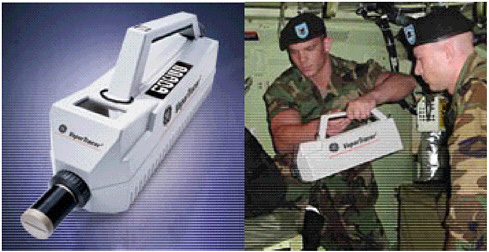
FIGURE 5.8 Military personnel using the IonTrack (now GE Interlogix) “sniffer,” which is capable of detecting drugs and explosives. It is based on ion trap mobility spectrometer (ITMS) technology. See http://www.geindustrial.com/geinterlogix/iontrack/app_military.html.
explosives and deployed as networks of detectors in sensitive areas. However, it will take a considerable amount of further research and new ideas to achieve this goal. It has been demonstrated30 that one can chemically form sites that selectively attract explosive molecules. These selective chemical bonding sites can be detected by fluorescence quenching (sensitivities as low as femtograms of material) and other techniques (e.g., resistive changes in thin films). However, these bonding sites can be saturated in a field environment with interferents. For example, common fumes and odors in the environment might be troublesome interferents in many explosive detection scenarios.
In principle it is possible to form a remote explosive sensor using a large area coated with a luminescent material designed so that the luminescence is quenched by small quantities of explosive molecules. Patterns of explosive plumes could in principle be observed at a distance by imaging a quenched luminescent pattern caused by a nearby explosive on a surface coated with the luminescent material. Luminescent sensitivity can be enhanced by arrays of optical micro-resonator structures formed using
photonic crystals,31 microdisks,32 and microcylinders. The sensitivity of these structures appears to be adequate for some scenarios, but the disadvantage at present is selectivity and saturation from interferents. Cycling of the luminescent detectors is also a challenge.
Electronic noses based on the change in resistance of inorganic or organic33 semiconductors are another potential technique for making low-cost sensitive detectors that could be deployed in arrays or networks over a large area. There are presently34 several hand-held instruments (weighing between 1.5 and 7 pounds) and portable instruments (weighing between 18 and 43 pounds) that can be used as remote point sensors. An important avenue for research and development is to explore the fabrication of compact, inexpensive electronic noses that can be used in arrays with a variety of resistive materials, each sensitive to a particular molecule. These multiple sensor arrays could effectively increase the selectivity of electronic noses and help solve the problem of interferent saturation. Plans exist for downsizing a commercial system based on chemical sensing arrays to “devices as small as 1-inch high and 1-inch wide that could be used to create a network of sensors that could be deployed around a stadium.” 35
Instead of a simple change in resistance one can hope that catalytic chemical processes can be developed that effectively amplify the response of electrochemical detectors. This may be part of the secret to the sensitivity of dog’s noses.
Very recently another technique has been developed36 using MEMS technology. The resonant frequency of micron-sized mechanical “tuning forks” is extremely sensitive to the mass of molecules absorbed on the resonant mechanism surfaces. Using a molecular film coating on the microresonator allows one to detect explosive molecule concentrations in
the range of 10 ppt. However, this technique suffers from the same selectivity and saturation problems described above. These limits may be surmountable with continued research. The tiny MEMS devices have the advantage that they are potentially very low cost and could be deployed in arrays, possibly with low-cost wireless reporting to a central analysis hub.
Optical
Optical Absorption and Fluorescence
Optical absorption has the potential to uniquely identify explosive molecules by using their UV electronic and infrared vibrational resonances. However most of the techniques require collecting a sample and analyzing it over a time period sufficient to increase the signal-to-noise ratio to the desired level. For example, photoacoustic spectroscopy37 using infrared active vibrational transitions has the sensitivity to detect 10 ppt with an averaging time of the order of 10 seconds. Similarly, surface enhanced Raman scattering38 and cavity ring-down spectroscopy39 (decreasing the Q of an optical cavity by the vibrational absorption of a molecule) can detect very low molecular concentrations in the parts per trillion range. The major disadvantage of these techniques is that large samples have to be acquired and analyzed with relatively expensive and fragile apparatus. This removes them from the standoff and remote category. They may be useful in fixed portal scenarios.
Optical fluorescence40 from granular materials is an interesting technique with standoff potential. Trace amounts of explosive can be laser irradiated in the UV where they strongly absorb and decompose into fragments that can undergo laser-induced fluorescence. The resulting fluorescent patterns can then be imaged from a standoff distance. The disadvantages of this technique are lack of very high sensitivity and problems of quenching the fluorescence with environmental contaminants.
|
37 |
C. K. N. Patel, personal communication. Also see Webber, M.E.; Pushkarsky, M.B.; Patel, C.K.N. Fiber-amplified enhanced photoacoustic spectroscopy using near-infrared tunable diode lasers, Applied Optics 2003, 42, 12 and http://www.pranalytica.com/tech.htm. |
|
38 |
Shibamoto, K.; Katayama, K.; Fujinami, M.; Sawada, T. Fundamental processes of surface enhanced Raman scattering detected with transient reflecting grating spectroscopy, Rev. Scien. Inst. 2003, 74(1), 910-912 (2003 ) and references contained therein. |
|
39 |
He, Y.; Orr, B.J. Rapidly swept, continuous-wave cavity ringdown spectroscopy with optical heterodyne detection: single and multi-wavelength sensing of gases, Appl. Phys.2002, B 75, 267-280 and references contained therein. |
|
40 |
Heflinger, D.; Arusi-Parpar, T.; Ron, Y. ; Lavi, R. Opt. Commun. 2002, 204, 327. See also Cabalo, J.; Sausa, R. Applied Spectroscopy 2003, 57, 1196. |
LIDAR, DIAL, and DIRL
These techniques include laser, light detection and ranging (LIDAR), differential absorption LIDAR (DIAL), and differential reflectance LIDAR (DIRL). Some forms of LIDAR have been used in environmental pollution studies41 and in chemical agent plume detection. LIDAR42 operates on the principle that radiation from a pulsed illuminating source is backscattered to a detector. The explosive molecules in the pulsed laser illuminating beam will absorb when the source light is tuned to a molecular resonance (typically a vibrational resonance in the IR spectral range). This absorption attenuates the backscattered beam, thus allowing detection of the explosive. Backscatter can result from particulates in the air. At standoff distances in the 10- to 30-m range, the very low molecular concentrations characteristic of explosive molecules result in sensitivity limits for these laser ranging techniques. It is possible that nonlinear optical techniques (e.g., optical phase conjugation)43 can be used to increase the signal-to-noise ratios. These techniques are generally used in a sensing rather than an imaging mode. In the sensing mode, they can locate the direction and distance of a target but cannot image it. Imaging is possible by scanning a scene and mapping the returned signal.
Research in this area is needed to obtain the detailed spectral absorption characteristics of explosive vapors and the spectral reflectance characteristics of explosive particles (of varying particle size). This should facilitate the choice of spectral bands for performing differential absorption or reflectance LIDAR. Instead of using particles in the air for the required backscattering, one can use retro-reflectors similar to those seen on highway signs. This is another example of using low-cost remote apparatus. The use of retro-reflectors would restrict this technique to portal scenarios.
Imaging using the DIAL or DIRL mode is a form of dual-spectral imaging. Although these techniques involve two laser wavelengths for illumination, one can use the equivalent technique of illuminating with a broadband source and viewing with two narrow-band filters. At present, there is one such “equivalent” explosive imaging system. It uses solar illumination and an imaging system with two rotating infrared filters and is designed to detect adhered particles of a nonnitrate explosive. Another
technique44 uses a sample of the gas to be detected as a filter in one of the laser beam channels and electro-optic switching from the filtered channel to the unfiltered channel.
The dual-spectral system mentioned above is a special case of hyperor multispectral imaging. These techniques should be explored for detecting airborne or surface-adhered explosive molecules. This requires obtaining a complete set of spectroscopic characteristics, from the UV to the millimeter wave region, of the explosive material in various forms (gaseous and particulate of diverse size). Banded spectroscopy combined with imaging should also be explored further. The challenge in these multi- or hyper-spectral techniques is to obtain “processed” images in real time.
Finally there are novel sensing schemes45 based on LIDAR that use laser to sense the position and motion of the ground or objects near the explosive after the ground has been subjected to an acoustic shock. The seismic disturbances in the ground or containers can have unique motional responses detectable remotely by the LIDAR apparatus.
Nonlinear Optical
Nonlinear optical interactions of light with gaseous or solid materials typically vary as the square of the intensity of the optical field. For example, if two exciting laser beams are focused on a volume of gas containing explosive molecules, the light scattered from a third laser that is tuned to have a frequency shifted from the two exciting lasers by the vibrational frequency of the molecule, will produce a fourth beam whose intensity varies as the square of the exciting beams (see Figure 5.9).
This process is called coherent anti-Stokes Raman scattering (CARS).46 CARS has the advantage that the detected signal can be increased dramatically with the square of the exciting intensity. This is an example of the opportunity for increased signal-to-noise ratios obtainable with nonlinear detection techniques relative to linear optical techniques. At present, CARS systems have not been developed that have enough stability for deployment in the field. This nonlinear technique requires stability of both the laser frequency and the pointing accuracy of better than tenths of a degree, which are difficult to achieve in the field with fluctuating air currents. These techniques require that the phases of the various fields be
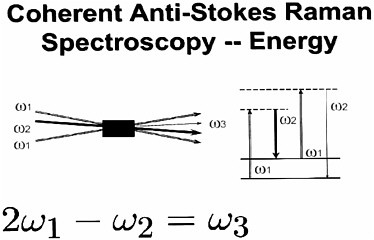
FIGURE 5.9 Two high-intensity exciting laser beams are incident on a sample of explosive molecules (black box). A third laser beam tuned to the difference vibrational frequency of the molecule to be detected results in coherent scattering of a fourth beam.
matched and coherent over relatively large distances of the order of a meter, again a difficult task in the field. One interesting possibility is to use CARS techniques for molecules collected at surfaces. A surface monolayer of molecules can be detected by CARS techniques in the laboratory; it remains to be seen if this can be done in the field.
Other nonlinear optical techniques that could be exploited include optical phase conjugation and excitation of index gratings using crossed laser beams. Optical phase conjugation has the potential to defeat optical distortions caused by a turbulent atmosphere. A nonlinear LIDAR system is certainly an interesting avenue for future research.
Exciting molecules to their excited states dramatically changes their effective index of refraction for reflecting and scattering light. Explosive molecules absorb light predominantly in the UV portion of the spectrum. Each explosive molecule has unique absorption spectra so that excitation techniques have the potential for high selectivity. Molecules that absorb illuminating radiation can be detected by monitoring the luminescence or their refractive properties. Using a new research technique called coherent control could further enhance molecular selectivity.47 Ultra-short la-
ser pulses contain a broad spectrum of light. By manipulating the phase and amplitude of this light over a range of frequencies near an explosive molecule’s absorption band, one can “coherently control” the final state of the molecule. For example, one could choose to selectively ionize or dissociate particular explosive molecules or excite them to specific states to optimize their luminescence. These new ideas from fundamental optics research have to be studied for their applicability to explosives detection.
In summary, nonlinear optical techniques have the potential for increased signal-to-noise ratios relative to linear techniques. Optical phase conjugation should be studied for optimizing the signal returned from LIDAR excitation. Nonlinear spectroscopy and coherent control of the excitation of explosive molecules should be studied for possible applications to explosive detection. The disadvantage of these techniques is that many of them may be limited by the very small concentrations of explosive molecules as well as adverse field environments. The low vapor concentrations associated with most common explosives near room temperature may mean that at least in some cases, LIDAR could best be applied to the detection of explosive particles adsorbed on surfaces, rather than to vapor detection.
Biological
Array biosensors have been developed for simultaneous analysis of multiple molecular samples. A patterned array of different capture antibodies, designed to be highly specific to explosive molecules, can be immobilized on the surface of a planar waveguide, with each different capture antibody at a different site. These capture antibodies remove explosive molecules from a sample. A second, fluorescent “tracer” antibody binds to the captured target, resulting in a fluorescent “sandwich” A diode laser excites the fluorescence, and a charge-coupled device (CCD) camera detects the pattern of fluorescent antigen-antibody complexes on the sensor surface. Flow cells and microfluidic technologies can make the apparatus compact. Computer analysis results in an analysis in several minutes. Since samples of the explosive molecules are required for these techniques, they are not considered to be standoff or remote unless the size and cost are dramatically reduced. They also have the disadvantage of the possibility of interferent signals in field environments.
Enzymes can be used to catalyze the reduction of explosive molecules. These techniques can be sensitive at the parts per trillion level but require concentrators and long analysis times. They can be made highly specific to particular explosive molecules. Research in this area could lead to the type of detection used by animal noses. At present, this is not classified as a standoff or remote technique.
Dogs, rats, and bees can be trained to detect explosive vapors. The committee does not classify these techniques as standoff or remote. An important avenue for future research is the development of robotic “insects” with onboard sensors or samplers. One would hope to develop low-cost, nonintrusive devices that could be controlled remotely in any weather. Surveillance teams circulating in crowded areas such as sporting events could wear similar compact detection devices. It should also be possible to relay the data in primitive form to fixed centers for data analysis using wireless local area networks (LANs).
Recommendation: The committee recommends continued research into biomimetic sensing based on animals, but research should focus on distributed, low-cost sensors.
ORTHOGONAL DETECTOR SCHEMES
It is important to consider using multiple detection technologies in a coordinated detection effort. No one technique appears to solve the explosive detection problem. Two promising directions using “orthogonal” detection techniques are discussed here (i.e., techniques that measure properties of the explosive that are not closely related). Examples of orthogonal measurements include the geometric shape of the explosive device and the composition of the explosive, or an image of the wires and detonator along with a thermal image of the clothing of a suicide bomber.
Hyperspectral Detectors
Imaging is a powerful tool for standoff detection. However, the information presented in the image varies widely with the spectral region imaged. For example, a terahertz or millimeter wavelength microwave image does not clearly show the facial features of the person imaged. Hyperspectral imaging refers to combining the information from widely disparate regions of the spectrum. A thermal IR image could be combined with a terahertz image to yield a much more specific indicator of a potential suicide bomber than either individual image.
Computer analysis of multiple images could yield orders-of-magnitude improvement in imaging detection systems. Computer analysis might alleviate some of the concern for privacy since no one need actually look at the images. Computer analysis also reduces the possibility of human error.
Combining Imaging and Material Composition
Imaging alone does not give a complete identification of explosives. It is clearly a major advantage to combine an image with a measurement of the specific explosive composition. Many composition detection techniques only identify an anomalous nitrogen content, and do not provide conclusive evidence of the presence of an explosive device. A combined image, showing wires or a dielectric shape in the form of an explosive device and an anomalously large nitrogen concentration, would enhance the decision-making task. An example of a portal scenario with combined imaging and nitrogen concentration is a backscatter X-ray image of a truck along with a neutron scattering signal showing anomalously high nitrogen concentrations. Another example is a suicide bomber imaged by a terahertz scan paired with an indication of explosive molecules by a LIDAR signal from the plume of vapors arising from the bomber.
Recommendation: Research is needed on new spectroscopic and imaging methods employable at a distance (passive and active). Examples include terahertz and microwave imaging and spectroscopy and X-ray backscattering.


