
2
Hubble Space Telescope
HUBBLE AS A SYSTEM
Conceptual discussions for a large space-based astronomical telescope date from the 1960s. Initially a 3-meter mirror with a stability of 0.003 arc second was considered. Because of cost and system complexity, the size of the primary mirror was changed in the mid-1970s to 2.4 meters with a stability of 0.007 arc second. Pivotal discussions then began within NASA on flying such a telescope, and an announcement of opportunity for “proposals for scientific investigations and related participation in the Space Telescope” was issued in March 1977. A memorandum of understanding between the European Space Agency (ESA) and NASA was signed in October 1977 for ESA participation in the NASA 2.4 Meter Space Telescope Project.
The design of the space telescope was begun in the late 1970s, with a launch by a space shuttle scheduled for 1983. Around that time, the name of the spacecraft was changed to the Hubble Space Telescope (HST) in honor of the famous astronomer Edwin Hubble. After delays that included those arising from the loss of the space shuttle Challenger in 1986, the telescope was finally launched in 1990. The HST has operated continuously since.
The Hubble telescope system was developed by the Marshall Space Flight Center in conjunction with its system and spacecraft contractor, Lockheed Missiles and Space Company, and optical system contractor Perkin-Elmer (later a part of Hughes Danbury, and now a part of the Goodrich Corporation; see Smith for details on the telescope’s genesis, design, development, and launch;1 see Logsdon2 for reproductions of selected documents related to telescopes in space and the space telescope). Goddard Space Flight Center managed the science and operations development in support of the pro-
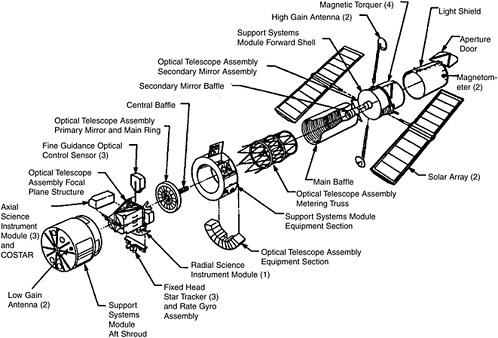
FIGURE 2.1 Exploded view of the Hubble Space Telescope and its major subsystems.
gram. Hubble’s structure and general avionics system are based on those of satellite systems of similar size and complexity that were developed by Lockheed and associated optical contractors in the 1970s and early 1980s. An exploded view of the telescope system is shown in Figure 2.1.
Hubble was designed with an anticipated 15-year lifetime based on the expected integrity of the main mirror. It was believed that over HST’s 15-year life the space environment in low Earth orbit would cause sufficient degradation of the mirror that the telescope’s light-gathering capabilities would be severely damaged by cosmic rays and orbital debris. To date, since the first shuttle servicing mission’s correction for a significant aberration in the mirror, there has been no measurable degradation. The operations of the telescope over the 14 years since launch have provided an extensive database on HST’s performance and failure mode and effects that can be used for engineering purposes to attempt to anticipate the spacecraft’s future performance.
An important feature of Hubble is that it was the first spacecraft to be designed specifically for on-orbit servicing by astronauts. At the same time, however, the telescope’s avionics subsystems, largely included in the Support Systems Module Equipment Section (see Figure 2.1), were not specifically designed to be accessible for servicing. These included such subsystems as the Data Management Unit, the Data Interface Unit, the Power Control Unit, and transponders. Even so, astronauts could change out some of these subsystems during servicing missions.
TABLE 2.1 Hubble Telescope Shuttle Servicing Missions
|
Servicing Mission |
New Instruments Installeda |
Major Repairsa |
Science Impacts |
|
SM-1 Dec. 1993 |
WFPC2, COSTAR RSU (2), ECU (2) |
Mirror aberration corrected; repairs to solar arrays, gyroscopes, GHRS kit, SADE, magnetometer (2), fuses |
Nominal performance achieved |
|
SM-2 Feb. 1997 |
NICMOS, STIS OCEK, ESTR-2 FGS-1R |
RWA-1R, DIU-2R, SADE 2R, MSS covers, MLI patches, SSR |
Capability for infrared imaging, long-slit spectroscopy |
|
SM-3A Dec. 1999 |
FGS-2R+ OCEK, RSU-3 |
Emergency repair of gyroscopes, advanced computer, SSAT-2R, MLI, NOBL |
Capabilities maintained |
|
SM-3B Mar. 2002 |
ACS |
RWA-1R, PCU, NCS, MLI, fuses, rigid solar arrays |
Wide-field visible imaging enabled; infrared imaging restored |
|
aSee Appendix E for definitions of acronyms. |
|||
Most of the astronaut-serviceable subsystems were designed with the intention of change-out on an approximately 3-year cycle. The principal serviceable elements are, by design, located in equipment bays external to the main spacecraft or reachable via compartment doors specifically designed for access by astronauts. Hence, assumptions about the basic reliability of HST’s major systems were predicated on astronaut servicing at regular 3-year intervals. In addition, key engineering subsystems of Hubble were also designed for astronaut servicing intended to maintain the spacecraft’s performance over its design lifetime. Such subsystems include the batteries, the solar arrays, the fine-guidance sensors, the gyroscopes, and the reaction wheels.
A key aspect of astronaut servicing of Hubble is that the capability to upgrade the astronomy science instruments on a regular basis has enabled the astronomy community to respond to new research opportunities and to utilize new technologies over the life of the facility.
After launch it was discovered that the telescope had a major optical flaw that resulted in operation at only 5 to 10 percent of its estimated capacity. In the first Shuttle servicing mission (SM-1), flown in December 1993, this flaw was corrected for by adding new instruments, including the new Wide Field Planetary Camera 2 (WFPC2), and adjustments were made to certain other instruments by adding the Corrective Optics Space Telescope Axial Replacement (COSTAR) module.3 Three additional servicing missions conducted by shuttle astronauts have improved Hubble’s capabilities and enhanced its reliability with no concomitant diminution of its performance. Table 2.1 summarizes the repairs and upgrades performed to date and the science impacts realized as a result of the four servicing missions by shuttle astronauts from December 1993 through March 2002.
TABLE 2.2 Elements of Planned Shuttle Servicing Mission 4 (SM-4) to the Hubble Space Telescope
|
Mission |
Instrumentsa |
Major Repairsa |
Science Impacts |
|
SM-4 |
WFC3, COS |
FGS-2R, 3 RSUs, 3 batteries, OCE, DSC ASCS, NOBL |
Five-year life extension, wide-field IR imaging, enhanced UV imaging, and spectroscopy |
|
aSee Appendix E for definitions of acronyms. |
|||
Several of the activities listed in Table 2.1 were not planned but were instead repairs of opportunity that the on-orbit astronauts could make because of their ability to adapt to unplanned events. These repairs of opportunity are discussed further in Chapters 4 and 6.
Prior to the Columbia shuttle accident a fifth Shuttle servicing mission (SM-4) to Hubble was being actively planned. Long envisioned by NASA, SM-4 had been incorporated into the strategic planning of the nation’s astronomy community. In particular, the most recent decadal survey of astronomy and astrophysics4 assumed (because of NASA’s plans) the existence of SM-4 for space visible and ultraviolet astronomy when the research strategy for the first decade of the 21st century was developed. In addition to needed servicing, replacements, and repairs, two major new instruments were scheduled to be flown on SM-4. These planned elements are listed in Table 2.2.
The planned SM-4 replacements and repairs would add to the science capabilities of HST (see Chapter 3) and ameliorate the overall degradation of Hubble as its subsystems age. Specifically, two new instruments planned for installation, the Wide-field Camera 3 (WFC3) and the Cosmic Origins Spectrograph (COS), both now ready for flight, would add wide-field IR imaging, efficient UV imaging, and UV spectroscopy on Hubble. The batteries would also be replaced, as well as gyroscopes and a fine-guidance sensor. In addition, the aft spacecraft shroud cooling system would be replaced, and a New Outer Layer Blanket (NOBL) and a DSC (data management unit (DMU) to scientific instrument (SI) command and data handling (C&DH) cross-strap) would be installed. The installation of these subsystems would ensure continued telescope integrity and pointing accuracy, among other capabilities.
CURRENT STATUS OF HUBBLE
Following its decision to cancel the SM-4 mission, NASA announced that it plans to continue HST’s operation until the observatory can no longer support scientific investigations, currently anticipated to occur around 2007 to 2008,5 depending on the success of certain planned efforts to preserve battery and gyroscope functions. Meanwhile, NASA is investigating methods of extending HST’s science lifetime, including the use of robotic servicing. If all else fails, NASA’s current plans are to deorbit HST by means of a robotic spacecraft by approximately 2013.
The telescope uses three gyroscopes to provide precision attitude control. There are currently four functional gyros on HST—three in operation plus one spare. As discussed in detail in Chapter 4, it is
|
4 |
National Research Council, 2001, Astronomy and Astrophysics in the New Millennium, National Academy Press, Washington, D.C. |
|
5 |
See Figure 4.3 in Chapter 4. |
likely that the HST system will be reduced to two operating gyros in the latter half of 2006. The HST engineering team is currently working on approaches to sustaining useful astronomical operations with only two gyros, and the team expects to have that capability by the time it becomes necessary. Two-gyro testing is scheduled to begin in March 2005. There are hopes that even a one-gyro operation mode might be feasible for limited telescope operations, but there are no detailed plans for this mode. The spacecraft can be held in a safe configuration with no operating gyros, but science operations would not be possible.
As is also discussed in detail in Chapter 4, battery failures are another likely cause of loss of science operations. HST now has six batteries, of which five are necessary for full operations. If battery levels fall too low, the temperature of structural elements in the Optical Telescope Assembly will fall below permissible levels, causing permanent damage.6 Recovery from this state is not possible.
A recent development is the failure on HST of the Space Telescope Imager and Spectrograph, a powerful ultraviolet/visible imager and spectrograph whose Side B electronics failed in August 2004 (Side A had failed earlier). The cause of the failure appears to be understood, and investigations are underway to understand the feasibility, if any, of a repair.
Details of the current status of the observatory are provided in Chapter 4.


