
3
The Impact of Hubble: Past and Future
OVERVIEW
The Hubble Space Telescope (HST) is arguably the most powerful single optical astronomical facility ever built. Hubble provides wavelength coverage and capabilities that are unmatched by any other optical telescope currently operating or planned, and there is nothing on the horizon to replace it. Hubble is a uniquely successful NASA science program and is a national asset well worth maintaining in operation.
The Hubble telescope provides four key advantages over most other optical astronomical facilities: unprecedented angular resolution over a large field, spectral coverage from the near infrared to the far ultraviolet, an extremely dark sky, and highly stable images that enable precision photometry. Hubble’s imaging fields of view are also considerable, permitting mapping of extended objects and significant regions of sky.
Unlike standard ground-based telescopes,1 whose view is blurred by the atmosphere and wholly impeded in the ultraviolet and large portions of the near infrared, Hubble can see sharply and clearly at all wavelengths from the far ultraviolet to the near infrared (Figure 3.1). Hubble images are 5 to 20 times sharper than those obtained from the ground, in effect bringing the universe that much “closer” (Figure 3.2). Image sharpness and the extremely dark sky help Hubble to see objects 10 times fainter than those that can be observed with even the largest ground-based telescopes. Moreover, Hubble’s images are extremely stable, in contrast to those of standard ground-based telescopes, which are subject to changing atmospheric clarity and turbulence that continually distort the view. Singly, each of these advantages would represent a significant advance for science. Coupled together they have resulted in the most powerful astronomical facility in history. Hubble is a general-purpose national observatory that enables unique contributions to and insights regarding most of the astronomical problems of greatest current interest.
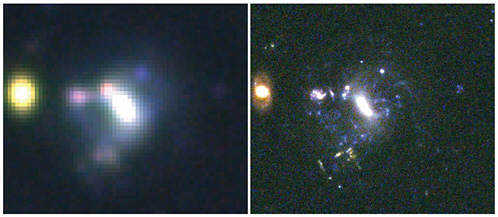
FIGURE 3.1 An example of the Hubble Space Telescope’s superior resolution compared with that of a standard ground-based telescope: (left) a distant, peculiar interacting galaxy imaged with the Subaru telescope on Mauna Kea; (right) the same object imaged with Hubble. Subaru (8 m) telescope image courtesy of National Astronomical Observatory of Japan; Hubble (2.4 m) image courtesy of STScI/NASA.
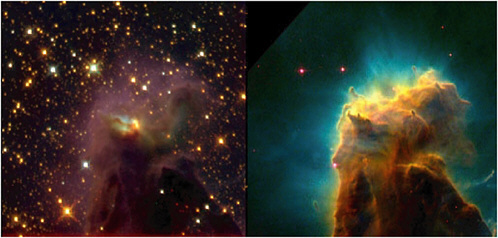
FIGURE 3.2 Two Hubble Space Telescope images illustrate the value of observing at different wavelengths. (left) An image obtained at near-infrared wavelengths, which penetrate the dust, reveals hundreds of stars in the region, as well as a large complex of newly forming stars deep within the dusty column itself. (right) An image obtained at visible wavelengths shows a column of obscuring dust and gas in the famous Eagle nebula (M16). The sculpting away of the dust by an intense rain of radiation from nearby hot stars (off image to top) reveals denser globules of gas inside the column that are seen as protuberances on the surface of the cloud. These protuberances are likely sites of star formation.
Each wavelength imaged by Hubble provides unique information about the sources studied. Images courtesy of STScI/NASA.
TABLE 3.1 Principal Hubble Science Instruments
|
Instrument |
Wavelength Range (micron) |
Pixel Size (arc sec) |
Field of View (arc sec) |
|
Existing: |
|||
|
ACS/Wide field |
0.35–1.05 |
0.045 |
205 × 205 |
|
ACS/High-resolution |
0.20–1.05 |
0.026 |
26 × 26 |
|
NICMOS/NIC1 |
0.8–1.8 |
0.043 |
11 × 11 |
|
NICMOS/NIC2 |
0.8–2.5 |
0.075 |
19 × 19 |
|
NICMOS/NIC3 |
0.8–2.5 |
0.20 |
51 × 51 |
|
WFPC2/Wide field |
0.12–1.05 |
0.1 |
3 × 75 × 75 |
|
WFPC2/Planetary |
0.12–1.05 |
0.046 |
35 × 35 |
|
Planned for SM-4: |
|||
|
WFC3/UV |
|||
|
Visible |
0.20–1.05 |
0.04 |
160 × 160 |
|
Near IR |
0.80–1.70 |
0.13 |
135 × 135 |
|
Cosmic Origin Spectrograph |
0.12–0.32 |
|
|
Of course, Hubble cannot do everything. It is not sensitive to very-high-energy radiation like x rays and gamma rays, or to low-energy radiation in the mid- and far-infrared or radio regions. It cannot collect the sheer quantity of light available to larger ground-based telescopes, a capability that is vital for obtaining high-resolution spectra. To fill these important gaps, Hubble must work synergistically with other telescopes to complete the portraits of celestial objects at all wavelengths.
FINDING: The Hubble Space Telescope is a uniquely powerful observing platform in terms of its high angular optical resolution, broad wavelength coverage from the ultraviolet to the near infrared, low sky background, stable images, exquisite precision in flux determination, and significant field of view.
The Hubble telescope is currently equipped with a selection of cameras operating at different wavelengths, as summarized in Table 3.1. The Space Telescope Imaging Spectrograph (STIS) failed in 2004, but several of its ultraviolet modes would be replaced with the installation of the Cosmic Origins Spectrograph (COS) during a servicing mission. A flexible mix of wavelengths, spectral resolutions, and field-of-view sizes is a key element of Hubble’s power.
OBSERVING WITH HUBBLE
Hubble observing is open to the worldwide astronomical community, and astronomers compete fiercely to win time on the telescope via their scientific proposals. Independent peer review of the proposals is the basis for selection by the Space Telescope Science Institute (STScI), and chosen programs cover the entire range of astrophysics. Requested time typically exceeds that available by a factor of about seven. This rate of oversubscription has remained essentially constant over the lifetime of the telescope and is about twice that of large U.S. ground-based telescopes.
Selection among the wealth of excellent proposed programs is done by panels of astronomers with significant international representation. In the most recent cycle, some 100 scientists participated in the review process. Two hundred proposals were selected, authored by 955 U.S. astronomers and 358 astronomers from 13 other countries. Many of the successful proposers were graduate students and postdoctoral fellows, making Hubble one of the most important astronomical training resources in the world. Roughly 60 percent of the grant funding in a typical proposal cycle (e.g., Cycle 12) goes to postdoctoral associates, fellows, and graduate students.
Observations are scheduled by the STScI based on detailed instructions from the proposers. The data acquired can be held by the investigators for a 12-month period, after which they become publicly available in the HST archive. Hubble has led the way in making astronomical data archives accessible, and the archived data are nearly as popular for analyses as are new data, given that each Hubble observation can be reused many times by new investigators for new projects. The archive currently boasts 1500 registered users and 19 terabytes of data. Its value continues to grow as new data arrive, and its total impact has increased the productivity of the telescope greatly. The data archive will be one of the most enduring elements of the HST’s legacy.
For successful U.S. proposers, an award of Hubble observing time carries with it a monetary grant to support the scientific research. This money pays for the salaries of researchers, stipends for students and postdoctoral fellows, computers, and publication costs. The annual HST grants program in Cycle 13 (the current cycle) is approximately $20 million, an appreciable fraction of the entire budget (approximately $31.5 million) for university grant programs and fellowships in all disciplines and wavelengths in the Astronomical Sciences Division at the National Science Foundation.
SCIENCE HIGHLIGHTS
The Space Telescope Science Institute has studied the scientific impact of Hubble observations using two metrics: the number of citations in the professional astronomical literature and references to Hubble discoveries in the popular media. Table 3.2 lists the top 10 Hubble contributions based on astronomical citations, and the following text expands on 5 representative examples from the list.
Ultradeep Images of the Universe—Galaxies in Formation
Hubble looks so far out into space that it observes objects whose light has taken many billions of years to reach us. Astronomers therefore see these objects as they were at some distant time in the past; in effect, Hubble provides a “time machine” that can show us how the universe evolved. The Hubble Ultradeep Field penetrates back more than 12 billion years to within 1 billion years of the Big Bang (Figure 3.3). Infant galaxies can be seen in the process of forming, harbingers of a great wave of star formation that soon afterward bathed the universe in the light of 10 billion trillion stars, and the major stages in the history of galaxy formation are accessible to direct observation.
Measurement of the Hubble Constant, the Distance Scale of the Universe
Knowledge of the size and age of the universe had long been uncertain by a factor of two, a level of uncertainty that was a major obstacle to the testing of cosmological theories. Hubble measured the apparent brightness of so-called Cepheid variable stars in nearby galaxies and used them to estimate the distances to those galaxies. This approach provided an accurate value for H0, the Hubble constant, thereby calibrating the distance scale and size of the universe.
TABLE 3.2 Top Ten Hubble Contributions
|
Observation or Result |
Significance |
|
Ultradeep images of the distant universe |
Shows the formation of galaxies and confirms that the universe evolves. Tells the story of how our Milky Way was born. |
|
Accurate measurement of the Hubble constant, H0 |
Establishes the size and age of the universe. |
|
Discovery of giant black holes at the centers of galaxies |
Confirms longstanding theory of the “central engines” of quasars. |
|
Confirmation of accelerated expansion of the universe |
Requires the existence of “dark energy.” |
|
Discovery of spectral lines in active galaxies |
Reveals that black holes can trigger massive star formation. |
|
Expansion of the census of the intergalactic medium |
Establishes existence of a web of invisible matter filaments linking galaxies over hundreds of millions of light-years and controlling the matter-energy budget of the universe. |
|
Importance of chemistry of the interstellar medium |
Probes the formation and distribution of the chemical elements and reveals the physical state of the gas in interstellar space. |
|
Identification of gamma-ray bursts with distant galaxies |
Confirms that sources of gamma-ray bursts lie at cosmological distances and that gamma-ray bursts (during their brief flashes) are the brightest objects in the universe. |
|
Resolved images of protoplanetary disks |
Reveals flattened, rotating disks of dust and gas that almost certainly resemble our own solar system in its infancy. |
|
Studies of extrasolar planets |
Offers a sensitive method for finding planets around other stars, based on partial eclipses when a planet passes in front of a distant star. |
Giant Black Holes at the Centers of Galaxies
Hubble’s high angular resolution allows astronomers to peer into the hearts of galaxies to measure the orbital speeds of gas and stars close to their centers. The speeds of stars reach 1000 km/s in many objects, thereby indicating the presence of intense gravitational fields caused by massive black holes of up to a billion solar masses. Though mostly invisible today, these black holes shone brilliantly in the past as quasars, fueled by the infall of then-abundant interstellar gas. Key data found by the Hubble telescope reveal a correlation between black hole mass and galaxy properties that may provide crucial clues to how and why these holes formed.
Accelerated Expansion of the Universe—Dark Energy
Einstein’s theory of general relativity says that gravity should slow the expansion of the universe.
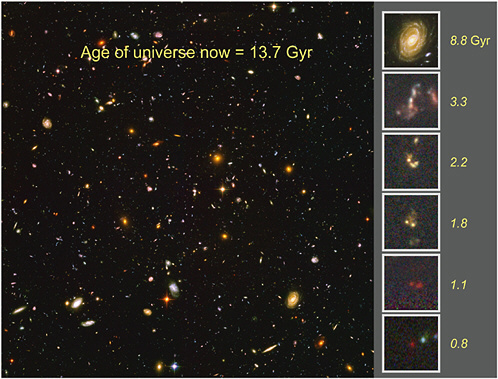
FIGURE 3.3 The Hubble Ultradeep Field, the deepest image of the universe yet taken. Deep images like this one look back in time as well as out in space, revealing the universe as it was billions of years ago. Representative galaxies are shown at the right, along with their ages after the Big Bang (Gyr, 1 billion years). The bottom image in the column is of one of the most distant galaxies yet seen, taking us to within 1 billion years (0.8 Gyr) of the beginning of our universe. Distant galaxies are seen as progressively smaller and dimmer compared with nearby galaxies. Astronomers are using look-back Hubble images like these to chart the course of galaxy evolution. Images courtesy of STScI/NASA.
Hubble data, when coupled with those from other telescopes, show to the contrary that the expansion is accelerating and that galaxies move apart ever faster with time. This observation can be reconciled with general relativity only by invoking a new kind of energy density that remains constant despite the dilution expected from expansion. This so-called dark energy is unlike ordinary matter or energy in that it generates a repulsive gravity that is literally blowing the universe apart. Discovery of this fundamentally new cosmic entity is considered by many physicists to be the most important milestone in physics since the advent of general relativity and quantum mechanics in the early 1900s.
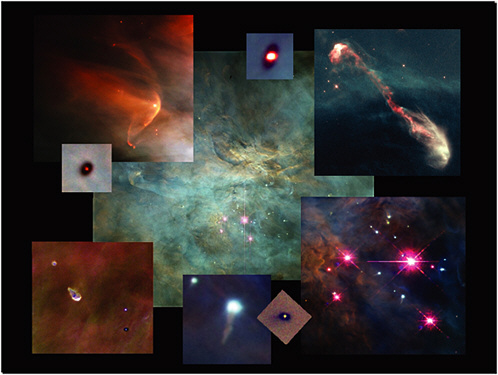
FIGURE 3.4 The Orion nebula, one of the regions of intense star formation nearest to Earth, is a cloud of glowing interstellar gas that has been ionized by the intense ultraviolet radiation coming from five hot, massive stars (the Trapezium) near the center. In this montage of Hubble images, these five very luminous stars can be seen near the center of the main mosaic and in the enlarged image at the bottom left. Energy input from these and other young stars stirs up the gas, giving rise to a network of delicate striations. Despite the chaotic environment, dozens of smaller stars are forming by condensing out of the cloud under their own self-gravity. Some of these stars are surrounded by opaque, dusty disks (“proplyds”) that are forming proto-solar systems much like our own. A few young stars are expelling jets of matter perpendicular to their proto-solar system disks (lower right). Fine details of star birth such as these are visible only at the resolution possible with Hubble. Images courtesy of STScI/NASA.
Protoplanetary Disks—Planetary Systems in Formation
Many luminous nebulas are dense regions of interstellar gas lit up by ultraviolet radiation from newly born massive stars. In the nearest such nebulas in our galaxy, Hubble’s high resolving power has uncovered a cornucopia of proto-solar systems seen as dark, flattened disks silhouetted against the glowing background of nebular gas (Figure 3.4). At the centers of such disks, young suns can be seen in the process of formation. Powerful jets of plasma and magnetic fields are spewed out from some of these disks by a magnetic propulsion mechanism not yet fully understood. The discovery of proto-solar systems and energetic phenomena in nearby glowing nebulas has turned them into gold mines for studying the formation of stars and planets—including, by analogy, that of our own solar system.
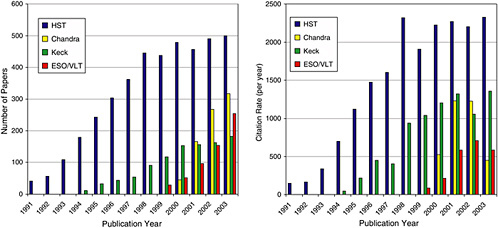
FIGURE 3.5 (left) The number of refereed scientific papers produced annually based on work enabled by major leading telescopes. (right) The number of citations in the scientific literature annually to papers produced from work enabled by major leading telescopes. The criteria used to assign papers to a telescope are parallel for all the telescopes shown here.
HUBBLE IN THE SCIENTIFIC AND POPULAR PRESS
Nearly 5000 scientific papers have been published based on Hubble observations, and the publication rate in refereed journals is currently about 500 per year. Except possibly for the Chandra X-ray Observatory, which rivaled Hubble in terms of papers published in 2003, Hubble outstrips all other telescopes by more than a factor of two in both the quantity of papers published and the rates at which they are cited (Figure 3.5).
The importance of Hubble science is clear to all—one need not be a trained scientist to know that unveiling the birth of stars and galaxies, finding billion-solar-mass black holes, and helping to discover an entirely new form of energy in the cosmos are ground-breaking milestones in the history of science. But progress in fundamental science is not the only way to judge Hubble’s achievements. To the list of science highlights can be added an even longer list of spectacular images that, though not necessarily in the top 10 scientifically, have had extraordinary public impact by virtue of their sheer beauty or arresting novelty (Figure 3.6). Among these one might list the big “black eye” left by comet Shoemaker-Levy’s direct hit on Jupiter, an image that alerted the public to the dangers of asteroids and comets hitting Earth; a panoply of jewel-like planetary nebulas that illustrate the ultimate death of our Sun; portraits of planets in our solar system, including auroras on Jupiter and Saturn; and, of course, the spectacular “pillars of dust” in the Eagle nebula that appeared on nearly every front page in America and became iconic for Hubble itself. Intense public interest in Hubble is borne out by many media studies of its impact; an example of the results of such an assessment is shown in Figure 3.7. Having garnered sustained public attention over its entire lifetime, the Hubble Space Telescope is clearly one of NASA’s most noticed science projects. In effect, Hubble has become a model that shows how NASA can combine its own unique expertise with that of scientists to educate the public about the natural world.
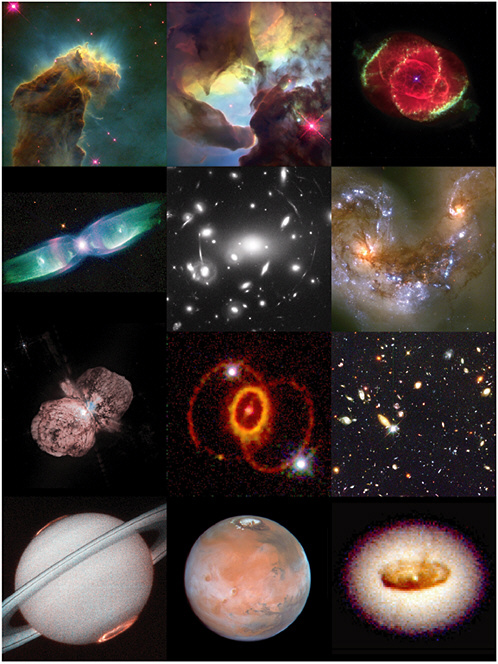
FIGURE 3.6 Montage of famous Hubble Space Telescope images. From upper left: (1) Eagle nebula (M16), (2) Lagoon nebula (M8), (3) Cat’s Eye planetary nebula, (4) M2-9 planetary nebula, (5) gravitational lens arcs in the Abell 2218 galaxy cluster, (6) colliding galaxies NGC 4038-9 (the Antennae), (7) Eta Carina, (8) “light-echo” ring around Supernova 1987a in the Large Magellanic Cloud, (9) the Hubble Deep Field, (10) auroras on Saturn, (11) Mars, and (12) the black-hole galaxy NGC 4261. Images courtesy of STScI/NASA.
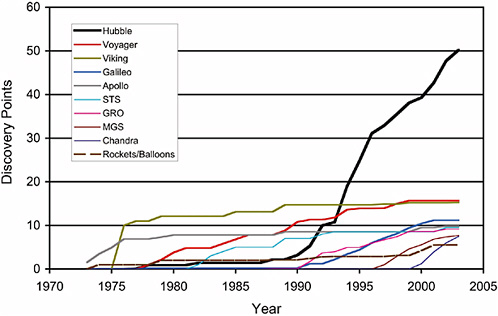
FIGURE 3.7 The cumulative impact of various NASA space science programs as indicated by media coverage. “Discovery points” reflect the number and importance of news stories appearing annually in “Science News.” Courtesy of STScI/NASA.
FINDING: Astronomical discoveries with Hubble from the solar system to the edge of the universe are among the most significant intellectual achievements of the space science program.
SCIENCE IMPACT OF HUBBLE SERVICING MISSIONS
Hubble today is not the same telescope that was launched in 1990. A series of servicing missions, summarized in Table 2.1, has repaired many key components, added new observing modes, and increased existing capabilities, typically by factors of 10 to 100. As a result, Hubble now produces much more data per unit time than it did originally. If the total data rate summed over all instruments can be taken as a rough measure of spacecraft productivity, Figure 3.8 shows how science data volume and thus productivity increased as a result of each of the three servicing missions that added science instruments. The total rate of calibrated data has grown by a factor of 33 since launch. A further increase is expected with the installation of Wide-field Camera 3 (WFC3) and COS, each of which would provide more than a 10-fold improvement in scientific efficiency and sensitivity with respect to previous instruments.
FINDING: The scientific power of Hubble has grown enormously as a result of previous servicing missions.
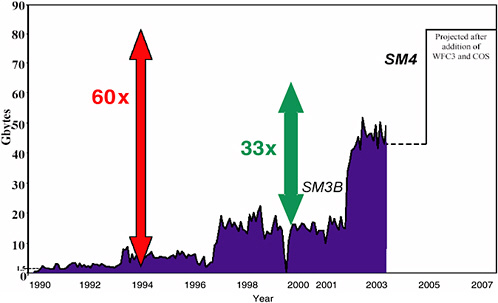
FIGURE 3.8 Growth as a function of time in the volume of data returned by the Hubble Space Telescope, 1990 to 2003, based on the rate of return just after launch. The rate tends to jump after each servicing mission (SM), due mainly to the installation of larger and more efficient detectors. Shown at the right is the volume of data projected as a result of the addition of two new instruments, the Wide-field camera 3 (WFC3) and the Cosmic Origins Spectrograph (COS) in a fifth servicing mission, SM-4.
The efficiency of a science instrument is a measure of the time needed to make a given observation; doubling the efficiency, for example, halves the time. Efficiency on Hubble has risen by orders of magnitude with increases in the size of the detectors and improvements in total optical throughput, and would increase further with the installation of the two new instruments planned for servicing mission 4 (SM-4). WFC3 is an imager with two separate arms operating in the ultraviolet (UV)-visible and the near infrared. With more sensitive detectors and larger fields of view, it affords a gain of 10 in efficiency at 0.17 to 0.30 micron, and a gain of 50 at 0.80 to 1.7 microns. These numbers are huge for astronomy: for example, doubling the diameter of a ground-based telescope gives an efficiency gain of only 4, yet even this much improvement is highly sought after. Science programs that would be able to exploit the gain to be provided by WFC3 are indicated in Figure 3.9.
The second instrument planned for installation by SM-4 is COS. COS is a moderate-resolution ultraviolet spectrograph that achieves large efficiency gains of 10 or more over STIS by virtue of a more sensitive, larger detector, a reduction in background noise, and an improved optical design with much higher throughput. This last feature is possible because COS is optimized for a small but very important group of cosmological problems (see below). Installation of COS is even more important if STIS, the
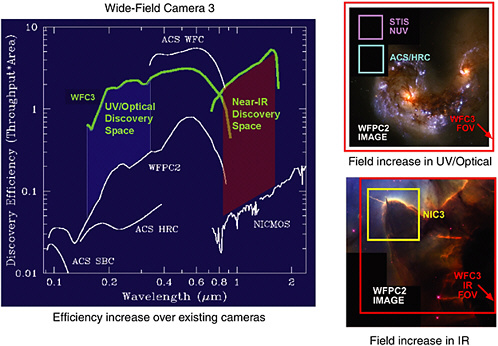
FIGURE 3.9 (left) Anticipated increase in Hubble’s imaging efficiency in the ultraviolet (UV) and near infrared (IR) with the addition of the Wide-field Camera 3 (WFC3). Curves indicate efficiency (explained in the text) for WFC3 versus other cameras on Hubble as a function of wavelength. Note the large gains in the ultraviolet below 0.3 micron and in the near infrared beyond 0.6 micron. (right) Anticipated increase in the field of view within the ultraviolet arm of WFC3 and in the near-infrared arm compared with the field of view of existing cameras on Hubble. Courtesy of STScI/NASA.
other moderate-resolution spectrograph, cannot be repaired—because COS can substitute to some degree for the UV arm of STIS.
FINDING: The growth in the scientific power of Hubble would continue with the installation of the two new instruments, WFC3 and COS, planned for the SM-4 shuttle astronaut mission.
DETERIORATING CAPABILITIES THAT AFFECT HUBBLE’S SCIENCE PERFORMANCE
Several Hubble subsystems have limited life and were to be serviced on SM-4. Chapter 4 presents a comprehensive review of these systems and establishes overall norms for spacecraft performance. This section discusses two of these systems in particular—the gyroscopes and the fine-guidance sensors (FGSs)—because their status bears particularly on the quality of the data that Hubble can return. The status and projected lifetimes of the science instruments are also reviewed.
-
Gyroscopes. Rate-sensing units and their associated electronics (collectively known as “gyros”) are used to slew the telescope and to maintain highly accurate pointing during exposures. Normal observing requires three working gyros. Currently there are three gyros operating, with a fourth working gyro held in reserve. Based on the gyro reliability assessment discussed in “Rate Sensor Unit (Gyroscope) Assessment” in Chapter 4, it is expected that Hubble will enter a two-gyro mode in 2006 (see Chapter 4), and plans are being made to operate the telescope that way. This transition will not greatly affect overall science productivity: increased pointing jitter will smear images somewhat in the highest-resolution modes, but the workhorse, wide-field modes will be affected only slightly. It will be more difficult to schedule observations because a much smaller portion of the sky will be accessible to the telescope at any one time, and a few targets may become totally inaccessible. However, the impact on science of Hubble’s operating in a two-gyro mode is mainly inconvenience rather than loss.
The effects of dropping down to a one-gyro mode are not well understood but could be severe. Given this uncertainty, the committee believes that it is prudent to assume that Hubble’s drop to a onegyro mode will result in a considerable drop in scientific output. This status is likely to occur in mid-2007 (see Chapter 4), providing a natural time frame for any servicing mission.
-
Fine-guidance sensors. Fine-guidance sensors are necessary to maintain accurate pointing during an observation; they line up on bright guide stars near the target. The telescope has three of these sensors, any two of which are normally used for each observation. Three are needed to ensure that at least two can find guide stars at any time. If one FGS fails, two options are available. The first would force the spacecraft to roll at each pointing so that the two remaining FGSs could find guide stars; this option would place restrictions on scheduling and would probably render some astronomy targets permanently unobservable. Nevertheless, Hubble would still be very productive. The second option would be to devise a way to observe some targets with only one FGS; currently this option would cause a degradation of image quality, but workarounds are under study to reduce image smear by using either an idle science detector or a fixed head star tracker as a substitute FGS. These studies have not progressed very far to date, and success is not assured. If two of the three FGSs were to fail, it would be necessary to observe in single-FGS mode all the time, a very risky prospect at the present time.
The conclusion is that it is necessary to maintain a minimum of two out of three FGS units operational through the end of the Hubble mission. Currently, two of the three FGS units have deteriorated, and the time at which they will fail can be estimated. Thus, as discussed in Chapter 4, one FGS unit should be included in a Hubble servicing mission. The shuttle version of SM-4 includes such a unit, but the baseline robotic mission does not.
-
Science instruments and related systems. Information on deteriorating systems that potentially affect science instrument performance is summarized in Table 3.3. As noted, Side B of the STIS electronics failed in August 2004, and its repair is currently under study. The failure of STIS illustrates why redundancy is so important to spacecraft health—at the time of its failure, STIS was one of only two non-redundant science instruments on the telescope, Side A having failed 2 years earlier. STIS’s failure was therefore in some sense foreseeable. The NICMOS cooler is also non-redundant, but the lowest-resolution, workhorse mode of NICMOS (NIC3) would be replaced by the WFC3 IR channel (although the two higher-resolution NICMOS modes would still be used). No other instruments exhibit serious problems or non-redundancies that imperil their functioning through 2011, although radiation damage to the Advanced Camera for Surveys (ACS) and WFPC2 is causing the charge-transfer efficiency of their detectors to decrease and the number of “hot” pixels to increase, leading to uncertainties of a few percent in their photometry by the end of the period. WFPC2 would be removed in SM-4 to make room for WFC3, and so its condition would then become irrelevant, but
TABLE 3.3 Deteriorating Capabilities of Hubble Systems That Affect Scientific Operations
|
System |
Current Status and Planned Fix |
Science Impact |
|
STIS |
Side A electronics failed in 2002; Side B electronics failed in August 2004; feasibility of Side B repair under study. |
With loss of redundancy, Hubble now has no moderate-resolution spectrograph. |
|
Batteries |
Charge capacity is decreasing; SM-4 would replace. |
All science operations will cease when batteries fail. |
|
Gyroscopes |
Reduction to two functioning gyros likely by early 2006, one gyro by mid-2007; new gyros to be installed during SM-4. |
Nominal operations require three gyros. Two-gyro mode will degrade highest-resolution images slightly and reduce target visibility; no proven workaround for one-gyro mode. |
|
Fine-guidance sensors |
Some degradation in two of the three currently available FGSs; one is predicted to fail between 2007 and 2009, leaving two without redundancy. |
Two-FGS mode will reduce target visibility and scheduling efficiency; no proven workaround for one-FGS mode. |
|
ACS |
Charge-transfer efficiency is gradually degrading, and “hot” pixels are increasing; no plan to service during SM-4. |
Degradation significant but not expected to be serious until after 2011. |
|
NICMOS |
Cooling unit is non-redundant mechanically; no plan to service during SM-4. |
NIC3 becomes backup when WFC3 is installed. High-resolution NIC1 and NIC2 modes will be lost if cooler fails. |
|
WFPC2 |
Charge-transfer efficiency is degrading; to be replaced by WFC3 during SM-4. |
Degradation not important if WFPC2 is replaced by WFC3. |
-
ACS, which is a workhorse camera with the largest field of view, would continue to operate. For this reason, early servicing is desirable to minimize the accumulating radiation damage. No servicing of ACS or NICMOS is planned for SM-4.
Two other systems potentially affect the thermal health of HST’s science instruments. These are the Aft Shroud Cooling System and the New Outer Blanket Layer, an outer insulation layer. Both of these are included in the shuttle version of SM-4 but not in the baseline robotic mission. These systems are discussed in Chapter 4, which indicates that they are desirable but not essential for instrument functioning.
To summarize, with the exception of STIS, all important items needed to keep Hubble functioning well through 2011 are included in the shuttle SM-4 servicing plan. Replacement of batteries and gyros and one FGS is deemed essential. Any spacecraft is subject to unanticipated failures, but if the repairs envisioned for SM-4 are carried out promptly, there is every prospect that Hubble can operate effectively for another 4 to 5 years after servicing.
THE PROMISE OF FUTURE DISCOVERIES
What important science programs would be enabled if Hubble’s life were extended? This essential question is examined here, starting with programs that could be done with the existing instruments and proceeding to those depending on the two new instruments, WFC3 and COS. It is important to note that typically only about half of all major discoveries made with new astronomical facilities are foreseen, while the other half are serendipitous. Hubble has been no exception in this regard—only five of the contributions listed in Table 3.2 were anticipated. Space here also permits listing only a small faction of the science projects likely to be undertaken. For both reasons, the following list provides a lower limit to the future discovery potential of Hubble.
One of the most active and exciting frontiers in astronomy in coming decades will be the discovery and study of planets in solar systems beyond our own. Finding planets, especially down to Earth-like size, has become an official goal of NASA. More than 100 extrasolar planetary systems have been discovered (by ground-based telescopes), and they are very different from those in our own solar system. Planets similar in mass to Jupiter have been found, but they are very close to their parent stars and often in highly elliptical orbits—not at all like the giant planets Jupiter, Saturn, Uranus, and Neptune that all orbit far from the Sun in nearly circular orbits. Given an example of exactly one solar system—ours—theorists had invented tidy theories that predicted that its structure was inevitable. The new discoveries have overturned these ideas, and the field of solar-system formation is now in ferment.
A rapidly developing technique for finding planets detects them as they transit across the face of their parent star and block a small part of the light. The great advantage of Hubble for transit photometry is its extraordinary photometric stability, which allows it to detect much smaller decreases in light than can be measured through Earth’s fluctuating atmosphere. This is evident in Figure 3.10, which shows a scatter in the measurements of only 0.02 percent, some 50 times smaller than is possible with typical ground-based photometry. This scatter is only a factor of two larger than the dip caused by Earth as it passes in front of the Sun, as seen by a hypothetical distant observer. HST’s high accuracy is important to this effort in three ways. The first is illustrated in Figure 3.10, where HST actually resolves the time needed for ingress and egress. This is the only known way to measure planet radii. The second is that Hubble can provide rapid confirmation for NASA’s Kepler mission,2 which is planned for launch in late 2007 and is specifically designed to search for transiting extrasolar planets, including Earth-like planets. The Kepler technique will produce many false positives that will have to be screened out by other methods. Kepler can do much of this itself, but the process will take years for Earth-size candidates; high-resolution Hubble photometry could provide much more rapid feedback and possible optimization of further Kepler observations. For maximum benefit, Hubble operations should overlap the Kepler mission from 2008 to beyond 2010. Finally, Hubble can take exceptionally accurate spectra of planetary systems during eclipse, yielding measurements of water and other species in jovian-sized planetary atmospheres.3
Photometry with the James Webb Space Telescope (JWST) will also have higher accuracy than that possible from ground-based telescopes and will also play an important role in planet detection. However, JWST’s system is not as well understood at this time, and its launch is still several years away.
|
2 |
For additional information see http://www.kepler.arc.nasa.gov/. |
|
3 |
David Charbonneau, “Hubble’s View of Transiting Planets,” in From Planets to Cosmology: Essential Science in Hubble’s Final Years, STScI 2004 May Symposium, Space Telescope Science Institute, Baltimore, Md., in press. |
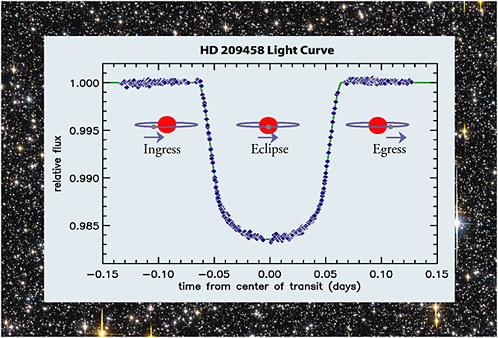
FIGURE 3.10 The presence of an otherwise invisible planet can be detected by the small drop in light caused as the planet travels in front of its parent star. The “light curve” of such a transit is shown here, with the drop in light at slightly more than 1.5 percent, as would occur with a giant Jupiter-like planet passing in front of the Sun. However, the scatter in the Hubble measurements is so small that even smaller planets could be detected. Hubble has begun to monitor rich star fields like that shown in the background, which is a region near the center of the Milky Way Galaxy. In this manner, several hundred thousand stars can be searched for Jupiter-size and smaller planets in roughly 1 week of Hubble Space Telescope observing time. Courtesy of STScI/NASA.
Similarly, most of the stars targeted by the Kepler mission are too faint for effective imaging with ground-based adaptive optics systems. For proven high accuracy and overlap/coordination with the Kepler mission, Hubble is preferred.
Besides detection of extrasolar planets, a great variety of other important work will be able to continue if Hubble remains operational. A large number of new supernovas could be found for the study of dark energy, reducing uncertainties in its properties by a factor of two. A wealth of data would be taken to explore the nature of stars in the Milky Way Galaxy and in neighboring galaxies. Hubble is just beginning to image objects being found by sister NASA missions such as the Chandra X-ray Observatory, GALEX (an ultraviolet imager), and Spitzer (an infrared imager and spectrograph), which are currently in orbit. These satellites are relatively wide-field survey telescopes, one of whose expressed purposes is to detect objects for Hubble follow-up observations. The chance for these follow-ups would be severely limited if Hubble’s life were curtailed, because the areas of the sky surveyed by Hubble for any one observation are much smaller than those observed at other wavelengths, and thus it requires more time to cover a field.
In the closing years of the Hubble telescope’s active life, emphasis is turning toward the gathering of large, homogeneous data sets—including spectral libraries and imaging surveys of large areas within the Milky Way, nearby galaxies, and the distant universe. These data sets, called Treasury Programs, will go into the data archive; they are Hubble’s lay-away plan for the future. These programs are extremely important because there are no plans in the foreseeable future to replace Hubble with a telescope of comparable size and wavelength coverage. The servicing mission SM-4 is needed to allow an orderly completion of this important aspect of Hubble’s mission.
Forefront programs would be enabled by the two new instruments to be installed by SM-4—starting with the near-infrared arm of WFC3. Long-wavelength imaging has been a popular mode on Hubble, but the relatively small field of view of the NICMOS camera has been a serious handicap. Important new vistas would be opened by the near-IR arm of WFC3. A major goal is observing the most distant galaxies, whose light is highly red-shifted by the expansion of the universe. Light from the most distant galaxies detectable by Hubble is red-shifted so much that it is “too red” for ACS, whose sensitivity ends at about 1 micron. Critical spectral features needed to measure age and distance are red-shifted entirely out of ACS’s range. WFC3 will reach these objects and enable Hubble at last to see the full distance to which its mirror is capable of giving access.
The deepest image taken yet with Hubble is its Ultradeep Field, in which a handful of objects have been identified beyond a redshift of 6 (see Figure 3.3). The age of the universe at this redshift is already 1 billion years; WFC3 images of the same field should reach back to redshift 10, nearly twice as close to the Big Bang. This capability is critical because the universe evolved rapidly at these epochs, and even a small increase in look-back time can reveal new phenomena. This is the era of the first galaxies, when stars began shining and black holes began to evolve toward quasars, when the featureless cosmic void began to condense and lay the foundations for planets and life. WFC3 looks through a window that will shed light on our own distant past.
How and when galaxies form stars is another great astronomical mystery. Much of the early star formation seems to have occurred in bursts triggered by collisions of massive galaxies. Such bursts are hidden within dark clouds of gas and dust and cannot be seen at visible wavelengths. WFC3’s near-infrared detector can penetrate the dust to reveal underlying properties of the starburst (see Figure 3.11). In this quest, WFC3 would work synergistically with the Spitzer infrared satellite, which will detect dust-enshrouded starbursts in great numbers but will rely on Hubble for high-resolution follow-up work.
A third important task of WFC3 is to pursue and extend the supernova discovery program. These objects have provided the best evidence that the universe is expanding faster with time, requiring dark energy to drive the acceleration. WFC3 could establish whether the amount of dark energy is evolving with time or has remained constant—potentially an extremely important question for fundamental physics. Even without WFC3, Hubble would make progress by likely discovering some 30 new supernovas in 4 years. WFC3 would increase this detection rate by a factor of 2.5, and should also detect some extremely important supernovas at much larger distances. Such distant supernovas are invisible now but should be detected in significant numbers by WFC3. The result would be much tighter constraints on the properties of dark matter.
Other programs for the WFC3-IR camera include a hunt for water-bearing rocks on Mars and ices on outer satellites in the solar system. In each case, capabilities provided by Hubble will be unique among existing astronomical facilities.
Because Earth’s atmosphere is opaque to wavelengths of less than 0.30 micron, the Hubble telescope offers unique opportunities at ultraviolet wavelengths. This potential has been only partly realized to date, because of the difficulty of making space-qualified ultraviolet detectors. High UV efficiency will be achieved on Hubble for the first time when both WFC3 and COS are installed. WFC3’s short-
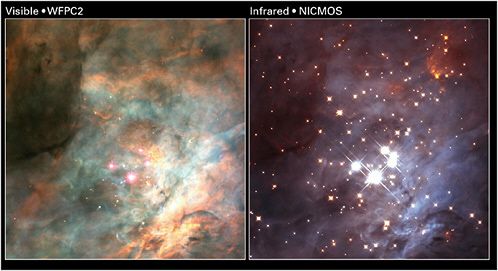
FIGURE 3.11 An illustration of the power of near-infrared light to penetrate dust clouds and reveal embedded, newly formed stars. (left) A Wide-field Planetary Camera 2 (WFPC2) view of the center of the Orion nebula with the five Trapezium stars. (right) The same region imaged in the near infrared with the NICMOS camera, which makes many previously hidden stars visible. This pair of images illustrates why observing at many different wavelengths is required. Wide-field Camera 3 will be 50 times more efficient than NICMOS for this work. Courtesy of STScI/NASA.
wavelength detector would provide sensitive ultraviolet imaging below 0.30 micron. Stellar populations redden as they age, as hot, blue, massive stars die away. Slicing the spectrum into colors thus slices the stellar population into age cohorts, with the youngest, most recently formed stars visible in the ultraviolet. It will be exciting to turn WFC3’s UV capability onto distant galaxies, whose star-formation histories can be captured at previous epochs and merged to synthesize the history of cosmic star formation.
While detecting radiation is usually the goal, sometimes not detecting it is even more important. Imaging at ultraviolet wavelengths can reveal the presence of distant proto-galaxies because light at wavelengths below 0.12 micron is absorbed by intervening clouds of intergalactic hydrogen gas, thereby creating a “hole” in the spectrum where it appears black. In distant objects, this hole is redshifted to longer wavelengths, so that objects disappear or “drop out” in certain colors. WFC3’s greater UV sensitivity will allow it to discover UV dropouts nearly 10 times fainter than those currently known, deepening our knowledge of distant galaxies beyond the brightest ones currently known.
The other gap in instrumentation in the ultraviolet—spectroscopy—will be significantly filled by the Cosmic Origins Spectrograph. COS is an instrument optimized for a number of highly important programs in cosmology. The first of these is study of the “cosmic web” consisting of diffuse matter not yet coalesced into galaxies (Figure 3.12). The cosmic web forms a huge network in space around our galaxy but is largely invisible because no stars or galaxies have yet formed in it. It contains many vital
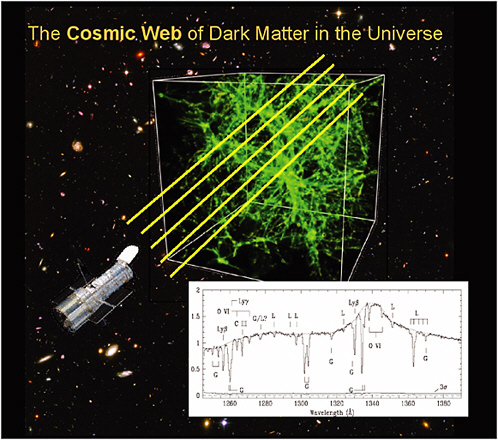
FIGURE 3.12 Theoretical models of galaxy formation predict that the universe is threaded by filaments of matter between the galaxies. It is at the intersection points of this so-called cosmic web that galaxies, and then clusters of galaxies, form. Because it contains only dark matter and gas that has not yet condensed into stars, the web is invisible. However, gas inside it is capable of absorbing light that passes through it on the way to Earth from background objects. Evidence of this absorption can be seen in the spectrum of a background object, which has dips where light is removed by web-gas atoms. A sample spectrum is shown at the lower right. The much higher efficiency of the Cosmic Origins Spectrograph would enable it to take spectra of many more background quasars, creating a dense network of sight lines with which to probe the cosmic web.
clues to cosmogenesis. The density and geometry of the web reflect the original density ripples in the universe that gave rise to all the structure seen today. Galaxies form at “nodes” in the web, where filaments intersect and grow via the pull of gravity, which drags matter along web-lines into the nodes. How and when does this happen, and how do galaxies “turn on”? If it were visible to the eye, the web would reveal the distribution of matter that has not yet fallen into galaxies—which is most of the matter in the universe! The web is thus the dominant player in the cosmic-matter energy budget.
With COS it would be possible to study the cosmic web in detail for the first time. Though not radiating much by itself, the web absorbs light from bright, background sources such as quasars, leaving
dips at particular wavelengths in the spectrum. Each quasar line-of-sight is thus a “core-drilling” through space that reveals pieces of the cosmic web. The big advantage of COS is higher sensitivity, some 10 to 30 times that of STIS. As a consequence, many more faint quasars can be studied, making a much denser pattern of core-drillings through space. The dense coverage should reveal the geometry of the web and its evolution with time.
The total observing program of COS would be rich because the same spectral features that delineate the web are also found in interstellar gas and in stellar atmospheres. The tracer elements involved include nitrogen, silicon, aluminum, oxygen, carbon, and iron—elements basic to the formation of Earth and life. COS spectra can be used to explore the chemical evolution of galaxies and the intergalactic medium via nucleosynthesis of these elements. Velocities of gas clouds can be measured to show how hot stars and quasars feed back their energy into surrounding gas, driving massive “winds” from galaxies. These UV spectral features are also important for studying the chemistry and physics of planetary atmospheres in the solar system. In total, the large efficiency gains enabled by COS would open for the first time a wide window for UV spectroscopy.
Of the two instruments slated for SM-4, WFC3 is the more powerful because of its wide wavelength range and its sensitivity in the near infrared, which is particularly important for studying the highly redshifted distant universe. WFC3 is thus essential for any servicing mission, and the installation of COS is highly desirable.
FINDING: A minimum scientifically acceptable servicing mission would install batteries, gyroscopes, WFC3, and one FGS. The installation of COS is highly desirable.
FUTURE SCIENCE POTENTIAL RELATIVE TO PAST ACHIEVEMENTS
Hubble’s oversubscription by a factor of about 7 indicates that scientific productivity with the present instruments is already high; the new instruments WFC3 and COS would extend the power of the observatory significantly further. In an attempt to quantify this statement, selected objectives from the above list of future science programs have been identified that, in the opinion of the committee, are comparable in importance to the top 10 Hubble contributions listed in Table 3.2. The result is five objectives listed in Table 3.4. Allowing for the overwhelming likelihood of important unforeseen discoveries in addition to those listed in Table 3.4, the committee concludes that the promise for future Hubble discoveries following a servicing mission is comparable to the telescope’s promise when first launched. The programs listed in Table 3.4 are also very well aligned with the list of key problems highlighted by the most recent decadal survey report for astronomy and astrophysics, Astronomy and Astrophysics in the New Millennium.4
COMPARISON OF HUBBLE WITH OTHER PLANNED FACILITIES
The unique advantage of HST with respect to other astronomical tools is its exquisite angular resolution extending from the ultraviolet to the near infrared. Observations in the ultraviolet and part of the near IR (IR) are impossible from the ground at any resolution. Even at wavelengths accessible from the ground, HST still has a big advantage for imaging and low-resolution spectroscopy because of its
TABLE 3.4 Foreseeable Major Contributions Made Possible with Hubble
|
Likely Discovery |
Hubble Instrument |
Importance |
|
Large number of extrasolar planets |
ACS |
Possibly detecting Earth-like planets and measuring their radii. |
|
The first galaxies |
WFC3 |
Obtaining key data concerning formation of the first stars and black holes. |
|
Evolution of dark energy |
WFC3, ACS |
Understanding the fundamental nature of dark energy. |
|
The cosmic web |
COS |
Mapping the total distribution of matter in the universe. |
|
The effects of quasars and stars on galaxies growth. |
COS |
Understanding how galaxies limit their own |
high spatial resolution and dark sky, which more than compensate for its relatively modest mirror size. In contrast, high-resolution spectroscopy requires a lot of light, so that large-aperture ground-based telescopes are often better, but only if the wavelength is visible from the ground and high spatial resolution is not needed. If either of these conditions is not met, multiple-orbit exposures with Hubble can be successful—indeed have been, for example, in the discovery of black holes at galactic centers.
It has been suggested that a new technique, called adaptive optics (AO), may enable ground-based telescopes to achieve and even surpass Hubble’s resolution, at lower cost. The AO method corrects for atmospheric blurring by constantly monitoring the bending of light rays by the atmosphere over the telescope. This information is transmitted several hundreds of times a second to a flexible mirror whose surface is deformed in order to “re-aim” the rays to their original trajectories, restoring above-atmosphere image sharpness. AO is quite new and is still in the development phase. The technique works well in the near IR (around 2 microns), where ground-based telescopes with AO can actually take sharper images than Hubble does. However, it becomes much more difficult at shorter wavelengths in proportion to the inverse fifth power of the wavelength. Thus, an AO system working at 0.5 micron would be approximately 1000 times more difficult to achieve (and perhaps approximately 1000 times more costly) than a 2-micron system; an AO system in the ultraviolet is out of the question. AO systems also have inherently narrow fields of view compared with those of Hubble; these fields of view can be enlarged, but not without considerable further work and cost. AO images are inherently much less stable than Hubble images because the atmosphere and the quality of the correction are constantly fluctuating. AO therefore does not lend itself to the precision measurements that Hubble makes routinely. Finally, even if ground-based AO telescopes can sometimes approach Hubble in image quality at long wavelengths and over small fields of view, Hubble still has a big edge in sensitivity beyond 0.8 micron because of its much darker sky.
To summarize, adaptive optics is currently useful for certain kinds of measurements in small fields of view at wavelengths beyond 1.6 microns. Field size and the quality of atmospheric correction will improve in coming years, but Hubble will still be superior for nearly all applications through its planned lifetime, even in the near IR. With time, ground-based telescopes will become more competitive,
starting with imaging at longer wavelengths and with spectroscopy (which benefits from the light-gathering capacities of large mirrors). However, for all work requiring high spatial resolution, wavelengths below 1 micron will remain the province of space telescopes for the foreseeable future. To equip a 3-meter ground-based telescope today with a system approaching Hubble’s image quality at 0.8 micron is technically exceedingly difficult, and such a system would be much less stable than Hubble; such a system operating at 0.5 micron is not feasible at present. Thus, Hubble will remain the instrument of choice for virtually all high-resolution observations over its wavelength range during its entire lifetime.
FINDING: Ground-based adaptive optics systems will not achieve Hubble’s high degree of image stability or angular resolution at visible wavelengths for the foreseeable future.
The satellites GALEX and FUSE have UV capabilities that are different from those of Hubble and therefore are in no sense a replacement for it. GALEX makes low-resolution images but covers a much wider field of view; its main role relative to Hubble is to find interesting objects for detailed Hubble follow-up. FUSE observes in the far UV at wavelengths beyond Hubble’s limit. The missions of GALEX and FUSE are relatively short, with GALEX likely ceasing operation in early 2007 and FUSE in 2010. For efficient follow-up of GALEX discoveries, it is desirable that Hubble operate for 3 years beyond GALEX, implying a mission lifetime out to 2010.
New facilities under construction or consideration that relate to Hubble’s capabilities include the James Webb Space Telescope. JWST will operate mostly at longer wavelengths than Hubble, out to 27 microns, but the two overlap between 0.6 and 2.5 microns; JWST does not operate in the short-wavelength visible or ultraviolet. The launch date of JWST is currently slated for 2011 but could slip to 2013, given the history of missions of comparable difficulty. With image quality comparable to or better than Hubble’s beyond 1 micron and a mirror diameter 2.5 times larger, a successful JWST will super-sede Hubble in the infrared. Nevertheless there are three important reasons for maintaining Hubble in operation through at least 2010: to reduce the gap in time between Hubble and JWST during which there is no high-resolution space imaging; to permit Hubble to carry out observations shortward of 0.6 micron where JWST cannot reach; and to protect against schedule slips and/or failure in the JWST mission, which is planned for a distant orbit and without any options for repair.
SNAP (a possible joint Dark Energy Mission concept) was envisioned as a project of NASA and the Department of Energy. Plans called for a 2-meter mirror with a wide field of view (0.34 deg2); it would provide somewhat poorer quality images than Hubble. Its stated goal is to find and study distant, highly red-shifted supernovas for the study of dark energy. Its wide-field optical and near-IR imaging could make it attractive for many other programs, as well. However, it is not yet an approved project, and a start for SNAP is not foreseen until 2015-2016. Moreover SNAP would not serve as a substitute for Hubble because its pixels would be twice the size of Hubble’s, it would have no capability for high-resolution spectroscopy, and it would not operate in the UV. Even if SNAP is completed on an optimistic schedule, Hubble will be able to return a wealth of information about distant supernovas before SNAP is operational. Indeed, the design of SNAP may benefit significantly from these yet-to-be-made Hubble observations.
To summarize, no telescope currently operating or planned covers the wide range of wavelengths and capabilities offered by Hubble, especially in the ultraviolet. JWST offers exciting capabilities in the near infrared, but JWST has significant development risk and no plans for on-orbit repair. The committee believes that it makes sense to exploit Hubble’s proven capabilities for a further 4 to 5 years with one more servicing mission.
COORDINATION WITH OTHER FACILITIES
The last several decades have seen an increasing emphasis on multi-wavelength astronomy, in which a panoply of telescopes operating from gamma-ray to radio wavelengths is brought to bear on an object to paint its total “cosmic portrait.” For example, x-ray regions are uniquely able to show hot gas, active black holes, and gas ejected in explosions of supernovas; the UV through the near IR is the realm of stars, from hot to cool; the deep infrared reveals young stars forming within dark dust clouds; and the radio region shows hydrogen gas and energetic plasma ejected from black holes. Each wavelength has its own story to tell.
Among the best examples of synergistic cooperation between different telescopes are recent results using the Chandra, HST, Very Large Telescope (VLT), Keck, and Spitzer telescopes. The Chandra X-ray Observatory has obtained some of the most sensitive x-ray observations ever made of distant galaxies, in both the Northern and Southern hemispheres. Ground-based telescopes (Keck and VLT) have obtained spectra for redshifts and distances; Hubble has surveyed both fields and provided much-needed high-resolution imaging. The combined result is the detection of hundreds of active galaxies containing super-massive black holes, the integrated flux of which is now known to make up the x-ray background. In fields where Keck, VLT, and Hubble could not identify a candidate object, the infrared capabilities of Spitzer were able to identify a quasar of very unusual characteristics. These projects are revolutionizing our understanding of the epoch of galaxy and black hole formation and evolution.
It is important that such measurements be carried out almost simultaneously, because high-energy phenomena are highly time variable and archival information is not relevant. Most of the x-ray emitters in Chandra deep-field pictures are variable on time scales from days to years. Gamma-ray bursts have even shorter time scales, seconds to days. Much will therefore be lost if the Hubble telescope is not available over the working lifetime of Chandra. Successors to these facilities may not be flown for two decades or more. This possibility argues for continuing the Hubble mission at least through the lifetime of Chandra (5 years from now), and also for servicing early, to maximize the period of simultaneous operations.
Furthermore, the continuation of Hubble surveys, even with the current complement of instruments, is essential to match the requirement of multi-wavelength surveys. Many of the instruments in the x-ray, UV, and infrared regions have wider fields of view than Hubble. This means that Hubble has to create a mosaic from many exposures to cover the same fields of view as, say, Chandra. Additional time is therefore needed to observe these fields with Hubble and thus ensure a much richer sample of cosmic objects to study.
THE TIMING OF A SERVICING MISSION
A number of strategic considerations indicate that any servicing mission should be flown as early as reasonably possible. Several such considerations are presented above in this chapter, and more are discussed in Chapter 4. They are collected here for convenience.
First, the detector in the workhorse ACS camera is steadily accumulating radiation damage, with significantly degraded performance expected around 2010. Second, gyroscope failure is expected to place the Hubble telescope in a one-gyro mode near fall 2007 (see Chapter 4), at which point efficient science operations cannot be guaranteed at present. An interruption in operation will ensue, with the telescope sitting idle on orbit waiting for repair. Such a gap interrupts the normal flow of planning, observation, and analysis, and valuable overlap time with SIRTF and Chandra would also be reduced. Third, battery failure is the one event that can irreparably damage the telescope structure by allowing it
to get too cold. Batteries are not predicted to fail until mid 2011 (Chapter 4), but the battery model involves considerable uncertainty, and Hubble’s batteries could fail sooner. Fourth, the failure model for Hubble’s avionics (Chapter 4) predicts an increasing number of component failures with time. A robotic servicing mission lacks the flexibility to deal with these. A shuttle mission has the required flexibility but might not have the capacity to deal with the added number of problems that a servicing delay might give rise to. Finally, it is a fact that all predictions for spacecraft longevity are just that, predictions. Components might start degrading sooner than expected, or the telescope could be hit by space debris, or some other unexpected event might occur. For all these reasons, it is prudent to get the maximum science out of the telescope in the shortest time possible, which points to servicing as soon as can reasonably be managed.
FINDING: Servicing Hubble expeditiously is highly desirable.
REHOSTING
A number of studies are underway to examine the possibility of rehosting WFC3 and/or COS on a new spacecraft(s). The alternatives being studied range from a full Hubble replacement, including a lighter mirror but with the same aperture and diffraction-limited performance in the UV and optical domain, to a smaller single-purpose spacecraft to carry one or the other of these two instruments. There was not time to explore the various possible options thoroughly, and most of them are still undefined in any case. The conclusions here are therefore very general.
It is possible that these studies, when completed, may result in a mission design that essentially replaces Hubble with a new spacecraft and a new mirror of equal performance to be launched as a replacement. The committee notes, however, that this approach would require a mirror that is at least 2.4 meters in diameter with diffraction-limited performance down to the ultraviolet, along with a very accurate pointing and guiding system consistent with HST’s capabilities. If all this could be done at a cost competitive with that of a servicing mission, still taking into account provisions for Hubble reentry, it would be scientifically attractive. However, preliminary cost information provided to the committee suggested that the savings would not be large.
Moreover, all options for rehosting take time to evaluate, select, and develop, and all options carry the risk that a new spacecraft may ultimately fail to operate to specifications. By contrast, Hubble is a proven platform on orbit now, to which several successful servicing missions have already been sent.


