
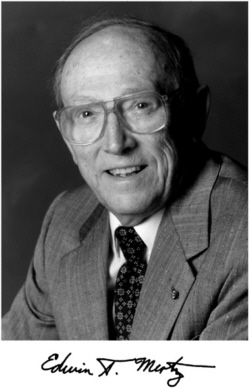
EDWIN THEODORE MERTZ
December 6, 1909–February 1, 1999
BY JOHN E. HALVER
ED MERTZ WAS A professor emeritus in biochemistry at Purdue University and a member of Section 61 (Animal, Nutritional, and Applied Microbial Sciences) of the National Academy of Sciences. He is best remembered for codiscovering high-lysine corn, which dramatically increased available protein levels in the typical Central American corn and beans diet. He also developed the test for phenylketoneuria in newborn humans. He also coproduced a method to quickly and simply isolate pure native plasminogen from the plasma of practically any species. This is used to dissolve blood clots.
He was born on December 6, 1909, in Missoula, Montana, the son of a Lutheran minister, who was also a school-teacher. His grandfather and an uncle were also Lutheran ministers. Both of Ed’s parents were of German descent and spoke both German and English fluently. They were determined to stay in a university town so that their five children (Richard, Edwin, Art, Hildy, and Ethyl) could obtain an advanced education. Music was also important to them, and all five children were given piano lessons. Ed had piano lessons from ages 8 to 18 and excelled musically. The family had limited financial resources, as was typical of many families
during the Depression. Ed had a paper route during grade school. During high school he became interested in chemistry. He was also the accompanist for the boy’s glee club and took part in piano competitions. After high school graduation he attended the University of Montana. He paid his way through college and helped his parents financially by playing piano in a college dance orchestra. Sometimes the band would go out into the mountains, where a dance floor had been set up and a crowd was gathering. They would play until about one in the morning, and during intermission they would be served a delicious supper by ladies in the gathering. Then Ed would tape all his fingers, which were becoming sore. After supper the band would play until dawn and then head back to town with pockets full of silver dollars. His determination to succeed was coupled with a positive and happy attitude.
Mertz received his B.A. with a double major in chemistry and mathematics at the University of Montana in 1931; an M.Sc. at the University of Illinois at Urbana in 1933; and a Ph.D. at the University of Illinois in 1935. He was a research biochemist at Armour and Company in Chicago from 1935 to 1937. In 1937 he met and married Mary Ellen Ruskamp, with whom he spent 45 years. They had two children: Edwin T., Jr., and Martha Ellen (Marty). Ed was a devoted family man who is remembered as being gentle and full of fun.
He was an instructor in biochemistry at the University of Illinois in 1937-1938, working on the isolation of amino acids from animal sources, and a research associate in pathology at the University of Iowa medical school from 1938 to 1940, working on blood-clotting proteins under H. P. Smith. His first contribution to science came in 1939 with the development of a special buffer system, the imidazole system, for blood-clotting studies. This system soon became
universally adopted by coagulationists and has been used extensively. He became an instructor in agricultural chemistry at the University of Missouri from 1940 to 1943. Too short for military duty during World War II, being about 5 feet and 4 inches tall, Ed worked as a research chemist in an explosives manufacturing factory, Hercules Powder Company in Wilmington, Delaware, from 1943 to 1946. This was dangerous work, as was demonstrated by the accidental explosive destruction of his research laboratory while working with Hercules Powder.
In 1946 he and his young family moved to West Lafayette, Indiana, where he became an assistant professor of agricultural chemistry at Purdue University (1946-1950), an associate professor of biochemistry (1950-1957), a professor of biochemistry from 1957, and then professor emeritus until 1999. For approximately 18 years he served as a consultant to the three Indiana state hospitals for the mentally retarded and helped staff biochemical research facilities in each hospital. He served on the U.S. Malnutrition Panels (1970-1973) and as a member of the Special Studies Section on Malnutrition of the National Institute of Allergy and Infectious Diseases.
His many honors included the Richard Newbury McCoy Award in 1967 from Purdue University; the John Scott Award in 1967 from the city of Philadelphia; the Hoblitzelle National Award in the Agricultural Sciences (Texas) in 1968; the Congressional Medal of the Federal Land Banks in 1968 for the discovery of high-lysine corn; the Kenneth A. Spencer award in 1970 from the Kansas section of the American Chemical Society for meritorious contributions to agricultural and food chemistry; the Osborne-Mendell Award in 1972 from the American Institute of Nutrition for outstanding basic research accomplishments in the science of nutrition; the Distinguished Service Award from the University
of Montana in 1973; the Edward W. Browning Award in 1974 for outstanding contributions to mankind in the improvement of the food supply; and the Honorary Master Farmer Award of the Prairie Farmer Magazine for leadership and distinguished service to American Agriculture in 1975. He was elected to the National Academy of Sciences in 1975.
Mertz’s diverse interests included amino acid requirements of humans, domestic animals, and fish; blood-clotting factors; and the biochemistry of mental retardation—all documented in his published research. This interest in amino acid requirements of human and monogastric animals led to an examination of the proteins of maize. Working with Nelson in the Agronomy Department at Purdue, he led ultimately to the identification of two maize mutants (opaque-2 and floury-2) that had altered amino acid compositions of the coleorhiza seed proteins, specifically in higher contents of lysine and tryptophan. These limiting essential amino acids in maize for monogastric animals are doubled in the endosperm proteins of these two maizes. He and collaborators showed that this alteration had its basis in an expression in the amount of lysine and tryptophan, a low prolamine fraction, and compensatory over-synthesis of other proteins usually synthesized in smaller amounts. The greater content of lysine and tryptophan in the mutant seeds supports the growth of young monogastric animals at rates much superior to those achieved on normal maize when no other source of protein is present in the diets. These mutant strains of maize are increasingly used in Brazil, Colombia, and Central America to provide better protein sources for low-income populations.
[F]eeding tests with undernourished children showed that opaque-2-maize could furnish protein of a quality equal in performance to that in milk at
one fifth the cost per pound of protein. The slight reduction in yield (10%) due to the opaque-2 gene is thus of little importance when compared with the large increase in the protein quality conferred on maize by this mutant gene. (World Review of Nutrition and Dietetics 48[1986]:222-262)
Dr. Mertz regarded this as one of the most important discoveries of his career.
He worked with William C. Rose at the University of Illinois on amino acid requirements of the rat, and later on phenylketonuria and brain development at the University of Iowa Medical School. His group perfected the strip test assay of ovarian fluid (now used nationally and internationally to detect phenylketonuria in the newborn human), which allows use of low-phenylalanine diets to prevent brain damage in these infants.
Ed improved Dunn’s methods for L-amino acid assays of proteins from human and animal tissue and agricultural seeds and products. Later assays were incorporated into standard techniques in Moore-Stein amino acid analytical procedures.
He was the coordinator for amino acid requirement studies of the elderly and for the assay of amino acid losses involved. He established the reference standards for amino acid assay techniques for the “Big 10” Midwestern universities involved in the cooperative project. His graduate students monitored variance in assay techniques of the different laboratories on reference standards distributed periodically to the other universities, and these data established quality assurance for assays between laboratories.
Mertz was the author of a textbook on biochemistry and published over 100 scientific papers. Research in his lab was concentrated on high-lysine corn, high-lysine sorghum, development of high-lysine varieties of other cereal grains, and on the clot-dissolving enzyme fibrinolysin.
He liked to fish as a boy in Montana, and as an adult he
would fish whenever time and location allowed. He often went with the crew during amino acid and tissue collecting at sea on the West Coast during the period he was conducting research in salmon with his graduate students who had been shipped to the Western Fish Nutrition Laboratory (Cook, Washington) for thesis research projects. One day on the Columbia River he caught a sturgeon as long as he was tall. He decided to ship it to his colleagues at Purdue University, to undermine the good-natured bragging of their angling stories. The sturgeon was shipped by rail and was iced several times during the trip. When Professor Roy Whistler opened the box at Purdue, the sturgeon when touched flipped his tail at Roy, and henceforth stymied further Whistler fish stories. Ed, though diminutive in physical stature, could hold his own in the fields of either sports or science.
In addition to his scientific interests, Ed was a classical pianist who relished Chopin and Beethoven. He began classical piano lessons at age eight. He was very talented and rapidly progressed until he could travel with his minister father on circuits to smaller churches, where he played the piano. He played all his life, teaching himself to improvise, and ultimately became a fan of Dixieland jazz.
He wrote a book Harmony for Fun for the piano. As soon as he arrived at Purdue he joined a jazz orchestra, named the Crusty Crumbs, made up of professors at Purdue University. They played for many years at civic and social functions, and after retirement he played Sunday dinner music at the Holiday Inn and at other restaurants for many years. His last gig was Mary Ellen’s Tea Room in Dallas, Texas. His repertoire ranged from the classics to Joplin, and he really had fun playing for the crowd.
At Purdue, Ed made many friends with his peers in education. He was known as a gentleman and a good scientist. He loved people and was accepting of others. His daugh-
ter remembers that he never raised his voice to anyone, and had no false pride or vanity. He was quick to see humor, and he had a love of life, optimism, and a faith in the orderliness and logic of the Universe. He had many charities that were his special concern and was committed to training Ph.D. genetic nutritionists worldwide. One of his Ph.D. students, Ricardo Bressani, remembers Mertz as affable, understanding, and with a clear and intelligent vision and approach to research. Mertz treated his students with respect and understanding and helped them overcome the problems and difficulties most graduate students have. He began professor-student relationships on a strictly academic level, and over time through mutual research interests developed friendships. He provided advice, support, and encouragement when needed, even after the students had graduated from Purdue. He kept contact with many of his former Ph.D. students and visited some in their home countries.
His pursuits were his work, his family, and his music. He made sure to spend time in each of those areas, including extended family. Fond memories abound of him teaching his step-granddaughter to titrate in the kitchen when she did a science fair project on the nutritional value of carrots. During his later years Mertz spent summers with his son in Montana and winters with his daughter in Texas.
He died on February 1, 1999, from complications of pneumonia while visiting his daughter, Marty, in Richardson, Texas. Mertz was preceded in death by his first wife (of 45 years), Mary Ellen Ruskamp, and his second wife, Virginia Thomas Henry. His son, Edwin (“Ted”) Jr., passed away in December 2002. Mertz is survived by his daughter, Martha Ellen West, and numerous relatives.
SELECTED BIBLIOGRAPHY
1939 With W. H. Seegers and H. P. Smith. Prothrombin, thromboplastin, and thrombin: Quantitative interrelationships. Proc. Soc. Exp. Biol. Med. 42:604-609.
1948 With W. M. Beeson and D. C. Shelton. The amino acid requirements of swine. I. Tryptophan. Science 107:599-600.
1950 With R. H. Waltz, Jr., D. C. Shelton, L. P. Doyle, and A. L. Delez. Effect of different levels of hexahomoserine on growth and hematopoiesis in rats. Proc. Soc. Exp. Biol. Med. 73:75-77.
1951 With D. C. Shelton and W. M. Beeson. The effect of methionine and cystine on the growth of weanling pigs. J. Anim. Sci. 10:57-64.
1952 With W. M. Beeson and H. D. Jackson. Classification of essential amino acids for the weanling pig. Arch. Biochem. Biophys. 38:121-128.
With J. W. West, C. W. Carrick, and S. M. Hauge. The tryptophan requirements of young chickens as influenced by niacin. Poult. Sci. 31:479-487.
1953 With S. M. Beeson and H. D. Jackson. Quantitative threonine requirement of the weanling pig. J. Anim. Sci. 12:870-875.
1954 With H. D. Jackson. Activation of bovine plasminogen by trypsin. Proc. Soc. Exp. Biol. Med. 86:827-831.
1957 With J. E. Halver and D. C. DeLong. Nutrition of salmonoid fishes. V. Classification of essential amino acids for Chinook salmon. J. Nutr. 63:95-105.
With B. A. Krautman, S. M. Hauge, and C. W. Carrick. The arginine level for chicks as influenced by ingredients. Poult. Sci. 36:935-939.
1958 With H. Meyer, H. E. Stadler, H. Leland, and J. Calandro. Psychometabolic changes in phenylketonuria treated with low-phenylalanine diet. Arch. Int. Med. 101:1094-1105.
With B. A. Krautman, S. M. Hauge, and C. W. Carrick. Sources of the factor which lowers the arginine level in a casein diet. Poult. Sci. 37:530-534.
With R. Bressani. Relationship of protein level to the minimum lysine requirement of the rat. J. Nutr. 65:481-492.
With D. C. DeLong and J. E. Halver. Nutrition of salmonoid fishes. VI. Protein requirement of Chinook salmon at two water temperatures. J. Nutr. 65:589-599.
1959 Recent research on human protein requirements and the amino acid supplementation of foods. Proceedings of the 115th Research Conference of the American Meat Institute Foundation (Mar. 26). Chicago: American Meat Institute Foundation.
1960 With H. E. Clark, S. P. Yang, and W. Walton. Amino acid requirements of men and women. II Relation of lysine requirement to sex, body size, basal caloric expenditure and creatinine excretion. J. Nutr. 71:229-234.
1962 With W. J. Culley, M. W. Luce, J. M. Calandro, and D. H. Jolly. Paper chromatographic estimation of phenylalanine and tyrosine using finger tip blood. Its application to phenylketonuria. Clin. Chem. 8:266-269.
With D. C. DeLong and J. E. Halver. Nutrition of salmonoid fishes. X. Quantitative threonine requirements of Chinook salmon at two water temperatures. J. Nutr. 76:174-178.
1963 With J. Y. S. Chan. Studies on plasminogen. III. Purification of bovine and human plasminogen by continuous electrophoresis. Canad. J. Biochem. Physiol. 41:1811-1819.
With H. E. Clark, N. J. Yess, E. J. Vermillion, and A. F. Goodwin. Effect of certain factors on nitrogen retention and lysine requirements of adult human subjects. III. Source of supplementary nitrogen. J. Nutr. 79:131-139.
1964 With L. S. Bates and O. E. Nelson. Mutant gene that changes protein composition and increases lysine content of maize endosperm. Science 145:279-280.
1965 With O. E. Nelson and L. S. Bates. Second mutant gene affecting the amino-acid pattern of maize endosperm proteins. Science 150:1469.
1970 With D. G. Deutsch. Plasminogen: Purification from human plasma by affinity chromatography. Science 179:1095.
1972 With R. E. Kline, W. M. Beeson, and T. R. Cline. Lysine availability of opaue-2 corn for rats. J. Anim. Sci. 35:551-555.
The protein and amino acid needs. In Fish Nutrition, ed. J. E. Halver, pp. 105-145. New York: Academic Press.
1974 Genetic improvement of cereals. Nutr. Rev. 32:129-131.


