
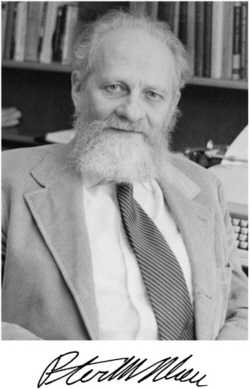
PETER MICHAEL BLAU
February 7, 1918–March 12, 2002
BY W. RICHARD SCOTT AND CRAIG CALHOUN
PETER BLAU WAS A LEADING figure in sociology throughout the second half of the twentieth century, and by its end among the most cited of all active sociologists. His major contributions were to the study of macrosocial structure—analyzing the large-scale systems of organizations, social classes, and the dimensions around which societies are structured. At the same time he was the author of an enduringly influential microsociological study of exchange relations. He was one of the founders of the field of organizational sociology and the coauthor of a highly influential study of the American occupational structure that transformed the study of social inequality and mobility. His contributions to conceptualizing and measuring the parameters of societal systems continue to inspire and guide current theory and research.
Peter was productive throughout his career, beginning with a pathbreaking and influential dissertation and first book examining the dynamics of bureaucracy. He continued to advance his macrostructural theory of society well beyond his formal retirement, submitting journal articles and working with graduate students into his eighties. He was a dynamic and inspiring teacher, and mentored a large and distinguished collection of graduate students and junior colleagues. He
served as president of the American Sociological Association in 1972-1973 and was elected to the National Academy of Sciences in 1980. Colleagues will remember Peter as a man with an active interest in the world, an inquiring mind, a probing intellect, a gentle manner, a wry sense of humor, and a thick Austrian accent. He was a lover of theater and art, but most of all he reveled in the life of the mind.
A MEETING OF OPPOSITES
We think of Peter as embodying three outstanding qualities, each of which spanned or integrated two seeming opposites. (Peter was very fond of dilemmas and paradoxes.) First, his work and career connected theory and empirical research in an era when these were often disengaged activities. While he was originally attracted to “grand theory,” he was converted by his graduate training at Columbia University to value theories of the “middle-range.” Later, reading extensively in the philosophy of science, he developed a strong interest in formal, deductive theorizing. Throughout his entire career, however, Peter blended abstract ideas and empirical indicators and evidence. He drew from classical theory to select problems, formulate arguments, and improve interpretations. He tested propositions with survey data. But he also worked inductively: He thought with data; he learned from data. He gathered data not just to test theories but to revise and extend them.
A second type of connection was his linking of teaching and research. He was equally devoted to and strong in both. He was a dynamic, intense, even eloquent teacher. He was truly excited by ideas, and as his former students we recall many times when his mind raced ahead of his mouth so that he would become more and more excited and animated—and harder to understand—as the lecture progressed. One of his most popular courses at the University of Chicago
was a required seminar on sociological theory. The “seminar” was often packed by more than 75 doctoral students, all struggling to understand and keep pace with this vigorous lecturer. Students were reminded in his class of the old adage that being a graduate student at Chicago was like trying to drink from a fire hose! Peter’s influence as a teacher continued at Columbia, SUNY Albany, and the University of North Carolina. In each setting he taught not what he believed were the settled truths of science but the scientific method as a continual probing of received wisdom and pursuit of new knowledge. He was remarkably willing to see his own work subjected to revision based on new evidence or analysis and so taught his students some of their most powerful lessons by example.
The third integration embodied by Peter was his bridging of the Old World and the new. Born in Vienna, with much courage and good luck, he was able to make his way to America, where he completed his undergraduate and graduate education. Although Peter “escaped” from the Old World, he remained permanently imprinted by it. He embodied an Old World grace and charm. He was somewhat reserved and formal, even shy, in his interactions. His daughters tell of the terror he could inspire in prospective boyfriends while only intending to make small talk. Long after it was fashionable in academic circles, he wore a hat and a tie and often a heavy tweed suit no matter what the weather. And he retained his strong Viennese accent—which, indeed, seemed to get thicker over the years! In Vienna he had planned to study medicine. Yet, in the United States he enthusiastically embraced the new discipline of sociology. He was strongly committed to the conduct of positivist, empirical scientific research, rather than a looser, more humanistic “social thought.” And he quickly mastered the skills of the entrepreneurial investigator, designing data-
intensive studies and obtaining funding for large-scale projects. At the same time he believed that better scientific knowledge was of fundamental importance for democracy and for addressing social problems. He was as deeply committed to the ideals of a free and open society as to free and open scientific inquiry. And at the end of his life Peter worried deeply that the public conditions for both democracy and free scientific inquiry were being undermined by reactionary antimodernists.
A DRAMATIC BEGINNING
Peter Blau was born in Vienna, Austria, in 1918—the year that the Austro-Hungarian Empire fell. He was the son of secular Jews, and he watched with mounting concern the rise of fascism in postwar Austria. As a young student he wrote articles for the underground newspaper of the Socialist Worker’s Party, speaking against his government’s repressive regime. When he was only 17, he was convicted of high treason and given a 10-year sentence in federal prison. Ironically, he was released soon thereafter, when the National Socialists came to power and lifted the ban on political activity (Blau, 2002).
When Hitler marched into Vienna in 1938, Peter’s family elected to stay, although his sister was sent to England on the Kindertransport. Peter, however, attempted to flee across the Czech border. He was captured, tortured, and eventually released, ending up in Prague. Returning to Austria to visit his family, which had been removed to the ghetto, Peter was able with the help of his high school teacher Fritz Redl to obtain an affidavit permitting his emigration to America. He managed to get to France by train, where because he was carrying a German passport, he gave himself in to the Allied forces. He spent time in a French labor camp, but through the intervention of an acquaintance was
released when his visa number came up. He immediately left for Le Havre to seek passage on a boat to America (Blau, 2002).
Let us quote a paragraph from Peter’s own matter-of-fact account of this terrible, wonderful, truth-is-stranger-than-fiction story.
World War II broke out and the ship on which my passage was booked did not sail. Thousands of people—Americans returning home as well as refugees immigrating—waited in Le Havre for passage, and this turned out to be fortunate for me. While waiting in Le Havre for news about sailing, I met and passed the time with some Americans, one of whom was the graduate of a Midwestern protestant college. He told me that students at his college had collected a fund for a refugee scholarship, but for this scholarship they had no candidate. He asked me whether I would be interested. I could not believe my ears, and I did not believe him, honest as he seemed (and was), but I told him I would be very interested. (Blau, 1995, p. 2)
The unlikely connection was successfully made, and Peter sailed to the United States and with his refugee scholarship attended Elmhurst College in Illinois, majoring in sociology. In his undergraduate years he was attracted to the work of the grand theorists, ranging from Marx and Durkheim to Freud and Fromm, and his interests were initially more social-psychological than structural. The balance would shift progressively through his career. Following graduation from college, Peter spent three years in the U.S. Army, returning to the combat zone in Europe. Because of his German language skills, he served as an interrogation officer. He later learned that his family had been killed in Auschwitz in 1942.
A REMARKABLE COHORT
Following the conclusion of World War II, thanks to the GI Bill, Peter was able to continue his education, entering the sociology department at Columbia University in February of 1946—encouraged by his lifelong friend Lewis Coser,
who entered a few months before. Attracted to Columbia by the work of Robert S. Lynd (1970), a scholar noted for his work on class and for translating sociological ideas into social reform efforts, Peter quickly fell under the influence of Robert K. Merton, the leading advocate of “middle-range” theory—theory closely related to and guided by empirical research (Merton, 1949). Merton, together with Paul Lazarsfeld, provided an alternative model to the continental tradition of “grand” theory—a tradition still entrenched at Harvard, under the sway of Pitirim Sorokin (1937-1941) and Talcott Parsons (1951). Gathered around Merton and Lazarsfeld were an extraordinary collection of graduate students, many returning veterans who were to be in the forefront of reinventing sociology for the postwar age. In addition to Blau they included Rose and Lewis Coser, James S. Coleman, Alvin W. Gouldner, Elihu Katz, Seymour Martin Lipset, Alice K. and Peter S. Rossi, Philip Selznick, Martin A. Trow, and Dennis Wrong.
A FOUNDER OF ORGANIZATIONAL SOCIOLOGY
Several of these scholars—including Coleman, Gouldner, Lipset, and Selznick—joined with Peter to launch the modern field of organizational sociology. All of them conducted insightful theory-driven, empirical studies of either public or private organizations and thus created a solid research foundation for this field of study. One of these studies was Peter’s dissertation, carried out under the supervision of Merton. Drawing upon the human relations tradition in industrial sociology, Peter elected to study the behavior of work groups but with several amendments and refinements. He focused on behavior within white-collar, administrative systems rather than blue-collar settings. Following the lead of the Columbia anthropologist Conrad Arensberg (1951), he elected to systematically record interaction patterns among
workers rather than basing his work exclusively on informal observations and interviews. And he addressed general theoretical questions regarding the bases of status and power, the unanticipated consequences of purposive action, and endogenous sources of bureaucratic change. The resulting study, The Dynamics of Bureaucracy (Blau, 1955), is rightly regarded as a sociological classic (Merton, 1990).
After his graduation from Columbia in 1952, Peter served briefly on the faculties of Wayne State and Cornell universities before moving to the University of Chicago, where he remained until 1970. While there he coauthored a treatise that became one of the foundational texts of the emerging field of organizational sociology (Blau and Scott, 1962). He also launched an ambitious research program—the Comparative Organization Research Project (CORP), which he continued after moving to Columbia in 1970. This involved a series of large-scale studies in which organizations rather than individuals were the units of analysis. He examined large samples of distinct types of organizations, including public bureaucracies, universities, and manufacturing organizations. Data were variously drawn from informant reports, official records, organization charts, personnel manuals, job descriptions, and performance ratings. The major findings were reported in The Structure of Organizations (Blau and Schoenherr, 1971) and The Organization of Academic Work (Blau, 1973).
One golden nugget resulting from this research program was, we believe, Blau’s theory of structural differentiation, in which Blau devised a remarkable series of propositions to account for the complex relation between organizational size and bureaucracy (measured as a proportion of administrative staff to production workers). Based on the empirical studies he had conducted, Blau (1970) proposed that (1) size increases structural complexity (differentiation), which in
turn increases pressures for coordination—the addition of administrators. But at the same time (2) size increases scale—the average size of organizational subunits—a development likely to be associated with administrative economies. Hence, size has two analytically distinct effects, which account for the indeterminant and conflicting association observed between size and bureaucratization.
A THEORY OF SOCIAL EXCHANGE
At the same time that Peter was pioneering organizational sociology, he undertook to develop a theory that would provide a more general explanation of the sorts of interactions and relationships he had observed in his field research. This led to the writing of one of his most famous books, Exchange and Power in Social Life (1964). Inspired by Max Weber’s treatment of sociology as first and foremost about relationships, by Merton’s concept of middle-range theory, and by microeconomic analysis and utility theory, Blau offered a microsociology of strategic interaction that anticipated and influenced the later rise of rational choice theory (Coleman, 1990; Cook, 1990, Homans, 1990).
Peter started from the premise that social interaction has value to people, and he explored the forms and sources of this value in order to understand collective outcomes, such as the distribution of power in a society. People enter all social interactions, Peter suggested, for the same reasons they engage in economic transactions: They need something from other people. By contrast with directly economic exchanges, other social exchanges tend to be long-term and to lack metrics by which parties can be clear as to whether their contributions are equal. Among other things, this leads to an escalation of social exchange as people strive to stay out of “debt” not only because of the norm of reciprocity but also because this gives them advantages of autonomy
and potentially power. As Peter put it, “An apparent ‘altruism’ pervades social life; people are anxious to benefit one another and to reciprocate for the benefits they receive. But beneath this seeming selflessness an underlying ‘egoism’ can be discovered; the tendency to help others is frequently motivated by the expectation that doing so will bring social rewards” (Blau, 1964, p. 17).
Beginning with his early work on organizations (Blau and Scott, 1962), Peter’s work consistently asked the question of who benefits, cui bono? Yet if he focused much attention on his own rewards it wasn’t apparent to those who worked with him (perhaps such manifest altruism is only the best strategy). Certainly he received many awards and enormous recognition. He especially delighted in a year at Cambridge as Pitt Professor and a senior fellow of King’s College (and brought back to the United States the rather formal custom of announcing a monthly date when he and his wife, Judith, would be “at home” for drinks). But it is crucial to remember that his formative experience was one of escape from the Anschluss, an almost miraculous chance to go to college, and mobility from a humble start in the United States to considerable eminence. Peter’s story, in other words, was a very American story of immigration, opportunity, and social mobility. He never forgot this, and remained both humbled and grateful. He knew that both chance and social structure were crucial to his success along-side his own brilliance and enormous capacity for hard work. And he could delight in each honor and achievement as, at least in part, a gift.
A LANDMARK STUDY IN STRATIFICATION
It is appropriate too that Peter’s most famous and influential book should address questions of stratification and mobility—and the distinctiveness of the American pattern
in each. The American Occupational Structure, which Peter coauthored with Otis Dudley Duncan, was the most influential quantitative study in the history of American sociology (Blau and Duncan, 1967). It offered powerful and novel findings—such as the widespread distribution of mobility in the United States, as great numbers advanced in small steps rather than the few in giant steps, a pattern inconsistent with the country’s Horatio Alger myth. The work embodied and popularized major new research methods—notably path analysis—and launched a novel approach to mobility processes that would guide a generation of work, giving rise to an entire school of “status attainment” research. The core question was to what extent factors other than parents’ status explained children’s status—operationalized mainly as education, occupation, and income. The more parental status explained, the more social inequalities were reproduced across generations.
Over time the enormous status attainment literature often focused on technical questions—to its critics, on explaining ever-smaller amounts of additional variance. This makes it easy to forget what a dramatic shift in the conceptualization and theorization of social inequality and mobility its origins involved. One central theme was thinking in terms of an overall occupational structure, integrating Weberian themes of status and Marxian concerns for economic inequality. There were, of course, critiques—not least of the fact that the initial work dealt with men and not women. More ironically the status attainment literature was criticized as insufficiently attentive to structural factors, too heavily focused on characteristics of individuals that aided in their attainment of higher statuses. Among the critics of this tendency was Peter Blau himself, though characteristically he didn’t pause to redo the older study but rather chose to embark on a major new project.
A MACROSOCIOLOGICAL THEORY OF SOCIAL STRUCTURE
In the early 1970s Peter began an ambitious effort to develop a new macrosociological theory of social structure. This was informed by the Comparative Organization Research Project, but it was also a significant departure. In many ways it was at odds with his earlier work. Though he had moved away from the mainly social psychological interests of his student days, in his work on exchange theory and social mobility he had sought what came to be called “microfoundations” for macrostructure. He treated social relations as emergent phenomena, not mere collective aggregates of individual phenomena—and his approach to exchange theory differed from that of George Homans (1961) on just this point. But he focused mostly on the directly interpersonal patterns that might explain those found at larger scales. Now, however, he asked the reverse question. How might the macrostructure shape the patterns of more micro relations (Schwartz, 1990)?
Innovative and curious as always, Peter started a dramatically new line of theory building at a stage when many scholars attempt only syntheses of their earlier work (or simply rest on their laurels). Peter’s 1974 presidential address to the American Sociological Association was the first major statement of his new theory, later developed in several books (Blau, 1977, 1994; Blau and Schwartz, 1984). New though the theory was, a key question harkened back to his earlier organizational research: How does size matter? Stimulated by Michels’s theory of oligarchy and Simmel’s advocacy of a formal sociology attentive to number and scale, Peter began to reason deductively about the implications of group size and rates of in-group and out-group interaction. A simple example: Assuming random interaction, any minority will have more out-group relations than a majority. Every marriage
between a Christian and a Jew in the United States, thus, has a bigger impact on the Jewish population. If overwhelmingly white colleges assigned roommates randomly, nearly all black students would have white roommates while most whites would also have white roommates. From such basic effects of relative group size, Peter began to build a complex and systematic account of the social structure of populations.
Though Peter’s theoretical strategy changed markedly from his work of the 1950s and 1960s, his new theory was capacious enough to allow for a reconciliation. As he showed in his 1994 book, opportunities were the products of structural contexts—whether they were opportunities for marriage, ethnic group relations, or social mobility. And social relationships were still matters of exchange and power, though they were always situated in and both made possible and constrained by larger structures (Calhoun et al., 1990).
Among other things Peter’s theory gave a more structural account of “homophily,” the concept coined by his mentor Robert Merton to describe the common observation that people are drawn to others like themselves. This attraction is a product of structure and not only taste, and indeed what seem individual tastes may be partly structurally produced. Sociologists, for example, are apt to spend a lot of time with other sociologists—and Peter married two fellow sociologists. With his first wife, Zena Smith Blau, he had a daughter, Pamela—herself now married to a sociologist. His second wife, Judith Blau, is a distinguished sociologist of culture, and their daughter Reva has followed that lead into art and literature. Even those with much in common are not just alike, which is after all the basis for an exchange relationship. Judith and Reva pushed Peter to see how cultural meaning matters alongside strategy and structure. And if there is one thing Peter Blau liked to exchange, it was ideas. He will be remembered for lively intellectual arguments
with a twinkle in his eye and sheer pleasure in thinking clearly and well.
A MAKER OF MODERN SOCIOLOGY
In an extraordinary career of more than 50 years, Peter Blau played a central role not merely in advancing but also in making modern scientific sociology. Together with his teachers, Merton and Lazarsfeld, themselves only slightly older, he and others of approximately the same generation developed lines of inquiry that became the main branches of sociology, and they developed analytic approaches and a characteristic way of relating theory to research that shaped the “mainstream” of the field as it matured into a stable and cumulative science. Peter pioneered the sociology of organizations, turning the insights of Weber, Merton, and others into a highly productive research program using methods ranging from ethnographic observation to comparative statistical analysis. He was among the founders of exchange theory and shaped the emergence of rational choice theory. He recast the study of social inequality as an increasingly precise and mainly quantitative inquiry into processes of social differentiation, mobility, and reproduction. He pushed sociologists to make more use of formal, deductive theorizing. He played a leading role in putting the analysis of social structure at the forefront of the sociological agenda and developed one of the most powerful of structural theories. Remarkably, his work from each stage of his career remains not only historically influential but in active, continuous use.
For each of us, as for an enormous range of others, Peter is an inspiration. Not only did he do great work, he also did it with a true love of science, a generous spirit, a mischievous sense of humor, and a deep appreciation for the opportunities chance and social structure gave him.
REFERENCES
Arensberg, C. 1951. Behavior and organization: Industrial studies. In Social Psychology at the Crossroads, eds. J. H. Rohrer and M. Sherif, pp. 324-352. New York: Harper.
Blau, P. M. 1955. The Dynamics of Bureaucracy. Chicago: University of Chicago Press.
Blau, P. M. 1964. Exchange and Power in Social Life. New York: Wiley.
Blau, P. M. 1970. A formal theory of differentiation in organizations. Am. Sociol. Rev. 35:201-218.
Blau, P. M. 1973. The Organization of Academic Work. New York: Wiley.
Blau, P. M. 1974. Parameters of social structure. Am. Sociol. Rev. 39:615-635.
Blau, P. M. 1977. Inequality and Heterogeneity: A Primitive Theory of Social Structure. New York: Free Press.
Blau, P. M. 1994. Structural Contexts of Opportunities. Chicago: University of Chicago Press.
Blau, P. M. 1995. A circuitous path to macrostructural theory. Annu. Rev. Sociol. 21:1-19.
Blau, P. M., and O. D. Duncan. 1967. The American Occupational Structure. New York: Wiley.
Blau, P. M., and R. A. Schoenherr. 1971. The Structure of Organizations. New York: Basic Books.
Blau, P. M., and J. E. Schwartz. 1984. Crossing Social Circles. Orlando: Academic Press.
Blau, P. M., and W. R. Scott. 1962. Formal Organizations: A Comparative Approach. San Francisco: Chandler (reissued as a Business Classic, Stanford University Press, 2003).
Blau, R. 2002. Colleagues remember Peter Blau. Footnotes (April):4-6.
Calhoun, C., M. M. Meyer, and W. R. Scott, eds. 1990. Structures of Power and Constraint: Papers in Honor of Peter M. Blau. New York: Cambridge University Press.
Coleman, J. S. 1990. Rational action, social networks, and the emergence of norms. In Structures of Power and Constraint: Papers in Honor of Peter M. Blau, eds. C. Calhoun, M. M. Mayer, and W. R. Scott, pp. 91-112. New York: Cambridge University Press.
Cook, K. 1990. Linking actors and structures: An exchange network perspective. In Structures of Power and Constraint: Papers in Honor of Peter M. Blau, eds. C. Calhoun, M. M. Mayer, and W. R. Scott, pp. 113-128. New York: Cambridge University Press.
Homans, G. C. 1961. Social Behavior: Its Elementary Forms. New York: Harcourt, Brace & World.
Homans, G. C. 1990. Rational-choice theory and behavioral psychology. In Structures of Power and Constraint: Papers in Honor of Peter M. Blau, eds. C. Calhoun, M. M. Mayer, and W. R. Scott, pp. 77-90. New York: Cambridge University Press.
Lynd, R. S. 1970. Knowledge for What? The Place of Social Science in American Culture. Princeton, N.J.: Princeton University Press.
Merton, R. K. 1949. Social Theory and Social Structure. Glencoe, Ill.: Free Press.
Merton, R. K. 1990. Epistolary notes on the making of a sociological dissertation classic. In Structures of Power and Constraint: Papers in Honor of Peter M. Blau, eds. C. Calhoun, M. M. Mayer, and W. R. Scott, pp. 37-66. New York: Cambridge University Press.
Parsons, T. 1951. The Social System. Glencoe, Ill.: Free Press.
Schwartz, J. E. 1990. Penetrating differentiation: Linking macro and micro phenomena. In Structures of Power and Constraint: Papers in Honor of Peter M. Blau, eds. C. Calhoun, M. M. Mayer, and W. R. Scott, pp. 353-374. New York: Cambridge University Press.
Sorokin, P. A. 1937-1941. Social and Cultural Dynamics. New York: American.
SELECTED BIBLIOGRAPHY
1954 Co-operation and competition in a bureaucracy. Am. J. Sociol. 19:530-536.
1955 The Dynamics of Bureaucracy: A Study of Interpersonal Relations in Two Government Agencies. Chicago: University of Chicago Press (rev. ed. 1963).
1956 Bureaucracy in Modern Society. New York: Random House (2nd ed., rev. with M. Meyer, 1971; 3rd ed., rev., 1987).
1957 Formal organization: Dimensions of analysis. Am. J. Sociol. 63:58-69.
Occupational bias and mobility. Am Sociol. Rev. 22:392-399.
1960 Structural effects. Am. Sociol. Rev. 25:178-193.
1962 With W. R. Scott. Formal Organizations: A Comparative Approach. San Francisco: Chandler (reissued by Stanford University Press, 2003).
Patterns of choice in interpersonal relations. Am. Sociol. Rev. 27:41-55.
1963 Critical remarks on Weber’s theory of authority. Am. Polit. Sci. Rev. 57:305-316.
1964 Exchange and Power in Social Life. New York: Wiley.
1966 With W. V. Heydebrand and R. E. Stauffer. The structure of small bureaucracies. Am. Sociol. Rev. 31:179-191.
1967 With O. D. Duncan. The American Occupational Structure. New York: Wiley.
1968 The hierarchy of authority in organizations. Am. J. Sociol. 73:453-467.
Theories: Organizations. In International Encyclopedia of the Social Sciences. New York: Macmillan and Free Press.
1970 A formal theory of differentiation in organizations. Am. Sociol. Rev. 35:201-218.
1971 With R. A. Schoenherr. The Structure of Organizations. New York: Basic Books.
1973 The Organization of Academic Work. New York: Wiley.
1974 On the Nature of Organizations. New York: Wiley.
Parameters of social structure. Am. Sociol. Rev. 39:615-635.
1976 Approaches to the Study of Social Structure, ed. and contributor. New York: Wiley.
1977 A macrosociological theory of social structure. Am. J. Sociol. 83:26-54.
Inequality and Heterogeneity: A Primitive Theory of Social Structure. New York: Free Press.
1981 With R. K. Merton. Continuities in Structural Inquiry, ed. and contributor. Beverly Hills, Calif.: Sage.
1984 With J. E. Schwartz. Crosscutting Social Circles. Orlando: Academic Press.
1987 Microprocess and macrostructure. In Social Exchange Theory, ed. K. S. Cook, pp. 83-100. Newbury Park: Sage.
1994 Structural Contexts of Opportunities. Chicago: University of Chicago Press.
2002 Reflections on a career as a theorist. In New Directions in Contemporary Sociological Theory, eds. J. Berger and M. Zelditch, Jr. New York: Rowman and Littlefield.


