
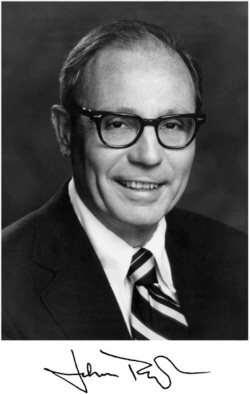
JOHN H. REYNOLDS
April 3, 1923–November 4, 2000
BY P. BUFORD PRICE
JOHN REYNOLDS, A MAN of many parts but foremost a geophysicist, died of complications from pneumonia in Berkeley on November 4, 2000. The modern sciences of geochronology and nuclear cosmochronology grew in large part out of the work of Reynolds and his students. He was the first to detect isotopic anomalies, the study of which culminated in over-whelming evidence for preservation in the meteorites of micron-size grains of stellar origin. In 1960 he detected the xenon isotope of mass 129 trapped in meteorites, and from that discovery inferred that the extinct radioactive isotope iodine-129 (half-life 16 million years and probably generated in a presolar supernova) was present when the meteorites formed. This indicated that the meteorites appeared in the early history of the solar system. In later studies he and collaborators showed that other short-lived species were present in the cloud of gas that turned into our solar system 4.6 billion years ago. For decades he kept his laboratory in the forefront of the field of cosmochemistry. He will be remembered as the “father” of extinct radioactivities.
John was born in Cambridge, Massachusetts, on April 4, 1923. His father, Horace Mason Reynolds, was educated at Harvard, taught English in various colleges in the Boston area and at Brown University, and wrote for newspapers
and magazines. His interests were the Irish literary renaissance and American folklore. His mother, Catherine Whitford, entered Wellesley College, but her education was interrupted by the death of her father in 1918. His parents met in Cambridge when she was secretary to Dr. Roger Lee, a physician who later became one of the members of the Harvard Corporation. His mother wrote articles for the Christian Science Monitor’s Home Forum Page. Literary people often visited John’s parents, and these contacts pre-disposed him toward the academic life. John lived in Cambridge for most of his boyhood, with occasional periods in Providence, Rhode Island, when his father taught at Brown and where his sister, Peggy, was born, and in Williamsburg, Virginia, when his father taught at William and Mary College.
The family was disrupted when his mother contracted tuberculosis and spent the years ~1930 to 1932 in a sanatorium in Charlottesville, Virginia. During that period his father continued his graduate studies at Harvard; his sister lived with her maternal grandmother in Westboro, Massachusetts; and John attended a small boarding school in South Sudbury. The family was reunited in 1932 in Cambridge, where John continued his education in the public schools. Although his strongest aptitudes were in math and physics, he enjoyed most subjects and took piano and organ lessons. At school and college he tinkered with electricity and radio, as did so many who later became physicists. He studied harmony in high school and college and sang in choirs and the college glee club. Much later, at Berkeley, he joined the Monks, who sang annually at the traditional holiday feast at the Faculty Club and at other affairs. At an early age he developed his lifelong interest in hiking and camping.
He entered Harvard in 1939. As an undergraduate he worked with his physics tutor, Leo Beranek, on his World War II defense research project in electroacoustics. After
graduating summa cum laude in 1943 with an A.B. degree in electronic physics, he was commissioned a Navy ensign and entered active service on June 28, 1943, as an ordnance officer; he worked on an antisubmarine project at island bases in the South Pacific. He was honorably discharged as a lieutenant on June 11, 1946.
Inspired by his reading about the Manhattan Project, John decided to do his graduate physics studies at the University of Chicago. His selections of mass spectroscopy as a topic and of Mark Inghram as a thesis advisor were based mainly on a friendship with Joseph Hayden, who was doing research with Inghram at the time. John was captivated by the enthusiasm of the stellar roster of geochemists and cosmochemists: Harold Urey, Harrison Brown, Hans Suess, and the relative youngsters Clair Patterson, George Tilton, and Sam Epstein. Gerry Wasserburg and George Wetherill were graduate students there a bit later. Like the other Chicago physics graduate students, John was strongly influenced by Enrico Fermi, and he audited two of Fermi’s courses, never missing a lecture. Much later in life, while on sabbatical in Western Australia, he gave a talk to undergraduate students on how to make back-of-the-envelope estimates, using as examples some of the problems Fermi gave students. The most famous of Fermi’s questions was, “How many piano tuners are listed in the Chicago telephone directory?” None of the students in John’s lecture had any idea how to estimate the number, until John led them through the reasoning and arrived at a solution that was correct to better than 50 percent. At Chicago he and Inghram discovered the double beta-decay of 130Te by way of 130Xe production in tellurium ores. The topic remains one of great interest, in view of the possibility that the decay might occur without neutrino emission, which would violate lepton number conservation. Also at Chicago John discovered 81Kr, the long-
lived isotope of krypton, which later became the basis of the most precise cosmic-ray exposure-dating method for meteorites and lunar rocks. Nineteen-fifty was an exciting year for John. He completed his Ph.D. thesis, married Genevieve Marshall, took on a short-term appointment as associate physicist at Argonne National Laboratory, and accepted an assistant professorship and moved to Berkeley.
In 1950, by virtue of Lawrence’s cyclotron and the presence of a number of outstanding nuclear physicists such as Alvarez, Segré, and Chamberlain (all future Nobel laureates), the Physics Department at Berkeley had been able to hire the pick of the crop of faculty trained in high-energy nuclear physics, and the department had become unbalanced. It was clear that a serious effort would have to be made to hire faculty members in other fields. On an extensive recruiting trip Francis (“Pan”) Jenkins interviewed over a hundred students across the country and produced an ordered list of his top choices for the faculty to consider. While interviewing at Chicago, Jenkins was influenced by suggestions by Francis Turner and John Verhoogen of the Berkeley Geology Department that a physicist skilled in isotope spectroscopy would be a useful adjunct. In the days long before official advertisements and affirmative action became the required mode for all faculty hiring, Chair Raymond Birge simply talked with the faculty and with their endorsement, requested the dean for the position. “With our present enormous number of graduate students, it is imperative that there be more fields of research and more instructors under whom graduate students may work…. The department has agreed to look for no new men in the high energy nuclear physics field, because of this need for broadening our offerings.” Within the same year or so the Physics Department hired five new faculty members who would later be elected to the National Academy of Sciences:
John Reynolds, Walter Knight, Erwin Hahn, Carson Jeffries, and Bill Nierenberg.
The university provided funds for John to set up his own laboratory for mass spectrometry. Two years later he requested funds from the Office of Naval Research for “studies by rare gas mass spectrometry of reactions of transmutation,” specifically to study transmutation of iodine into isotopes of xenon by deuterons; to search for absorption of solar neutrinos in bromine and its transmutation into krypton; and to increase the sensitivity for K-Ar geochronology so that rocks containing only a moderate potassium concentration could be dated. These funds enabled him to design and construct the first static (nonpumped) all-glass mass spectrometer, which he used for isotopic analysis of the noble gases. Others have since referred to it as the Reynolds-type mass spectrometer. A key ingredient in that instrument was his incorporation of a bakeable ultrahigh-vacuum system, which had just been invented by Daniel Alpert, and without which he could not have achieved the sensitivity he sought. Prior to his development, analyses were made dynamically, with the sample leaked through the ion source and analyzed with very low efficiency en route to the vacuum pumps.
The idea to use the decay of long-lived potassium-40 into argon-40 as a dating tool can be traced back to C. F. von Weizsäcker in 1937. Because of the complicated decay scheme of 40K, its poorly known half-life, questions concerning its retention in rocks, and the inadequacy of mass spectrometers, the method developed slowly, and no one scientist can be said to have invented the K-Ar technique. By the time Reynolds appeared on the scene, it was being used in laboratories around the world to date 108- to 109-year-old potassium-rich rocks. In 1956, by virtue of the factor 102 higher sensitivity afforded by his static mass spectrometer, he and graduate student Joe Lipson in Physics, together
with Garniss Curtis and Jack Evernden in Geology, were able to date rocks as young as ~106 years. This capability opened the door for Richard Doell, Allan Cox, and Brent Dalrymple, who had been trained at Berkeley and were then at the U.S. Geological Survey in Menlo Park, to determine the timescale for geomagnetic reversals. Applying that timescale to the stripes of alternating paleomagnetic polarity in lavas as a function of distance from a mid-ocean ridge, they showed that lava ages increased in both directions from zero at the ridge, from which a seafloor spreading rate of a few cm/yr could be inferred. This provided a quantitative proof of plate tectonics. Another important application of the Reynolds spectrometer was to hominid anthropology. In 1963 Professor Richard Hay (Geology, Berkeley) used it to date the volcanic ash layers at Olduvai Gorge, from which he was able to fix closely the fossil sequence of man’s pre-history.
The first of John’s many sabbatical leaves was in 1956-1957 as a Guggenheim fellow at the University of Bristol, England, in Cecil Powell’s cosmic-ray physics group. Although this stay did not tempt him to shift his interest away from geochronology, it did inspire in him a love of England, to which he and his wife, Ann, returned many times in later life.
In 1947 Harrison Brown had suggested that meteorites could be used to determine quite accurately the age of the elements if the daughter of an extinct natural radioactive nuclide could be found there. What one would actually measure would be the time delay between nucleosynthesis of elements in the solar system and the freezing-in of long-lived radioactive nuclides in solar system bodies. A number of leading mass spectrometrists, including Gerry Wasserburg, had hoped to be first to detect 129Xe, the decay product of 129I, an isotope with a 16-million-year half-life.
John’s discovery of extinct 129I in 1960 was the crowning achievement of his career. His promotion to full professor that same year was a shoo-in. Letters in support of the promotion were glowing: “His work on meteorites … has revolutionized much of cosmological theory. His latest result is the most important single event in the whole field” (Willard Libby). “Reynolds has made an exceedingly important discovery, namely that there is a variation in the abundance of the isotopes of xenon in meteorites. The nature of this variation is two-fold: first, there is a special anomaly due to the decay of iodine-129 which shows that the meteorites were formed within a couple of hundred million years after the last important synthesis of the elements; and second, there is a general anomaly which indicates that nuclear processes of some kind were different for the meteorites than they were for the material of the Earth…. I regard this as a very important discovery” (Harold Urey). “One can point to one particular accomplishment in his investigation of the xenon content of meteorites. The isotopic composition of xenon has led to most striking conclusions concerning the conditions under which our planetary system must have formed” (Edward Teller).
It is worthwhile to ask how one professor, without graduate students, could make a discovery of that magnitude. Before 1960 little was known about the age and time interval for formation of the solid bodies of the solar system except that the Earth was 4.6 billion years old, as measured with the uranium-lead technique by Clair Patterson, Harrison Brown, George Tilton, and Mark Inghram in 1953. Thanks to the prediction by Harrison Brown, John (as well as other geoscientists) knew exactly what to look for in order to estimate the age (i.e., the time since nucleosynthesis) of the elements that made up the solar system. A key ingredient in his success was his static all-glass mass spectrometer, which
made it possible to pass the same rare gas atoms through the instrument many times in search of an isotopic anomaly. Thanks to fully funded leaves in residence, funded by Berkeley’s Miller Institute, he was able to devote full time to the search. Furthermore, as an assistant professor he was not burdened with the numerous service responsibilities with which senior faculty are saddled. It was partly good fortune that so many chondritic meteorites contain xenon-129 up to 50 percent in excess of the atmospheric xenon-129 concentration. His observation of the large excess of 129Xe in the Richardton chondrite, memorialized in introductory physics textbooks, constituted the “home run” that led to his election to the National Academy of Sciences eight years later.
Shortly after John’s discovery of excess 129Xe, Bob Walker, Bob Fleischer, and I at General Electric Research Laboratory were discovering the multifarious uses of nuclear tracks in solids, including fission track dating, and we visited John, as did the many others who regarded his lab as Mecca. During my visit in 1962, I remember the stir created when John brought me to the Faculty Club for lunch. The geologists hollered for us to come to their table, and later Jack Evernden drove me to the helicopter pad for my shuttle to the airport.
In preparation for his second sabbatical, 1963-1964, John studied Portuguese for a year and obtained both a National Science Foundation senior postdoctoral fellowship and NSF funding to set up a complete K-Ar laboratory at the University of Sao Paolo, Brazil. In preparation Professor Umberto Cordani of that university spent six months learning mass spectrometry at John’s Berkeley laboratory. Cordani wrote: “All of us South American geochronologists will be forever indebted to John Reynolds. It was his idea, back in the late fifties, to set up what was to be the first geochronology
laboratory on our continent. We valued his conveyance of ethics, respect, and humility toward knowledge and science.” During his stay, the group measured ages of Brazilian rocks that fitted with age patterns seen along the coast of Africa. The agreement in ages supported the theory of continental drift. An important visual clue that South America was once part of Africa is the jigsaw puzzle-like fit of their coastlines, and the match in ages of coastal rocks provided strong evidence that South America separated from Africa some 108 years ago. While in Sao Paolo, John stimulated interactions with colleagues of other Brazilian institutions and from neighboring countries.
John was proud of the training he gave his students, and the freedom he gave students and postdocs to try their own ideas. While he was in Brazil, his students Grenville Turner and Craig Merrihue, working in John’s laboratory, discovered the 39Ar-40Ar method, which has since become the most important and most versatile dating method. Their idea was to irradiate the rock sample with neutrons in order to transmute some of the stable isotope 39K into 39Ar. Analysis of the two Ar isotopes thus gave both the potassium content and the radiogenic argon. The idea of using neutron irradiation traces directly back to John’s earlier use, with Peter Jeffery, of neutron activation of 127I to produce stable 128Xe, from which a correlation can be made between radiogenic 129Xe and 127I. Knowing the initial ratio of 127I/129I produced in nucleosynthesis leads to the I-Xe dating method.
John was well aware that most of the Physics faculty felt that his research was far afield from mainstream physics. For example, Luis Alvarez once wrote in support of a merit increase for John: “I remember wondering when John Reynolds first came to Berkeley why any bright young physicist would want to work in the field of mass spectroscopy, which I considered to be a rather dead field at that time.
But in the hands of John and several other innovative young physicists, the field came back to life, and it has been a very exciting and productive branch of science in the past 10 or 15 years.” Despite his success in single-handedly creating a new field, John longed for another Physics faculty member with interests in geophysics. After a failed campaign to move Bob Walker to Berkeley, in 1969 he succeeded, to my delight, in getting me an appointment. For a few years while we were studying lunar samples and I was searching for fossil spontaneous fission tracks of superheavy elements (Z ≈ 110) in meteorites and lunar rocks, we ran a joint seminar; but I moved gradually into astrophysics and started a separate weekly seminar. John then got a faculty appointment for Rich Muller, who had switched from high-energy physics into geophysics, but his and Rich’s researches never converged.
For his next sabbatical year, 1971-1972, with the award of a Fulbright Fellowship, he decided to refresh his knowledge of Portuguese by setting up a mass spectrometric laboratory to do K-Ar dating of rocks at the University of Coimbra, Portugal. In recognition of his success in establishing geochronology there, in 1987 the University of Coimbra awarded John the degree of doctor, honoris causa. He brushed up on his Portuguese and gave his acceptance speech in that language.
Xenon is particularly rich in stable isotopes that provide cosmochemical information. For example, a second extinct radioactivity amenable to a mass spectrometric search was the spontaneous fission of 244Pu with an 82-million-year half-life. It was certain that fragments of its fission should include 136Xe, 134Xe, 132Xe, and 131Xe, but the relative amounts were not known. A number of geoscientists had found reproducible excesses of those isotopes in uranium- and rare-earth-rich minerals in meteorites, but the case for a 244Pu origin was
not airtight. In a beautiful experiment on 244Pu artificially produced at Oak Ridge, in 1971 Reynolds and his colleagues conclusively demonstrated that the relative abundances of the heavy xenon isotopes resulting from spontaneous fission of 244Pu agreed with those found in various meteorites. From the 129I and 244Pu results they concluded that the meteorites formed within ~107 years of each other, some 108 years after cessation of nucleosynthesis of the material that formed the solar system. Excess heavy xenon isotopes in certain carbonaceous chondrites with an apparent fissiogenic origin different from 244Pu were thought by some to be due to spontaneous fission of an unknown superheavy element, but that intriguing possibility has never been confirmed.
In his typical fashion, when he agreed to be joint organizer of a U.S.-Japan symposium on cosmochemistry at Hakone National Park in 1977, he began preparing a year in advance by auditing a course in Japanese. By the time of the symposium, he could read comic books in Japanese and write in Katakana.
With support from a National Science Foundation Cooperative Research Award, John spent a sabbatical year (1978-1979) at the University of Western Australia, Perth, where he collaborated with Peter Jeffery in the development of a miniaturized mass spectrometer. With this instrument they were able to study excesses of certain xenon isotopes in microgram-size mineral grains in the Allende carbonaceous chondrite and to add to the momentum of John’s Berkeley group in the competition to decipher the message in the micronuggets carrying the anomalous gas in carbonaceous chondrites. He did this by developing a small tungsten conical heating filament and installing the then-new Baur-Signer ion source and an ion-counting system. This new technique allowed the isotopic measurement of as few as ~104 atoms of xenon to be determined. Besides his research
activities John enjoyed early morning jogging and 1-mile ocean swims seaward of the reef at Cotteloe Beach. I recall him telling me how surprised he was when he encountered Prince Charles, who happened to be enjoying a swim along the same stretch of ocean.
John’s next big project, which occupied him for the better part of the decade 1978-1988, was to design, construct, and do research with a new type of mass spectrometer, which along with electronics and computing facilities, was carried in a 25-foot trailer. I remember seeing their trailer, painted with the giant acronym RARGA (for Roving Automated Rare Gas Analyzer) parked year after year between two of the Physics buildings (Birge and LeConte halls). With this facility John and his group were able to do precise in situ measurements of isotopes of rare gases from deep terrestrial fluids, mainly geothermal. The fluids included primordial gas from the Earth’s mantle, radiogenic gases from the crust, gases that were products of nuclear reactions induced by neutrons and alpha particles from radioactivity, and recirculated atmospheric gases. The primordial gases, which were the most interesting because they dated back to the formation of the solar system, were excesses of 3He and 129Xe from decay of extinct 129I. Among the sites from which they collected samples were geothermal areas within Yellowstone Park. For the culmination of the RARGA project John was awarded a second Guggenheim Fellowship in his 1987-1988 sabbatical year. With the trailer parked on the perimeter of Los Alamos National Laboratory, he and his students studied gases from various geothermal sources, mainly in New Mexico, with his wife, Ann, cooking for the entire group. Eventually, after nearly a decade, Berkeley bureaucracy caught up with John. He was told that RARGA was parked in violation of the campus’s policy on temporary buildings, and he was required to move it to another temporary location for a
three-year period, after which it had to be permanently moved off campus.
In parallel with the RARGA project he and his group followed up on an important 1975 discovery by Chicago geochemist Ed Anders and coworkers (which included former students of John’s) of traces of gases with exotic isotopic composition that had been trapped in tiny extrasolar grains in the most primitive carbonaceous meteorites. The Chicago group was able to isolate the sources of the exotic rare gases by dissolving mineral grains in strong acids and then extracting almost all the exotic gases from the 0.5 percent remaining solid matter. They proposed a spectacular explanation for the heavier xenon isotopes: that they were the products of spontaneous fission of some extinct superheavy element. John and his students found that the trapped rare gases were predominantly associated with the carbon in the meteorite. They offered a less bizarre but still very exciting explanation: that the exotic gases had been trapped in presolar grains with a different nucleosynthetic history from the gases in our solar system. The study of such grains, made in stellar atmospheres and later incorporated into the material of which our meteorites were formed, is on the forefront of cosmochemistry today.
Soon after John arrived at Berkeley, the president of the university appointed a number of volunteers as faculty fellows, with the goal of improving contacts between undergraduate students and faculty. John enjoyed serving as a fellow at Bowles Hall, one of the university residence halls. I remember visiting him in 1966 and joining the students at lunch, where John represented me as an expert who could answer any of their questions on physics. When I could not give a satisfactory answer to one of their questions, I realized that I had better move from the ivory tower of industrial research to the real world of involvement with students.
As often as his other duties would permit he swam at the pool and basked in the sun and conversed afterwards with the regulars. He was a member of Little Thinkers, a diverse group of faculty who met monthly for serious conversation at the Faculty Club.
His societal concerns extended beyond the walls of academia. He was a staunch believer in representative democracy and ran for the Berkeley Rent Board out of a sense of civic duty. He was also active in the League of Women Voters. For an example of his political orientation as well as his felicity in written expression, I quote from his contribution to the Harvard twenty-fifth yearbook in 1968: “Berkeley has recently been a focal point in this kind of conflict [the Free Speech Movement], because there the University is especially good and the public is especially bad (at least I am forced so to conclude)—the latest important acts of the electorate have been to strike down a ‘fair housing’ enactment of the state legislature and to install a movie actor in the high office of Governor.”
John played an active part in the Cal Sailing Club. As an assistant professor with a modest income he shared ownership of a boat with two other professors. Later he acquired a much grander boat of his own. Shortly after I joined the faculty, he and his second wife invited me and my wife to sail with them to Tiburon and have a picnic lunch there. Unfortunately, we were becalmed in the middle of the San Francisco Bay. Unfazed, they brought out the champagne and lunch, and we had a pleasant time on the bay before the wind returned.
In 1989 he partly fulfilled his dream of returning under sail to the South Pacific where he was stationed during World War II. As a crew member aboard a sailboat in the California to Hawaii Transpac Race, he sailed from Long Beach to Honolulu. After his retirement he cruised extensively with
Ann in their 30-foot sailboat. They made summer cruises to Alaska as well as a two-year passage through the Great Lakes and New England, during which time he stopped whenever possible to send his many friends detailed e-mail messages recounting their adventures. As a reward for her putting up with long periods of life in relatively primitive quarters, he would take her on long visits to England. He had just completed his second round-trip sailing voyage to Alaska several weeks before his untimely passing.
John took the responsibility of service to the university seriously and served as chairman of the Physics Department in the 1980s. During this time, he made several changes that benefited the department in lasting ways and promoted a feeling of harmony and cohesiveness among the faculty. He believed strongly in U.C. Berkeley’s tradition of faculty governance, and he encouraged his colleagues on the Physics faculty to participate in meetings and committees of the Academic Senate.
He was president of the Faculty Club in 1968-1970 and served on the board in 1996-2000. He enjoyed singing at the Club with the Monks. During his final hospital stay he was concerned that the Club piano be tuned for the Christmas parties in the month to follow. His interests also extended to amateur astronomy, bread making, beer brewing, and harvesting California fungi. Ann and he often hosted dinners and parties both for international visitors and for Berkeley friends. He remained intellectually curious and eager for new knowledge to the last. On the morning of his passing, he called a colleague for a book he intended to read on the life of Ulysses S. Grant.
He is survived by his wife, Ann Reynolds; his children, Amy, Horace, Brian, Petra, and Karen; and his sister, Peggy. Amy, Horace, and Brian were children by his first wife;
Karen was his daughter by his second wife; John and Ann adopted Petra, the daughter of his second wife.
HONORS
|
1965 |
Awarded the John Price Wetherill Medal of the Franklin Institute |
|
1967 |
Awarded the J. Lawrence Smith Medal of the National Academy of Sciences |
|
1968 |
Elected to National Academy of Sciences Golden Plate Award of the American Academy of Achievement, Dallas |
|
1973 |
Awarded the Leonard Medal of the Meteoritical Society NASA Exceptional Achievement Award Selected to give the Faculty Research Lecture, awarded to a professor each year. (He spoke on “Telling the Aeons of Forgotten Time.”) |
|
1980 |
Elected to American Academy of Arts and Sciences |
|
1987 |
Doctor, honoris causa, University of Coimbra, Portugal |
|
1988 |
Awarded the National Order of the Southern Cross, with grade of Comendador Awarded the Berkeley Citation, for outstanding research, teaching, and service |
I AM INDEBTED to Ann Reynolds for her friendship and for her help with this memoir, to Professors Bruce Bolt and Richard Packard for contributing part of the text, and to the Physics office at Berkeley for use of its extensive records.
SELECTED BIBLIOGRAPHY
1950 With M. G. Inghram. Double beta-decay of tellurium 130. Phys. Rev. 78:822-823.
A new long-lived krypton activity. Phys. Rev. 79:886.
1953 The isotopic constitution of silicon, germanium, and hafnium. Phys. Rev. 90:1047.
1956 High sensitivity mass spectrometer for rare gas analysis. Rev. Sci. Instrum. 27:928.
With R. E. Folinsbee and J. Lipson. Potassium-argon dating. Geochim. Cosmochim. Acta 10:60.
1958 With G. H. Curtis. Notes on the potassium-argon dating of sedimentary rocks. Bull. Geol. Soc. Am. 69:151.
1960 Determination of the age of the elements. Phys. Rev. Lett. 4:8.
Isotopic composition of primordial xenon. Phys. Rev. Lett. 4:351.
The age of the elements in the solar system. Sci. Am. 203:171.
1961 With R. E. Zartman and G. J. Wasserburg. Helium, argon, and carbon in some natural gases. J. Geophys. Res. 66:277.
1963 Xenology. J. Geophys. Res. 68:2939.
With W. A. Butler, P. M. Jeffery, and G. J. Wasserburg. Isotopic variations in terrestrial xenon. J. Geophys. Res. 68:3283-3291.
1967 With C. M. Hohenberg and F. A. Podosek. Xenon-iodine dating; sharp isochronism in chondrites. Science 156:233-236.
Isotopic anomalies in the solar system (a review). Annu. Rev. Nucl. Sci. 17:253-316.
With G. Amaral, J. Bushee, U. G. Cordani, and K. Kawashita. Potassium-argon ages of alkaline rocks from Southern Brazil. Geochim. Cosmochim. Acta 31:117-142.
1968 Plutonium-244 in the early solar system. Nature 218:1024.
1970 With C. M. Hohenberg, P. K. Davis, and W. A. Kaiser. Isotopic analysis of rare gases from stepwise heating of lunar fines and rocks. Science 167:545.
1971 With E. C. Alexander, Jr., R. S. Lewis, and M. C. Michel. Plutonium 244: Confirmation as an extinct radioactivity. Science 172:840.
1974 With E. C. Alexander, Jr., and P. K. Davis. Studies of K-Ar dating and xenon from extinct radioactivities in breccia 14318: Implications for early lunar history. Geochim. Cosmochim. Acta 38:401.
1975 With D. Phinney and S. B. Kahl. 40Ar-39Ar dating of Apollo 16 and 17 rocks. Proc. Lunar Sci. Conf., 6th, 1953.
1978 With U. Frick, J. M. Neil, and D. L. Phinney. Rare-gas-rich separates from carbonaceous chondrites. Geochim. Cosmochim. Acta 42:1775-1797.
1980 With G. R. Lumpkin and P. M. Jeffery. Search for 129Xe in mineral grains from Allende inclusions: An exercise in miniaturized rare gas analysis. Z. Naturforsch. 35a:257.
1981 With S. P. Smith. Excess 129Xe in a terrestrial sample as measured in a pristine system. Earth Planet. Sci. Lett. 54:236-238.


