
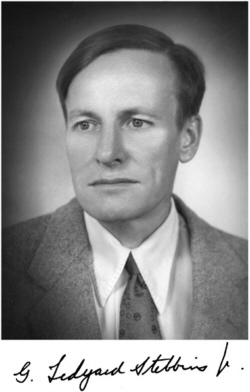
GEORGE LEDYARD STEBBINS
January 6, 1906–January 19, 2000
BY VASSILIKI BETTY SMOCOVITIS AND FRANCISCO J. AYALA
GEORGE LEDYARD STEBBINS’S most important scientific contribution was the publication in 1950 of Variation and Evolution in Plants, the last of a quartet of classic books that in the second quarter of the twentieth century set forth what became known as the synthetic theory of evolution or the modem synthesis. The other books are Theodosius Dobzhansky’s Genetics and the Origin of Species (Dobzhansky, 1937), Ernst Mayr’s Systematics and the Origin of Species (Mayr, 1942), and George Gaylord Simpson’s Tempo and Mode in Evolution (Simpson, 1944). The pervading conceit of these books is the molding of Darwin’s evolution by natural selection within the framework of rapidly advancing genetic and biological knowledge. Variation and Evolution in Plants distinctively extends the scope of the other books to the world of plants, as explicitly set in the book’s title. Dobzhansky’s perspective had been that of the geneticist and he set the tone for the others, Mayr’s that of the zoologist and systematist, and Simpson’s that of the paleontologist. All four books were outcomes of the famed Jesup Lectures at Columbia University. Plants, with their unique genetic, physiological, and evolutionary features, had been all but left completely out of the synthesis until that point. In 1941 the eminent botanist Edgar Anderson had been invited to
write botany’s analogue to Mayr’s Systematics and the Origin of the Species and to publish it jointly with Mayr’s book. Anderson did not fulfill the task, and Stebbins was thereafter invited to deliver the Jesup Lectures in 1947. Variation and Evolution in Plants, the outgrowth of the lectures, is the most important book on plant evolution of the twentieth century.
Stebbins’s scientific contributions comprise botany, genetics, and evolution (Solbrig, 1979). His research was mostly done in the field, with laboratory work focused on cytological and genetic investigation of collected plant specimens, seeking, for example, to determine the number of chromosomes or whether hybridization had occurred. In the 1970s and 1980s he became much interested in the interaction between plant development processes and their evolution. His discoveries in this area were modest, but his vision was not: By the early 1990s “evo/devo,” as this research subject has come to be known, had become one of the most active and productive areas of evolutionary research. Stebbins was an accomplished synthesizer of biological knowledge (Smocovitis, 1997). Throughout the decades he wrote numerous review articles. He was considered a master of this genre (Crawford and Smocovitis, 2004). Stebbins was elected to the National Academy of Sciences in 1952. George Ledyard Stebbins, Jr., was born on January 6, 1906, named after his father, although he preferred to be called Ledyard and dropped the “junior” from his name after his father died. He wrote about his early years:
My home background was upper middle class white protestant in New York and New England. My Father was a reasonably prosperous produce merchant and real estate owner and agent. He ran the Seal Harbor (Maine) Realty Co. for 30 years (1899-1929) and was largely responsible for the development of that summer resort on Mt. Desert Island. He also played an important role in setting aside the land that later became Acadia National Park. For
the first 8 years of my life our home was, for six months, Seal Harbor, and for the other six months Woodmere, Long Island, New York. Later, we had to spend winters in California and Colorado because of my mother’s health: She was a semi-invalid from 1914 until her death in 1952, but from 1922 (my age was 16) until 1929, I spent summers regularly in Seal Harbor. Neither parent was a naturalist, biologist or academician, but both had amateur interests in Natural History. My interest was stimulated by them as well as by a neighbor and close friend, Professor Edward S. Dana (geologist) of Yale.*
At the age of three Stebbins had already shown a marked tendency to enjoy time out of doors and developed a love of plants and natural history, but he had also begun to manifest a behavior pattern for which he later became renowned: a tendency to quick, sudden outbursts of anger, especially as a means to gain attention or win arguments. As an adult his temper tantrums became the stuff of legends and amusement among friends and acquaintances. A much repeated but probably apocryphal story had Stebbins as an adult throwing a secretary’s typewriter out the window in a fit of anger. As an adult he quickly recovered from his bursts of anger and meekly apologized, but the recovery often was much more difficult and slower for those subject to them. Distinctive traits that were expressed early also included a distaste and inability for “manual training and other occupations that required muscular coordination and manual dexterity. I was very poor at athletics and team games.”* Vestiges of his early childhood that remained with him until the end included a New England “preppie” accent and a
schoolboy sense of humor, frequently seen in his love of rhyme and silly verse.
Ledyard “attended only private schools: Lawrence School on Long Island, Polytechnic Elementary in Pasadena, CA, St. Stephens Boarding School in Colorado Springs, Colorado, and Cate School, Carpinteria, CA [near Santa Barbara].”* He later wrote that “most of my formative years (from 8 yrs. on) due to my mother’s invalid condition, were supervised by governesses or masters at boarding school. I took a considerable interest in hiking, mountain climbing and general natural history…. I was also much interested in music, and took piano lessons from the ages of 8 to 15. My lack of manual dexterity made me always a poor performer, but I grew to an avid like of and appreciation for classical music.”*
An especially important period of Ledyard’s life was the four years spent at Cate School in Santa Barbara. There he learned to ride horseback, explored the Santa Inez Mountains, and fell under the influence of the botanist Ralph Hoffmann, who taught him much about the plants and natural history of that beautiful region. In 1924 Ledyard enrolled at Harvard University, a choice dictated by family background, but also because his older brother Henry was enrolled there. At first he had difficulty defining his major, but the summer between his freshman and sophomore years, spent investigating the plants around Bar Harbor, Maine, the family home, brought him into contact with Edgar T. Wherry, professor of botany from the University of Pennsylvania and a specialist in ferns, who encouraged his botanical interests. When he enrolled for the fall semester of 1925 at Harvard, he had decided to pursue a botanical career.
He began graduate work in Harvard’s botany department in 1928. The experiences in graduate school shaped his subsequent research style. He acquired a lifelong tendency to move from one vital area of research to another as the science demanded, even when this meant overcoming practical obstacles and difficult personalities. His initial training was in floristic botany with the renowned systematist Merritt Lyndon Fernald in the Gray Herbarium. He quickly lost interest in Fernald’s outdated taxonomic methods and was disappointed by Fernald’s rigid personality. Stebbins derided his teacher as one of the “eminent exsiccatae in the Gray Herbarium.” His interests turned instead to the newer, more modern approaches of Karl Sax, who was applying cytogenetic principles to gaining a deeper understanding of plants and their reproductive processes. For his doctoral research he began anatomical and cytological studies of megasporogenesis in the ovule and microsporogenesis in the pollen of the plant genus Antennaria with the eminent morphologist and cytologist E. C. Jeffrey. He collected Antennaria easily in the nearby environs so that he could also study geographic variation in the genus; this work was satisfying, but he began to fall out with his graduate advisor. Jeffrey, who was frequently referred to as “the stormy petrel of botany,” hated with a vengeance the work of the noted plant geneticist Karl Sax and others, which emerged from the school of genetics associated with Thomas Hunt Morgan. He preferred instead the idiosyncratic hybridization theories made popular by J. P. Lotsy. Jeffrey actively campaigned against Morgan’s genetics and vigorously discouraged Ledyard from pursuing that subject.
The growing interest in genetics took on a life of its own, however, especially since plant genetics, systematics, and evolution and the zones of contact between the three were becoming exciting new areas of research in the 1920s
(Hagen, 1982, 1984). Stebbins made frequent visits to the library of Harvard’s Bussey Institution to keep up with genetics journals, such as Hereditas and Genetica, that contained articles by A. Muntzing and C. Leonard Huskins. He sought out E. M. East and other geneticists at the Bussey and took courses with W. E. Castle, although Castle’s mammalian genetics was not immediately helpful to a student of botany. Stebbins’s growing interest in the genetical literature became serious after he began to work with Karl Sax, who had recently been appointed to the Arnold Arboretum. His growing collaboration and friendship with Sax, one of the leaders of plant genetics in his generation, did not, however, sit well with Jeffrey. When Sax located a serious error of interpretation in Stebbins’s chromosomal studies in his doctoral research, Jeffrey threatened to resign from the thesis committee in retaliation for what he viewed as intrusion into his direction of a student. Stebbins was caught in the crossfire between Jeffrey and Sax. His dissertation was finally approved, thanks to judicious efforts by Ralph Wetmore and others, but it had been amended so many times to meet the demands of a squabbling committee that it bore numerous scissor and paste marks masking the “offending” passages. It still stands in the Harvard archives as a testament to the contentious Harvard personalities in the botany department of those times. The dissertation was completed in 1931 and was published as two papers in 1932. Stebbins had already published some articles on the flora of Mt. Desert Island with the assistance of Fernald in his journal Rhodora.
One of the key events in Ledyard’s early career was his attending the International Botanical Congress at Cambridge, England, in 1930. There he met Edgar Anderson, who was to become a lifetime friend and colleague, Irene Manton, and C. D. Darlington. These and other contacts greatly encouraged his interest in and enthusiasm for botany, which
was to be sustained for the rest of his life. Edgar Anderson was at the time a fellow at the John Innes Horticultural Institute. Anderson’s and Stebbins’s strong and colorful personalities complimented each other. In 1930 Anderson was about to begin his work on detecting and measuring variation patterns in plants, such as Iris, that were frequent hybridizers. He eventually went on to do pioneering work on hybridization and was the first to articulate the notion of introgressive hybridization, a phenomenon seen often in plants (Kleinman, 1999).
Stebbins spent the four years after he obtained his Ph.D. (1931-1935) at Colgate University. He later described these years as unhappy ones, one reason being the heavy teaching load assigned to him, and the other being the emphasis the school placed on its athletic program over its academic mission. Despite the difficult environment, Ledyard found time for research, concentrating on cytogenetic studies of Paeonia. He collaborated with Percy Saunders (of the Canadian Saunders family of wheat breeders) at nearby Hamilton College. Saunders was a keen collector and breeder of peonies, and his backyard was a profusion of these beautiful plants. Stebbins and Saunders engaged in chromosomal studies of hybrids of Paeonia of both Old World and New World forms. The cytogenetic work was mostly done in a makeshift laboratory in the basement of the Saunders house. This was the first of a series of essentially biosystematic investigations of diverse plant groups that dominated much of Stebbins’s subsequent research career. During this time he discovered complex structural heterozygosity in the western North American species of the genus, an exciting find that was to fuel his enthusiasm for further cytogenetic investigations.
With Saunders, Ledyard attended the 1932 International Congress of Genetics in Ithaca, New York. Stebbins later reminisced that he had seen the famous posters that Sewall
Wright had set up displaying his shifting balance theory of evolution, but he could not understand at the time what precisely they represented. Only later, after reading Dobzhansky’s Genetics and the Origin of Species, would Stebbins understand the significance of the graphs. He attended one particularly memorable session that featured Sax and the English cytogeneticist C. D. Darlington, who engaged in a heated debate about chiasma-type theory. He listened closely to Thomas Hunt Morgan’s famous address on the future of genetics. He also studied John Belling’s poster demonstration of chromomeres, which had mistakenly been identified as genes. Most exciting of all, however, was Barbara McClintock’s presentation of some of her cytological studies of maize. McClintock showed the linear pairing of parental chromosomes at the mid-prophase or pachytene of meiosis and the crossing over between chromosomes. She also demonstrated beautifully the presence of inversions and translocations. A few years later Stebbins replicated some of the same studies in Paeonia and was the first to detect chromosomal ring formation in this genus. This work was not groundbreaking, but it confirmed what McClintock and others had described (1939).
In 1935 Professor Ernest Brown Babcock of the University of California, Berkeley, offered Stebbins a research position in connection with his investigations of the genus Crepis, which he accepted cheerfully. Met at the train station by his fellow Harvard student Rimo Bacigalupi, he plunged into this project with enthusiasm. Stebbins had been recommended for the position by the Washington-based expert on the Compositae, Sidney F. Blake. At Berkeley, Stebbins began his lifetime preoccupation with Democratic politics, working actively in the 1936 Roosevelt election, and from there onward.
Babcock was engaged in an ambitious team-oriented
project to find a plant equivalent of Drosophila. Very much eclipsed by his contemporary T. H. Morgan at the California Institute of Technology, Babcock was one of the most important figures in establishing and institutionalizing genetics within the agricultural college at Berkeley. One of the first genetics departments in the country was established there, thanks to the efforts of Babcock, who was convinced that genetics generally, and agricultural genetics in particular, was a vital part of the mission of the University of California. Babcock’s vision for genetics at Berkeley was that it should rival the success of the Morgan school’s investigations with Drosophila melanogaster. He chose the genus Crepis to be the plant equivalent of Drosophila, even though it was a weed and not an important crop plant, mostly because this genus with its diverse geographic variation patterns could be used to understand the genetic basis for evolutionary change, which could then form the basis for taxonomic studies (Babcock, 1920). Preliminary work had begun as early as 1917-1918, but the project continued into the late 1940s until Babcock’s retirement. Babcock considered his monograph on the genus Crepis to be the centerpiece of his life’s work (Babcock, 1947).
Stebbins’s assignment assisting Babcock was to perform chromosome counts in some of the nearest relatives of Crepis in the tribe Cichorieae. He quickly developed an interest in Babcock’s own research with the New World species of Crepis, because he recognized patterns of evolution that resembled Antennaria and Paeonia. Like these other genera, Crepis was a commonly hybridizing group of species that displayed polyploidy and could reproduce apomictically.
In 1938 Babcock and Stebbins jointly published a monograph on the American species of Crepis. It laid the foundation for understanding polyploidy complexes and the role of apomixis in the formation of some of them; for this
reason they first termed the American species of Crepis an agamic complex. They recognized clearly that certain plant genera consisted of a complex of reproductive forms that centered on sexual diploids and that had given rise to polyploids; sometimes, as in Crepis, these were apomictic polyploids. Polyploids that combined the genetic patrimony of two species usually had a wider distribution pattern. The articulation of the polyploid complex was considered pathbreaking work at the time. Not only did it demonstrate in detail the complex interplay of apomixis, polyploidy, and hybridization in a geographic context but it also offered insights into species formation, polymorphy in apomictic forms, and knowledge of how all these complex processes could inform an accurate phylogenetic history of the genus. Stebbins extended these ideas further in articles in 1940, 1941, and 1947. “Types of Polyploids: Their Classification and Significance,” published in 1947, became a classic review article that synthesized knowledge bearing on polyploidy in plants.
In 1939 Stebbins was appointed to the faculty at Berkeley as an assistant professor in the genetics department in the College of Agriculture. Babcock, who was impressed with Ledyard’s energy and industry, was instrumental in making the appointment. Earlier Stebbins had a significant disappointment in that he had failed to obtain the replacement position for Willis Linn Jepson in the botany department, which went instead to Lincoln Constance. Although he made himself at home with the botanists at Berkeley, Stebbins’s interests were considered primarily genetic by his colleagues in botany, who did not feel that he would sufficiently focus on the curatorial work that the position demanded. The vacancy of a position in the genetics department that required the teaching of the general course on evolution was oppor-
tune for Stebbins, whose interests were shifting to the exciting areas in evolutionary genetics emerging in the late 1930s.
Stebbins’s growing interest in evolution was fueled by two additional circumstances: his association with a unique group of biologists all concerned with evolutionary approaches to systematics, who called themselves “the biosystematists,” and his special relationship with the eminent evolutionist Theodosius Dobzhansky. Beginning in the mid-1930s, the San Francisco Bay area became a hotbed for evolutionary activity. A new generation of systematists who incorporated insights from genetics and ecology had taken root in the Bay area at several institutions, notably Stanford University, the Carnegie Institution at Stanford University, the California Academy of Sciences, and the University of California, Berkeley. The biosystematists met at alternating locations every month to share in the methods and research that were characterizing the “new systematics” (Hagen, 1982, 1984). Ledyard was a prominent member of the group nearly from the start. He was active in inviting speakers, some of whom included visitors from other states, like his close friend Edgar Anderson and his fellow plant systematist at the University of California, Los Angeles, Carl Epling. The critical players in the biosystematists were the interdisciplinary Carnegie team that included the Danish genecologist Jens Clausen, the taxonomist David Keck, and the physiologist William Hiesey. By the mid-1930s this team was engaged in long-term systematic studies of patterns of variation in plants as these adapted along the steep altitudes in the California landscape. Ledyard followed this work closely and visited the team in their experimental sites at Stanford and at Mather Station near the entrance to Yosemite National Park.
The friendship with the evolutionary geneticist Theodosius Dobzhansky began in the mid-1930s. Stebbins met Dobzhansky
on a visit to the California Institute of Technology in the spring of 1936, when Dobzhansky was already engaged in investigating the genetics of natural populations using Drosophila pseudoobscura. The two interacted further when Dobzhansky frequented the Berkeley campus to see his close friend, the geneticist I. Michael Lerner (then in the poultry husbandry department). Stebbins interacted with Lerner in a fortnightly journal club called Genetics Associated. Ledyard enjoyed listening to them discuss their mutual interests in evolutionary genetics, even though Lerner and Dobzhansky frequently turned to speak in Russian. The friendship with Dobzhansky was to prove critical to Stebbins as his own interests were shifting more and more to evolutionary genetics, stimulated in part by the teaching demands made by the evolution course. Dobzhansky, who published his own pathbreaking synthesis of evolutionary genetics, Genetics and the Origin of Species in 1937, fostered Ledyard’s evolutionary interests. Through the 1940s they occasionally came in closer contact when they both met for fieldwork at the Carnegie Institution’s field site at Mather. Both were avid horseback riders.
Dobzhansky, who had moved from Caltech to Columbia University in 1940, played the single most important role influencing Stebbins’s career as an evolutionist. Columbia University invited Stebbins to deliver the prestigious Jesup Lectures at Columbia University in October and November 1946. During his stay of nearly three months, Stebbins was Dobzhansky’s house guest. Stebbins had been selected because of the need for a comprehensive synthesis of plant evolution. In 1941 Edgar Anderson had delivered the Jesup Lectures with zoologist Ernst Mayr. Mayr subsequently published his lectures under the title Systematics and the Origin of Species, but Anderson never completed his set of lectures (Kleinman, 1999). The botanist’s viewpoint was
needed in what was emerging as the new synthesis of evolutionary theory. The book version of the lectures was published by Columbia University Press in 1950 under the title Variation and Evolution in Plants. Stebbins upheld the importance of most of the tenets emerging as the new consensus on evolutionary theory and was heavily influenced by Dobzhansky’s Genetics and the Origin of Species. Stebbins stressed the centrality of natural selection but left plenty of room for random genetic drift and nonadaptive evolution, which had gained importance in the 1941 second edition of Dobzhansky’s 1937 book. Stebbins also upheld Dobzhansky and Mayr’s notion of the biological species concept (BSC), but the concept did not fit as well with plants. Weighing in at 643 pages and with a bibliography of more than 1,250 references, Variation and Evolution in Plants was the longest of the four books associated with the evolutionary synthesis. The book received instant recognition for its ambitious synthesis of a broad range of research areas, which opened up a new field of research for younger scholars who would consider themselves as plant evolutionary biologists. Of great significance is that Variation and Evolution in Plants effectively killed any serious belief in alternative mechanisms of evolution for plants, such as Lamarckian evolution or soft inheritance, which were still upheld by some botanists. Variation and Evolution in Plants has been assessed as “the most influential single book in plant systematics this century” (Raven, 1974).
Stebbins’s second most important book was Flowering Plants: Evolution Above the Species Level, published in 1974, based on the Prather Lectures he gave at Harvard, which may be seen as an update of his 1950 book. Other books included a widely adopted undergraduate textbook on evolution, Processes of Organic Evolution, which went through three editions from 1966 to 1977, and a more advanced
text written with Dobzhansky, Francisco Ayala, and James Valentine, Evolution, published in 1977. In 1965 he and Herbert Baker edited The Genetics of Colonizing Species, derived from papers presented at an Asilomar Conference. Additional books are The Basis of Progressive Evolution (1969); Chromosomal Evolution in Higher Plants (1971), which was also adopted as an advanced textbook; and his 1982 semi-popular Darwin to DNA: Molecules to Humanity. He published more than 250 scientific papers.
In 1950 Stebbins accepted an invitation from the university to establish a department of genetics at the Davis campus, which became his home until his death. He loved Davis. He remained as chairman of the genetics department until 1963. Stebbins was proud of his work at Davis, proud of the growing campus as it matured, pleased with his own contributions, and was always contented living there. He was particularly proud of having attracted to Davis from Rockefeller University in 1971 his admired friend Dobzhansky and his associate Francisco J. Ayala (Raven, 2000). He was the major professor of 33 graduate students. He enjoyed teaching undergraduate students, who received his courses with enthusiasm, which very much pleased Ledyard. He taught a popular evolution course to several hundred students every year. He was an engaging teacher. When he delivered his last lecture in 1973, a few months before retirement, he received a long standing ovation. Stebbins cared deeply about the teaching of evolution, and in the early and mid-1960s worked closely with other biologists involved in the Biological Sciences Curriculum Study (BSCS), which published textbooks for the teaching of evolution in U.S. high schools. He actively fought the rise of “scientific creationism” groups in California and in the nation. Between 1960 and 1964 he served as secretary general to the International Union of Biological Sciences.
Stebbins was also an early conservationist. In 1967, while president of the California Native Plant Society, he was influential in efforts to conserve native plants and habitats. He organized weekly field trips that got people into the habit of the conservationist’s credo of “taking nothing but pictures, leaving nothing but footprints.” In 1967 he prevented the destruction of a raised beach on the Monterey peninsula that he dubbed Evolution Hill, now called the S. F. B. Morse Botanical Area, where Stebbins said all the problems and principles of evolution could be seen played out among the plant species. Stebbins had an encyclopedic knowledge of plant taxonomy, and had particularly detailed knowledge of the flora of California, which he enjoyed displaying with students, colleagues, and friends. In the obituary published by the New York Times on January 21, 2000, one of us (F.J.A.) is quoted: “Stebbins seemed to know every plant in the world, not just scientifically, but personally.”
Stebbins retired in 1973 but remained active for 20 more years, conducting research and publishing papers and books. After retirement Professor Stebbins was visiting professor at the Universidad de Chile in Santiago in 1973, which was sponsored by the Convenio of the University of Chile and the University of California, and a visiting professor at the Australian National University in 1974, which was sponsored by the Australian American Educational Foundation. In 1975 he spent six weeks in the Soviet Union visiting scientific institutions, as a fellow of the Exchange Program, National Academy of Sciences, and the Soviet Academy of Sciences. In 1974 he was research scientist and visiting professor in Montpellier, France, sponsored by the Commission Nationale des Recherches Scientifiques (CNRS). He was also at various times visiting professor at the following institutions: Carleton College, Northfield, Minn.; San Francisco State University; Ohio State University; St. Olaf College, Northfield, Minn.;
and Universidad de Leon, Leon, Spain. Stebbins’s strong personality spilled over into his professional life. He was industrious, intensely focused, and always enthusiastic. He seemed constantly excited by some new insight that usually came out of his voracious reading. The new insight usually made its way into his latest project almost immediately. He loved following the work of younger people and supported them generously. At times he seemed almost desperate to please people who mattered to him. At other times, however, he could be self-absorbed and insensitive to the thoughts and wishes of people around him. His whole life was evolution and evolutionary botany. Working in the field, he would pay no attention to the proper time of eating or anything else. Often he would be oblivious to the world around him. An episode involving Stebbins and one of us (F.J.A.) is the following. We were collecting in Pope Valley, near Napa, and in the process we killed a rattlesnake with a stick. Not knowing what to do with it, we put it on the hood of the car we were sharing. We continued working. After it grew dark, Ayala drove the two of them back to Davis. (Ledyard was kept from driving, whenever possible, because he was prone to see some hybrid plant by the roadside and forget about keeping the car on the road.) The next morning Stebbins drove the car 60 miles to UC Berkeley, delivered a lecture, and drove it back home to Davis with no notice of the rattlesnake that was still resting on the hood. Upon his return, he told Ayala, “I think something strange is wrong with this car. When I came out of the lecture, about 30 students were standing around looking at it.”
By the second half of the 1940s Stebbins was emerging as a leader in evolutionary biology. He was an active member of the recently established Society for the Study of Evolution and became its third president in 1950. National and international recognition in the form of awards and honors
would pile up over the years. His election to the National Academy of Sciences in 1952 was followed by elections to the American Philosophical Society, the American Academy of Arts and Sciences, the Royal Swedish Academy of Sciences, the German Academia Leopoldina, and the Linnaean Society of London, among others. He received the Lewis Prize of the American Philosophical Society in 1960, the Verrill Medal of Yale University in 1967, and the Gold Medal of the Linnaean Society of London in 1973. In December 1979 he was awarded the National Medal of Science, by President Carter. In 1980 the University of California regents named a UC natural reserve in his honor, the Stebbins Cold Canyon Reserve, a 577-acre parcel about 20 miles from the Davis campus, which Stebbins received with enormous joy as well as honor, and where he frequently went to botanize until the last few years of his life.
The coming of the new millennium served as the opportunity to appreciate Stebbins’s contribution to the history of the biological sciences. In 1998 a past-president’s symposium in honor of Stebbins titled “G. Ledyard Stebbins and Evolutionary Biology in the Next Millenium” was held at the Baltimore, Maryland, meetings of the Botanical Society of America; in 1999 he was honored with a special ceremony at the banquet of the XVI International Botanical Congress in St. Louis, Missouri, where he received the American Institute of Biological Sciences Distinguished Service Award for 1999, with zoological colleague Ernst Mayr. Ledyard was able to attend this ceremony and in a moving speech delivered from the confines of his wheelchair, he reflected on a lifetime of experiences as a botanist; it was to be his last public appearance. A colloquium (“Variation and Evolution in Plants and Microorganisms: Toward a New Synthesis 50 Years After Stebbins”) sponsored by the National Academy of Sciences was held January 27-29, 2000, in Irvine, California,
at the Arnold and Mabel Beckman Center of the National Academies. The 17 papers presented at the colloquium were published in Proceedings of the National Academy of Sciences (97:6941-7057) and as a separate book (Variation and Evolution in Plants and Microorganisms) edited by F. J. Ayala, Walter M. Fitch, and Michael T. Clegg, published by the National Academy Press in 2000. The colloquium celebrated the fiftieth anniversary of the publication of Stebbins’s classic 1950 book by examining current knowledge about the same topics of the 1950 book plus some related subjects that have become subjects of investigation owing to recent advances. Ledyard, although frail for the last few years, intended to attend the colloquium. Alas, he became ill about one month before the colloquium was held and died on January 19, 2000, two weeks after his ninety-fourth birthday.
REFERENCES
Ayala, F. J., W. M. Fitch, and M. T. Clegg, eds. 2000. Variation and Evolution in Plants and Microorganisms. Toward A New Synthesis 50 Years After Stebbins. Washington, D.C.: National Academy Press.
Babcock, E. B. 1920. Crepis—A promising genus for genetic investigation. Am. Nat. 54:270-276.
Babcock, E. B. 1947. The Genus Crepis I and II. University California Publications in Botany 21 and 22.
Dobzhansky, T. 1937. Genetics and the Origin of Species. New York: Columbia University Press.
Crawford, D. J., and V. B. Smocovitis, eds. 2004. The Scientific Papers of G. Ledyard Stebbins (1929-2000). Goenigstein, Germany: Regnum Vegetabile, Koeltz Scientific Books.
Hagen, J. B. 1982. Experimental taxonomy, 1930-1950: The impact of cytology, ecology, and genetics on ideas of biological classification. Ph.D. dissertation. Oregon State University, Corvallis, Ore.
Hagen, J. B. 1984. Experimentalists and naturalists in twentieth century botany, 1920-1950. J. Hist. BioI. 17:249-270.
Kleinman, K. 1999. His own synthesis: Edgar Anderson and evolutionary theory in the 1940s. J. Hist. BioI. 32:293-320.
Smocovitis, V. 1997. G. Ledyard Stebbins, Jr. and the evolutionary synthesis (1924-1950). Am. J. Bot. 84:1625-1637.
Solbrig, O. 1979. George Ledyard Stebbins. In Topics in Plant Population Biology, ed. O. Solbrig, S. Jain, G. B. Johnson, and P. H. Raven, pp. 1-17. New York: Columbia University Press.
Raven, P. 1974. Plant systematics 1947-1972. Ann. Mo. Bot. Gard. 61:166-178.
Raven, P. H. 2000. G. Ledyard Stebbins (1906-2000): An appreciation. Proc. Natl. Acad. Sci. U. S. A. 97:6945-6969.
SELECTED BIBLIOGRAPHY
1937 With E. B. Babcock. The genus Youngia. Washington, D.C.: Carnegie Institution of Washington.
1939 With S. Ellerton. Structural hybridity in Paeonia Californica and P. brownii. J. Genet. 1-36.
With E. B. Babcock and J. Jenkins. The effect of polyploidy and apomixis on the evolution of species in Crepis. J. Hered. 30:519-530.
1940 The significance of polyploidy in plant evolution. Am. Nat. 74:54-66.
1941 Apomixis in the angiosperms. Bot. Rev. 7:507-542.
1942 With E. B. Babcock and J. A. Jenkins. Genetic evolutionary processes in Crepis. Am. Nat. 76:337-363.
1947 Types of polyploids: Their classification and significance. Adv. Genet. 1:403-429.
1950 Variation and Evolution in Plants. New York: Columbia University Press.
1954 With E. Anderson. Hybridization as an evolutionary stimulus. Evolution 8:378-388.
1957 The inviability, weakness and sterility of interspecific hybrids. Adv. Genet. 9:147-215.
Self fertilization and population variability in the higher plants. Am. Nat. 91:337-354.
1959 The role of hybridization in evolution. Proc. Am. Philos. Soc. 103:231-251.
1960 The comparative evolution of genetic systems. In Evolution after Darwin, ed. S. Tax, pp. 1-40. Chicago: University of Chicago Press.
1965 With H. Baker (eds.). The Genetics of Colonizing Species. New York: Academic Press.
1966 Chromosomal variation and evolution. Science 152:1463-1469.
Processes of Organic Evolution. Englewood Cliffs, N.J.: Prentice-Hall.
1969 The Basis of Progressive Evolution. Chapel Hill: University of North Carolina Press.
1970 Variation and evolution in plants: Progress during the past twenty years. In Essays in Evolution and Genetics in Honor of Theodosius Dobzhansky: Evolutionary Biology (Suppl), eds. M. K. Hecht and W. C. Steere, pp. 173-208. New York: Appleton-Century-Crofts.
1971 Chromosomal Evolution in Higher Plants. London: E. Arnold.
1973 Morphogenesis, vascularization and phylogeny in angiosperms. Breviora 418:1-19.
1974 Flowering Plants: Evolution above the Species Level. Cambridge, Mass.: Harvard University Press.
Adaptive shifts and evolutionary novelty: A compositionist approach. In Studies in the Philosophy of Biology, eds. F. J. Ayala and T. Dobzhansky, pp. 285-306. London and Berkeley: Macmillan/University of California Press.
1976 Chromosomes, DNA and plant evolution. Evol. BioI. 9:1-34.
1977 With T. Dobzhansky, F. J. Ayala, and J. W. Valentine. Evolution. New York: W. H. Freeman.
1980 Polyploidy in plants: Problems and prospects. In Polyploidy. Biological Relevance, ed. W. Lewis, pp. 495-518. New York: Plenum Press.
1981 With F. J. Ayala. Is a new evolutionary synthesis necessary? Science 213:967-971.
1982 Darwin to DNA: Molecules to Humanity. San Francisco: W. H. Freeman.
1985 With F. J. Ayala. The evolution of Darwinism. Sci. Am. 253:72-82.


