
Executive Summary
The Earth receives a continuous influx of energy from the Sun. Some of this energy is absorbed at the Earth’s surface or by the atmosphere, while some is reflected back to space. At the same time, the Earth and its atmosphere emit energy to space, resulting in an approximate balance between energy received and energy lost. Knowledge of the natural and anthropogenic processes that affect this energy balance is critical for understanding how Earth’s climate has changed in the past and will change in the future.
In order to advance understanding of this issue, the U.S. Climate Change Science Program asked the National Academies to examine the current state of knowledge of how the energy balance regulating Earth’s climate is modified by “forcings” including gases and aerosols, land use, and solar variability and to identify relevant research needs (see Appendix B for the full statement of task). This report provides the consensus view of the committee that was formed to undertake the study. In this report, the committee presents specific recommendations for expanding current radiative forcing concepts and metrics and outlines research priorities for exploiting these concepts and metrics as tools for climate change research and policy.
WHAT IS RADIATIVE FORCING?
Factors that drive climate change are usefully separated into forcings and feedbacks (Figure ES-1). A climate forcing is an energy imbalance imposed on the climate system either externally or by human activities.
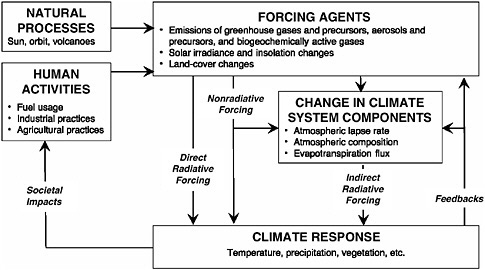
FIGURE ES-1 Conceptual framework of climate forcing, response, and feedbacks under present-day climate conditions. Examples of human activities, forcing agents, climate system components, and variables that can be involved in climate response are provided in the lists in each box.
Examples include changes in solar energy output, volcanic emissions, deliberate land modification, or anthropogenic emissions of greenhouse gases, aerosols, and their precursors. A climate feedback is an internal climate process that amplifies or dampens the climate response to a specific forcing. An example is the increase in atmospheric water vapor that is triggered by an initial warming due to rising carbon dioxide (CO2) concentrations, which then acts to amplify the warming through the greenhouse properties of water vapor. Climate forcings are usefully subdivided into direct radiative forcings, indirect radiative forcings, and nonradiative forcings. Direct radiative forcings directly affect the radiative budget of the Earth; for example, added CO2 absorbs and emits infrared (IR) radiation. Indirect radiative forcings create an energy imbalance by first altering climate system components (e.g., precipitation efficiency of clouds), which then lead to changes in radiative fluxes; an example is the effect of solar variability on stratospheric ozone. Nonradiative forcings create an energy imbalance that does not directly involve radiation; an example is the increasing evapotranspiration flux resulting from agricultural irrigation.
Studies of long-term changes in climate have emphasized global mean surface temperature as the primary index for climate change. The concept of “radiative forcing” provides a way to quantify and compare the contributions of different agents that affect surface temperature. Radiative forc-
ing traditionally has been defined as the instantaneous change in energy flux at the tropopause resulting from a change in a component external to the climate system. Many current applications use an “adjusted” radiative forcing in which the stratosphere is allowed to relax to thermal steady state, thus focusing on the energy imbalance in the Earth and troposphere system, which is most relevant to surface temperature change. Once the stratosphere has been allowed to adjust to a forcing, the change in energy flux at the tropopause is equivalent to that at the top of the atmosphere (TOA), which is how radiative forcings are commonly reported.
Figure ES-2 shows the magnitude of several important forcings as esti-
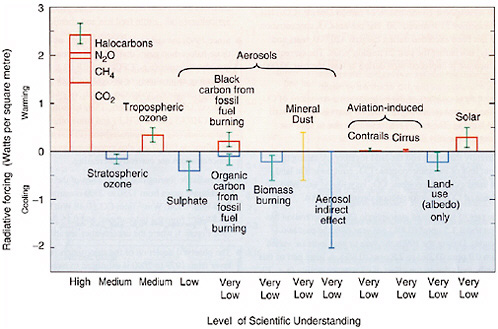
FIGURE ES-2 Estimated radiative forcing since preindustrial times for the Earth and troposphere system (TOA radiative forcing with adjusted stratospheric temperatures). The height of the rectangular bar denotes a central or best estimate of the forcing, while each vertical line is an estimate of the uncertainty range associated with the forcing, guided by the spread in the published record and physical understanding, and with no statistical connotation. Each forcing agent is associated with a level of scientific understanding, which is based on an assessment of the nature of assumptions involved, the uncertainties prevailing about the processes that govern the forcing, and the resulting confidence in the numerical values of the estimate. On the vertical axis, the direction of expected surface temperature change due to each radiative forcing is indicated by the labels “warming” and “cooling.” SOURCE: IPCC (2001).
mated in the most recent synthesis report of the Intergovernmental Panel on Climate Change (IPCC, 2001). The largest positive forcing (warming) in Figure ES-2 is from the increase of well-mixed greenhouse gases (CO2, nitrous oxide [N2O], methane [CH4], and chlorofluorocarbons [CFCs]) and amounted to 2.4 W m−2 (watts per square meter) between the years 1750 and 2000. Of the forcings shown in the figure, the radiative impact of aerosols is the greatest uncertainty.
The radiative forcing concept has been used extensively in the climate research literature over the past few decades and has also become a standard tool for policy analysis endorsed by the Intergovernmental Panel on Climate Change. For a wide range of forcings, there is a nearly linear relationship between the TOA radiative forcing and the resulting equilibrium response of global mean surface temperature as simulated in general circulation models. This allows quantitative and expedient comparison of the effects of different forcings in the past and of various possible future forcing scenarios. TOA radiative forcing is relatively easy to compute, generally robust across models, straightforward to use in policy applications, directly observable from space, and also inferable from observed changes in ocean heat content. It provides an extremely useful metric for climate change research and policy.
EXPANDING THE RADIATIVE FORCING CONCEPT
Despite all these advantages, the traditional global mean TOA radiative forcing concept has some important limitations, which have come increasingly to light over the past decade. The concept is inadequate for some forcing agents, such as absorbing aerosols and land-use changes, that may have regional climate impacts much greater than would be predicted from TOA radiative forcing. Also, it diagnoses only one measure of climate change—global mean surface temperature response—while offering little information on regional climate change or precipitation. These limitations can be addressed by expanding the radiative forcing concept and through the introduction of additional forcing metrics. In particular, the concept needs to be extended to account for (1) the vertical structure of radiative forcing, (2) regional variability in radiative forcing, and (3) nonradiative forcing. A new metric to account for the vertical structure of radiative forcing is recommended below. Understanding of regional and nonradiative forcings is too premature to recommend specific metrics at this time. Instead, the committee identifies specific research needs to improve quantification and understanding of these forcings.
Account for the Vertical Structure of Radiative Forcing
The relationship between TOA radiative forcing and surface temperature is affected by the vertical distribution of radiative forcing within the atmosphere. This effect is dramatic for absorbing aerosols such as black carbon, which may have little TOA forcing but greatly reduce solar radiation reaching the surface. It can also be important for land-use driven changes in the evapotranspiration flux at the surface, which change the energy deposited in the atmosphere without necessarily affecting the surface radiative flux. These effects can be addressed by considering surface as well as TOA radiative forcing as a metric of energy imbalance. The net radiative forcing of the atmosphere can be deduced from the difference between TOA and surface radiative forcing and may be able to provide information on expected changes in precipitation and vertical mixing. Adoption of surface radiative forcing as a new metric will require research to test the ability of climate models to reproduce the observed vertical distribution of forcing (e.g., from aircraft campaigns) and to investigate the response of climate to the vertical structure of the radiative forcing.
PRIORITY RECOMMENDATIONS:
 Test and improve the ability of climate models to reproduce the observed vertical structure of forcing for a variety of locations and forcing conditions.
Undertake research to characterize the dependence of climate response on the vertical structure of radiative forcing.
Report global mean radiative forcing at both the surface and the top of the atmosphere in climate change assessments.
Determine the Importance of Regional Variation in Radiative Forcing
Regional variations in radiative forcing may have important regional and global climatic implications that are not resolved by the concept of global mean radiative forcing. Tropospheric aerosols and landscape changes have particularly heterogeneous forcings. To date, there have been only limited studies of regional radiative forcing and response. Indeed, it is not clear how best to diagnose a regional forcing and response in the observational record; regional forcings can lead to global climate responses, while global forcings can be associated with regional climate responses. Regional diabatic heating can also cause atmospheric teleconnections that influence regional climate thousands of kilometers away from the point of forcing. Improving societally relevant projections of regional climate impacts will require a better understanding of the magnitudes of regional forcings and the associated climate responses.
PRIORITY RECOMMENDATIONS:
Use climate records to investigate relationships between regional radiative forcing (e.g., land-use or aerosol changes) and climate response in the same region, other regions, and globally.
Quantify and compare climate responses from regional radiative forcings in different climate models and on different timescales (e.g., seasonal, interannual), and report results in climate change assessments.
Determine the Importance of Nonradiative Forcings
Several types of forcings—most notably aerosols, land-use and land-cover change, and modifications to biogeochemistry—impact the climate system in nonradiative ways, in particular by modifying the hydrological cycle and vegetation dynamics. Aerosols exert a forcing on the hydrological cycle by modifying cloud condensation nuclei, ice nuclei, precipitation efficiency, and the ratio between solar direct and diffuse radiation received. Other nonradiative forcings modify the biological components of the climate system by changing the fluxes of trace gases and heat between vegetation, soils, and the atmosphere and by modifying the amount and types of vegetation. No metrics for quantifying such nonradiative forcings have been accepted. Nonradiative forcings have eventual radiative impacts, so one option would be to quantify these radiative impacts. However, this approach may not convey appropriately the impacts of nonradiative forcings on societally relevant climate variables such as precipitation or ecosystem function. Any new metrics must also be able to characterize the regional structure in nonradiative forcing and climate response.
PRIORITY RECOMMENDATIONS:
Improve understanding and parameterizations of aerosol-cloud thermodynamic interactions and land-atmosphere interactions in climate models in order to quantify the impacts of these nonradiative forcings on both regional and global scales.
Develop improved land-use and land-cover classifications at high resolution for the past and present, as well as scenarios for the future.
Provide Improved Guidance to the Policy Community
The radiative forcing concept is used extensively to inform climate policy discussions, in particular to compare the relative impacts of forcing agents. For example, integrated assessment models use radiative forcing as input to simple climate models, which are linked with socioeconomic models that predict economic damages from climate impacts and costs of various response strategies. The simplified climate models generally focus on global mean surface temperature, ignoring regional temperature changes
and other societally relevant aspects of climate, such as rainfall or sea level. Incorporating these complexities is evidently needed in policy analysis. It is important to communicate the expanded forcing concepts as described in this report to the policy community and to develop the tools that will make their application useful in a policy context.
PRIORITY RECOMMENDATION:
Encourage policy analysts and integrated assessment modelers to move beyond simple climate models based entirely on global mean TOA radiative forcing and incorporate new global and regional radiative and nonradiative forcing metrics as they become available.
ADDRESSING KEY UNCERTAINTIES
The radiative forcing since preindustrial times by well-mixed greenhouse gases is well understood. However, there are major gaps in understanding of the other forcings, as well as of the link between forcings and climate response. Error bars remain large for current estimates of radiative forcing by ozone, and are even larger for estimates of radiative forcing by aerosols. Nonradiative forcings are even less well understood. The following recommendations identify critical research avenues that should be persued immediately with high priority.
Conduct Accurate Long-Term Monitoring of Radiative Forcing Variables
The most important step for improving understanding of forcings is to obtain a robust record of radiative forcing variables, both in the past and into the future. A robust observational record is essential for improved understanding of the past and future evolution of climate forcings and responses. Existing observational evidence from surface-based networks, other in situ data (e.g., aircraft campaigns, ocean buoys), remote sensing platforms, and a range of proxy data sources (e.g., tree rings, ice cores) has enabled substantial progress in understanding, but there remain important shortcomings. The observational evidence needs to be more complete both in terms of the spatiotemporal and electromagnetic spectral coverage and in terms of the quantities measured. Long-term monitoring of forcing and other climate variables at much improved accuracy is needed to detect and understand future changes. In addition, surface-based observational networks for the detection of long-term changes in climate variables need to be improved, notably by accounting for local changes (e.g., in land use and vegetation dynamics). Long-term, accurate observations of changes in the heat content of the oceans are also needed as a continuous record of globally averaged radiative forcing.
PRIORITY RECOMMENDATIONS:
Continue observations of climate forcings and variables without interruption for the foreseeable future in a manner consistent with established climate monitoring principles (e.g., adequate cross-calibration of successive, overlapping datasets).
Develop the capability to obtain benchmark measurements (i.e., with uncertainty significantly smaller than the change to be detected) of key parameters (e.g., sea level altimetry, solar irradiance, and spectrally resolved, absolute radiance to space).
Conduct highly accurate measurements of global ocean heat content and its change over time.
Advance the Attribution of Decadal to Centennial Climate Change
Establishing relationships between past climate changes and known natural and anthropogenic forcings provides information on how such forcings may impact large-scale climate in the future. Instrumental records extend back about 150 years at best. Comparisons of observed surface temperatures with those simulated using reconstructions of the past forcings have yielded important insights into the roles of various natural and anthropogenic factors governing climate change. However, the shortness of the instrumental record limits the confidence with which climate change since preindustrial times can be attributed to specific forcings. Proxy records obtained from ice cores, sediments, tree rings, and other sources provide a critical tool for extending knowledge of forcings and effects further back in history. The lack of proxy climate data in certain key regions is a major limitation. Such regional information is important in evaluating the potential roles of changes in modes of climate variability, such as the El Niño/ Southern Oscillation (ENSO).
PRIORITY RECOMMENDATIONS:
Develop a best-estimate climate forcing history for the past century to millennium.
Using an ensemble of climate models, simulate the regional and global climate response to the best-estimate forcings and compare to the observed climate record.
Reduce Uncertainties Associated with Indirect Aerosol Radiative Forcing
The interaction between aerosols and clouds can lead to a number of indirect radiative effects that arguably represent the greatest uncertainty in current radiative forcing assessments. In the so-called first indirect aerosol
effect, the presence of aerosols leads to clouds with more but smaller particles; such clouds are more reflective and therefore have a negative radiative forcing. These smaller cloud droplets can also decrease the precipitation efficiency and prolong cloud lifetime; this is known as the second indirect aerosol effect. The so-called semidirect aerosol effect occurs when absorption of solar radiation by soot leads to an evaporation of cloud droplets. A number of research avenues hold promise for improving understanding of indirect and semidirect aerosol effects and for better constraining estimates of their magnitude. These include fundamental research on the physical and chemical composition of aerosols, aerosol activation, cloud microphysics, cloud dynamics, and subgrid-scale variability in relative humidity and vertical velocity.
PRIORITY RECOMMENDATION:
Improve understanding and parameterizations of the indirect aerosol radiative and nonradiative effects in general circulation models using process models, laboratory measurements, field campaigns, and satellite measurements.
Better Quantify the Direct Radiative Effects of Aerosols
Aerosols have direct radiative effects in that they scatter and absorb both shortwave and longwave radiation. Knowledge of direct radiative forcing of aerosols is limited to a large extent by uncertainty about the global distributions and mixing states of aerosols. Mixing states have major implications on aerosol optical properties that are not well understood and are difficult to parameterize in climate models. Small-scale variability of humidity and temperature, which has a major impact on aerosol optical properties, is also difficult to represent in models. Mechanisms of aerosol production are not understood, so the effects of future changes in emissions and climate are highly uncertain. Removal of aerosols from the atmosphere occurs mainly by wet deposition, but model parameterizations of this process are highly uncertain and rudimentary in their coupling to the hydrological cycle.
PRIORITY RECOMMENDATIONS:
Improve representation in global models of aerosol microphysics, growth, reactivity, and processes for their removal from the atmosphere through laboratory studies, field campaigns, and process models.
Better characterize the sources and the physical, chemical, and optical properties of carbonaceous and dust aerosols.
Better Quantify Radiative Forcing by Ozone
Ozone is a major greenhouse gas. The greatest uncertainty in quantifying this forcing lies in reconstructing ozone concentrations in the past and projecting them into the future. Global modeling of tropospheric ozone remains a major challenge because of the complex coupling between photochemical and transport processes. The inability of models to reproduce ozone trends over the twentieth century suggests that there could be large errors in current estimates of natural ozone levels and the sensitivity of ozone to human influence. These errors could relate to emissions of precursors, chemical processes, and stratospheric influence. Lightning emissions of nitrogen oxides are particularly uncertain and play a major role in ozone production in the middle and upper troposphere where the radiative effect is maximum. Transport of ozone between the stratosphere and troposphere greatly affects upper tropospheric concentrations in a manner that is still poorly understood.
PRIORITY RECOMMENDATION:
Improve understanding of the transport of ozone in the upper troposphere and lower stratosphere region and the ability of models to describe this transport.
Integrate Climate Forcing Criteria in Environmental Policy Analysis
Policies designed to manage air pollution and land use may be associated with unintended impacts on climate. Increasing evidence of health effects makes it likely that aerosols and ozone will be the targets of stricter regulations in the future. To date, control strategies have not considered the potential climatic implications of emissions reductions. Regulations targeting black carbon emissions or ozone precursors would have combined benefits for public health and climate. However, because some aerosols have a negative radiative forcing, reducing their concentrations could actually increase radiative warming. Policies associated with land management practices could also have inadvertent effects on climate. The continued conversion of landscapes by human activity, particularly in the humid tropics, has complex and possibly important consequences for regional and global climate change as a result of changes in the surface energy budget.
PRIORITY RECOMMENDATIONS:
Apply climate models to the investigation of scenarios in which aerosols are significantly reduced over the next 10 to 20 years and for a range of cloud microphysics parameterizations.
Integrate climate forcing criteria in the development of future policies for air pollution control and land management.


