
2
Activities and Membership
FIRST QUARTER HIGHLIGHTS
The Space Studies Board (SSB) held its 142nd meeting on March 16-18, 2004, at the National Academies’ Keck Center in Washington, D.C. One major topic for discussion was the administration’s fiscal year 2005 budget proposal and its implications for space research and applications. Guest speakers included David Radzanowski, Office of Management and Budget (OMB); William Jeffrey, Office of Science and Technology Policy (OSTP); David Goldston, Bill Adkins, and Richard Obermann, House Science Committee staff; and Michelle Burkett, House Appropriations Committee staff.
A NASA overview of the budget and the new Vision for Space Exploration were presented by John Schumacher, Gary Martin, and Doug Comstock. Edward Weiler, NASA Office of Space Science, spoke on the implications for the space science program and on the Hubble Space Telescope (HST). He reported that the National Academies will be asked to do a study on how to keep the HST going as long as possible. Ghassem Asrar, NASA Office of Earth Science; Mary Kicza, NASA Office of Biological and Physical Research; Douglas Cook, NASA Office of Exploration Systems; and Colleen Hartman, National Oceanic and Atmospheric Administration (NOAA) National Environmental Satellite, Data, and Information Service, also spoke on programs of their offices as well as on the 2005 budget. Other special guests during the meeting included Mike Moore, NASA HST program executive, and Steven Beckwith, director of the Space Telescope Science Institute, who discussed HST lifetime and servicing issues. A luncheon splinter group meeting addressed international issues of interest to the SSB. Graham Gibbs, Canadian Space Agency; Masato Koyama, Japanese Aerospace Exploration Agency; Frederic Nordlund, European Space Agency; and Ian Pryke, George Mason University, discussed international views on NASA’s new space exploration goals.
Chair Lennard Fisk reported on his testimony to the Aldridge Moon-Mars Commission and to the House Science Committee and on his attendance at the NASA Advisory Council and the Aeronautics and Space Engineering Board meetings during the week prior to the Board meeting.
The Board discussed task statements for a number of new studies and also reviewed the status of ongoing studies and committee activities.
SECOND QUARTER HIGHLIGHTS
The Space Studies Board held its 143rd meeting on June 15-17 at the NOAA Space Environment Center in Boulder, Colorado. A major agenda item for this meeting was a series of progress reports by committee chairs and National Research Council (NRC) staff members and SSB review of the status of all projects that are being conducted under SSB auspices.
NOAA staff presented a series of briefings and tours at the NOAA SEC. Ernest Hildner and Barbara Poppe’s presentations were on NOAA’s Space Weather Program; Joseph Kunches’ presentation was “Predicting Extreme Events: The Halloween Storms of 2003”; and Howard Singer’s presentation was “Research and Development at SEC.” Marc Allen from NASA Headquarters provided an update on lunar mission and exploration planning. A special highlight was the Web telecast of the press conference on the Report of the President’s Commission on Implementation of United States Space Exploration Policy. Board member Meg Urry gave a science presentation on her work on supermassive black holes, and member Hap McSween briefed the Board on new results from the Mars Exploration Rovers.
Planning for the Executive Committee meeting on August 24-26 and the next Board meeting on November 17-19 also took place. Farewells were said to several retiring members: J. Roger Angel; James L. Burch, chair of the Committee on Solar and Space Physics; Howard M. Einspahr; Steven H. Flajser; Michael H. Freilich, chair of the Committee on Earth Studies; Don P. Giddens; Bruce D. Marcus; Robert Serafin; Mitchell Sogin; and C. Megan Urry.
Board staff members continue to work with the Board and other NRC staff to broaden our pool of qualified candidates from underrepresented minority populations who can be nominated to serve on study committees formed under the aegis of the Board. In keeping with this commitment, an SSB staff member attended the NASA 2004 Chicago Diversity Workshop in June. From this workshop we successfully identified candidates who could be considered for membership on forthcoming study committees.
THIRD QUARTER HIGHLIGHTS
The Space Studies Board did not meet during the third quarter; however, the SSB Executive Committee did meet on August 24-26 at the National Academies’ J. Erik Jonsson Woods Hole Center in Woods Hole, Massachusetts, for its annual strategic planning session. In addition to a general discussion with Al Diaz, the new NASA associate administrator for science, topics during the meeting included a review of roles and operations of the Board and its committees, several studies in progress, international topics, future SSB membership, potential new study projects, as well as planning for the November Board meeting.
FOURTH QUARTER HIGHLIGHTS
SSB held its 144th meeting on November 17-19, at the National Academies’ Beckman Center in Irvine, California. The meeting provided a venue for wide-ranging discussions of guiding principles and major roles for science in the context of NASA’s new vision for space exploration. The meeting included presentations by and discussions with Al Diaz, NASA associate administrator for science, and Charles Elachi, director of the Jet Propulsion Laboratory and NASA director of advanced planning. Gerhard Haerandel, chair of the European Space Science Committee, Laurie Leshin, who served on the President’s Commission on Implementation of United States Space Exploration Policy, and SSB member Radford Byerly, who was rapporteur for the report on the 2003 NRC space policy workshop, all gave background presentations to provide perspectives for the discussions. Various SSB members also provided summary overviews of recent relevant NRC science strategy reports for consideration at the meeting. Following open plenary sessions on November 17-18, the Ad Hoc Committee on the Scientific Context for Space Exploration, consisting of the SSB members present plus Laurie Leshin and U.S. COSPAR representative Edward Stone, met in closed session to outline a draft report. The report was sent to NRC external review in mid-December, and was released in the first quarter of 2005.
Other items covered at the meeting included the SSB’s annual bias and conflict of interest discussion, reviews of ongoing and potential new SSB studies, and plans for the spring meeting.
PERFORMANCE MEASURES
A summary of all reports published by the Space Studies Board during 2004 is presented in Table 2.1. Included in that collection were reports of interest to the NASA science offices and to the National Science Foundation (NSF) and NOAA. The reports included four full-length studies, two workshop reports, two letter reports, and a special publication for lay audiences.
TABLE 2.1 Space Studies Board Reports Published in 2004
|
Report Title |
Authoring Committee or Boarda |
Principal Agency Audienceb |
||||
|
SMD |
ExSMD |
NOAA |
NSF |
Other |
||
|
“Assessment of Options for Extending the Life of the Hubble Space Telescope,” Letter Report (July 13) |
TG |
X |
X |
|
|
|
|
Assessment of Options for Extending the Life of the Hubble Space Telescope: Final Report |
TG |
X |
X |
|
|
|
|
Exploration of the Outer Heliosphere and the Local Interstellar Medium: A Workshop Report |
CSSP |
X |
|
|
X |
|
|
Issues and Opportunities Regarding the U.S. Space Program: A Summary Report of a Workshop on National Space Policy |
SSB |
X |
X |
|
|
X |
|
Plasma Physics of the Local Cosmos |
CSSP |
X |
|
|
X |
|
|
“Review of Science Requirements for the Terrestrial Planet Finder: Letter Report” (September 23) |
TG |
X |
|
|
|
|
|
Solar and Space Physics and Its Role in Space Exploration |
TG |
X |
X |
|
|
X |
|
Space Studies Board Annual Report—2003 |
SSB |
|
|
|
|
All |
|
Understanding the Sun and Solar System Plasmas: Future Directions in Solar and Space Physics [booklet] |
CSSP |
X |
X |
X |
X |
X |
|
Utilization of Operational Environmental Satellite Data: Ensuring Readiness for 2010 and Beyond |
TG |
X |
|
X |
|
|
|
aAuthoring committee or board |
||||||
|
CES |
Committee on Earth Studies |
|
CSSP |
Committee on Solar and Space Physics |
|
SSB |
Space Studies Board |
|
TG |
Ad Hoc Task Group |
|
bPrincipal agency audience |
|
SMD |
NASA Science Mission Directorate |
|
ExSMD |
NASA Exploration Systems Mission Directorate |
|
NOAA |
National Oceanic and Atmospheric Administration |
|
NSF |
National Science Foundation |
|
|
Except for the Space Studies Board Annual Report—2003 and the illustrated booklet Understanding the Sun and Solar System Plasmas: Future Directions in Solar and Space Physics, all reports were subjected to full peer review overseen by the NRC Report Review Committee (RRC). Typically from 4 to 7 reviewers (occasionally as many as 12) are selected, on the basis of recommendations by NAS and NAE section liaisons and SSB members and staff and subject to approval by the NRC. The identities of external reviewers are not known to the report’s authors until after the review has been completed and the report has been approved by the RRC. The report authors, with the assistance of SSB staff, must provide some response to every specific comment from every external reviewer. The response-to-review process is overseen and refereed by an independent coordinator, to ensure that appropriate technical revisions are made to the report, and by a monitor appointed by the RRC, to ensure that the revised report complies with NRC policy and standards. All of the reviews place an emphasis on scientific and technical clarity and accuracy and on proper substantiation of the findings and recommendations presented in the report. Names of
TABLE 2.2 Experts Involved in the SSB and Its Subunits, January 1, 2004, to December 31, 2004
|
|
Number of Board and Committee Members |
Number of Institutions or Agencies Represented |
|
Academia |
174 |
67 |
|
Government and national facilitiesa |
22 |
13 |
|
Private industry |
53 |
30 |
|
Nonprofit and otherb |
27 |
16 |
|
276 |
126 |
|
|
aIncludes NASA and other U.S. agencies and national facilities (e.g., Los Alamos National Laboratory (LANL), National Institute of Standards and Technology (NIST), U.S. Geological Survey (USGS), NOAA). bOther includes foreign institutions and entities not classified elsewhere. cIncludes 33 NAS, NAE, IOM members. dThirty-seven SSB members, 239 committee and task group members. |
||
TABLE 2.3 Summary of Participation in Space Studies Board Activities, January 1, 2004, to December 31, 2004
|
|
Academia |
Government and National Facilitiesa |
Private Industry |
Nonprofit and Others |
Total Individuals |
|
Board/committee members |
174 |
22 |
53 |
27 |
276 |
|
Guest experts |
42 |
87 |
18 |
31 |
178 |
|
Reviewers |
40 |
10 |
6 |
5 |
61 |
|
Workshop participants |
25 |
20 |
4 |
11 |
60 |
|
Total |
281 |
139 |
81 |
74 |
575 |
|
NOTE: Counts of individuals are subject to an uncertainty of ±3 due to possible miscategorization. aIncludes government agencies and national facilities (e.g., National Optical Astronomy Observatory (NOAO), LANL, National Radio Astronomy Observatory, Space Telescope Science Institute). |
|||||
|
Total number of NAS, NAE, and/or IOM members |
45 |
|
Total number of non-U.S. participants |
10 |
|
Total number of countries represented, incl. United States |
6 |
|
Total number of participants by gender |
346(M); 74(F) |
|
Total number of different institutions represented |
|
|
Academia |
75 |
|
Government and national facilities |
21 |
|
Industry |
40 |
|
Nonprofit and other |
29 |
|
U.S. government agencies represented: NASA, NOAA, NSF, NIST, USGS, Environmental Protection Agency (EPA), OSTP, OMB, Smithsonian Institution, U.S. Congress. |
the external reviewers, including the coordinator and monitor, are published in the final report, but their individual comments are not released.
Another important measure of the capacity of the Board to produce high-quality work derives from the size, breadth, and depth of the cadre of experts who serve on SSB committees and task groups or who participate in other ways in the activities of the Board. Some highlights of the demographics of the SSB in 2004 are presented in Tables 2.2 and 2.3. During the year, a total of 276 individuals from 67 colleges and universities and 59 other public or private organizations served as formally appointed members of the Board and its committees and task groups. Over 200 individuals participated in SSB activities either as presenters or as invited workshop participants. The report review process is as important as the writing of reports, and during the period 60 different external reviewers contributed to critiques of draft reports. Overall, approximately 575 individuals from 75 academic institutions, 69 industry or nonprofit organizations, and 21 government agencies or offices participated in SSB activities. That number included 45 elected members of the NAS, NAE, and/or the Institute of Medicine (IOM). Being able to draw on such a broad base of expertise is a unique strength of the NRC advisory process.
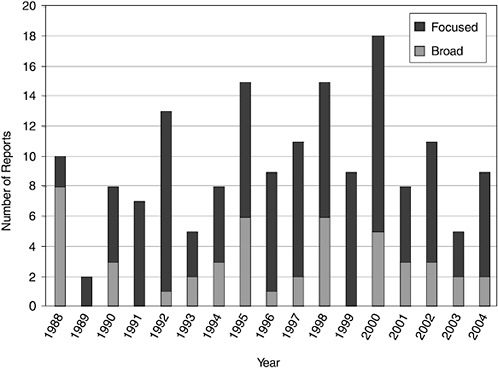
A different way to assess the performance of the SSB is to examine its productivity with respect to study reports. The chart in Figure 2.1 shows the total number of peer-reviewed reports published by the SSB from 1988 to 2004. “Broad” reports include classical scientific strategies (long-range goals and priorities in a particular discipline or set of disciplines) and programmatic strategies or analyses that cross all of an agency office or even several agencies. “Focused” reports include more narrowly directed topical studies, assessments, and letter reports.
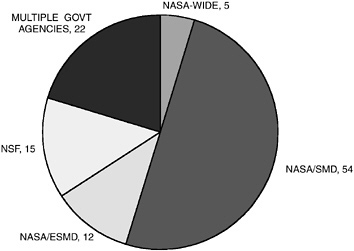
Finally, one can also examine the extent to which the Board’s efforts have been relevant to the full range of government interests in civilian space research. Figure 2.2 summarizes the principal federal agency audiences to which SSB reports were directed from 1998 through 2004. Reports on NASA-wide issues were addressed to multiple NASA offices or the whole agency; reports on SMD issues to the Science Mission Directorate (created in 2004 from the consolidation of the former Office of Space Science and Office of Earth Science); reports on ExSMD issues to the Exploration Systems Mission Directorate (formerly the Office of Biological and Physical Research). The “multiple government agencies” category covers reports that were directed to one or more agencies besides NASA—for example, NOAA, NSF, the Department of Energy (DOE), and/or the Department of Defense (DOD). One also sees a few reports prepared specifically for NSF. Within NASA, SMD has been the leading sponsor of reports.
SSB OUTREACH AND DISSEMINATION
Enhancing outreach to a variety of interested communities and improving dissemination of Board reports was a special priority for the SSB during the year. The quarterly newsletter’s print distribution list was expanded and supplemented with an electronic version that continued to attract over 300 subscribers at year’s end. Several kinds of report announcements, fliers, and mailing list sign-up cards were designed and used at SSB committee meetings and national and international scientific society meetings. The Board teamed with other NRC units (including the Division on Earth and Life Studies, the Board on Physics and Astronomy, the National Academies Press, the Office of News and Public Information, the Proceedings of the National Academy of Sciences, and the Office of Scientific and Engineering Personnel) to take exhibits to national meetings of the American Geophysical Union (AGU) and the American Astronomical Society. Popular versions of two recent decadal surveys (the Solar System Exploration Survey and the Solar and Space Physics Survey) were shipped to Native American schools in Wisconsin. In addition to these schools, NASA Explorer Schools and Science Outreach Centers affiliated with several universities continue to request the popular versions. As a consequence of these activities, roughly 6,000 additional SSB reports were distributed.
Membership of the Space Studies Board
Lennard A. Fisk,§ University of Michigan (chair)
George A. Paulikas,§ The Aerospace Corporation (retired) (vice chair)
J. Roger P. Angel,§* University of Arizona
Daniel N. Baker, University of Colorado, Boulder
Ana P. Barros,§ Duke University
Reta F. Beebe, New Mexico State University
Roger D. Blandford, Stanford University
James L. Burch,* Southwest Research Institute
Radford Byerly, Jr.,§ University of Colorado, Boulder
Judith A. Curry, Georgia Institute of Technology
Howard M. Einspahr,* Bristol-Myers Squibb Pharmaceutical Research Institute (retired)
Jack D. Farmer, Arizona State University
Steven H. Flajser,* Loral Space and Communications Ltd.
Michael Freilich,* Oregon State University
Don P. Giddens,* Georgia Institute of Technology/Emory University
Jacqueline N. Hewitt, Massachusetts Institute of Technology
Donald E. Ingber, Harvard Medical School
Ralph H. Jacobson,§ Charles Stark Draper Laboratory (retired)
Tamara E. Jernigan, Lawrence Livermore National Laboratory
Margaret G. Kivelson,§ University of California, Los Angeles
Calvin W. Lowe, Bowie State University
Bruce D. Marcus,* TRW (retired)
Harry Y. McSween, Jr., University of Tennessee
Berrien Moore III, University of New Hampshire
Norman P. Neureiter, Texas Instruments (retired)
Suzanne Oparil, University of Alabama, Birmingham
Ronald F. Probstein, Massachusetts Institute of Technology
Dennis W. Readey, Colorado School of Mines
Anna-Louise Reysenbach, Portland State University
Roald Z. Sagdeev, University of Maryland, College Park
Carolus J. Schrijver, Lockheed Martin Solar and Astrophysics Laboratory
Robert J. Serafin,* National Center for Atmospheric Research
Mitchell Sogin,* Marine Biological Laboratory
Harvey D. Tananbaum, Smithsonian Astrophysical Observatory
C. Megan Urry,* Yale University
J. Craig Wheeler, University of Texas, Austin
A. Thomas Young, Lockheed Martin Corporation (retired)
Edward C. Stone, California Institute of Technology (ex officio, U.S. representative to COSPAR)
William W. Hoover, U.S. Air Force (retired) (ex officio, chair of the Aeronautics and Space Engineering Board)
Gerhard Haerendel, International University Bremen (liaison, chair of the European Space Science Committee)
Joseph K. Alexander, Director
Betty C. Guyot, Administrative Officer
Barbara S. Akinwole, Information Management Associate
Vern Menkir, Financial Associate
Christina O. Shipman, Financial Associate
Richard Leshner, Research Associate (through July 9, 2004)
Claudette K. Baylor-Fleming, Senior Program Assistant
Catherine A. Gruber, Assistant Editor
Membership of the Ad Hoc Committee on the Scientific Context for Space Exploration
Lennard A. Fisk, University of Michigan (chair)
Daniel N. Baker, University of Colorado
Ana P. Barros, Duke University
Reta F. Beebe, New Mexico State University
Roger D. Blandford, Stanford University
Radford Byerly, Jr., University of Colorado
Donald E. Ingber, Harvard Medical School
Tamara E. Jernigan, Lawrence Livermore National Laboratory
Margaret G. Kivelson, University of California, Los Angeles
Laurie Leshin, Arizona State University
Suzanne Oparil, University of Alabama, Birmingham
George A. Paulikas, The Aerospace Corporation (retired)
Ronald F. Probstein, Massachusetts Institute of Technology
Dennis W. Readey, Colorado School of Mines
Edward C. Stone, California Institute of Technology
Harvey D. Tananbaum, Smithsonian Astrophysical Observatory
J. Craig Wheeler, University of Texas, Austin
A. Thomas Young, Lockheed Martin Corporation (retired)
Joseph K. Alexander, Study Director
David H. Smith, Senior Program Officer
Claudette K. Baylor-Fleming, Senior Program Assistant
COMMITTEE ON ASTRONOMY AND ASTROPHYSICS
The Committee on Astronomy and Astrophysics (CAA) did not meet during the first quarter but instead prepared for upcoming meetings and a NASA-requested review of the scientific goals for the Terrestrial Planet Finder (TPF) mission. The TPF mission was recommended by the 2000 astronomy and astrophysics decadal survey, Astronomy and Astrophysics in the New Millennium. As a result, the Panel to Review the Science Requirements for the Terrestrial Planet Finder was tasked with producing a brief letter report that reviews NASA’s current scientific objectives for the TPF mission by conducting an independent scientific assessment as to whether these objectives remain consistent with the priority given to the mission by the Astronomy and Astrophysics Survey Committee. Other topics studied were the implementation of the decadal survey report’s theory recommendations, interagency cooperation on a Joint Dark Energy Mission (JDEM), and effects of the new NASA exploration vision on the astronomy program.
The CAA panel to review the science goals of the TPF mission met on May 18 in Washington, D.C. Mike Brown of the California Institute of Technology, Jim Kasting of Pennsylvania State University, and Ben Oppenheimer of the American Museum of Natural History provided the committee with extended knowledge in certain key areas. The committee heard presentations on recent decisions on TPF science, technology for finding and characterizing Earth-like planets, and the status of the TPF project.
CAA did not meet during the third quarter, but several projects that were organized under its auspices passed key milestones. The letter report on the TPF mission was delivered to NASA on September 23, 2004. The committee also began work on organizing a group to prepare a document that will help interested lay audiences appreciate research to understand the origins of galaxies, stars, and planets.
CAA met on November 30-December 1, in Irvine, California. The committee examined plans for the Advanced Technology Solar Telescope as presented by Thomas Rimmele and Steve Keil of the National Solar Observatory. A science talk from Alan Title helped the committee place the instrument in its scientific context. Other topics were the Laser Interferometer Space Antenna (LISA) and the Laser Interferometer Gravitational-Wave Observatory (LIGO) Scientific Collaboration, presented by Tom Prince and Albert Lazzarini, respectively (both from Caltech). In addition, the committee heard program updates from the astronomy divisions at the NSF and NASA.
A new ad hoc committee, the Committee on Review of Progress in Astronomy and Astrophysics Toward the Decadal Vision, was established to begin review of the scientific discoveries and technical advances in astronomy and astrophysics over the 5 years since the publication of the 2000 decadal survey. The committee will address the implications of recent scientific and technical developments as well as changes in the federal program and assess progress toward realizing the vision for the field articulated in the decadal survey and the report Connecting Quarks with the Cosmos. Chaired by Meg Urry, the committee’s first meeting was October 23-24 in Washington, D.C. The report is planned for early in 2005.
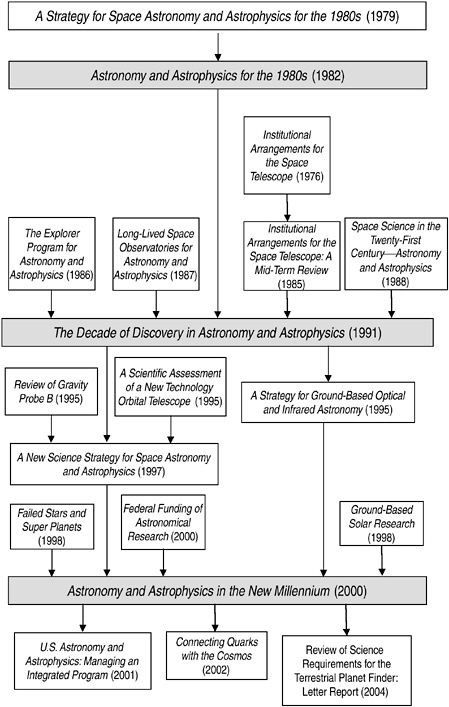
A historical summary of reports from CAA and related committees is presented in Figure 2.3.
CAA Membership
Roger D. Blandford, Stanford University (co-chair)
C. Megan Urry, Yale University (co-chair)
Wendy L. Freedman,* Observatories of the Carnegie Institution of Washington (co-chair)
Charles Alcock, University of Pennsylvania
Donald Backer, University of California, Berkeley
Lars Bildsten, University of California, Santa Barbara
Thomas J. Bogdan, National Center for Atmospheric Research
John E. Carlstrom,* University of Chicago
Richard S. Ellis,* California Institute of Technology
Alexei Filippenko, University of California, Berkeley
Andrea Ghez,* University of California, Los Angeles
Timothy M. Heckman, Johns Hopkins University
David J. Hollenbach, NASA Ames Research Center
Chryssa Kouveliotou, NASA Marshall Space Flight Center
Stephan Meyer, University of Chicago
Eve Ostriker, University of Maryland
Frazer N. Owen,* National Radio Astronomy Observatory
Mark J. Reid, Harvard-Smithsonian Center for Astrophysics
Scott Tremaine, Princeton University
Jean L. Turner, University of California, Los Angeles
Charles E. Woodward, University of Minnesota
Brian Dewhurst, Study Director
Celeste Naylor, Senior Program Assistant
Membership of the Committee on Review of Progress in Astronomy and Astrophysics Toward the Decadal Vision
C. Megan Urry, Yale University (chair)
Lars Bildsten, University of California, Santa Barbara
Roger D. Blandford, Stanford University
John E. Carlstrom, University of Chicago
Neal J. Evans, University of Texas at Austin
Jacqueline N. Hewitt, Massachusetts Institute of Technology
Craig James Hogan, University of Washington
John P. Huchra, Harvard-Smithsonian Center for Astrophysics
Christopher F. McKee, University of California, Berkeley
Anneila I. Sargent, California Institute of Technology
Sara Seager, Carnegie Institution of Washington
Charles E. Woodward, University of Minnesota, Minneapolis
COMMITTEE ON PLANETARY AND LUNAR EXPLORATION
The Committee on Planetary and Lunar Exploration (COMPLEX) met on March 3-5 at the National Academies’ Keck Center in Washington, D.C., devoting the meeting to advanced planning and preparation for the forthcoming study on priorities for space science enabled by nuclear power and propulsion. In addition, the committee heard presentations on the current status of NASA’s Solar System Exploration and Mars Exploration programs and on the formation of NASA’s new Exploration Systems Office.
COMPLEX’s planned June meeting was cancelled so that committee members could assist with the activities of the Committee on Space Science Priorities Enabled by Nuclear Power and Propulsion.
COMPLEX’s final meeting of 2004 was held on October 20-22 at New Mexico State University in Las Cruces, New Mexico. The meeting was devoted to preparing material, requested by the Space Studies Board, on the impact of NASA’s new exploration vision on solar system decadal science priorities. In addition, the committee heard presentations on the current status of NASA’s Solar System, Lunar, and Mars Exploration programs. NASA representatives Marc Allen and Doug McCuistion briefed the members on the proposed roadmap for the coming year. Members continue to offer assistance with PI-led missions and the panels of the Committee on Priorities for Space Science Enabled by Nuclear Power and Propulsion as requested.
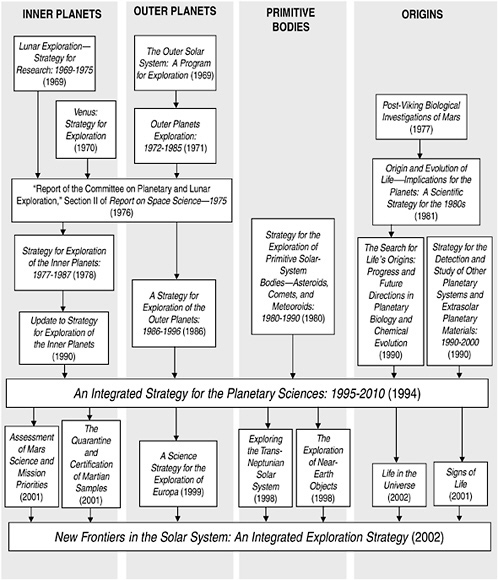
A historical summary of reports from COMPLEX and related committees is presented in Figure 2.4.
COMPLEX Membership
Reta F. Beebe, New Mexico State University (chair)
Stephen W. Bougher, University of Michigan
Michael E. Brown, California Institute of Technology
William D. Cochran, University of Texas, Austin
Robert Farquhar, Johns Hopkins University
Martha S. Gilmore, Wesleyan University
William B. Hubbard, University of Arizona
Krishan Khurana, University of California, Los Angeles
Thomas R. Spilker, Jet Propulsion Laboratory
David H. Smith, Study Director
Rodney N. Howard, Senior Program Assistant
TASK GROUP ON EXPLORING ORGANIC ENVIRONMENTS IN THE SOLAR SYSTEM
The Task Group on Exploring Organic Environments in the Solar System (TGOESS), a joint committee under the auspices of COMPLEX, COEL, and the Board on Chemical Sciences and Technology, continued work on finalizing its report Exploring Organic Environments in the Solar System, which looks at the sources, location, and history of organic carbon in the solar system. TGOESS did not meet during 2004; however, the report will be released in 2005.
TGOESS Membership
James P. Ferris, Rensselaer Polytechnic Institute (chair)
Luann Becker, University of California, Santa Barbara
Kristie A. Boering, University of California, Berkeley
George D. Cody, Carnegie Institution of Washington
G. Barney Ellison, University of Colorado
John M. Hayes, Woods Hole Oceanographic Institution
Robert E. Johnson, University of Virginia
William Klemperer, Harvard University
Karen J. Meech, University of Hawaii, Honolulu
Keith S. Noll, Space Telescope Science Institute
Martin Saunders, Yale University
David H. Smith, Study Director, Space Studies Board
Sandra J. Graham, Study Director, Space Studies Board
Christopher K. Murphy, Senior Program Officer, Board on Chemical Sciences and Technology
Rodney N. Howard, Senior Program Assistant
COMMITTEE ON THE ORIGINS AND EVOLUTION OF LIFE
The Committee on the Origins and Evolution of Life (COEL), a joint activity between the Space Studies Board and the Board on Life Sciences, met on January 26-28 in Tucson, Arizona. The majority of the meeting was devoted to work on The Astrophysical Context of Life. In addition, the committee heard presentations on planetary protection issues, NASA’s Phoenix mission to Mars in 2007, the activities of the NASA Astrobiology Institute (NAI) Titan Focus Group, and the research being performed by the University of Arizona node of NAI. Committee members also toured the University of Arizona’s Mirror Laboratory and other research facilities.
During the second quarter, COEL and the Task Group on the Limits of Organic Life in Planetary Systems (LIMITS) jointly hosted a workshop in Washington, D.C., on May 10-12. The meeting served as a forum for experts in the fields of terrestrial and martian evolution, along with research scientists specializing in the icy moons Europa (Jupiter) and Titan (Saturn). Both satellites are thought to be the best locations, along with Mars, to discover evidence of water, which might hold the key to forms of life. Following the workshop, both committees convened separately to discuss matters pertaining to their respective statements of task.
During the third quarter, COEL did not meet, but work on The Astrophysical Context of Life continued. A complete draft of the report was assembled in late April and sent to nine external reviewers in early May. Revisions to the draft report responding to reviewers’ comments were completed in mid-August, and the report was approved for release in October.
COEL’s final meeting of 2004 was held October 11-13 at the National Academies’ Beckman Center in Irvine, California. The meeting was devoted to a variety of presentations on the current status of NASA’s Mars exploration activities. In addition, the committee received an update on NASA’s Astrobiology program and on the activities of the University of Hawaii lead NAI center.
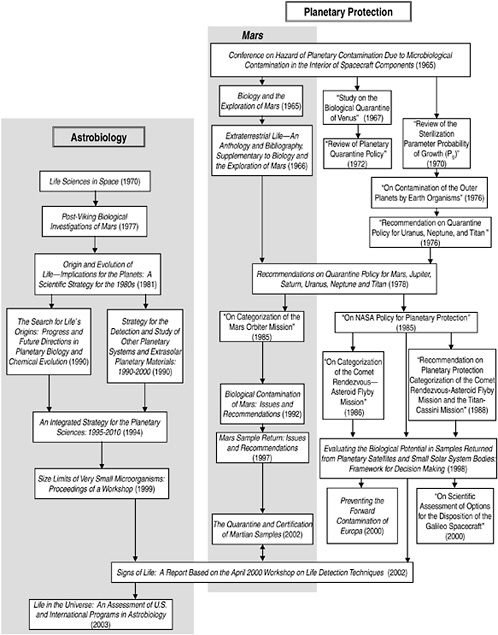
A historical summary of reports from COEL and related committees is presented in Figure 2.5.
COEL Membership
Jack W. Szostak, Massachusetts General Hospital (co-chair)
J. Craig Wheeler, University of Texas, Austin (co-chair)
Steven A. Benner,* University of Florida
Joseph A. Berry,* Carnegie Institution of Washington
Ruth Blake, Yale University
Wendy M. Calvin,* University of Nevada, Reno
Michael Daly, Uniformed Services University of the Health Sciences
Katherine H. Freeman,* Pennsylvania State University
Johann P. Gogarten,* University of Connecticut
James F. Kasting,* Pennsylvania State University
Anthony Keefe, Archemix Corporation
Martin Keller, Diversa Corporation
Sandra Pizzarello,* Arizona State University
Janet Siefert, Rice University
Roger Summons, Massachusetts Institute of Technology
Neville J. Woolf, University of Arizona
Lucy M. Ziurys,* University of Arizona
Pascale Ehrenfreund, European Space Science Committee Liaison
David H. Smith, Study Director
Robert L. Riemer, Senior Program Officer
Rodney N. Howard, Senior Program Assistant
TASK GROUP ON THE LIMITS OF ORGANIC LIFE IN PLANETARY SYSTEMS
During the second quarter, COEL and the Task Group on the Limits of Organic Life in Planetary Systems (LIMITS) jointly hosted a workshop in Washington, D.C., on May 10-12. LIMITS met September 28-30 at the University of Colorado’s Laboratory for Atmospheric and Space Physics in Boulder, Colorado. The meeting was devoted to drafting an outline of the task group’s report and initial discussion of conclusions and recommendations. LIMITS did not meet during the fourth quarter.
LIMITS Membership
John A. Baross, University of Washington (chair)
Steven A. Benner, University of Florida
George D. Cody, Carnegie Institution of Washington
Shelley Copley, University of Colorado, Boulder
Norman R. Pace, University of Colorado
James H. Scott, Carnegie Institution of Washington
Robert Shapiro, New York University
Mitchell L. Sogin, Marine Biological Laboratory
Jeffrey L. Stein, Quorex Pharmaceuticals
Roger Summons, Massachusetts Institute of Technology
Jack W. Szostak, Massachusetts General Hospital
David H. Smith, Study Director
Rodney N. Howard, Senior Program Assistant
COMMITTEE ON SOLAR AND SPACE PHYSICS
The Committee on Solar and Space Physics (CSSP) met on January 13-15 at the National Academies’ Beckman Center in Irvine, California. Most of the meeting was devoted to response to external review of Exploration of the Outer Heliosphere and the Local Interstellar Medium: A Workshop Report. The committee also completed a first draft of a popularization of the decadal survey in solar and space physics (The Sun to the Earth—and Beyond: A Decadal Research Strategy in Solar and Space Physics, 2002) to be distributed to a broad audience that includes federal policy makers, students, and the public. Also during the meeting, the committee was briefed on Project Prometheus by Krishan Khurana, University of California, Los Angeles, and later developed its contribution to a new SSB-led study on priorities for space science enabled by nuclear power and propulsion. The committee finalized its contribution to another SSB-led study, “PI-led Missions in the Space Sciences: Lessons Learned.” In addition, the committee developed plans for a workshop on distributed arrays of small instruments.
On February 6, a prepublication version of Plasma Physics of the Local Cosmos was delivered to NASA.
On March 18, CSSP chair Jim Burch and Solar and Space Physics Survey Committee chair Lou Lanzerotti briefed the staff of the House Space and Aeronautics Subcommittee, focusing on implementation of the priorities outlined in the 2002 decadal survey in solar and space physics. As a result of this briefing and discussions with NASA, the committee made plans to examine the role of Office of Space Science’s Sun-Earth Connections (SEC) program in supporting NASA’s space exploration initiative and analyze how to best align SEC activities in the near future with those recommended in the decadal survey.
During the second quarter, CSSP met April 26-29 at Southwest Research Institute in Boulder, Colorado, May 26-27 at the National Academies’ Keck Center in Washington, D.C., and June 8-10 at the National Academies’ Woods Hole, Massachusetts, conference facility. These meetings examined the role of NASA’s Office of Space Sciences SEC program in supporting NASA’s new vision for space exploration and analyzed how to best align SEC activities in the near future with those recommended in the recently completed decadal survey. At the June meeting, the committee met in conjunction with the June 8-9 DASI workshop, which was chaired by CSSP member John Foster.
During the third quarter, CSSP completed and delivered prepublication versions of two reports: Solar and Space Physics and Its Role in Space Exploration and Exploration of the Outer Heliosphere and the Local Interstellar Medium: A Workshop Report. In addition, the committee also began work on its draft report from the DASI workshop, scheduled to be released in 2005. Finally, the committee completed work on a richly illustrated booklet, Understanding the Sun and Solar System Plasmas: Future Directions in Solar and Space Physics, that is intended to make the results of the solar and space physics decadal survey accessible to the general public.
CSSP welcomed its new chair Daniel Baker, director and researcher at the Laboratory for Atmospheric and Space Physics at the University of Colorado, Boulder. Baker replaces James Burch from the Southwest Research Institute, whose highly successful tenure included a central role in the organization and execution of the 2002 decadal survey, The Sun to the Earth—and Beyond: A Decadal Research Strategy in Solar and Space Physics.
During the fourth quarter, CSSP met on October 28-29 at the National Academies’ Keck Center in Washington, D.C. Richard Fisher, deputy director of NASA’s Sun-Earth System Division, and Richard Behnke, head of NSF’s Upper Atmosphere Research Section, provided updates for the committee on their respective agency programs. Much of the meeting was devoted to reviewing the progress of ongoing studies being conducted under CSSP auspices, planning for future studies, and support that the committee will provide for NRC reviews of NASA’s strategic roadmaps in 2005. The final edited version of the report Solar and Space Physics and Its Role in Space Exploration was published during this quarter. Work continued of the draft report of the DASI workshop, to be completed in early 2005. CSSP’s new publication for lay audiences, Understanding the Sun and Solar System Plasmas: Future Directions in Solar and Space Physics, was completed in early December. The 40-page, richly illustrated document was distributed for the first time at the fall AGU meeting in San Francisco, California, along with copies of a new CD-ROM collection of recent CSSP reports.
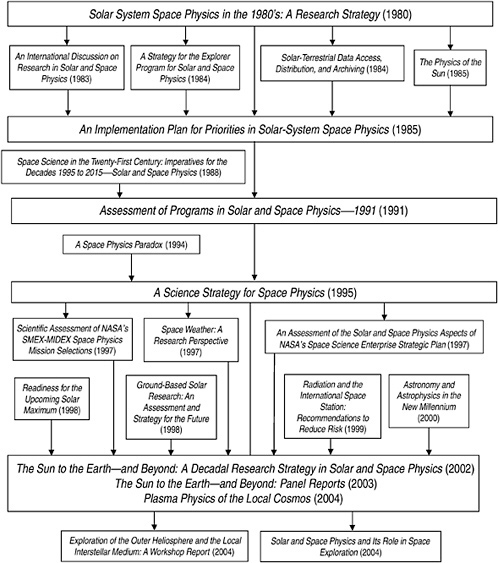
A historical summary of reports from CSSP and related committees is presented in Figure 2.6.
CSSP Membership
Daniel N. Baker, University of Colorado, Boulder (chair)
James L. Burch,* Southwest Research Institute (chair)
Claudia J. Alexander, Jet Propulsion Laboratory
Vassilis Angelopoulos, University of California, Berkeley
Anthony Chan, Rice University
Andrew F. Cheng, Johns Hopkins University
James F. Drake, Jr.,* University of Maryland, College Park
John C. Foster, Massachusetts Institute of Technology
Stephen A. Fuselier,* Lockheed Martin Advanced Technology Center
Sarah Gibson, National Center for Atmospheric Research
Jack R. Jokipii, University of Arizona
Paul M. Kintner, Cornell University
Craig Kletzing,* University of Iowa
William S. Lewis, Southwest Research Institute
Dana W. Longcope, Montana State University
Gang Lu, National Center for Atmospheric Research
Barry H. Mauk, Johns Hopkins University
Frank B. McDonald,* University of Maryland, College Park
Eugene N. Parker,* University of Chicago (retired)
Robert W. Schunk,* Utah State University
Howard J. Singer, National Oceanic and Atmospheric Administration
Leonard Strachan, Jr., Harvard-Smithsonian Center for Astrophysics
Niescja Turner, Florida Institute of Technology
Gary P. Zank,* University of California, Riverside
Thomas H. Zurbuchen University of Michigan
Arthur A. Charo, Study Director
Theresa M. Fisher, Senior Program Assistant
Membership of the Ad Hoc Committee on Distributed Arrays of Small Instruments for Research and Monitoring in Solar-Terrestrial Physics: A Workshop
James L. Burch, Southwest Research Institute (chair)
Claudia J. Alexander, Jet Propulsion Laboratory
Vassilis Angelopoulos, University of California, Berkeley
Anthony Chan, Rice University
James F. Drake, Jr., University of Maryland, College Park
John C. Foster, Massachusetts Institute of Technology
Stephen Fuselier, Lockheed Martin Advanced Technology Center
Sarah Gibson, National Center for Atmospheric Research
Craig Kletzing, University of Iowa
Gang Lu, High Altitude Observatory at National Center for Atmospheric Research
Barry H. Mauk, Johns Hopkins University, Applied Physics Laboratory
Eugene N. Parker, University of Chicago (retired)
Robert W. Schunk, Utah State University
Gary P. Zank, University of California, Riverside
Membership of the Committee on the Assessment of the Role of Solar and Space Physics in NASA’s Space Exploration Initiative
Fran Bagenal, University of Colorado, Chair
Claudia J. Alexander, Jet Propulsion Laboratory
James L. Burch, Southwest Research Institute
Anthony Chan, Rice University
James F. Drake, University of Maryland
John C. Foster, Massachusetts Institute of Technology
Stephen A. Fuselier, Lockheed Martin Advanced Technology Center
Sarah Gibson, National Center for Atmospheric Research
Roderick A. Heelis, University of Texas at Dallas
Craig Kletzing, University of Iowa
Louis J. Lanzerotti, New Jersey Institute of Technology
Gang Lu, National Center for Atmospheric Research
Barry H. Mauk, Johns Hopkins University
Terrance G. Onsager, National Oceanic and Atmospheric Administration
Eugene N. Parker, University of Chicago, Professor Emeritus
Membership of the Ad Hoc Committee on the Exploration of the Outer Heliosphere: A Workshop*
James L. Burch, Southwest Research Institute (chair)
Claudia J. Alexander, Jet Propulsion Laboratory
Vassilis Angelopoulos, University of California, Berkeley
Anthony Chan, Rice University
Andrew F. Cheng, Johns Hopkins University
James F. Drake, Jr., University of Maryland, College Park
John C. Foster, Massachusetts Institute of Technology
Stephen A. Fuselier, Lockheed Martin Advanced Technology Center
Sarah Gibson, National Center for Atmospheric Research
Craig Kletzing, University of Iowa
Gang Lu, National Center for Atmospheric Research
Barry H. Mauk, Johns Hopkins University
Frank B. McDonald, University of Maryland, College Park
Eugene N. Parker, University of Chicago (retired)
Robert W. Schunk, Utah State University
Gary P. Zank, University of California, Riverside
COMMITTEE ON EARTH STUDIES
The Committee on Earth Studies (CES) did not meet during the year; however, members were working on a number of activities. During the first quarter CES assisted in planning a major new study on Earth science and applications from space (ESAS). The final version of the report Steps to Facilitate Principal-Investigator-Led Earth Science Missions was delivered to NASA and published in the second quarter. Several members also responded to congressional queries regarding the future of the Tropical Rainfall Measuring Mission (TRMM). The committee continued to revise its report Extending the Effective Lifetimes of Earth Observing Research Missions. The report release is planned for early 2005.
The Committee on Earth Science and Applications from Space was established to conduct a major new study to address the following tasks:
-
Review the status of the Earth sciences to assess recent progress in resolving major scientific questions.
-
Develop a consensus of the top-level scientific questions that should provide the focus for Earth and environmental observations in the period 2005-2015.
-
Survey the principal federal- and state-level users of these observations and identify opportunities and challenges to the exploitation of the data generated by Earth observations from space.
-
Recommend a prioritized list of flight missions and supporting activities within NASA and NOAA to support national needs for research and monitoring of the dynamic Earth system during the decade 2005-2015. In addition to elucidating the fundamental physical processes that underlie the interconnected issues of climate and global change, these needs include weather forecasting, seasonal climate prediction, aviation safety, natural resources management, agricultural assessment, homeland security, and infrastructure planning.
-
Identify important directions that should influence planning for the decade beyond 2015.
The study will address critical technology development requirements and opportunities; needs and opportunities for establishing and capitalizing on partnerships between NASA and NOAA and other public and private entities; and the human resource aspects of the field involving education, career opportunities, and public outreach. A minor but important part of the study is the review of complementary initiatives of other nations in order to identify potential cooperative programs. The 2-year study will generate consensus recommendations regarding a systems approach to space-based and ancillary observations that encompasses the research programs of NASA, the related operational programs of NOAA, and associated programs such as Landsat, a joint initiative of USGS and NASA. Planning meetings were held in April and May.
An initial step in the study was a planning workshop held on August 23-25, 2004 in Woods Hole, Massachusetts. In preparation for a workshop, a letter from co-chairs Berrien Moore and Richard Anthes was sent to nearly 100 scientific community leaders, requesting input on how to set directions for the study. The responses to the committee’s request for input from the scientific community were discussed at the August 23-25 meeting. This meeting was attended by some 50 researchers and representatives from NASA, NOAA, and the USGS. Agency representatives at the meeting included NASA science associate administrator Al Diaz and science deputy administrator Ghassem Asrar. NOAA representatives included the administrator, Conrad C. Lautenbacher, Jr., and David L. Johnson, director of the National Weather Service.
The study will be carried out by the committee and seven thematically organized panels: (1) Earth science applications and societal objectives; (2) land use change, ecosystem dynamics, and biodiversity; (3) weather; (4) climate variability and change; (5) water resources and the global hydrologic cycle; (6) human health and security; and (7) solid-earth dynamics, natural hazards, and resources.
The committee held its first meeting November 8-9 at the National Academies’ Keck Center in Washington, D.C. During the meeting, the committee heard from representatives of NASA, NOAA, USGS, and the House Science Committee about their needs and expectations with respect to the study. Committee co-chairs Richard Anthes and Berrien Moore hosted a well-attended town-meeting discussion about the survey at the fall AGU meeting in San Francisco. The committee has established a Web site at http://qp.nas.edu/decadalsurvey, where interested members of the community can stay up to date with the study and provide views to the committee. The study is being led by the SSB, but it is benefiting from collaboration and assistance from other units in the NRC, especially the Board on Atmospheric Sciences and Climate, the Board on Earth Studies and Resources, the Ocean Studies Board, and the Coordinating Committee on Global Change.
CES Membership
Michael Freilich, Oregon State University (chair)
Antonio J. Busalacchi, Jr., University of Maryland, College Park
Carol Anne Clayson, Florida State University
William B. Gail, Ball Aerospace and Technologies Corporation
William C. Gibson, Southwest Research Institute
Sarah T. Gille, Scripps Institution of Oceanography
Ross N. Hoffman, Atmospheric and Environmental Research, Inc.
Bruce D. Marcus, TRW, Inc. (retired)
Steven W. Running, University of Montana, Missoula
Robert A. Shuchman, Altarum, Inc.
Roy W. Spencer, University of Alabama, Huntsville
William Stoney, Mitretek Corporation
Jan Svejkovsky, Ocean Imaging, Inc.
Kurt Thome, University of Arizona
John Townshend, University of Maryland, College Park
Arthur A. Charo, Study Director
Theresa M. Fisher, Senior Program Assistant
Membership of the Committee on Earth Science and Applications from Space
Richard A. Anthes, University Corporation for Atmospheric Research (co-chair)
Berrien Moore III, University of New Hampshire (co-chair)
James G. Anderson, Harvard University
Susan K. Avery, University of Colorado, Boulder
Eric J. Barron, Pennsylvania State University
Otis B. Brown, Jr., University of Miami
Susan L. Cutter, University of South Carolina
William B. Gail, Vexcel Corporation
Bradford H. Hager, Massachusetts Institute of Technology
Anthony Hollingsworth, European Centre for Medium-Range Weather Forecasts (retired)
Kathryn A. Kelly, University of Washington
Neal F. Lane, Rice University
Dennis P. Lettenmaier, University of Washington
Aram M. Mika, Lockheed Martin Space Systems Company
Warren M. Washington, National Center for Atmospheric Research
Mark L. Wilson, University of Michigan
Mary Lou Zoback, U.S. Geological Survey
Arthur A. Charo, Study Director, Space Studies Board
Anne Linn, Senior Program Officer, Board on Earth Sciences and Resources
Theresa M. Fisher, Senior Program Assistant, Space Studies Board
COMMITTEE ON SPACE BIOLOGY AND MEDICINE
The Committee on Space Biology and Medicine (CSBM) was not active in 2004 except for various tracking and dissemination activities, providing requested materials and information on prior reports, and developing a journal article for publication. NRC staff provided assistance in organizing a study with the Institute of Medicine and the Aeronautics and Space Engineering Board to conduct an independent assessment of NASA’s Bioastronautics Critical Path Roadmap.
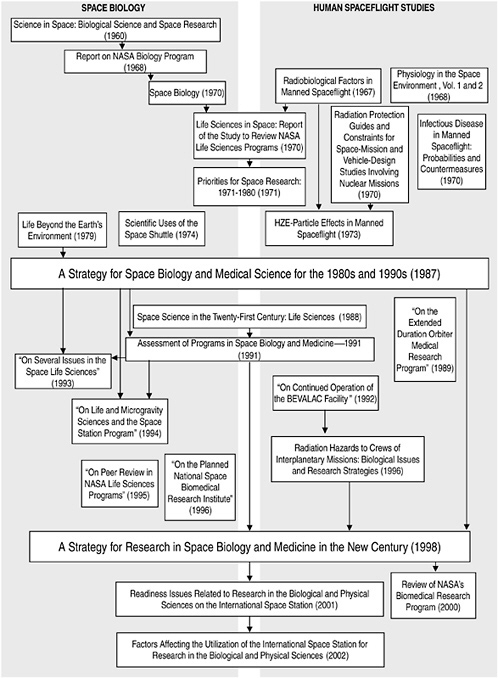
A historical summary of reports from CSBM and related committees is presented in Figure 2.7.
CSBM Membership
Donald E. Ingber, Harvard Medical School (chair)
Sandra J. Graham, Study Director
Celeste Naylor, Senior Program Assistant
COMMITTEE ON REVIEW OF NASA’S BIOASTRONAUTICS CRITICAL PATH ROADMAP
The Committee on Review of NASA’s Bioastronautics Critical Path Roadmap is a joint committee organized under the auspices of the Institute of Medicine (IOM) Board on Health Sciences Policy with assistance from the Space Studies Board and the Aeronautics and Space Engineering Board.
Membership of the Committee on Review of NASA’S Bioastronautics Critical Path Roadmap
David E. Longnecker, University of Pennsylvania Health System (chair)
James P. Bagian, Veterans Health Administration
Elizabeth R. Cantwell, Lawrence Livermore National Laboratory
Valerie J. Gawron, Veridian Corporation
Christopher Hart, Federal Aviation Administration
Charles E. Land, National Cancer Institute
Daniel R. Masys, University of California, San Diego
Bruce McCandless, Lockheed Martin Space Systems Company
Tom S. Neuman, University of California, San Diego
Thomas F. Oltmanns, Washington University
Lawrence A. Palinkas, University of California, San Diego
James Pawelczyk, Pennsylvania State University
Bruce Rabin, University of Pittsburgh Medical Center
Karlene H. Roberts, University of California, Berkeley
Carol Scott-Conner, University of Iowa Hospitals and Clinics
Margaret Rhea Seddon, Vanderbilt University Medical Center
Jay R. Shapiro, Kennedy Krieger Institute
Thomas R. Ten Have, University of Pennsylvania School of Medicine
Lisa M. Vandemark, Staff Officer, Institute of Medicine
Sandra J. Graham, Senior Staff Officer, Space Studies Board
COMMITTEE ON MICROGRAVITY RESEARCH
The Committee on Microgravity Research (CMGR) was not active during 2004, except for various tracking and dissemination activities such as providing requested materials and information on prior reports. CMGR is awaiting NASA feedback regarding a proposed task to develop a physical sciences research strategy that would enable advanced exploration technology development. The committee chair, Dennis Readey, proposed some restructuring of the committee to reflect recent changes in the content of NASA’s microgravity program.
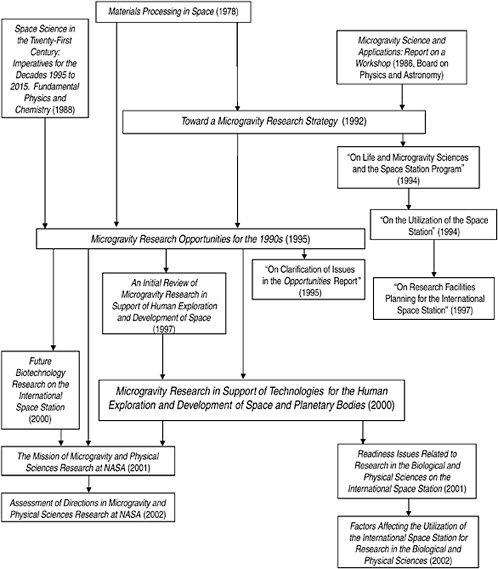
A historical summary of reports from CMGR and related committees is presented in Figure 2.8.
CMGR Membership
Dennis W. Readey, Colorado School of Mines (chair)
Cristina H. Amon,* Carnegie Institute of Technology
Howard R. Baum,* National Institute of Standards and Technology
Jayavant P. Gore,* Purdue University
John L. Hall,* University of Colorado
Michael Jaffee,* Medical Device Concept Laboratory
Jan D. Miller,* University of Utah
G.P. Peterson,* Rensselaer Polytechnic Institute
Peter Staudhammer,* TRW, Inc.
Sandra J. Graham, Study Director
Celeste Naylor, Senior Program Assistant
COMMITTEE ON ENVIRONMENTAL SATELLITE DATA UTILIZATION
The Committee on Environmental Satellite Data Utilization (CESDU) held its final writing meeting on February 17 at the National Academies’ Keck Center in Washington, D.C. Its report, Utilization of Operation Environmental Satellite Data: Ensuring Readiness for 2010 and Beyond, concerns such topics as the likely multiplicity of uses of environmental data collected by operational environmental satellites, the likely interfaces between the data provider (principally the National Oceanic and Atmospheric Administration as the satellite system operator) and the range of data users, the implications of these interfaces in terms of data management activities, and approaches to secure the engagement of the science and applications community in successfully dealing with the challenges identified in the topics above.
Preparation of Utilization of Operation Environmental Satellite Data: Ensuring Readiness for 2010 and Beyond continued during the second quarter. Prepublication copies were delivered to NASA and NOAA on September 2. Committee chair Allen Huang briefed NASA and NOAA on September 7. Dissemination of the printed report began on December 9.
CESDU Membership
Hung-Lung Allen Huang, University of Wisconsin-Madison (chair)
Philip E. Ardanuy, Raytheon Information Technology and Scientific Services
John R. Christy, University of Alabama
James Frew, University of California, Santa Barbara
Susan B. Fruchter, Smithsonian Institution
Aris P. Georgakakos, Georgia Institute of Technology
Ying-Hwa (Bill) Kuo, University Corporation for Atmospheric Research
David S. Linden, DSL Consulting, Inc.
Kevin P. Price, University of Kansas
Steven W. Running, University of Montana
Marijean T. Seelbach, QuakeFinder
Thomas H. Vonder Haar, Colorado State University
Robert A. Weller, Woods Hole Oceanographic Institution
Robert L. Riemer, Study Director
Richard Leshner, Research Associate
Rosalyn A. Pertzborn, Assistant to Chair, University of Wisconsin-Madison
Claudette K. Baylor-Fleming, Senior Program Assistant
COMMITTEE ON PREVENTING THE FORWARD CONTAMINATION OF MARS
The Committee on Preventing the Forward Contamination of Mars (PREVCOM) held its first meeting on February 26-27 at the National Academies’ Keck Center in Washington, D.C. The meeting focused on obtaining an overview of planetary protection and on understanding the statement of task for the study. John Rummel, NASA’s
planetary protection officer, provided an overview of NASA’s Planetary Protection Program and the COSPAR Planetary Protection Program. Other briefings to the committee covered the 1992 National Research Council (NRC) study Biological Contamination of Mars: Issues and Recommendations; planetary protection for the Mars Spirit and Opportunity rovers; methods for detecting bioload on spacecraft; and an overview of the NASA Mars program and recent science results. The committee also heard about issues relevant to preventing forward contamination of Mars; lessons learned from planetary protection on the Beagle 2 rover of the Mars Express mission; and lessons learned from planetary protection for the Viking landers.
During the second quarter, PREVCOM held its second meeting on May 5-7 at Diversa Corporation in San Diego, California, to obtain data and information for the report, develop a preliminary outline for the report, identify preliminary conclusions and recommendations, and discuss assignments for drafting the report. The committee held a miniworkshop that included speakers on microbial contamination on Viking missions and recent Mars rovers; measurement techniques and molecular methods for detecting life; new methods and instrumentation for detecting life; organic contamination and the Astrobiology Field Laboratory; the Mars Advanced Radar for Subsurface and Ionospheric Sounding (MARSIS) on the European Space Agency’s Mars Express spacecraft; the SHAllow RADar (SHARAD) that will fly on the Mars Reconnaissance Orbiter (MRO); life detection experiments for Mars and sensitive techniques in the search for life; and work on radioisotope thermoelectric generators and melting ice. Eric Mathur, vice president of scientific affairs at Diversa and a member of the PREVCOM, led the committee and visitors on a tour of Diversa.
On the second day, the committee heard presentations on planetary protection and human missions to Mars and theory and evidence for the distribution of water on Mars: the Mars Odyssey mission’s Gamma Ray Spectrometer (GRS) observations of hydrogen and water on the near surface; ground-penetrating radar as applied to the search for ground-water and ground ice; nucleic-acid-based techniques for microbial discovery; high-throughput cultivation; and microbial diversity research at the Jet Propulsion Laboratory (JPL). The committee devoted the remainder of its meeting to preparing a preliminary outline for the report, deliberating on key issues, identifying gaps, and discussing the schedule.
PREVCOM held its third meeting on August 3-5 at the Search for the Extraterrestrial Intelligence (SETI) Institute in Mountain View, California, to conduct final data-gathering efforts, deliberate on its findings, and to work on a first draft of the committee’s report. Topics included a geographic information system (GIS) to aid decision making on Mars planetary protection; the search for life on Mars and the implications of planetary protection on life detection; sterilization techniques and their potential application for spacecraft; and research projects and plans to explore methods for bioburden reduction at JPL. The committee also toured the SETI Institute.
During the fourth quarter, PREVCOM held a splinter group meeting with five members on November 8-10 at the National Academies’ Beckman Center in Irvine, California, to revise the draft report. External review, approval, and release of the report are planned for the first quarter of 2005.
PREVCOM Membership
Christopher F. Chyba, Stanford University (chair)
Stephen Clifford, Lunar and Planetary Institute
Alan Delamere, Ball Aerospace and Technologies Corporation
Martin S. Favero, Johnson & Johnson
Eric J. Mathur, Diversa Corporation
John C. Niehoff, Science Applications International Corporation
Gian Gabriele Ori, Universitá d’Annunzio
David A. Paige, University of California, Los Angeles
Ann Pearson, Harvard University
John C. Priscu, Montana State University
Margaret S. Race, SETI Institute
Mitchell Sogin, Marine Biological Laboratory
Cristina Takacs-Vesbach, University of New Mexico
Pamela L. Whitney, Study Director
Carmela J. Chamberlain, Senior Program Assistant
COMMITTEE ON ASSESSMENT OF OPTIONS TO EXTEND THE LIFE OF THE HUBBLE SPACE TELESCOPE
The Committee on Assessment of Options to Extend the Life of the Hubble Space Telescope held its first meeting on June 1-3 in Washington, D.C., and met again on June 22-24. This joint SSB and Aeronautics and Space Engineering Board study was tasked to consider issues of safety of use of the space shuttle for servicing with an astronaut crew, feasibility of robotic servicing approaches, the impacts of servicing options on the scientific capability of the HST, and risk/benefit relationships between servicing options that are deemed acceptable.
During the third quarter, the committee’s third meeting, on July 12-14, at the National Academies’ Keck Center in Washington, D.C., was devoted to development of the final committee report and briefings related to that effort. The committee heard presentations from NASA on planning for a robotic servicing option and on recent analyses of lifetime expectancies for Hubble components such as batteries and fine guidance sensors. Representatives of the Defense Advanced Research Projects Agency gave a presentation on the Orbital Express program. The interim report was transmitted to NASA and congressional staff on July 13.
On August 23-25, the committee met at the National Academies’ Beckman Center in Irvine, California. The committee received briefings from Al Diaz, NASA associate administrator for science, and Jennifer Wiseman, Hubble program scientist, regarding the status of NASA studies and plans. Former astronaut Bruce McCandless shared his perspectives with the committee, and the committee spent considerable time in discussions with representatives of the Aerospace Corporation regarding the Aerospace Corporation’s analysis of servicing alternatives. The remainder of the meeting was devoted to the committee’s own analysis efforts and preparation of its report. The committee’s final meeting, held on September 27-29 at the National Academies’ Keck Center in Washington, D.C., was devoted entirely to work on the final report.
During the fourth quarter, prepublication copies of Assessment of Options for Extending the Life of the Hubble Space Telescope were delivered to NASA and the public on December 8. Committee chair Louis Lanzerotti briefed the agency on December 7. On December 8 a press briefing was held with commentary from a panel of four committee members, and several briefings were also given to congressional staff. The release of the final printed report was scheduled for the first quarter of 2005. The terms of the committee members were extended through April 2005 in order to support congressional briefings on Hubble planned for February 2005 and potential follow-up requests from Congress.
Membership of the Committee on Assessment of Options to Extend the Life of the Hubble Space Telescope*
Louis J. Lanzerotti, Bell Laboratories; Lucent Technologies; and New Jersey Institute of Technology (chair)
Steven J. Battel, Battel Engineering
Charles F. Bolden, Jr., U.S. Marine Corps (retired); TechTrans International, Inc.
Rodney A. Brooks, Massachusetts Institute of Technology
Jon H. Bryson, The Aerospace Corporation (retired)
Benjamin Buchbinder, National Aeronautics and Space Administration (retired)
Bert Bulkin, Lockheed Missiles and Space (retired)
Robert F. Dunn, U.S. Navy (retired); National Consortium for Aviation Mobility
Sandra M. Faber, University of California Observatories/Lick Observatory; University of California, Santa Cruz
B. John Garrick, Independent Consultant
Riccardo Giacconi, Johns Hopkins University; Associated Universities, Inc.
Gregory J. Harbaugh, Sun ’n Fun Fly-In, Inc.; Florida Air Museum
Tommy W. Holloway, National Aeronautics and Space Administration (retired)
John M. Klineberg, Space Systems/Loral (retired)
Vijay Kumar, University of Pennsylvania
Forrest S. McCartney, U.S. Air Force (retired); Lockheed Martin Astronautics (retired)
Stephen M. Rock, Stanford University
Joseph H. Rothenberg, Universal Space Network
Joseph H. Taylor, Jr., Princeton University
Roger E. Tetrault, McDermott International, Inc. (retired)
Richard H. Truly, U.S. Navy (retired); National Renewable Energy Laboratory
Sandra J. Graham, Study Director, Space Studies Board
Maureen Mellody, Program Officer, Aeronautics and Space Engineering Board
Amanda Sharp, Research Assistant, Space Studies Board
Celeste Naylor, Senior Program Assistant, Space Studies Board
Committee on Priorities for Space Science Enabled by Nuclear Power and Propulsion
The Committee on Priorities for Space Science Enabled by Nuclear Power and Propulsion was organized jointly with the Aeronautics and Space Engineering Board to identify meritorious space science missions that could be enabled in the time frame beyond 2015 by development of advanced spacecraft nuclear power and propulsion systems. The committee’s study also considers the engineering requirements for such missions and makes recommendations for an evolutionary technology development program for future space science mission nuclear power and propulsion capabilities.
The steering committee, supported by three science panels and an engineering panel, met for the first time in Washington, D.C., on April 7-9. The steering group held its second meeting on August 31-September 2 at the National Academies’ Keck Center in Washington, D.C.
The panels met during the second, third, and fourth quarters: Solar System Exploration Panel (May 5-7 and June 21-23), Solar and Space Physics Panel (September 9-11 and October 4-6), and Astronomy and Astrophysics Panel (August 16-18 and September 22-24). Each panel forwarded draft material to the steering group prior to the November meeting. Prior to its first meeting, the steering committee had received extensive input from the SSB’s standing committees, in particular, the Committee on Planetary and Lunar Exploration (COMPLEX) and the Committee on Solar and Space Physics. In addition, COMPLEX members made up a significant fraction of the membership of the Solar System Exploration Panel and, to a lesser extent, the steering committee.
The steering committee held its final meeting at the Beckman Center in Irvine, California, on November 15-16. Input to the report has been received from the Astronomy and Astrophysics Panel, the Solar System Exploration Panel, and the Solar and Space Physics Panel. The committee is on track to release its phase one report in the second quarter of 2005.
Steering Committee Membership
William A. Anders, General Dynamics Corporation (retired) (co-chair)
Ellen R. Stofan, Proxemy Research (co-chair)
Reta F. Beebe, New Mexico State University
William D. Cochran, University of Texas
Robert Farquhar, Johns Hopkins University
Sergio B. Guarro, The Aerospace Corporation
William W. Hoover, U.S. Air Force (retired)
Steven D. Howe, Los Alamos National Laboratory
William Madia, Battelle Memorial Institute
William B. McKinnon, Washington University
Nathan A. Schwadron, Southwest Research Institute
David H. Smith, Senior Program Officer, Space Studies Board
Maureen Mellody, Program Officer, Aeronautics and Space Engineering Board, until August 2004
Alan C. Angleman, Program Officer, Aeronautics and Space Engineering Board
Rodney N. Howard, Senior Program Assistant, Space Studies Board
Astronomy and Astrophysics Panel Membership
E. Sterl Phinney, California Institute of Technology (chair)
William D. Cochran, University of Texas (vice chair)
Gary Bernstein, University of Pennsylvania
Webster C. Cash, University of Colorado, Boulder
Michael S. Kaplan, The Boeing Company
Victoria M. Kaspi, McGill University
Daniel F. Lester, University of Texas, Austin
Ho Jung Paik, University of Maryland
Edward L. Wright, University of California, Los Angeles
Solar and Space Physics Panel Membership
William C. Feldman, Los Alamos National Laboratory (chair)
Nathan A. Schwadron, Southwest Research Institute (vice chair)
Stephen W. Bougher, University of Michigan
Herbert Funsten, Los Alamos National Laboratory
Umran S. Inan, Stanford University
William S. Kurth, University of Iowa
Paulett C. Liewer, Jet Propulsion Laboratory
Robert P. Lin, University of California, Berkeley
Ralph McNutt, Johns Hopkins University
Mark E. Wiedenbeck, California Institute of Technology
Solar System Exploration Panel Membership
Richard P. Binzel, Massachusetts Institute of Technology (chair)
Reta F. Beebe, New Mexico State University (vice chair)
Anita L. Cochran, University of Texas, Austin
Michael Duke, Colorado School of Mines
Martha S. Gilmore, Wesleyan University
Heidi B. Hammel, Space Science Institute
James W. Head III, Brown University
Krishan Khurana, University of California, Los Angeles
Ralph Lorenz, University of Arizona
Louise M. Prockter, Johns Hopkins University
Thomas R. Spilker, Jet Propulsion Laboratory
David J. Stevenson, California Institute of Technology
Engineering Panel Membership
William W. Hoover, U.S. Air Force (retired) (chair)
Samim Anghaie, University of Florida
Douglas M. Chapin, MPR Associates, Inc.
Alec D. Gallimore, University of Michigan
Sergio B. Guarro, The Aerospace Corporation
Yacov Y. Haimes, University of Virginia
Robert Hanrahan, Jr., U.S. Department of Energy
Steven D. Howe, Los Alamos National Laboratory
Ivana Hrbud, Purdue University
Anthony K. Hyder, University of Notre Dame
Andrew Klein, Oregon State University
William Madia, Battelle Memorial Institute
Dennis Readey, Colorado School of Mines
David A. Waite, CH2M Hill, Inc.
Harvey J. Willenberg, Independent Consultant, Huntsville, Alabama
George M. Levin, Director, ASEB
Alan C. Angleman, Senior Program Officer, ASEB
Connie Woldu, Administrative Assistant, ASEB
COMMITTEE ON PI-LED MISSIONS IN THE SPACE SCIENCES: LESSONS LEARNED
The Committee on Principal Investigator (PI)-Led Missions in the Space Sciences (COMPILED) is exploring factors that have contributed to the successes and challenges of PI-led missions, mainly in the Discovery and Explorer lines. The committee also is considering the Mars Scout and New Frontiers PI mission lines. The committee held its first meeting on September 1-2 at the National Academies’ Keck Center in Washington, D.C. During the meeting Al Diaz, associate administrator for NASA’s Science Mission Directorate, spoke to the committee on perspectives on PI-led space science missions. The committee also heard presentations from NASA project managers, project scientists, and PIs on the Explorer, Discovery, Mars Scout, and New Frontiers projects, including Deep Impact, SPIDR, TERRIERS, WMAP, Messenger, SWIFT, SAMPEX, CINDI Mission of Opportunity, and PI-Led Missions in the Earth Sciences. On the last day of the meeting, the committee discussed the next steps, study process, communications, and meeting and report schedule.
COMPILED held its second meeting on November 17-19 at the Laboratory for Atmospheric and Space Physics (LASP) at the University of Colorado, Boulder, to continue conducting interviews of principal investigators, project managers, and industry officials as part of its data gathering efforts. The presentations included industry perspectives on PI-led missions, project management on Deep Impact, Solar Radiation and Climate Experiment (SORCE), Jupiter Magnetospheric Explorer, Stardust, Student Nitric Oxide Explorer (SNOE), Lunar Prospector, Genesis, Comet Nucleus Tour Mission (CONTOUR), Phoenix, Imager for Magnetopause-to-Aurora Global Exploration (IMAGE), and New Horizons. The remainder of the meeting was devoted to discussing an outline and writing assignments for the report. Publication of the report is planned for mid-2005.
COMPILED Membership
Janet G. Luhmann, University of California, Berkeley (chair)
James S. Barrowman, NASA Goddard Space Flight Center (retired)
Mary Chiu, Johns Hopkins University, Applied Physics Laboratory (retired)
Hugh H. Kieffer, U.S. Geological Survey (retired)
John W. Leibacher, National Solar Observatory
Gary J. Melnick, Harvard-Smithsonian Center for Astrophysics
H. Warren Moos, Johns Hopkins University
Kathryn Schmoll, University Corporation for Atmospheric Research
Alan M. Title, Lockheed Martin Advanced Technology Center
Pamela L. Whitney, Study Director
Carmela J. Chamberlain, Senior Program Assistant
LARGE OPTICAL SYSTEMS IN SPACE
During a project scoping meeting on Large Optical Systems in Space held at and funded by the NRC in late September 2003, several federal agencies (National Reconnaissance Office, NASA, the U.S. Air Force, NOAA, and the Defense Advanced Research Projects Agency) expressed interest in a full NRC study on the topic. SSB staff members began work with several agencies to obtain sponsorship for the study. Staff members also solicited suggestions for candidates—especially individuals with active security clearances—to chair the study, which requires access to classified information.
In consultation with the ASEB, a committee will be formed to summarize existing studies and activities that identify scientific and operational goals for large spaceborne optical systems; conduct an initial, top-level assessment of technology, infrastructure, and policies relevant to goals and needs and identify key areas for in-depth
analysis in a subsequent study; and identify the issues that would need to be analyzed with respect to locating large optics on the Moon, if that alternative were to be evaluated in a future study.
The study will summarize national goals for large optics in space and identify key technologies and infrastructures needed to meet those goals. The study will include a review of the conclusions of previous studies by the NRC and by the different agencies and consideration of which goals cannot be achieved through options other than large space optics. It will also identify those specific key technology, infrastructure, and policy issues that may warrant thorough exploration in a more detailed investigation, thereby providing the basis for decision and tasking for a subsequent new study.
A subcommittee made up of committee members with appropriate security clearances will focus on specific aspects of the charge to the committee that may involve specific technologies and issues pertaining to classified national security applications of large optical systems in space. Members of the subcommittee will also serve on the full committee.
There will be a report of the full committee and there may also be a separate report of the subcommittee.
Pamela L. Whitney, Study Director
Carmela J. Chamberlain, Senior Program Assistant
U.S. NATIONAL COMMITTEE FOR COSPAR
Officers of the Publications Committee, the Program Committee, and the Bureau of the Committee on Space Research (COSPAR) met March 29-April 1 at COSPAR headquarters in Paris. The meetings focused on approaches for continuing to strengthen COSPAR publications, especially Advances in Space Research (ASR), on planning for the COSPAR scientific assembly to be held July 18-25 in Paris, and on COSPAR business and operations.
COSPAR continued to make strides in improving the quality, image, and speed of ASR. All papers must be refereed by two scientists, and editors are encouraged to insist on high standards of quality in the content of the journal. The journal has a newly designed cover, and all papers are now typeset to create a more uniform and professional appearance. In addition, COSPAR has contracted with Elsevier Sciences, publisher of ASR, for an editorial office for the journal. This measure streamlines the processing of ASR papers and improves the speed of getting papers published. Further, Elsevier is publishing ASR papers through its online Science Direct service. As soon as individual papers are ready for publication, they can be posted to Science Direct, accessed, and referenced by readers. Printed, hardcopy issues of ASR continue to be published as thematic volumes.
The president of COSPAR, Roger Bonnet, initiated an effort to reflect and brainstorm on the future of COSPAR and any necessary changes the organization should consider. To that end, the Space Studies Board, as the U.S. National Committee to COSPAR, invited input on the future of COSPAR. General questions to scientists active in the COSPAR community included these: What is the value added of COSPAR? What role should COSPAR play vis-à-vis the science community, agencies, and international scientific bodies—e.g., the International Council for Science (ICSU), the International Astronomical Union, and the International Academy of Astronautics? What will space research be like 20 years from now? Should the COSPAR commissions change, and in what ways?
COSPAR met July 18-27 in Paris for its 35th scientific assembly. Key issues on the COSPAR agenda included continuing improvements to COSPAR publications and an assessment of the future of COSPAR as a scientific organization. A brainstorming workshop, which included COSPAR officers and invited speakers, was held following the COSPAR Paris meeting. The participants considered whether and how COSPAR should change, how the organization can best meet the needs of the scientific community, and how COSPAR can attract young scientists, among other issues regarding COSPAR’s future. Several task groups were formed to explore key issues identified during the brainstorming sessions and to report their results at COSPAR’s next Bureau meeting in March 2005.
Edward C. Stone, California Institute of Technology, U.S. representative to COSPAR
Pamela L. Whitney, Executive Secretary
Carmela J. Chamberlain, Senior Program Assistant
PRESIDENT’S CIRCLE COMMUNICATION INITIATIVE
The SSB obtained internal NRC funds to expand outreach and dissemination efforts for the 2003 report of the Steering Committee on Space Applications and Commercialization, Using Remote Sensing in State and Local Government: Information for Management and Decision Making. The outreach effort focused on bringing the results of the report to state and local managers and elected officials and on further dissemination of the report to interested individuals. Roberta Balstad, chair of the authoring committee, presented the results of the report at a workshop held in May 2004 at Rutgers University. The workshop focused on the use of remote sensing data in New Jersey state and local government. In addition, the SSB used President’s Circle Communication Initiative (PCCI) funds to create and distribute CDs including all three of the steering committee’s remote sensing reports to the 100 workshop participants. PCCI funds also supported the wide dissemination of a lay-audience publication, New Frontiers in Solar System Exploration, which was prepared to summarize highlights of the decadal science strategy for solar system exploration, and the funds were used to prepare and distribute a similar document, Understanding the Sun and Solar System Plasmas: Future Directions in Solar and Space Physics. Both publications have been made available via a variety of education venues.


