
A CASE IN POINT: INFLUENZA—WE ARE UNPREPARED*
The factors that underlie the emergence of all infectious diseases are expanding in magnitude and converging at an ever more rapid pace, thus increasing individual and societal vulnerability to infection. Not only do individual factors lead to the emergence of infectious diseases, but the convergence of factors in time and space can lead to effects greater than the summing of individual factors might predict. Recognition of a convergence of factors can provide warning of an impending microbial threat, and an impetus to act now rather than simply react after an infection has become rooted in society. A better understanding of how the factors involved in emergence can converge to change vulnerability to infectious diseases would allow better preparedness for the prevention and control of microbial threats to health.
Humanity’s struggle with influenza is illustrative of such a convergence of factors, which has resulted in maintaining the presence of this virus and periodically led to epidemics of the disease. Social, political, and economic factors interact with ecological factors to drive influenza viruses to respond through biological and genetic factors, thus circumventing human defense mechanisms and, in today’s increasingly global society, exerting effects on economic, social, and political life worldwide (see Figure 3-1 for a visual model of this convergence of factors). The challenges to the prevention and control of influenza as a natural threat illuminate the ultimate challenge of addressing the convergence of factors that led to its emergence in the first place. Indeed, influenza is the paradigm of a microbial threat to health in which continual evolution of the virus is the main mechanism underlying epidemic and pandemic human disease. The gene pool of influenza A viruses in wild aquatic birds provides all the genetic diversity required for the emergence of new strains of pandemic influenza in humans, lower animals, and birds. A new influenza pandemic in humans is inevitable, and despite the development of pandemic plans in several countries, including the United States, we remain poorly prepared.
Epidemics and Pandemics
The highly variable nature of influenza virus permits the microbe to escape immune responses generated by previous infections and to cause annual epidemics and occasional pandemics of disease in humans (Wright
|
BOX 3-20 The 1918 influenza A pandemic claimed more than 20 million lives worldwide in less than a year and ranks among the worst disasters in human history. In the United States alone, it is estimated that 1 in 4 people became ill during the pandemic and that 675,000 people died. Doubt remains as to whether the 1918 influenza pandemic originated in the United States, China, or France. There is agreement that a mild wave occurred simultaneously in the United States, Europe, and Asia in March–April 1918. It is postulated that genetic changes in that virus resulted in high pathogenicity in the second wave. The second wave occurred in September–November 1918 and affected one-quarter of the world’s population; 500 million people were clinically affected during the pandemic. The name Spanish flu came not from major outbreaks in Spain, but from high mortality among troops in France that for intelligence reasons were attributed to Spanish origins. The highest mortality from the disease occurred after the arrival of American troops in France. Indeed, General Erich Ludendorff, the Imperial German Army Chief of Staff, concluded that it was the virus, not the fresh troops, that ended the World War. A remarkable feature of the 1918 pandemic was that deaths were highest among young adults in the 20–40 year age range. Molecular analysis of the hemagglutinin (HA), neuraminidase (NA), and nonstructural genes from formalin-treated lung samples in paraffin blocks from soldiers that died in the second wave and from lung tissue from an Inuit woman buried in the permafrost in Alaska has provided information on the probable origin of the virus (Taubenberger et al., 2001). Phylogenetic analysis of the complete HA and NA sequences supports the hypothesis that the 1918 virus was derived from avian influenza precursors and was most closely related to classical swine influenza virus. To date, however, this analysis provides no insight into the enormous pathogenicity of the virus. The return of military personnel throughout the world coincided with the peak of the second wave. In many cities, the disease was so severe that coffins were stacked in the streets, and the impact was so profound that it depressed the average life expectancy in the United States by more than 10 years. In spring 1919, a nasty but less lethal third wave occurred, and substantial mortality also recurred in 1920 (Kilbourne et al., 1987). The complete sequence of the 1918 virus will be resolved in the near future, and reverse genetics technology is in place to remake this virus. If we wish to understand the molecular basis of high pathogenicity, remaking the virus may be the only option. If this is done, great care must be exercised to use the highest level of biosecurity. The available sequence information on the HA would permit us to make vaccines, and the sequence of the NA indicates sensitivity to the neuraminidase inhibitors. The precursor virus(es) of the 1918 virus still exist in nature and there is nothing to prevent it or a virus of similar virulence from reemerging (Taubenberger et al., 2001). |
and Webster, 2001). The severity of the epidemics ranges from mild to severe; on average, in nonpandemic years influenza causes 20,000 deaths in the United States. At irregular intervals—three to four times per century—human pandemics of influenza arise. The most devastating of these in recent history, the “Spanish flu” of 1918 (see Box 3-20), caused more than 20 million deaths worldwide and affected more than 200 million people. In only a few months, it killed more people than had been killed in battle during the 4 years of World War I (1914 to 1918). Viruses descended from the pandemic strain continued to cause annual epidemics from 1920 to 1956. The “Asian flu” pandemic (caused by an H2N2 virus) killed approximately 70,000 persons in the United States. The most recent pandemic, the 1968 “Hong Kong flu,” killed approximately 34,000 persons in the United States. Thus, a pattern is evident: each pandemic is followed by relatively mild yearly epidemics caused by related viruses for which the populace enjoys widespread immunity. After a time, however, the evolving influenza virus gene pool inevitably produces a strain to which humans have no immunity. If we are unlucky, it is a highly transmissible and lethal strain.
Disturbingly, in 1977 an H1N1 virus similar in all respects to a virus from 1957 reappeared in humans in Northern China. This virus was not highly lethal—in fact, it caused only moderate respiratory illness in persons under 20 years of age. The cause of great concern was the possibility that this virus could have come from a frozen source, released accidentally from a laboratory. This event raises the specter of the reappearance of H2N2 influenza viruses that have been stored since the pandemic of 1957. No one born after 1957 has high-level immunity to these viruses, and the biosecurity of such agents is a matter of increasing concern. It has now been more than 30 years since a new pandemic influenza virus has emerged. The world’s influenza advisory groups have warned that a new pandemic is not only inevitable, but overdue.
Impact of Influenza on Society and the Economy
The social and economic impacts of influenza are most apparent during a pandemic. During the lethal wave of the 1918 Spanish flu pandemic (October–November 1918), cities throughout the world were unable to bury their dead; in undeveloped areas, entire villages perished. The social and economic burden of influenza during interpandemic periods is less well studied, especially in tropical areas where malaria and diarrheal diseases remain major problems. However, studies in Canada, the United States, and Holland have shown that annual epidemics of influenza have a major impact on hospital costs among children and the elderly and reduce productivity. Indeed, after evaluating the economic impact of interpandemic influenza, several countries have recommended the annual use of influenza vac-
cine. In the United States, this recommendation has been extended to all persons aged 50 years or older and those at high risk because of underlying diseases or immunosuppression. The province of Ontario, Canada, has made the most progress in this respect; in 2002, vaccination was offered free of charge to everyone over 6 months of age. In other provinces of Canada, vaccination is still recommended for those aged 65 and older and for all high-risk groups. Broader vaccination has not been pressed in the United States, purportedly because of limited supplies of vaccine. The result is a vicious cycle, however, as manufacturers will not produce quantities in excess of the certain demand.
Genetic and Biological Factors
Microbial Adaptation and Change
Influenza virus is ideally designed for continuous evolution. Its highly variable antigenic domains, which are situated at the outer end of the spike glycoproteins, permit maximal variability without compromising the function or assembly of the virion (see Figure 3-10) (Lamb and Krug, 2001). The virus’s genome comprises eight RNA segments that can be shuffled or reassorted in cells that are coinfected with multiple viruses. Because of the lack of proofreading mechanisms, influenza virus undergoes an extremely high rate of mutation as it replicates (approximately 1.5 × 10⁻⁵ mutations per nucleotide per replication cycle). To cope with the continual genetic variation of human influenza viruses, WHO has established a worldwide network of more than 100 laboratories that isolate viruses for antigenic and molecular analysis (Cox and Subbarao, 2000). These analyses form the basis of WHO’s annual recommendations for influenza vaccines for the Northern and Southern Hemispheres.
Unlike influenza viruses in humans, influenza viruses in their natural aquatic bird reservoirs appear to be in evolutionary stasis (Webster et al., 1992). Some avian influenza viruses have shown no changes in their surface glycoproteins for more than 50 years. The RNA continues to undergo mutation, but the mutations provide no selective advantage; these influenza viruses have become perfectly adapted to their natural hosts over the course of time. After transfer to a new host, however, the viruses evolve rapidly, undergoing a high rate of nonsynonymous mutation that alters their amino acid structure.
The existence of five host-specific lineages of influenza (in humans, horses, pigs, domestic poultry, and sea mammals) indicates that aquatic avian influenza viruses have adapted to these species, overcoming differences between avian and mammalian hosts in body temperature, cell surface receptors, and mode of transmission (see Figure 3-11). In aquatic birds,
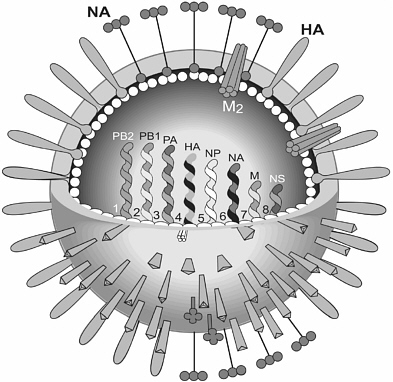
FIGURE 3-10 Diagram of influenza virus. The surface of the influenza virus particle is comprised of three kinds of spike glycoproteins—the hemagglutinin (HA) that attaches the viruses to sialic acid residue on the respiratory tract; neuraminidase (NA), an enzyme that releases the influenza virus from infected cells and is the target of the anti-neuraminidase drugs; and matrix (M2) protein, which is an ion channel and is the target for the antiviral agents amandatine and rimantadine. The spike glycoproteins are embedded in a lipid bilayer obtained from the host cell. The inside of the lipid bilayer is lined by the matrix protein (M1). A core of the virus contains eight single-stranded RNA segments of negative sense that permits genetic mixing (reassortment) when two different viruses infect a single cell. The polymerase complex (PB2, PB1, PA, NP) is involved in viral replication. The two smallest segments (M and NS) each encode two proteins in different reading frames. The NS gene is important in regulating the host cell response to influenza virus infection.
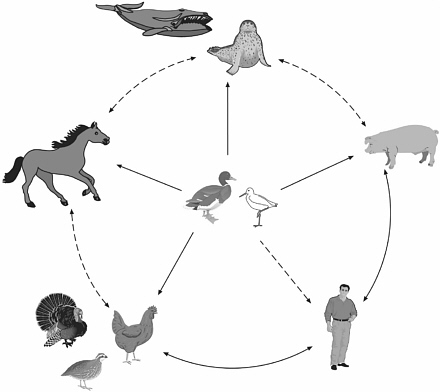
FIGURE 3-11 The reservoir of influenza A viruses. The working hypothesis is that wild aquatic birds are the primordial reservoir of all influenza viruses for avian and mammalian species. Transmission of influenza has been demonstrated between pigs and humans and between chickens and humans but not between wild birds and humans (dotted lines). There is extensive evidence for transmission of influenza viruses between wild ducks and other species (solid lines). The five different host groups are based on phylogenetic analysis of the nucleoprotein genes of a large number of different influenza viruses.
influenza virus is an enteric parasite that is transmitted by ingestion of fecally contaminated water. In humans, the virus replicates in the respiratory tract and is transmitted via aerosol. The available evidence suggests that the avian–human transition is accomplished via infection of pigs. Pigs possess receptors for both avian (α 2–3 terminal sialic acid) and human (α 2–6 terminal sialic acid) influenza viruses and thus can act as intermediate hosts. In this respect, it is noteworthy that both the 1918 Spanish and the 1968 Hong Kong pandemic viruses were isolated from pigs and from
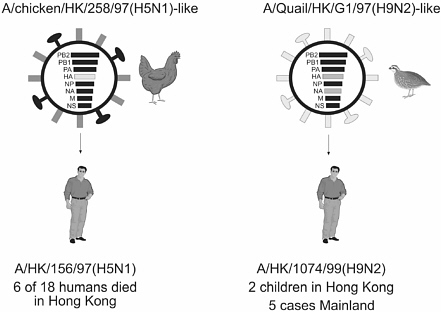
FIGURE 3-12 Direct transmission of avian influenza viruses to humans. In 1997, avian influenza viruses transmitted directly to humans in Hong Kong killed 6 of 18 persons(Left). In 1999, a quail influenza virus transmitted to humans in Hong Kong and caused mild respiratory infection in two children (Right). Five additional cases of H9N2 influenza have been reported from humans in Mainland China. It is noteworthy that the two influenza viruses from avian species that infected humans contain identical internal genes (PB2, PB1, PA, NP, M, NS—black gene segments) suggesting that these gene segments contain unique regions that facilitated transmission to humans.
humans at approximately the same time. The interspecies transmission of influenza usually results only in transitory, localized disease that may be mild to severe. The H5N1 “bird flu” incident in Hong Kong in 1997 was such an incident. Six of eighteen infected persons died, but a stable lineage was not established (see Figure 3-12). The possibility that the virus might adapt to humans, however, was sufficiently disquieting to prompt the wholesale slaughter of poultry in Hong Kong on two occasions.
During and after adaptation of influenza viruses to a new host, a continuing battle for supremacy occurs between microbe and host. The innate and adaptive human immune responses battle to clear the virus, while the virus evolves strategies to circumvent the immune responses. The virus stays a few steps ahead of natural or vaccine-induced human immunity by means of antigenic drift, or the accumulation of amino acid substitutions in
the antigenic epitopes on the spike glycoproteins (hemagglutinin [HA] and neuraminidase [NA]) to which neutralizing antibodies bind. Genetic shift, or the acquisition of new gene segments from the aquatic bird reservoir, can completely change the epitopes that evoke humoral and cell-mediated immunity. This phenomenon may explain in part the devastation wreaked by the 1918 Spanish flu pandemic. The microbe has also developed ways to downregulate the innate immune response. One of the nonstructural proteins of influenza A viruses (NS1) is an interferon agonist that downregulates interferon—a natural inhibitor of influenza viruses (Garcia-Sastre, 2002). The yearly epidemics of influenza attest to the ongoing battle between host and virus. Human interventions—vaccines and antivirals—are efficacious on an individual basis, but have had little effect on the global spread of the disease.
Two classes of antivirals are used against influenza viruses: the adamantines, which block the ion channel formed by the influenza matrix (M2) protein, and the neuraminidase inhibitors, which prevent virus release by blocking NA enzyme activity (Hayden, 2001). The virus is able to circumvent these antivirals through the natural selection of resistant mutants. Resistance to the adamantines emerged in the first patients who were treated. However, the microbe has had less success in developing resistance to the NA inhibitors. Resistance to these agents requires mutations in both HA and NA, and the NA mutation compromises transmission of the virus. Thus, resistance can be achieved only at a price to the virus.
In summary, the challenges presented by influenza virus reflect its ability to alter itself with remarkable rapidity. This characteristic allows it to survive, to adapt to new hosts, and to evade control strategies.
Human Susceptibility to Infection
The most severe influenza virus infection experienced by most humans is the first infection acquired after the decline of maternal antibodies; the outcome depends on the competency of the individual’s immune function and on the pathogenic potential of the specific variant of influenza virus. Patients who are immunosuppressed because of disease or therapy may shed influenza virus for long periods, and a greater likelihood exists in these individuals that the virus will acquire resistance to natural immune mechanisms and to antiviral therapy. The pathogenicity of influenza virus strains may also differ among host groups. Young adults were most susceptible in the 1918 pandemic, despite peak immune competence at that age. The future may reveal that the virus was able to downregulate the host immune response through as-yet unrecognized mechanisms.
Pacific Island communities also appeared to differ in their susceptibility to the 1918 Spanish flu. The death rate among the Maori population in
New Zealand was 43.3 per 1,000 people—almost six times the death rate among New Zealanders of European extraction. Socioeconomic factors account for some but not all of this difference. Other possible factors include the absence of previous exposure of the Maori population to any influenza virus.
The main preventive human defense mechanism against influenza virus infection is humoral immunity (i.e., antibodies) to the highly variable HA and NA spike glycoproteins of the virus. To recover from influenza infection and remove infected cells, on the other hand, the body depends on cell-mediated immunity. Thymus-derived lymphocytes (T cells) recognize specific antigenic epitopes on the viral nucleoprotein and polymerase proteins, and they cross-react with these epitopes on other influenza virus strains. Both types of specific immune response require prior exposure to the virus. Therefore, an immune-naïve child, who has developed neither humoral nor cell-mediated immunity to the virus, may have a severe respiratory infection. On exposure to a second influenza virus that is antigenically similar to the first but has undergone antigenic drift, the child will be infected but will recover more rapidly because of the cross-reactive cell-mediated immune response. However, there is a conundrum associated with the immune response to highly variable microbes. The child’s second exposure to influenza virus will induce a response directed mainly against the first influenza virus encountered. In this phenomenon, known as original antigenic sin, the immune system retains a lifelong memory of the first virus exposure in childhood. Thus, the antibody response is misdirected, and the efficacy of humoral immunity is reduced. This mechanism affects immunity to all infectious agents that undergo antigenic drift, including HIV.
Ecological Factors
Fifteen HA and nine NA subtypes of influenza A viruses circulate in the aquatic birds of the world. The viruses cause no apparent disease in these natural hosts, with which they appear to be in near-perfect equilibrium (Webster et al., 1992). Phylogenetically, these viruses can be divided into two clades, one in the Americas and the other in Eurasia. To date, only three of the fifteen HA subtypes have established lineages in humans. It is possible that only those subtypes have the capacity to infect humans. However, the direct transmission of avian H5N1 and H9N2 influenza viruses to humans in Hong Kong in 1997 and 1999 suggests the possibility that all subtypes can infect humans. The adaptation of influenza viruses to wild aquatic birds that migrate over vast distances (e.g., from southern South America to the North Slopes of Alaska) is an evolutionary strategy that allows the widespread fecal dissemination of the viruses at no apparent cost
to the host. It is only after transmission and adaptation to mammals or domestic poultry that the virus evolves into a disease-causing microbe.
Social, Political, and Economic Factors
Animal Husbandry, Human Behavior, and Travel
The human population of the world continues to increase, as does the number of animals required to feed it. China has seen the most dramatic rise in the number of animals over the past decade. The demand for meat protein has increased strikingly as the result of socioeconomic progress, and populations of pigs and chickens have grown exponentially. Zoonotic disease potential inevitably increases in proportion to the animal population. Poultry, pigs, and people are the known hosts of influenza viruses, and most of the influenza pandemics of the twentieth century have originated in China. Substantial influenza activity has been noted in Hong Kong, which is hypothesized to be a documentable epicenter for the emergence of influenza pandemics. In 1997, avian H5N1 influenza virus was transmitted directly from poultry to humans, killing six of eighteen infected persons. In 1999, avian H9N2 influenza viruses were transmitted to two children and caused mild respiratory disease (see Figure 3-12). In 2001 and 2002, H5N1 viruses that are highly pathogenic to poultry and to mammals (as shown by testing in mice) reappeared in Hong Kong. To prevent spread to humans of the 2001/H5N1 viruses, all of the poultry in Hong Kong was killed and buried. Since 2001, all poultry markets in Hong Kong have been emptied on the same day each month to reduce the buildup of virus. Despite these precautions, however, all of the elements are in place to generate a new pandemic: vast numbers of the primary and secondary susceptible hosts on the mainland and in Hong Kong, and a constantly evolving pathogen. It is inevitable that an influenza pandemic strain will emerge from this mix.
However, the purchase of live poultry is a long-standing tradition, and thousands of people are employed in that industry. A change to the Western-style sale of chilled or frozen slaughtered poultry will meet with resistance until health authorities and the public recognize the ultimate cost of a new pandemic in Asia. Technical and political factors are also at work. The wide availability of refrigeration has now rendered the live poultry markets obsolete, but cultural preferences remain a strong political impediment to regulatory change. As a long-term solution, live poultry markets should be closed not only in Asia, but also in New York City. The markets in New York City are a factor in the emergence of the H7N2 influenza viruses that are causing great losses in the poultry industry in the northeastern United States. More than 4 million birds have had to be slaughtered, and the disease outbreak has prompted a ban on U.S. poultry in Japan.
Besides the live markets, close monitoring of other crowded flocks of poultry will be needed.
Modern air travel (discussed earlier) will inevitably hasten the spread of a new pandemic of influenza. Once the virus appears in a major urban area, modern travel will allow its global distribution within a matter of days. The economic impact of an outbreak of highly pathogenic influenza was clearly seen in Hong Kong in 1997. The tourist and poultry industries collapsed because of the H5N1 “bird flu” incident, and Hong Kong suffered a severe economic downturn.
Intent to Harm
Recent advances in reverse genetics of influenza viruses now make it possible to generate influenza viruses to order (Neumann and Kawaoka, 2001). This new technology can reduce the time needed for vaccine preparation by 1 to 2 months if all other necessary resources are available. Perhaps more important, it will allow us to discover the molecular basis of the lethality of some viruses, such as the 1918 Spanish flu pathogen, and identify new targets for intervention in both the microbe and the host. Unfortunately, this new knowledge will also make it possible to generate extremely deadly agents—to recreate the 1918 Spanish flu virus, for example, or to add the H5N1 bird flu genes to a human influenza strain. Although influenza is not high on the list of bioterrorism agents, it has the potential to wreak widespread havoc on human life or to devastate important agricultural resources. Influenza is an exemplar of nature’s natural biowarfare; it now has the added potential to be used by humans for intentional harm.
Pandemic Preparedness
Influenza is not an eradicable disease. It has now been more than 34 years since the Hong Kong/68 (H3N2) pandemic, and, as noted, all influenza virologists agree that a new pandemic is imminent. All of the developed countries of the world and WHO have created influenza pandemic plans to deal with such an event, and WHO is in the process of developing a Global Agenda for Influenza. Key issues in the global agenda are improvement of global surveillance, assessment of the global burden of influenza, and acceleration of vaccine development and usage.
The disturbing reality is that despite the certainty of a pandemic, even the developed countries of the world are quite unprepared for such an event. The public health infrastructure is inadequate. Hospitals lack the capacity to accommodate a surge of patients. Vaccine manufacturers had severe problems in meeting the demand in 2001 and 2002, the mildest
influenza years in two decades, and the repertoire of antiviral drugs is completely inadequate. And increasing bacterial resistance to antibiotics raises questions about our ability to deal effectively with secondary pneumonia, a common cause of influenza deaths.
If a country cannot cope with interpandemic influenza, it is likely that the pandemic, when it does occur, will cause massive societal disruption. Such disruption cannot be prevented, but it can be lessened if we take action now. A minimum of 6 months is needed to prepare a new influenza vaccine. Only 11 companies worldwide manufacture influenza vaccine, and all of these companies together could not prepare a sufficient quantity even for national, let alone global needs. Therefore, the only immediately available strategy in the face of an influenza pandemic is the use of antivirals. Supplies of these agents are currently tailored to meet very low demand, and it takes an estimated 18 months to manufacture significant quantities of the drugs from the starting materials. Therefore, anti-influenza drugs will be available only if they are stockpiled in advance of a pandemic. Modeling studies are needed to plan the most effective use of such a stockpile of drugs.
The steps needed to deal effectively with interpandemic influenza can also help in preparing for an influenza pandemic. The new initiative promoting universal influenza vaccination in Ontario, Canada, can serve as a model for the world. If demonstrated to be effective, it should be expanded to other areas. Unless vaccine usage is substantially increased during interpandemic years, vaccine manufacturing capacity will be inadequate to meet the demand generated by a pandemic.


