
9
What Might Life in the United States Be Like if It Is Not Competitive in Science and Technology?
Since World War II, the United States has led the world in science and technology, and our significant investment in research and education has translated into benefits from security to healthcare and from economic competitiveness to the creation of jobs. As we enter the 21st century, however, our leadership is being challenged. Several nations have faster growing economies, and they are investing an increasing percentage of their resources in science and technology. As they make innovation-based development a central economic strategy, we will face profoundly more formidable competitors as well as more opportunities for collaboration. Our nation’s lead will continue to narrow, and in some areas other nations might overtake us. How we respond to the challenges will affect our prosperity and security in the coming decades.
To illustrate the stakes of this new game, it is useful to examine the changing nature of global competition and to sketch three scenarios for US competitiveness—a baseline scenario, a pessimistic case, and an optimistic case. The scenarios demonstrate the importance of maintaining the nation’s lead in science and technology.
“THE AMERICAN CENTURY”
In the second half of the 20th century, the United States led the world in many areas. It was the world’s superpower, it had the highest per capita income of any major economy, it was first among developed countries in economic growth, and it generated the largest share of world exports—with less than 5% of the world’s population, it consumes 24% of what the world
produces.1 US-based multinational corporations dominated most industrial sectors. In the 1990s, the United States experienced the longest economic boom in its history, driven in large part by investments in information technology and by accelerating productivity.
Central to prosperity over the last 50 years has been our massive investment in science and technology. Government spending on research and development (R&D) soared after World War II, and government spending on R&D as a percentage of the gross domestic product (GDP) reached a peak of 1.9% in 1964 (it has since fallen to 0.8%2). By 1970, the United States enrolled 30% of all postsecondary students in the world, and more than half the world’s science and engineering doctorates were awarded here.3
Today, with just 5% of the world’s population, the United States employs nearly one-third of the world’s scientific and engineering researchers, accounts for 40% of all R&D spending, publishes 35% of science and engineering articles, and obtains 44% of science and engineering citations.4 The United States comes out at or near the top of global rankings for competitiveness. The International Institute for Management Development ranks the United States first in global competitiveness; the World Economic Forum puts us second (after Finland) in overall competitiveness and first in technology and innovation.5
Leadership in science and technology has translated into rising standards of living. Technology improvements have accounted for up to one-half of GDP growth and at least two-thirds of productivity growth since 1946.6 Business Week chief economist Michael Mandel argues that, without innovation, the long-term growth rate of the US economy would have been closer to 2.5% annually rather than the 3.6% that has been the average since the end of World War II. If our economy had grown at that lower
|
1 |
Center for Sustainable Energy Systems, University of Michigan, “US Energy System Factsheet.” August 2005. Available at: http://css.snre.umich.edu/css_doc/CSS03-11.pdf. |
|
2 |
American Association for the Advancement of Science. “US R&D as Percent of Gross Domestic Product, 1953-2003.” May 2004. Available at: www.aaas.org/spp/rd. Based on National Science Foundation data in National Science Board. Science and Engineering Indicators 2004. NSB 04-01. Arlington, VA: National Science Foundation, 2004. Figure 4-5. |
|
3 |
R. B. Freeman. Does Globalization of the Scientific/Engineering Workforce Threaten US Economic Leadership? Working Paper 11457. Cambridge, MA: National Bureau of Economic Research, June 2005. P. 3. |
|
4 |
Ibid., p. 1. |
|
5 |
IMD. World Competitiveness Yearbook (2005); World Economic Forum. The Global Competitiveness Report, 2004-2005. New York: Oxford University Press, 2004. |
|
6 |
G. Tassey. R&D Trends in the US Economy: Strategies and Policy Implications. NIST Planning Report 99-2. Gaithersburg, MD: National Institute of Standards and Technology, April 1999. |
rate over the last 50 years, he says, it would be 40% smaller today, with corresponding implications for jobs, wages, and the standard of living.7
NEW GLOBAL INNOVATION ECONOMY
The dominant position of the United States depended substantially on our own strong commitment to science and technology and on the comparative weakness of much of the rest of the world. But the age of relatively unchallenged US leadership is ending. The importance of sustaining our investments is underscored by the challenges of the 21st century: the rise of emerging markets, innovation-based economic development, the global innovation enterprise, the new global labor market, and an aging population with expanding entitlements.
Emerging Markets
Over the last two decades, the global economy has been transformed. With the fall of the Berlin Wall in 1989, the collapse of the Soviet Union in 1991, China’s entry into the World Trade Organization in 2001, and India’s recent engagement with international markets, almost 3 billion people have joined the global trading system in little more than a decade.
In the coming years, developing markets will drive most economic growth. Goldman Sachs projects that within 40 years the economies of Brazil, Russia, India, and China (the so-called BRICs) together could be larger than those of the G6 nations together—the United States, Japan, the United Kingdom, Germany, France, and Italy (Figure 9-1). The BRICs currently are less than 15% the size of the G6.8 But India’s economy could be larger than Japan’s by 2032, and China could surpass every nation other than the United States by 2016 and reach parity with the United States by 2041.
The enormous populations of the BRICs (China’s population is now 4.4 times and India’s is 3.6 times the size of the US population9) mean that even though per capita income in those nations will remain well below that in the developed world, the BRICs will have a growing middle class of consumers. Within a decade, nearly 80% of the world’s middle-income consumers could live in nations outside the currently industrialized world.
|
7 |
M. J. Mandel. Rational Exuberance: Silencing the Enemies of Growth and Why the Future Is Better Than You Think. New York: Harper Business, 2004. P. 27. |
|
8 |
Goldman Sachs. Dreaming with the BRICs: The Path to 2050. Global Economics. Paper No. 99. New York: Goldman Sachs, October 2003. |
|
9 |
US Census Bureau Data Base. “Total Mid-Year Population, 2004-2050.” Available at: http://www.census.gov/ipc/www/idbsprd.html. |
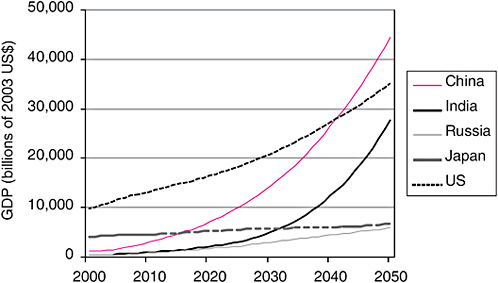
FIGURE 9-1 Projected growth of emerging markets for selected countries, in billions of constant 2003 US dollars, 2000-2050.
SOURCE: Goldman Sachs. Dreaming with the BRICs: The Path to 2050. Global Economics. Paper No. 99. New York: Goldman Sachs, October 2003.
China alone could have 595 million middle-income consumers and 82 million upper-middle-income consumers,10 a combined number that is double the total projected population of the United States in that period. China’s domestic market is already the largest in the world for more than 100 products. With 300 million subscribers and rising, China already is by far the biggest mobile-telephone market in the world. Only a small fraction of its population has Internet access, but China still has 100 million computer users, second only to the United States. China has become the second largest market for personal computers, and it will soon pass the United States.11 Many US companies—including Google, Yahoo, eBay, and Cisco—expect China to be their largest market in the next 20 years.12
For decades, the United States has been the world’s largest and most sophisticated market for an enormous range of goods and services. US consumers have stimulated productivity around the world with our apparently insatiable demand. Foreign multinational companies have invested in the
United States to gain access to our markets, giving this nation the largest stock of foreign direct investment in the world and employing 5.4 million Americans.13 New products and services are designed, marketed, and launched here. Technical standards are set here. But as other markets overtake us, we could lose these advantages.
Innovation-Based Development
Driving the rapid growth in developed economies and in emerging markets is a new emphasis on science and technology. A report of the President’s Council of Advisors on Science and Technology (PCAST) notes, “Other countries are striving to replicate the US innovation ecosystem model to compete directly against our own.”14 Through investments in R&D, infrastructure, and education and aided by foreign direct investment, many nations are rapidly retooling their economies to compete in technologically advanced products and services.
One sign of this new priority is increased R&D spending by many governments. The European Union (EU) has stated its desire to increase total R&D spending (government and industry) from less than 2% of GDP to 3% (the United States currently spends about 2.7%).15 From 1992 to 2002, China more than doubled its R&D intensity (the ratio of total R&D spending to GDP), although the United States still spends significantly more than China does both in gross terms and as a percentage of GDP. Other nations also have increased their numbers of students, particularly in science and engineering. India and China are large enough that even if only relatively small portions of their populations become scientists and engineers, the size of their science and engineering workforce could still significantly exceed that of the United States. India already has nearly as many young professional engineers (university graduates with up to 7 years of experience) as the United States does, and China has more than twice as many.16
Multinational corporations are central to innovation-based development strategies, and nations around the world have introduced tax benefits, subsidies, science-based industrial parks, and worker-training programs to
|
13 |
Organization for International Investment. “The Facts About Insourcing.” Available at: http://www.ofii.org/insourcing/. |
|
14 |
President’s Council of Advisors on Science and Technology. Sustaining the Nation’s Innovation Ecosystems, Information Technology Manufacturing and Competitiveness. Washington, DC: White House Office of Science and Technology Policy, December 2004. P. 15. |
|
15 |
Organisation for Economic Co-operation and Development. Science, Technology and Industry Outlook 2004. Paris: OECD, 2004. P. 25. Available at: http://www.oecd.org/document/63/0,2340,en_2649_ 33703_33995839_1_1_1_1,00.html. |
|
16 |
McKinsey and Company. The Emerging Global Labor Market: Part II—The Supply of Offshore Talent in Services. New York: McKinsey and Company, June 2005. |
lure the owners of high-technology manufacturing and R&D facilities. China uses those tools and its enormous potential market to encourage technology transfer to Chinese partner companies.17 Most of the world’s leading computer and telecommunications companies have R&D investments in China, and they are competing with local high-technology enterprises for market share. High-tech goods went from about 5% of China’s exports in 1990 to 20% in 2000. Foreign enterprises accounted for 80% of China’s exports in capital- and technology-intensive sectors in 1995, but they were only responsible for 50% by 2000. The United States now has a $30 billion advanced-technology trade deficit with China.
There was once a belief that developing nations would specialize in low-cost commodity products and developed economies would focus on high technology, allowing the latter to maintain a higher standard of living. Developing nations—South Korea, Taiwan, India, and China—have advanced so quickly that they can now produce many of the most advanced technologies at costs much lower than in wealthier nations. Most analysts believe that the United States, Europe, and Japan still maintain a lead in innovation—developing the new products and services that will appeal to consumers. But even here the lead is narrowing and temporary. And while the United States does currently maintain an advantage in terms of the availability of venture capital to underwrite innovation, venture capitalists are increasingly pursuing what may appear to be more promising opportunities around the world.
The Global Innovation Enterprise
Among the most powerful drivers of globalization has been the spread of multinational corporations. By the end of the 20th century, nearly 63,000 multinationals were operating worldwide.18 Over the last few decades, corporations have used new information technologies and management practices to outsource production and business processes. Shifting from a vertically integrated structure to a network of partners allows companies to locate business activities in the most cost-efficient manner. The simultaneous opening of emerging markets and the rapid increase in workforce skill levels in those nations helped stimulate the offshore placement of key functions. First in manufacturing, then in technical support and back-office
operations, next in software design, increasingly sophisticated work is being performed in developing economies. Innovation itself is being both outsourced and sent offshore.19 This is all part of the process that Thomas Friedman calls “the flattening of the world.”20
Locations that combine strong R&D centers with manufacturing capabilities have a clear competitive advantage. Hence, in addition to the availability of scientists and engineers whose salaries are a fraction of the salaries of their US counterparts, India and China offer synergies between manufacturing and R&D. Top-level R&D and design are still conducted mostly in the United States, but global companies are becoming increasingly comfortable with offshore R&D, and other nations are rapidly increasing their capabilities.21
In 1997, China had fewer than 50 research centers that were managed by multinational corporations; by mid-2004, there were more than 600.22 Much of the R&D currently performed in developing markets is designed to tailor products to local needs, but as local markets grow, the most advanced R&D could begin to migrate there. That said, it should be noted that the United States also benefits from offshore R&D—the amount of foreign-funded R&D conducted here has quadrupled since the mid-1980s. In fact, more corporate R&D investment now comes into the United States than is sent out of the country.23
The Emerging Global Labor Market
The three trends discussed already—the opening of emerging markets, innovation-based development, and the global innovation enterprise—have created a new global labor market, with far-reaching implications.
In the last few years, the phenomenon of sending service work overseas has garnered a great deal of attention in developed nations. The movement of US manufacturing jobs offshore through the 1980s and 1990s had major consequences for domestic employment in those sectors, although many argue that productivity increases were responsible for most of the reported
job losses.24 Until recently, it seemed that jobs in the service sector were safe because most services are delivered face-to-face and only a small fraction is traded globally. But new technologies and business processes are opening an increasing number of services to global competition, from technical support to the reading of x-rays to stock research to the preparation of income taxes and even to the ordering of hamburgers at drive-through windows. There is a US company that uses a receptionist in Pakistan to welcome visitors to its office in Washington via flat-screen television.25 The transformation of collaboration brought about by information and communications technologies means that the global workforce is now more easily tapped by global businesses. It is important to note, however, that a recent McKinsey Company report estimates that only 13% of the potential talent supply in low-wage nations is suited for work in multinational companies because the workers lack the necessary education or language skills.26 But that is 13% of a very large number.
Forrester Research estimates that 3.4 million US jobs could be lost to offshoring by 2015.27 Ashok Bardhan and Cynthia Kroll calculate that more than 14 million US jobs are at risk of being sent offshore.28 The Information Technology Association of America (ITAA), Global Insight,29 and McKinsey and Company30 all argue that those losses will be offset by net gains in US employment—presuming that the United States takes the steps needed to maintain a vibrant economy. Many experts point out that the number of jobs lost to offshoring is small compared with the regular monthly churning of jobs in the US economy. McKinsey, for example, estimates that about 225,000 jobs are likely to be sent overseas each year, a small fraction of the total annual job churn. In 2004, the private sector created more than 30 million jobs and lost about 29 million; the net gain was 1.4 million jobs.31
|
24 |
American Electronics Association. Offshore Outsourcing in an Increasingly Competitive and Rapidly Changing World: A High-Tech Perspective. Washington, DC: American Electronics Association, March 2004. |
|
25 |
S. M. Kalita. Virtual Secretary Puts New Face on Pakistan. Washington Post, May 10, 2005. P. A01. |
|
26 |
McKinsey and Company. The Emerging Global Labor Market: Part II—The Supply of Offshore Talent in Services. New York: McKinsey and Company, June 2005. P. 23. |
|
27 |
Forrester Research. Near-Term Growth of Offshoring Accelerating. Cambridge, MA: Forrester Research, May 14, 2004. |
|
28 |
A. Bardhan and C. Kroll. The New Wave of Outsourcing. Fisher Center Research Reports #1103. Berkeley, CA: University of California, Berkeley, Fisher Center for Real Estate and Urban Economics, November 2, 2003. |
|
29 |
Information Technology Association of America. The Impact of Offshore IT Software and Services Outsourcing on the US Economy and the IT Industry. Lexington, MA: Global Insight (USA), March 2004. |
|
30 |
McKinsey and Company. Offshoring: Is It a Win-Win Game? New York: McKinsey and Company, August 2003. |
|
31 |
US Bureau of Labor Statistics. “NEWS: Business Employment Dynamics: First Quarter 2005.” November 18, 2005. Available at: http://www.bls.gov/rofod/3640.pdf. |
Once again, this suggests that the US economy will continue to create new jobs at a constant rate, an assumption that in turn depends on our continued development of new technologies and training of workers for the jobs of the 21st century. Economists and others actively debate whether outsourcing or, more generally, free trade with low-wage countries with rapidly improving innovation capacities will help or hurt the US economy in the long term.32 The optimists and the pessimists, however, agree on two fundamental points: in the short term, some US workers will lose their jobs and face difficult transitions to new, higher skilled careers; and in the long term, America’s only hope for continuing to create new high-wage jobs is to maintain our lead in innovation.
Aging and Entitlements
The enormous and growing supply of labor in the developing world is but one side of a global demographic transformation. The other side is the aging populations of developed nations. The working-age population is already shrinking in Italy and Japan, and it will begin to decline in the United States, the United Kingdom, and Canada by the 2020s. More than 70 million US baby boomers will retire by 2020, but only 40 million new workers will enter the workforce.33 Europe is expected to face the greatest period of depopulation since the Black Death, shrinking to 7% of world population by 2050 (from nearly 25% just after World War II).34 East Asia (including China) is experiencing the most rapid aging in the world. At the same time, India’s working-age population is projected to grow by 335 million people by 2030—almost equivalent to the entire workforce of Europe and the United States today.35 Those extreme global imbalances suggest that immigration will continue to increase.
Population dynamics have major economic implications. The Organisation for Economic Co-operation and Development (OECD)
|
32 |
W. C. Mann. Globalization of IT Services and White Collar Jobs. Washington, DC: Institute for International Economics, 2003; J. Bhagwati, A. Panagariya, and T. N. Srinivasan. “The Muddles Over Outsourcing.” Journal of Economic Perspectives 18(Summer 2004):93-114 offer examples of the optimist view; R. Gomory and W. Baumol. Global Trade and Conflicting National Interests. Cambridge, MA: MIT Press, 2001; P. A. Samuelson. “Where Ricardo and Mill Rebut and Confirm Arguments of Mainstream Economists Supporting Globalization.” Journal of Economic Perspectives 18(Summer 2004):135-146 offer a more pessimistic perspective. |
|
33 |
P. A. Laudicina. World Out of Balance: Navigating Global Risks to Seize Competitive Advantage. New York: McGraw-Hill, 2005. P. 49. |
|
34 |
United Nations, Department of Economic and Social Affairs, Population Division. “The World at Six Billion.” October 12, 1999. Available at: http://www.un.org/esa/population/publications/sixbillion/sixbillion.htm. |
|
35 |
P. A. Laudicina. World Out of Balance: Navigating Global Risks to Seize Competitive Advantage. New York: McGraw-Hill, 2005. P. 62. |
projects that the scarcity of working-age citizens will hamper economic growth rates between 2025 and 2050 for Europe, Japan, and the United States.36 The Center for Strategic and International Studies (CSIS) estimates that the average cost of public pensions in the developed world will grow by 7% of GDP between now and the middle of the century; public health spending on the elderly will grow by about 6% of GDP.37 There are now 3 pension-eligible elders in the developed world for every 10 working-age adults. Thirty-five years from now, the ratio will be 7 to 10. Here in the United States, the ratio of adults aged 60 and over to working-age adults aged 15-59 is expected to increase from .26 to .47 over the same period.38
Those trends have profound implications for US leadership in science and technology:
-
The US science and engineering workforce is aging while the supply of new scientists and engineers who are US citizens is decreasing. Immigration will continue to be critical to filling our science and engineering needs.
-
The rapidly increasing costs of caring for the aging population will further strain federal and state budgets and add to the expense columns of industries with large pension and healthcare obligations. It will thus become more difficult to allocate resources to R&D or education.
-
Aging populations and rising healthcare costs will drive demand for innovative and cost-effective medical treatments.
Taken together, those trends indicate a significant shift in the global competitive environment. The importance of leadership in science and technology will intensify. As companies come to see innovation as the key to revenue growth and profitability, as nations come to see innovation as the key to economic growth and a rising standard of living, and as the planet faces new challenges that can be solved only through science and technology, the ability to innovate will be perhaps the most important factor in the success or failure of any organization or nation.
A recent report from the Council on Competitiveness argues that “innovation will be the single most important factor in determining America’s success through the 21st century.”39 The United States cannot control such global forces as demographics, the strategies of multinational corporations,
and the policies of other nations, but we can determine how we want to engage with this new world, with all of its challenges and opportunities.
SCENARIOS FOR AMERICA’S FUTURE IN SCIENCE AND TECHNOLOGY
To highlight the choices we face, and their implications, it is useful to examine three scenarios that address the changing status of America’s leadership in science and engineering.
Scenario 1: Baseline, America’s Narrowing Lead
What is likely to happen if we do not change our current approach to science and technology? The US lead is so large that it is unlikely that any other nation would broadly overtake us in the next decade or so. The National Intelligence Council argues that the United States will remain the world’s most powerful actor—economically, technologically, and militarily—at least through 2020.40 But that does not mean the United States will not be challenged. The Center for Strategic and International Studies concludes, “Although US economic and technology leadership is reasonably assured out to 2020, disturbing trends now evident threaten the foundation of US technological strength.”41
Over the last year or so, a virtual flood of books and articles has appeared expressing concern about the future of US competitiveness.42 They identify trends and provide data to show that the relative position of the United States is declining in science and technology, in education, and in high-technology industry.43 All of this leads to a few simple extrapolations
for our global role over the next 30 years, assuming that we change nothing in our approach to science and education.
The US share of global R&D spending will continue to decline.
-
US R&D spending will continue to lead the world in gross terms, but R&D intensity (spending as a percentage of GDP) will continue to fall behind that of other nations.
-
US R&D will rely increasingly on corporate R&D spending.
-
Industry spending now accounts for two-thirds of all US R&D.
-
Total government spending on all physical sciences research is less than the $5 billion that a single company—IBM—spends annually on R&D, although an increasing amount of IBM’s research, like that of most large corporations, is now performed abroad.
-
Most corporate R&D is focused on short-term product development rather than on long-term fundamental research.
-
US multinational corporations will conduct an increasing amount of their R&D overseas, potentially reducing their R&D spending in the United States, because other nations offer lower costs, more government incentives, less bureaucracy, high-quality educational systems, and in some cases superior infrastructure.
The US share of world scientific output will continue to decline.
-
The share of US patents granted to US inventors is already declining, although the absolute number of patents to US inventors continues to increase.
-
US researchers’ scientific publishing will decline as authors from other nations increase their output.
-
The number of scientific papers published by US researchers reached a plateau in 1992.44
-
Europe surpassed the United States in the mid-1990s as the world’s largest producer of scientific literature.
-
If current trends continue, publications from the Asia Pacific region could outstrip those from the United States within the next 6 or 7 years.45
-
The US share of scientists and engineers will continue to decline.
-
Other nations will have larger numbers of students receiving undergraduate degrees in science and engineering. In 2000, more than 25 countries had a higher percentage of 24-year-olds with degrees in science and engineering than did the United States.46
-
The number of graduate degrees awarded in science and engineering will decline.
-
The number of new doctorates in science and engineering peaked in the United States in 1998.
-
By 2010, China will produce more science and engineering doctorates than the United States does.47
-
The US share of world science and engineering doctorates granted will fall to about 15% by 2010, down from more than 50% in 197048 (Figure 9-2).
-
-
International students and workers will make up an increasing share of those holding US science and engineering degrees and will fill more of our workforce.
Our ability to attract the best international researchers will continue to decline.
-
From 2002 to 2003, 1,300 international students enrolled in US science and engineering graduate programs. In each of the 3 years before that, the number had risen by more than 10,000.51
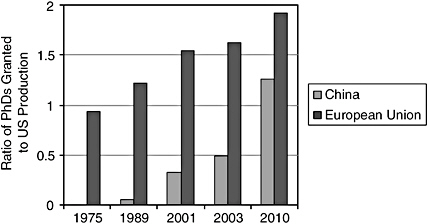
FIGURE 9-2 China and European Union production of science and engineering doctorates compared with US production, 1975-2010.
SOURCE: R. B. Freeman. Does Globalization of the Scientific/Engineering Workforce Threaten US Economic Leadership? Working Paper 11457. Cambridge, MA: National Bureau of Economic Research, June 2005. Ratio of PhDs Granted
-
After a decline of 6% from 2001 to 2002, first-time, full-time enrollment of students with temporary visas fell 8% in 2003.52
-
Snapshot surveys indicate international graduate student enrollments decreased again in 2004 by 6%53 but increased by 1% in 2005.
-
In the early 1990s, there were more science and engineering students from China, South Korea, and Taiwan studying at US universities than there were graduates in those disciplines at home. By the mid-1990s, the number attending US universities began to decline and the number studying in Asia increased significantly.54
PCAST observes, “While not in imminent jeopardy, a continuation of current trends could result in a breakdown in the web of ‘innovation ecosystems’ that drive the successful US innovation system.”55 Economist Ri-
|
52 |
Ibid. |
|
53 |
H. Brown. Council of Graduate Schools Finds Declines in New International Graduate Student Enrollment for Third Consecutive Year. Washington, DC: Council of Graduate Schools, November 4, 2004; H. Brown. 2005. Findings from 2005 CGS International Graduate Admissions Survey III: Admissions and Enrollment. Washington, DC: Council of Graduate Schools. Available at: http://www.cgsnet.org/pdf/CGS2005IntlAdmitIII_Rep.pdf. |
|
54 |
The Task Force on the Future of US Innovation. The Knowledge Economy: Is the United States Losing Its Competitive Edge, Benchmarks for Our Innovation Future. Washington, DC: The Task Force on the Future of US Innovation, February 2005. |
|
55 |
President’s Council of Advisors on Science and Technology. Sustaining the Nation’s Innovation Ecosystems, Information Technology Manufacturing and Competitiveness, Washington, DC: White House Office of Science and Technology Policy, December 2004. P. 13. |
chard Freeman says those trends foreshadow a US transition “from being a superpower in science and engineering to being one of many centers of excellence.”56 He adds that “the country faces a long transition to a less dominant position in science and engineering associated industries.”57
The United States still leads the world in many areas of science and technology, and it continues to increase spending and output. But our share of world output is declining, largely because other nations are increasing production faster than we are, although they are starting from a much lower base. Moreover, the United States will continue to lead the world in other areas critical to innovation—capital markets, entrepreneurship, and workforce flexibility—although here as well our relative lead will shrink as other nations improve their own systems.
The biggest concern is that our competitive advantage, our success in global markets, our economic growth, and our standard of living all depend on maintaining a leading position in science, technology, and innovation. As that lead shrinks, we risk losing the advantages on which our economy depends. If these trends continue, there are several likely consequences:
-
The United States will cease to be the largest market for many high-technology goods, and the US share of high-technology exports will continue to decline.
-
Foreign direct investment will decrease.
-
Multinational corporations (US-based and foreign) will increase their investment and hiring more rapidly overseas than they will here.
-
The industries and jobs that depend on high-technology exports and foreign investment will suffer.
-
The trade deficit will continue to increase, adding to the possibility of inflation and higher interest rates.
-
Salaries for scientists, engineers, and technical workers will fall because of competition from lower-wage foreign workforces, and broader salary pressures could be exhibited across other occupations.
-
Job creation will slow.
-
GDP growth will slow.
-
Growth in per capita income will slow despite our relatively high standard of living.
-
Poverty rates and income inequality, already more pronounced here than in other industrialized nations, could increase.
Today’s leadership position is built on decisions that led to investments made over the past 50 years. The slow erosion of those investments might not have immediate consequences for economic growth and job creation, but the long-term effect is predictable and would be severe. Once lost, the lead could take years to recover, if indeed it could be recovered. Like a supertanker, the US economy does not turn on a dime, and if it goes off course it could be very difficult to head back in the right direction.
Given that they already have a commanding lead in many key sectors, it is likely that US multinational corporations will continue to succeed in the global marketplace. To do so, they will shift jobs, R&D funds, and resources to other places. Increasingly, it is no longer true that what is good for GM (or GE or IBM or Microsoft) is good for the United States. What it means to be a US company is likely to change as all multinationals continue to globalize their operations and ownership. As China and other developing nations become larger markets for many products and services, and as they maintain their cost advantages, US companies will increasingly invest there, hire there, design there, and produce there.
This nation’s science and technology policy must account for the new reality and embrace strategies for success in a world where talent and capital can easily choose to go elsewhere.
Scenario 1 is the most likely case if current trends in government policies continue both here and in other nations and if corporate strategies remain as they are today. Two other scenarios represent departures from recent history. As such, they are more speculative and less detailed.
Scenario 2: Pessimistic Case, America Falls Decisively Behind
In Scenario 1, the United States continues to invest enough to maintain current trends in science and technology education and performance, leading to a slow decline in competitiveness. Scenario 2 considers what might happen if the commitment to science and technology were to lessen. Although that would run counter to our national history, several factors might lead to such an outcome:
-
Rising spending on social security, Medicare, and Medicaid (now 42% of federal outlays compared with 25% in 1975) limit federal and state resources available for science and technology.58 In 2005, Social Security, Medicare, and Medicaid accounted for 8.4% of GDP. If growth continues
-
at the current rate, the federal government’s total spending for Medicare and Medicaid alone would reach 22% of GDP by 2050.
-
The war on terrorism refocuses government resources on short-term survival rather than long-term R&D.
-
Increasingly attractive opportunities overseas draw industrial R&D funding and talented US scientists and engineers away from the United States.
-
Higher US effective corporate tax rates discourage companies from investing in new facilities and research in the United States.
-
Excessive regulation of research institutions reduces the amount of money available for actual research.
Those possibilities would exacerbate and accelerate the trends noted in Scenario 1:
-
The availability of scientists and engineers could drop precipitously if foreign students and workers stop coming in large numbers, either because immigration restrictions make it more difficult or because better opportunities elsewhere reduce the incentives to work in the United States.
-
US venture capitalists begin to place their funds abroad, searching for higher returns.
-
Short-term cuts in funding for specific fields could lead to a rapid decline in the number of students in those disciplines, which could take decades to reverse.
-
If they were faced with a lack of qualified workers, multinational corporations might accelerate their overseas hiring, building the capabilities of other nations while the US innovation system atrophies.
-
Multinationals from China, India, and other developing nations, building on success in their domestic markets and on supplies of talented, low-cost scientists and engineers, could begin to dominate global markets, while US-based multinationals that still have a large percentage of their employees in the United States begin to fail, affecting jobs and the broader economy.
-
Financing the US trade deficit, now more than $600 billion or about 6% of GDP, requires more than $2 billion a day of foreign investment. Many economists argue that such an imbalance is unsustainable in the long term.59 A loss of competitiveness in key export industries could lead to a loss of confidence in the US ability to cover the debt, bringing on a crisis.
-
As innovation and investment move overseas, domestic job creation and wage growth could stall, lowering the overall standard of living in the United States.
The rapid pace of technological change and the increasing mobility of capital knowledge and talent mean that our current lead in science and technology could evaporate more quickly than is generally recognized if we fail to support it. The consequences would be enormous, and once lost, our lead would be difficult to regain.
Scenario 3: Optimistic Case, America Leads in Key Areas
The relative competitive lead enjoyed by the United States will almost certainly shrink as other nations rapidly improve their science and technology capacity. That means greater challenges for the United States, but it also presents an opportunity to raise living standards and improve quality of life around the world and to create a safer world. The United States might have a smaller share of the world’s economy, but the economy itself will be larger. For that reason, the success of other nations need not imply the failure of the United States. But it does require that the United States maintain and extend its capacity to generate value as part of a global innovation system.
If we increase our commitment to leadership in science and technology, there are several likely results:
-
Although the US share of total scientific output continues to decline, the United States maintains leadership across key areas.
-
US researchers become leaders of global research networks.
-
The US education system sets the standard for quality and innovation, giving graduates a competitive edge over the larger number of lower wage scientists and engineers trained in the developing world.
-
Our universities and national laboratories act as centers for regional innovation, attracting and anchoring investment from around the world.
-
Our economy generates sufficient growth to reduce our trade imbalances, reduce the federal budget deficit, and support an aging population.
-
Investors continue to find it attractive to place their funds in US firms seeking to innovate and generate jobs in America.
-
US leadership in science and technology supports our military leadership and addresses the major challenges of homeland security.
The rapid worldwide development that has resulted from advances in science and technology has raised global standards of living, but it also
spawned a range of challenges that, paradoxically, will have to be solved through appropriate investments in research:
-
To maintain its current rate of growth, by 2020 China will need to boost energy consumption by 150%, and India will need to do so by 100%.60 It will be essential to develop clean, affordable, and reliable energy.
-
The increased movement of people around the world will lead to more outbreaks of communicable diseases. Meanwhile, aging populations will require new treatments for chronic diseases.
-
As the means to develop weapons of mass destruction become more widely available, security measures must advance.
-
In an increasingly interconnected economy, even small disruptions to communications, trade, or financial flows can have major global consequences. Methods to manage complex systems and respond quickly to emergencies will be essential.
The strains of managing global growth will require global collaboration. Around the world, the growing scale and sophistication of science and technology mean that we are much more likely to be able to solve those and other problems that will confront us. Advances in information technology, biotechnology, and nanotechnology will improve life for billions of people. The leadership of the United States in science and technology will make a critical contribution to those efforts and will benefit the lives of Americans here at home. Each challenge offers an opportunity for the United States to position itself as the leader in the markets that will be created for solutions to global challenges in such fields as energy, healthcare, and security.
It is important to recognize that all nations in the global economy are now inextricably linked. Just as global health, environmental, and security issues affect everyone, so are we all dependent on the continued growth of other economies. It is clearly in America’s interest for China, India, the EU, Japan, and other nations to succeed. Their failure would pose a far greater threat to US prosperity and security than would their success. In the global economy, no nation can prosper in isolation. However, it is the thesis of this report that it is important that such global prosperity be shared by the citizens of the United States.
CONCLUSION
It is easy to be complacent about US competitiveness and pre-eminence in science and technology. We have led the world for decades, and we continue to do so in many fields. But the world is changing rapidly, and our advantages are no longer unique. Without a renewed effort to bolster the foundations of our competitiveness, it is possible that we could lose our privileged position over the coming decades. For the first time in generations, our children could face poorer prospects for jobs, healthcare, security, and overall standard of living than have their parents and grandparents. We owe our current prosperity, security, and good health to the investments of past generations. We are obliged to renew those commitments to ensure that the US people will continue to benefit from the remarkable opportunities being opened by the rapid development of the global economy.


