
International Students and Researchers in the United States
SUMMARY
The United States has experienced a steadily growing influx of graduate students and postdoctoral scholars from throughout the world. International students now constitute more than a third of US science and engineering (S&E) graduate-school enrollments, up from less than a quarter in 1982. More than half the S&E postdoctoral fellows are temporary residents, half of whom earned a doctorate degree outside the United States. Including undergraduates, more than a half-million foreign citizens are studying at colleges and universities in the United States.
Many of the international students educated in this country choose to remain here after receiving their degrees. More than 70% of the foreign-born S&E doctorates who received their degrees in 2001 remained in the United States for more than 2 years, up from about half the 1989 doctorate recipients. These skilled migrants are an important source of innovation for the US economy.
The terrorist attacks of September 11, 2001, caused drops in the numbers of international students applying to and enrolling in US graduate programs. In addition, other countries are developing their own systems of graduate education to recruit and retain more highly skilled students and professionals. In this environment of increased competition and reduced
international mobility, the US education and research enterprise will have to readjust to be able to keep attracting the best students from home and abroad.
International exchanges of students and skilled professionals can benefit both the sending and receiving countries. Certainly, the United States S&E research enterprise depends critically on international students and scholars. Recommendations that various groups have made to maintain and enhance the ability of the United States to attract these highly skilled people include the following:
-
Create new nonimmigrant visa categories exempted from the 214b provision for doctoral-level graduate students and postdoctoral scholars.
-
Extend the validity of Visas Mantis security clearances for international students and scholars from the current 2-year limit to the duration of their academic appointments.
-
Allow international students, scholars, scientists, and engineers to renew their visas in the United States.
-
Implement a points-based immigration policy, similar to that of Canada or the United Kingdom, in which graduate education and S&E skills count toward obtaining citizenship.
SCIENCE AND ENGINEERING GRADUATE ENROLLMENTS AND DEGREES
The exchange of people and ideas across borders, accelerated in the last two decades by perestroika and the emergence of East Asia as a world economic power, has transformed institutions and individuals. Most countries today send bright young people to study abroad.1 Many of them stay and contribute in lasting ways to their adopted countries. And whether they stay, return home, or move on to a third country, they become part of a global network of researchers, practitioners, and educators that provides cultural and intellectual support for students and scholars whatever their origins.
Since World War II, the United States has been the most popular destination for S&E graduate students and postdoctoral scholars choosing to study abroad. With about 6% of the world’s population, the United States has been producing over 20% of S&E PhD degrees.2 International graduate students and postdoctoral researchers, many of whom stay in the United
States after completing their studies, make substantial contributions to our society by creating and applying new knowledge.
The total number of S&E graduate students in US institutions has grown consistently over the last several decades, with an acceleration during the 1990s.3 These increases have taken place despite evidence that US graduate schools give preference to domestic applicants.4 Since the 1970s, the strongest inflow of graduate students has been from Asian countries. From 1985 to 2001, students from China, Taiwan, India, and South Korea earned more than half of the 148,000 US science and engineering doctoral degrees awarded to foreign students, four times the number awarded to students from Europe.
The percentage of international students in US graduate schools has risen from 23.4% in 1982 to 34.5% in 2002 (see Figure IS-1). In 2002, international students received 19.5% of all doctorates awarded in the social and behavioral sciences, 18.0% in the life sciences, 35.4% in the physical sciences, and 58.7% in engineering.5 For doctorate-granting institutions, total enrollment of international S&E graduate students increased dramatically between 2000 and 2002. In 2002, 55.5% of international S&E graduate students were enrolled at Research I (R1) universities; R1s also enroll the highest proportion (26.0%) of international students (see Figure IS-2). Today, the total number of foreign citizens studying in US universities (including undergraduates) has passed the half-million mark.
A recent study further delineates the changing demographics of graduate students in US institutions.6 In 1966, US-born males accounted for 71% of S&E PhD graduates, and 6% were awarded to US-born females; 23% of doctorate recipients were foreign-born. In 2000, 36% of doctorate recipients were US-born males, 25% US-born females, and 39% foreign-born. Among postdoctoral scholars, the participation rate of temporary residents has increased from 37.4% in 1982 to 58.8% in 2002 (see Figure IS-3). Similarly, the share of foreign-born faculty who earned their doctoral degrees at US universities has increased from 11.7% in 1973 to 20.4% in
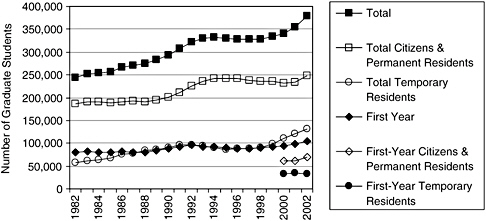
FIGURE IS-1 Number of graduate students enrolled, by citizenship status, 1982-2002.
NOTE: Enrollment numbers include medical fields.
SOURCE: National Science Foundation. Survey of Graduate Students and Postdoctorates in Science and Engineering 2002. Arlington, VA: National Science Foundation, 2004.
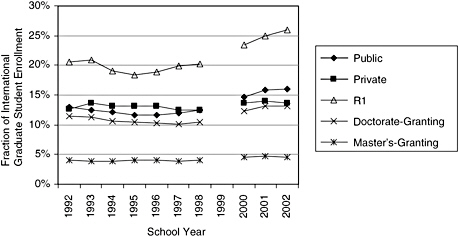
FIGURE IS-2 Fraction of international graduate student enrollment,by institution type, 1992-2002.
NOTE: The CGS enrollment numbers include all major S&E fields, as business, education, humanities and arts, and public administration and services. The non-S&E fields have 3% and 17% enrollment of international students. CGS states, “Institution type was a major differentiating variable in the enrollment of non-US students, reflecting the concentration of international students in doctoral programs in science and engineering.”
SOURCE: The Council of Graduate Schools. “CGS/GRE Graduate Enrollment and Degrees: Annual Surveys from 1992-2002.” Washington, DC. Available at: http://www.cgsnet.org/VirtualCenterResearch/graduateenrollment.htm.
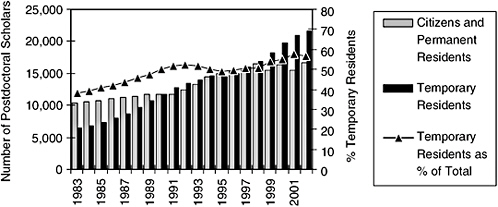
FIGURE IS-3 Total postdoctoral pool, by US residency status, 1983-2002.
NOTE: Medical fields are included, but postdoctoral scholars with medical degrees (presumably acting as physicians) are excluded from the analysis.
SOURCE: National Science Foundation. Survey of Graduate Students and Postdoctorates in Science and Engineering 2002. Arlington, VA: National Science Foundation, 2004.
1999. In engineering fields, the share increased from 18.6 to 34.7% in the same period.7
Stay Rates of International Graduate Students and Scholars
Representation of foreign-born scientists and engineers in US S&E occupations varies by field, country of origin, economic conditions in the sending country, and when the PhD was awarded. In total, foreign-born scientists and engineers were 22.7% of the US S&E labor force in 2000, an increase from 12.7% in 1980. Foreign-born doctorates were 37.3% of the US S&E labor force, an increase from 23.9% in 1990.
One study found that 45% of international students from developing countries planned to enter the US labor market for a time, and 15% planned to stay permanently; another 15% planned to go to a third country.8 Another study showed that the stay rate of international doctorate scientists
|
7 |
National Science Board. Science and Engineering Indicators 2004. NSB 04-01. Arlington, VA: National Science Foundation, 2004. Appendix Table 5-24. Available at: http://www.nsf.gov/sbe/srs/seind02/append/c5/at05-24.xls. |
|
8 |
N. Aslanbeigui and V. Montecinos. “Foreign Students in US Doctoral Programs.” Journal of Economic Perspectives 12(1998):171-182. |
and engineers has increased steadily and substantially in the last decade.9 The proportion of foreign-born doctorates remaining in the United States for at least 2 years after receiving their degrees increased from 49% for the 1989 cohort to 71% for the larger 2001 cohort.10
Stay rates were highest among engineering, computer-science, and physical-science graduates. Stay rates also varied dramatically among graduate students from the top source countries—China (96%), India (86%), Taiwan (40%), and Korea (21%). Decisions to stay in the United States appear to be strongly affected by conditions in the students’ home countries, primarily the unemployment rate, the percentage of the labor force that works in agriculture, and per capita GDP.11
COSTS AND BENEFITS OF INTERNATIONAL MOBILITY
Skilled migrants contribute to the US economy as technicians, teachers, and researchers and in other occupations in which technical training is desirable (see Table IS-1). Some research suggests that they generate economic gains by contributing to industrial and business innovation, resulting in a net increase in real wages for both citizen and immigrant workers. One study, for example, found that the immigration of skilled workers added to local skills rather than substituting for them.12 The authors’ econometric analyses suggest that a 10% increase in the number of international graduate students would raise university patent grants by 6% and nonuniversity patent grants by 4%. The authors concluded that bureaucratic hurdles in obtaining student visas may impede innovation if they decrease the inflow of international graduate students.
Foreign-born and foreign-educated scientists and engineers have made a disproportionate number of “exceptional” contributions to the S&E en-
TABLE IS-1 Number of Foreign Born in US S&E Occupations, by Degree and Field, 2000
|
|
Number of Foreign-Born in US S&E Occupations, 2000 |
|||||
|
|
All S&E |
Engineering |
Life Sciences |
Mathematics and Computer Sciences |
Physical Sciences |
Social Sciences |
|
All college-educated |
816,000 |
265,000 |
52,000 |
370,000 |
92,000 |
37,000 |
|
Bachelor’s degree |
365,000 |
132,000 |
6,000 |
197,000 |
21,000 |
9,000 |
|
Master’s degree |
291,000 |
100,000 |
10,000 |
146,000 |
21,000 |
14,000 |
|
Professional degree |
25,000 |
5,000 |
8,000 |
6,000 |
4,000 |
2,000 |
|
Doctoral degreea |
135,000 |
28,000 |
28,000 |
21,000 |
46,000 |
12,000 |
|
aIn 2001, 57% of those who were foreign-born S&E doctorate holders were US citizens. NOTE: Data are from US Census 2000 5% Public Use Microdata Samples (PUMS) and include all S&E occupations other than postsecondary teachers, because field of instruction was not included in occupation coding for the 2000 census. SOURCE: The National Academies. Policy Implications of International Graduate Students and Postdoctoral Scholars in the United States. Washington, DC: The National Academies Press, 2005. Table 1-5. |
||||||
terprise of the United States.13 Since 1990, almost half the US Nobel laureates in science fields were foreign-born; 37% received their graduate education abroad. The large number of foreign-born scientists and engineers working in the United States who were educated abroad suggests that the United States has benefited from investments in education made by other countries.
Many people believe that emigration of technically skilled individuals—often called a “brain drain”—is detrimental to the country of origin. However, the concept of brain drain may be too simplistic inasmuch as it ignores the many benefits of emigration, including remittances, international collaborations, the return of skilled scientists and engineers, diaspora-facilitated international business, and a general investment in skills caused by the prospect
of emigration.14 As the R&D enterprise becomes more global, some observers propose that “brain drain” be recast as “brain circulation”15 and include the broader topics of the international circulation of thinkers, knowledge workers, and rights to knowledge.16 Such a discussion would include issues of local resources; many countries lack the educational and technical infrastructure to support advanced education, so aspiring scientists and engineers have little choice but to seek at least part of their training abroad, and in many instances such travel is encouraged by governments. Supporting the concept of brain circulation is the finding that ethnic networks developed in the United States by international students and scholars help to support knowledge transfer and economic development in both the United States and the sending country.17
In other countries, migration for employment, particularly for highly skilled workers, remains a core concern.18 European Union (EU) countries, especially those with developed S&E capacity, have implemented strategies to facilitate retention and immigration of the technically skilled. Several Organisation for Economic Co-operation and Development (OECD) countries have relaxed their immigration laws to attract high-skilled students and workers.19 Some are increasing growth in their international student populations and are encouraging these students to apply for resident status.
Point-based immigration systems for high-skilled workers, while not widespread, are starting to develop.20 Canada, Australia, and New Zealand use
|
14 |
D. Kapur and J. McHale. Sojourns and Software: Internationally Mobile Human Capital and High-Tech Industry Development in India, Ireland, and Israel. In A. Arora and A. Gambardella, eds. From Underdogs to Tigers: The Rise and Growth of the Software Industry in Israel, Ireland and India. Oxford, UK: Oxford University Press, 2005. |
|
15 |
Organisation for Economic Co-operation Development. International Mobility of the Highly Skilled. Policy Brief 92 2002 01 1P4. Washington, DC: OECD, 2002. Available at: http://www.oecd.org/dataoecd/9/20/1950028.pdf. |
|
16 |
B. Jewsiewicki. The Brain Drain in an Era of Liberalism. Ottawa, ON: Canadian Bureau for International Education, 2003. |
|
17 |
W. Kerr. “Ethnic Scientific Communities and International Technology Diffusion.” Working Paper. 2004. Available at: http://econ-www.mit.edu/faculty/download_pdf.php?id=994. |
|
18 |
OECD members countries include Australia, Austria, Belgium, Canada, the Czech Republic, Denmark, Finland, France, Germany, Greece, Hungary, Iceland, Ireland, Italy, Japan, Ko-rea, Luxembourg, Mexico, The Netherlands, New Zealand, Norway, Poland, Portugal, the Slovak Republic, Spain, Sweden, Switzerland, Turkey, the United Kingdom, and the United States. |
|
19 |
K. Tremblay. “Links Between Academic Mobility and Immigration.” Symposium on International Labour and Academic Mobility: Emerging Trends and Implications for Public Policy, Toronto, October 22, 2004. |
|
20 |
Organisation for Economic Co-operation Development. Trends in International Migration: 2004 Annual Report. Paris: OECD, 2005. See http://www.workpermit.com for more information on immigration policies in English-speaking countries and the European Union. |
such systems to recruit highly skilled workers. The United Kingdom has been doing so since 2001, and the Czech Republic set up a pilot project that started in 2004. In 2004, the European Union Justice and International Affairs council adopted a recommendation to facilitate the immigration of researchers from non-EU countries, asking member states to waive requirements for residence permits or to issue them automatically or through a fast-track procedure and to set no quotas that would restrict their admission. Also, the European Commission has adopted a directive for a special admissions procedure for third-world nationals coming to the EU to perform research.
RECENT TRENDS IN GRADUATE SCHOOL ENROLLMENT
Declines in international student applications for entry to US graduate schools have stimulated considerable discussion and more than a few warnings that our national S&E capacity may have begun to weaken. In 2002, the National Science Foundation noted a decrease in first-time full-time S&E graduate enrollments among temporary residents, by about 8% for men and 1% for women.21 At the same time, first-time full-time S&E graduate-student enrollment increased by almost 14% for US citizens and permanent residents—15% for men and more than 12% for women (see Figure IS-1).
More recent surveys by the Council on Graduate Schools showed dramatic decreases in applications among international students for the 2003 academic year but much smaller decreases in admissions. Applications and admissions for domestic students did not change appreciably during this period, whereas enrollments decreased by 5%. There appear to be much smaller effects on applications for the 2004 academic year (see Table IS-2).
These declines were partly in response to the terrorist attacks of September 11, 2001, after which it became clear to everyone that the issuance and monitoring of visas are as important to graduate education as the training experience. Even more so, however, the declines reflect increasing global competition for graduate students amid the globalization of S&E education and research.
RISING GLOBAL CAPACITY FOR HIGHER EDUCATION
Given the fast-rising global tide of S&E infrastructure and training, it would be surprising if the S&E education and research enterprise currently dominated by the United States did not begin to change into a more global
TABLE IS-2 Applications, Admissions, and Enrollments of International Graduate Students, by Field, 2002-2003
|
|
Total |
Engineering |
Life Sciences |
Physical Sciences |
|
Applications |
–28% (–5%)a |
–36% (–7%) |
–24% (–1%) |
–26% (–3%) |
|
Admissions |
–18% |
–24% |
–19% |
–17% |
|
Enrollments |
–6% |
–8% |
–10% |
+6% |
|
aAvailable data for the 2005 academic year are shown in parentheses. SOURCE: H. Brown. Council of Graduate Schools Finds Decline in New International Graduate Student Enrollment for the Third Consecutive Year. Washington, DC: Council of Graduate Schools, November 4, 2004. |
||||
network of scientific and economic strength. Indeed, there is considerable evidence that that process has begun. Students have been leaving their home countries in search of academic opportunities abroad for thousands of years.22 For scientists and engineers, the trend gained importance with the rise of universities and the need for formal training unavailable at home. As early as the late 19th century, many Americans were drawn abroad to German universities to gain expertise in fast-growing new technical fields.23 In the following decades, that trend gradually reversed as US universities gained technical strength and attracted both faculty and students. US universities also benefited from an influx of educated refugees fleeing war-torn Europe during and after World War II.
Now, even while the United States can boast of 17 of the world’s top 20 universities,24 the US share of the world’s S&E graduates is declining rap-
|
22 |
W. I. Cohen. East Asia at the Center: Four Thousand Years of Engagement with the World. New York: Columbia University Press, 2001. |
|
23 |
D. E. Stokes. Pasteur’s Quadrant: Basic Science and Technological Innovation. Washington, DC: Brookings Institution, 1997. Pp. 38-41. Stokes explains the effect of this export and re-importation of S&E talent on US universities: “This tide, which was at a flood in the 1880’s, reflected the lack of an American system of advanced studies adequate to the needs of a rising industrial nation, and was a standing challenge to create one. The efforts to fill this gap in American higher education were generously supported by America’s economic expansion, particularly by the private individuals who had acquired great wealth in the decades after the Civil War, many of whom had gained a vision of what might be done from their studies in the German universities.” |
|
24 |
Shanghai’s Jiao Tong University Institute of Higher Education. “Academic Ranking of World Universities.” 2004. Available at: http://ed.sjtu.edu.cn/rank/2004/2004Main.htm. The ranking emphasizes prizes, publications, and citations attributed to faculty and staff, as well as the size of institutions. The Times Higher Education supplement also provides international comparisons of universities. |
idly. European and Asian universities have increased degree production while the number of students obtaining US graduate degrees has stagnated (see Figure IS-4). Other interesting notes:
-
The percentage of foreign students on OECD campuses rose by 34.9% on average between 1998 and 2002 and by 50% or more in the Czech Republic, Iceland, Korea, New Zealand, Norway, Spain, and Sweden. In absolute terms, more than 450,000 new individuals crossed borders to study in an OECD country during this short period, raising the number of foreign students enrolled on OECD campuses to 1,781,000. K. Tremblay. “Links Between Academic Mobility and Immigration.” Symposium on International Labour and Academic Mobility: Emerging Trends and Implications for Public Policy, Toronto, October 22, 2004.
-
In 2000, the EU was ahead of the United States and Japan in the production of S&E graduates. As a proportion of PhDs per 1,000 population aged 25-34 years, the EU-15 had an average of 0.56, the United States had 0.48 and Japan had 0.24. However, the emigration of EU-15 S&E graduates is creating a restriction for European R&D. In the late 1990s, the European S&E workforce accounted for 5.4 per thousand workers vs 8.1 per thousand in the United States and 9.3 in Japan. European Commission. Towards a European Research Area. Science, Technology, and Innovation, Key Figures 2002. Brussels: European Commission, 2002. Pp. 36-38. Available at: ftp://ftp.cordis.lu/pub/indicators/docs/ind_kf2002.pdf.
-
Two independent estimates indicate that of the 60% of academic postdoctoral scholars who hold temporary visas, about four-fifths have non-US doctorates, which means that half of all US academic postdoctoral scholars have non-US doctorates.25 Of postdoctoral scholars on temporary visas, almost 80% had earned their PhDs outside the United States. Of those with non-US PhDs, the highest number came from China (25%), followed by India (11%), Germany (7%), South Korea (5%), Canada (5%), Japan (5%), the UK (4%), France (4%), Spain (2%), and Italy (2%). The United States is benefiting from an inflow of postdoctoral scholars who have received graduate support and training elsewhere.
As countries develop knowledge-based economies, they seek to reap more of the benefits of international educational activities, including strong positive effects on gross domestic product (GDP) growth.26 Emerging econo-
|
25 |
Estimates based on the NSF Survey of Doctorate Recipients 2001, the NSF Survey of Graduate Students and Postdocs 2001, and the 2004 Sigma Xi National Postdoctoral Survey. Available at: http://postdoc.sigmaxi.org. |
|
26 |
The Conference Board of Canada. The Economic Implications of International Education for Canada and Nine Comparator Countries: A Comparison of International Education |
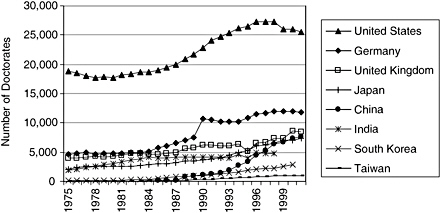
FIGURE IS-4 S&E doctorate production, by selected country, 1975-1999.
SOURCE: Based on National Science Board. Science and Engineering Indicators 2004. NSB 04-01. Arlington, VA: National Science Foundation, 2004. Appendix Tables 2-38 and 2-39.
mies have coupled education-abroad programs with strategic investments in S&E infrastructure—in essence pushing students away to gain skills and creating jobs to draw them back. Other countries, particularly in Europe, are trying to retain their best students and also to increase quality and open international access to their own higher educational institutions.
VISA AND IMMIGRATION POLICY
A growing challenge for policy-makers is to reconcile the flow of people and information with security needs. Policies and regulations, particularly those governing visas and immigration, can disrupt the global movement of individuals and therefore the productivity of scientists and engineers. In turn, this can affect a nation’s economic capabilities.
The repercussions of the terror attacks of September 11, 2001, have included security-related changes in federal visa and immigration policy. Other immigration-related policies relevant to international student flows are international reciprocity agreements and deemed-export policies. Policy changes intended to restrict the illegal movements of an extremely small
|
Activities and Economic Performance. Ottawa, ON: Department of Foreign Affairs and International Trade, 1999. Also see A. Saxenian. Silicon Valley’s New Immigrant Entrepreneurs. San Francisco: Public Policy Institute, 1999. Available at: http://www.ccis-ucsd.org/PUBLICATIONS/wrkg15.PDF. |
population have had a substantial effect on international graduate students and postdoctoral scholars already in the United States or contemplating a period of study here.
Changes in visa and immigration policies and structures had a rapid and adverse effect on student mobility. Nonimmigrant-visa issuance rates decreased, particularly for students (see Figure IS-5). Implementation of the student-tracking system, the Student and Exchange Visitor Information System (SEVIS), and enhanced Visas Mantis security screening led to closer scrutiny and longer times for visa processing, in some cases causing students to miss classes or to turn to other countries for their graduate training.27 After intense discussions between the university community and government agencies,28 some of these policies have been adjusted to reduce effects on student mobility (see Figure IS-6 and Box IS-1). However, unfavorable perceptions remain, and international sentiment regarding the United States and its visa and immigration processes is a lingering problem for the recruitment of international students and scholars.
RECOMMENDATIONS
To maintain its leadership in S&E research, the United States must be able to recruit the most talented people worldwide for positions in academe, industry, and government.29 The United States therefore must work to attract the best international talent while seeking to improve the mentoring, education, and training of its own S&E students, including women and members of underrepresented minority groups. This dual goal is especially important in light of increasing global competition for the best S&E students and scholars.
Federal actions that have been recommended include the following:
-
Create new nonimmigrant-visa categories for doctoral-level graduate students and postdoctoral scholars, whether they are coming to the United States for formal educational or training programs or for short-term research collaborations or scientific meetings.30 The categories should be exempted
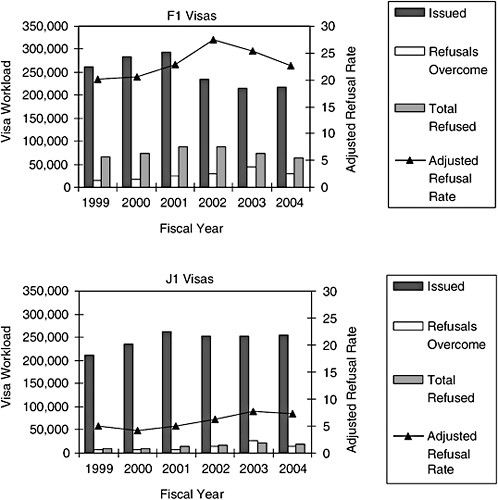
FIGURE IS-5 Visa workload and outcomes, by visa type, 1999-2004.
NOTE: Report of the Visa Office is an annual publication of the US Department of State, published by the Bureau of Consular Affairs. Recent editions are available at: http://travel.state.gov/visa/report.html. The adjusted refusal rate is calculated with the following formula: (Refusals – Refusals Overcome/Waived)/(Issuances + Refusals – Refusals Overcome/Waived).
A steep decline in visa issuances began in 2001 and continued through 2003. J-visa issuances, mostly to Europeans, followed roughly the same pattern, with a larger rise in the 1990s and a smaller downturn after 2001. To date, the downturn has reflected an increased denial rate more than a decreased application rate. As seen in the figure, the refusal rate for J-visa applicants rose steadily from 2000 through 2003. The adjusted refusal rate for F-visa applicants peaked in 2002. In 2004, denial rates had decreased considerably and were approaching 1999 levels.
SOURCE: United States Department of State, Bureau of Consular Affairs. Report of the Visa Office: Multi Year Reports (1992-2004). Washington, DC: US Department of State, 2004. Available at: http://travel.state.gov/visa/report.html.
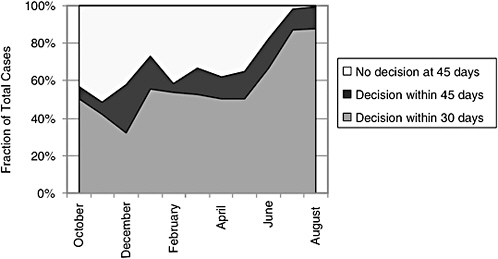
FIGURE IS-6 Visas Mantis Security Advisory Opinion (SAO) workload, FY 2004.
SOURCE: Data presented to Committee on Science, Engineering, and Public Policy’s Committeee on Policy Implications of International Graduate Students and Postdoctoral Scholars in the United States on October 12, 2004, by Janice Jacobs, deputy assistant secretary of visas affairs, US Department of State.
-
from the 214b provision whereby applicants must show that they have a residence in a foreign country that they have no intention of abandoning.
-
Allow international students, scholars, scientists, and engineers to renew their visas in the United States.31
-
Negotiate visa reciprocity agreements between the United States and key sending countries, such as China, to extend visa duration and to permit multiple entries.27,28
-
In the case of deemed-export controls, clear students and scholars to conduct research and use equipment required for such research through the visa process.32
-
Implement a points-based immigration policy, similar to that of Canada or the United Kingdom, in which US graduate education and S&E skills count toward obtaining US citizenship.33
|
BOX IS-1 VISA UPDATE In 2002, a new antiterrorist screening process called Visas Condor was added for nationals of US-designated state sponsors of terrorisma that initially overloaded the Security Advisory Opinion (SAO) interagency process and slowed Mantis clearances.b The problem of extended waiting times for clearance of nonimmigrant visas flagged by Mantis has for the most part been addressed successfully.c By August 2004, the proportion of Visas Mantis visitors cleared within 30 days had risen substantially, and fewer than 15% took more than 30 days. The Visas Mantis processd is triggered when a student or exchange-visitor applicant intends to study a subject covered by the Technology Alert List (TAL). The express purpose of the TAL, originally drawn up as a tool for preventing proliferation of weapons technology, is to prevent the export of “goods, technology, or sensitive information” through such activities as “graduate-level studies, teaching, conducting research, participating in exchange programs, receiving training or employment.”e Initially, Mantis procedures were applied on entry and each re-entry to the United States for persons studying or working in sensitive fields. In 2004, SAO clearance was extended to 1 year for those who were returning to a US government-sponsored program or activity and performing the same duties or functions at the same facility or organization that was the basis for the original Mantis authorization.f In 2005, the US Department of State extended the validity of Mantis clearances for F-, J-, H-, L-, and B-visa categories. Clearances for F-visas are valid for up to 4 years unless the student changes academic positions. H, J, and L clearances are valid for up to 2 years unless the visa holder’s activity in the United States changes.g
|
ANNEX 1
Existing High-Skilled Immigration Policies in OECD Countries34
Migration for employment, particularly for high-skilled workers, remains a core concern for OECD member countries.35 EU countries, especially those with developed S&E capacity, have implemented strategies to facilitate retention and immigration of the technically skilled. Several OECD countries have relaxed their immigration laws to attract high-skilled students and workers. Some are increasing growth in their international-student populations and encouraging these students to apply for resident status.36
-
Points-Based Immigration for High-Skilled Workers
Points systems, while not widespread, are starting to develop. Canada, Australia, New Zealand, and the United Kingdom use such systems to recruit highly skilled workers. The Czech Republic set up a pilot project that started in 2004. In 2004, the EU Justice and International Affairs council adopted a recommendation to facilitate researchers from non-EU countries, which asks member states to waive requirements for residence permits or to issue them automatically or through a fast-track procedure and to set no quotas that would restrict their admission. Permits should be renewable and family reunification facilitated. The European Commission has adopted a directive for a special admissions procedure for third-world nationals coming to the EU to perform research. This procedure will be in force in 2006.
-
Canada has put into place a points-based program aimed at fulfilling its policy objectives for migration, particularly in relation to the labor-market situation. The admission of skilled workers depends more on human capital (language skills and diplomas, professional skills, and adaptability) than on specific abilities.37 Canada has also
-
|
34 |
Unless otherwise noted, policies listed are from an overview presented in: Organisation for Economic Co-operation and Development. Trends in International Migration: 2004 Annual Report. Paris: OECD, 2005. |
|
35 |
OECD members countries include Australia, Austria, Belgium, Canada, the Czech Republic, Denmark, Finland, France, Germany, Greece, Hungary, Iceland, Ireland, Italy, Japan, Korea, Luxembourg, Mexico, The Netherlands, New Zealand, Norway, Poland, Portugal, the Slovak Republic, Spain, Sweden, Switzerland, Turkey, the United Kingdom, and the United States. |
|
36 |
K. Tremblay. “Links Between Academic Mobility and Immigration.” Symposium on International Labour and Academic Mobility: Emerging Trends and Implications for Public Policy, Toronto, October 22, 2004. |
|
37 |
Applicants can check online their chances to qualify for migration to Canada as skilled workers. A points score is automatically calculated to determine entry to Canada under the Skilled Worker category. See Canadian Immigration Points Calculator Web site at http://www.workpermit.com/canada/points_calculator.htm. |
-
-
instituted a business-immigrant selection program to attract investors, entrepreneurs, and self-employed workers.
-
Germany instituted a new immigration law on July 9, 2004. Among its provisions, in the realm of migration for employment, it encourages settlement by high-skilled workers, who are eligible immediately for permanent residence permits. Family members who accompany them or subsequently join them have access to the labor market. Like Canada, Germany encourages the immigration of self-employed persons, who are granted temporary residence permits if they invest a minimum of 1 million euros and create at least 10 jobs. Issuance of work permits and residence permits has been consolidated. The Office for Foreigners will issue both permits concurrently, and the Labor Administration subsequently approves the work permit.
-
UK38 The UK Highly Skilled Migrant Programme (HSMP) is an immigration category for entry to the UK for successful people with sought-after skills. It is in some ways similar to the skilled migration programs for entry to Australia and Canada. The UK has added an MBA provision to the HSMP. Eligibility for HSMP visas is assessed on a points system with more points awarded in the following situations:
-
Preference for applicants under 28 years old.
-
Skilled migrants with tertiary qualifications.
-
High-level work experience.
-
Past earnings.
-
In a few rare cases, HSMP points are also awarded if one has an achievement in one’s chosen field.
-
One may also score bonus points if one is a skilled migrant seeking to bring a spouse or partner who also has high-level skills and work experience.
-
-
Australia encourages immigration of skilled migrants, who are assessed on a points system with points awarded for work experience, qualifications, and language proficiency.39 Applicants must demonstrate skills in specific job categories.
-
-
Business Travel
-
Asia-Pacific Economic Cooperation (APEC) has instituted the Business Travel Card Scheme designed to liberalize trade and stimulate economic growth. The scheme facilitates travel for business people
-
|
38 |
The UK Highly Skilled Migrant Programme Web page also has a points calculator. See http://www.workpermit.com/uk/highly_skilled_migrant_program.htm. |
|
39 |
See points calculator at: http://www.workpermit.com/australia/point_calculator.htm. |
-
-
traveling for short periods to participating countries (in 2004, APEC had 16 member countries, including China). Travel is possible between participating countries after submission of a single application, which is filtered by the applicant’s home country and forwarded to all the participating countries for precertification. Cardholders are checked against police records in their own country as well as against warning lists in participating countries. Approved travelers get cards valid for 3 years that provide special access to fast-track lanes at airports. In 2004, there were over 5,000 cards in circulation.
-
-
Student Visas Many OECD countries are determined to attract a larger number of international students. In addition to developing special programs and streamlining application processes, some countries have signed bilateral agreements while others have decided to offer job opportunities to graduates.
-
Canada Students no longer require study permits for stays of less than 6 months.
-
France Since 1999, it has been possible to obtain a 3- to 6-month visa for short-term studies without registration.
-
-
Work Permits for International Students and Spouses
-
Canada40 A new off-campus work program allows international students at public postsecondary institutions to work off campus, extending the previous policy enacted earlier in 2005 that allowed students to work on campus while in Canada on a student visa.
-
Germany Since 2003, international students have been allowed to work 180 half-days per year without a work permit.
-
Austria Since 2003, students can work half-time to finance their studies.
-
-
Permit to Stay After Graduation to Find a Job
-
Canada41 As of May 16, 2005, a new policy allows certain students to work in their field of study for up to 2 years after graduation. Previously, international students were allowed to stay only 1 year after graduation to work in Canada.
-
|
40 |
Office of Science and Technology. “Canada: Immigration Policy Change Widens Door for Foreign Students and Scholars.” Bridges 6(July 13, 2005). Available at: http://bridges.ostina.org. |
|
41 |
Ibid. |
-
-
Germany International students may remain in Germany for 1 year after the end of their studies to seek employment.
-
UK 42 Foreign students at UK universities graduating from specific engineering, physical-sciences and mathematics courses are now permitted to stay in the UK for 1 year after graduation to take up employment.43 The Science and Engineering Graduate Scheme was launched on October 25, 2004, and is now fully operational. This new immigration category allows non-European Economic Area nationals who have graduated from UK higher or further education establishments in certain mathematics, physical-sciences, and engineering subjects with a 2.2 degree or higher to remain in the UK for 12 months after their studies to pursue a career. Only those who have studied approved programs are eligible to apply to remain under the scheme. The scheme was first announced in the UK 2003 budget as an incentive to encourage foreign students to study in these fields in the UK and to be an asset to the workplace after graduation by relieving the shortages of engineering, physical-sciences, and mathematics graduates in the UK. Applicants must
-
Have successfully completed a degree course with second-class honors (2.2) or higher, a master’s course or PhD on the relevant list of Department for Education or skills-approved physical-sciences, mathematics, and engineering courses at a UK institution of higher or further education.
-
Intend to work during the period of leave granted under the scheme.
-
Be able to maintain and accommodate themselves and any dependents without recourse to public funds.
-
Intend to leave the UK at the end of their stay (unless granted leave as a work-permit holder, high-skilled migrant, business person, or innovator).
-
-
|
42 |
UK Home Office “Working in the UK” Web page. Available at: http://www.workingintheuk.gov.uk/working_in_the_uk/en/homepage/schemes_and_programmes/graduate_students.html. |
|
43 |
The scheme was highlighted in Sir Gareth Roberts’ review, “The Supply of People with Science, Technology, Engineering and Mathematics Skills” (see http://www.kent.ac.uk/stms/research-gc/roberts-transferable-skills/roberts-recommendations.doc), that the UK was suffering from a shortage of engineering, mathematics, and physical sciences students at university and skilled workers in the labor market. This shortage could do serious damage to the UK’s future economical growth. There is currently a reported shortage in sectors such as research and development and financial services for mathematics, science, and engineering specialists. |


