
Achieving Balance and Adequacy in Federal Science and Technology Funding
SUMMARY
The complementary goals of balance and adequacy in federal funding for science and technology require both diversity and cohesion in the nation’s R&D system. Diversity fosters creativity, creates competition among people and ideas, brings new perspectives to problems, and fosters linkages among sectors. Cohesion helps ensure that basic research is not squeezed out by more immediate needs and that the highest quality research is supported.
Federal actions that could improve the balance of federal science and technology (FS&T) funding include the following:
-
Create a process in Congress that examines the entire FS&T budget before the total federal budget is aggregated into allocations to appropriations committees and subcommittees.
-
Establish a stronger coordinating and budgeting role for the Office of Science and Technology Policy to promote cohesion among federal R&D agencies.
-
Maintain the diversity of FS&T funding in terms of sources of funding, performers, time horizons, and motivations.
-
Balance funding between basic and applied research and across fields of research to stimulate innovative cross-disciplinary thinking.
-
Protect funding for high-risk research by setting aside a portion of the R&D budgets of federal agencies for this purpose.
-
Maintain a favorable economic and regulatory environment for capitalizing on research—for example, by using tax incentives to build stronger partnerships among academe, industry, and government.
-
Encourage industry to boost its support of research conducted in colleges and universities from 7 to 20% of total academic research over the next 10 years.
Two important goals can help policy-makers judge the adequacy of federal funding for FS&T. First, the United States should be among the world leaders in all major areas of science. Second, the United States should maintain clear leadership in some areas of science. The recent doubling of the budget of the National Institutes of Health—and other recent increases in R&D funding—acknowledge the tremendous opportunities and national needs that can be addressed through science and technology. Similar opportunities exist in the physical sciences, engineering, mathematics, computer science, environmental science, and the social and behavioral sciences—fields in which federal funding has been essentially flat for the last 15 years.
Among the steps that the federal government could take to ensure that funding for science and technology is adequate across fields are these:
-
Increase the budget for mathematics, the physical sciences, and engineering research by 12% a year for the next 7 years within the research accounts of the Department of Energy, the National Science Foundation, the National Institute for Standards and Technology, and the Department of Defense.
-
Return federal R&D funding to at least 1% of US gross domestic product.
-
Make the R&D tax credit permanent to promote private support for research and development, as requested by the Administration in the fiscal year (FY) 2006 budget proposal.
Support for a new interdisciplinary field of quantitative science and technology policy studies could shed light on the complex effects that scientific and technologic advances have on economic activities and social change.
A Century of Science and Technology
In 1945, in his report Science—The Endless Frontier, Vannevar Bush proposed an idea that struck many people as far-fetched.1 He wrote that the
federal government should fund the research of scientists without knowing exactly what results the research would yield—an idea that flatly contravened the US government’s historical practice.2
Despite the misgivings of many policy-makers, the US government eventually adopted Bush’s idea. The resulting expansion of scientific and technological knowledge helped produce a half-century of unprecedented technologic progress and economic growth. New technologies based on increased scientific understanding have enhanced our security, created new industries, advanced the fight against disease, and produced new insights into ourselves and our relationship with the world. If the 20th century was America’s century, it also was the century of science and technology.
Since 1950, the federal government’s annual support for research and development (R&D) has grown from less than $3 billion to more than $130 billion—more than a 10-fold expansion in real terms.3 Today, about 1 in every 7 dollars in the federal discretionary budget goes for R&D. Performers of federal R&D include hundreds of colleges and universities and many thousands of private companies, federal laboratories, and other non-profit institutions and laboratories. These institutions produce not only new knowledge but also the new generations of scientists and engineers who are responsible for a substantial portion of the innovation that drives changes in our economy and society.
Major priorities within the federal R&D budget have shifted from the space race in the 1960s to energy independence in the 1970s to the defense buildup of the 1980s to biomedical research in the 1990s. In the 1990s, the nation’s R&D system also began to encounter challenges that it had not faced before. The end of the Cold War, an acceleration of economic globalization, the rapid growth of information technologies, new ways of conducting research, and very tight federal budgets led to thorough re-evaluations of the goals of federal R&D. Though Vannevar Bush’s vision remains intact, the R&D system today is much more complex, diversified, and integrated into society than would have been imagined 60 years ago.
In this decade, the challenges to the R&D system have intensified. International competitors are now targeting service sectors, including R&D, just as they have targeted manufacturing sectors in the past. Global development and internationalization, new trade agreements, and the rapid flow of capital are reshaping industries so quickly that policy-makers barely have time to respond. Similarly, workplace technologies and demands change so quickly that workers must be periodically retrained to remain competitive.
Throughout modern economies, advantages accrue to individuals, governments, and companies that are adaptable, forward-looking, knowledgeable, and innovative.
At the beginning of the 21st century, the United States stands at a crossroads. The only way for this nation to remain a high-wage, high-technology country is to remain at the forefront of innovation. Achieving this goal will require that the nation remain a leader in the scientific and technological research that contributes so heavily to innovation.
ACHIEVING BALANCE IN FEDERAL SCIENCE AND TECHNOLOGY FUNDING
Federal funding for science and technology in the United States historically has been balanced along several dimensions—between research and development, between defense and nondefense R&D, between academic and nonacademic R&D performers, and so on. Much of this balance arises in a de facto manner from the independent actions of a wide range of array supporters and performers. But some is the consequence of explicit policy decisions by the executive and legislative branches.
In the 1995 report Allocating Federal Funds for Science and Technology, a committee of the National Research Council laid out five broad principles designed in part to help the federal government achieve the proper balance of R&D funding:4
-
Make the allocation process more coherent, systematic, and comprehensive.
-
Determine total federal spending for federal science and technology based on a clear commitment to ensuring US leadership.
-
Allocate funds to the best projects and people.
-
Ensure that sound scientific and technical advice guides allocation decisions.
-
Improve federal management of R&D activities.
The report recommended that
-
The President present an annual comprehensive FS&T budget, including areas of increased and reduced emphasis. The budget should be sufficient to serve national priorities and foster a world-class scientific and technical enterprise.
-
Departments and agencies make FS&T allocations based on clearly
-
articulated criteria that are congruent with those used by the Executive Office of the President and by Congress.
-
Congress create a process that examines the entire FS&T budget before the total federal budget is disaggregated into allocations to appropriations committees and subcommittees.
-
The President and Congress ensure that the FS&T budget is sufficient to allow the United States to achieve preeminence in a select number of fields and perform at a world-class level in other major fields.
The Executive Branch responded by providing, as part of the President’s budget submission, an analysis of the FS&T budget that encompasses federal funds spent specifically on scientific and technological research programs, the development and maintenance of the necessary research infrastructure, and the education and training of scientists and engineers. In addition, the White House Office of Management and Budget (OMB) and Office of Science and Technology Policy (OSTP) issue a joint budget memorandum that articulates the President’s goals for the upcoming budget year to aid them in the preparation of agency budgets before submission to OMB.
Analysis of this budget reveals trends in the support of scientific and technologic research that the broader category of R&D obscures. For example, in the president’s FY 2006 budget request, federal R&D would be up 1% from $131.5 billion to $132.3 billion. But FS&T would be down 1%, from $61.7 billion to $60.8 billion (see Figures R&D-1 and R&D-2).5 (The director of OSTP has pointed out that it can be misleading to compare proposed budgets with enacted budgets because the latter can contain funds specified by Congress for research projects that were not included in the President’s budget.6)
Congress has not yet adopted a process that entails an overall consideration of the scientific and technological research supported by the federal government.7 Subcommittees in both the House and Senate still consider portions of the federal R&D budget separately without deliberations or hearings on the broad objectives of S&T spending. At a minimum, the use of a common budget classification code could allow Congress more easily to address science and technology programs in a unified manner.
Overall consideration of the FS&T budget could reiterate the importance of basic research and of diversity among research supporters and performers.
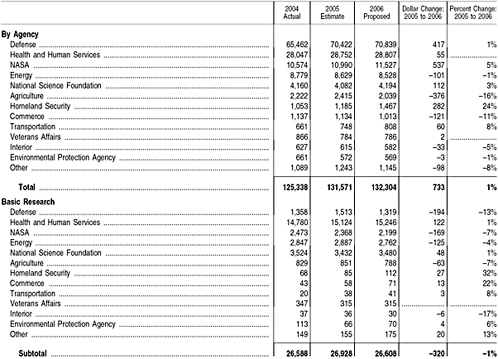
FIGURE R&D-1 Federal research and development spending, in millions of dollars, for all R&D and for basic research, by agency, 2004-2006.
SOURCE: Executive Office of the President. Budget of the United States Government, Fiscal Year 2006, Part Two: Analytical Perspectives. Washington, DC: US Government Printing Office, 2005. P. 66. Available at: http://www.ostp.gov/html/budge/2006/FY06RDChapterFinal.pdf.
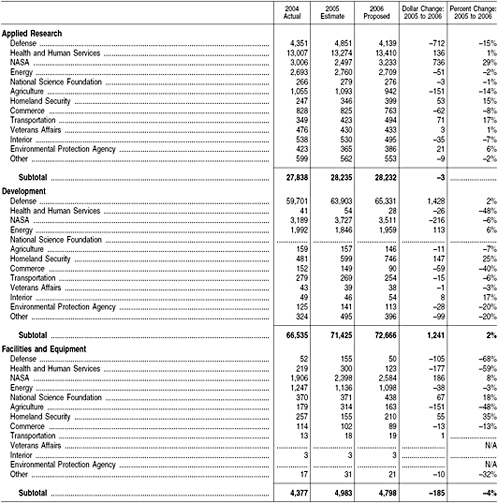
FIGURE R&D-2 Federal research and development spending, in millions of dollars, by agency, for applied research, development, facilities, and equipment, 2004-2006.
SOURCE: Executive Office of the President. Budget of the United States Government, Fiscal Year 2006, Part Two: Analytical Perspectives. Washington, DC: US Government Printing Office, 2005. P. 67. Available at: http://www.ostp.gov/html/budget/2006/FY06RDChapterFinal.pdf.
Especially when budgets are tight, basic research can be displaced by the more immediate needs of applied research and technology development. In fact, less than half of all federal R&D funding is allocated for basic and applied research (see Figure R&D-3). The FS&T budget has increased since 2000, but these increases are primarily due to increases in funding of the National Institutes of Health (NIH). Nondefense-related R&D funding has
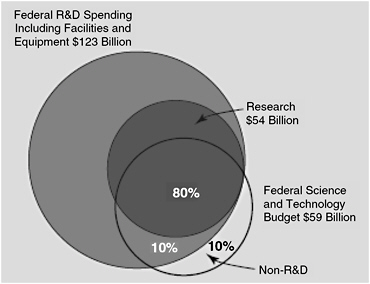
FIGURE R&D-3 Funding concepts in FY 2004 budget proposal.
SOURCE: National Science Board. Science and Engineering Indicators 2004. NSB 04-01. Arlington, VA: National Science Foundation, 2004. Figure 4-12.
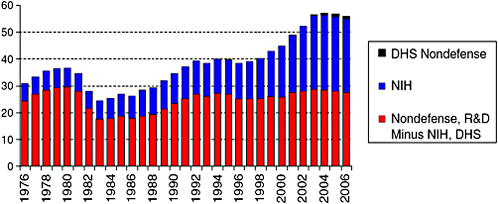
FIGURE R&D-4 Selected trends in nondefense R&D, FY 1976-FY 2006, in billions of constant FY 2005 dollars.
SOURCE: American Association for the Advancement of Science. Chart: Selected Trends in Nondefense R&D: FY 1976-2006. Washington, DC: American Association for the Advancement of Science, 2005. Available at: http://www.aaas.org/spp/rd/trnon06c.pdf.
been stagnant in recent years (see Figure R&D-4). Recently, the FS&T budget has been declining since the charge to double NIH funding has been completed (see Figure R&D-5). Recent Department of Defense (DOD) budgets offer another example—ever the last decade, the resources provided for basic research by the DOD have declined substantially.8 Recent trends show that while defense R&D budgets have been increasing overall, the amount of resources allocated to science research in DOD is decreasing (see Figures R&D-6A and B). This lack of support for basic research could have major consequences for the development of necessary future military capabilities.
Allocating Federal Funds for Science and Technology also recommended that:
-
R&D conducted in federal laboratories focus on the objectives of the sponsoring agency and not expand beyond the assigned missions of the laboratories. The size and activities of each laboratory should correspond to changes in mission requirements.
-
FS&T funding generally favor academic institutions because of their flexibility and inherent quality control and because they link research to education and training in science and engineering.
-
FS&T budget decisions give preference to funding projects and people rather than institutions. That approach will increase the flexibility in responding to new opportunities and changing conditions.
-
Competitive merit review, especially that involving external reviewers, be the preferred way to make awards, because competition for funding is vital to maintain the high quality of FS&T programs.
-
Evaluations of R&D programs and of those performing and sponsoring the work also incorporate the views of outside evaluators.
-
R&D be well managed and accountable but not micromanaged or hobbled by rules and regulations that have little social benefit.
Diversity cannot be an excuse for mediocrity. People, projects, and institutions need to be reviewed to ensure that they are meeting national needs in science and technology. Open competition involving evaluation of merit by peers is the best-known mechanism to maintain support for the highest-quality projects and people. Quality also can be maintained by knowledgeable program managers who have established external scientific and technical advisory groups to help assess quality and to help monitor whether agency needs are being met.
Possible actions for the federal government to maintain the diversity
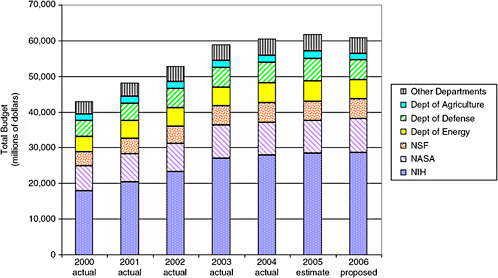
FIGURE R&D-5 Federal science and technology (FS&T) budget, in millions of dollars, FY 2000-FY 2006.
SOURCE: Based on data in several editions of Executive Office of the President. Budget of the United States Government, Part Two: Analytical Perspectives. Washington, DC: US Government Printing Office, 2005. Chapter 5. For research and development in the FY 2006 budget, see Table 5-3. Available at: http://www.gpoaccess.gov/usbudget.fy06/browse.html.
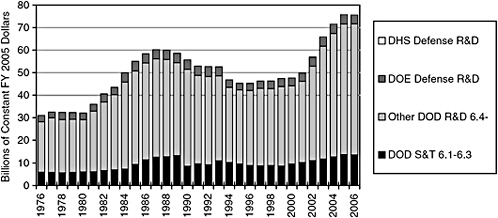
FIGURE R&D-6A Trends in defense R&D, FY 1976-FY 2006, in billions of constant fiscal year (FY) 2005 dollars, by agency.
SOURCE: American Association for the Advancement of Science. Chart: Trends in Defense R&D: FY 1976-2006. Washington, DC: American Association for the Advancement of Science, February 2005. Available at: http://www.aaas.org/spp/rd/trdef06c.pdf.
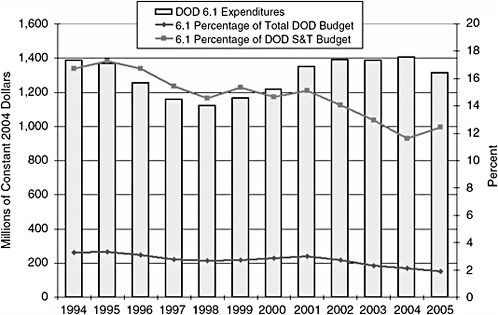
FIGURE R&D-6B Trends in Department of Defense (DOD) 6.1 R&D, FY 1994-FY 2005, in millions of constant FY 2004 dollars.
SOURCE: National Science Board. Science and Engineering Indicators 2004. NSB 04-01. Arlington, VA: National Science Foundation, 2004.
and balance of federal funding for science and technology include the following:
-
Create a process in Congress that examines the entire FS&T budget before the total federal budget is aggregated into allocations to appropriations committees and subcommittees.9
-
Establish a stronger coordinating and budgeting role for OSTP to promote cohesion among federal R&D agencies.10
-
Maintain the diversity of FS&T funding in terms of sources of funding, performers, time horizons, and motivations.11
-
Balance funding between basic and applied research and across fields of research to stimulate innovative cross-disciplinary thinking.12
-
Protect funding for high-risk research by setting aside a portion of the R&D budgets of federal agencies for this purpose.13
-
Maintain a favorable economic and regulatory environment for capitalizing on research—for example, by using tax incentives to build stronger partnerships among academe, industry, and government.14
-
Encourage industry to boost its support of research conducted in colleges and universities from 7 to 20% of total academic research over the next 10 years.15
ACHIEVING ADEQUACY IN FEDERAL SCIENCE AND TECHNOLOGY FUNDING
Given the importance of maintaining balance and diversity in the FS&T budget, the next logical question is, What is the appropriate magnitude of federal support for science and technology?
In 1993, the Committee on Science, Engineering, and Public Policy
(COSEPUP) of the National Academy of Sciences, the National Academy of Engineering, and the Institute of Medicine established two broad goals to guide federal investments in science and technology:16
-
The United States should be among the world leaders in all major areas of science. Achieving this goal would allow this nation quickly to apply and extend advances in science wherever they occur.
-
The United States should maintain clear leadership in some areas of science. The decision to select a field for leadership would be based on national objectives and other criteria external to the field of research.
These goals provide a way of assessing the adequacy of federal funding for science and technology. Being world class across fields requires that the United States have the funding, infrastructure, and human resources for researchers to work at the frontiers of research. Preeminence in fields relevant to national priorities requires that policy-makers choose specific areas in which to invest additional resources.
An important way of measuring leadership and preeminence in fields and subfields of research is benchmarking of US research efforts against those in other countries. Experiments with benchmarking have demonstrated that data can be gathered fairly readily for analysis.17 Benchmarking analyses then can be converted into funding guidance that takes into account the activities of other research performers (including industry and other countries) and the inherent uncertainties of research.
Responding to abundant opportunities and national priorities in science and technology, the federal government has increased R&D funding substantially in recent years. From 1990 to 2002, inflation-adjusted investment by the federal government in academic research went up 66%.18 Increases in total R&D have been especially dramatic in the last few years because of increases for defense weapons development, the creation of homeland-security R&D programs, and the effort to double the budget of NIH.
However, as a percentage of gross domestic product (GDP), R&D has fallen from 1.25% in 1985 to about 0.75% today, and a continuation of current trends will extend this decline into the future (see Figure R&D-7). Compared with the European Union, the Organisation for Economic Cooperation and Development, and Japan, US federal R&D expenditures as a
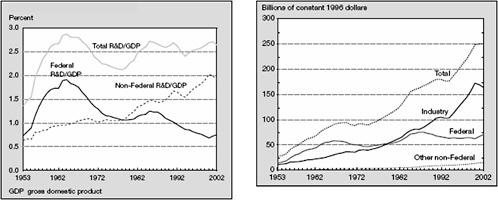
share of GDP are declining (see Figure R&D-8). Sweden, Finland, Japan, and Korea all invest a larger percentage of their GDP in R&D than the United States (see Figure R&D-9). In the president’s FY 2006 budget request, most R&D programs would drop in real terms, and overall expenditures for R&D would fail to keep pace with inflation for the first time in more than a decade.19 Funding for all three multiagency R&D initiatives—Networking and Information Technology R&D, the National Nanotechnology Initiative, and the Climate Change Science Program—would drop in FY 2006. Furthermore, with record-breaking budget deficits and new federal obligations ranging from the war in Iraq to the expansion of Medicare to pay for prescription drugs, prospects for outyear increases in R&D are dim.
The doubling of the NIH budget from 1998 to 2003 implicitly acknowledged that the rate of return on additional federal investments in science and technology is very high. Similar opportunities exist in the physical sciences, engineering, mathematics, computer science, environmental science, and the social and behavioral sciences—fields in which federal funding has been essentially flat for the last 15 years (see Figure R&D-10). Microelectronics, biotechnology, information technology, systems analysis, alternative fuels, robotics, nanotechnology, and many other research areas all have the potential to transform entire industries. Even such seemingly esoteric fields as cosmology and elementary particle physics could reveal new aspects of matter that not only could have practical implications but will inspire future generations of scientists, engineers, and mathematicians.
In addition, increases in funding of fields outside the biomedical sciences can pay dividends by complementing the tremendous advances occurring in molecular biology. Much of the recent progress in the health sciences has been underpinned by earlier achievements in mathematics, the physical sciences, and engineering. Deciphering the human genome, for example, was heavily dependent on advancements in robotics and computers. The development of modern imaging machines was made possible to a great extent by advances in engineering and mathematics.
The federal government could take several steps to ensure that funding for science and technology is adequate across fields:
-
Increase the budget for mathematics, the physical sciences, and engineering research by 12% a year for the next 7 years in the research accounts of the Department of Energy, the National Science Foundation, the National Institute for Standards and Technology, and the Department of Defense.20
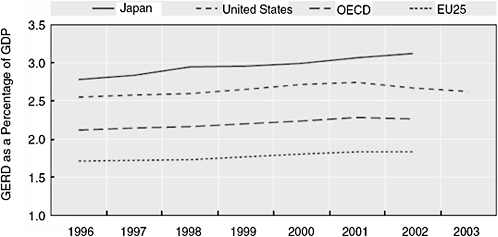
FIGURE R&D-8 Trends in R&D intensity, in United States, Japan, OECD, and EU, 1996-2003. R&D intensity is the gross domestic expenditure on R&D (GERD) as a percentage of GDP.
SOURCE: Organisation for Economic Co-operation and Development. Main Science and Technology Indicators 2004. Paris: OECD, June 2004.
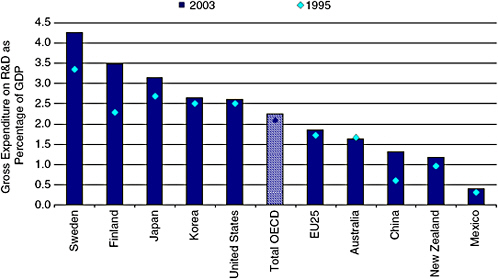
FIGURE R&D-9 Gross expenditure on R&D investments as a percentage of GDP, for select countries, OECD, and EU, 1995 and 2003.
SOURCE: Organisation for Economic Co-operation and Development. Main Science and Technology Indicators 2005. Paris: OECD, June 2005. Available at: http://www.oecd.org/document/26/0,2340,en_2649_34451_1901082_1_1_1_1,00.html.
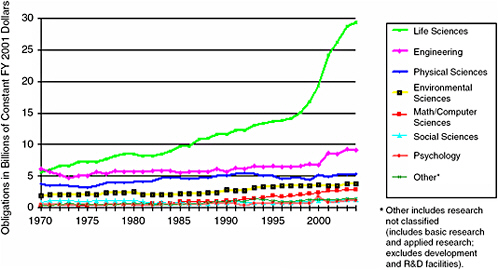
FIGURE R&D-10 Trends in federal research by field, FY 1970-FY 2004, in obligations of billions of constant FY 2004 dollars.
SOURCE: American Association for the Advancement of Science. Chart: Trends in Federal Research by Discipline: FY 1970-2004. Washington, DC: American Association for the Advancement of Science, February 2005. Available at: http://www.aaas.org/spp/rd/discip04.pdf.
-
Return federal R&D funding to at least 1% of the US GDP.21
-
Minimize earmarks in science and technology funding because these types of research requests diminish the funding available for competitive merit-reviewed research.22
-
Provide a tax credit to corporations that fund basic research in science and technology at our nation’s universities.
-
Make the R&D tax credit permanent to promote private support of R&D, as requested by the Administration in the FY 2006 budget proposal.
LEARNING MORE ABOUT THE EFFECTS OF RESEARCH
Innovation has become more important than capital or labor in boosting economic productivity, but the course and effects of innovation are much harder to predict and understand. New technologies can spread rap-
idly through a society, transforming multiple areas of economic activity and in turn triggering further innovations. The prime example is information technology, which has had a dramatic and accelerating influence on manufacturing, the provision of services, and other economic activities.
Intensive study of innovation as an engine of economic growth and social change in an extremely complex social context could provide guidance for policy-makers and other leaders. For example, is the current federal support of science and technology appropriately balanced across fields? What would be the effects if federal R&D were returned to its historical high as a share of GDP?
Another important topic for research is the organization of the federal agencies that support R&D. New organizational models could be explored, performance metrics developed, and approaches tested.
Options for the federal government include the following:
-
Support the development of a new interdisciplinary field of quantitative science and technology-policy studies that could work to predict the effect of specific science and technology projects on the world’s economies and workforces.23
-
Support research to examine the organization models of R&D agencies and potential changes in practices and structures.


