
Investing in High-Risk and Breakthrough Research
SUMMARY
If processes for awarding research grants are too risk-averse, innovative research projects that could lead to future breakthroughs in science and technology may never be funded. To avoid over-cautious R&D funding, recent reports and new programs have focused on three critical areas: adequate funding for basic, discovery-oriented research; independent research funding for young investigators; and funding for individuals who propose visionary research.
Among the federal actions that have been proposed to encourage high-risk research are the following:
-
Reallocate 3% of all federal-agency R&D budgets toward grants that invest in novel, high-risk, and exploratory research.
-
Establish a program at the National Institutes of Health (NIH) to promote the conduct of innovative research by scientists transitioning into their first independent positions.
-
Within NIH, continue to explore programs, such as the Pioneer Awards, to increase funding for high-risk, high-benefit biomedical research.
SUPPORT HIGH-RISK RESEARCH
Besides favoring older investigators, the current peer-review system can tend to drive award decisions toward conservative research that is based on precedent and is consensus-oriented. As a result, public funding for research can gradually shift from investments in bold, transformational discovery to much more incremental research.
The Council on Competitiveness proposes in the 2004 report Innovate America that the nature of discovery-focused research creates a need for government support. However, federal research support since the Cold War has become more conservative, focusing on short-term, incremental, low-risk goals. Outside the government, the council believes that risk-based investments are also needed to promote innovation. Investors tend to focus on short-term profits and are unwilling to accept the risks that come with investing in a long-term research project (see Figure HRR-1).1 The report recommends the following:
-
Reallocate 3% of all federal-agency R&D budgets toward grants that invest in novel, high-risk, and exploratory research.
-
Provide a 25% tax credit for early-stage investments of at least $50,000 through qualified angel funds.2
In the United States, NIH has, through its Roadmap initiative, also begun to seed more innovative, high-risk research. “The past two decades have brought tremendous scientific advances that can greatly benefit medical research,” the Roadmap argues. “While progress will continue into the foreseeable future, human health and well-being would benefit from accelerating the current pace of discovery. One way to achieve this goal is to support scientists of exceptional creativity who propose highly innovative approaches to major contemporary challenges in biomedical research. NIH has traditionally supported research projects, not individual investigators. However, complementary means might be necessary to identify scientists with ideas that have the potential for high impact, but that may be too novel, span too diverse a range of disciplines, or be at a stage too early to fare well in the peer review process.” As part of this initiative, NIH has created the NIH Director’s Pioneer Awards “to encourage creative, outside-the-box thinkers to pursue exciting and innovative ideas about biomedical research.” The first Pioneer Awards were granted in 2004.3
|
1 |
Council on Competitiveness. Innovate America. Washington, DC: Council on Competitiveness, 2004. |
|
2 |
Ibid. |
|
3 |
National Institutes of Health, NIH Roadmap. “High Risk Research.” 2005. Available at: http://nihroadmap.nih.gov/highrisk/. |
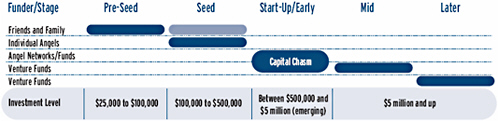
FIGURE HRR-1 Funding for innovation, by funder and investment stage.
SOURCE: Council on Competitiveness. Innovate America. Washington, DC: Council on Competitiveness, 2004. P. 36. Figure 6.
To revitalize frontier research capable of providing breakthroughs, the federal government could
-
Within NIH, continue to explore programs, such as the Pioneer Awards, to increase funding for high-risk, high-benefit biomedical research.
The National Science Board, at the National Science Foundation (NSF), is also discussing this issue. In 2004, an ad hoc Task Group on High-Risk Research was formed, which recommended that a formal Task Force on Transformative Research be established under the Committee on Programs and Plans. Additionally, the ad hoc Task Group noted that there is no formal definition of “high-risk” or “transformative” research, so there is no way to adequately determine how much support NSF is providing to such projects, but there are several reasons to begin doing so. The formal committee is researching these and other questions, and a report is expected within 2 years.4
The European Commission (EC), meanwhile, has focused part of its R&D funding on seeding high-risk research. Under its Sixth Framework Programme (FP6), the EC has established a New and Emerging Science and Technology (NEST) program at €215 million to “support unconventional and visionary research with the potential to open new fields for European science and technology, as well as research on potential problems uncovered by science.”5
|
4 |
National Science Board. “Committee on Programs and Plans, Charge to the Task Force on Transformative Research.” Available at: http://www.nsf.gov/nsb/committees/cpptrcharge.htm. |
|
5 |
European Commission, Enterprise and Industry Directorate-General. “New and Emerging Science and Technology (NEST) Programme.” 2005. Available at: http://www.cordis.lu/nest/home.html. |
FOSTER INNOVATION THROUGH YOUNG INVESTIGATORS
While peer review provides a high-integrity process sheltered from political forces, evidence suggests that it tends to favor both established investigators and investigators, new or continuing, who build on established research lines.6 As a result, young investigators have difficulty establishing themselves as independent researchers, which can have a variety of negative consequences for establishing careers, ensuring an adequate research workforce, and bringing fresh insights and ideas to the research enterprise. Indeed, recent research indicates that the age at which great innovations are produced has increased by about 6 years over the 20th century, and the loss of productivity at earlier ages is not compensated for by increased productivity after early middle age7 (see Figures HRR-2A and B). The risk is that competence and productivity can be honored to the point where they become the “enemies of greatness.”
The current system tends to emphasize the number of papers published and can overlook whether important problems are being tackled. Because requests for grant funds from new investigators are evaluated on the basis of “preliminary results,” most funded research becomes constrained to well-worn research paths, which for new investigators often means the research they previously pursued when they were postdoctoral fellows in established laboratories. In short, innovation can become the victim of a system that has become too risk-averse.
Because of the difficulties facing new investigators, the median age at which investigators receive their first research grant from NIH, for example, had crept up to 42 years in 2002. This raises the concern that new investigators are being driven to pursue more conservative research projects instead of high-risk, high-reward research that can significantly advance science. Also, young investigators can end up focusing much of their attention on others’ research, forfeiting the special creativity that they may bring to their own work (see Figures HRR-3A, B, and C).8
The same considerations apply to work funded by the Department of Defense (DOD). The need for new discoveries and innovation argues for substantial involvement of university researchers. Yet some younger university researchers in the expanded fields of interest to the DOD are discouraged by difficulty in acquiring research support from the department.9
|
6 |
National Research Council. Bridges to Independence: Fostering the Independence of New Investigators in Biomedical Research. Washington, DC: The National Academies Press, 2005. |
|
7 |
B. Jones. Age and Great Innovation. Working Paper 11359. Cambridge, MA: National Bureau of Economic Research, 2005. Available at: http://www.nber.org/papers/w11359. |
|
8 |
National Research Council. Bridges to Independence: Fostering the Independence of New Investigators in Biomedical Research. Washington, DC: The National Academies Press, 2005. |
|
9 |
National Research Council. Assessment of Department of Defense Basic Research. Washington, DC: The National Academies Press, 2005. |
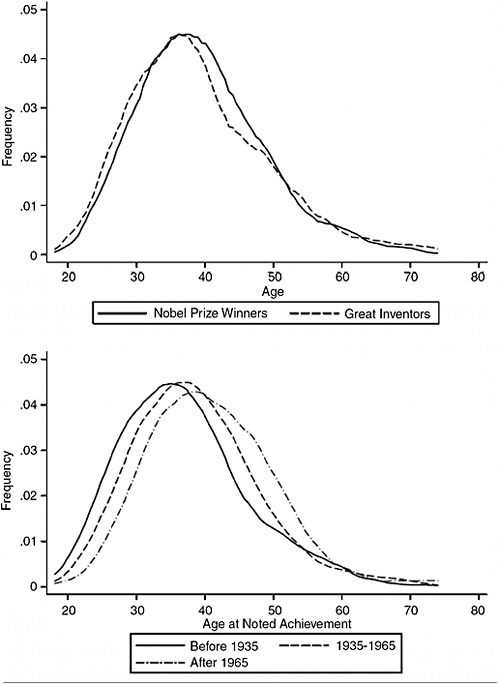
FIGURE HRR-2A Frequency distribution of age of Nobel Prize winners and great inventors at time of noted achievement.
SOURCE: B. Jones. Age and Great Innovation. Working Paper 11359. Cambridge, MA: National Bureau of Economic Research, 2005. Available at: http://www.nber.org/papers/w11359/.
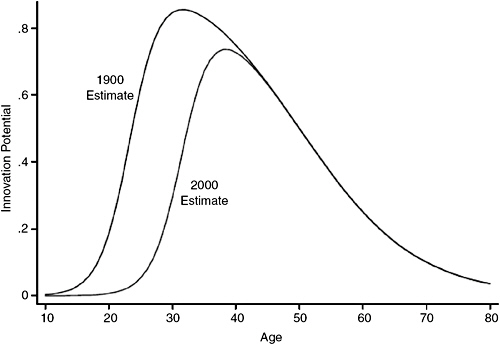
FIGURE HRR-2B Maximum likelihood estimates for potential to produce great innovations as a function of age.
SOURCE: B. Jones. Age and Great Innovation. Working Paper 11359. Cambridge, MA: National Bureau of Economic Research, 2005. Available at: http://www.nber.org/papers/w11359/.
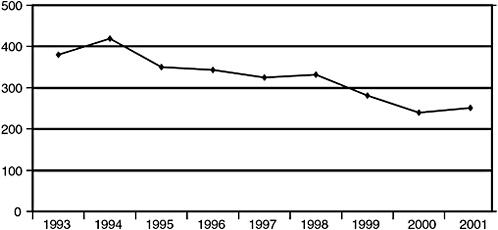
FIGURE HRR-3A Number of federal awards received by those 35 and under, 1993-2001.
SOURCE: P. Stephan. Presentation at Bridges to Independence Workshop. Board on Life Sciences, The National Academies, June 16, 2004. Available at: http://dels.nas.edu/bls/bridges/Stephan.pdf. Data are drawn from the National Science Foundation’s Survey of Doctorate Recipients.
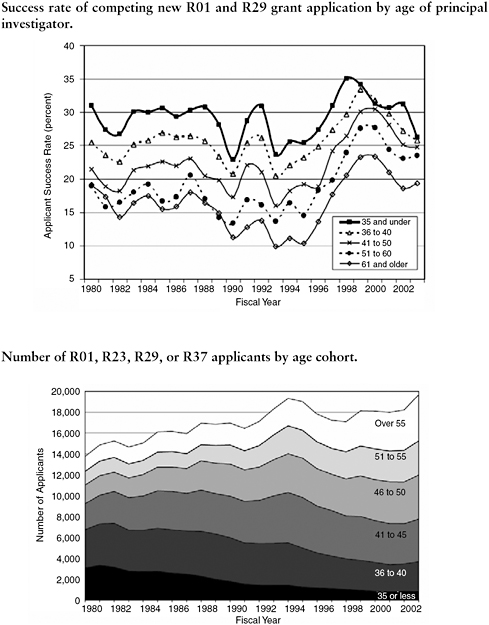
FIGURE HRR-3B Success rate of competing new R01 and R29 grant application by age of principal investigator and number of R01, R23, R29, or R37 applicants by age cohort.
NOTE: Data are from the National Institutes of Health, Office of Extramural Research. Available at: http://grants.nih.gov/grants/oer.htm.
SOURCE: National Research Council. Bridges to Independence: Fostering the Independence of New Investigators in Biomedical Research. Washington, DC: The National Academies Press, 2005.
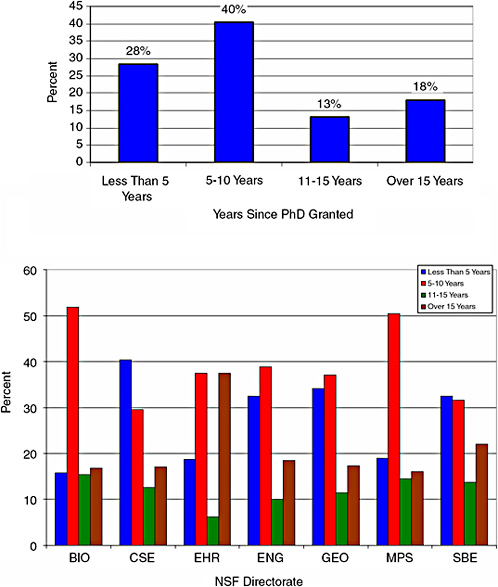
FIGURE HRR-3C Percent of fiscal year 2003 awards to new principal investigators, versus year since PhD, by field and NSF directorate.
NOTE: BIO = Biological Sciences; CSE = Computer, Information Sciences, and Engineering; EHR = Education and Human Resources; ENG = Engineering; GEO = Geosciences; MPS = Mathematical and Physical Sciences; SBE = Social, Behavioral, and Economic Sciences.
SOURCE: M. Clutter. Presentation at Bridges to Independence Workshop. Board on Life Sciences, The National Academies, June 16, 2004. Available at: http://dels.nas.edu/bls/bridges/Clutter.pdf.
To address these needs, the federal government could:
-
Establish a program at NIH to promote the conduct of innovative research by scientists transitioning into their first independent positions. These research grants would replace the existing collection of K22 awards and would provide sufficient funding and resources for promising scientists to initiate independent research programs and allow for increased risk-taking during the final phase of these efforts. The program should make 200 grants annually of $500,000 each, payable over 5 years. Each award would provide funding for 2 years of postdoctoral training support while the awardee develops an independent research program and 3 years of support as a fully independent researcher.10
-
Establish and implement uniformly across all the NIH institutes a New Investigator R01 grant. The “preliminary results” section of the application should be replaced with “previous experience” to be appropriate for new investigators and to encourage higher-risk proposals or scientists branching out into new areas. This award should include a full budget and have a 5-year term. NIH should track New Investigator R01 awardees in a uniform manner, including their success on future R01 applications.11
-
Encourage, through DOD funding and policies for university research, participation by younger researchers as principal investigators.12


