
Ensuring That the United States Is at the Forefront in Critical Fields of Science and Technology
SUMMARY
As concerns over the declining competitiveness of some US industries emerged in the 1980s, policies and programs were put into place with the goal of enabling new ideas—particularly those created through federal support—to be commercialized more quickly.
These policies and programs have taken a number of forms. They have included support for R&D partnerships among companies and between industry and government, support for R&D activities in small companies, programs to support academic research in areas of interest to industry, policies to encourage commercialization of inventions made by federal laboratories and those made by academic researchers with federal support, initiatives to coordinate federal R&D in areas of interest to several agencies, and the creation of private-sector advisory committees concerned with the future international competitiveness of particular industries.
Some of these programs have attracted controversy. For example, the Advanced Technology Program (ATP), having survived several attempts to eliminate it, was not appropriated funds for new awards in fiscal year (FY) 2005.1 Others have continued and expanded or have made a variety of transitions—for example, from government-supported to privately funded.
|
This paper summarizes findings and recommendations from a variety of recently published reports and papers as input to the deliberations of the Committee on Prospering in the Global Economy of the 21st Century. Statements in this paper should not be seen as the conclusions of the National Academies or the committee. |
|
|
1 |
See ATP Web site’s “Update for 2005.” Available at: http://www.atp.nist.gov/atp/05comp.htm. |
Federal actions that have been proposed include the following:
New Policies and Initiatives
-
Create interdisciplinary discovery-innovation institutes to bring together research, education, and practice around the solution of major societal problems.
-
Create a program of “Innovation Acceleration” grants to stimulate high-risk research through a set aside of 3% of agency R&D budgets.
-
Create a National Institute of Innovation to provide venture capital for innovative startups.
-
Expand industry-led roadmaps for R&D priorities.
-
Launch a large new initiative to develop the computational science base and the necessary broad infrastructure (such as networks) and domain-specific tools for research and education enabled by information technology across the various fields of science, engineering, and medicine.
-
Establish centers for production excellence and Innovation Extension Centers to improve the capabilities of small and medium-sized enterprises.
Modifications of Existing Policies and Programs
-
Make improvements to the Small Business Innovation Research program, including bridges between phase I and phase II funding, increased phase II funding relative to phase I funding, and regular assessments across agencies.
-
Restore ATP funding—including the ability to support new awards— to the average level of recent years.
-
Make improvements in ATP, including streamlining the application process and widening the window for funding, better integrating ATP with other programs, and focusing some funding in thematic areas.
-
Have such agencies as the Securities and Exchange Commission, the Federal Communications Commission, and the Internal Revenue Service consider launching industry–university collaborative research centers to benefit the services industries.
-
Re-examine and amend the Bayh–Dole Act to encourage collaboration among university licensing offices, thereby promoting economic development.
THE FEDERAL GOVERNMENT AS VENTURE CAPITALIST
The Small Business Innovation Research (SBIR) and Small Business Technology Transfer (STTR) programs have sought to encourage the innovative activities of small businesses. SBIR was established in 1982 and sets
aside 2.5% of the extramural R&D budgets of the largest federal science agencies for funding R&D by small businesses; it currently runs at over $1 billion per year.2 Table EL-1 shows the overall trend. SBIR encompasses three phases: feasibility, development, and commercialization. SBIR has been reviewed and evaluated a number of times over the course of its existence.3 The National Research Council is currently undertaking a new assessment of the program.4
STTR was established in 1992 to encourage small businesses to partner with research institutions in R&D and commercialization.5
Although there has been debate over the years about the impacts of these programs and the appropriate evaluation metrics, past assessments have been positive overall. Political support also has been very strong, with a number of technical changes having been recommended and enacted over the years.
Possible federal actions to improve and extend these programs include the following:
-
Bridge the funding gap between phase I and phase II awards provided by the SBIR program.6
-
Increase the number of phase II SBIR awards at the expense of phase I awards.7
-
Regularly assess SBIR program results and compare with the Department of Defense (DOD) Fast Track results, and assess the costs and benefits of better integrating SBIR awards in the development of “clusters” around universities and technology parks.8
-
Create a National Institute of Innovation that would provide venture capital for innovative startup companies to smooth the peaks and valleys of private-sector venture-capital flows.9 A similar idea, called the Civil-
TABLE EL-1 Small-Business Innovation Research Award Funding, by Type of Award: FY 1983-FY 2001
|
FY |
All Agencies |
||
|
Total |
Phase I (feasibility) |
Phase II (main phase) |
|
|
1983 |
45 |
45 |
0 |
|
1984 |
108 |
48 |
60 |
|
1985 |
199 |
69 |
130 |
|
1986 |
298 |
99 |
199 |
|
1987 |
351 |
110 |
241 |
|
1988 |
389 |
102 |
285 |
|
1989 |
432 |
108 |
322 |
|
1990 |
461 |
118 |
342 |
|
1991 |
483 |
128 |
336 |
|
1992 |
508 |
128 |
371 |
|
1993 |
698 |
154 |
491 |
|
1994 |
718 |
220 |
474 |
|
1995 |
835 |
232 |
602 |
|
1996 |
916 |
229 |
646 |
|
1997 |
1,107 |
278 |
789 |
|
1998 |
1,067 |
262 |
804 |
|
1999 |
1,097 |
300 |
797 |
|
2000 |
1,190 |
302 |
888 |
|
2001 |
1,294 |
317 |
977 |
|
SOURCE: National Science Board. Science and Engineering Indicators 2004. NSB 04-01. Arlington, VA: National Science Foundation, 2004. Appendix Table 4-39. |
|||
-
ian Technology Corporation, was proposed by a National Academies committee some years ago.10
THE ADVANCED TECHNOLOGY PROGRAM AND OTHER CONSORTIA
Partly as a response to Japan’s success in benefiting from industrial consortia in such areas as steel and semiconductors, Congress passed the National Cooperative Research Act in 1984. This legislation limited potential antitrust liabilities in order to encourage corporate R&D consortia.
With the launch of SEMATECH in 1987, the US government moved to actual financial support for collaborative industrial R&D. SEMATECH was founded as a partnership between US semiconductor companies and the DOD. In the succeeding years, as the US semiconductor industry regained competitive strength, the federal contribution to SEMATECH was gradually reduced and then eliminated.11 The consortium, now named International SEMATECH, includes countries based in Europe, Korea, and Taiwan in addition to those based in the United States.
ATP was established in 1988 as a program of the National Institute of Standards and Technology (NIST). ATP supports collaborative research among companies. The program has operated at a level of $150 million to $200 million per year in recent years. As mentioned above, the FY 2005 budget included funds to continue existing projects but no money to fund new proposals. Figure EL-1 shows how ATP funding has fluctuated over the years. ATP also supports an extensive program of evaluation and research, which has supported work at the National Academies and the National Bureau of Economic Research.12
Possible federal actions to derive advantage from government–industry partnerships and industrial consortia include the following:
-
Create “Innovation Acceleration” grants to stimulate high-risk research.13 These grants would be supported through a set aside of 3% of agency R&D budgets.
-
Restore the support of ATP and its ability to fund new projects to the level of recent years.
-
Streamline and shorten the ATP application process and timeline.14
-
Give applications from single companies parity with those from joint ventures or consortia.15
-
Extend the window for ATP award applications, accelerate the decision-making process for awards, and extend the period in which awards can be made.16
|
11 |
National Research Council. Securing the Future: Regional and National Programs to Support the Semiconductor Industry. Washington, DC: The National Academies Press, 2003. See also the “History” page on the International SEMATECH Web site, http://www.sematech.org/corporate/history.htm. |
|
12 |
See the ATP Web site. Available at: http://www.atp.nist.gov/factsheets/1-a-1.htm. |
|
13 |
Council on Competitiveness. Innovate America. Washington, DC: Council on Competitiveness, 2004. |
|
14 |
National Research Council. The Advanced Technology Program: Challenges and Opportunities. Washington, DC: National Academy Press, 1999. |
|
15 |
Ibid. |
|
16 |
National Research Council. The Advanced Technology Program: Assessing Outcomes. Washington, DC: National Academy Press, 2001. |
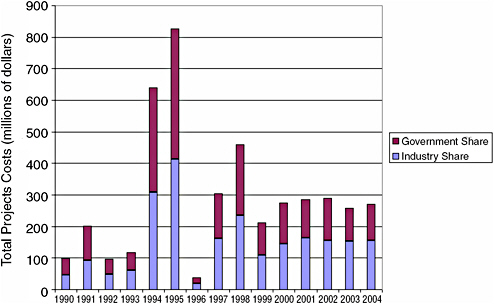
FIGURE EL-1 Summary of ATP awards, by source of funding, 1990-2004.
SOURCE: Advanced Technology Program. “ATP Factsheet: 3.A.3: ATP Awards Summary Data-Funding ($ Millions).” September 2004. Available at: http://www.atp.nist.gov/factsheets/3-a-3.htm.
-
Retain the debriefing process for unsuccessful ATP applicants.17
-
Concentrate a significant portion of ATP awards in selected thematic areas.18
-
Coordinate ATP with SBIR and national initiatives.19
-
Establish a regular outreach program within NIST to coordinate ATP awards with matching grants by states.20
-
Pass legislation that would allow industries to form self-organizing investment boards that would raise funds through a “tax” on sales of their products in order to support R&D on common problems.21
UNIVERSITY-BASED CENTERS
Federally supported university-based centers constitute a category of programs that support collaborative (usually interdisciplinary) research between universities and industries. These include such programs as the Engineering Research Centers (ERCs), Science and Technology Centers (STCs), and Industry–University Cooperative Research Centers (I/UCRCs) of the National Science Foundation (NSF). Other agencies, such as the Department of Transportation and the Department of Energy (DOE), also support university-based centers. These programs are generally awarded on a continuing basis with renewal reviews at fixed periods. NSF support for individual STCs phases out after 11 years, while other center programs are funded longer. Leveraged support from industry is generally required, the level of which varies by program.
The NSF efforts have the longest track record. For example, the ERCs program was established in 1985.22 The program itself is occasionally evaluated internally and by an external contractor using surveys, bibliometric analysis, and other methods.23 These evaluations generally show that a large percentage of industry participants derive benefits from participation, including knowledge transfer and the ability to hire students. At the time when the STCs program was being considered for renewal, a National Academies committee recommended that the program continue.24 Figure EL-2 shows how the various NSF centers programs fit into the overall funding picture.
Options for federal action include the following:
-
Establish a new, large, multi-agency centers program. In a preliminary report released for public comment earlier this year, a committee of the National Academy of Engineering proposed to create a program of interdisciplinary discovery-innovation institutes on research-university campuses. The institutes would bring together research, education, and practice around the solution of major societal problems.25 Multi-agency federal support for the institutes would build to several billion dollars per year, to be supplemented by support from industry, states, and nonprofits.
|
22 |
L. Parker. The Engineering Research Centers (ERC) Program: An Assessment of Benefits and Outcomes. Arlington, VA: National Science Foundation, 1997. Available at: http://www.nsf.gov/pubs/1998/nsf9840/nsf9840.htm. |
|
23 |
J. D. Roessner, D. Cheney, and H. R. Coward. Impact of Industry Interactions with Engineering Research Centers—Repeat Study. Arlington, VA: SRI International, 2004. |
|
24 |
NAS/NAE/IOM. An Assessment of the National Science Foundation’s Science and Technology Centers Program. Washington, DC: National Academy Press, 1996. |
|
25 |
National Academy of Engineering. Assessing the Capacity of the US Research Enterprise. Preliminary Report for Public Comment. Washington, DC: The National Academies Press, 2005. |
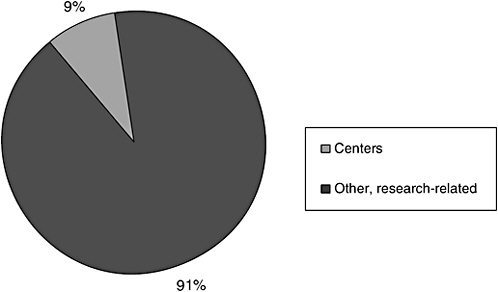
FIGURE EL-2 Centers as a percentage of the NSF research and related account.
SOURCE: Based on data in the National Science Foundation. FY 2005 Performance and Accountability Report. Arlington, VA: National Science Foundation, 2005.
-
Establish centers in agencies that have not supported centers in the past. Federal mission and regulatory agencies with primary responsibility for the services industries—such as the Securities and Exchange Commission, the Internal Revenue Service, the Federal Communications Commission, and the Department of Health and Human Services (DHHS)—should consider funding academic research in ways that encourage greater participation by the services industries.26
COLLABORATIVE RESEARCH AND DEVELOPMENT AGREEMENTS
Another mechanism for government–industry collaboration is a collaborative and development agreement (CRADA). The Stevenson–Wydler Technology Innovation Act of 1986 allowed federal laboratories to enter into CRADAs with private companies. The legislation has been amended several times and covers most agencies.The National Aeronautics and Space
Administration has a separate authority under the 1958 Space Act and the 1989 National Space Policy.27
As of FY 2001, there were 3,603 active CRADAs, 80% of which involved DOD, DOE, or the Department of Health and Human Services.28
CRADAs can range from focused collaboration on a specific technology to large programs, such as FreedomCAR, a successor to the Partnership for a New Generation of Vehicles (PNGV) CRADA between DOE and the big three automakers.29 PNGV was reviewed by a standing National Academies committee.30 Although the research made impressive technological progress, only with the recent rapid rise in gasoline prices are advanced technologies for high-fuel-economy vehicles becoming a competitive factor in the marketplace.
THE BAYH–DOLE ACT
The Bayh–Dole Act of 1980, which allowed universities to own and license patents of university inventions (even inventions supported by federal funds), ushered in an explosion of university patenting and licensing activity.31 There is broad recognition that Bayh–Dole has encouraged a variety of university–industry collaborations and small-firm startups. Figures EL-3 and EL-4 show how industry support for university research and university licensing income has gone up. There has been continuing research and debate on the ultimate impacts.32
Calls to amend or rethink Bayh–Dole have come from several quarters in recent years. Some companies and universities have found it difficult to work out the intellectual-property aspects of collaboration.33 There also have been cases in which university intellectual-property rights might have
|
27 |
National Aeronautics and Space Administration. Space Act Manual. Washington, DC: National Aeronautics and Space Administration, 1998. Available at: http://nodis3.gsfc.nasa.gov/1050-1.html. |
|
28 |
National Science Board. Science and Engineering Indicators 2004. NSB 04-01. Arlington, VA: National Science Foundation, 2004. See summary points for Chapter 4 at: http://www.nsf.gov/sbe/srs/seind04/c4/c4h.htm. |
|
29 |
US General Accounting Office. “Lessons Learned from Previous Research Could Benefit FreedomCAR Initiative.” Statement of Jim Wells. GAO-02-810T. Washington, DC: General Accounting Office, 2002. |
|
30 |
National Research Council. Review of the Research Program of the Partnership for a New Generation of Vehicles. Washington, DC: National Academy Press, 2001. |
|
31 |
Council on Government Relations. The Bayh-Dole Act: A Guide to the Law and Implementing Regulations. Washington, DC: Council on Government Relations, 1999. Available at: www.ucop.edu/ott/bayh.html. |
|
32 |
D. C. Mowery and A. A. Ziedonis. Numbers, Quality and Entry: How Has the Bayh-Dole Act Affected US University Patenting and Licensing? In A. B. Jaffe, J. Lerner, and S. Stern, eds. Innovation Policy and the Economy, Volume 1. Cambridge, MA: MIT Press, 2001. |
|
33 |
S. Butts and R. Killoran. “Industry-University Research in Our Times: A White Paper.” 2003. Available at: http://www7.nationalacademies.org/guirr/IP_background.html. |
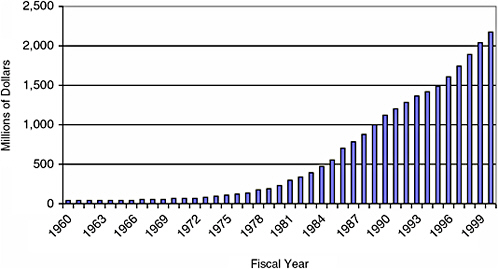
FIGURE EL-3 Industry support of science and engineering research at US colleges and universities, in millions of dollars, 1960-1999.
SOURCE: R. Killoren and S. Butts. Industry-University Research in Our Times. Background paper for Re-Engineering Intellectual Property Rights Agreements in Industry-University Collaborations. Government-University-Industry Research Roundtable, National Academies, June 26, 2003. Available at: http://www7.nationalacademies.org/guirr/IP_background.html.
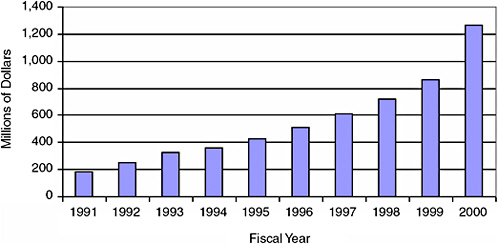
FIGURE EL-4 License income to North American universities and research institutes, in millions of dollars, 1991-2000.
SOURCE: R. Killoren and S. Butts. Industry-University Research in Our Times. Background paper for Re-Engineering Intellectual Property Rights Agreements in Industry-University Collaborations. Government-University-Industry Research Roundtable, National Academies, June 26, 2003. Available at: http://www7.nationalacademies.org/guirr/IP_background.html.
impeded the flow of a superior medical treatment to the market, to the detriment of public health.34
Possible options for federal action include the following:
-
Evaluate and amend the Bayh–Dole Act to promote collaborations between university technology-transfer offices, local community colleges, local economic-development planning agencies, federal laboratories, select managers of venture funds, and industry leaders. This would respond to the increasing pressure on university technology-transfer specialists to become stewards of their regional economic development. Cooperative Economic Development Agreements (CEDAs) can accomplish this goal.35
COMMISSIONS AND COUNCILS ON SPECIFIC INDUSTRIES AND TECHNOLOGIES
Over the years, a number of national advisory bodies have been set up to develop policy ideas and recommendations affecting specific industries. These bodies have sometimes taken on science and engineering issues as a central part of their work. The National Advisory Committee on Semiconductors, which operated in the late 1980s and early 1990s, is one example. A more recent example is the Commission on the Future of the United States Aerospace Industry.36 A followup effort, the National Aerospace Initiative, has sought to involve the relevant agencies in the development of technology roadmaps for the industry.37
The President’s Information Technology Advisory Committee, which was disbanded in June 2005, issued a final report recommending that federal agencies change the way they fund computational science and calling on the National Academies to lead a roadmapping effort.38 Several years ago, an advisory committee to NSF recommended the launch of an effort to boost cyberinfrastructure for research enabled by information technology.39
|
34 |
A. B. Shalom and R. Cook-Deegan. “Patents and Innovation in Cancer Therapeutics: Lessons from CellPro.” The Milbank Quarterly 80(December 2002):iii-iv, 637-676. |
|
35 |
C. Hamilton. “University Technology Transfer and Economic Development: Proposed Cooperative Economic Development Agreements Under the Bayh-Dole Act.” John Marshall Law Review (Winter 2003). |
|
36 |
Commission on the Future of the United States Aerospace Industry. Final Report. Arlington, VA: Commission on the Future of the United States Aerospace Industry, 2002. Available at: http://www.ita.doc.gov/td/aerospace/aerospacecommission/AeroCommissionFinalReport.pdf. |
|
37 |
National Research Council. Evaluation of the National Aerospace Initiative. Washington, DC: The National Academies Press, 2004. |
|
38 |
President’s Information Technology Advisory Committee. Computational Science: Ensuring America’s Competitiveness. Washington, DC: National Coordination Office for Information Technology Research and Development (NCO/ITR&D), 2005. |
|
39 |
Blue-Ribbon Advisory Panel on Cyberinfrastructure. Revolutionizing Science and Engineering Through Cyberinfrastructure. Arlington, VA: National Science Foundation, 2003. |
Possible options for federal action include the following:
-
Make coordinated, fundamental, structural changes that affirm the integral role of computational science in addressing the 21st century’s most important problems, which are predominantly multidisciplinary, multiagency, multisector, and collaborative. To initiate the required transformation, the federal government, in partnership with academe and industry, must create and execute a multidecade roadmap directing coordinated advances in computational science and its applications in science and engineering disciplines.
-
Commission the National Academies to convene one or more task forces to develop and maintain a multidecade roadmap for computational science and the fields that require it, with a goal of ensuring continuing US leadership in science, engineering, the social sciences, and the humanities.
-
Direct NSF to establish and lead a large-scale, interagency, and internationally coordinated Advanced Cyberinfrastructure Program to create, deploy, and apply cyberinfrastructure in ways that radically empower all scientific and engineering research and allied education. Sustained new NSF funding of $1 billion per year is required to achieve “critical mass” and to leverage the necessary coordinated coinvestment from other federal agencies, universities, industry, and international sources required to empower a revolution.40
MANUFACTURING AND INNOVATION EXTENSION
The Manufacturing Extension Partnership (MEP) program of NIST was established in 1989 and now comprises about 350 nonprofit MEP centers that collectively receive a little over $100 million annually from NIST.41 The centers have been successful in attracting support from states, industry, and other entities.
Several recent recommendations for federal action are related to manufacturing technology and extension services:
-
Establish a program of Innovation Extension Centers to enable small and medium-sized enterprises to become first-tier manufacturing partners.42
-
Create centers for production excellence that include shared facilities and consortia.43
|
40 |
Ibid. |
|
41 |
See the NIST Web site. Available at: http://www.mep.nist.gov/about-mep/about.html. |
|
42 |
Council on Competitiveness. Innovate America. Washington, DC: Council on Competitiveness, 2004. |
|
43 |
Ibid. |


