
Understanding Trends in Science and Technology Critical to US Prosperity
SUMMARY
Sound policies rest on a solid foundation of information and analysis. The collection and analysis of data have become key components of the innovation system.
During the late 1980s and early 1990s, policy-makers expressed a growing interest in assessments and international comparisons of critical technologies. This interest was prompted by the rapid (and unexpected) emergence during the 1980s of Japanese companies in high-technology fields, such as microelectronics, robotics, and advanced materials. Policy-makers proposed that regular efforts to identify the technologies likely to underlie future economic growth and to assess the relative international standing of the United States in those technologies would yield information useful for making investment decisions.
Today, a number of government and private groups undertake a variety of technology assessments that enhance our understanding of America’s relative standing in specific science and engineering fields. More detailed and innovative measures could provide important additional information on the status and effects of scientific and technological research.
Recommendations for federal actions in these areas include the following:
International Benchmarking of US Research Fields
-
Establish a system to conduct regular international benchmarking assessments of US research to provide information on the world leadership status of key fields and subfields of scientific and technologic research.
Critical Technologies
-
Establish a federal office that would coordinate ongoing private and public assessments of critical technologies and initiate additional assessments where needed.
Data Collection and Dissemination
-
Mandate that the White House Office of Science and Technology Policy prepare a regular report on innovation that would be linked to the federal budget cycle.
-
Provide the National Science Foundation (NSF) Division of Science Resources Statistics (SRS) with resources to launch a program of innovation surveys.
-
Ensure that research and innovation survey programs, such as the NSF R&D survey, incorporate emerging, high-growth, technology-intensive industries, such as telecommunications and biotechnology, and industries across the service sector—financial services, transportation, and retailing, among others.
SCIENCE AND TECHNOLOGY BENCHMARKING
As part of the technology and international-competitiveness debates of the 1980s and 1990s, several initiatives were launched to assess national capabilities in specific fields of science and engineering. Many of the early assessments looked at Japanese capabilities and were performed by US or international panels.1 In the late 1980s, the Japan Technology Evaluation Center started as an interagency federal initiative managed by SAIC; it evolved into an NSF-contracted center at Loyola College of Maryland and is now an independent nonprofit known as WTEC, Inc.2 WTEC assessments cover a variety of countries and fields and are undertaken on an ad hoc basis. They are funded by the federal agencies most interested in the specific field being assessed.
|
1 |
National Research Council, National Materials Advisory Board. High-Technology Ceramics in Japan. Washington, DC: National Academy Press, 1984. |
|
2 |
See the WTEC, Inc., Web site. Available at: http://www.wtec.org/welcome.htm. |
A 1993 National Academies report recommended that the world leadership status of research fields be evaluated through international benchmarking.3 A followup report that reviewed three benchmarking experiments (mathematics, immunology, and materials science and engineering) concluded that the approach of using expert panels could yield timely, accurate “snapshots” of specific fields.4 The report also suggested that benchmarking assessments be conducted every 3-5 years to capture changes in the subject fields. Figure UT-1 illustrates one such assessment.
The factors considered most important in determining US leadership status, on the basis of all the international benchmarking experiments, were human resources and graduate education, funding, innovation process and industry, and infrastructure.
In addition, the Bureau of Industry and Security of the US Department of Commerce undertakes assessments of the US industrial and technology base in areas considered important for national defense.5 These assessments often take into account international competitiveness.
Possible federal action includes the following:
-
Establish a system to conduct regular international benchmarking assessments of US research to provide information on the world leadership status of key fields and subfields of scientific and technological research.
An example of the potential utility of this information is shown in Figures UT-2 to UT-5 which show funding and innovation process metrics for nanotechnology.
CRITICAL TECHNOLOGIES
In 1990, Congress mandated that a biennial review be conducted of America’s commitment to critical technologies deemed essential for “maintaining economic prosperity and enhancing the competitiveness of the US research enterprise.” The legislation required that the number of technologies identified in the report not exceed 30 and include the most economically important civilian technologies expected after the decade following the report’s release with the estimated current and future size of the domes-
|
3 |
NAS/NAE/IOM. Science, Technology, and the Federal Government. Washington, DC: National Academy Press, 1993. |
|
4 |
NAS/NAE/IOM. Experiments in International Benchmarking of U.S. Research Fields. Washington, DC: National Academy Press, 2000. |
|
5 |
See http://www.bis.doc.gov/defenseindustrialbaseprograms/osies/DefMarketResearchRpts/Default.htm. |
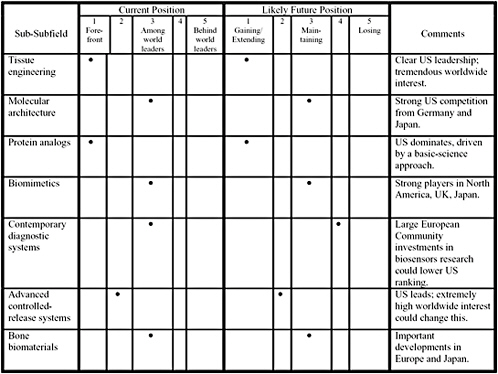
FIGURE UT-1 Example of international benchmarking for several materials science and engineering subfields.
SOURCE: NAS/NAE/IOM. Experiments in International Benchmarking of US Research Fields. Washington, DC: National Academy Press, 2000.
tic and international markets for products derived from the identified technologies. However, the exact definition of critical technologies was not included in the legislation.
The Office of Science and Technology Policy (OSTP) prepared National Critical Technologies Reports (NCTR) to Congress in 1991,6 1993,7 1995,8 and 1998.9 The content of and methods used to prepare the NCTRs varied
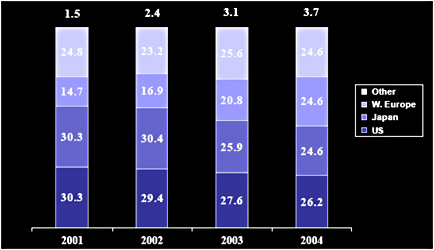
FIGURE UT-2 Share of total government investment for nanotechnology, in billions of dollars.
SOURCE: S. Murdock. Testimony before the Research Subcommittee of the Committee on Science of the United States House of Representatives. Hearing on “Nanotechnology: Where Does the US Stand?” June 29, 2005.
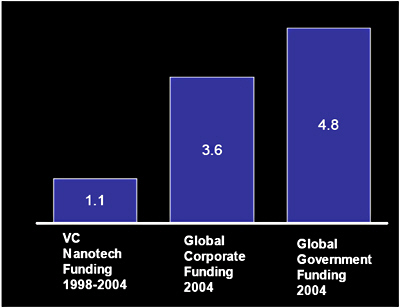
FIGURE UT-3 Venture capital, global corporate, and global government nanotechnology funding, in billions of dollars.
SOURCE: S. Murdock. Testimony before the Research Subcommittee of the Committee on Science of the United States House of Representatives. Hearing on “Nanotechnology: Where Does the US Stand?” June 29, 2005.
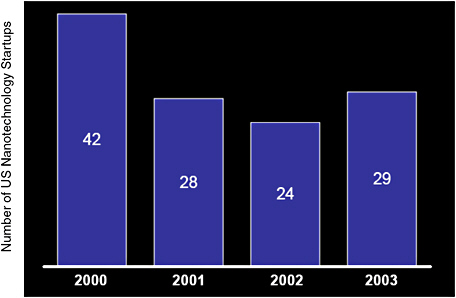
FIGURE UT-4 Number of US nanotechnology startups, 2000-2003.
SOURCE: S. Murdock. Testimony before the Research Subcommittee of the Committee on Science of the United States House of Representatives. Hearing on “Nanotechnology: Where Does the US Stand?” June 29, 2005.Number of US Nanotechnology Star
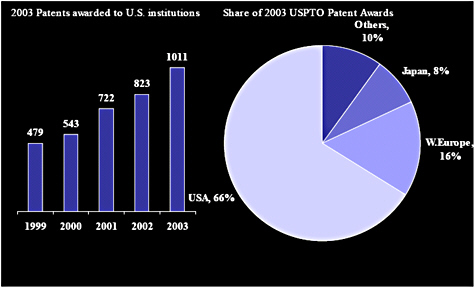
FIGURE UT-5 US patents awarded to US institutions, 2003.
SOURCE: S. Murdock. Testimony before the Research Subcommittee of the Committee on Science of the United States House of Representatives. Hearing on “Nanotechnology: Where Does the US Stand?” June 29, 2005. This figure was based on an analysis done by Jim Murday and Mike Roco of the Nano Business Alliance.
throughout the decade.10 The 1995 report, for example, identified seven “technology categories” (energy, environmental quality, information and communication, living systems, manufacturing, materials, and transportation), which were divided into 27 “technology areas.” Figure UT-6 illustrates the NCTR analyses for materials research. Each of the 27 areas was identified on a competitive scale ranging from lagging to leading, and each area was then compared with Europe and Japan.11
Over the 1990s, the RAND Corporation played an increasingly important role in the preparation of the NCTRs. RAND assisted with the background research for the 1993 report and was a co-author of the 1995 report with OSTP.12 The 1998 critical-technologies report was prepared by RAND with little involvement of OSTP.13 This report, which refocused the study specifically on input from the private sector, identified five critical sectors of technology: software, microelectronics and telecommunications technologies, advanced manufacturing, materials, and sensor and imaging technologies.14 After the release of the 1998 report, the legal requirement for OSTP to prepare the NCTR was removed.
Those involved in the NCTR process point out that federal agencies and state and local governments used the reports as a basis for policy-making. However, the NCTRs do not appear to have had a formal effect on US federal policy toward technology development.15 For example, the NCTRs did not lead to the creation of any large cross-agency technology initiative. Nanotechnology was not a focus of the final 1998 NCTR, but OSTP started work around that time on discussions that would culminate in the creation of the National Nanotechnology Initiative several years later.16
In addition to the NCTRs, several other public and private efforts to identify critical technologies in both the defense and civilian arenas were undertaken during the 1990s by such groups as the US Department of Defense17 and the Council on Competitiveness.18 More recently, several government agencies have expressed interest in assessing international capabilities in
|
10 |
C. S. Wagner and S. W. Popper. “Identifying Critical Technologies in the USA.” Journal of Forecasting 22(2003):113-128. |
|
11 |
National Critical Technologies Panel, 1995. |
|
12 |
Wagner and Popper, 2003, p. 120. |
|
13 |
Ibid. |
|
14 |
Popper, Wagner, and Larson, 1998. |
|
15 |
Wagner and Popper, 2003, p. 123. |
|
16 |
N. Lane and T. Kalil. “The National Nanotechnology Initiative: Present at the Creation.” Issues in Science and Technology 21(Summer 2005):49-54. |
|
17 |
See the Militarily Critical Technologies Web site. Available at: http://www.dtic.mil/mctl. |
|
18 |
Council on Competitiveness. Gaining New Ground: Technology Priorities for America’s Future. Washington, DC: Council on Competitiveness, 1991. |
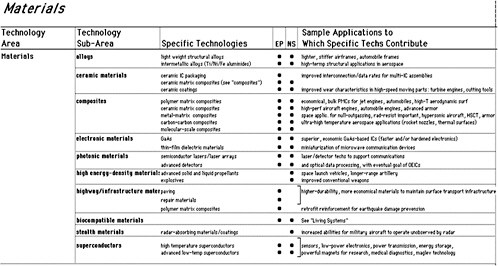
FIGURE UT-6 Example of critical technologies list for materials.
NOTE: EP = Economic Prosperity, NS = National Security.
SOURCE: Office of Science and Technology Policy. “National Critical Technologies List, March 1995.” Available at: http://clinton1.nara.gov/White_House/EOP/OSTP/CTIformatted/AppA/appa.html.
militarily critical technologies.19 Also, a number of countries are engaged in periodic assessments of critical technologies and international capabilities.
Possible federal actions include the following:
-
Establish a federal office that would coordinate ongoing private and public assessments of critical technologies and initiate additional assessments where needed.
-
Analyze the technology forecasting and foresight activities of other countries to identify where such activities can provide useful input to policy processes.
DATA ON RESEARCH AND INNOVATION
The adequacy of measures and statistical data to inform policy-making remains a concern of the science and technology policy community. For example, during the 1990s, information technologies were widely deployed throughout the US economy and played a major role in a surge of US innovation, yet this process was captured poorly, if at all, by traditional indicators of research and innovation. Except for statistics on formal R&D spending, patents, and some aspects of science and engineering education, innovation-related data are extremely limited.20
Among the steps the federal government could take to improve data collection and analysis are the following:
-
Mandate that OSTP prepare a regular report on innovation that would be linked to the federal budget cycle.21 The goal of the report would be to give the government and the public a clear sense of how federal support for R&D fits into the larger national economic system and how both are linked to an increasingly international process of innovation.
-
Provide the NSF SRS with resources to launch a program of innovation surveys.22 SRS should work with experts in universities and public institutions that have expertise in a broad spectrum of related issues. In some cases, it may be judicious to commission case studies. NSF also should
-
build an internal capacity to resolve the methodologic issues related to collecting innovation-related data.
-
Ensure the collection of information needed to construct data series of federal science and technology (FS&T).23 NSF needs to continue to collect the additional data items that are readily available in the defense agencies and expand collection of civilian data that would permit users to construct data series on FS&T expenditures in the same manner as the FS&T presentation in the president’s budget documentation.
-
Overhaul the field-of-science classification system to take account of changes in academic research, including interdisciplinary and multidisciplinary research.24 It has been some three decades since the field-of-science classification system has been updated, and the current classification structure no longer adequately reflects the state of science and engineering fields. The Office of Management and Budget needs to initiate a review of the Classification of Fields of Science and Engineering, last published as Directive 16 in 1978. The SRS could serve as the lead agency for an effort that must be conducted on a governmentwide basis. NSF should engage in a program of outreach to the disciplines to begin to develop a standard concept of interdisciplinary and multidisciplinary research, and on an experimental basis it should initiate a program to collect information from a subset of academic and research institutions.
-
Redesign NSF’s industrial R&D survey.25 The redesign should begin by assessing the US survey against the international “standard”—the definitions promulgated through the Frascati Manual from the Organisation for Economic Co-operation and Development. The redesign also should update the industry questionnaire to facilitate an understanding of new and emerging R&D issues, enhance the program of data analysis and publication, revise the sample to enhance coverage of growing sectors, and improve the collection procedures to better involve and educate the respondents.
-
Ensure that research and innovation survey programs, such as NSF’s R&D survey, incorporate emerging, high-growth, technology-intensive industries, such as telecommunications and biotechnology, and industries across the service sector—financial services, transportation, and retailing, and others.26 Also, survey programs should collect information at the business-unit level of corporate activity rather than on a firm as a whole, and geographic location detail should be collected.
-
NSF should increase the analytic value of its data by improving comparability and linkages among its data sets and between its data and data from other sources, such as the US census.27
-
SRS should develop a long-term plan for its Science and Engineering Indicators publication so that it is smaller, more policy-focused, and less duplicative of other SRS publications.28 SRS also should substantially reduce the time between the reference date and data release of each of its surveys to improve the relevance and usefulness of its data.


