
Location of Recent or Planned R&D Sites
A major goal of the survey was to determine the relative importance of factors in deciding where to place R&D facilities and how the importance of these factors depends on whether facilities are inside or outside the home country.
To minimize noise in the data, the survey did not pose questions about respondents’ general perceptions of the pros and cons of locating R&D facilities in the home country versus possible locations elsewhere.1 Rather, respondents were asked if they could think of an R&D facility outside the home country that was either recently established or is in a planning phase. If such a facility did not come to mind, then no further questions were asked about factors for facilities outside the home country. Focusing on actual decisions, in principle, minimizes the probability that respondents answer what they believe “should” influence decisions. The specific phrase was as follows:
Think about some of the more recent R&D facilities established by your firm. This can include facilities you are in the process of building or staffing or
which are only in the planning phase. Choose one of these that is OUTSIDE the home country and that is both considered to be central to your firm’s current R&D strategy and about which you are familiar.
Does such a facility come to mind?
A “yes” response was followed by a series of questions about that facility; these questions were skipped if the response was “no.” The above was repeated substituting “INSIDE the home country” for “OUTSIDE the home country.”
Those respondents familiar with a recent or planned facility were asked about the destination country, the year the facility was established (or expected to be established), and the number (or expected number) of technical employees. Table 1, Part A gives the distribution of facilities by destination and by home country of all respondents. The left-most column is the home country or region of the respondent. The remaining columns give the destination. For example, 19 U.S. respondents identified a recent or planned facility in Western Europe. Note that only four firms responding
TABLE 1 Location of Recent or Planned Facilities
|
Part A. Number and Destination of Facilities Outside the Home Country |
||||||
|
|
Destination |
|||||
|
Home Country |
United States |
Western Europe |
China |
India |
Other |
Row Total |
|
United States |
0 |
19 |
30 |
9 |
13 |
71 |
|
Western Europe |
14 |
10 |
23 |
9 |
12 |
68 |
|
Other |
0 |
0 |
2 |
0 |
2 |
4 |
|
Column Total |
14 |
29 |
55 |
18 |
27 |
143 |
|
Part B. Number of Facilities Inside the Home Country |
||||||
|
Home Country |
|
|
|
|
|
|
|
United States |
34 |
|
|
|
|
|
|
Western Europe |
51 |
|
|
|
|
|
|
Other |
7 |
|
|
|
|
|
|
Column Total |
92 |
|
|
|
|
|
to this question listed their home country as outside the United States and Western Europe. Part B of Table 1 gives the number of respondents by home country who were able to identify a recent or planned facility in the home country. There is a mix across U.S. and Western European firms and a mix of sites in developed economies and in developing or emerging economies. Note that these responses are not for all recent or planned sites; they are only for the sites that respondents were familiar with and which they considered central to their overall R&D strategy.
From Figure 3 it is clear that over the near future there will be expansion of R&D into emerging economies with some contraction in developed economies. It is interesting to note that when asked for recent or planned facilities that are central to the firm’s current R&D strategy, respondents responded about more facilities at home or in another developed economy than they did about facilities in an emerging economy. Also, U.S. respondents were more likely to respond about a site in Western Europe than in India, and Western European respondents were more likely to respond about a site in the United States than in India.
Respondents were asked for the number of technical employees employed or expected to be employed in the facilities about which they were responding. They were also asked for the number of technical employees employed worldwide. Together these pieces of information provide a picture of the importance, in terms of employment, of these facilities. Table 2 provides the means and medians for employment worldwide for respondents as well as for sites identified inside and outside the home country.
Facility employment is highly skewed. A majority (58.2 percent) of new or planned facilities outside the home country have fewer than 50 employees, and 72.3 percent have fewer than 100 employees. For new or planned facilities inside the home country, 44.7 percent have 50 or fewer technical employees, and 60.6 percent have fewer than 100 employees.
TABLE 2 Mean and Median Size of R&D Facilities (Number of Technical Employees)
|
|
Mean |
Median |
|
Worldwide |
3788 |
700 |
|
Outside/Emerging |
205 |
50 |
|
Outside/Developed |
127 |
44.5 |
|
Inside |
219 |
90 |
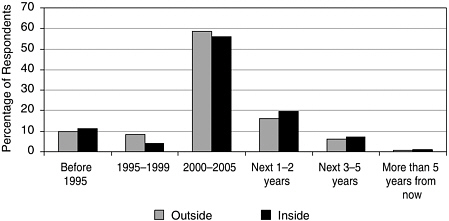
FIGURE 5 Relative frequency of site dates.
For each facility (whether inside or outside the home country) respondents were asked for the year established or, if it is a planned facility, for the expected time before the facility would become operational. Figure 5 gives the relative frequency distribution for inside and outside sites. There is not a statistically significant difference between sites that are inside and sites that are outside the home country. By far the most common answer is for sites established in the past few years.
Next, respondents were asked whether the site characteristics found in Box 1 were correct for this facility.
Figure 6 presents results on the questions for all respondents according
|
BOX 1 General Site Characteristics
|
to whether the site is in the home country, another developed economy (DEV), or a developing or emerging economy (EMG). In comparing responses by characteristic and across sites, there are few significant differences. A site in another developed economy is more likely to be an acquisition than is a site in an emerging economy (5-percent level). More interesting is the significantly higher percentage (5-percent level) of respondents for emerging economy sites who indicated that the site was to support research relationships with local universities or research institutes. This result likely follows from the fact that these companies have already established extensive research networks with universities in developed economies (home or otherwise), but they are in the process of developing those networks in emerging economies. Finally, note that the most likely characteristic is that the R&D site is an expansion. In contrast, it is very unlikely that the site is a relocation of R&D activity.
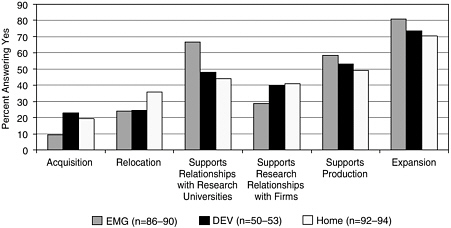
FIGURE 6 General site characteristics.
|
Statistical Tests for Figure 6(5-percent level): |
||
|
Emerging economies |
Developed economies |
Home |
|
NeedsProd=SupResUniv |
Expand=NeedsProd |
NeedsProd=SupResUniv=SupResFirm=Relocate |
|
SupResFirm=Relocate |
NeedsProd=SupResUniv=SupResFirm |
|
|
|
SupResFirm=Relocate=Acquire |
|
|
|
SupResFirm=Acquire=SupResUniv |
|


