
Protecting and Capitalizing on Intellectual Property and the Types of Research Conducted
For each R&D site outside the home country, respondents were asked about methods for protecting and capitalizing on intellectual property. Specifically, they were asked:
We want to know the approaches used to protect and capitalize on intellectual property either developed in this facility or transferred to it. First we will ask whether you agree or disagree that you use an approach. We will use a 5-point scale where 5 is strongly agree and 1 is strongly disagree. Second, we will ask how important the approach is for this facility. We will use a 5-point scale where 5 is extremely important and 1 is not important at all.
The intellectual property strategies are given in Box 3.
Respondents generally provided the same response for both the level of agreement and the level of importance. In no case is there a statistically significant difference between the levels of agreement and importance; thus, only the levels of agreement are presented in Figure 10.
Based on a 5-percent significance level, respondents are more likely to agree that they use the same intellectual property strategies in a developed economy and the home country than they are to agree that they use the same strategies in an emerging economy and the home country. However, the only strategy for which there is a statistically significant difference (5-
|
BOX 3 Strategies for Protecting and Capitalizing on Intellectual Property
|
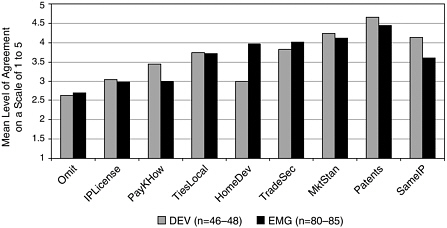
FIGURE 10 Protecting and capitalizing on intellectual property outside the home country.
|
Statistical Tests for Figure 10(5-percent level) |
||
|
|
Developed economies |
Emerging economies |
|
|
Omit=IPLicense=HomeDev |
Omit=IPLicense=PayKHow |
|
|
PayKHow=TiesLocal=TradeSec |
TiesLocal=HomeDev=TradeSec |
|
|
PayKHow=HomeDev=IPLicense |
TradeSec=MktStan |
|
|
TradeSec=MktStan |
|
percent level) is statement 5: The potentially important intellectual property is developed in the home country.
In interviews with industry R&D managers, the case was often made that ties to local authorities are very important for intellectual property protection in China, and this is the primary reason for its inclusion in the strategies list. The results in Figure 10 include responses about other emerging economies as well. For sites in China the mean response for TiesLocal is 3.9, but it is not statistically significantly different from the mean for developed economies.
A related series of questions concerned the type of research conducted at home versus sites outside the home country; that is, the questions focused on the creation of intellectual property rather than on protecting and capitalizing on intellectual property. The focus is on whether the science application is novel or not and on whether the R&D is for the creation of products or services that are new to the firm or already offered to customers of the firm. Respondents were provided with the following:
We are interested in the types of R&D conducted OUTSIDE the home country as they relate to new technologies and markets defined as follows.
A NEW TECHNOLOGY is a novel application of science as an output of the R&D. It may be patentable or not.
Improving FAMILIAR TECHNOLOGY refers to an application of science currently used by you and/or your competitors.
R&D for NEW MARKETS is designed to create products or services that are new to your firm.
R&D for FAMILIAR MARKETS refers to improvement of products or services that you already offer your customers or where you have a good understanding of the end use.
This gives four possible types of R&D:
-
Improving familiar technologies for familiar markets
-
Improving familiar technologies for new markets
-
Creating new technologies for familiar markets
-
Creating new technologies for new markets.
Note that “new” versus “familiar” markets does not refer to geographical markets. Rather, the focus is on whether the firm is currently selling such a product or service. This taxonomy can be summarized in four quadrants:
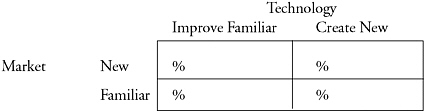
Respondents were asked for the percentage of the technical staff in each quadrant:
Approximately what percent of the technical staff employed OUTSIDE the home country are engaged in R&D for the purpose of
-
Improving familiar technologies for familiar markets
-
Improving familiar technologies for new markets
-
Creating new technologies for familiar markets
-
Creating new technologies for new markets.
This exercise was repeated both for identified R&D sites inside the home country and for sites outside the home country. Results are shown in Figure 11.
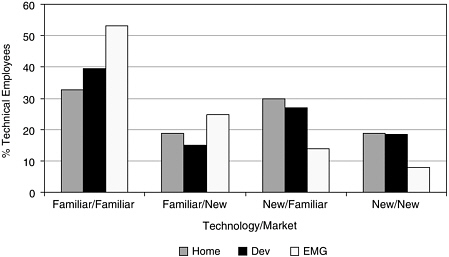
FIGURE 11 Type of research conducted.
Results by quadrant are not statistically significantly different by home versus other developed economies. However, results for home and other developed sites are significantly different from results for emerging economy sites. The potentially important R&D (new technologies and familiar products and new technologies and new markets) is conducted typically in developed economies (home or elsewhere) where intellectual property protection is greatest.


