
2
Today’s Prisoners: Changing Demographics, Health Issues, and the Current Research Environment
The conditions of confinement in today’s prisons and jails have many of the same characteristics that were of concern to the National Commission for the Protection of Human Subjects of Biomedical and Behavioral Research (NCPHSBBR) some 30 years ago (see Appendix B). Yet important new factors have emerged that require consideration. The correctional population has expanded more than 4.5 fold between 1978 and 2004—from 1.5 million to almost 7 million as a result of tougher sentencing laws and the war on drugs (Bureau of Justice Statistics [BJS], 1997, 2005a,f,g,h; Human Rights Watch [HRW], 2003; Jacobson, 2005). Just within prisons and jails, the population grew from 454,444 to 2.1 million (BJS, 2005a,f). The rest of the expansion occurred among probationers and parolees (BJS, 2005g,h).
In addition, with the closing of large state mental institutions, prisons have effectively become the new mental illness asylums. Prisoners suffer higher rates of communicable diseases, such as human immunodeficiency virus (HIV)/acquired immune deficiency syndrome (AIDS) and hepatitis, than the general population, and chronic diseases such as diabetes are on the rise, especially among the growing older population of prisoners (National Commission on Correctional Health Care [NCCHC], 2002). Health care within some prison systems is less than satisfactory. Through class actions over the inadequacies of state prison health-care systems, the most serious problems were largely addressed and health-care delivery systems were put in place (Metzner, 2002; Sturm, 1993). However, problems remain. Most recently, a federal district court judge placed California’s entire prison medical health-care system into federal receivership, taking it out of
control of the state and placing it under the control of a trustee appointed by the court.1 In addition, the entire state prison mental health system is being monitored by another federal court after being found to be providing constitutionally inadequate mental health services to inmates with serious mental illnesses (Coleman v. Wilson, 912 F.Supp. 1282 [E.D.Cal 1995]). And New York regulators have faulted the private firm Prison Health Services in several deaths within the state’s prison system (Von Zielbauer, 2005d). This follows by 30 years the case of Estelle v. Gamble, in which the U.S. Supreme Court articulated a constitutionally protected right to health care in prisons and jails (U.S. Supreme Court, 1976).
The committee’s review of current research indicated that the majority of research involving prisoners is happening outside the purview of Subpart C, and many prisoner studies are being conducted without review or approval by an institutional review board (IRB). Prison research committees that may serve some type of proxy IRB role only infrequently include prisoners or prisoner representatives among their membership. All of these factors point to a population of prisoners who may be more vulnerable and require stronger protections than those inspired by the commission in the 1970s.
CHANGING DEMOGRAPHICS AND HEALTH ISSUES
Descriptions of Prisons, Jails, and Other Correctional Settings
Within the United States, correctional settings, which constrain liberty, entail more than prisons. Local jails, usually county or city facilities, house prisoners from arraignment through conviction and for sentences usually no longer than one year. State and federal prisons incarcerate those sentenced for longer periods. About 6 percent, or close to 99,000 prisoners, are held in privately operated facilities that incarcerate the state and federal overflow (BJS, 2005a,c). In six states, all in the West, at least one-quarter of all persons in prisons are in private facilities (BJS, 2005a). Several other alternatives to prisons and jails that constrain liberty, including restitution centers, camps, treatment facilities, and electronic monitoring programs, are listed in Table 4-1 (see Chapter 4); specific options within the state of California are provided in Table 4-2 (see Chapter 4). Parole and probation are two other settings in which individuals have restricted liberties by virtue of involvement in the criminal justice system. Parole is used for offenders
who are conditionally released from prison to community supervision. An offender is required to observe the conditions of parole and is under the supervision of a parole agency. Parole differs from probation, which is determined by judicial authority and is usually an alternative to initial confinement.
The Prisoner Population
The Incarcerated Population Has Grown Enormously
The total estimated correctional population in the United States in 2004 was very close to 7 million, according to the Bureau of Justice Statistics (2005a). Table 2-1 indicates that the majority of these individuals were on probation (4 million), followed by confinement in prison (1.4 million), on parole (765,355), and confinement in jail (713,990). Overall, the population in 2004 was more than 4.5 times larger than it was in 1978.
By the end of 2004, the nation’s prisons and jails incarcerated 2.1 million persons (BJS, 2005a) compared with 216,000 in 1974 (BJS, 2003a). Today, two-thirds of inmates are housed in federal and state prisons, and the other third are in local jails.
The numbers in Table 2-1 are point-in-time figures. Annual flow in and out of jail, where incarceration time is comparatively short, provides a useful picture as well. Nearly a quarter (23 percent) of all jail inmates spend 14 days or less in jail, 29 percent are held from 2 to 6 months, 7 percent are held for a year or more (BJS, 2004c). The transitory nature of jail confinement can have an impact on research participation, as discussed in Chapter 4.
Using Department of Justice statistics and trends, the Justice Policy
TABLE 2-1 Persons Under Adult Correctional Supervision, 1978–2004 Total Estimated
|
Year |
Correctional Population |
Probation |
Parole |
Jail |
Prison |
|
1978 |
1,531,596 |
899,305 |
177,847 |
158,394 |
296,050 |
|
1980* |
1,840,400 |
1,118,097 |
220,438 |
82,288 |
319,598 |
|
1995 |
5,342,900 |
3,077,861 |
679,421 |
507,044 |
1,078,542 |
|
2000 |
6,445,100 |
3,826,209 |
723,898 |
621,149 |
1,316,333 |
|
2001 |
6,581,700 |
3,931,731 |
732,333 |
631,240 |
1,330,007 |
|
2002 |
6,758,800 |
4,024,067 |
750,934 |
665,475 |
1,367,547 |
|
2003 |
6,936,600 |
4,144,782 |
745,125 |
691,301 |
1,392,796 |
|
2004 |
6,996,500 |
4,151,125 |
765,355 |
713,990 |
1,421,911 |
|
*1980 figures from BJS, 2003c. SOURCES: U.S. Census, 1998, 1994; BJS, 1997, 2000a, 2003c, 2004b, 2005a,f,g,h. |
|||||
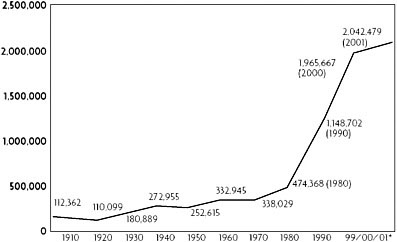
FIGURE 2-1 The punishing decade: number of prison and jail inmates, 1910– 2000.
SOURCE: JPI (2002).
Institute (JPI) based in Washington, D.C., estimated in 2000 that the United States had the world’s largest incarcerated population and highest incarceration rate. Just 6 weeks into the new millennium, America had one-quarter of the world’s prison population, despite having less than 5 percent of the world’s population (JPI, 2002). The U.S. incarceration rate was highest, with 686 per 100,000 of the national population (Walmsley, 2003), followed by the Cayman Islands (664), Russia (638), Belarus (554), Kazakhstan (522), Turkmenistan (489), and Belize (459). More than 62 percent of countries worldwide have rates below 150 per 100,000. By 2004, the U.S. rate had risen to 724 per 100,000 (BJS, 2005a).
Calling the 1990s “the punishing decade,” JPI noted that the imprisoned population grew at a faster rate during the 1990s than during any decade in recorded history (see Figure 2-1). The prison growth during the 1990s dwarfed the growth in any previous decade; it exceeded the prison growth of the 1980s by 61 percent and is nearly 30 times the average prison population growth of any decade before the 1970s (JPI, 2002). This growth has led to serious overcrowding. According to BJS data for 2004 (BJS, 2005a), 24 state departments of corrections and the federal prison system are operating above capacity. The federal prison system is operating at 40 percent above capacity.
The population of prisoners under jail supervision who are confined in
TABLE 2-2 Persons Under Jail Supervision, by Confinement Status and Type of Program, Midyear 1995, 2000, and 2002–2004
|
Confinement Status and Type of Program |
Number of Persons Under Jail Supervision |
||||
|
1995 |
2000 |
2002 |
2003 |
2004 |
|
|
Total |
541,913 |
687,033 |
737,912 |
762,672 |
784,538 |
|
Held in jail |
507,044 |
621,149 |
665,475 |
691,301 |
713,990 |
|
Supervised outside of jail facilitya |
34,869 |
65,884 |
72,437 |
71,371 |
70,548 |
|
Weekender programs |
1,909 |
14,523 |
17,955 |
12,111 |
11,589 |
|
Electronic monitoring |
6,788 |
10,782 |
9,706 |
12,678 |
11,689 |
|
Home detentionb |
1,376 |
332 |
1,037 |
594 |
1,173 |
|
Day reporting |
1,283 |
3,969 |
5,010 |
7,965 |
6,627 |
|
Community service |
10,253 |
13,592 |
13,918 |
17,102 |
13,171 |
|
Other pretrial supervision |
3,229 |
6,279 |
8,702 |
11,452 |
14,370 |
|
Other work programsc |
9,144 |
8,011 |
5,190 |
4,498 |
7,208 |
|
Treatment programsd |
NA |
5,714 |
1,256 |
1,891 |
2,208 |
|
Other/unspecified |
887 |
2,682 |
9,663 |
3,080 |
2,513 |
|
NOTE: NA, not available. aExcludes persons supervised by a probation or parole agency. bIncludes only those without electronic monitoring. cIncludes persons in work-release programs, work gangs, and other work alternative programs. dIncludes persons under drug, alcohol, mental health, and other medical treatment. SOURCE: BJS, 2005c. |
|||||
settings outside of a jail facility has doubled since 1995 (see Table 2-2). This point is important for the Chapter 4 discussion regarding the definition of the term prisoner. In 2004, jail authorities supervised 70,548 men and women in the community in work-release, weekend reporting, electronic monitoring, and other alternative programs.
Why Has the Prisoner Population Grown?
The exponential growth of prison and jail populations in the last two decades has many causes. Some relate to changes in federal and state sentencing policies, and some reflect the actions of American society in those years as it engaged in a war against drugs. BJS reports that, in 1997, 21 percent of state prisoners and more than 60 percent of federal prisoners were incarcerated for drug offenses (BJS, 1999c). Between 1995 and 2003, 49 percent of the total growth in the federal prison population was from drug offenses (BJS, 2005a). Michael Jacobson, former Commissioner of the
New York City Departments of Correction and Probation, argues in his book, Downsizing Prisons (2005), that mandatory minimum sentencing, parole agencies intent on sending people back to prison, three-strike laws (defined below), for-profit prisons, and other changes in the legal system have contributed to the spectacular rise of the general prison population. The Sentencing Project (TSP) came to the same conclusion, stating that rigid sentencing formulas such as mandatory sentencing and truth in sentencing often result in lengthy incarceration (TSP, 2001). According to Human Rights Watch (2003), the U.S. rate of incarceration soared to the highest in the world for the reasons stated previously: “Championed as protecting the public from serious and violent offenders, the new criminal justice policies in fact yielded high rates of confinement for nonviolent offenders. Nationwide, nonviolent offenders account for 72 percent of all new state prison admissions.”
Three-strikes laws impose mandatory life terms or extremely long prison terms without parole for criminals who have been convicted of three felonies involving violence, rape, use of a deadly weapon, or molestation. In some states, such as California, the third felony does not even have to be a violent crime. California’s three-strikes law is considered the toughest in the country, because it can be invoked when a third felony conviction is for a nonviolent crime—even one that could have been charged as a misdemeanor if the prosecutor had wanted to [JPI, 2004; TSP, 2001].) Nationally, half of the states have enacted some form of three-strikes legislation, but only a handful have convicted more than 100 individuals using the statute, led by a wide margin by California, according to the Justice Policy Institute and the Sentencing Project (JPI, 2004; TSP, 2001). “As of mid 1998, only California (40,511 individuals), Georgia (942), South Carolina (825), Nevada (304), Washington, (121), and Florida (116) had been using the three-strikes legislation to any significant extent” (TSP, 2001). Moving into 2004, three strikes was most heavily used in three states, with 42,322 persons incarcerated under the three-strikes law in California, 7,631 in Georgia, and 1,628 in Florida (JPI, 2004).
Reported rates of recidivism for adult offenders in the United States are extraordinarily high, as noted in a report by the Open Society Institute (OSI, 1997): “The national rearrest rate is around 63 percent, and the reimprisonment rate averages around 41 percent.” Among probationers and parolees, recidivism is lower but still occurs. In 2003, 16 percent of probationers were incarcerated because of a rule violation or a new offense (BJS, 2004b). That same year, 38 percent of parolees were incarcerated because of violations of parole conditions (26 percent) or committing a new crime (11 percent) (BJS, 2004b). Parole officers are spending more time on policing whether conditions are violated (with more drug tests, more track-
TABLE 2-3 Prisoners Under the Jurisdiction of State or Federal Correctional Authorities, by Gender, 1995, 2003, and 2004
|
Variable |
Men |
Women |
|
All inmates |
|
|
|
1995 |
1,057,406 |
68,468 |
|
2003 |
1,363,813 |
100,384 |
|
2004 |
1,391,781 |
104,848 |
|
Average annual change, 1995–2004 |
3.1% |
4.8% |
|
Sentenced to > 1 year |
|
|
|
2003 |
1,315,790 |
92,571 |
|
2004 |
1,337,668 |
96,125 |
|
Percent change, 2003–2004 |
1.7% |
3.8% |
|
Incarceration ratea |
|
|
|
1995 |
789 |
47 |
|
2004 |
920 |
64 |
|
aTotal number of prisoners with a sentence of more than 1 year per 100,000 U.S. residents on December 31. SOURCE: BJS, 2005a. |
||
ing of movement, and so on) and less on promoting reintegration (Petersilia, 2000).
Finally, admissions to state and federal prisons are outpacing releases (BJS, 2005c). There was also a large increase in parole violators returning to prison between 1990 and 1998. The number of returned parole violators increased 54 percent between 1990 and 1998 (from 133,870 to 206,152) and has since slowed to a 2 percent annual increase (BJS, 2005a,c).
Who Is in Prison and Jail?
Men far outnumber women in prisons and jails. Men make up 93 percent of all inmates (BJS, 2005a). By the end of 2004, 104,848 women and 1,391,781 men were in state or federal prisons. The female prisoner population has been rising at a faster rate than the male prisoner population (Table 2-3). The overall increase since 1995 for male prisoners is 32 percent and for female prisoners, 53 percent (BJS, 2005a).
More women are entering the correctional system Between 1980 and 1998, the number of female inmates under the jurisdiction of federal and state correctional authorities increased more than 500 percent, from about 13,400 in 1980 to roughly 84,400 by the end of 1998, according to the U.S.
TABLE 2-4 Jail Populations by Gender, 1990– 2004 (1-Day Count)
|
Year |
Adult Males |
Adult Females |
|
1990 |
365,821 |
37,190 |
|
1991 |
384,628 |
39,501 |
|
1992 |
401,106 |
40,674 |
|
1993 |
411,500 |
44,100 |
|
1994 |
431,300 |
48,500 |
|
1995 |
448,000 |
51,300 |
|
1996 |
454,700 |
55,700 |
|
1997 |
498,678 |
59,296 |
|
1998 |
520,581 |
63,791 |
|
1999 |
528,998 |
67,487 |
|
2000 |
543,120 |
70,414 |
|
2001 |
551,007 |
72,621 |
|
2002 |
581,411 |
76,817 |
|
2003 |
602,781 |
81,650 |
|
2004 |
619,908 |
86,999 |
|
SOURCE: BJS, 2005e. |
||
General Accounting Office (GAO, 1999). In 2004 (BJS, 2005a), that number had risen to 104,848 (Table 2-3). A large percentage of these women (85 percent) were on parole or probation (BJS, 1999b).
Within jails specifically (Table 2-4), between 1990 and 2004, the female inmate population grew 134 percent, whereas the male inmate population grew by 70 percent.
Not only is the female population becoming larger, but it is also becoming more diverse. Increasingly, incarcerated women are older and more likely minority and drug abusers than earlier populations of women prisoners (BJS, 2005a; GAO, 1999, 2000).
In Gender-Responsive Strategies for Women Offenders (2005), the National Institute of Corrections (NIC) staff characterize women in the criminal justice system: “Women offenders typically have low incomes and are undereducated and unskilled. They have sporadic employment histories and are disproportionately women of color. They are less likely than men to have committed violent offenses and more likely to have been convicted of crimes involving drugs or property. Often, their property offenses are economically driven, motivated by poverty and by the abuse of alcohol and other drugs.” Women prisoners in general have poorer health than men, with higher rates of mental illness (BJS, 1999a) and HIV infection (BJS, 1999b). Women prisoners also are more likely to report medical problems after admission than men (BJS, 2001b). These data and the rising rates of
incarceration among women make health care for women in prison a pressing issue (Young and Reviere, 2001).
Women offenders have needs that are different from those of men, stemming in part from their disproportionate victimization from sexual and physical abuse and their responsibility for children, according to the authors of Women Offenders: Programming Needs and Promising Approaches (BJS, 1998b). In an American Journal of Public Health editorial, Braithwaite et al. (2005) noted that the diverse needs of women are forgotten and neglected in the criminal justice system. Medical concerns that relate to reproductive health and to the psychosocial matters that surround imprisonment of single female heads of households are often overlooked. The authors state that “Women in prison complain of a lack of regular gynecological and breast examinations and say their medical concerns are often dismissed.” They also note the poor physical health of women as they enter the correctional system, with higher than average risk for high-risk pregnancies, HIV/AIDS, hepatitis C, and human papillomavirus infection, a risk factor for cervical cancer. Nearly 6 in 10 women in state prisons had experienced physical or sexual abuse in the past (BJS, 1999b).
|
“Women have more severe substance abuse histories by the time they come to the attention of the criminal justice system,” said Nena P. Messina, Ph.D., a criminologist at University of California, Los Angeles Integrated Substance Abuse Programs. “That means they are using drugs on a daily basis. They are more likely to be injecting drugs, using multiple drugs, and trading sex for drugs and money. Their histories and their paths to substance abuse and crime are very different than men’s.” Messina described her experience with women prisoners at the July 2005 meeting of this Institute of Medicine (IOM) committee. |
In a survey of prisoners in New Jersey (Blitz et al., 2005), researchers found that women were more likely to be classified as special needs inmates (those with behavioral health disorders) than men (37 percent versus 16 percent). An active addiction disorder was present in one-half to three-quarters of women with behavioral health disorders. National data collected by the BJS in 1998 also showed more women than men (20 percent versus 16 percent) are diagnosed with mental disorders (BJS, 1999a).
Although substance abuse is common, drug rehabilitation programs are not common in these institutions (Braithwaite et al., 2005). Consequently, when women prisoners are released, they are at high risk of falling
TABLE 2-5 Children of Women Under Correctional Supervision, 1998
back into addiction with exposure to the environmental pressures that led them there in the first place.
Women are also more likely than men to be solely responsible for their children. Two-thirds of incarcerated women have children younger than 18 years (BJS, 1999b). Approximately 1.3 million children in the United States have mothers under correctional supervision (Table 2-5). Just under a quarter million children have mothers who are serving time in prison or jail (BJS, 1999b).
Racial and ethnic disparities Blacks and Hispanics are disproportionately represented in prison and jail populations. At midyear 2004, an estimated 12.6 percent of all black males in their late 20s were in prisons or jails compared with 3.6 percent of Hispanic males and 1.7 percent of white males (BJS, 2005c). Young black men are particularly hit hard. One in eight black men in their late 20s is incarcerated on any given day (Mauer & King, 2004). A report of the National Center on Institutions and Alternatives (Lotke, 1997) indicated that in the District of Columbia, 50 percent of young black men ages 18 to 35 were under criminal justice supervision (in prison, jail, probation, parole, out on bond, or being sought on a warrant). Table 2-6 shows jail incarceration rates by race and ethnicity from 1990 through 2004.
Educational level and reading skills of prisoners Often individuals come into the correctional system with little education and, therefore, poor reading, writing, math, and oral communication skills (Haigler et al., 1994; Spangenberg, 2004). Poor reading and communication skills pose a challenge to informed consent, which is often handled through written documents, and points to the importance of ensuring that informed consent procedures are monitored to determine that prisoners truly understand what they are consenting to. The BJS (2003b) reported on the poor educa-
TABLE 2-6 Jail Incarceration Rates by Race and Ethnicity, 1990–2004a
tion level of prisoners. Forty-one percent of inmates in the nation’s state and federal prisons and local jails and 31 percent of probationers had not completed high school or its equivalent (Table 2-7). In comparison, 18 percent of the general population age 18 or older had not finished the twelfth grade. Minority prisoners had lower education levels than whites (53 percent of Hispanics, 44 percent of blacks, and 27 percent of whites had no diploma or general equivalency diploma). The same report indicates that less educated prisoners were less likely to have jobs before they entered prison and more likely to have a prior sentence, to be sentenced as juveniles, and to return to prison after release.
Prisoners tend to leave the system poorly educated as well. According to a 1997 report by the OSI, Education As Crime Prevention: Providing Education to Prisoners, in the shift from rehabilitation to punishment and the exponential population growth, educational and vocational programs, which, OSI notes, correlate positively with the ability to remain out of prison, have been substantially reduced. Despite evidence supporting the connection between higher education and lowered levels of recidivism, the
TABLE 2-7 Educational Attainment for Correctional Populations and the General Population, 1997
Violent Crime Control and Law Enforcement Act of 1994 ended access to federal Pell Grants for undergraduate education to all prisoners. At least 25 states cut back on vocational and technical training programs since the Pell Grants were cut. In 1990, there were 350 higher education programs for inmates; by 1997, only 8.
Eight in 10 state prisons offer basic education and high school courses (BJS, 2003b). Fewer than one in three offer college classes. College, vocational, and high school courses are most common in federal prisons and least common in private prisons. For example, college courses are offered by 80 percent of federal prisons and 27 percent of private prisons. However, less than 20 percent of prisoners participated in college courses while incarcerated; this percentage dropped between 1991 and 1997 (Table 2-8). Vocational courses are more popular, taken by about one in three inmates in state and federal prisons.
Age of inmates The U.S. prison population is aging (BJS, 2004d). By year end 2003, 28 percent of all inmates were ages 40 to 54 (up from 22 percent in 1995). Inmates age 55 and older have experienced the largest percent change—an increase of 85 percent since 1995. However, they are still a small group, relative to inmates in other age groups, accounting for 4.3 percent of all inmates in 2003, up from 3.0 percent in 1995 (BJS, 2004d; TSP, 2005). According to the Sentencing Project, California’s three-strikes law contributed to a rapid aging of the California prison population in the
TABLE 2-8 Participation in Educational Programs Since Most Recent Incarceration or Sentence, for State and Federal Prison Inmates, 1997 and 1991, for Local Jail Inmates, 1996, and for Probationers, 1995
first 7 years since it was instituted (King and Mauer, 2001). The authors projected that, in 2026, 30,000 three-strikes prisoners will be serving sentences of 25 years to life. In California, new felony admissions of prisoners older than 40 increased from 15.3 percent in 1994 to 23.1 percent in 1999.
A survey by the New York Times (Liptak, 2005) found that 132,000 of the nation’s prisoners are serving life sentences. The number of “lifers” has almost doubled in the last decade, far outpacing the overall growth of the prison population. About one-third of the lifers sentenced between 1988 and 2001 are serving time for crimes other than murder, including burglary and drug crimes. Fewer lifers have a chance of parole. In 1993, the New York Times survey found that about 20 percent of lifers had no chance of parole. In 2004, that number rose to 28 percent. As a result, the United States has a large and permanent population of prisoners who will die of old age behind bars. According to the Sentencing Project (Mauer et al., 2004), the increase in life sentences reflects changes in state policies, not continuous increases in violent crimes.
These figures on the graying of the prison population indicate that a small, but growing segment of today’s prisoners face chronic diseases, such as diabetes and heart disease.
Health Status of Inmates
A highly disproportionate number of inmates suffer from infectious diseases, chronic diseases, and mental illness compared with the rest of the nation’s population. According to a 3-year study requested by Congress and delivered in May 2002 by the National Commission on Correctional Health Care (The Health Status of Soon-to-Be-Released Inmates), tens of thousands of inmates are being released into the community every year with undiagnosed or untreated communicable disease, chronic disease, addiction, and mental illness (NCCHC, 2002). The report paints a picture of a large and concentrated population at high risk for communicable and chronic diseases.
Communicable diseases During 1996, about 3 percent of the U.S. population spent time in a prison or jail; however, between 12 and 35 percent of the total number of people with certain communicable diseases in the nation passed through a correctional facility during that same year (NCCHC, 2002). There were an estimated 107,000 to 137,000 cases of sexually transmitted diseases (STDs) among inmates in 1997 and at least 465,000 STD cases among releasees.
Hepatitis Hepatitis B and C are viral diseases that attack the liver. Both can cause lifelong infection, cirrhosis of the liver, cancer, liver failure, and
death (BJS, 2004a; National Institutes of Health [NIH], 2002). Both viruses are spread through infected blood, most commonly via shared needles used to inject illegal drugs and through sexual contact. Nearly 2 percent of the U.S. population is chronically infected with hepatitis C virus (Hammett et al., 2002), while studies in prison populations in California, Virginia, Connecticut, Maryland, and Texas have found evidence of hepatitis C infection in 29 to 42 percent of prisoners (Centers for Disease Control and Prevention [CDC], 2002). Across the country, hepatitis C infection rates for prisoners are estimated at 15 to 30 percent. Between 1.3 and 1.4 million prisoners released from prison or jail in 1996 were infected with hepatitis C (NCCHC, 2002). The prevalence of hepatitis B infection among incarcerated individuals has been reported to range from 8 to 43 percent (Khan et al., 2005), while the rate in the U.S. population as a whole is 4.9 percent. In a state correctional facility in Georgia (housing up to 1,340 male inmates, one-third of whom are transferred or released each year), and within Rhode Island’s prison system, there was a high prevalence of hepatitis B, and a high rate of ongoing HBV transmission (Khan et al., 2005).
Antiviral therapies for chronic hepatitis B and C are complicated, have limited effectiveness, and are not appropriate for everyone (CDC, 2002). Hepatitis B vaccination is recommended for incarcerated individuals (CDC, 2003). Although vaccination is offered to some inmate populations in state and federal correctional settings, universal immunization is not common (Khan et al., 2005).
HIV/AIDS At year end 2003, there were 23,659 inmates in state and federal prisons known to be infected with HIV (BJS, 2005d). Female prisoners were more likely to be HIV positive than male prisoners. Overall, 1.9 percent of male inmates and 2.8 percent of all female inmates were known to be HIV positive. In two states, more than 10 percent of the female inmate population was HIV positive (New York State: 14.6 percent; Maryland: 11.1 percent).
The overall rate of confirmed AIDS cases among the prison population (0.51 percent) was more than three times the rate in the U.S. general population (0.15 percent). In 2002 the percentage of deaths from AIDS was more than two times higher in the prison population than in the U.S. general population among individuals ages 15 to 54 years. About 1 in every 11 prisoner deaths were attributable to AIDS-related causes compared with 1 in 23 deaths in the general population. AIDS is the second leading cause of death in prisons (BJS, 2003d).
Tuberculosis Tuberculosis (TB) is an airborne disease that thrives among people who live in close quarters (Restum, 2005). About 12,000 people who had active TB during 1996 served time in a correctional facility
during that year (NCCHC, 2002). More than 130,000 inmates tested positive for latent TB infection in 1997. An estimated 566,000 inmates with latent TB infection were released in 1996. More recent data (MacNeil et al., 2005) indicate that TB rates remain higher in prison systems than in the general population, and that prisoners with TB are less likely than noninmates to complete treatment. From 1993 to 2003, the percentage of TB cases among local jail inmates increased from 42.8 percent to 53.5 percent. Cases among federal inmates increased from 2.9 percent to 11.8 percent. Inmates with TB were more likely to be coinfected with HIV than noninmates with TB. Outbreaks of multidrug-resistant TB related to HIV coinfection have been documented in correctional facilities. The authors note: “Correctional systems, especially jails, offer distinct logistical obstacles to screening and treatment; inmates are moved frequently or are released, making evaluation and completion of therapy difficult at best.”
Chronic diseases The National Commission on Correctional Health Care report (NCCHC, 2002) provided 1995 prevalence estimates for certain chronic diseases among federal, state, and local inmates: Asthma was estimated at 8 to 9 percent, diabetes at 5 percent, and hypertension at 18 percent. Figures on federal prisoners alone (BJS, 2001b) are somewhat lower: asthma at about 4 percent, diabetes at 4 percent, and hypertension at 8 percent. BJS (2001b) noted that inmate self-reported data may underestimate the prevalence of some medical conditions, especially those problems that require more sophisticated diagnosis and those that are more sensitive in nature. For many conditions, inmate self-reports are the only source of information.
Most state prison systems lack comprehensive and accessible data on the health status of their prisoners. A 1998 inventory of state and federal correctional information systems found that 20 states had electronic information systems that could identify offenders with physical disabilities at admission, 22 had systems that could identify inmates with mental or emotional problems, and 22 could identify inmates with specialized medical conditions. Eighteen states had this information electronically on current medical conditions for more than 75 percent of their inmates (BJS, 1998c).
Mental illness “Prisons are the largest mental health institutions in our country,” stated Darrel A. Reiger, M.D., M.P.H., deputy medical director of the American Psychiatric Association, in his October 19, 2005, remarks to the committee. More than a quarter-million mentally ill individuals were incarcerated in a prison or jail at midyear 1998 (BJS, 1999a). In 1998, more than 179,000 offenders in state prisons, 7,900 in federal prisons, 96,700 in local jails, and almost 548,000 probationers were identified as mentally ill (Table 2-9). In this BJS survey, prisoners were counted as mentally ill if they
TABLE 2-9 Inmates and Probationers Identified as Mentally Ill, by Gender, Race/Hispanic Origin, and Age, Midyear 1998
|
Offender Characteristic |
Inmates |
State Inmates |
Federal Inmates |
Jail Probationers |
|
Total |
179,200 |
7,900 |
96,700 |
547,800 |
|
Gender (%) |
|
|
|
|
|
Male |
15.8 |
7.0 |
15.6 |
14.7 |
|
Female |
23.6 |
12.5 |
22.7 |
21.7 |
|
Race/Hispanic |
|
|
|
|
|
Origin (%) |
|
|
|
|
|
White* |
22.6 |
11.8 |
21.7 |
19.6 |
|
Black* |
13.5 |
5.6 |
13.7 |
10.4 |
|
Hispanic |
11.0 |
4.1 |
11.1 |
9.0 |
|
Age (%) |
|
|
|
|
|
24 or younger |
14.4 |
6.6 |
13.3 |
13.8 |
|
25–34 |
14.8 |
5.9 |
15.7 |
13.8 |
|
35–44 |
18.4 |
7.5 |
19.3 |
19.8 |
|
45–54 |
19.7 |
10.3 |
22.7 |
21.1 |
|
55 or older |
15.6 |
8.9 |
20.4 |
16.0 |
|
*Excludes Hispanics. SOURCE: BJS, 1999a. |
||||
answered yes to either of two questions, “Do you have a mental or emotional condition?” or “Because of emotional or mental condition, have you ever been admitted to a mental hospital, unit, or treatment program where you stayed overnight?” Mental illness is identified more often in women and whites, and the incidence increases with age. Mentally ill prisoners tend to serve longer sentences and experience more disciplinary problems while in prison. In addition, approximately 75 percent of people with serious mental illnesses in the criminal justice system have a co-occurring substance abuse disorder (New Freedom Commission on Mental Health [NFCMH], 2004).
Anxiety disorders and major depression were the most common mental illness diagnoses in jails and state prisons (Table 2-10). The prevalence of mental illnesses appears to rise when moving from local jails to state prisons.
Six in 10 mentally ill prisoners received treatment while incarcerated in a state or federal prison. Only 4 in 10 in local jails received treatment (BJS, 1999a). Women were more likely than men to receive mental health services while incarcerated (Table 2-11). Whites were more likely than blacks and Hispanics to receive mental health services (NFCMH, 2004). Mental health treatment is lacking for probationers and parolees as well. In 1998, probationers serving their current sentence had less exposure to mental
TABLE 2-10 Estimated Prevalence of Mental Illness, 1999
|
Illness |
Jail Inmates (%) |
State Prison Inmates (%) |
|
Schizophrenia |
1 |
2–4 |
|
Major depression |
8–15 |
13–19 |
|
Bipolar disorder |
1–3 |
2–5 |
|
Dysthymia |
2–5 |
8–14 |
|
Anxiety disorder |
14–20 |
22–30 |
|
Post-traumatic stress disorder |
4–9 |
6–12 |
|
SOURCE: NCCHC, 2002. |
||
health treatment compared with confined prisoners. Specifically, mentally ill probationers were less likely than state and federal prisoners to have taken a psychiatric medication, to have received any mental health service, or to have been hospitalized for their condition, although they were just as likely to have received counseling or therapy (BJS, 1999a). Furthermore, less than half of the probationers (43 percent) who were required to engage in mental health treatment had actually participated (BJS, 1999a).
Human Rights Watch (2003) has called prison mental health services “woefully deficient.” Too often, they state, seriously ill prisoners are neglected, accused of malingering, or treated as disciplinary problems.
Without the necessary care, mentally ill prisoners suffer painful symptoms and their conditions can deteriorate. They are afflicted with delusions and hallucinations, debilitating fears, extreme and uncontrollable mood swings. They huddle silently in their cells, mumble incoherently, or yell incessantly. They refuse to obey orders or lash out without apparent prov-
TABLE 2-11 Percent of Mentally Ill Receiving Mental Health Services While Incarcerated, 1998
|
Variable |
State Prison |
Federal Prison |
Local Jail |
|
Gender (5) |
|
|
|
|
Male |
59.9 |
57.4 |
38.4 |
|
Female |
67.3 |
76.5 |
56.2 |
|
Race/ethnicity (%) |
|
|
|
|
White |
64.1 |
65.4 |
44.7 |
|
Black |
56.4 |
50.0 |
34.2 |
|
Hispanic |
59.9 |
62.5 |
40.6 |
|
SOURCE: BJS, 1999a. |
|||
ocation. They beat their heads against cell walls, smear themselves with feces, self-mutilate, and commit suicide. Prisons were never intended as facilities for the mentally ill, yet that is one of their primary roles today. Many of the men and women who cannot get mental health treatment in the community are swept into the criminal justice system after they commit a crime. In the United States, there are three times more mentally ill people in prisons than in mental health hospitals, and prisoners have rates of mental illness that are two to four times greater than the rates of members of the general public.
Substance abuse Drug and alcohol use and abuse play major roles in the lives of prisoners. Overall, three of four state prisoners and four of five federal prisoners are characterized as alcohol- or drug-involved offenders, according to a BJS report (BJS, 1999c). A history of drug and alcohol use and abuse was also common among probationers and parolees. In 1995, a U.S. Department of Justice survey found that 70 percent of probationers reported drug use in the past, 32 percent during the month before the crime, and 14 percent at the time of the crime (BJS, 1998a). A large number of parolees were also involved with drugs and alcohol. In 1991, more than half of parolees (54 percent) had used drugs in the month preceding their most recent crime, and 41 percent reported daily use during the same time period (BJS, 1995).
Injury, violence, rape, and suicide Prisoners face violence and injury within correctional settings. More than one-quarter of state and federal inmates reported being injured since admission to prison (Table 2-12). The likeli-
TABLE 2-12 Reason for Injury During Incarceration, 1999
|
Injury |
Number |
Percenta |
|
Assault/fight |
3,134 |
2.7 |
|
Accidental, total |
25,975 |
22.1 |
|
Occupational |
6,844 |
5.8 |
|
Recreational |
11,141 |
9.5 |
|
Accidental, otherb |
7,859 |
6.7 |
|
aPercentages are based on the average daily population. If they were based on the total who had spent any time in prison in 1999, they would be lower. bU.S. Bureau of Prisons distinguishes occupational and recreational injuries from accidental injuries. SOURCE: BJS, 2001b. |
||
TABLE 2-13 Likelihood of Injury Based on Time in Prison, 1999
|
Time Since Admission |
Injured (%) |
Medical Problem (Excluding Injury) (%) |
|
Less than 12 months |
13.2 |
15.8 |
|
12–23 months |
19.8 |
19.1 |
|
24–47 months |
26.7 |
20.4 |
|
48–71 months |
36.8 |
20.3 |
|
72 months or more |
45.9 |
30.4 |
|
SOURCE: BJS, 2001b. |
||
hood of injury increases with time served in prison, as does the likelihood of a medical problem (Table 2-13).
In 2000, there were 34,355 assaults by state and federal prisoners against other inmates, and 51 prisoners died as a result of those violent actions (BJS, 2003d). These numbers do not capture assaults against officers and others who work in the nation’s jails.
In 1999, nearly 22 percent of state inmates had a history of being injured while in prison (BJS, 2001b). Overall, 7 percent of state inmates were injured in a fight while in prison.
According to the 2003 Prison Rape Elimination Act,2 more than 1 million people have been sexually assaulted in prisons over the past 20 years. The act also describes the devastating effects of sexual assault in this context: an increase in other types of violence, including murder, involving inmates and staff, and long-lasting trauma, which makes it even more difficult for people to succeed in the community after release.
In 2005, the BJS completed the first-ever national survey of administrative records on sexual violence in adult and juvenile correctional facilities (BJS, 2005b). This covers only reported incidents and thus provides just a partial picture. The survey included 2,700 adult and juvenile facilities. Nationwide in 2004, there were 8,210 allegations of sexual violence reported: 42 percent of allegations involved staff sexual misconduct; 37 percent were inmate-on-inmate nonconsensual sexual acts; 11 percent, staff sexual harassment; and 10 percent, abusive sexual contact. Correctional authorities reported 3.15 allegations of sexual violence per 1,000 inmates held in 2004. Ninety percent of victims and perpetrators of inmate-on-inmate nonconsensual sexual acts in prison and jail were male.
Where Are Prisoners Incarcerated and How Are They Provided Services?
Since 1995, the federal system has grown at a much faster rate than state systems, peaking at 6 percent growth in the first 6 months of 1999 (BJS, 2005a). In 2004, the number of federal inmates increased 4.2 percent, more than twice the rate of state growth (1.6 percent). In 2004, private facilities held 6.6 percent of all state and federal inmates. However, six states, all in the West, had at least one-quarter of their prisoners in private facilities (BJS, 2005a). This does not account for the much larger population of prisoners on probation and parole and those who can be found in a wide variety of “alternative to incarceration” or community settings (see Tables 4-1 and 4-2).
Dislocation of inmates from local to distant jurisdictions Many states are outsourcing their prisoners to other state institutions away from urban areas and to a growing for-profit correctional business. In October 1999, according to a GAO (1999) report, about 30 percent of female inmates and 24 percent of male inmates in federal prisons were assigned to facilities more than 500 miles from their release residences. In situations in which prisoners are housed great distances from their homes, prisoners can lose total contact with their families. Because 64 percent of federal inmates have minor children, this is a great hardship for them and a burden for their children (BJS, 2000b). Schafer (1994) conducted a survey of visitors to two men’s prisons and found that maintenance of family ties during incarceration is significantly related to successful completion of parole.
Increased use of isolation in punishment of inmates The United States has more than 60 supermaximum confinement facilities, housing well over 20,000 people (NIC, 1997). Rhodes (2005) describes the fortresslike facilities that force complete isolation and says that U.S. reliance on isolation is due to many factors, including political pressure for harsh sentencing, population pressure inside prison systems, and the internal architectural and staffing features of general population units. A study in Washington State (Lovell et al., 2000), which provides medium- and maximum-security psychiatric facilities, noted that the number of mentally ill inmates far exceeds available beds. As a consequence, some disturbed prisoners are held in supermaximum units. They found that 20 to 25 percent of supermaximum inmates showed strong evidence of mental illness.
Human Rights Watch (HRW, 2000) described life in isolation in supermaximum confinement in its 2000 report, Out of Sight: Super-Maximum Security Confinement in the United States:
Prisoners in [supermaximum] facilities typically spend their waking and sleeping hours locked in small, sometimes windowless, cells sealed with
solid steel doors. A few times a week they are let out for showers and solitary exercise in a small, enclosed space. Supermax prisoners have almost no access to educational or recreational activities or other sources of mental stimulation and are usually handcuffed, shackled and escorted by two or three correctional officers every time they leave their cells. Assignment to supermax housing is usually for an indefinite period that may continue for years. Although supermax facilities are ostensibly designed to house incorrigibly violent or dangerous inmates, many of the inmates confined in them do not meet those criteria.
Quality of health care provided The U.S. Supreme Court ruled in Estelle v. Gamble (429 U.S. Part 97 [1976]) that “deliberate indifference to serious medical needs of prisoners constitutes the ‘unnecessary and wanton infliction of pain’ proscribed by the Eighth Amendment.” The court in Estelle v. Gamble made clear, however, that a right to adequate medical care did not mean that “prisoners will have unqualified access to health care.”
Coleman et al. (2005) noted that inadequacies of health care in most correctional settings existed in the 1970s and continue today: “Federal court decisions have documented continuing and severe health deprivations in many states.”
|
“I have litigated my whole life about health care in prisons, seeing that it needs improvement,” said Jack Beck, director of the Prison Visiting Project at the Correctional Association of New York at an October 2005 meeting of this committee. “However, it is an overstatement to say that no appropriate health care occurs in prisons throughout the United States. I think there are some places where it does occur. Is it a minority? Absolutely. But I think it does occur in some places.” Mr. Beck is a member of the committee’s Prisoner Liaison Panel. |
Model programs exist, however, NCCHC states that “many correctional agencies are doing too little to address communicable disease, chronic disease, and mental illness” (NCCHC, 2002). Few prison or jail systems have implemented comprehensive HIV-prevention programs in all their facilities. About 10 percent of state and federal prisons and 50 percent of jails do not adhere to CDC standards for screening and treating latent TB infection and active disease. Most prisons and jails fail to conform to nationally accepted health-care guidelines for mental health screening and treatment. Finally, of 41 state correctional systems responding to a survey
|
BOX 2-1 California Prison Systems Medical Care System in Receivership By all accounts, the California prison medical care system is broken beyond repair. The harm already done in this care to California’s prison inmate population could not be more grave, and the threat of future injury and death is virtually guaranteed in the absence of drastic action. The Court has given defendants every reasonable opportunity to bring its prison medical system up to constitutional standards, and it is beyond reasonable dispute that the State has failed. Indeed, it is an uncontested fact that, on average, an inmate in one of California’s prisons needlessly dies every six to seven days due to constitutional deficiencies in the CDCR’s (California Department of Corrections and Rehabilitation’s) medical delivery system. This statistic, awful as it is, barely provides a window into the waste of human life occurring behind California’s prison walls due to the gross failures of the medical delivery system. It is clear to the Court that this unconscionable degree of suffering and death is sure to continue if the system is not dramatically overhauled. Decades of neglecting medical care while vastly expanding the size of the prison system has led to a state of institutional paralysis. The prison system is unable to function effectively and suffers a lack of will with respect to prisoner medical care. SOURCE: Findings of Fact and Conclusions of Law Re Appointment of Receiver, Marciano Plata, et al. vs. Arnold Schwarzenegger, et al., U.S. District Court for the Northern District of California, October 3, 2005, p. 2. |
conducted for the NCCHC report, just over half (24) reported having protocols for diabetes, 25 for hypertension, and 26 for asthma.
In July 2005, a federal judge ordered that a receiver take control of California’s prison health-care system and correct what he called deplorable conditions that led to 64 unnecessary inmate deaths each year because of poor medical care (see Box 2-1). California houses approximately 164,000 inmates at 33 state prisons. The state expects to spend $1.1 billion on prison health care this year (Sterngold, 2005). Many U.S. state systems have been sued over the quality of their health care (Metzner, 2002; Sturm, 1993).
Health care for profit does not always offer a better alternative, according to a blistering series published in 2005 in the New York Times. The entry of Prison Health Services at Rikers Island in January 2001 made New York State’s jail system the largest in the nation to entrust its health care to a commercial enterprise (Von Zielbauer, 2005b). Since then, state regulators have faulted Prison Health Services in several deaths (Von Zielbauer, 2005d).
|
“Medical care within the Federal Bureau of Prisons (FBOP) is symbolic, with minimal expectations of improving prisoners’ health,” writes Daniel S. Murphy, a member of the committee’s prisoner liaison panel who experienced prison medical care firsthand and then obtained a doctorate degree and completed an in-depth analysis of medical directives and policies and the realities of medical care (2005). His article contains several firsthand accounts from prisoners whose medical needs were not met. He concludes: “Many prisoners are condemned to death due to a lack of fundamental medical care.” |
A year-long examination of Prison Health [Services] by the New York Times revealed repeated instances of medical care that was flawed and sometimes lethal. The company’s performance around the nation provoked criticism from judges and sheriffs, lawsuits from inmates’ families and whistle-blowers, and condemnations by federal, state, and local authorities. The company has paid millions of dollars in fines and settlements. Despite a tarnished record, Prison Health has sold its promise of lower costs and better care and become the biggest for-profit company providing medical care in jails and prisons. It has amassed 86 contracts in 28 states, and now cares for 237,000 inmates, or about one in every 10 people behind bars (Von Zielbauer, 2005a).
|
“They put you out of the prison at midnight, to save a day of expenses. If you are lucky, you get a month’s worth of medications, but maybe only 10 days. Unless you live in Rhode Island, Connecticut, and maybe Massachusetts, you don’t get discharge planning,” explained David P. Paar, M.D., director, AIDS Care and Clinical Research Program, University of Texas Medical Branch in Galveston. “They put you out of the prison into another traumatic situation. ‘Where are my drugs coming from? Where am I going to get medical care? Who is going to take care of my kids.’ You immediately go back to substance use and you miss the opportunity to change your life. That is the linkage between post-traumatic stress disorder, acquisition of blood-borne diseases, prison, and recidivism.” Dr. Parr spoke to the committee at its July 2005 meeting. |
The New York City Department of Health and Mental Hygiene, which oversees the work of Prison Public Health Services Inc. at Rikers Island and at a jail in Lower Manhattan, found that during the first quarter of 2005, Prison Health failed to earn a passing grade on 12 of 39 performance standards the city sets for treating jail inmates. Some of the problems, like incomplete medical records or slipshod evaluations of mentally ill inmates, have been evident since 2004 but have not been corrected, according to health department reports. The company did not meet standards on practices ranging from HIV and diabetes therapy to the timely distribution of medication to adequately conducting mental health evaluations (Von Zielbauer, 2005c)
Public health implications of inadequate health care for prisoners The high recidivism rate in state and federal prisons, poor screening3 and treatment for prisoners, and inferior follow-up health care on their release are a growing threat to U.S. rates of deadly communicable diseases, such as HIV/ AIDS, hepatitis B and C, and TB (NCCHC, 2002; Restum, 2005). Prisoners are leaving prisons and jails and returning to their communities with a plethora of unaddressed health issues (NCCHC, 2002), including mental health and substance abuse problems. In 1992, prisoners who were expecting to be released to the community without supervision by 1999 had the following mental health and substance abuse problems: 14 percent were mentally ill, 25 percent were alcohol dependent, 42 percent reported the use of alcohol at the time of the offense, 59 percent reported drug use in the month before the offense and 45 percent at the time of the offense, 25 percent reported intravenous drug use in the past, and 12 percent were homeless when they were arrested (BJS, 2001a).
Mental illness and addiction disorders amplify the difficulties that prisoners face on release (Pogorzelski et al., 2005). In a study including adult women returning home from New York City jails (Freudenberg et al., 2005), annual incomes were well below poverty level, anxiety and depression increased in the postrelease period (from 15 percent to 25 percent), and rearrest rates were high (39 percent for adult women at 15 months
after release). The authors concluded that public policies created a class of people who are perpetually labeled as unqualified for public support, limiting or precluding access to health insurance, public housing, and employment opportunities.
History of Research with Prisoners
In 1997, Hornblum detailed the history of prisoners as research subjects in 20th-century America, stating that “From the early years of this century, the use of prison inmates as raw material for medical experiments became an increasingly valuable component of American scientific research. Postwar American research grew rapidly, as prisoners became the backbone of a lucrative system predicated on utilitarian interests. Uneducated and financially desperate prisoners “volunteered” for medical experiments that ranged from tropical and sexually transmitted diseases to polio, cancer, and chemical warfare.” By the 1960s, new drug-testing regulations mandated by the Food and Drug Administration permitted increased human experimentation as large pharmaceutical companies sought stronger relationships with penal institutions. This article references earlier work by Jessica Mitford (1974), plus reports of prisoner involvement in studies of treatments for malaria, syphilis vaccines, radiation experiments, and more. In his 1998 book, Acres of Skin: Human Experiments at Holmesburg Prison, Hornblum details the medical experimentation that went on in one facility, Holmesburg Prison, a county facility in Philadelphia, which he says became a “supermarket of investigatory opportunity,” where an array of studies explored everything from simple detergents and diet drinks to dioxin and chemical warfare agents. Sponsors included major pharmaceutical houses, RJ Reynolds, Dow Chemical, and the U.S. Army. From 1962 to 1966, a total of 33 pharmaceutical companies tested 153 experimental drugs at Holmesburg Prison alone, including Retin-A. After the national commission’s 1976 report, medical research in prisons was sharply curtailed.
Echoes of Tuskegee and Retin-A Attitudes of blacks toward medical care in general and medical care within the prison system are extremely complicated and have become even more so since the emergence of AIDS. In communities of color, among some community members and advocates there was, and still is, a suspicion that AIDS was created in some form or fashion by sinister forces, either government or otherwise as a part of a scourge on black persons (Dalton, 1989). This suspicion was grafted onto an existing and ongoing refusal to participate in research, which is considered in the black communities, as “being used as guinea pigs.” Much of this is the legacy of Tuskegee and of Retin-A. In the first, the Tuskegee experi-
ments, black men in Tuskegee, Alabama, in the 1930s were enrolled in a research project designed and funded by the U.S. Public Health Service and intended to gather data on the natural history of syphilis, although the subjects were not told the real purpose. They were lied to and thought that they were gaining some sort of access to medical care and to funding for a burial on death. In the years after the project’s funding, treatments were developed but were not offered to this cohort. Indeed, if the men moved from the Tuskegee site they were followed and a nurse was charged with ensuring that they did not gain access to care at another location.
After having been discussed in the scholarly literature for decades, the study was finally exposed in the popular press. The public was horrified by the conduct, planning, and execution of the study. This study, revealed in 1972 (Jones, 1993), was still alive in the consciousness of communities of color in the early 1980s when AIDS was identified and treatments began to be developed. A set of realities then converged: All treatment for AIDS during the 1980s was under protocols through the 1980s; a disproportionate number of persons of color and inmates had AIDS because needle sharing was one of the main routes of transmission; the war on drugs placed drug users in prison; and the only available treatment was provided under the label of research.
Retin-A was developed in Holmesburg Prison in Pennsylvania (Hornblum, 1998). In these experiments, it appears that prisoners were not told the possible immediate and long-term consequences of their participation and were not adequately treated for pain and suffering. Paradoxically, however, the AIDS epidemic was the occasion for some prisoner advocacy groups to contest the categorical restrictions of Subpart C. Inmates told prisoners’ rights groups that they wanted “access to, not protection from” protocols offering treatments for AIDS. Despite the fact that these protocols described research and not treatment, they were sought as the only alternative to certain death. However, even in these requests, the mix of treatment and research, the lack of quality medical treatment in general, the history of mistreatment of prisoners in medical research (such as the Retin-A studies), and the epidemiology of AIDS made discussions of research in prisons fraught with emotion.
Implications of Demographics for the Ethical Conduct of Research
The limitations on personal freedoms and inadequacies in health care carry important challenges for the ethical conduct of research involving prisoners. (A more complete discussion of an ethical framework for research with prisoners is contained in Chapter 5.) Two areas in which the impact is clear are informed consent and privacy.
The ability of prisoners to provide ethically adequate informed consent Obtaining informed consent is a challenge because of several factors discussed in this chapter. Many prisoners have poor reading and communication skills (Haigler et al., 1994; Spangenberg, 2004), yet informed consent documents are often written for college-level readers (Sharp, 2004). In addition, correctional institutions are closed facilities that are designed to confine and punish. Medical care is designed to diagnose, comfort, and cure. These are mutually incompatible purposes from which flow many of the ethical dilemmas of care and, secondarily, of research in these settings (Anno and Dubler, 2001). Over the last three decades, the goal of rehabilitation has largely been replaced by goals of confinement and punishment. During the same period, despite the Supreme Court’s holding that a constitutional right to health care exists for prisoners, problems remain in health-care delivery (NCCHC, 2002; Restum, 2005).
When correctional health care services are inadequate, voluntary informed consent becomes a greater challenge (Anno and Dubler, 2001). The absence of adequate health care arguably creates a coercive influence on prisoners, who may feel compelled to join investigative trials to access decent medical treatment available only through research protocols. Within correctional settings, the problem of dual loyalty—conflicts between the ethic of undivided loyalty to patients and pressure to use clinical methods and judgment for social purposes and on behalf of third parties—is a particular challenge (Bloche, 1999; Physicians for Human Rights [PHR], 2003). Although NCCHC standards require an independent medical staff, to the extent that the medical staff is part of the prison, their role as patient advocates may be discouraged. For example, prison physicians have been asked to medicate prisoners to quell physical resistance, to restore competence to stand trial, or to prepare for execution. Some states have put a stop to these practices, for example, forbidding psychiatrists from medicating condemned prisoners to make them competent for execution (Bloche, 2006); others have not.
Barriers to privacy and right to consent or refuse care The sanctity of the provider-patient relationship, the right to privacy and confidential care, and the voluntary informed decision whether to consent to or refuse care can be compromised in correctional settings. Maintaining privacy can be a monumentally difficult task. Confidential health information may be surmised from factors as simple as in an inmate’s movement, a cell search, or a pattern of scheduled visits. It is a given, even in an independent medical service, that information that might be relevant to correctional officials will be shared for the good of the community, such as for the purpose of avoiding danger to the inhabitants (Dubler and Sidel, 1989).
It is but just that the public be required to care for the prisoner, who cannot, by reason of the deprivation of his liberty, care for himself.
Spicer v. Williamson,
Supreme Court of North Carolina (1926)4
Because of incarceration, the legal context of providing medical, dental, and mental health services is different in prisons and jails from that in the outside community. In no other setting are such services constitutionally guaranteed. Drawing upon the prohibition against “cruel and unusual punishment” in the Eighth Amendment to the Constitution (and the due process clauses of the Fifth and Fourteenth Amendments for juveniles, pretrial detainees, and federal prisoners), the courts require that institutions with custody of human beings provide for their basic necessities, including health care.
The legal framework was established in the 1976 landmark decision of Estelle v. Gamble,5 in which the Supreme Court ruled that prisoners have a right to be free of “deliberate indifference to their serious health-care needs.” In the hundreds of published cases following Estelle, three basic rights have emerged: the right to access to care, the right to care that is ordered, and the right to a professional medical judgment. The failure of correctional officials to honor these rights has resulted in protracted litigation and the issuance of injunctions regarding the delivery of health-care services (Winner, 1981).6,7,8
A mentally competent adult has a constitutional right to refuse medical treatment, including the direction that life-saving or other extraordinary measures be withdrawn in terminal cases (Cruzan v. Missouri Department of Health).9 As Judge Cardozo stated almost 80 years ago: “Every human being of adult years and sound mind has a right to determine what shall be done with his own body” (Schloendorff v. Society of New York Hospitals).10 This right extends to prisoners as well (White v. Napoleon).11 The right to refuse is based on the concept of informed consent:
A prisoner’s right to refuse treatment is useless without knowledge of the proposed treatment. Prisoners have a right to such information as is reasonably necessary to make an informed decision to accept or reject pro-
posed treatment, as well as a reasonable explanation of the viable alternative treatments that can be made available in a prison setting.
White v. Napoleon12
The right has never been regarded as absolute, however, (see Comm’n of Correction v. Myers);13 and it may be overridden if there are strong public health reasons to administer treatment, as when the Supreme Court upheld mandatory smallpox vaccination in 1905, despite the patient’s religious objections (Jacobson v. Massachusetts).14 Inmates have been required, for example, to submit to blood and tuberculosis tests and to diphtheria and tetanus injections (Thompson v. City of Los Angeles; Zaire v. Dalsheim; Ballard v. Woodard).15 Involuntary administration of antipsychotic medication has also been upheld when accompanied by appropriate clinical findings and procedural protections for the inmate patient (Washington v. Harper).16
Summary of Findings on Changing Demographics and Health Issues
-
The correctional population has expanded more than 4.5 fold between 1978 and 2004—from 1.5 million to almost 7 million. Prisons and jails house 2.1 million prisoners; an additional 4.9 million are on probation and parole.
-
Distrust of the AIDS/HIV movement in the 1990s within some minority communities resulted in more skepticism about physicians and researchers. This means that there is now, compared with the 1970s, a more compelling need for collaboration among all parties (details on collaborative responsibility are presented in Chapter 5).
-
The aging of the prisoner population, the high number of prisoners with mental illness, and the poor reading and communication skills among prisoners means that there are now increased concerns about prisoners’ capability to give informed consent, calling for a greater focus than before on the informed consent process and validation of prisoner consent to test their comprehension of research disclosures (see Chapter 6).
-
Because the possibility of poor health-care delivery exists in correctional settings, new regulations should include instructions that IRBs con-
-
sider the adequacy of health care in considering whether to approve biomedical protocols in the correctional setting (see Chapter 6).
CURRENT RESEARCH ENVIRONMENT
Current Status of Prisoner Research
As the committee approached its task of addressing possible ethical considerations for revisions to the U.S. Department of Health and Human Services (DHHS) regulations for the protection of prisoners involved in research, it faced a dearth of information as to the recent and current landscape of research involving prisoners as participants. There were no comprehensive reviews17 and no central repository of information about the amount and different types of research involving prisoners. To better describe the volume and scope of contemporary research with prisoners, the committee undertook these three activities:
-
An extensive survey, conducted by telephone or face-to-face interviews with key personnel from the departments of corrections (DOC) in four large states (California, Florida, New York, Texas) and two smaller states (Iowa, Utah). The questions were designed to reveal policies and procedures that govern research activities in those organizations and yield estimates of the volume of research activities over the past 2 years.18
-
A similar survey of somewhat more limited scope conducted by e-mail with key DOC informants from the remaining 44 states (42 responded).
-
A review of a random sample of articles published from 1999 to 2005 that involved prisoners as research participants.
The committee also considered several commissioned papers (see Box A-1). Because of the wide array of research objectives, methodologies, and designs, a brief typology of research was developed to describe relevant types of research (see Appendix A).
Results from the Surveys with Key DOC Personnel
This section summarizes key findings from the surveys of key DOC personnel (from in-depth interviews with personnel from six states plus e-mail survey responses by 42 additional state DOCs). See Appendix A for additional details of this survey.
Types of Research Permitted and Research Personnel
-
The vast majority of states permit research that involves administrative records reviews and DOC program evaluations (46 of 48).
-
Social/behavioral studies of a nontherapeutic nature involving minimal risk designs (e.g., survey, questionnaire, or nonintervention correlational studies [36 of 48]) are also commonly permitted.
-
Just about half of the states permit social or behavioral studies of a therapeutic intervention implemented by an outside investigator (i.e., not a standing DOC program).
-
Few states permit nontherapeutic social or behavioral studies that involve greater than minimal risk (5 of 48).
-
Therapeutic biomedical research is permissible in 15 of 48 state DOCs. Some states prohibit this research by legislation and others by DOC policy.
-
Three states permit biomedical studies of a nontherapeutic nature.
-
Many research activities (mainly records reviews and program evaluations) are initiated by in-house staff, according to the six state DOCs that responded to the more in-depth interviews. Each receives applications from external investigators as well, most commonly institutions of higher learning (university faculty and graduate students), federal agencies (e.g., National Institute on Drug Abuse), and private research groups (e.g., Rand Corporation). Given that most states in this sample prohibit, either by state law or DOC policy, medical and biomedical studies, pharmaceutical companies were not commonly mentioned as sources of extramural research applications.
Policies and Procedures for Application Review and Study Implementation
-
About 30 state DOCs require IRB review before research can commence. Certain states (e.g., California, Iowa, New York, and Utah) only require external IRB review for applications from external investigators.
-
Eighteen state DOCs use an internal IRB for proposal review. Just five of those include a prisoner or prisoner representative as a member of the IRB.
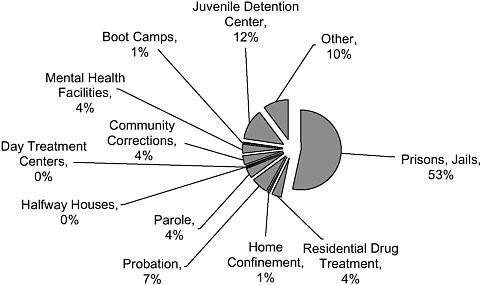
FIGURE 2-2 Facilities/location of studies.
-
Financial or other incentives to inmates for research participation are prohibited by five of the six state DOCs interviewed in depth. In some cases, this prohibition has been waived on a case-by-case basis.
-
Fewer than half of the states have a procedure in place for reporting adverse events associated with research activity.
Key findings from the literature survey include the following:
Locus of research activity Just over half of the prisoner studies were conducted in higher-security confinement settings, including jails and prisons (see Figure 2-2). More than one-third occurred in alternatives to incarceration, which included, in order of importance, juvenile detention centers,
|
19 |
The committee would like to thank John Weir and James Ray, graduate students at the University of South Florida, who reviewed the articles and provided the codings on which these data are based. |
|
20 |
See Appendix A for a description of the literature selection strategy and additional findings. |
probation, residential drug treatment programs, parole, mental health facilities, community corrections, home confinement, and boot camps.
Types of research Very little research in the published literature involves medical clinical trials or other biomedical studies (see Figure 2-3). The majority of published studies were minimal risk, nontherapeutic social and behavioral studies (41 percent), DOC program evaluations (26 percent), administrative records review (21 percent), or social or behavioral therapeutic studies (6 percent).
Study content/design Prisoner research is dominated by epidemiological studies (e.g., surveys, 39 percent) and correlational designs (27 percent).
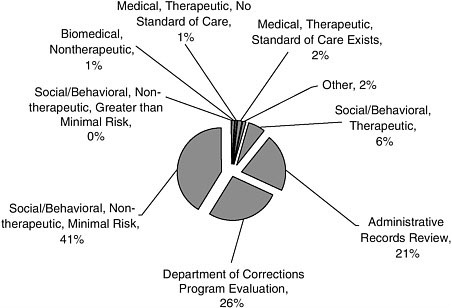
FIGURE 2-3 Type of study.
NOTE: Greater than minimal risk included any biomedical (nontherapeutic) study; any medical therapeutic study (regardless of the existence of a standard of care); any social/behavioral therapeutic study; and any nontherapeutic study involving a manipulation that the research assistant (RA) judged to involve potentially serious physical or emotional stress (e.g., long sleep deprivation). Not greater than minimal risk included any study based on review of administrative records; any program evaluation study; any nontherapeutic social/behavioral study that involved either no manipulation (e.g., innocuous questionnaires and surveys) or involved a manipulation that the RA judged not to involve potentially serious physical or emotional stress (e.g., long sleep deprivation).
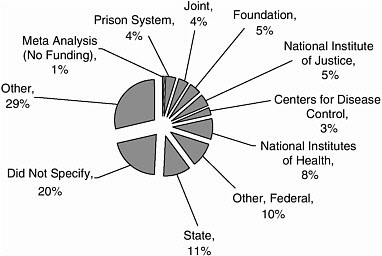
FIGURE 2-4 Source of funding.
Other studies are described as examining behavioral issues (14 percent), medical outcomes (5 percent), case studies (6 percent), nonmedical experiments (1 percent), or “other” (8 percent). An alternative classification of study content reveals that health status questions (43 percent) and personality characteristics (19 percent) are the focus of most research. Other studies deal with aspects of being confined (10 percent) or reentry into the community (11 percent) or bear no clear relationship to prisoner status (9 percent).
Sources of funding It was sometimes challenging to determine or to categorize the source of funding for prisoner research from published reports. Approximately 20 percent of the studies reviewed did not indicate the source of support (see Figure 2-4), and another 29 percent fit the “other” coding category (e.g., a medical school grant; university small grants; a study supported by a Veterans Affairs office). Prisoner research is funded by a wide variety of state and federal entities. Federal resources cited in the present sample included two DHHS agencies (NIH, 8 percent and CDC, 3 percent), National Institute of Justice (5 percent), and “other” federal (10 percent). Also mentioned were state funds (11 percent), foundation grants (5 percent), and prison system funding (4 percent).
Mechanisms of research approval For 15 percent of the studies, a statement in the report indicated that the investigators had obtained IRB approval for the research; for another 19 percent of studies, the approval of some other reviewing body (e.g., a research committee) was referenced. For
most studies (66 percent), the reports did not indicate whether, or by whom, the research was approved (in terms of human subjects protections).21
A review of 10 years of correctional and scientific literature on HIV/ AIDS studies involving prisoners (Farley, unpublished, 2005) yielded similar findings. The studies reviewed lacked transparency. Fewer than one-third of the studies mentioned review by an IRB, and nearly one-half made no mention of informed consent.
Data Retrieval Needs Improving
|
“[Prisoners’] only single armor against being subjected to experimental abuse hangs on a single thread, on a single federal regulation in federally funded research only,” said Vera Hassner Sharav, founder and president of the Alliance for Human Research Protection. “Chimpanzees, by contrast, are protected by mandatory rules, oversight, and enforcement mechanisms since the Animal Welfare Act of 1966. The U.S. Department of Agriculture (USDA) must submit annual reports to Congress documenting the disposition of every chimp, dog, rabbit, and hamster. No one keeps track of how many human beings have died or been harmed in clinical research.” Sharav painted this stark comparison of protections for prisoners with protections for animals in research at the committee’s July 2005 meeting. |
The dearth of information regarding the contemporary landscape of prisoner research led the committee to gather systematic information concerning the frequency and types of prisoner research currently being conducted and the research-related policies and procedures of state agencies that house large numbers of prisoners. It was conceded at the outset that the scope of the committee’s efforts in this regard would be limited. For example, the surveys of key personnel in prisons were limited to state DOCs and did not include the federal prison system or the myriad city, county, and municipal jails in which offenders may be at least temporarily
|
Jeffrey Ian Ross, an associate professor in the Division of Criminology, Criminal Justice, and Social Policy at the University of Baltimore, and a member of the committee’s Prisoner Liaison Panel, agreed at the committee’s October 2005 meeting that a registry is needed. “I would make it a point to have some sort of clearinghouse that actually tracks this kind of research on a regular basis so we know if it is increasing, decreasing, and whether it is more behavioral, social science, criminologic, or medical.” |
housed. Similarly, the review of published literature was of limited scope and was not supplemented with efforts to uncover, sample, and review unpublished reports in the possession of state, federal, or private agencies or research institutions.
There is no central repository of information about the amount and type of research involving prisoners. For the same reason that registries of clinical research on drugs and biologics exist and have recently garnered strong support (DeAngelis et al., 2004; IOM, 2006), a national database would bring clarity to the currently murky landscape of research involving prisoners.
Recommendation 2.1: Maintain a public database of all research involving prisoners. The Department of Health and Human Services, in cooperation with the Department of Justice, should systematically and comprehensively document all human subjects research with prisoners.22
The establishment of a national registry of research involving prisoners should include data, such as who is conducting research, with what support, what kind of research, on what populations, and the nature and extent of ethical oversight provided. There is currently no central repository of information about the amount and type of research involving prisoners, however a government-run registry of clinical research does exist (www.Clinicaltrials.gov) and could be a starting point and leveraging mechanism to make this endeavor feasible and not cost prohibitive. A national registry would shed light on the totality of research taking place on prisoners and the quality of ethical oversight provided for each protocol. To enable consideration of questions of justice, it could be used to examine
|
22 |
The term prisoner is defined by the Committee in Chapter 4 and used throughout this report in a broader way that it is commonly used. In this report, the term prisoner refers to all persons, including parolees and probationers, whose liberty has been restricted by decisions of the criminal justice system. |
the magnitude and volume of prisoners in different types of research to determine the allocation of benefits and burdens of research among prisoners. A registry would also enhance the application of research findings to prisoner populations. In the absence of such a registry, the committee was unable to accurately determine the nature and extent of prisoners’ participation as subjects of research.
Cost is always a consideration when suggesting a database be developed. The director of Clinicaltrials.gov, the federal government’s public database of clinical research, indicated that the annual costs for that database, which is maintained at the National Library of Medicine, is $3.2 million per year (Deborah Zarin, personal communication, May 17, 2006). She noted, however, that there may not be a reason to start a new registry for research involving prisoners. The existing clinicaltrials.gov could add a field that indicated if prisoners were included in a study, and then users could customize the view to see only those studies. At present, clinicaltrials. gov does not include social/behavioral research, but it could be a starting point and leveraging mechanism to make Recommendation 2.1 feasible and not cost prohibitive.
Summary of Findings on Current Research Environment
Findings from the surveys of DOC personnel and the literature review shed light on the possible impact of the national commission’s Report and Recommendations—Research Involving Prisoners (NCPHSBBR, 1976) and indicate practical and political complexities that may hamper efforts to create a uniform and comprehensive system of protections for prisoners as research participants. Findings and implications from these data include the following:
-
The reach of the Subpart C regulations to protect prisoners involved in research does not extend to the vast majority of prisoner research participants. The current regulations are binding only with respect to research supported by DHHS or in those institutions that voluntarily extend the regulations to non-DHHS funded studies involving prisoners (currently the Central Intelligence Administration and Social Security Administration; see Chapter 3). Survey responses from key DOC personnel reveal that a significant amount of research with prisoners is initiated and conducted internally, and that extramural research applications come from a wide variety of investigators, some (perhaps many) of whom may not be supported by DHHS funding, and thus not bound by the regulations. Similarly, the review of published prison research studies indicates that only about 11 percent of studies are DHHS funded, through NIH and the CDC (the
-
percentage may be slightly higher given that NIH and CDC may jointly fund some studies coded as having multiple funding sources).
-
It is not clear that all studies involving prisoners are being conducted with IRB review and approval. Also, prison research committees, which may serve some type of proxy IRB role, only infrequently include prisoners or prisoner representatives among their membership.
-
Biomedical research involving prisoners, particularly that of a nontherapeutic nature, is rare, perhaps as a consequence of the national commission’s 1976 report. Across the two surveys, one-third of respondents indicated that therapeutic medical studies might be permissible, and only 5 percent (two states) indicated that nontherapeutic biomedical research might be permissible. Several DOCs report that biomedical research, including potentially therapeutic research, is prohibited by state law or DOC policy. Further, medical studies with the potential for therapeutic outcome make up only 2 percent of the published prisoner research studies. Although the current regulations permit therapeutic medical studies with prisoners under certain circumstances, little such research appears to be taking place.
-
Some DOC research implementation policies may preclude potential remedies that some have suggested to ensure fair and equitable research participation by prisoners. For example, some have suggested the prisoner participants be allowed to receive incentives that, if not equal, are at least proportional to those available to nonprisoner participants in the community. Five of the six state DOCs interviewed in depth prohibit prisoner participants from receiving financial or other incentives for research participation.
REFERENCES
Anno BJ, Dubler N. 2001. Correctional Health Care: Guidelines for the Management of an Adequate Delivery System. Chapter 4. Chicago: National Commission on Correctional Health Care.
BJS (Bureau of Justice Statistics). 1995. Probation and Parole Violators in State Prison, 1991. [Online]. Available: http://www.ojp.usdoj.gov/bjs/pub/pdf/ppvsp91.pdf [accessed December 16, 2005].
BJS. 1997. Jail Inmates in Custody, by Gender, Federal and State-By-State, 1973, 1983, 1988, 1993. [Online]. Available: http://www.ojp.usdoj.gov/bjs/jails.htm#selected [accessed April 4, 2006].
BJS. 1998a. Substance Abuse and Treatment of Adults on Probation, 1995. [Online]. Available: http://www.ojp.usdoj.gov/bjs/pub/pdf/satap95.pdf [accessed December 16, 2005].
BJS. 1998b. Women Offenders: Programming Needs and Promising Approaches. Washington, DC: U.S. Department of Justice.
BJS. 1998c. State and Federal Corrections Information Systems. [Online]. Available: http://www.ojp.usdoj.gov/bjs/pub/pdf/sfcis.pdf [accessed December 21, 2005].
BJS. 1999a. Mental Health and Treatment of Inmates and Probationers. [Online]. Available: http://www.ojp.usdoj.gov/bjs/pub/pdf/mhtip.pdf [accessed December 16, 2005].
BJS. 1999b. Women Offenders. [Online]. Available: http://www.ojp.usdoj.gov/\bjs/pub/pdf/wo.pdf [accessed October 13, 2005].
BJS. 1999c. Substance Abuse and Treatment, State and Federal Prisoners, 1997. [Online]. Available: http://www.ojp.usdoj.gov/bjs/pub/pdf/satsfp97.pdf. [accessed October 15, 2005].
BJS. 2000b. Incarcerated Parents and Their Children. Washington, DC: U.S. Department of Justice.
BJS. 2001a. Trends in State Parole, 1990-2000. [Online]. Available: http://www.ojp.usdoj.gov/bjs/pub/pdf/tsp00.pdf [accessed December 16, 2005].
BJS. 2001b. Medical Problems of Inmates, 1997. [Online]. Available: http://www.ojp.usdoj.gov/bjs/pub/pdf/mpi97.pdf [accessed October 14, 2005].
BJS. 2003a. Prevalence of Imprisonment in the U.S. population, 1974-2001. [Online]. Available: http://www.ojp.usdoj.gov/bjs/pub/pdf/piusp01.pdf [accessed December 30, 2005].
BJS. 2003b. Education and Correctional Populations. Washington, DC: U.S. Department of Justice.
BJS. 2003c. Sourcebook of Criminal Justice Statistics. Adults on Probation, in Jail or Prison, and on Parole. [Online]. Available: http://albany.edu/sourcebook/pdf/sb2002/sb2002-section6.pdf [accessed January 2, 2006].
BJS. 2003d. Census of State and Federal Correctional Facilities, 2000. [Online]. Available: http://www.ojp.usdoj.gov/bjs/pub/pdf/csfcf00.pdf [accessed January 3, 2006].
BJS. 2004a. Hepatitis Testing and Treatment in State Prisons. [Online]. Available: http://www.hcvinprison.org/docs/hep_stateprisons_04.pdf [accessed January 3, 2006].
BJS. 2004b. Probation and Parole in the United States, 2003. [Online]. Available: http://www.ojp.usdoj.gov/bjs/pub/pdf/ppus03.pdf [accessed December 16, 2005].
BJS 2004c. Profile of Jail Inmates, 2002. [Online]. Available: http://www.ojp.usdoj.gov/bjs/pub/pdf/pji02.pdf [accessed April 5, 2006].
BJS. 2004d. Prisoners in 2003. [Online]. Available: http://www.ojp.usdoj.gov/bjs/pub/pdf/p03.pdf. [accessed April 6, 2006].
BJS. 2005a. Prisoners in 2004. [Online]. Available: http://www.ojp.usdoj.gov/bjs/abstract/p04.htm [accessed January 23, 2006].
BJS. 2005b. Sexual Violence Reported by Correctional Authorities, 2004. [Online]. Available: http://www.ojp.usdoj.gov/bjs/pub/pdf/svrca04.pdf [accessed October 14, 2005].
BJS. 2005c. Prison and Jail Inmates at Midyear 2004. Washington, DC: U.S. Department of Justice.
BJS. 2005d. HIV in Prisons, 2003. [Online]. Available: http://www.ojp.usdoj.gov/bjs/pub/pdf/hivp03.pdf [accessed October 14, 2005].
BJS. 2005e. Key Facts at a Glance, Demographic Trends in Jail Populations. [Online]. Available: http://www.ojp.usdoj.gov/bjs/glance/tables/jailagtab.htm [accessed March 20, 2006].
BJS. 2005f. Prisoners in Custody, 1977-98. [Online]. Available: http://www.ojp.usdoj.gov/bjs/prisons.htm#selected [accessed April 4, 2006].
BJS. 2005g. Adults on Probation, Federal and State by State, 1977-2004. [Online]. Available: http://www.ojp.usdoj.gov/bjs/pandp.htm#selected [accessed April 4, 2006].
BJS. 2005h. Adults on Parole, Federal and State by State, 1977-2004. [Online]. Available: http://www.ojp.usdoj.gov/bjs/pandp.htm#selected [accessed April 4, 2006].
Blitz CL, Wolff N, Pan KY, Pogorzelski W. 2005. Gender-specific behavioral health and community release patterns among New Jersey prison inmates: Implications for treatment and community reentry. American Journal of Public Health 95(10):1741–1746.
Bloche MG. 1999. Clinical loyalties and the social purposes of medicine. Journal of the American Medical Association 281(3):268–274.
Bloche MG. 2006. The supreme court and the purposes of medicine. The New England Journal of Medicine 354(10):993–995.
Braithwaite RI, Treadwell HM, Arriola KRJ. 2005. Health disparities and incarcerated women: A population ignored. American Journal of Public Health 95(10):1679–1680.
CDC (Centers for Disease Control and Prevention). 2002. Viral Hepatitis and the Criminal Justice System. [Online]. Available: http://www.cdc.gov/idu/hepatitis/viralhepcrimhal just.pdf [accessed January 3, 2006].
CDC. 2003. Prevention and control of infections with hepatitis viruses in correctional settings. Morbidity and Mortality Weekly Report 52(RR-1):1–44.
Coleman CH, Menikoff JA, Goldner JA, Dubler NN. 2005. The Ethics and Regulation of Research with Human Subjects. Dayton, OH: Lexis/Nexis.
Dalton H. 1989. AIDS in blackface. Daedalus: Proceedings of the American Academy of Arts and Sciences 118(3):205–228.
DeAngelis CD, Drazen JM, Frizelle FA, Haug C, Hoey J, Horton R, Kotzin S, Laine C, Marusic A, Overbeke AJ, Schroeder TV, Sox HC, Van Der Weyden MB. 2004. Clinical trial registration: A statement from the International Committee of Medical Journal Editors. Journal of the American Medical Association 292(11):1363–1364.
Dubler N, Sidel V. 1989. On research on HIV infection and AIDS. The Milbank Quarterly 67(2):171–207.
Farley JE. 2005. 10 Years of HIV/AIDS Research Behind Bars: Time for Change. Unpublished manuscript.
Freudenberg N, Daniels J, Crum M, Perkins T, Richie BE. 2005. Coming home from jail: The social and health consequences of community reentry for women, male adolescents, and their families and communities. American Journal of Public Health 95(10):1725–1736.
GAO. 1999. Women in Prison: Issues and Challenges Confronting U.S. Correctional Systems. [Online]. Available: http://www.gao.gov/archive/2000/gg00022.pdf [accessed November 23, 2005].
GAO. 2000. State and Federal Prisoners: Profiles of Inmate Characteristics in 1991 and 1997. Washington, DC: U.S. Government Printing Office.
Haigler KO, Harlow C, O’Connor P, Campbell A. 1994. Literacy Behind Prison Walls: Profiles of the Prison Population from the National Adult Literacy Survey National Center for Education Statistics [Online]. Available: http://nces.ed.gov/pubsearch/pubsinfo.asp?pubid=94102 [accessed October 15, 2005].
Hammett TM, Harmon MP, Rhodes W. 2002. The burden of infectious disease among inmates of and releasees from US correctional facilities, 1997. American Journal of Public Health 92:1789–1794.
Hornblum AM. 1997. They were cheap and available: Prisoners as research subjects in twentieth century America. British Medical Journal 315:1437–1441.
Hornblum AM. 1998. Acres of Skin: Human Experiments at Holmesburg Prison. New York: Routledge.
HRW (Human Rights Watch). 2000. Out of Sight: Super-Maximum Security Confinement in the United States [Online]. Available: http://www.hrw.org/reports/2000/supermax/ [accessed October 13, 2005].
HRW. 2003. Ill-Equipped: U.S. Prisons and Offenders with Mental Illness. [Online]. Available: http://www.hrw.org/reports/2003/usa1003/index.htm (accessed October 13, 2005).
IOM (Institute of Medicine). 2006. Developing a National Registry of Pharmacologic and Biologic Clinical Trials: Workshop Report. Washington, DC: The National Academies Press.
Jacobson M. 2005. Downsizing Prisons: How to Reduce Crime and End Mass Incarceration. New York: New York University Press.
Jones JH. 1993. Bad Blood: The Tuskegee Syphilis Experiment. New York: The Free Press.
JPI (Justice Policy Institute). 2002. The Punishing Decade: Prison and Jail Estimates at the Millennium. [Online]. Available: http://www.cjcj.org/pubs/punishing/punishing.html [accessed October 14, 2005].
JPI. 2004. An examination of 3-Strike Laws 10 years after their Enactment [Online]. Available: http://www.justicepolicy.org/article.php?id=450 [accessed May 9, 2006].
Khan AJ, Simard EP, Bower WA, Wurtzel HL, Khristova M, Wagner KD, Arnold KE, Nainan OV, LaMarre M, Bell BP. 2005. Ongoing transmission of hepatitis B virus infection among inmates at a state correctional facility. American Journal of Public Health 95(10): 1793–1799.
King RS, Mauer M. 2001. Aging Behind Bars: “Three Strikes” Seven Years Later. [Online]. Available: http://www.sentencingproject.org/pdfs/9087.pdf [accessed October 14, 2005].
Liptak A. 2005, October 2. To more inmates, life term means dying behind bars. The New York Times, p. 1.
Lotke E. 1997 Hobbling a Generation: Young African American Men in D.C.’s Criminal Justice System Five Years Later. National Center on Institutions and Alternatives. [Online]. Available: http://66.165.94.98/stories/hobblgen0897.html [accessed April 6, 2006].
Lovell D, Cloyes C, Allen DG, Rhodes LA. 2000. Who lives in supermaximum custody? A Washington State study. Federal Probation 61(3):40–45.
Macalino GE, Dhawan D, Rich JD. 2005. A missed opportunity: Hepatitis C screening of prisoners. American Journal of Public Health 95(10):1739–1740.
MacNeil JR, Lobato MN, Moore M. 2005. An unanswered health disparity: Tuberculosis among correctional inmates, 1993 through 2003. American Journal of Public Health 95(10):1800–1805.
Mauer M, King RS. 2004. Schools and Prisons: Fifty Years After Brown V. Board of Education [Online]. Available: http://sentencingproject.org/pdfs/brownvboard.pdf [accessed January 2, 2006].
Mauer M, King RS, Young MC. 2004. The Meaning of “Life”: Long Prison Sentences in Context. [Online]. Available: http://www.sentencingproject.org/pdfs/lifers.pdf [accessed October 17, 2005].
Metzner JL. 2002. Class action litigation in correctional psychiatry. Journal American Academy of Psychiatry and the Law 30:19–29.
Mitford J. 1974. Kind and Usual Punishment. New York: Vintage.
Murphy D. 2005. Health care in the federal bureau of prisons: Fact or fiction. California Journal of Health Promotion 3(2):23–37.
NCCHC (National Commission on Correctional Health Care). 2002. The Health Status of Soon-to-Be Released Inmates: Executive Summary. [Online]. Available: http://www.ncchc.org/stbr/Volume2/ExecutiveSummary.pdf [accessed October 10, 2005].
NCPHSBBR (National Commission for the Protection of Human Subjects of Biomedical and Behavioral Research). 1976. Report and Recommendations: Research Involving Prisoners. Washington, DC: NCPHSBBR.
NFCMH (New Freedom Commission on Mental Health). 2004. Subcommittee on Criminal Justice Background Paper. DHHS Pub. No. SMA-04-3880, Rockville, MD. Available: http://www.mentalhealthcommission.gov/papers/CJ_ADACompliant.pdf [accessed March 20, 2006].
NIC (National Institute of Corrections). 1997. Supermax Housing: A Survey of Current Practice. Longmont, CO: U.S. Department of Justice.
NIC. 2005. Gender-Responsive Strategies for Women Offenders: A Summary of Research, Practice, and Guiding Principles for Women Offenders. Washington, DC: U.S. Department of Justice.
NIH (National Institutes of Health). 2002. Management of Hepatitis C: 2002. [Online]. Available: http://consensus.nih.gov/2002/2002Hepatitisc2002116html.htm [accessed January 23, 2006].
OSI (Open Society Institute). 1997. Education as Crime Prevention. Providing Education to Prisoners (Research Brief No. 2). New York: Chesapeake Institute.
Petersilia J. 2000. Challenges to prisoner reentry and parole in California. California Policy Research Center Brief Series. [Online]. Available: http://www.ucop.edu/cprc/parole.html [accessed April 4, 2006].
PHR (Physicians for Human Rights). 2003. Dual Loyalty & Human Rights in Health Professional Practice: Proposed Guidelines and Institutional Mechanisms. [Online]. Available: http://www.phrusa.org/healthrights/dl_intro.html [accessed May 17, 2006].
Pogorzelski W, Wolff N, Pan KY, Blitz CL. 2005. Behavioral health problems, ex-offender reentry policies, and the “second chance” act. American Journal of Public Health 95(10): 1718–1724.
Restum ZG. 2005. Public health implications of substandard correctional health care. American Journal of Public Health 95(10):1689–1691.
Rhodes LA. 2005. Pathological effects of the supermaximum prison. American Journal of Public Health 95(10)1692–1693.
Schafer NE. 1994. Exploring the link between visits and parole success: A survey of prison visitors. International Journal of Offender Therapy and Comparative Criminology 38(1): 17–32.
Sharp, SM. 2004. The problem of readability of informed consent documents for clinical trials of investigational drugs and devices: United States considerations. Drug Information Journal 38:353–359.
Spangenberg, G. 2004. Current Issues in Correctional Education: A Compilation & Discussion. [Online]. Available: http://www.caalusa.org/correct_ed_paper.pdf [accessed October 14, 2005].
Sterngold, J. 2005, July 1. U.S. seizes state prison health care: Judge sites preventable death of inmates, depravity of system. San Francisco Chronicle, p. A-1.
Sturm SP. 1993. The legacy and future of corrections litigation. University of Pennsylvania Law Review 142:638–738.
Tewksbury R, Mustaine EE. (2001). Where to find corrections research: An assessment of research published in corrections specialty journals, 1990–1999. The Prison Journal 81:419–435.
TSP (The Sentencing Project). 2001. Aging Behind Bars: “Three Strikes” Seven Years Later. [Online]. Available: http://www.sentencingproject.org/pdfs/9087.pdf [accessed October 14, 2005].
TSP. 2005. New Incarceration Figures: Growth in Population Continues. Available: http://www.sentencingproject.org/pdfs/1044.pdf [accessed April 6, 2006].
U.S. Census. 1998. Table no. 377: federal and state prisoners: 1970 to 1996. In: Statistical Abstracts of the United States: 1998. [Online]. Available: http://www.census.gov/prod/3/98pubs/98statab/sasec5.pdf [accessed December 23, 2005].
U.S. Supreme Court. 1976. Estelle v. Gamble, 429 U.S. 97. [Online]. Available: http://www.justia.us/us/429/97/case.html [accessed January 2, 2006].
Von Zielbauer P. 2005a, February 27. As health care in jails goes private, 10 days can be a death sentence. New York Times, p 1.
Von Zielbauer P. 2005b, February 28. In city’s jails, missed signals open way to season of suicides. New York Times, p. 1.
Von Zielbauer P. 2005c, June 10. Inmates’ medical care at Rikers fails in evaluation. New York Times, p. B-1.
Von Zielbauer P. 2005d, August 1. A company’s troubled answer for prisoners with HIV. New York Times, p. 1.
Walmsley R. 2003. World Prison Population List (4th edition). [Online]. Available: http://www.homeoffice.gov.uk/rds/pdfs2/r188.pdf [accessed January 2, 2006].
Winner, 1987. An introduction to the constitutional law of prison medical care. Journal of Prison Health 1(1):67–84.
Young VD, Reviere R. 2001. Meeting the health care needs of the new woman inmate: A national survey of prison practices. Journal of Offender Rehabilitation 34(2):31–48.


