
2
NRC Strategies, Priorities, and Guidelines for the Exploration of Mars
Is the Mars architecture reflective of the strategies, priorities, and guidelines put forward by the NRC’s solar system exploration decadal survey and related science strategies and NASA plans?
THE EXPLORATION OF MARS IN A SOLAR SYSTEM CONTEXT
How does the Mars Exploration Program fit into the overall goals for solar system exploration as defined in the SSE decadal survey? The decadal survey envisions a very active and balanced Mars Exploration Program that would substantially contribute to an integrated understanding of the formation and evolution of the solar system. This is demonstrated by the fact that, although down-sized from what was considered just a year ago, the proposed architecture addresses key questions associated with all four of the crosscutting themes of the survey.
The crosscutting themes and key questions associated with them that are addressed by the Mars Exploration Program as outlined in the proposed architecture are described in the next four subsections.
The First Billion Years of Solar System History
This theme is concerned with the formative period that features the initial accretion and development of Earth and its sibling planets, including the emergence of life on our globe. This pivotal epoch in the solar system’s history is only dimly glimpsed at present. Key SSE decadal survey questions associated with this theme that are addressed by exploring Mars include the following:
-
What processes marked the initial stages of planet and satellite formation?
-
How did the impactor flux decay during the solar system’s youth, and in what way(s) did this decline influence the timing of life’s emergence on Earth?
Volatiles and Organics: The Stuff of Life
This crosscutting theme addresses the reality that life as we understand it requires organic materials and volatiles, notably, liquid water. Key SSE decadal survey questions associated with this theme that are addressed by exploring Mars include the following:
-
What is the history of volatile compounds across the solar system?
-
What is the nature of organic material in the solar system, and how has this matter evolved?
-
What global mechanisms affect the evolution of volatiles on planetary bodies?
The Origin and Evolution of Habitable Worlds
This crosscutting theme recognizes that our concept of the “habitable zone” has been overturned, and greatly broadened, by recent findings on Earth and elsewhere throughout our galaxy. Key SSE decadal survey questions associated with this theme that are addressed by exploring Mars include the following:
-
What are the habitable zones for life in the solar system, and what planetary processes are responsible for generating and sustaining habitable worlds?
-
Does (or did) life exist beyond Earth?
-
Why did the terrestrial planets differ so dramatically in their evolutions?
Processes: How Planetary Systems Work
This crosscutting theme concerns the search for a deeper understanding of the fundamental mechanisms operating in the solar system today. A key SSE decadal survey question associated with this theme that is addressed by exploring Mars is the following:
-
How do the processes that shape the contemporary character of planetary bodies operate and interact?
In response to the question, How does the Mars Exploration Program fit into the overall goals for the solar system as defined by the SSE decadal survey?, the committee is in agreement that because the exploration of Mars addresses all of the crosscutting themes and many of the key questions identified in the SSE decadal survey, it continues to be a significant priority in a balanced program for exploring the solar system.
MAJOR NEW DISCOVERIES SINCE THE SSE DECADAL SURVEY REPORT WAS ISSUED
What major new discoveries have occurred since the SSE decadal survey report was issued that might call into question the recommendations of that report? The solar system exploration decadal survey, New Frontiers in the Solar System, captured the state of Mars exploration in early 2002, and the recommendations of that study were based on that state of knowledge. A range of seminal observations have been made since that time, and these properly influence the view of this committee. These observations address two equally fundamental issues about the history and evolution of Mars.
-
Evidence for the past presence of water; and
-
Evidence of a diverse igneous history, possibly extending to the present.
Past Presence of Water
Key recent discoveries relating to the presence of water in the martian past include the following:
-
Observations from Mars Odyssey for the presence of abundant near-surface hydrogen (possibly indicative of water ice) at mid- to high latitudes;1
-
The inference, from Mars Global Surveyor observations of layered sedimentary rocks in craters, that large areas of the martian surface have periodically been buried and exhumed;2
-
The positive identification of clay minerals in ancient terrains by Mars Express;3
-
Observations of sedimentary rocks, including hydrated minerals, and fluvial structures at the Opportunity landing site on Meridiani Planum;4-6 and
-
Observations for aqueous alteration of igneous rocks at the Spirit landing site at Gusev Crater.7,8
These observations reinforce the strength of an integrated program of robotic exploration. Orbital reconnaissance observations of hematite by the Thermal Emission Spectrometer on Mars Global Surveyor, and of near-surface hydrogen by the Gamma-Ray Spectrometer on Mars Odyssey, led to the in situ examination of Meridiani Planum by the Mars Exploration Rover, Opportunity, which revealed evidence for hydrated minerals and fluvial structures. The combination of the in situ results and orbital data allows much broader inferences to be made regarding the extent of a regional-scale hydrologic system.
These discoveries also help address one of the pivotal questions asked by the SSE decadal survey—How hospitable was Mars to life? The past presence of liquid water on Mars has now been demonstrated, triggering NASA to follow a pathway of searching for evidence of past life. The next step in the incremental investigation of Mars’s potential as a past or present abode of life might be to ask: Where, when, and for how long did water exist? The answer to these questions may require new approaches, instruments, and types of missions.
Igneous Diversity
Mars exhibits evidence of a diverse igneous history, possibly extending to the present. Key recent findings include the following:
-
Detection (putative) of significant and spatially variable amounts of methane that may indicate igneous or biological activity;9,10
-
Observations of lava flow fields with low crater densities that could potentially indicate that volcanism has occurred within the past few million years;11 and
-
Evidence for localized evolved igneous compositions ranging from alkalic basalts at the Spirit landing site to quartz-bearing and dacitic compositions on regional scales observed from orbit.12-15
As is discussed in a subsequent section, the SSE decadal survey highlighted the observation of magnetic anomalies in the southern hemisphere of Mars. The survey also explicitly noted the importance of internal heat in determining the stability field of liquid water and the magnetic field in shielding the surface from harmful radiation as keys to the evolution of life. Coupled with these more recent observations, exploration of the interior structure of Mars seems of paramount importance to understanding its role in both the evolution of the planet and martian surface composition, and as a key to understanding the sources of energy for, and possible origin and evolution of, life.
In response to the question, What major new discoveries have occurred since the SSE decadal survey report was issued that might call into question the recommendations of that report?, the committee is in agreement that there have been no new developments that change the recommendations of the SSE decadal survey report; if anything, recent scientific discoveries reinforce the report’s recommendations.
THE MARS ARCHITECTURE AND THE SSE DECADAL SURVEY’S MARS EXPLORATION GOALS
Is the Mars architecture reflective of the strategies, priorities, and guidelines put forward by the NRC’s solar system exploration decadal survey? The SSE decadal survey recommended a Mars exploration program (Appendix A) addressing the following broad thematic goals:
-
Mars as a potential abode of life;
-
Water, atmosphere, and climate on Mars; and
-
Structure and evolution of Mars.
Mars as a Potential Abode of Life
Key scientific issues identified in the SSE decadal survey relevant to the overarching theme of Mars as a potential abode of life include the following:
-
How hospitable was, and is, Mars to life? Even though biological processes produce a range of biosignatures, most geological processes progressively destroy them. Thus, the recognition that organisms and their environment constitute a system, each producing an effect on the other, is key to the search for life on Mars. Therefore, all of the missions in the proposed architecture have the potential to provide insight regarding the question of whether Mars did or does host hospitable environments. Appropriately instrumented AFL or Mid Rover missions could, potentially, perform a comprehensive characterization of the geochemistry and mineralogy of the materials they analyze and provide significant insights regarding the biological potential of the environments they examine. The rover missions might also provide information relevant to assessing the possibility of locating biosignatures in the environments examined.
-
Did life ever exist there? An appropriately instrumented AFL mission—i.e., one equipped with instruments capable of simultaneously providing information about past or present environments suitable for life and, also, microbial biosignatures—should make significant advances toward achieving this goal. To initiate the process of life detection requires the comprehensive geochemical characterization of samples analyzed over a range of spatial scales within the context of a geological setting. The strategy of following the MSL mission, which will provide an environmental model based on geological and some geochemical information, with an AFL that carries instruments designed to detect and characterize with high precision potential biosignatures should continue to be emphasized in the Mars mission architecture. MSTO could also provide clues to the evolution of the martian atmosphere, which will have affected the potential for Mars as an abode for past and present life.
-
Does life currently exist on Mars? A confirmation of the existence of potential biogenic gases by MSTO or other means would be a significant advance in the search for extant life on Mars. Microbial environments on Earth’s surface, in the shallow subsurface, and in the deep rock fracture habitat zone (to many kilometers) are known to produce distinguishable trace gases as by-products of their activities. Knowledge of the trace gas inventory of Mars, and of the location and residence time of anomalous concentrations of trace gases, could be invaluable in leading researchers to sites with high astrobiological potential.
The SSE decadal survey identified the following future steps as being of the greatest importance for advancing understanding of Mars as a potential abode of life:
-
Sample return missions will ultimately be required to permit definitive tests in terrestrial laboratories for present and past life on Mars; robotic missions preceding the sample return missions will assist in locating the most fruitful sites to be sampled. A Mars sample return mission is not included in the architecture. The precision and sophistication of in situ instruments are anticipated to improve, provided that the necessary research and technology-development funding is sustained. Nevertheless, the amount of information that can be extracted in terrestrial laboratories from samples returned from Mars will dwarf the science forthcoming from an in situ analysis on the planet. All the missions in the Mars architecture can contribute in one way or another to the selection of sites from which samples will ultimately be returned to Earth. However, none of the planned missions, either alone or in combination with others, will achieve the type of sustained analysis possible with a Mars sample return mission. The recent application of new technologies and techniques to samples of rocks returned from the Apollo missions underscores this point.
-
A broad program of study of the Mars environment, present and past, is needed to understand the context in which life did or did not arise on that planet. The full spectrum of Mars missions outlined in the architecture is responsive to the need to understand the past and present martian environment. Astrobiological investigations are best conducted in a systems framework. Thus, other, non-biological investigations will have a significant impact on astrobiological goals for the exploration of Mars. Overarching issues that, if addressed, could have a significant impact on astrobiological search strategies for Mars include the absolute chronology of the planet, the chemistry of
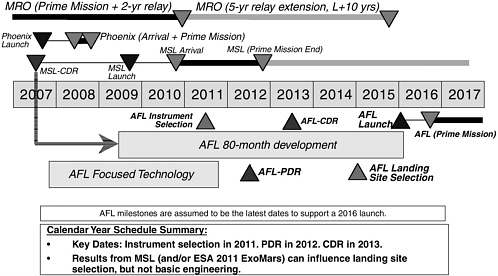
FIGURE 2.1 A notional timeline indicating the critical steps in the development of the Astrobiology Field Laboratory mission. The timeline indicates that if AFL is to be launched in 2016, a normal development schedule would imply that the instruments for this mission would have to be selected in 2011, just months after the landing of the Mars Science Laboratory. Thus, it is highly likely that those individuals proposing instruments will not be able to respond to any of the results from MSL. Courtesy of Luther Beegle, James F. Jordan, Gregory Wilson, and Michael Wilson, Jet Propulsion Laboratory.
NOTE: AFL, Astrobiology Field Laboratory; CDR, critical design review; ESA, European Space Agency; L, launch; MRO, Mars Reconnaissance Orbiter; MSL, Mars Science Laboratory; and PDR, preliminary design review.
-
trace martian gases (potentially addressed by MSTO), and the geochemical or mineral traces of past environments that can guide the selection of landing sites (addressed by MSL, AFL, and Mid Rovers).
The proposed architecture will make important contributions to addressing the SSE decadal survey’s theme, Mars as a potential abode of life. The architecture embodies a discovery-based strategy to search for potential environments on Mars suitable for life. That is, the results from ongoing missions—e.g., Mars Reconnaissance Orbiter (MRO)—and future missions such as Phoenix and Mars Science Laboratory will determine whether AFL or the Mid Rovers will be selected to fly in 2016. The relative timing of MSL and AFL is potentially problematic. The 6 years separating the launch of the two missions is barely sufficient for the findings from MSL to influence the scope of AFL. Indeed, consideration of the notional development timeline (Figure 2.1) suggests that AFL instruments would have to be selected just a few months after MSL arrives at Mars. In other words, those individuals involved in the selection of the instruments would have the benefit of the early results from MSL, but the instrument proposers would have to draft their proposals while MSL is en route to Mars.
Another issue of potential concern with AFL is that the likelihood of finding definitive biosignatures in situ with a single mission is low. Thus, the absence of any discoveries of potential biosignatures could severely impact future programmatic support of Mars missions in much the same way as did the negative results from the life detection experiments on the Viking landers in 1976.
Two high-priority missions identified by the SSE decadal survey, Mars Sample Return and Mars Long-Lived Lander Network, are not in the architecture. These missions are, however, relevant to issues relating to the search for life on Mars. A sample return mission would optimize researchers’ ability to determine whether or not life exists or ever existed on Mars. A network mission would provide estimates of geothermal heat flow potential and fracturing, which could be significant in providing habitat assessment and locating sites of potential biogenic gas escape. Similarly, if the network stations include a trace-gas-analysis capability, then they can potentially contribute to understanding of whether or not there might be extant life on Mars.
Water, Atmosphere, and Climate on Mars
A second unifying theme for Mars exploration identified by the SSE decadal survey concerns Mars’s water, atmosphere, and climate. Clearly, this theme is coupled to the life theme, in the context of both past and present conditions that could be suitable for life and the preservation of evidence of life.
The most important scientific investigations in this area as identified by the SSE decadal survey are as follows:
-
What are the sources, sinks, and reservoirs of volatiles on Mars? Phoenix should contribute substantially to addressing this question, by directly searching for near-subsurface water ice (the presence of which has been inferred from orbital observations) at high northern latitudes. Dust is generally understood as being included in the category of volatiles for Mars, and Phoenix will also make valuable observations of the atmospheric dust using a lidar. The proposed MSTO mission will directly address the permanent sink of volatiles which loss to space represents, if it carries the full aeronomy instrument payload that is baselined. The mission is planned to have the capability of studying trace atmospheric gases, and thus it will be able to investigate the sources, sinks, and reservoirs of any volatiles that it is able to measure in the atmosphere. These could include methane, which would be of particularly great importance in relation to the life theme. The rover missions (MSL, AFL, and Mid Rovers) all have at least the potential to address the question above; the MSL meteorology experiment will definitely address it.
-
How does the atmosphere evolve over long time periods? Phoenix will make a contribution to addressing this question, particularly via its search for subsurface ice. MSL could provide additional information on the presence of water in the past and will make meteorological measurements that will improve understanding of the current atmosphere and thus the ability to model the evolution of the atmosphere. The aeronomy component of MSTO would make a very strong contribution to answering this question, by greatly advancing understanding of current atmospheric escape processes. The AFL and Mid Rover missions could provide additional observations relating to the presence of water, as well as to the current atmosphere and climate.
Of somewhat lesser importance are questions relating to the following topics:
-
Is there an active water cycle on Mars? This question is strongly tied to investigating the exchanges of water between surface and subsurface reservoirs and the atmosphere. Phoenix will make extremely important measurements, both above and below the surface, of relevance to this question. If the trace-gas component of the proposed MSTO mission provides measurements of atmospheric water, then this mission will also contribute to understanding this question. This mission should also be able to determine the rate of net loss of water from the current atmosphere. The meteorology package on the MSL mission will make measurements of atmospheric humidity at one site. The other proposed rover missions (AFL and Mid Rovers) could carry instruments to measure atmospheric and subsurface water, but these capabilities are not explicitly included in the discussion of the science objectives of these missions.
-
What are the dynamics of the middle and upper atmosphere of the planet? The MSTO mission could provide a great amount of information relating to this question, if the right instruments are included. A direct wind-sensing instrument is crucial to investigating the dynamics of this region of the atmosphere.
-
What are the rates of atmospheric escape? The MSTO mission would allow the current atmospheric escape rates to be determined, if it has the necessary instruments to make the key measurements in the exospheric region. None of the other currently proposed missions will address this question.
A final question, relating to building the foundation of knowledge of the solar system, is the following:
-
What is the three-dimensional distribution of water in the martian crust? Phoenix should contribute very significantly to this study, by directly investigating the presence of near-subsurface ice in the north polar region. All planned landed missions could address this question, given the right instruments; MSL does not have any instruments that can address this question directly.
Important topics for future studies relating to Mars’s water, atmosphere, and climate as identified by the SSE decadal survey are the following:
-
The ground-level chemical and isotopic composition of the atmosphere, including humidity, should be tracked for at least a martian year at a network of lander stations. A surface network mission is not, however, included in the Mars architecture.
-
The distribution of water (in both solid and liquid form) in the crust, globally or at a wide variety of sites, should be established (e.g., by sounding radar). A surface network mission is not included in the Mars architecture. Water sounding instruments could potentially be included on any landed mission, but they are not included in the selected payload for MSL and are not part of the science discussed for the AFL or Mid Rover missions (although the science for these is not currently well defined).
-
The composition and dynamics of the middle and upper atmosphere and the rate of escape of molecules from the atmosphere should be measured. Given a full complement of appropriate aeronomy instruments, the proposed MSTO mission could go a long way toward meeting this objective.
The proposed Mars architecture does a reasonably good job of addressing the key questions relating to the theme of water, atmosphere, and climate on Mars but not, necessarily, in the manner envisaged by the authors of the SSE decadal survey. The recommended decadal survey missions most relevant to this theme are the Mars Long-Lived Lander Network and the Mars Upper Atmosphere Orbiter. The former is not included in the architecture, and the latter may possibly be identified with the proposed MSTO mission (see MEPAG’s recently released report on MSTO16). What is clear, however, is that an appropriately instrumented MSTO mission can, potentially, address many if not all of the highest-priority science questions relating to Mars’s atmosphere, climate, and volatiles. The current Scout mission—Phoenix—will likely make important contributions, as will the rover missions.
Structure and Evolution of Mars
The SSE decadal survey concluded that the single most compelling question for Mars is the extent to which it was (or is) an abode of life. However, the decadal survey also recognized that Mars is a system and that questions concerning past or present martian life are strongly coupled to the evolution of the planet’s atmosphere and interior. For instance, the existence of an early dynamo may have had profound implications both for the evolution of volatiles and for biological potential. Thus, one of the three key themes identified by the decadal survey was the structure and evolution of Mars.
The most important scientific questions related to the structure and evolution of Mars are as follows:
-
What rock types constitute the crust of Mars? The rovers (MSL, AFL, and Mid Rovers) all have the potential to address this question. To expand knowledge of the rock types on Mars, careful site selection to visit the full diversity of terrains identified by global mapping will be needed.
-
What are the nature and origin of Mars’s crustal magnetism? High-resolution maps of the martian magnetic field can, potentially, be obtained by low-altitude measurements from MSTO. Such sampling is also needed, along
-
with simultaneous upper-atmosphere measurements, to establish and understand the link between crustal fields and solar wind/ionosphere interactions that affect escape rates. Instruments on rovers may be capable of identifying specific magnetized minerals.
Additional questions of importance are the following:
-
What is the degree of internal activity in Mars? None of the missions in the current architecture addresses this issue. A network mission including seismometers would do so.
-
What is the size of the martian core, and is it partly or wholly liquid? Again, a definitive answer to these questions requires a network of seismometers.
-
What was the origin and fate of the Mars dynamo? It is unclear how this question might be answered in the absence of a comprehensive Mars sample return program, although both absolute chronology measurements and seismology (e.g., absence of a liquid core) could provide some important insights.
-
What is the absolute chronology of the planet? Although the capacity to gauge in situ chronology, even with uncertainties on the order of ±500 million years, would be highly significant, the technical challenges of performing the necessary measurements remain formidable. A precise understanding of the timing of key events in martian history, including the duration of water at any single location, will require Mars sample return, likely with roving and, perhaps, caching capabilities.
-
How does the oxidation state of the Mars crust vary with depth? The oxidation state of the upper meter or so of the crust of Mars is potentially accessible to rover technology; however, for depths of geological interest (kilometers), this question is unlikely to be answered in the near to mid term.
The SSE decadal survey also identified the following future steps as being of the greatest importance for advancing understanding of the structure and evolution of Mars:
-
A long-lived network of seismic stations is needed on Mars for determining the structure, properties, and activity of its interior. The current architecture does not satisfy this recommendation.
-
Heat flow from Mars ultimately should be measured at a series of surface stations. The current architecture does not satisfy this recommendation.
-
The compositions and ages of crystalline rocks from a distribution of martian sites should be measured. This will best be done by studying returned samples, but the database can be expanded with in situ measurements made by landers. The rover missions (MSL, AFL, Mid Rovers) can begin to meet this recommendation but, ultimately, a sample return mission is needed.
-
A high-resolution magnetic map of Mars’s southern highlands should be made. None of the missions in the proposed architecture, which the possible exception of MSTO, is likely to address this recommendation.
The proposed Mars architecture does not, in general, do a good job of addressing the key questions regarding the structure and evolution of Mars. Information on crustal composition (and potentially magnetization) may be provided by the proposed rovers. However, the nature of the deep interior, its degree of activity, the state and evolution of the core, and the chronology of the crust are not addressed by any of the proposed missions. The architecture’s ability to address these key scientific topics is hindered by the absence of two high-priority Mars missions identified by the SSE decadal survey, Mars Sample Return and the Mars Long-Lived Lander Network.
Summary
In response to the question, Is the Mars architecture reflective of the strategies, priorities, and guidelines put forward by the NRC’s solar system exploration decadal survey?, the committee is in agreement that the proposed Mars architecture does a good job of addressing two of the SSE decadal survey themes relating to Mars—i.e., (1) Mars as an abode of life and (2) water, atmosphere, and climate on Mars—and a poor job of addressing the third theme, the structure and evolution of Mars. Of the five high-priority Mars missions mentioned in the decadal
survey, two are explicitly included in the proposed architecture—i.e., Mars Science Laboratory and Mars Scout (goals defined as part of the competitive selection process)—and two are explicitly excluded from the proposed architecture—i.e., Mars Sample Return and the Mars Long-Lived Lander Network. The committee notes, in passing, that a Mars sample return mission has been a fundamental element of the Mars exploration strategy enunciated by the Space Studies Board for the last three decades.17-22 It is likely that an appropriately instrumented MSTO will be able to address the goals of the fifth of the SSE decadal survey’s missions, the Mars Upper Atmosphere Orbiter. The committee cannot be more specific at this time because much depends on the exact scope and instrument complement of missions such as MSTO, AFL, and the Mid Rovers. The committee recognizes that this lack of definition allows the Mars Exploration Program some flexibility to respond to future discoveries. Indeed, responsiveness to new scientific results and community input are major strengths of NASA’s Mars Exploration Program. Nevertheless, flexibility must be tempered with programmatic realities. While some aspects of mission design can be left undecided until a particular spacecraft is on the launch pad—most notably, the selection of landing sites—others cannot. Given that it can take a decade for an instrument concept to be developed to the point at which it is ready for flight, basic mission parameters—power, mass, volume, data rate, orbital parameters, and instrument accommodation issues—need to be defined well in advance. For these reasons, the committee sees the lack of definition of what these missions are, what they will do, and how they will do it as a major deficiency in the Mars architecture. Deficiencies of this type have traditionally been resolved by the convening of science and technology definition teams. Such an action would provide sufficient detail concerning the relevant missions that further assessment and refining of the architecture could be contemplated and needed technology development could be identified. Finally, the absence of sample return and a geophysical/meteorological network mission significantly reduces the potential for achieving many of the SSE decadal survey’s goals for the exploration of Mars.
THE MARS ARCHITECTURE AND RELATED SCIENCE STRATEGIES
Is the Mars architecture reflective of the strategies, priorities, and guidelines put forward by related science strategies, in particular, those issued by MEPAG? At periodic intervals over the last 5 years MEPAG has issued a comprehensive assessment of goals, investigations, objectives, and priorities for the exploration of Mars.23 MEPAG’s goals for the exploration of Mars are as follows:
-
Determine if life ever arose on Mars;
-
Understand the processes and history of climate on Mars;
-
Determine the evolution of the surface and interior of Mars; and
-
Prepare for human exploration.
Although the goals are not ranked, each is, however, broken down into a prioritized, hierarchical listing of objectives, investigations, and measurement (Appendix B). Consideration of how the Mars architecture addresses each of the first three MEPAG goals is found below. Discussion of how the architecture addresses issues relating to human exploration is postponed until the section below titled “The Mars Architecture and Other NASA Plans.”
Life
Although MEPAG’s four goals are coequal, the goal of determining whether life ever arose on Mars is often considered “first among equals.” The proposed Mars architecture addresses the life goal by an ordered sequence of missions. This sequence begins with a search for organic materials using the Mars Science Laboratory, continues with measurement of trace gases (e.g., methane) by the Mars Science and Telecommunications Orbiter, and leads up to a decision as to what science payload the Astrobiology Field Laboratory should carry and whether or not it should fly in 2016. This general sequence of missions has the potential to make significant progress toward the life goal’s highest-priority objective—i.e., assessing the possibility of extinct or extant life on Mars. However, the decision to fly AFL versus another mission in 2016 must be made early during MSL’s prime mission. Therefore,
as noted in the discussion of the SSE decadal survey’s Mars priorities, the committee is worried that the necessary data and results may not be in hand to distinguish the relative merits of AFL versus other options for launch in 2016. It might prove better to delay AFL until the 2018 opportunity so that decisions on its merit relative to other possible missions and on the choice of appropriate instrumentation (e.g., for remote and direct access to the subsurface) can be informed by a mature consideration of the results from prior missions, particularly MSL.
Climate
The MSTO mission in 2013 is presumably focused on the highest-priority MEPAG objective with respect to the climate goal—i.e., characterization of Mars’s atmosphere, present climate, and climate processes. Definition of the science to be accomplished with MSTO is currently incomplete, and so assessing how many MEPAG climate investigations this mission will address is difficult. A clear science justification for MSTO should be made and linked to investigations outlined in the MEPAG document. The committee notes that MEPAG’s MSTO Science Analysis Group just issued a draft report discussing these linkages.24 Finally, the committee points out that the inclusion of a network of meteorological stations, as a third alternative for the 2016 launch opportunity, would also provide a means of addressing MEPAG’s climate goal.
Surface and Interior
Recent Mars missions (e.g., Odyssey, Mars Exploration Rovers, and, now, Mars Reconnaissance Orbiter) have focused strongly on the objective of determining the nature and evolution of the geological processes that have created and modified the martian crust and surface. As a result, considerable progress is being made toward investigations related to determining the nature and evolution of geological processes on Mars. Missions now in development (e.g., MSL and, possibly, AFL) will undoubtedly further understanding of these areas. Unfortunately, few missions or instruments geared toward gaining a better understanding of the interior of the planet have been flown, despite numerous studies by alternate groups stating the importance of so doing. The committee believes strongly that the possibility of making progress toward this MEPAG goal and its objective of characterizing the structure, composition, dynamics, and evolution of Mars’s interior should be included in the proposed Mars architecture. An approach to achieving this is to include a geophysical network mission as an option for the 2016 launch opportunity.
Summary
In general, much of the proposed Mars architecture can be viewed as somewhat consistent with existing priorities and guidelines of the Mars science community as represented by MEPAG. However, although the stated focus of the architecture’s proposed missions can be traced to MEPAG’s current goals relating to the study of life, climate, and geology,25 important details are lacking. This lack of detail introduces uncertainties as to whether or not MEPAG’s prioritized objectives will be addressed in an integrated and comprehensive fashion. Hence the committee had difficulty in assessing this question.
Mars Scout missions are the wild card in the architecture, and it is difficult to predict how they might address one or multiple MEPAG goals and objectives. The committee agrees that Scout missions are extremely valuable and should continue, but there is a potential for overlap between proposed Scout missions and strategic (e.g., MSTO) missions during later launch opportunities. However, it is not possible to predict how a Scout proposal might be evaluated in this instance or how it might impact other missions in the Mars Exploration Program. Nevertheless, the committee supports the addition of funds to the Scout program that may enable a broader range of mission scenarios to be proposed that could better satisfy one or multiple MEPAG goals, objectives, and investigations.
Finally, a Mars sample return mission has the potential to yield samples uniquely capable of addressing all four MEPAG goals and multiple objectives. The committee agrees that issues of cost26 and technical readiness imply that a sample return mission will fall beyond the horizon of the coming decade. Nevertheless, the committee
reaffirms the importance of a mission to return samples of Mars to Earth for study and strongly argues that there is an immediate need for developing relevant technologies and infrastructure to enable the implementation of this mission as soon as possible after 2016.
In response to the question, Is the Mars architecture reflective of the strategies, priorities, and guidelines put forward by related science strategies, in particular, those issued by MEPAG?, the committee is in agreement that the Mars architecture does address certain of the broad goals and objectives defined by MEPAG, but the strategy for achieving those goals and related science objectives is incompletely articulated and/or justified. High-priority MEPAG objectives (e.g., those relating to meteorological and geophysical studies) are absent, and longer-term goals (e.g., preparation for sample return) are neglected. In this respect, NASA’s proposed Mars exploration architecture is an inadequate implementation of MEPAG goals.
THE MARS ARCHITECTURE AND OTHER NASA PLANS
Is the Mars architecture reflective of the strategies, priorities, and guidelines put forward in other NASA documents such as NASA’s 2006 strategic plan and, in particular, the Vision for Space Exploration? The Vision for Space Exploration (VSE) is an explicitly articulated statement of the human drive to explore and learn. In a memorial service for the crew of the Space Shuttle Colombia, President G.W. Bush said, “This cause of exploration and discovery is not an option we choose; it is a desire written in the human heart.”27 As Administrator Michael Griffin remarked in the 2006 edition of NASA’s strategic plan, “This … plan embraces the goals articulated in the Vision for Space Exploration and addresses our strategy for reaching them.”28 The VSE has become the major focus of NASA activities.
Although often discussed as if they were entirely unrelated and even competing enterprises, robotic planetary science missions and eventual human exploration are one in spirit, although typically requiring a focus on different technologies and involving very different budgetary scales. Those who labor over robotic missions are some of the great explorers of our times, even though their feet never tread the soil of another world. As their minds touch alien destinations, they truly have a passion for exploration written in their hearts. When a robotic mission heads beyond its planet of origin, it is not stripped of its essential humanity. Similarly, as humans move out into the solar system, they will do so with the intimate assistance of their robotic devices. Thus, the robotic-human continuum informs all future activities—be that classified as purely scientific, purely exploration, or something in between. The VSE specifically recognizes this close connection, and researchers must consider it even as they plan the near-term decade of robotic Mars missions.
The space science enterprise is one of significant risk and uncertainty; thus, it is essential to be mindful of potential drawbacks in maintaining a close intellectual connection to the VSE. The Mars Exploration Program and mission architecture must be driven by fundamental scientific questions to be successful. Connections between scientific exploration of Mars and the VSE are highly beneficial to both robotic and human exploration, particularly when the scientific investigations drive the intellectual framework and instrumentation of missions. At the same time, soundly grounded, fundamental Mars mission science can provide significant synergistic benefits if it also addresses potential future human impacts. Such impacts come from virtually every conceivable area of science, from magnetic field studies to aeronomy to geochemistry and beyond. The search for ancient and modern habitats spelled out in the Mars Exploration Strategy 2007-2016 document can be slightly amended to read “ancient, modern, and future habitats” to encompass the notion of the human exploration phase of our future and thus couple the Mars Exploration Program to the VSE.
Given the desire to create a seamless relationship between the robotic science missions and human exploration without adversely affecting either program element, how can researchers connect to the VSE given the pre-VSE Mars architecture considered here? There are numerous significant measurements planned for robotic missions that will have a major impact on characterization of the martian environment from the point of view of human habitation. Table 2.1 illustrates several examples of this interconnectedness.
In response to the question, Is the Mars architecture reflective of the strategies, priorities, and guidelines put forward in other NASA documents such as NASA’s 2006 strategic plan and, in particular, the Vision for Space Exploration?, the committee is in agreement that the Mars architecture is basically consistent with NASA’s
TABLE 2.1 Mars Mission Science Important for the Vision for Space Exploration
strategic plan and the Vision for Space Exploration. A strong, independent architecture will stand alone on its scientific merit and will also contribute significantly to the VSE. Both the utility of the Mars mission architecture and its value within the VSE and NASA’s strategic plan would be strengthened by the addition of a network of meteorological/seismic stations and a sample return mission.
RESPONSE TO QUESTION 1
In response to the question, Is the Mars architecture reflective of the strategies, priorities, and guidelines put forward by the NRC’s solar system exploration decadal survey and related science strategies and NASA plans?, the committee finds that the proposed Mars architecture addresses some of the strategies, priorities, and guidelines promoted by the solar system exploration decadal survey and the Mars Exploration Program Analysis Group and is basically consistent with NASA’s plans as exemplified by the agency’s 2006 strategic plan and the Vision for Space Exploration. However, the absence of a sample return mission and a geophysical/ meteorological network mission runs counter to the recommendations of the SSE decadal survey and significantly reduces the architecture’s scientific impact. Other topics of concern include the lack of well-defined mission parameters and scientific objectives for the MSTO, AFL, and Mid Rover missions; issues
relating to the phasing and responsiveness of these missions to the results obtained from preceding missions; and the incompletely articulated links between these missions and the priorities enunciated by the SSE decadal survey and MEPAG.
The committee offers the following recommendations:
Recommendation: Include the Mars Long-Lived Lander Network in the mix of options for the 2016 launch opportunity.
Recommendation: Consider delaying the launch of the Astrobiology Field Laboratory until 2018 to permit an informed decision of its merits and the selection of an appropriate instrument complement in the context of a mature consideration of the results from the Mars Science Laboratory and other prior missions.
Recommendation: Establish science and technology definition teams for the Astrobiology Field Laboratory, the Mars Science and Telecommunications Orbiter, the Mid Rovers, and the Mars Long-Lived Lander Network as soon as possible to optimize science and mission design in concert with each other. (This model has been employed successfully by the heliospheric community.)
Recommendation: Devise a strategy to implement the Mars Sample Return mission, and ensure that a program is started at the earliest possible opportunity to develop the technology necessary to enable this mission.
NOTES
|
|
1. W.C. Feldman et al., “Global Distribution of Near-Surface Hydrogen on Mars,” Journal of Geophysical Research 109: E09006, 2004. |
|
|
2. M.C. Malin and K.S. Edgett, “Evidence for Persistent Flow and Aqueous Sedimentation on Early Mars,” Science 302: 1931-1934, 2003. |
|
|
3. J.P. Bibring et al., “Global Mineralogical and Aqueous Mars History Derived from OMEGA/Mars Express Data,” Science 312: 400-404, 2006. |
|
|
4. S.W. Squyres et al., “In Situ Evidence for an Ancient Aqueous Environment at Meridiani Planum, Mars,” Science 306: 1709-1714, 2004. |
|
|
5. J.P. Grotzinger et al., “Stratigraphy and Sedimentology of a Dry to Wet Eolian Depositional System, Burns Formation, Meridiani Planum, Mars,” Earth and Planetary Science Letters 240: 11-72, 2005. |
|
|
6. S.M. McLennan et al., “Provenance and Diagenesis of the Evaporite-Bearing Burns Formation, Meridiani Planum, Mars,” Earth and Planetary Science Letters 240: 95-121, 2005. |
|
|
7. D.W. Ming, D.W. Mittlefehldt, R.V. Morris, et al., “Geochemical and Mineralogical Indicators for Aqueous Processes in the Columbia Hills of Gusev Crater, Mars,” Journal of Geophysical Research 111: E02S12, 2006. |
|
|
8. R.V. Morris et al., “Mössbauer Mineralogy of Rock, Soil, and Dust at Gusev Crater, Mars: Spirit’s Journey Through Weakly Altered Olivine Basalt on the Plains and Pervasively Altered Basalt in the Columbia Hills,” Journal of Geophysical Research 111: E02S13, 2006. |
|
|
9. V.A. Krasnopolsky, J.P. Maillard, and T.C. Owen, “Detection of Methane in the Martian Atmosphere: Evidence for Life?” Icarus 172: 537-547, 2004. |
|
|
10. V. Formisano, S. Atreya, T. Encrenaz, N. Ignatiev, and M. Giuranna, “Detection of Methane in the Atmosphere of Mars,” Science 306: 1758-1761, 2004. |
|
|
11. G. Neukum, R. Jaumann, H. Hoffmann, et al., “Recent and Episodic Volcanic and Glacial Activity on Mars Revealed by the High Resolution Stereo Camera,” Nature 432: 971-979, 2004. |
|
|
12. R. Gellert, R. Rieder, R.C. Anderson, et al., “Chemistry of Rocks and Soils in Gusev Crater from the Alpha Particle X-ray Spectrometer,” Science 305: 829-832, 2004. |
|
|
13. P.R. Christensen, H.Y. McSween, J.L. Bandfield, et al., “Evidence for Magmatic Evolution and Diversity on Mars from Infrared Observations,” Nature 436: 504-509, 2005. |
|
|
14. H.Y. McSween et al., “Basaltic Rocks Analyzed by the Spirit Rover in Gusev Crater,” Science 305: 842-845, 2004. |
|
|
15. H.Y. McSween et al., “Characterization and Petrologic Interpretation of Olivine-Rich Basalts at Gusev Crater, Mars,” Journal of Geophysical Research 111: E02S10, 2006. |
|
|
16. MEPAG’s study of MSTO is available at <mepag.jpl.nasa.gov/reports/MSTO_SAG_report.doc>. |
|
|
17. National Research Council, Strategy for the Exploration of the Inner Planets: 1977-1987, National Academy of Sciences, Washington, D.C., 1978. |
|
|
18. National Research Council, 1990 Update to Strategy for Exploration of the Inner Planets, National Academy Press, Washington, D.C., 1990. |
|
|
19. National Research Council, International Cooperation for Mars Exploration and Sample Return, National Academy Press, Washington, D.C., 1990, pp. 1, 3, and 25. |
|
|
20. National Research Council, An Integrated Strategy for the Planetary Sciences: 1995-2010, National Academy Press, Washington, D.C., 1994. |
|
|
|
|
|
21. National Research Council, Review of NASA’s Planned Mars Program, National Academy Press, Washington, D.C., 1996, pp. 3, 26, and 29. |
|
|
22. National Research Council, Assessment of Mars Science and Mission Priorities, The National Academies Press, Washington, D.C., 2003, pp. 3, 83-88, and 99-102. |
|
|
23. MEPAG reports can be found at <mepag.jpl.nasa.gov/reports/index.html>. |
|
|
24. MEPAG’s study of MSTO is available at <mepag.jpl.nasa.gov/reports/MSTO_SAG_report.doc>. |
|
|
25. Mars Exploration Program Analysis Group Goals Committee, Mars Scientific Goals, Objectives, Investigations, and Priorities, MEPAG, Jet Propulsion Laboratory, Pasadena, Calif., 2006. Available at <mepag.jpl.nasa.gov/reports/MEPAG%20Goals_2-10-2006.pdf>. |
|
|
26. Estimates provided to the committee by NASA representatives suggest that a Mars sample return mission would likely cost $3 billion to $5 billion. Given the Mars Exploration Program’s current budget, a Mars sample return mission would likely require that NASA bank the resources of three to five Mars launch opportunities. Implementing such a strategy would have numerous scientific, technical, programmatic, political, and budgetary pitfalls. Some have argued that a sample return mission will cost far more than NASA’s current estimates, whereas others have argued that a simple “grab sample” can be acquired at far less cost. Commenting on the realism of these competing claims and the scientific usefulness of grab samples versus carefully selected samples is beyond the scope of this current study. |
|
|
27. See, for example, NASA, The Vision for Space Exploration, National Aeronautics and Space Administration, Washington, D.C., 2004, inside front cover. |
|
|
28. NASA, 2006 Strategic Plan, National Aeronautics and Space Administration, Washington, D.C., 2006. |


