
3
The Goals of NASA’s Mars Program
Does the revised Mars architecture address the goals of NASA’s Mars Exploration Program and optimize the science return, given the current fiscal posture of the program?
THE MARS ARCHITECTURE AND THE GOALS OF NASA’S MARS EXPLORATION PROGRAM
Does the revised Mars architecture address the goals of NASA’s Mars Exploration Program? The agency’s overall goals for the exploration of Mars can be summarized under the headings life, climate, geology, and preparation for human exploration. A common thread linking these four topics is water,1 specifically its origin, nature, amount, and distribution as a function of time.
Table 3.1 summarizes information relating to these four goals as extracted and summarized from the report Mars Exploration Strategy 2007-2016.2 The bottom two rows contain the committee’s assessment of the degree to which the proposed architecture will address the four stated goals. For identifying shortfalls, the committee has also suggested potential mitigating options, although this potential still needs to be addressed in studies of appropriate trade-offs, technology readiness, and cost analysis.
The committee explicitly notes that all stated implementations, with current shortfalls, still require adequate technology, instrument development, research and analysis, and, especially, astrobiology programs in order to be successful.
Two issues arise in consideration of the proposed architecture’s ability to address NASA’s Mars exploration goals—the role of the Mars Scouts and the decision rules governing the selection of the mission to be launched in 2016.
Mars Scout
An important component of the Mars architecture is the Mars Scout program. But, as mentioned above, the Scouts are wild cards. These competitively selected missions have the potential to fill in needs. However, it must be kept in mind that Scouts must be proposed as “complete missions” and not as architectural elements. Hence, the more demanding implementations required for addressing the Mars exploration goals may require multiple missions. Thus, by definition, individual missions that are required for implementing the architecture cannot be
fulfilled by Scouts. The SSE decadal survey was highly supportive of the initiation and continuation of the Mars Scout line, and so NASA is to be commended for the inclusion of two Scout missions in the period under consideration—i.e., Phoenix in 2007 and an as-yet unselected mission in 2011. Indeed, the inclusion of two missions is in accord with the decadal survey’s recommendation that a Scout be included at every other Mars launch opportunity.
2016 Mission Selection
Choosing between the alternatives for the 2016 opportunity will depend on the results of the Mars Reconnaissance Orbiter and the initial results from the Mars Science Laboratory. As stated above, the committee is concerned that there may not be sufficient time for analysis of MSL data before a decision must be made on the 2016 opportunity. Indeed, the document Mars Exploration Strategy 2007-2016 comments that the “response time for missions to investigate findings from prior missions [is] typically 6 to 7 years.”3 Thus, by the architecture’s own admission, it is far from clear how a mission launching in 20164 can be influenced by the results from MSL, which will not reach Mars until the middle months of 2010.5 NASA needs to articulate explicitly a strategy to address the short lead time between science results obtained from MSL and selection of the mission to fly in 2016. Of equal or greater concern is the absence from the architectures of any criteria for distinguishing between the various options for launch in 2016. NASA needs to clarify how trade-offs between mission costs versus science will be made for the various launch opportunities to justify the rationale behind the proposed sequence of specific missions and the exclusion of others.
Summary
The committee cannot definitively say whether or not the revised Mars architecture addresses the goals of NASA’s Mars Exploration Program because the architecture lacks sufficient detail with respect to science and cost to allow a complete evaluation. The various mission options are, as already stated above, not fully defined, and the strategic approach to, and selection criteria to distinguish between, various mission options is lacking.
OPTIMIZING THE SCIENCE RETURN
Does the Mars architecture optimize the science return, given the current fiscal posture of the program? The anticipated budget for NASA’s Mars Exploration Program over the next 5 years is about $3 billion less than expected as recently as 1 year ago. This reduction is not unique to the Mars program. The combined effect of recent delays, descopings, deferments, and deletions of other NASA science programs led a Space Studies Board committee to conclude that the “program proposed for space and Earth sciences is not robust; it is not properly balanced to support a healthy mix of small, medium, and large missions and an underlying foundation of scientific research and advanced technology projects; and it is neither sustainable nor capable of making adequate progress toward the goals that were recommended in the National Research Council’s decadal surveys.”6 Nevertheless, the Mars Exploration Program’s current budget still amounts to some $600 million per year, and so a mission costing as much as $1 billion could, in principle, be flown at every Mars launch opportunity. On the other hand, the near-to mid-term expectation is for flat budgets, and so inflation will eat away at the program’s buying power over time. Yet, in the near term at least, the resources available for Mars exploration are still remarkably healthy. If the architecture is regarded purely as a sequence of near-term missions, then NASA is to be congratulated for designing missions that will almost certainly provide a science return at least commensurate with what the Mars program has achieved over the last 5 years.
The Mars Exploration Program’s prospects over the longer term are far from clear. The program’s resilience in the face of major upsets is an issue of concern to some observers. The cost of MSL has grown significantly in the past few years. What if its costs continue to grow? What happens if its new landing system fails and MSL is lost? The key to a robust program is a mix of orbiters and landers, a mix of large and small missions, and a mix of strategic and PI-led missions. Problems are likely to arise when the coupling between missions at adjacent launch
TABLE 3.1 The Mars Architecture and Its Responsiveness to the Goals of NASA’s Mars Exploration Program
|
Mars Exploration Architecture |
Goals of NASA’s Mars Exploration Program |
|||
|
Life |
Climate |
Geology |
Human Exploration |
|
|
Accomplishments to date and next steps |
Highest priority: establishing that life is or was present on Mars, or, if life never was present, understanding why not; distribution and history of water; sources of biologically usable energy; composition, states, and reservoirs of C, N, S, O, H, and P |
Climate change as a central theme; history and process; emphasis on process |
None identified in reporta |
None identified in reporta |
|
Improved knowledge to date |
Liquid water has been present and weathered the crust; crust complex and diverse with early sustained hydrological cycle, episodic volcanic eruptions, and climate cycles driven by obliquity; putative observation of methane |
Primary progress has been from the Thermal Emission Spectrometer, the Mars Orbiter Camera, and the radio science from Mars Global Surveyor; seasonal cycles of dust, temperature, and water discerned; boundary layer observations are not complete; upper atmosphere only sparsely sampled; vertical mixing and trace gas loss rates not yet examined |
Geological evolution of planet from previous missions and current MER rovers; geological diversity and complex evolution; dynamo early in planet’s history and volcanic emissions may have helped provide active hydrothermal systems; previous beds under salty groundwater identified; chemistry bounds deduced on hydrological cycle on surface; possible relation to long-term orbital obliquity changes |
Risks to humans can be mitigated through precursor scientific investigations (~20 identified), with four having high priority: water accessibility near landing site, wind shear and turbulence effects on landing, martian life effects on Earth’s biosphere, and adverse effects of dust on mission hardware; also level of radiation exposure, but technical development and flight systems on hold due to fiscal constraints |
|
Potential outcomes of near-term investigations |
May find water and/or ice reservoirs; may discover more biologically significant landing sites |
Most promise from MRO observations, lower atmosphere in greater detail; landed spacecraft will likely not constrain boundary-layer processes; surface- atmosphere aerosol fluxes will remain beyond observation; high latitudes of unique importance |
MRO to provide identification of sites with mineralogical evidence of habitability, and ground-penetrating radar may find evidence of groundwater and subsurface ice; Phoenix to characterize chemistry, mineralogy, and isotopic composition of evolved gases in subsurface soils and ices; MSL to provide detailed exploration of potential habitable site identified from orbit |
Phoenix for evaluation of accessibility of water at high latitudes; MRO for maps of atmospheric properties; need both long-and short-term atmospheric state and variability; MSL for effects of dust on landed systems; landed mass increase from 0.2 to 1.5 metric tons; MSL for addressing human health |
opportunities becomes too tight, i.e., if a technical issue with one mission has an impact on the next mission. The current architecture’s diversity of missions gives it some resilience to weather misfortune and, also, to be responsive to new developments.
More Than Just Missions
A mission architecture is, however, a global strategic approach to address a multifaceted systems problem. As such, it should be viewed as involving not only the set of missions to be flown during the period 2007-2016, but also the analyses of data and supporting infrastructure to make the program successful and effective. The overall strategy for the Mars Exploration Program and its place in the Vision for Space Exploration can be viewed in a pyramidal hierarchy, with a human presence on Mars representing the apex, the ultimate form of exploration (Figure 3.1). At the base of the pyramid is the foundation provided by analyses of existing data, study of martian meteorites, development of technologies required by future missions, and other supporting research.
From this supporting base, the next level involves the definition of missions to derive a global perspective of Mars, as generally accomplished from spacecraft in orbit. Global data are used to identify locations for landed spacecraft to obtain in situ measurements and to provide ground truth for the orbiter data. In addition, lander data can contribute to global studies of the planet. Both global and local data sets are then used to identify key locations for the return of martian samples to Earth, where the full capabilities of laboratory instruments can be employed. Results gained from the supporting base and the robotic missions can then be used to develop a safe and scientifically productive role for humans on Mars.
The next four subsections highlight particular examples of non-mission activities that will contribute to the optimization of the science return from flight missions.
Basic Research: Biosignatures
The process of life detection on Mars involves two sequential steps, both of which are critically dependent on basic research activities unconnected with flight missions. The first is identification of phenomena that are or could be potential biosignatures—i.e., morphological, molecular, or isotopic features produced by either biotic or abiotic processes. The second is establishment of a definitive biosignature—i.e., a feature produced exclusively by life. Mission discoveries of potential biosignatures will lead to claims that life is or was present. Though such claims are easily made, demonstrating a definitive biosignature in situ will be the ultimate challenge. Consider the
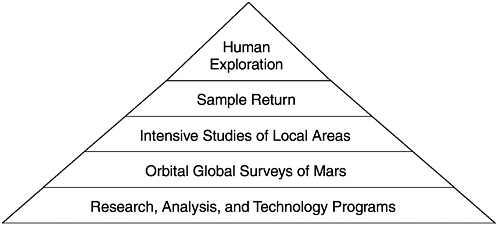
FIGURE 3.1 Schematic of the programmatic elements of an optimum Mars exploration strategy.
ongoing heated debate for claims of ancient life on Earth7—for which the geological and geochemical context of the deposit harboring the evidence is already known—and the likely pitfalls inherent in finding definitive biosignatures on Mars via in situ techniques become apparent. The development of biosignatures and biosignature preservation models for different potentially biologically relevant environments on Mars requires an active program of basic research informed by the most recent discoveries and findings from Mars analog and Earth-based experiments, theoretical analyses, and other activities typically supported via research and analysis (R&A) programs.
Data Analysis: Landing Site Selection
Are there geochemical or mineral traces of past environments that can guide the selection of future landing sites of astrobiological interest? Locating rock deposits that accumulated in environments in which microbial biosignatures could be preserved is critical to life detection search strategies on Mars. High concentrations of aqueously deposited minerals, such as silica, carbonate, and evaporites, are often associated with microbial communities on Earth. Many of these distinctive phases can be deposited over the full range of temperatures that support life. The detection of such materials via the analysis of orbital remote-sensing data may constitute potential signposts for past or present life. Search strategies can be optimized by selecting sites with mineralogies consistent with long crustal residence times. Clay-rich detrital sediments can also preserve organic remains on Earth if they were deposited under anaerobic conditions and were cemented by silica, carbonate, phosphate, or clays. The development of preservation models for these geochemically distinct types of deposits is essential and will have important predictive value in guiding future strategies for the search for life in various martian geological environments.
Laboratory Studies: Martian Meteorites
Since the 1980s, it has been recognized that certain classes of meteorites are probably samples of Mars. The 30+ known martian meteorites have, therefore, been extensively studied using state-of-the-art laboratory techniques in order to determine some chemical, petrologic, and chronologic information about Mars, and the early evolution of its atmosphere. For example, radiometric age measurements have yielded the timing of early planetary differentiation, crystallization ages of individual rocks (but without geological context), and dates of ejection by impact from the planet. Early atmospheric evolution has been studied through the isotopic composition of xenon derived from extinct radionuclides.8 Identification of the martian hydrosphere has been made by measurement of hydrogen and oxygen isotopes in hydrous minerals in Mars meteorites.9 However, there has been a general lack of communication between the Mars meteorite community and mission planners, which has been harmful to both groups. Close cooperation can be achieved by focusing on important problems of mutual interest, such as absolute dating of geological units on Mars, either by sample return or, potentially, by the development of new in situ techniques.
Technology Development
To address increasingly sophisticated questions about the origin and evolution of Mars requires the development of new technologies. Many of these technologies are required simply to execute the missions planned for the coming decade, including new entry, descent, and landing capabilities for large rovers, complex sample-handling and distribution systems, and instruments capable of, e.g., in situ organic detection and age determination. With the inclusion of a Mars sample return mission, the technical complexities multiply to include possible near-surface and deep drilling,10 sample cache capabilities with pinpoint landing of subsequent landers, sample containment, and ascent vehicles. These technologies have long lead times and require substantial investment in development in both the near term and the far term. It seems clear that current technology development funds are insufficient to bring these missions to flight and threaten to delay a Mars sample return mission beyond what can be technologically and fiscally accomplished. More worrying still is the fact that NASA’s technology development woes transcend the current budgetary climate. That is, virtually every lessons-learned study has indicated that technol-
ogy funding has been a chronic problem for NASA for many years—indeed a 2003 NRC report found that for one important technology development activity, “funding was dropping dangerously close to the critical threshold.”11 The committee is not sanguine that these problems are going to get any better soon.
In addition to the technology-activities-enabling missions are the technology activities aimed at developing a particular mission’s scientific instruments. Unfortunately, key programs supporting the development of instrumentation for future Mars missions—e.g., the Mars Instrument Development Program (MIDP), the Planetary Instrument Definition and Development Program (PIDDP), the Astrobiology Science and Technology Instrument Development (ASTID) program, and the Astrobiology Science and Technology for Exploring Planets (ASTEP) program—are in danger of collapse, given President Bush’s budget proposals for FY 2007.12 Indeed, the funding for MIDP and PIDDP is slated to be cut by approximately 15 percent, and the proposed cuts to the funding for ASTID and ASTEP will amount to approximately 50 percent.13 When such potential cuts are viewed against the backdrop of the decade or longer it currently takes a PI at a NASA center or university to develop an instrument from concept to laboratory demonstration to flight hardware, it becomes all too clear that a hiatus in instrument development activities will seriously compromise future missions. The Astrobiology Field Laboratory (AFL) presents the most telling example of the potential disconnects between proposed missions and the instrument required to achieve the advertised mission goals. AFL was conceived as being able to carry a complex sample-selection and sample-handling system and a comprehensive suite of analytical instruments, designed to follow up on and exploit the potential identification of organic compounds at a particular location by the Mars Science Laboratory. The validity of this strategy is currently in some doubt because of a combination of factors including budget, overweight instruments, the dynamical characteristics of the 2016 launch opportunity, and a high probability of dust storms that will complicate AFL’s entry, descent, and landing profile.14 The importance of focused technology development as a strategic investment in the success of future missions cannot be overstated.
Ensuring Optimum Science Return
The Mars architecture as presented does not address the broad base of data analysis, the study of martian meteorites, technology development, and related activities. The committee considers these non-mission elements to be critically essential to the success of the Mars Exploration Program and the VSE. Funding for research and analysis (R&A) is vital to scientific discoveries, many of which will be enabled by data collected in the timeframe 2007-2016. Without adequate funding for R&A, the scientific return from, and long-lived public appreciation of, currently planned missions is compromised. Analysis of existing data in a timely fashion enables the definition of subsequent missions and provides a means for training the next generation of scientists in the planetary community. The committee noted that even though no new planetary exploration missions were launched for most of the 1980s, the maintenance of a healthy R&A program, based on the wealth of data obtained by the Viking project, provided the means for training some of the current leaders of the Mars science and engineering communities.
It should also be noted that the cost of support for R&A is small in comparison with the cost of a single Mars mission. R&A is, however, essential to the future of Mars exploration. Indeed, if the Mars exploration strategy is represented by a pyramid (see Figure 3.1) with basic research activities as its base, then the cost of these activities can equally well be represented by an inverted pyramid with R&A support as the least costly item, and human exploration as the most expensive item.
Similarly, adequate funding of technology is needed to ensure viable hardware, software, and communications for the current and future decades. The report Mars Exploration Strategy 2007-2016 highlights four main “Sustaining Elements of the Strategy”: planetary protection, technical heritage, telecommunications, and international cooperation. Of these, the first three all require investment in new or improved technologies. These are required for successful missions in the current decade, but investment in technology now is required for high-priority future missions such as Mars Sample Return. Given the limited availability of technology development funds, the prospect of reusing proven flight hardware on subsequent missions has its attractions. It could be argued that the most cost-effective strategy for NASA to follow would be to perform surface exploration of Mars by sending copies of the Mars Exploration Rovers to different areas, each equipped with payloads optimized to address the appropriate science questions. An exploration strategy based on the use of minimally modified
technology would probably be scientifically productive. Whether or not such an approach would be cost-effective is beyond the scope of this study. What is clear is that such an exploration strategy is not likely to be capable of adequately addressing all of the non-geological and geochemical priorities identified in the SSE decadal survey and MEPAG reports. Thus, the adoption of such a strategy would represent an implicit narrowing of the scientific focus of NASA’s Mars Exploration Program. If the budgetary situation continues to deteriorate, such an approach may be warranted, but the committee does not believe such a turning point has yet been reached.
It is clear, however, that the extraordinary resilience of the Mars Exploration Rovers strongly suggests that a prudent, risk-reduction strategy is to use their design as a basis for the proposed Mid Rovers. Similarly, commonalities in the design of MSL and AFL might be appropriate. The committee notes, however, that technical heritage has not, historically, been a cost-saving measure as exemplified by the Mars Observer and Mariner Mark 2 “common buses.” Areas requiring technological development include entry, descent, and landing systems, pinpoint landings, drilling technology, and astrobiology instrumentation for AFL.
International Activities
The continuing success of the European Space Agency’s Mars Express highlights that Mars exploration today is an international endeavor with the requisite technical know-how no longer the monopoly of one player. Given the current fiscal environment, NASA and the scientific community should optimize potential international collaborations, such that missions, payloads, and data sets are complementary, but not overlapping. The European Space Agency’s rapidly solidifying plans for a rover mission, ExoMars,15 in 2011 and much more tentative plans for a sample return mission in 2018 are cases in point.16 The former mission is of particular interest here because it is, apparently, somewhat similar in scope to NASA’s proposed Mid Rovers. Payload exchange of individual instruments or instrument suites is an area for significant international collaborations. However, the vulnerability of any nation’s missions to changes in fiscal environments underscores the need to not rely on international missions to fulfill specifically Mars exploration goals, and to exercise caution regarding interdependencies. Free exchange of data, for both scientific analysis and mission planning, is important, as is the need for opportunities for international science team participation.
Summary
The committee is concerned about the absence from the Mars architecture of essential programmatic elements—e.g., support of research and analysis programs and technology development activities—which provide the foundation on which future missions are built.
RESPONSE TO QUESTION 2
In response to the question, Does the revised Mars architecture address the goals of NASA’s Mars Exploration Program and optimize the science return, given the current fiscal posture of the program?, the committee finds that it cannot definitively say whether or not the revised Mars architecture addresses the goals of NASA’s Mars Exploration Program because the architecture lacks sufficient detail with respect to the science and the cost to allow a complete evaluation. The various mission options are, as stated above, incompletely defined, and the strategic approach to, and the selection criteria to distinguish among, various mission options are lacking. The presence of Mars Scout missions in the architecture is welcomed because they help to optimize the science return and provide balance. Nevertheless, the Mars architecture as a whole is not optimized, because the importance of foundational strategic elements—e.g., research and analysis programs and technology development—is not articulated.
The committee believes that many of the concerns identified here owe their origin to a viewpoint that equates an architecture with a sequence of missions and not with a global strategy approach to address a complex, interrelated series of scientific and engineering challenges. To address this problem, the committee offers the following recommendations:
Recommendation: Develop and articulate criteria for distinguishing between the three options for missions to launch in 2016. Similarly, define a strategy that addresses the short lead time between science results obtained from MSL and selection of the mission to fly in 2016.
Recommendation: Clarify how trade-offs involving mission costs versus science were made for the various launch opportunities to justify the rationale behind the proposed sequence of specific missions and the exclusion of others.
Recommendation: Maintain the Mars Scouts as entities distinct from the core missions of the Mars Exploration Program. Scout missions should not be restricted by the planning for core missions, and the core missions should not depend on selecting particular types of Scout missions.
Recommendation: Immediately initiate appropriate technology development activities to support all of the missions considered for the period 2013-2016 and to support the Mars Sample Return mission as soon as possible thereafter.
Recommendation: Ensure a vigorous research and analysis (R&A) program to maintain the scientific and technical infrastructure and expertise necessary to implement the Mars architecture, and encourage collaboration on international missions.
NOTES
|
|
1. D.J. McCleese et al., Mars Exploration Strategy 2007-2016, NASA, Jet Propulsion Laboratory, Pasadena, Calif., 2006, p. 9. |
|
|
2. D.J. McCleese et al., Mars Exploration Strategy 2007-2016, NASA, Jet Propulsion Laboratory, Pasadena, Calif., 2006, pp. 9-18. |
|
|
3. D.J. McCleese et al., Mars Exploration Strategy 2007-2016, NASA, Jet Propulsion Laboratory, Pasadena, Calif., 2006, p. 19. |
|
|
4. The launch window stretches from January to April, 2016. |
|
|
5. A spacecraft launched during the October-November, 2009, launch window will reach Mars between May and October of 2010. |
|
|
6. National Research Council, An Assessment of Balance in NASA’s Science Programs, The National Academies Press, Washington, D.C., 2006, p. 2. |
|
|
7. See, for example, J.W. Schopf, A.B. Kudryavtsev, D.G. Agresti, T.J. Wdowiak, and A.D. Czaja, “Laser-Raman Imagery of Earth’s Earliest Fossils,” Nature 416: 73-76, 2002; and M.D. Brasier, O.R. Green, A.P. Jephcoat, A.K. Kleppe, M.J. Van Kranendonk, J.F. Lindsay, A. Steele, and N.V. Grassineau, “Questioning the Evidence for Earth’s Oldest Fossils,” Nature 416: 76-81, 2002. |
|
|
8. K. Zahnle, “Xenological Constraints on the Impact Erosion of the Early Martian Atmosphere,” Journal of Geological Research 98: 10899-10913, 1993. |
|
|
9. L.L. Watson, I.D. Hutcheon, S. Epstein, and E.M. Stolper, “Water on Mars—Clues from Deuterium/Hydrogen and Water Contents of Hydrous Phases in SNC Meteorites,” Science 265: 86-90, 1994. |
|
|
10. Recent discoveries of sustained surficial water and potential biogenic gas emissions strengthen the need to characterize the subsurface environment on Mars. Because of the hostile nature of the martian surface, the capability to reach some distance (>3 m) below the surface must be provided on future missions. The capability to drill to a depth of several meters or to reach under rocks, rock ledges, or overhangs will be an important asset on missions beyond the scope of this report (e.g., Mars Sample Return). In the long term, the technology necessary to access even greater depths in the martian subsurface—on the order of tens to hundreds of meters—will be required to access putative martian aquifers. |
|
|
11. National Research Council, Review of NASA’s Aerospace Technology Enterprise, The National Academies Press, Washington, D.C., 2003, p. 82. |
|
|
12. National Research Council, An Assessment of Balance in NASA’s Science Programs, The National Academies Press, Washington, D.C., 2006, p. 18. |
|
|
13. National Research Council, An Assessment of Balance in NASA’s Science Programs, The National Academies Press, Washington, D.C., 2006, p. 20. |
|
|
14. Luther Beegle, Jet Propulsion Laboratory, “Status of Astrobiology Instrument Development,” presentation to the Space Studies Board’s Mars Astrobiology Strategy Committee, May 11, 2006. |
|
|
15. For more information on ExoMars see, for example, <www.esa.int/SPECIALS/Aurora/SEM1NVZKQAD_0.html>. |
|
|
16. For more information on ESA’s planning for a Mars sample return mission see, for example, <www.esa.int/SPECIALS/Aurora/SEM1PM808BE_0.html>. |


