
6
Fulfilling the Potential of Women in Academic Science and Engineering
While the number and proportion of women earning science and engineering degrees has increased dramatically, the need for additional focused steps to increase the representation of women in science and engineering faculties is obvious and persistent. Universities and colleges play central roles both in the education of scientists and engineers and in the conduct of research and development. Progress toward equality on their campuses is crucial if we are to optimize the productivity of the nation’s science and engineering enterprise.
ROOT CAUSES OF DISPARITIES
Making full use of the nation’s scientific and technical talent, regardless of the sex, social, and ethnic characteristics of the persons who possess it, will require both understanding of the causes of inequality and effective remedies.
Biological explanations for the dearth of women professors in science and engineering have not been confirmed by the preponderance of research (Chapter 2). Studies of brain structure and function, of hormonal modulation of performance, of human cognitive development, and of human evolution provide no significant evidence for biological differences between men and women in performing science and mathematics that can account for the lower representation of women in these fields. The dramatic increase in the number of women science and engineering PhDs over the last 30 years clearly refutes long-standing myths that women innately or inher-
ently lack the qualities needed for success; obviously, no changes in innate abilities could occur in so short a time.1
Surveys of the definite postgraduate plans of science and engineering doctoral recipients show that similar proportions of women and men plan for a career in academe. As shown in Chapter 3, despite similar career aspirations, women have not been able to translate their success at earning science and engineering PhDs into academic careers equal to those attained by men.
Academe is purportedly a meritocracy that rewards objectively determined accomplishment. However, many studies document that both bias and structural barriers built into academic institutions and the occupation of professor limit many women’s ability to be hired and promoted in university faculties. In fact, the academy has perpetuated patterns of bias that devalue women and minorities and their abilities, aspirations, accomplishments, and roles. As described in Chapter 4, small but consistent differences in evaluation, often caused by gender bias, can have a sustained and substantial impact on career outcomes.
|
I have always believed that contemporary gender discrimination within universities is part reality and part perception, but I now understand that reality is by far the greater part of the balance. —Chuck Vest, President, MIT2 |
A substantial body of research demonstrates that women are underrepresented at higher levels of business and academe because of the influence of gender schemas and the accumulation of disadvantage that such schemas generate.3 Gender schemas systematically influence both women and men’s perceptions and evaluations of competence and performance, and they cause women to be consistently underrated and men consistently overrated. Academic scientists and engineers show bias against women applying for grants, employment, and tenure. To achieve the same competence rating as a man, a woman must have a significantly superior
|
1 |
J Handelsman, N Cantor, M Carnes, D Denton, E Fine, B Grosz, V Hinshaw, C Marrett, S Rosser, D Shalala, and J Sheridan (2005). More women in science. Science 309:1190-1199, http://www.sciencemag.org/cgi/content/full/309/5738/1190. |
|
2 |
Massachusetts Institute of Technology (1999). A study on the status of women faculty in science at MIT. MIT Faculty Newsletter 11(4), http://web.mit.edu/fnl/women/women.html. |
|
3 |
V Valian (1998). Why So Slow? The Advancement of Women. Cambridge, MA: MIT Press. |
|
FOCUS ON RESEARCH BOX 6-1 Benefits of Presumed Competence Acquisition of human capital parallels the accumulation of advantage or disadvantage. Exposure to discrimination influences earnings and leads to inequalities in income across the career, particularly among the highly educated.a Those familiar with compound interest know that even a difference in return of 1% per year leads to a 25% lower total return over a 30-year period. A computer simulation of promotion practices shows a similar effect.b The model assumes a pyramidal organizational hierarchy and a tournament model of success, in which evaluation of early career success is necessary for promotion. A hypothetical corporation with eight levels is staffed at the bottom level by equal numbers of men and women, and 15% of the staff is promoted from one level to the next, but there is an evaluation bias in favor of men. With a 5% bias, only 29% of those promoted to the very top level of the organization were women, whereas 58% of the bottom-level positions were filled by women. Even more dramatic is the finding that when sex differences explained only 1% of the variance, an estimate that might be dismissed as trivial, only 35% of the highest-level positions were filled by women. Clearly, even small disadvantages can create significant disparities over time. |
record.4 Although most individual differences in treatment are typically quite subtle and seemingly small, these small but consistent advantages or disadvantages accumulate into significant discrepancies in salary, promotion, and prestige (Box 6-1).
In addition to bias, systematic structural constraints built into academic institutions have impeded the careers of women scientists.5 As docu-
|
4 |
C Wennerås and A Wold (1997). Nepotism and sexism in peer-review. Nature 387:341-343; R Steinpreis, KS Anders, and D Ritzke (1999). The impact of gender on the review of the curriculum vitae of job applicants and tenure candidates: A national empirical study. Sex Roles 41(7-8):509-528; Massachusetts Institute of Technology (1999). A study on the status of women faculty in science at MIT. MIT Faculty Newsletter 11(4), http://web.mit.edu/fnl/women/women.html. |
|
5 |
For example, see J Jacobs and S Winslow (2004). The academic life course: Time pressures and gender inequality. Community, Work and Family 7(2):143-161; B Baginole (1993). How to keep a good woman down: An investigation of the role of institutional factors in the process of discrimination against women academics. British Journal of Sociology of Education 14(3):261-274. |
mented in Chapter 5, organizational rules and structures may appear neutral on the surface but can function in a way that leads to differential treatment of or differential outcomes for men and women. One example is the effect on productivity of unequal access to institutional resources.6 Another is the assumption that faculty members have substantial spousal support. The evidence demonstrates that anyone lacking the work and family support provided by someone fulfilling the traditional role of wife is at a serious disadvantage in academe. Most faculty members no longer belong to households that fit that mold. In 2003, 64.4% of women and 83.5% of men tenured or tenure-track faculty were married; 42.2% of women and 50% of men faculty had at least one child in the household.7 About 90% of the spouses of science and engineering women faculty are employed full-time; almost half the spouses of male faculty also work fulltime (see Figures 5-2 and 5-3).8 Furthermore, even within today’s two-career households, women still shoulder a disproportionate share of responsibility for children and other dependents, which places a burden on women faculty members that their male colleagues ordinarily do not bear.
WHY CHANGE IS NECESSARY
This nation can no longer afford the underperformance of our academic institutions in attracting the best and brightest minds to the science and engineering enterprise. Nor can it afford to underappreciate or devalue the contributions of that workforce through gender inequities and discrimination. There are four compelling reasons for taking action to eliminate gender disparities and bias in science and engineering careers in academe and elsewhere.
-
Global competitiveness. America’s technological advances, its standard of living, and ultimately its prosperity and security depend on global pre-eminence in science and engineering. Other countries are making strong
|
6 |
RK Merton (1968). The Matthew effect in science. Science 158:56-63; P Allison and JS Long (1990). Departmental effects on scientific productivity. American Sociological Review 55:469-478; B Keith, JS Layne, N Babchuk, and K Johnson (2002). The context of scientific achievement: Sex status, organizational environments, and the timing of publication on scholarship outcomes. Social Forces 80(4):1253-1282; Y Xie and KA Shauman (1998). Sex differences in research productivity: New evidence about an old puzzle. American Sociological Review 63:847-870. |
|
7 |
National Science Foundation (2003). Survey of Doctorate Recipients. Data provided by Joan Burrelli, Division of Science Resource Statistics. |
|
8 |
The National Science Foundation has compiled a table on marital status and spousal employment for men and women scientists and engineers in 2001, see http://www.nsf.gov/statistics/wmpd/employ.htm, Table H-31. |
-
gains emulating the successes of the United States by investing heavily in science and technology.9 To remain competitive in a fast-changing global economy, the United States needs to make optimal use of its scientific and engineering talent.
-
Law. Our nation has strong anti-discrimination laws. Title VII of the Civil Rights Act of 196410 prohibits employment discrimination based on race, color, religion, sex, and national origin. Title IX, passed in 1972,11 prohibits discrimination or exclusion on the basis of sex from any education program or activity receiving federal financial assistance. The Science and Engineering Equal Opportunities Act of 1980 made “equal opportunity [for men and women] in education, training and employment in scientific and technical fields” the official policy of the United States.
-
Economics. States, the federal government, and the private sector invest heavily in training scientists and engineers. The average annual support provided for a full-time doctoral student is about $50,000, not including research and training expenses.12 The average doctoral student takes about 7 years to complete the PhD,13 bringing the investment to $350,000 per PhD. That is a substantial cost. It makes no sense economically to have highly educated, expensive PhDs leave science and engineering because they perceive a lack of opportunity to excel.
-
Ethics. Men and women should have an equal opportunity to serve society, work in rewarding jobs, and earn a living.
|
Until women can feel as much at home in math, science, and engineering as men, our nation will be considerably less than the sum of its parts. If we do not draw on the entire talent pool that is capable of making a contribution to science, the enterprise will inevitably be underperforming its potential. —The Presidents of the Massachusetts Institute of Technology, Stanford University, and Princeton University14 |
|
9 |
See NAS/NAE/IOM (2007). Rising above the Gathering Storm: Energizing and Employing America for a Brighter Economic Future. Washington, DC: The National Academies Press. |
|
10 |
Pub. L. 88-352. For a full description, see http://www.eeoc.gov/policy/vii.html. |
|
11 |
Title 20 U.S.C. Sections 1681-1688. See http://www.dol.gov/oasam/regs/statutes/titleix.htm. |
|
12 |
In 2001, the average annual stipend support was $37,234, and tuition and fees were $8,070. Overheads on federal grants help to support health benefits. The numbers do not include the amount invested in research or teaching. Data from National Center for Education Statistics (2002). Digest of Education Statistics, 2002 (NCES 2003060). Washington, DC: US Department of Education Statistics. |
|
13 |
National Science Board (2006). Science and Engineering Indicators, 2006 (NSB 06-01). Arlington, VA: National Science Foundation, Figure 2-27 and Appendix Table 2-34. |
|
14 |
J Hennessey, S Hockfield, and S Tilghman (2005). Women and science: The real issue. The Boston Globe, Feb. 12, http://www.boston.com/news/education/higher/articles/2005/02/12/women_and_science_the_real_issue/. |
WHAT MUST BE DONE: A BLUEPRINT FOR ACTION
Career impediments for women deprive the nation of an important source of talented and accomplished scientists and engineers. Transforming institutional structures and processes to eliminate gender bias requires a major national effort, incorporating strong leadership and continuous attention, evaluation, and accountability. It will require persistent diligence and abiding patience.15 The committee’s recommendations are rooted in strategies shown to be successful. They are large-scale and interdependent, and require the combined efforts of university leaders and faculties, professional societies and higher education organizations, funding agencies, federal agencies, and Congress.
|
Attaining gender equity is a deep cultural problem, one that most scientists would like to see overcome, but one that is likely to persist unless active steps are taken to change the culture in which we live. —Richard Zare, Chair, Chemistry Department, Stanford University16 |
Change Institutional Processes to Combat Bias
Faculty members and administrators at all levels need to correct or eliminate the policies and practices that lead to or permit gender bias. How should faculty interact with students? How should young women faculty deal with unwelcome social or sexual advances? How should faculty members work with staff? How should institutions and individuals interview and hire? What are effective, unbiased strategies for evaluating performance? A recent Harvard Task Force developed a comprehensive list of policy actions for improving the retention and advancement of women in science and engineering, across the educational and career path (Box 6-2).
Many women faculty cite workplace climate as an important factor in career satisfaction and decisions about whether to pursue a career in academe.17 All too often, newly minted scientists begin their faculty positions
|
15 |
JH Franklin (2005). Mirror to America. New York: Farrar, Straus, and Giroux. |
|
16 |
R Zare (2006). Sex, lies, and Title IX. Chemical and Engineering News 84(2):46-49, http://pubs.acs.org/cen/education/84/8420education.html. |
|
17 |
For example, see LLB Barnes, MO Agago, and WT Coombs (1998). Effects of job-related stress on faculty intention to leave academia. Research in Higher Education 39(4):457-469; P Bronstein and L Farnsworth (1998). Gender differences in faculty experiences of interpersonal climate and processes for advancement. Research in Higher Education 39(5):557-585; |
|
DEFINING THE ISSUES BOX 6-2 The Harvard University Task Force on Women in Science and Engineeringa “A diverse faculty is a strong faculty because it emerges from the broadest possible consideration of available talent.” On February 3, 2005, Harvard University announced the formation of two Task Forces—the Task Force on Women Faculty (WF-TF) and the Task Force on Women in Science and Engineering (WISE-TF)—to “develop concrete proposals to reduce barriers to the advancement of women faculty at Harvard.” WISE-TF was charged to analyze and make recommendations concerning effective ways to build and sustain the pipeline of women pursuing academic careers in science, from undergraduate studies to graduate and postdoctoral work to advancement through faculty ranks. The task force made recommendations across several broad topics: sustaining commitment, mentoring and advising, enabling academic careers in the context of family obligations, and faculty development and diversity. Sustaining commitment
|
with little or no training in effective strategies for running a laboratory, lacking even basic training and skills in writing and managing a budget, hiring and evaluating personnel, and conflict management. The dearth of training contributes in turn to some of the observed climate problems in the academic science workplace.18 In recent years, training strategies and pro-
|
LS Hagedorn (2000). Conceptualizing faculty job satisfaction: Components, theories, and outcomes. New Directions for Institutional Research 105:5-20; MF Fox and P Stephan (2001). Careers of young scientists: Preferences, prospects and realities by gender and field. Social Studies of Science 31(1):109-122; CA Trower and RP Chait (2002). Faculty diversity. Harvard Magazine, http://www.harvard-magazine.com/on-line/030218.html; L August and J Waltman (2004). Culture, climate, and contribution: Career satisfaction among female faculty. Research in Higher Education 45(2):177-192. |
|
Mentoring and advising
Enabling academic science careers in the context of family obligations
Faculty development and diversity
|
grams have emerged to fill the void. Box 6-3 details an existing program that has proven effective at increasing the retention of women and men junior faculty.
Tenured faculty with management responsibilities—including department chairs, deans, and search committee chairs—would benefit from periodic workshops in which they examine ground rules and work to correct gender bias. Efforts should focus on providing mandatory workshops for deans, department heads, search committee chairs, grant reviewers, and other faculty with personnel evaluation and management responsibilities. The workshops should include an integrated component on diversity and the strategies needed to overcome bias and gender schemas. For example, the WISELI program at the University of Wisconsin-Madison convenes department heads for workshops on department climate (Box 6-4). Such forums provide an opportunity for general discussion of how to manage
|
EXPERIMENTS AND STRATEGIES BOX 6-3 Improving the Retention of Junior Faculty Case Study: Johns Hopkins Department of Medicine Task Force The Task Force on Women’s Academic Careers in Medicine at the Johns Hopkins Department of Medicine is a model for academic departments to reduce gender bias and foster career development for women faculty.a This case study begins in 1989 with a report from the Provost’s Committee on the Status of Women that showed lower salaries for women faculty compared with men and substantially slower rates of promotion. In 1990, the chair of the Department of Medicine appointed a Task Force on Women’s Academic Careers in Medicine to evaluate and characterize career pathways for men and women medical faculty. They found women faculty were less likely than men to be nominated for promotion, to have mentors who actively fostered their careers, to have comparable salaries, and to participate in decision making. Women faculty were more likely than male faculty to have mentors who used the women faculty’s work for the mentor’s own benefit, to feel isolated, and to experience conflict between work and personal responsibilities. The Task Force set out to evaluate the basis of the obstacles to career advancement, hypothesizing that they were due to a combination of institutional policy, structure, and culture. The Task Force collected baseline data using individual interviews and a survey administered to all full-time faculty. Based on these data, they implemented interventions and evaluated the impact of these interventions by tracking such factors as faculty turnover, tenure rate, and proportion of men and women faculty at various ranks along the tenure-track, and by re-administering the same survey 3 and 5 years later. They found a substantial improvement in the proportion of junior women retained and promoted—without any change in evaluation criteria—as well as improvement for both men and women in timeliness of promotions, manifestations of gender bias, access to information needed for faculty development, isolation, and salary equity. What did they do? The Task Force outlined six intervention areas and associated tasks to eliminate the gender-based obstacles to women’s careers.
|
A follow-up survey 3 years later indicated that this multifaceted strategy significantly decreased gender bias and improved the retention and promotion of men and women junior faculty. Isolation decreased. There was a 77% increase in the proportion of women faculty reporting that their division director had informed them of promotion criteria, and a 110% increase in the proportion who had mentors. The women in the department also reported significant improvement in the quality of mentoring. Monitoring of promotion rates from 1990-1995 showed that the number of women and men on the tenure track had increased, and the proportion of women faculty at the associate ranks increased from 4/45 (9%) in 1990 to 26/64 (41%) in 1995, a proportion similar to that of men (57/167 in 1990 and 70/223 in 1995). Key lessons: (1) implement a long-term strategy that has multiple facets; (2) while interventions can start with a marginalized group, to minimize backlash it is critical that programs be generalized to all faculty;b (3) leadership is critical in maintaining focus and expectations; and (4) the quality and effectiveness of the program must be evaluated to determine what works and what does not. |
|
EXPERIMENTS AND STRATEGIES BOX 6-4 Women in Science and Engineering Leadership Institute: Climate Workshops for Department Chairs Climate (Kli−’mi˘t), n. The atmosphere or ambience of an organization as perceived by its members. An organization’s climate is reflected in its structures, policies, and practices; the demographics of its membership; the attitudes and values of its members and leaders; and the quality of personal interactions. Committee on Women, University of Wisconsin-Madison’s Working Group on Climate (2002). Many women cite workplace climate—hostility from colleagues, exclusion from the department community and its decision-making process, and slights and ridicule—as pervasive in university settings. Men are often unaware of the impact that climate has on women and describe a better climate for women than women report experiencing. Those troubling trends in campus climates have been documented in faculty surveys at the Massachusetts Institute of Technology, Princeton, the University of Wisconsin-Madison, and the University of Michigan. Harsh climates have made it difficult for universities to recruit and retain women faculty members. At the University of Wisconsin-Madison, the Women in Science and Engineering Leadership Institute (WISELI)a has developed a series of workshops, the WISELI Climate Workshops for Department Chairs, that engage small groups of department chairs in discussions of climate in their own departments and give participants a chance to learn from each others’ experiences and ideas. The WISELI Climate Workshops for Department Chairs also provide information about various resources and people on campus that can assist department chairs in their efforts. The goals of these workshops are
|
bias, and a vehicle for department leaders to exchange strategies and best practices.
A recent national meeting of chemistry department chairs in collaboration with the major federal funders of academic chemistry research—the Department of Energy, the National Science Foundation, and the National Institutes of Health—is an example of an effective cross-institutional strategy (Box 6-5).
Workshops are conducted over three sessions and structured around a Web-based department climate survey. The survey is administered between the first and second workshops. The survey enables chairs to identify specific concerns of their departments. During the course of the workshop, participants develop an action plan to address the issues raised in the survey. The third workshop is an opportunity for the chairs to discuss the impact of the changes they have implemented and to identify the key challenges they still face. WISELI conducted a survey of the chairs within a year of completing the workshop. Of the 19 chairs surveyed, all but one said that the five goals stated above were met. Fourteen said that the climate in their department had improved and five said the climate was unchanged. Perhaps the most telling results were derived from a campus-wide survey of faculty, which was conducted in 2003 (before the climate workshops were instituted) and again in 2006 (after the workshops were instituted). An analysis of perceptions of climate in departments in which the chair had participated in WISELI training indicated that both men and women in those departments gave the climate for women a higher rating in 2006 than they had in 2003, whereas those in departments whose chairs had not participated rated it less favorable in 2006. The chairs who had participated in workshops were more aligned with the ratings given by their faculty than in 2003, suggesting that the workshops shifted their perception of the climate to be closer to the actual climate.
|
Create New Institutional Structures
Changing the “culture” of departments and institutions will not suffice to eliminate bias and institutional constraints on women’s careers unless institutions frankly confront and resolve the issues raised by child and family responsibilities. The traditional career model clearly does not take into account the life course of women scientists who wish to become parents, because it requires unbroken concentration on work during their peak reproductive years; indeed, the career interruption associated with motherhood has been identified as the most likely factor that keeps a woman with science or engineering training from pursuing or advancing in a scientific or
|
EXPERIMENTS AND STRATEGIES BOX 6-5 Building Strong Academic Chemistry Departments through Gender Equitya In January 2006, 60 chemistry department chairs or senior leaders from the most active research universities convened with funding agency representatives and academic, government, and national chemistry leaders to identify specific strategies that chemistry departments, universities, and federal agencies could implement to encourage and enable broader participation of women in academic chemistry careers. The program for the workshop was developed by a steering committee of chemistry department chairs and several Committee on the Advancement of Women Chemists (COACh) (Box 4-3) board members, and was sponsored by the National Science Foundation, the Department of Energy, and the National Institutes of Health. Presentations by university leaders, social scientists, and funding agency representatives were intermixed with breakout sessions and panel discussions. The workshop focused on (1) presentation of demographic data on the top 50 chemistry departments; (2) research on discriminatory biases and practices that negatively impact the recruitment, hiring, and advancement of women faculty; (3) identification of challenges and opportunities for chemistry departments, academic institutions, and federal funding agencies as they strive for gender equity in the sciences; and (4) development of action items for adoption by departments, institutions, and federal funding agencies. These action items included doubling the pool of women chemists considered for faculty positions in chemistry departments, creating sufficient child-care facilities, and strategies to advance the careers of young faculty such as modifying tenure rules, developing departmental procedures that mesh with family schedules, educating all faculty members to understand gender and caregiving bias, and providing opportunities for two-career families. An on-site postworkshop survey was developed and conducted by COACh to determine what parts of the workshop the participants found most informative and useful. Participants attached high priority to gaining a better appreciation of subtle biases and discrimination that can accumulate to become a major career disadvantage for female faculty members. That issue was highlighted in several presentations and was effectively reinforced through both the presentation of the CRLT Players (Box 4-4), who provided an interactive and realistic demonstration of department communication, and by the testimony of women chemistry faculty members and women department chairs present at the meeting. Also identified as ef |
technical career.19 Nor does the model take into account the needs of unmarried scientists—women and men—who have household, family, and community obligations without spousal support. It is a model that fits the
|
fective was a presentation by Senator Ron Wyden, who spoke on the need to diversify the scientific workforce. COACh also conducted an on-line survey completed by the department chairs and their representatives before and after the workshop to learn their views on what limited their ability to hire women, of factors that could affect women’s career progress, and to see whether any of these views changed as a result of the workshop. Before the conference, chairs generally believed that factors limiting their ability to hire women were largely beyond their control. Over two-fifths of the respondents indicated that having too few female applicants, losing female candidates to other departments, and not having employment for spouses or partners limited their departments’ ability to hire women. Less than 12% indicated that the commitment of department faculty or opposition of department faculty to hiring women were limiting factors. The only barrier to women’s advancement that was seen as moderately or very important by a majority of the attendees was the issue of balancing career and family life (cited by 88% of the respondents). At the same time, over half believed that heavier teaching loads, few mentoring opportunities, and discrimination in the peer review process were either “not an issue” or “not important.” After attending the conference, department chairs were significantly more likely to perceive that factors under their control limited their hiring of women or served as barriers to their progress. For instance, attendees were more likely than before the conference to report that their department faculty were not committed to hiring women, that some were actually opposed to doing so, that they didn’t have enough financing, and that they did not have enough employment for spouses or partners. In addition, they were more likely to say that women faced career barriers involving heavier teaching loads, an unwelcoming department climate, few mentoring opportunities, and subtle biases against women. Over the subsequent year, COACh will monitor changes in chemistry departments implemented as a result of this workshop. A chemistry department chair Web site has been established for the chairs to report the action items that they have selected to implement in their departments, to provide periodic progress reports, and to assess the effect of their efforts on their departments. It also provides a forum for department chairs to to share their challenges, progress, and successes.
|
|
EXPERIMENTS AND STRATEGIES BOX 6-6 Stanford University’s Childbirth Policy for Female Graduate Students In acknowledgment of the conflict between the academic timeline and the prime childbearing years, and in an effort to increase the number of women pursuing advanced degrees, Stanford University put into place in January 2006 a substantial new childbirth policy for female graduate students. Stanford’s university-wide policy has four main features:a
Stanford’s childbirth policy is not a leave-of-absence policy (although students are free to pursue maternity and medical leave under existing policies), and under this policy students are expected to continue to participate in coursework and required research activities, albeit at a reduced rate. Stanford’s university- |
lifestyle of an ever smaller group of people. It is urgent that academic norms and expectations be transformed so that the academy can continue to attract the very best people.
University faculty and leaders must develop and implement hiring, tenure, and promotion policies that take into account the flexibility that scientists need across the life course and that integrate family, work, and community responsibilities. They should provide central policies and funding for faculty and staff on leave and should visibly and vigorously support campus programs that help graduate students, postdoctoral scholars, and faculty with children or other caregiving responsibilities to maintain productive careers. Programs should include provisions for paid parental leave for faculty, staff, postdoctoral scholars, and graduate students (Box 6-6); facilities (Box 5-10) and subsidies (Box 6-7) for on-site and community-based child care;20 dissertation defense and tenure clock extensions; modi-
|
wide childbirth policy is intended as a minimum standard; departments are encouraged to establish their own policies. Stanford’s Chemistry Department established its own childbirth policy before the enactment of the university-wide policy. The Chemistry Department’s policy has an additional critical feature: it allows a student who is pregnant or is a new mother to reduce coursework and research activities for a period of 12 weeks while receiving the financial support of fellowships and assistantships.b Both policies stress the continued importance of continued communication between students and their advisers. The policies aim “to support—not replace— the open communication and good will that should characterize the relationship between student and advisor.”c Both the Stanford Chemistry Department’s policy and the university-wide policy are among the most generous childbirth policies in the country; recently, Dartmouth University announced a similar policy for its graduate students.d
|
fied duty schedules; lactation rooms; and family-friendly scheduling of critical meetings.
As described in Chapter 5, the mere existence of apparently family-friendly policies will not reduce the pressure on women faculty or their fear that family life will damage or even destroy their careers. Rather, to reduce the conflict between work and family that faculty members experience, faculties and their Senates must examine tenure guidelines and ensure that committees appropriately evaluate candidates who have taken parental leave. In addition, university leaders, including top administrators and department chairs, must adopt policies that recognize and mitigate the disadvantages imposed by caregiving.21
Create Methods for Evaluation and Accountability
Academic institutions must work jointly with scientific and professional societies and federal agencies for lasting change to occur. All three
|
21 |
K Ward and L Wolf-Wendel (2004). Fear factor: How safe is it to make time for family? Academe 90(6), http://www.aaup.org/publications/Academe/2004/04nd/04ndward.htm. |
|
EXPERIMENTS AND STRATEGIES BOX 6-7 Financial Support for Dependent Care Several successful strategies and programs exist in which students, postdoctoral scholars, and faculty are able to receive financial support to cover expenses related to dependent child care. Programs of this sort are sponsored by universities, professional societies, and research funding agencies. Universities: A number of universities and research centers have programs that provide partial financial support to eligible students, faculty, and postdoctoral scholars to cover childcare expenses.
Scientific and Professional Societies: The availability of child-care services at scientific and professional meetings can be an important factor in encouraging faculty, graduate students, and postdoctoral scholars with children to attend these
|
|
meetings. Several strategies have emerged through which societies act to make child care available.
Funding Agencies and Organizations: Child-care support may also be available from funders.
|
|
sectors must provide leadership in equity, hold their constituents accountable for change, and provide clear measures and standards. Together, the three sectors can work to promote and ensure equity, increase the pool of talented scientists and engineers, and increase their integration into the nation’s economy (Box 6-8).
Coordinating Body
To help coordinate efforts between the actors, the assistance of an inter-institution monitoring organization body is crucial. An example of such an organization is the National Collegiate Athletic Association (NCAA), which works with its member institutions to set standards and review Title IX compliance.22 The NCAA has published an annual gender-equity report since 1992.23 The NCAA, established in 1906, is a voluntary organization through which the nation’s colleges and universities govern their athletic programs. It comprises more than 1,250 institutions, conferences, organizations, and individuals committed to the best interests, education, and athletic participation of student-athletes. The member colleges, universities, and conferences appoint volunteer representatives that serve on committees that introduce and vote on rules called bylaws. The members also establish programs to govern, promote, and further the purposes and goals of intercollegiate athletics.
|
22 |
The Office of Civil Rights of the Department of Education is responsible for enforcement. |
|
23 |
For example, see the 2002-2003 NCAA gender-equity report at http://www.ncaa.org/library/research/gender_equity_study/2002-03/2002-03_gender_equity_report.pdf. |
National higher education organizations, including the American Council of Education (ACE), Association of American Universities, and the National Association of State Universities and Land Grant Colleges, through formation of an inter-institution monitoring body, could play a leading role in promoting equal treatment of women and men studying and working in our nation’s universities. Such a body could serve to recommend norms and measures, collect data, and track compliance and accountability across institutions. ACE is an umbrella organization encompassing all of higher education: degree-granting colleges, universities, and higher education-related associations, organizations, and corpora-tions.24 ACE, with its convening power and strong reputation for consensus-building, is the logical organization to take the initial step to convene higher education groups to discuss the creation of such a monitoring organization. A primary focus of the discussion should be on defining the scope and structure of data collection.
In addition, scientific and professional societies could serve in a role similar to that of the national governing bodies for sports25 and help to set professional and equity standards, collect and disseminate field-wide education and workforce data, and provide professional development training for members that include a component on bias in evaluation.
|
While opportunities for male and female athletes are an important issue, the possible implications of Title IX on educational opportunities for male and female college students have the potential of influencing many more students in a much more important manner. Access to high quality educational programs is more important from a policy standard point than whether one gets to play in intercollegiate soccer. —James Monks, Department of Economics, University of Richmond26 |
|
24 |
ACE has over 1,800 member institutions and organizations. Among the over 100 national member organizations that are members of ACE are the American Association of State Colleges and Universities, American Association of University Professors, American Chemical Society, Association of American Colleges and Universities, Association of American Medical Colleges, Association of American Universities, National Association of Independent Colleges and Universities, National Association of College and University Business Officers, National Association of State Universities and Land-Grant Colleges, and the National Collegiate Athletic Association. |
|
25 |
See http://www.ncaa.org/library/general/achieving_gender_equity/resources.pdf. |
|
26 |
J Monks (2005). Title IX Compliance and Preference for Men in College Admission (Working Paper 80). Ithaca, NY: Cornell Higher Education Research Institute, http://www.ilr.cornell.edu/cheri/wp/cheri_wp80.pdf. |
Continuous Evaluation: Scorecard
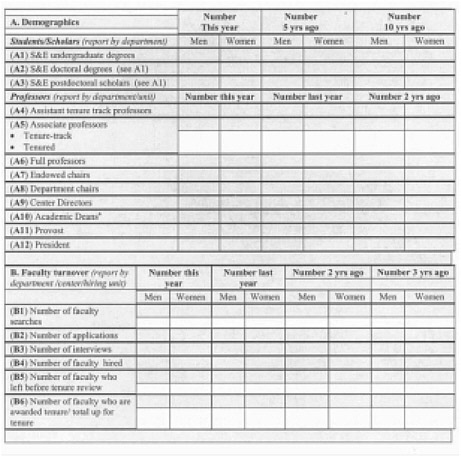
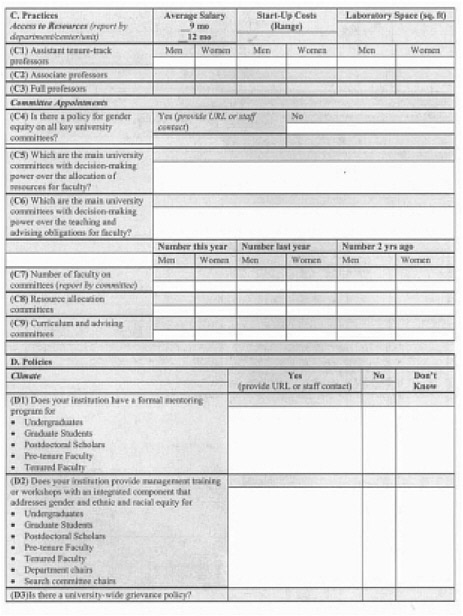
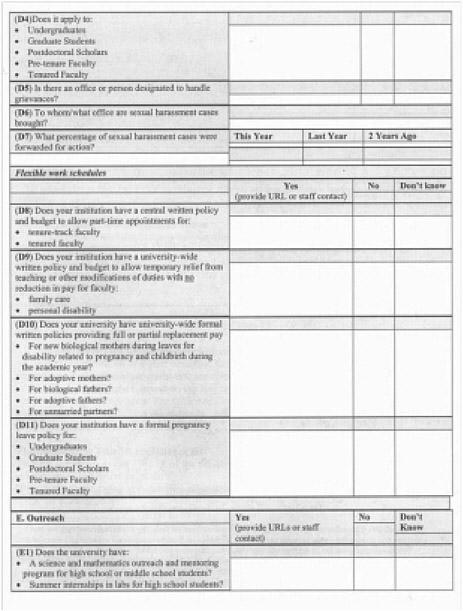
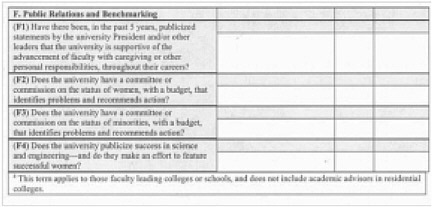
Monitoring and evaluating progress toward gender equity in access to science and engineering education and academic careers require making appropriate measurements and comparisons. The committee has developed a proposed scorecard for measuring many of the factors relevant to equity, including climate, or “intangible” environment (see Box 6-8). The committee recommends that universities monitor their programs through annual self-audits that collect data on the education and employment of scientists and engineers disaggregated by sex and race or ethnicity. The recommended audits should be part of a larger effort to establish metrics for gender equity in academic science and engineering. Coordinating organizations should act to create uniform standards among their members and provide a central clearinghouse for publication of the results.
Federal Standards and Compliance Issues
Relevant civil rights statutes include Title IX (see Box 6-9), Title VI for students, and Title VII and Executive Order 11246 for faculty and employees. Together those laws bar discrimination on the basis of sex, race, and disability.27 The federal agencies should work with higher education institutions to establish clear guidelines and measures for compliance with all civil rights statutes.
Civil rights statutes cover every aspect of student education and faculty employment. For students, these statutes cover recruitment, admission to undergraduate programs (at a minimum at public institutions), admission to graduate programs, housing arrangements, scholarships and fellowships, internships and work-study opportunities, assignment to classes, assignment of advisers, selection for teaching assistantships, and “intangible” environment.
For faculty and employees the statutes bar discrimination based on sex, race, and national origin in all aspects of employment in educational institutions and programs, including recruitment; hiring; selection of graduate fellowships or teaching assistantships if these create an employer-employee
|
DEFINING THE ISSUES BOX 6-9 Title IX Title IX bans sex discrimination in education and covers (a) students, faculty, and employees at institutions of higher education that receive federal funds and (b) students and employees of educational programs that are offered by other institutions that receive federal funds. When it was passed, however, the law did not specify how institutions would be measured to be in compliance. The Office of Civil Rights (OCR) of the Department of Education was charged with establishing these details. After years of review and extensive public feedback, the OCR issued standards in 1979. The Three-Prong Title IX Compliance Test To show compliance with Title IX of the Education Amendments of 1972, institutions must meet at least one of the following tests:
That policy provides flexibility in meeting compliance, but many universities and most courts have focused on the proportionality standard in Title IX compliance and litigation.a Every federal agency that gives funds to institutions of higher education or to other institutions that run educational programs—including all cabinet agencies (such as the Department of Education and the Department of Defense), and such agencies as the National Science Foundation, the National Institutes of Health, and the National Aeronautics and Space Administration—is obliged to enforce Title IX. Each federal agency has issued regulations delineating its enforcement responsibilities under the law, and each has the authority to investigate and resolve discrimination complaints and to initiate compliance reviews of recipients of federal aid. The Department of Justice is charged with coordination of agency efforts under Title IX and is obliged to ensure overall enforcement of the statute. |
relationship; promotion; tenure; termination; allocation of resources, such as laboratory space, research assistants, and research funding; receipt of awards and opportunities for public recognition; terms and conditions of employment, including leave, benefits, teaching load, availability of sabbaticals, appointments as department chairs, selection for research projects, committee assignments, and office location; and “intangible” environment.
Sanctions
The current stated sanction for noncompliance with federal statutes is retraction of federal funds or cancellation of federal contracts. What the NCAA has done with regard to Title IX compliance is create an intermediate sanction to precede such action: withdrawal from competition of a member organization found to be in noncompliance. There are no analogous science and engineering “teams,” however, an option that could be considered by the NCAA-like organization is withdrawal of an institution’s ability to compete for federal funds for a given period. The pressure of civil rights enforcement tends to be indirect: institutions change behavior not because of the threat of sanctions, but rather because the law cultivates a normative environment that legitimates and motivates compliance.28
Possible Unintended Consequences
Some have argued that Title IX as applied to athletics has led to the elimination of men’s sports teams in favor of women’s teams. However, it appears that institutions are more likely to add female teams and female athletes than to cut male teams and reduce the number of male athletes in response to a finding of noncompliance.29 A more common strategy used by institutions that are out of compliance with the proportionality standard is to provide preference to men in college admissions, and thereby establish a lower proportion of female students.30 That has the obvious effect of
|
28 |
WT Bielby (2000). Minimizing workplace gender and racial bias. Contemporary Sociology 29:120-129; B Reskin (2000). The proximate causes of employment discrimination. Contemporary Sociology 29(2):319-328; S Strum (2001). Second generation employment discrimination: A structural approach. Columbia Law Review 101(3):458-568; E Hirsh (2006.) Enforcing Equal Opportunity: The Impact of Discrimination Charges on Sex and Race Segregation in the Workplace (Working Paper). Department of Sociology, University of Washington. |
|
29 |
DJ Anderson and JJ Cheslock (2004). Institutional strategies to achieve gender equity in intercollegiate athletics: Does Title IX harm male athletes? American Economic Review Papers and Proceedings 94(2):307-311. |
|
30 |
J Monks (2005). Title IX Compliance and Preference for Men in College Admission (Working Paper 80). Ithaca, NY: Cornell Higher Education Research Institute, http://www.ilr.cornell.edu/cheri/wp/cheri_wp80.pdf. |
exacerbating imbalances between men and women and should be carefully considered in the crafting of standards for evaluation and compliance in science and engineering.
CALL TO ACTION
|
“Institutions of higher education have an obligation, both for themselves and for the nation, to develop and utilize fully all the creative talent available.” —Nine-University Statement on Gender Equity, 200531 |
America’s competitiveness in today’s global economy depends on fully developing and using all the nation’s scientific and engineering talent. However, substantial barriers still exist to the full participation of women, not only in science and engineering, but also in other academic fields throughout higher education.
That women are capable of contributing to the nation’s scientific and engineering enterprise but are impeded in doing so because of gender and racial or ethnic bias and outmoded “rules” governing academic success is a call to action. Creating environments that promote the professional success of all people, regardless of their sex, race, or ethnicity, must be a top priority for all institutions and individuals concerned with maintaining and advancing the nation’s scientific and engineering enterprise.
Transforming academic institutions so that they will foster the career advancement of women scientists and engineers at all levels of their faculties is a complex task of identifying and eliminating institutional barriers. Individual institutional efforts have had dramatic effects but sustained change across higher education is unlikely unless there is a transformation of the process by which students and faculty are educated, trained, recruited, evaluated, tenured, and retained.
Our analysis shows that policy changes are sustainable only if they create a “new normal,” a new way of doing things. Increasing the number of women and underrepresented minority-group faculty substantially will require leadership from faculty, individual departments, and schools; rigorous oversight from provosts and presidents; and sustained normative pressure from external sources. The first step is to understand that women are
|
31 |
Nine-University Statement on Gender Equity (2006), http://www.berkeley.edu/news/media/releases/2005/12/06_geneq.shtml. |
|
DEFINING THE ISSUES BOX 6-10 Elephants in the Rooma I’m going to offer you a set of recommendations that will cost you nothing but courage. They can also be used more broadly well beyond the hallowed halls, and thus impact the “cross-institutional interlock,” or as I would say as an electrical engineer, “the system.”
We must confront and act on these “elephants in the room”b as much as we must also change recruitment processes, become more family-friendly, ensure presence of role models, create new models for evaluation and promotion, and revamp the academic salary structure for staff and faculty.
|
as capable as men of contributing to the science and engineering enterprise. Second, the science and engineering community needs to come to terms with the biases and structures that impede women in realizing their potential. Finally, the community needs to work together, across departments, through professional societies, and with funders and federal agencies to bring about gender equity.
The current situation is untenable and unacceptable. We must unite to ensure that all of our nation’s people are welcomed and encouraged to excel in science and engineering at our colleges and universities.
Our nation’s future depends on it.


