10
LABLAB
In parts of tropical Asia lablab is a popular, even important, food. For the rural population of southern India, for instance, this crop supplies a considerable proportion of the protein in the daily diet. Both there and in other regions of India young lablab pods are widely consumed as a vegetable—boiled like French beans, dumped into curries…things like that. Sometimes the immature seeds are extracted from the green pods and boiled or roasted for dinner.
And India is not the only tropical Asian nation to exploit lablab. Farther east, the mature seeds are treated like soybeans: boiled and processed into tofu or fermented into tempeh. The sprouts are said to compare in flavor and quality with those of mung bean. The leaves and flowers are consumed like spinach (most notably in a famous Indonesian dish that goes by the generalized name of “lablab”). And the seeds have been processed like soybean into a protein concentrate.
The strange thing about this nutritional cornucopia of Asia is that it is, by origin, African. Stranger still is the fact that the plant is almost unknown to the present-day inhabitants of its native continent. Whereas it certainly can be grown in almost all regions of Subsaharan Africa, lablab’s use as a vegetable seems all but unknown and has not been pursued vigorously in any of them until, perhaps, recent years.
“Shameful” certainly seems to be the right word for this. The fact that little or no help is being provided this food plant in its home territory, where malnutrition is chronic, is more than distressing. Making the situation particularly ironic is the reality that this local counterpart of the soybean possesses qualities that could prove exceptionally valuable for Africa’s rural development and environmental stability. Beyond being a prolific food producer, lablab thrives on relatively acid soil of low fertility and high aluminum toxicity. Its penetrating roots draw nourishment from deep below the surface. And this vigorous legume improves the land’s nitrogen content through the action of the highly active beneficial bacteria residing in nodules on its roots.
Lablab is also suited to poor-people’s needs. The plant is simple to establish and easy to manage under subsistence conditions. It gives high yields. It resists droughts that affect leguminous crops that farmers now
struggle to produce in tropical Africa. And, generally speaking, it stays green and productive well into—even all through—the dry season, a period in the monsoonal tropics when food is hard to come by and the possibility of hunger looms large.
Tropical botany publications typically describe lablab as being of “probable Asian origin.” On the surface that seems correct; the plant certainly finds its greatest development in South Asia and Southeast Asia. However, the center of diversity of genus Lablab is Africa, so there should be little uncertainty over its ultimate biological birthplace. Indeed, lablab’s wild ancestor is even now scattered across, and is clearly a native to, much of tropical Africa.1 Sometime before history was recorded one or more observant souls came to appreciate the wild species’ potential and hauled seed samples across the Indian Ocean. In its new Subcontinental home people seized on the plant and down the many centuries since then developed it as a garden crop.
Having being cultivated since ancient times those food types have now reached a high degree of development in Asia. They are the main focus of this chapter. It is time to bring those vegetables home again and put them to use in Africa itself.
However, in a parallel and relatively recent endeavor, non-food varieties of lablab have been selected and advanced as forage and green manure crops. These coarser, more robust, and less palatable types, are planted in various parts of the tropics—including parts of Africa—mainly to produce forage. As a result, forage specialists these days consider lablab among their most useful tools. Managers of coconut, rubber, and oil palm plantations revere the species also, knowing from long experience that it is one of the most valuable, trouble-free, and reliable of all leguminous herbs for suppressing weeds and rejuvenating worn out soils.
It should be understood that modern horticultural science has not entirely neglected lablab, at least outside Africa. In India, for example, a series of cultivated varieties (numbered Co-1 through Co-9) have been developed as green vegetable crops. One of them (Co-9) is said to average 7,500 kg of pods per hectare in the southern state of Tamil Nadu. It is quick maturing (120 days), with broad, flat pods, and an attractive light-green color as well as good flavor, aroma, and texture.
In Australia (notably, northern New South Wales and southern Queensland) another promising food variety is becoming quite widely used. ‘Koala’ is a short season, early maturing lablab, suitable for food (and fodder) production. Its developers claim that its white-to-cream colored
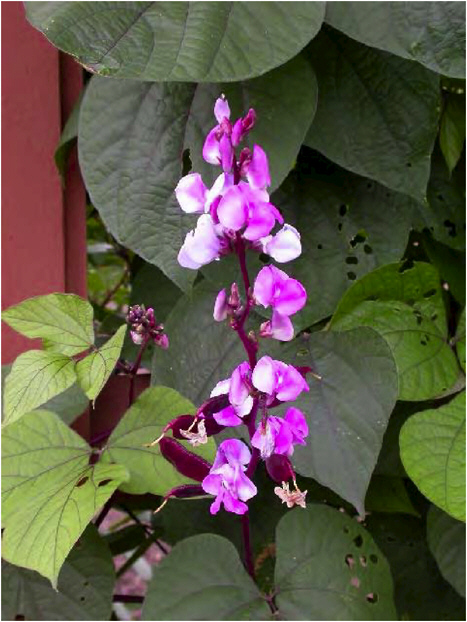
In Asia lablab is a popular foodstuff. For rural peoples of southern India, for instance, its pods and seeds supply much of the daily protein. The strange thing is that lablab is African. Stranger still is the fact that it is almost unknown to present-day Africa. Yet this local counterpart of the soybean possesses qualities that could prove exceptionally valuable for nutritional well-being, rural development, and environmental stability almost throughout its continent of origin. Glenn Kopp/Missouri Botanical PlantFinder mobot.org/gardeninghelp/plantfinder
grain is suitable even for export, and they dream of sending shiploads of it to Asia like a southern-hemisphere soybean. Commercial crops of ‘Koala’ have yielded up to 2 tons of grain per hectare (without irrigation but under otherwise good conditions). Trials show that on average it produces 20 percent more grain per hectare in subtropical Australia than does mung bean.
Beyond all its uses for food and fodder, the plant can be used advantageously to provide organic matter and fix soil nitrogen; thereby improving subsequent crop yields in a cheap and environmentally friendly manner. It is not inconceivable that it could become an essential part of certain sustainable farming systems.
Taken all round, lablab might seem not too far removed from some botanical diamond in the rough. And that appearance is not untrue. Moreover, it is remarkably adaptable and so useful that it can be employed without waiting for the ultimate benefits that will come from agronomic cutting and polishing.
PROSPECTS
There seems no reason why the refined kitchen-garden types as well as the coarse field types (not to mention specimens combining qualities of each) should not take off vigorously in Africa. Indeed, they could be employed widely and with due dispatch. At present, Africa does not use the vegetable type to any great degree, but the forage types are already there to provide a foundation for progress and understanding. Moreover, smallholder farmers are beginning to use legumes in rotations, and multipurpose legumes like lablab are promising for land restoration and sustainable agricultural systems in most parts of the continent.
Within Africa
Strains of lablab capable of thriving under the diversity of conditions occurring across most of Africa can be found but the more refined types for food use probably need to be selected for specific sites.
Humid Areas Excellent. The plant thrives under high heat and humidity. However, in hot, moist climates certain fungal diseases are a concern.
Dry Areas Excellent. A well-established lablab plant’s root system often penetrates into water sources more than 2 m deep, permitting luxurious growth to persist long after the rains have ended and the surface soil is parched. For this reason, the crop can have a long production season and can provide food, fodder, and soil protection long after other herbaceous species have dried and died.2
Upland Areas Excellent. Lablab is already grown in the eastern African highlands. And in Zimbabwe it is doing very well at an altitude of 1,500m.3
Beyond Africa
Excellent. The plant is already widespread throughout the tropics, but it offers so many uses, so many varieties, and such wide adaptability that it has by no means reached its potential even in places like South India that know it best. The plant also has potential in subtropical and warm temperate regions worldwide, as has been demonstrated in eastern Australia in recent decades.
USES
Lablab can be put to so many overlapping uses that it is hard to summarize them clearly. A selection of examples follows:
Pods The young pods of the culinary type are popular vegetables in India, Indonesia, the Philippines, and elsewhere in the Asian tropics. They are eaten like green beans or snow peas.
Seeds In India the dried seeds are split like lentils and used in making dhal, the major protein source for millions of the populace. They are also sprouted, soaked in water, shelled, boiled, and smashed into a paste, which is fried with spices and used as a condiment. Dried seeds are also fed to livestock.
In Africa, lablab seeds are cooked in any of the ways commonly used for beans: boiled with maize, ground and fried, or added to soups. It is included in the traditional Kikuyu dish called imo, a mixture including such things as maize, beans, bananas, potatoes or green vegetables all boiled down into a tasty paste. In Egypt lablab seeds are sometimes substituted for broad beans in preparing the fried bean cake called tanniah.
Leaves The leaves are occasionally used as a potherb, although they are said to be less palatable and less popular than cowpea leaves.
Environmental Protection As mentioned, the field-type lablabs are effective for land restoration.4 They can be grown alone, interplanted with field crops, or included in crop rotations. They make a good cover crop in
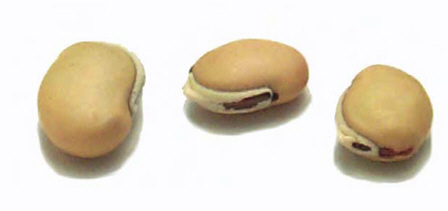
With a crude-protein content of 20-28 percent, lablab seeds are worth considering in malnutrition prevention programs. In addition the amino acids are moderately well balanced, with an especially high lysine content, which means that they help balance out diets that are heavy on the staples. The seeds are also a good source of energy. (Lori Alden, The Cook’s Thesaurus)
coffee and coconut plantations, fruit orchards, and more. They are often planted as a second crop in rice fields after the harvest of paddy. In each case, they may be grazed after the pods have been harvested for food.
Forage Lablab is so fast growing that grazing or haymaking can begin 7 to 10 weeks after sowing. The plant withstands severe cutting. Cattle, sheep, goats, and pigs eat it avidly. Fodder yields of 5 to 10 tons per hectare are said to be normal. Hay from the whole plant (if cut at a young, leafy stage) is nutritionally comparable to alfalfa, although somewhat less digestible. When chopped, the plant produces good silage. Incorporating living lablab into grass pastures improves the quality, palatability, and digestibility.
Other Uses Nurserymen in the United States sell lablab as an ornamental. Certain varieties of what they call “hyacinth bean” are renowned for their long, bright, showy, purple blossoms. In a very clever initiative, the Government of Guyana encourages city dwellers to grow ornamental varieties along fence lines to form hedges that provide protein for the family table as well as a pretty prospect for the passerby. It is notable that lablab is suited to urban use.
NUTRITION
Comparing the crude-protein contents of lablab and dried seeds of common legumes shows that, at 20-28 percent, lablab is exceptionally
nutritious. In addition, amino acids are moderately well balanced, with especially high lysine content (6-7 percent), which means that lablab seeds complement cereal diets well. However, methionine deficiency (0.65 percent in one count) is reported, so in this regard the protein profile is not perfect.
The seeds, in addition to contributing relatively good quality protein, are also a good source of energy. However, as with many other pulses, the lablab seed contains antinutritional factors, which must be taken into account (see later).
The leaves also are rich in protein (up to 28 percent) and, at least among legumes, they are one of the best sources of iron (155 mg per 100 g of leaves, dry weight). Whole-plant protein ranges from 14 to 22 percent, depending on the season and the lushness of the plants.
HORTICULTURE
The lablab plant looks somewhat like cowpea and can be grown in a like manner. Although in the tropics the plant persists two or three years (if well watered) it mostly acts as an annual. When grown for food, lablab is usually sown in rows, either alone or mixed with crops such as maize, beans, potatoes, peas, and bananas. Normally, the seeds are directly planted into the soil of the field, kitchen garden, or fence line where the crop will grow. Germination is rapid, but establishing a good stand requires continuous soil moisture. Typically, several seeds are sown in each hole and the seedlings are left unthinned. The resulting dense growth tends to suffocate weeds.
Lablab is sometimes sown together with annuals such as sorghum and cotton. It suppresses weeds, helps protect exposed land, and contributes food after the primary crop has been harvested. It is normally left to its own devices, although weeding during the establishment phase may be necessary. The climbing varieties often support themselves on the convenient stems of taller plants, such as maize or sorghum.
The growth period can vary from approximately 75 to 300 days. In India, Co-1 begins to bear pods approximately 60-65 days after sowing and continues for 90 to 100 days. Other improved cultivars such as Co-6, Co-7, and Co-8, which can be grown year-round, produce pods 60 days after sowing and continue up to 120 days in South India. Mature seeds are normally harvested 150 to 210 days after sowing, but this depends upon the cultivar and the season of sowing (i.e. daylength regime). In equable tropical climates and with good management the plant can yield continuously for two or three years if desired.
Lablab nodulates easily—either with its specific rhizobia or with the cowpea-type, which occurs widely in tropical soils.
Compared with cowpea, the plant is more resistant to root diseases and more productive. In fact, certain types reportedly produce twice the herbage of cowpea. However, lablab stems are stronger, more fibrous, and less palatable than their cowpea counterparts.
HARVESTING AND HANDLING
When grown as a vegetable the green pods are picked by hand when they reach a reasonable size, usually when the seeds are about three-quarters formed. The plants are subsequently picked at intervals of several days, the pods being cleaned, graded for size, and packed in baskets for hauling to market. In the heat of the tropics both the green pods and the immature beans have relatively short shelf lives. The average yield of green pods in India has been recorded as varying from 2.6 to 4.5 tons per hectare.
Species of the genus Lablab tend to hold their seeds; they are less likely to dehisce immediately on maturity than many other legumes. Thus shattering is not a huge problem, and when grown for seed, lablab can be mechanically harvested. After drying in the sun the mature pods are beaten (using sticks or machines) to separate the dried seeds.
When grown as a forage, lablab can provide both high seed yields and high biomass yields. In experimental trials in northern Australia, four accessions yielded over 4 tons of dry seed per hectare.5 One of these, a commercially registered variety called ‘Highworth,’ consistently provides over 1.5 tons of seed per hectare in commercial cultivation as well as 5-11 tons (dry weight) of forage. The forage has a protein content up to 22 percent and production is fast. In Queensland, lablab pastures are ready for grazing 60 to 80 days after planting, and optimum stocking with cattle is about 1.5 animals per hectare.
LIMITATIONS
Despite resisting attacks from Mexican bean beetles and other insects that devastate common bean, lablab is not immune to pests. Insects of the leaves, pods, flowers, and soil have proven serious in northern Australia, for example. And in Africa the neat little holes drilled by bruchid beetles are often seen in lablab seed.
Similarly, although generally reported to be fairly resistant to disease, lablab is not immune from attack. Some cultivars, for instance, have proven susceptible to bean rust and fungal rot.
Root-knot nematodes also can afflict this crop, sometimes seriously. And, in some African areas, the parasitic weed striga sucks the plant’s juices and energy with as much gusto as on other crop species.
The mature seeds (especially dark-colored ones) must be boiled before eating. Like most soybeans, they contain a trypsin inhibitor that is broken down by heat as well as a cyanogenic glucoside that is leached out by the cooking water.
At least in theory a vigorous plant like this carries the possibility of invasiveness. However, there are no reports of serious problems in this
regard. Indeed, lablab’s palatability to cattle, goats, and other herbivores helps lessen the risk of it becoming a problem.
Lablab provides a very dense cover but not right on the surface of the soil. Beneath the canopy there is enough space for water to wash through and (especially on sloping land) cause erosion.
NEXT STEPS
Though moderately well known as a resource for tropical agricultural systems, lablab is far from being used to its full potential. For purposes of improving the situation specifically in Africa, one can conceive of many activities, including the following.
Africa-Wide Thrust Because of its many outstanding qualities, the plant is recommended for immediate use in tropical Africa as a pulse, green vegetable, green manure, and forage. This is worthy of a coordinated—or at least an international effort.
Farmer Survey From the start, it would be wise to identify who might grow lablab and why. It might take off not as a food crop but as a dual-purpose plant—for food-and-forage, perhaps, or food-and-soil fertility. Finding local preferences might best be achieved with farmers. The crop will be new to them but their ideas about preferred varieties and uses would come out as the research progresses.6
Also from the start it would be good to identify not only farming-system opportunities but also taste-testing components (leaves, pods, grain) and then evaluation of key types of plants for systems. Africa does not use the vegetable type to any great degree. But, as noted, the forage types are already there and smallholder farmers have begun using multipurpose legumes in rotations in recent years.
Seed Supply In many local African areas where lablab could be beneficial, there is no way people can get started for the sole reason there is no source of seed. Rural NGOs, companies, farmer organizations, and others involved in seed production and supply should adopt lablab. With this dual-purpose legume getting farmers to use the seed should not be a problem. What is needed is to identify the best seeds for the locality, get them farmer-tested, then encourage on-farm seed production and storage for subsequent seasons.
In a related vein, key work is needed to identify core seed collections. A

The forms of lablab that have been developed as green vegetables are promising profit-makers, producing huge yields (up to 7.5 tons per hectare) of pods that look and taste good, and producing them quite quickly (4 months). In addition, the dry seeds are becoming commercially important in Australia, where it is claimed that they are even suitable for export, like some kind of southern-hemisphere soybean. (J.H. Wildin)
recent paper describes the available germplasm and its diversity.7 One of the world’s largest lablab-seed collections is at the International Livestock Centre in Addis Ababa. And a seed collection in Kenya was the source of the lablabs now widely used in Australia.
Sustainable-Agriculture Projects Now is the time to incorporate lablab into sustainable-agriculture projects Africa-wide. In particular, trials are needed to identify best varieties and best practices to use this legume in smallholder farmings systems. One example: integrating lablab within cereal-based systems such as maize or rice, which could reduce the need for inputs of inorganic fertilizer.
It should be recognized that legumes generally add little organic matter to soils. Their litter is broken down too easily and too quickly. In this regard, lablab is no exception. Nonetheless, trials are needed, and they should incorporate more than just this species. Mucuna, perennial soybean, jackbean, and other potential competitors should be included for comparison. Some will be better than lablab in some situations. Mucuna, for example, is less susceptible to insects than lablab, so in a humid environment it will probably be a better choice for producing green manure.
Demonstrations To overcome farmers’ reluctance to adopt any new practice, demonstrations involving lablab should be established across Africa. These might well be established on farms, allowing select farmers to demonstrate and sell the resulting seeds to their neighbors. An alternative approach is to use participatory on-farm lablab research, focusing on agronomy and taste-tests for grain and vegetable use.
Horticultural Development Despite lablab’s widespread occurrence, little agronomic improvement has been reported. There is need for research into genetics and breeding for faster-maturing varieties with better and more dependable yields as well as for improved resistance to pests and diseases. One target might be lablabs that mature their pods or seeds uniformly together, making them attractive for commercial harvest. Another target might be lablabs that mature over time, so as to supply pods and leaves to the family diet for weeks or months.
Of course, before embarking on plant improvement researchers should locate the types farmers have selected over the past 3,000 years. The diversity in the existing landraces is already remarkable.
Once seed types are selected, then research and testing of management practices, including fertilizer requirements, time of planting, and plant populations for specific products (seed, forage, hay, or green manure) should be done. The impact on soil nitrogen and soil organic matter should be included, too.
Forage We think that farmers will jump at the chance to grow lablab when they see how productive it is and how much their livestock love it. But in developing forage types, attention should be given to several special features: dry matter yield and its distribution through the year, palatability and feeding value, and compatibility as an intercrop with crop species to improve stover/lablab grazing quality.
Food Technology Research into the feeding value of the seeds for humans and livestock (not overlooking poultry and pigs) is also needed. Methods to reduce or remove the antinutrition factors, either by processing or by plant breeding, are needed. Such aspects as processing the seeds into
protein concentrates for livestock, poultry, and human foods, and the functional and chemical properties of the protein, similarly deserve attention.
Commercial Operations Although the lablab now finds its greatest use in small-scale agriculture, its potential for large-scale mechanized production of protein seems impressive. Lablab thrives in the monsoonal tropics, a region where soybean fares poorly. The ‘Highworth’ variety— which is grown in Australia but actually hails from Kenya—shows that the crop can be suited to mechanical harvesting and production. Research along these lines is needed for possible large-scale rural development projects.
Torture Tests Because of this extremely adaptable species’ potential to help marginal environments, varieties should be further tested for their outer limits of tolerance to aridity as well as to acid-, alkaline-, saline-, high-alumina-, and nutrient-deficient soils. Production levels will fall off in such areas but the value to human life might nonetheless be all the greater.
SPECIES INFORMATION
Botanical Name Lablab purpureus (L.) Sweet
Synonyms Dolichos lablab L. and Lablab niger Medik8.
Family Leguminoseae. Subfamily: Papilionoideae.
Common Names Almost every country (indeed every Indian province) uses a different common name. A few in widespread use are:
English: bonavist, chicharos, chink, Egyptian bean, Indian bean, hyacinth bean
India: seem, sim, pharao, val, anunula, ararai, chapprada, chikkudu, field bean, mochair, parta
East Africa: fiwi
Sudan: lubia bean, kashrengeig
Ethiopia: amora-guaya
Philippines: agaya, apikak, batao, hab
Indonesia: kerana
Thailand: tua nang
Malaysia: kara-karci
Myanmar: pegyi
Description
The wild germplasm seems to be always perennial, but over the past few thousand years the landraces have been selected to be mainly annuals. Thus, most lablab landraces today are true annuals, but they will perennate if their seed production is curtailed.
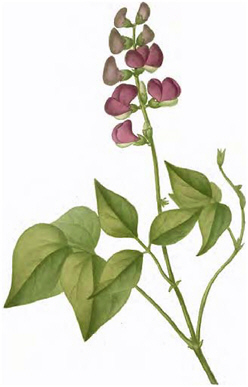
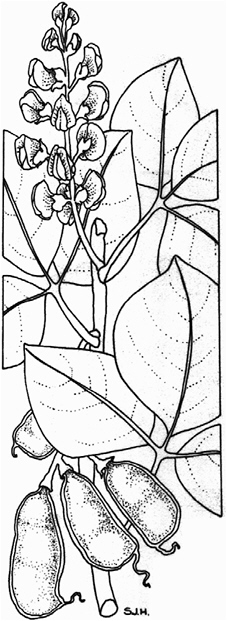
Varieties differ in many characteristics: The growth habit may be bunch, spreading, or climbing. The flowers may be white, purple, pink, or blue. The pods may be short and half-moon shaped or long and thin. The seeds, although usually brown or black, may be cream, white, red, or speckled. The pods contain 3 to 6 seeds and are up to 15 cm long. They are generally oblong, curved and flat, and have wavy margins and pronounced beaks. Each seed has a prominent white hilum.
The plant is vigorous and the climbing type can grow 5 to 6 m tall. In most varieties the inflorescence is an erect, long stalked raceme held high above the foliage.
Distribution
These days, lablab is found in warm regions worldwide.
Within Africa. Lablab’s wild ancestor grows in hilly areas and coastal lowlands in southern, eastern, and western Africa. Its beans are small and apparently are not eaten. The cultivated form is known in Egypt, Sudan, and both East and West Africa.
Beyond Africa Lablab is most widely grown in South Asia and Southeast Asia (for instance, Malaysia, Indonesia, the Philippines, and Papua New Guinea). It is also known in the Caribbean, Central America, and the tropical zones of South America.
Horticultural Varieties
Although there are few formal varieties, lablab occurs in two botanical types. The garden type is twining and is grown on supports. It is late maturing and is employed mainly as a green vegetable. The field type is erect and bushy. It matures earlier but cannot be used as a green vegetable because even the green pods are fibrous and have an unpleasant smell. Over 200 genotypes are recognized. Despite the wealth of available germplasm, only a handful of registered commercial varieties are known in the countries that now cultivate the lablab.
Environmental Requirements
This is such an adaptable species that there are varieties for most kinds of conditions and locales. Speaking generally, however, the following are its
environmental requirements.
Daylength The plant is sensitive to daylength. Most genotypes require short days to initiate flowering, but long-day cultivars exist as well.
Rainfall Lablab is suitable for growing as a rain-fed crop where the average annual rainfall is 600-900 mm. In India it is successfully grown commercially, with supplementary irrigation, in areas with a rainfall as low as 400 mm. It requires adequate moisture during the early stages of growth, after which its deep roots enable it to exploit residual soil moisture. When grown as a market-garden crop for the production of the immature pods it requires watering or frequent rains throughout its growing period. Seed production can be a problem in regions with high humidity.
Altitude Locations up to and beyond 2,000 m have proved suitable for economic production, at least in equatorial nations such as Papua New Guinea.
Low Temperature For optimum results, a warm, equable climate is required, with average temperatures between 18 and 30°C. Many lablab types withstand frost for a limited period, although it is liable to cause leaf damage. Lablab is both self- and bee-pollinated, and cooler weather at flowering time can affect seed-set.
High Temperature Most—perhaps all—cultivars tolerate exceptional heat.
Soil The plant survives on a wide variety of soil types, provided they are well drained. It is reported to do particularly well on sandy loams that are slightly acid (pH 6.5), but in Brazil it thrives on heavy clays that are quite acid (pH 5.0). It cannot tolerate waterlogged or salty conditions. Little is known of any fertilizer requirements, but the plant reportedly responds to phosphate and potash. In experiments at Beltsville, Maryland, it grew well in soils ranging from acid to alkaline (pH 4.4 to 7.8) as well as in aluminous soils deadly toxic to most crops because of their level of soluble aluminum.9