
4
Data Analysis and Fit-Test Panels
To establish an effective face panel, the National Institute for Occupational Safety and Health (NIOSH)-sponsored Anthrotech study performed a number of different analyses on the data it collected. This chapter reviews how the study analyzed the dataset and critiques those analyses.
WEIGHTING OF DATA
As a result of variability in sample collection, the number of subjects surveyed by Anthrotech in each demographic category was not in the correct proportions to accurately represent the demographic distribution of the U.S. workforce. Therefore, the first step in Anthrotech’s data analysis was to weight each sample cell (Table 4-1). Although it was necessary to weight each sample cell, it is unclear if choosing to weight the data against the entire U.S. workforce, versus the population of current and potential respirator-wearing workers, may have an impact on the final distributions.
Using these weights as multipliers against the data in each cell, the Anthrotech investigators then derived basic summary statistics for each of the dimensions measured and provided summary tables of those analyses. Based on these statistics, Anthrotech developed revised face panels utilizing the methods that had been developed for the earlier Los Alamos
TABLE 4-1 Sample Weights
|
Race |
Male Age Group |
Female Age Group |
||||
|
18-29 |
30-44 |
45-66 |
18-29 |
30-44 |
45-66 |
|
|
White |
1.516531 |
1.070699 |
1.473671 |
1.502991 |
1.881647 |
2.407866 |
|
African |
||||||
|
American |
0.835324 |
0.424599 |
0.312164 |
1.000204 |
0.324416 |
0.181680 |
|
Hispanic |
0.808564 |
0.691170 |
0.933218 |
1.124507 |
1.823606 |
1.150489 |
|
Other |
2.332153 |
1.338566 |
0.741441 |
0.597626 |
0.566132 |
0.265141 |
|
SOURCE: Anthrotech, 2004. |
||||||
National Laboratory (LANL) face panels (Hack et al., 1974; Hack and McConville, 1978). The proposed face panels are meant to represent the current U.S. workforce, and not the subset of young men and women who belonged to the U.S. Air Force in the early 1970s. However, without additional data comparing the outcome of the LANL face panel and the proposed face panel, including quantitative fit tests, it is not possible for the committee to determine if the updated target population was an improvement and appropriate given the demographics of the current workforce too broad.
Data Stratification
Data stratification is a useful sampling technology that uses information about the reference population to conduct sampling in a more efficient manner. The reference population is broken up into strata based on auxiliary variables (e.g., age, gender, ethnicity, and race), and a random sample of a certain size is obtained from each of the strata. The sample number can be determined based on issues of variability and cost—a problem of optimal design (Neyman, 1934). Typically, and assuming that information about variability within strata is available, the larger the stratum variance, the larger the sample size from that stratum. Stratified sampling works best when strata have small (internal) variability while variability across strata is large by comparison.
In the survey conducted by Anthrotech, the distribution of subjects based on demographics was not known until after the subjects were sampled, thus the sampling plan used a poststratification method. That is, subjects were assigned to the various strata only after they had been sampled and measured. This implies, for example, that the number of
subjects per stratum is not known until after all the subjects are sampled. The initial goal of sampling exactly 166 subjects in each of the 24 strata using 3984 subjects, although difficult to accomplish, could have been attained by seeking out specific groups (Zhuang, 2001). Nevertheless, poststratification provides a way to utilize the information that was collected. To adjust for undersampling or oversampling in some of the strata, as compared to the target population, stratum-specific weights are used and the 24 cells become “adjustment cells.” In the NIOSH-sponsored Anthrotech study, the weights are computed as the relative frequency of a given stratum in the census (Ni/N: where Ni is size of ith stratum and N is total count over all strata) divided by a relative frequency of the same stratum (ni/n: where ni is the sample count in ith stratum and n is the sum of counts over all strata) in the study (Anthrotech, 2004). Under the assumption of random sampling within strata, the weighted estimators of population means, for example, are unbiased. As the Ni and N counts for the target population are unavailable, the investigators instead used counts obtained from the 2000 U.S. Census for the U.S. population in each stratum, not for the U.S. workforce. Because “The primary purpose of the study is to build an anthropometric database that can be representative of the nation’s workers who wear, or have the potential to wear, respirators,” it is unclear if it is appropriate to calculate weights using data from the U.S. Census. For the purposes of this analysis and critique, and absent any better dataset, the committee has chosen to proceed under the assumption that the default target population was the U.S. workforce. However, due to the absence of a more appropriate dataset, it would likely have been in the study’s best interest to establish a dataset that was directly proportional to the workforce population that should be wearing face masks.
Giving each of the members of stratum i the weights wi computed as above, allows the weighted average to be expressed as so that the weighted average can then be written as an unweighted average, where j is the jth person in the ith stratum. This stratified weighted average produces unbiased estimators of population parameters.
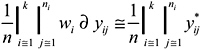
Nevertheless, as a result of the way the researchers implemented the sampling plan, the committee can not guarantee that the various population estimators are unbiased. Specifically:
-
The sample needs to be a random sample (though not necessarily with equal probabilities in each stratum). The survey did not use random sampling. Rather, it was a convenience sample with subjects that were then assigned to each stratum. This approach has two important consequences.
-
Under poststratification (as opposed to stratification) the estimators are no longer unbiased unless ni/n = Ni/N for each strata
-
Even if ni/n = Ni/N for all strata (i), it is unclear whether this “reference” population is similar to the “target” population. Therefore the assumption of there being no bias in the resulting estimators of population parameters can not be guaranteed.
-
-
When calculating weights, the researchers show that the weights were calculated within gender (Zhuang and Bradtmiller, 2005). For example, when calculating the weight for white men aged 18-29, the researchers provided ni/n = 271/2,543 and Ni/N = 14,281,917/88,336,773. The ratio of these two fractions then gives the weight = 1.517127. (These fractions, and hence the weights, are computed from the following sample and reference population information, should ni/n not be equal to 271/3,997 and Ni/N = 14,281,917/178,189,001 the total sum used instead of gender sum used). This obviously has a significant effect on the size of the weights and the remaining analyses. There does not seem to be any reason given for deciding to do this. If instead they had decided to calculate weights within age groups, for example, the weights would have been different. This is illustrated in the tables that follow (Tables 4-2 through 4-7).
TABLE 4-2 Sample Size by Race
TABLE 4-3 The Population
TABLE 4-4 The Sample Fraction Based on Gender-Specific Total
|
Race |
Male Age Group |
Female Age Group |
||||||
|
17-29 |
30-44 |
45-66 |
Total |
17-29 |
30-44 |
45-66 |
Total |
|
|
White |
0.106567 |
0.240267 |
0.190720 |
0.537554 |
0.103851 |
0.133425 |
0.119670 |
0.356946 |
|
African |
0.039717 |
0.100275 |
0.109350 |
0.249312 |
0.035076 |
0.146492 |
0.223521 |
0.405089 |
|
American |
||||||||
|
Hispanic |
0.060952 |
0.071569 |
0.029493 |
0.162013 |
0.036451 |
0.024759 |
0.025447 |
0.086657 |
|
Other |
0.009438 |
0.018482 |
0.023201 |
0.051121 |
0.035763 |
0.044704 |
0.070839 |
0.151307 |
|
Total |
0.216673 |
0.430594 |
0.352733 |
1.000000 |
0.211142 |
0.349381 |
0.439477 |
1.000000 |
|
NOTE: Data contained in this table is a ratio of Table 4-2 sample sizes for each category to total sample aggregate. SOURCE: Personal communication, Z. Zhuang, NPPTL, July 13, 2006. |
||||||||
TABLE 4-5 Population Fraction Basedon Gender-Specific Totals
|
Race |
Male Age Group |
Female Age Group |
||||||
|
17-29 |
30-44 |
45-66 |
Total |
17-29 |
30-44 |
45-66 |
Total |
|
|
White |
0.161676 |
0.256934 |
0.281169 |
0.699778 |
0.155980 |
0.252180 |
0.287951 |
0.696111 |
|
African American |
0.033189 |
0.042594 |
0.034139 |
0.109922 |
0.035059 |
0.047492 |
0.040581 |
0.123132 |
|
Hispanic |
0.049303 |
0.049486 |
0.027534 |
0.126322 |
0.040961 |
0.045120 |
0.029256 |
0.115338 |
|
Other |
0.022019 |
0.024749 |
0.017209 |
0.063977 |
0.021358 |
0.025291 |
0.018769 |
0.065419 |
|
Total |
0.266187 |
0.373763 |
0.360051 |
1.000000 |
0.253359 |
0.370083 |
0.376558 |
1.00000 |
|
NOTE: Data contained in this table is a ratio of Table 4-3 population for each category to total population aggregate. SOURCE: Personal communication, Z. Zhuang, NPPTL, July 13, 2006. |
||||||||
TABLE 4-6 Weighting Factors Based on Gender-Specific Totals
TABLE 4-7 Corrected Weighting Factors Based on Population Totals
|
Race |
Male Age Group |
Female Age Group |
||||||
|
17-29 |
30-44 |
45-66 |
Total |
17-29 |
30-44 |
45-66 |
Total |
|
|
White |
1.1822 |
0.8332 |
1.1492 |
1.0143 |
2.082 |
2.6227 |
3.338 |
2.7033 |
|
African |
0.6522 |
0.3307 |
0.2428 |
0.3436 |
1.3828 |
0.4484 |
0.2522 |
0.4213 |
|
American |
||||||||
|
Hispanic |
0.6289 |
0.5385 |
0.7234 |
0.6075 |
1.5564 |
2.533 |
1.5914 |
1.8449 |
|
Other |
1.8167 |
1.0424 |
0.5764 |
0.9752 |
0.8308 |
0.7853 |
0.3682 |
0.5993 |
|
Total |
0.9573 |
0.6764 |
0.7954 |
0.7792 |
1.6633 |
1.4683 |
1.1877 |
1.3862 |
|
SOURCE: (Personal communication, Z. Zhuang, NPPTL, July 13, 2006). |
||||||||
As Tables 4-6 and 4-7 demonstrate, there are significant differences in the weights, depending whether the data are corrected or not. For example, the male weights in Table 4-7 are roughly 3/4 of the weights used in the Anthrotech report; the exact fraction is 0.7792 (1.1822/1.517127) for white men in the 18-29 age group. The weights for women also changed by a factor of 1.3862. Thus, using the “corrected” weights (Table 4-7) could have a great impact on all subsequent analyses, and therefore raises a concern about the analyses presented in the NIOSH-sponsored Anthrotech study. In particular, since one of the main arguments for updating the LANL face panel relies on the high proportion of the population no longer covered by the LANL face panel when fitting the weighted Anthrotech data into it, it remains to be seen whether this conclusion holds when using the revised set of weights.
The set of weights used for the data summaries and statistical analyses were computed within gender, and no discussion supporting this choice was presented. Instead, the set of weights given in Table 4-7 should have been used. Although it is conceivable that similar conclusions will be reached, the committee strongly believes that NIOSH should rework all the data summaries and statistical analyses using the set of weights provided in Table 4-7.
Conclusion
The demographic makeup of the United States workforce has, and will continue to become, more diverse, resulting in an increased range of facial dimensions.
Recommendation 4-1: Ensure Appropriate Representation of Demographics Groups.
NIOSH should benchmark its sample population against the current and future United States workforce that should be wearing respirators, to ensure adequate representation of demographic groups on the panel (e.g., age, gender, race, and ethnicity).
ESTABLISHING THE FACE PANEL
To develop the proposed respirator fit-test panels, NIOSH contracted with Anthrotech “to assess and refine the LANL fit-test panels,” relying on the same facial dimensions and utilizing methods similar to those used by the original LANL face panel designers (Zhuang, 2001). The rationale for choosing to assess and refine the LANL face panels, using the same parameters, and not consider using strategies that have been developed since the 1970s to develop the updated face panels was not clear to the committee. The NIOSH-sponsored Anthrotech report notes, however, that, unlike the LANL face panel, the proposed face panel was not confined to a strictly rectangular arrangement of cells (Anthrotech, 2004). They found that, in offsetting some of the cells, they were able to achieve a greater coverage of the target population. However, there was no discussion of whether the number of boxes is appropriate, or whether there may be problems of fit for persons near the edges of the boxes.
The updated full- and half-face panels proposed by the NIOSH-sponsored Anthrotech study were based on the menton-sellion length and bizygomatic breadth facial dimensions. The full-face panel accommodates 96.2 percent of the study population—that is, 96.2 percent of the nearly 4,000 workers recruited for the study have faces with a bizygomatic breadth and menton-sellion length that fall into one of the boxes of this panel (Figure 4-1). The revised half-face panel, which relies on menton-sellion length and lip length, accommodates 97.2 percent of the study population (Figure 4-2). As was done in the development of the LANL face panel, the NIOSH-sponsored Anthrotech study populated the individual cells so that the cells that represent larger percentages of the study population—the middle cells—were assigned more subjects than
the cells representing smaller percentages of the study population. Further, the individual cells were populated so that men and women were distributed nearly equally (13 men and 12 women), and no cell was allowed to be populated with only one member.
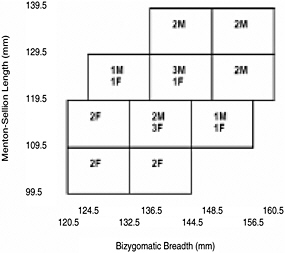
FIGURE 4-1 Revised full-face panel.
SOURCE: Anthrotech, 2004.
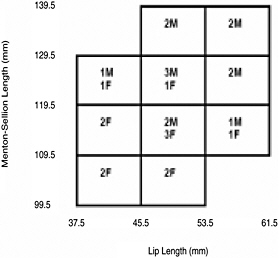
FIGURE 4-2 Revised half-face panel.
SOURCE: Anthrotech, 2004.
Sample Size
Concerns over the sample sizes within individual cells are related to the variability of facial characteristics within each cell: the greater the variability, the less information a sample of given size can provide about those faces. Thus there are competing objectives. It is better to have a good fit for a large number of workers than for a smaller number, which argues for more panel members in the most-populated cells. However, the greater variability in the smaller cells required larger samples of faces to give the worker the same degree of respiratory protection as workers in the more homogeneous cells. Equal number in cells seems a reasonable compromise between these competing objectives.
In testing the fit of masks for certification, NIOSH assigns test subjects to cells based on their facial dimensions as measured at the time of the fit test. NIOSH staff members told the committee that they rely on a small pool of volunteers who are geographically proximate to their laboratory in Pittsburgh, Pennsylvania, when performing certification tests. Although time efficient and cost-effective, this procedure introduces biasesas the small panel of volunteers is not representative of the target populationand should be discontinued. Instead, subjects must be selected according to a sound statistical sampling design.
Differences in the Proposed Face Panel and the LANL Face Panel
Anthrotech’s analysis of the data demonstrated significant differences between the new sample and the 1972 U.S. Air Force data that was used to develop the LANL face panel (Hack et al., 1974). An overlay of the proposed NIOSH-sponsored Anthrotech study panel and the LANL face panel shows a clear shift to the upper-right quadrant, representing larger faces (Figure 4-3). This trend is also observed in an analysis of the facial dimensions (Table 4-8). Further, Figure 4-4 shows the revised data for the face widths and face lengths from the NIOSH-sponsored Anthrotech study’s 4,000 subjects plotted against the bivariate panel that LANL constructed from the 1972 survey. Of those surveyed, 15.3 percent would not be included in the LANL face panel, mostly those individuals with larger faces. However, the shift of the face panel toward individuals with larger faces comes at the expense of smaller-faced individuals, including many minority populations.
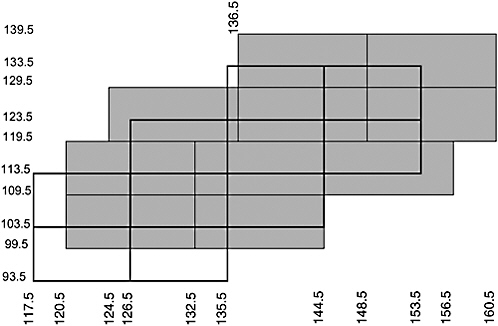
FIGURE 4-3 Revised Anthrotech panel superimposed over LANL panel for full face pieces.
SOURCE: Anthrotech, 2004.
TABLE 4-8 Differences in Key Measurements Between LANL and NIOSH Surveys
|
|
|
Men |
Women |
||
|
Facial Dimension |
Survey |
Mean(mm) |
Std Dev |
Mean (mm) |
Std Dev |
|
Menton-Sellion |
LANL |
120.3 |
6.1 |
106.3 |
6.1 |
|
Length |
NIOSH |
122.7 |
7.1 |
113.4 |
6.1 |
|
|
Difference |
2.4 |
|
7.1 |
|
|
Bizygomatic |
LANL |
142.3 |
5.2 |
129.0 |
5.8 |
|
Breadth |
NIOSH |
143.5 |
6.9 |
135.0 |
6.5 |
|
|
Difference |
1.2 |
|
6.0 |
|
|
Lip Length |
LANL |
52.3 |
3.8 |
43.8 |
4.2 |
|
|
NIOSH |
51.1 |
4.2 |
48.0 |
4.0 |
|
|
Difference |
1.2 |
|
4.2 |
|
|
SOURCE: Zhuang, November 3, 2005. |
|||||
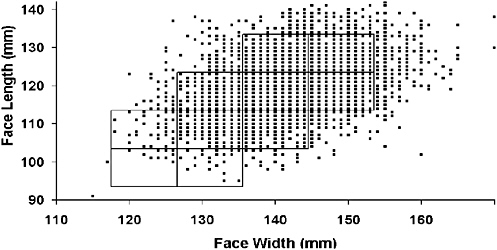
FIGURE 4-4 Distribution of facial sizes against LANL panel boxes. Face length is menton-sellion length and face width is bizygomatic breadth.
SOURCE: Adapted from (Anthrotech, 2004).
Conclusion
The proposed NIOSH-sponsored Anthrotech face panel selects larger dimension faces at the expense of the smaller faces currently included in the LANL face panel, even though some of these small faces still make up a considerable proportion of the workforce.
Recommendation 4-2: Include Large and Small Faces in Panel.
NIOSH should develop an expanded anthropometric face panel that includes the larger-sized faces described in the NIOSH-sponsored Anthrotech study, while retaining the small-sized subjects from the LANL face panel. This may require adjusting the total number of subjects in the face panel.
VALIDITY OF THE PROPOSED FACE PANELS
To evaluate the validity of the new face panel, NIOSH compared the proposed face panel to the data collected in the 2002 Civilian American and European Surface Anthropometry Resource (CAESAR) study1 (CAESAR, 2002). This comparison revealed that the proposed panel accommodated 98 percent of the population included in the CAESAR. However, there was no discussion of how well persons near the edges of the cells may be fitted, nor could there be, since no fit data were collected.
Manufacturers in the United States have also conducted analyses of the anthropometric face panels (Colten, July 10, 2006; Frund, July 10, 2006). Notably, the Minnesota Mining and Manufacturing Company (3M) found that while the LANL face panel accommodates most of the U.S. respirator population, it is less inclusive of foreign populations. This is particularly true in the case of citizens from Asian countries and highlights a potential problem with the proposed face panels.
However, for U.S. workers, at least, the CAESAR data and the comparisons to the LANL face panel imply that the proposed face panels accommodate a larger percentage of the workforce than do the LANL face panels. In this limited sense, at least, it would seem that the proposed face panels are an improvement over the LANL face panels.
Conclusion
The proposed NIOSH-sponsored Anthrotech face panel is likely to be more representative of the current United States workforce than the LANL panel, but information is not available to determine the extent to which the new panel provides a better fit for that workforce.
Recommendation 4-3: Perform Studies to Compare the Proposed Face Panel to the LANL Face Panel.
NIOSH should perform a study in which it compares the range of quantitative fit provided for specified respirators on subjects representing the LANL face
panel and subjects representing the proposed NIOSH-sponsored Anthrotech bivariate face panel (adjusted in accordance with Recommendation 4-2).
THE IMPACT OF FACE DIMENSION ON FIT
Understanding and well-representing various anthropometric features of the U.S. workforce are essential to developing appropriate anthropometric face panels, which in turn will ensure that NIOSH-certified respirators are capable of fitting a large percentage of workforce that should be wearing a respirator. In other words, the ultimate test of a face panel is not only that it represents the facial measurements of the workforce, but that it ensures that only those respirators that are likely to fit the greatest number of people are approved.
The committee heard anecdotal evidence from a respirator fit-test expert that he and his staff are capable of fitting nearly all wearers to either a half- or full-face respirator, provided that one or more brand and size of NIOSH-certified respirators are available (McKay, July 10, 2006). He also noted that there were no commonalities between those persons he was unable to fit with a respirator.
The committee is uncertain if the bivariate face panels that the NIOSH-sponsored Anthrotech study provide are an acceptable means of determining if tested respirators can be relied on to fit the group of workers for which the sizes are designed. One potential problem with the proposed face panels is that, although Anthrotech chose face length and face width as the foundation for the face panels, there is no consensus within the literature as to which anthropometric features have the greatest impact on respirator fit.
Literature Review of Facial Measurements and Fit
In the following section the committee reviews the currently available literature that explores the relationship between facial measurements and fit. A review of this literature helps provide an understanding of how facial measurements, such as face length and width, are correlated to fit.
In 1982, Liau and colleagues compared the facial features of 190 white male subjects with quantitative fit-test results for half-face respirators (10 sizes from four manufacturers) and found significant correlations
between fit and face width and mouth width (Liau et al., 1982). In 1990, Oestenstad and colleagues evaluated the distribution of leak sites on three sizes of a single manufacturer’s half-face respirator for 73 subjects. Seventy-nine percent had face piece leaks that included the nose, 33 percent had leaks only at the nose, and 51 percent had leaks that included the chin. The researchers found that chin and combined nose and chin leaks were significantly correlated with much lower fits (higher aerosol penetration) than any other type of leak. Of the measurements obtained by the researchers, three nasal dimensions (menton-subnasale, binocular breadth, and nasal root breadth) were found to be significantly correlated with fit for all subjects (Oestenstad, Dillion, and Perkins, 1990).
In 1992, Oestenstad and Perkins found significant correlations between four facial dimensions (menton-subnasale, binocular breadth, nasal root breadth, and nose width) and fit in 68 subjects wearing one of three sizes of a single manufacturer’s half-face respirator. They were best able to predict fit when taking the race and the gender of the subjects into account. The dimensions of binocular breadth and nasal root breadth, as well as those of face length and lower face length, were significantly correlated with fit in most of the regression models (Oestenstad and Perkins, 1992). However, in 1990, Gross and Horstman found no association between any of 10 facial measurements and the fit of respirators (Gross and Horstman, 1990).
In 1998 Brazile et al. evaluated fit and facial dimensions in White, African American, and Mexican American subjects. They found that only nose protrusion was significantly correlated with respirator fit (Brazile et al., 1998). This differed slightly with the findings of a 2003 study performed by Han and Choi, which analyzed the relationship between fit and facial dimensions in 150 Korean subjects (112 men and 38 women) using three medium-sized elastomeric half-face respirators (Han and Choi, 2003). As with the Oestenstad and Perkins study, the researchers found the greatest correlation in models that took the gender of the subject into account (Oestenstad and Perkins, 1992). In five of their models, the bitragion-menton arc was significantly correlated with fit. However, no dimension was correlated with fit for all gender/brand subgroups. For the mask that had the highest degree of fit (i.e., fit the most subjects), bizygomatic breadth and nose protrusion were found to be good predictors of fit.
Also in 2003, Kim et al. performed a study of mask fit and facial dimensions and found significant differences in a range of facial measurements between Koreans and White ethnic groups, especially for face
width, lip width, nose width, and nasal root breadth (Kim et al., 2003). The authors note that “Koreans generally have a significantly wider face width and nose breadth and relatively narrow lip width than those of Whites and Australians. Nasal root breadth was also significantly narrower in Koreans.” The researchers found no correlation between fit and any facial dimensions for men in quarter-face respirators. On the other hand, fit in women was significantly correlated with bitragion-subnasale arc.
In 2005 Zhuang et al. reviewed the literature and concluded that “face length,2 face width,3 and lip length have not been shown to be consistently correlated with fit factor, while other dimensions such as nasal root breadth have been shown to correlate with fit factor” (Zhuang, 2005). The researchers drew from a pool of 33 subjects (18 women, 15 men) to fill 25 member panels and perform fit tests on 18 models of N95 filtering face-piece respirators (ranging from one to three sizes per model) using a Portacount Plus quantitative fit test. Each subject donned the same respirator six times and performed six 1-minute exercises. Respirator size was selected using subjects’ face and lip length measurements, based on a procedure established by another study (Coffey et al., 2002).
Zhuang and colleagues found that cup-style respirators (as opposed to those that fold flat) with three sizes achieved the highest geometric mean fit factor for all subjects (240), which was significantly different from other cup-style respirators, and all folding style respirators (Zhuang, 2005). There were no differences between men and women for 16 of the 18 respirator models tested. Bigonial breadth, face width (bizygomatic breadth), and nose protrusion were significantly correlated with fit in the most model/size subsets (5 or 6 of 21 subsets). The researchers also found that men who failed the fit test had larger face dimensions than those who passed.
Thus, although the NIOSH-sponsored Anthrotech study chose face length and face width as the foundation for the bivariate face panel, the data presented above demonstrates there is no consensus within the literature as to which features actually have the greatest effect on respirator fit. Indeed, that case is even more compelling for half-face respirators; most published studies—including Zhuang’s 2005 studies sponsored by NIOSH (Zhuang and Bradtmiller, 2005)—find at least one nasal dimension to be more highly correlated with fit than are face width and face
length. Thus, while face length and width may well be appropriate for the bivariate full-face panel, there are likely better dimensions upon which to base a half-face panel.
The committee concludes that the NIOSH protocol should have instructed Anthrotech to include an analysis of how various facial measures affect fit. The results of that analysis should have been used to inform decisions about which measurements to use when designing face panels. NIOSH personnel did indicate to the committee that they have conducted total inward leakage4 (Box 4-1) testing on the fit panels, and are planning to conduct an analysis of that data. Unfortunately, the study design did not call for fit-testing subjects, and this omission limited how much can be learned from their data about the effect of facial features on respirator fit.
|
BOX 4-1 Total Inward Leakage vs. Quantitative Fit Test The committee notes that the term total inward leakage is unique to NIOSH, as the rest of the scientific community uses the term quantitative fit test. The term may have been adapted to describe filtering facepiece studies wherein the filter element cannot be altered, and therefore, leakage measurements include both the filter element and the facepiece. However, this is still a quantitative fit test if the challenge aerosol is chosen properly to match the filtering element. Rather than establishing a new term that may cause confusion among the professional and research communities, NIOSH may wish to use the conventional quantitative fit test terminology. Furthermore, here NIOSH is interested in how well facepieces fit users with its anthropometric panel and not how filters perform, which is the subject of existing and different certification requirements. |
Conclusion
The present state of knowledge does not permit the committee to conclude with any degree of confidence that respirators that fit the proposed NIOSH-sponsored Anthrotech study face panel are likely to fit 95 percent
of the population of workers who should be using respirators. Further, the committee was unable to determine a level of confidence or margin of error for the proposed face panel. However the proposed panel, based on newer data, appears to be more representative of the population than the 30-year-old data used in the LANL face panel.
Recommendation 4-4: Analyze an Appropriate Proportion of the Respirator-Using Population That Should Be Fitted to Respirators.
NIOSH should perform a statistical analysis of the proportion of workers who should be using respirators to determine the proportion of that population that is included in the proposed NIOSH face panels. Based on that analysis NIOSH should either adjust the proposed face panel to meet a 95 percent confidence level and some appropriate margin of error, or state the confidence metric as it stands. This recommendation assumes that NIOSH will take into account Recommendation 4-1 in the design of its future face panel(s).
Conclusion
The ultimate utility of the data collected in the NIOSH-sponsored Anthrotech study is limited because the study did not include the collection of fit-testing data along with facial measurements.
Recommendation 4-5: Determine Key Features Related to Fit Using Quantitative Fit Measures.
NIOSH should perform research to determine which facial features have the greatest impact on the respiratory protection of face masks in the workplace, using quantitative measures. These research
findings should be utilized in the design of future anthropometric face panel studies.
Conclusion
Proper analyses of facial dimensions have not been performed for half-facepiece respirators; lip length and menton-sellion length may not be the most appropriate dimensions to use when developing anthropometric face panels.
Recommendation 4-6: Perform Facial Dimension Analyses for Half-Face Respirators.
NIOSH should perform additional facial dimension analysis when developing anthropometric face panels for half-facepiece respirators, including at least one nasal dimension.
Principal Component Analysis
Although the face panels that the NIOSH-sponsored Anthrotech study developed were, in the end, simply updates of the original LANL face panels that used new and more comprehensive survey data, NIOSH did develop a separate face panel derived from a principal component analysis (PCA) of the anthropometric data collected in Anthrotech’s survey (Box 4-2). For this panel the NIOSH researchers used PCA to derive two new variables, each of them linear combinations of several different anthropometric measures, and then based the panel on those new variables.
|
BOX 4-2 Principal Components Analysis To represent the form of the face appropriately, generally a number of different anthropometric measurements are needed. However, it is difficult to visualize and to use all of these different measurements simultaneously, and, further, the measurements tend to be correlated. To make visualization possible, it is important to find the best lower-dimensional summary of the multi-dimensional data, preferably a summary with no more than two or three dimensions of data. Assuming that the histogram of these measurements is bell-shaped (symmetric with a single mode), it is possible to find optimal lower-dimensional summaries of the data by using the statistical technique of PCA. To understand how PCA works, suppose there are 10 different measurements taken from a number of individuals. A simple one-dimensional summary of the measurements for each individual could be a weighted sum of the measurements, some of the measurements being weighted more than the others depend-ing on their importance. Choosing the weights in this weighted sum would depend on what the summary statistics are supposed to represent. In a one-dimensional PCA, the weights are chosen so that the weighted sum captures the largest proportion of total variance in the data. If this proportion is not sufficiently large, the one-dimensional representation is deemed inadequate. In that case, a second weighted sum of the measurements is performed in such a fashion that, in conjunction with the first weighted sum, it accounts for the largest proportion of the total variance. This process continues until the proportion of total variance explained by the weighted sums is considered adequate. |
To perform the principal component analysis of the survey data, Zhuang evaluated the various anthropometric measurements using such methods as expert opinion and regression analysis in order to zero in on the variables that were best correlated with fit (Zhuang, November 3, 2005). After the screening, the analysis was performed on 10 variables:
-
Minimum frontal breadth
-
Face width (bizygomatic breadth)
-
Bigonial breadth
-
Menton-sellion length
-
Interpupilary distance
-
Head breadth
-
Nose protrusion
-
Nose breadth
-
Nasal root breadth
-
Subnasale-sellion length
The PCA resulted in two principal components that can be described (approximately) as the overall size of the face (from small to large) and the general shape of the face (from a small face with a short, wide nose to a long face with a long, narrow nose). Figure 4-5 shows the overall facial size trends of the individuals in the survey plotted against these two principal components. Working from the distribution of faces as plotted on these two dimensions, NIOSH researchers proposed a new system of five facial groups defined by a combination of size and shape. These facial form groups can be thought of as
-
an average group,
-
faces that are smaller than average,
-
faces that are larger than average,
-
faces that are shorter and wider than average, and
-
faces that are longer (from forehead to chin) and narrower than average (Figure 4-5).
It is unclear to the committee whether these PCA-derived features correlate well with fit. In performing this analysis, the underlying and generally unspoken assumption is that how well it fits the various members of a group will depend in large part on how well the respirator fits a
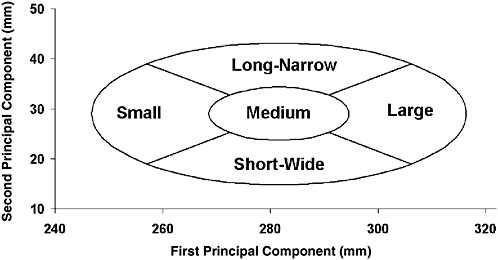
FIGURE 4-5 Facial size trends as compared to principal components.
SOURCE: Zhuang, November 3, 2005.
face that represents the average form of the members of that group. In PCA analysis it is possible that dimensions and shapes that determine fit are represented in the first two components only weakly, or not at all.
As described above, there is a great deal of potentially conflicting literature on this topic. The average “face” identified in the NIOSH-sponsored Anthrotech study is a composite and does not exist in reality. An important variable that determines fit may very well be the amount and nature of variation around the average. For example, the variation around a particular group mean (i.e., the average face on the panel) is more important to fit than the average form itself. It is also possible that fit depends critically on some measure that contributes little to overall facial shape. The NIOSH-sponsored Anthrotech study paid little attention to these matters, yet different mean forms will undoubtedly have different variances, different fits, and local aspects of these will very likely vary in magnitude (as pertains to fit around a specific part of the face).
The committee reviewed the data and found that male and female faces have similar shapes depending on what variables are used to describe them. The committee also found that age seems to have a very small correlation with every other variable, and yet, may have sufficient power to predict fit to justify its inclusion on the panel. The committee found no statistical analysis that provides guidance in this regard, as NIOSH data on fit are not available to the committee (or may not exist within NIOSH). One of the manufacturers (3M) stated that they have collected this type of information but that it may be proprietary (Colten, July 10, 2006).
Are the PCA Face Panels an Improvement over the Proposed Bivariate Face Panels?
One issue that remains unanswered with respect to PCA is whether performing such an analysis will provide a better face panel than the proposed or the LANL face panels. Although the new proposed face panel is not without its own limitations, as discussed above, it may well be better than the PCA face panel.
PCA may provide a more informative classification of faces. The researchers made an effort to include in their analysis only those variables that correlated with aspects of fit. However, in the absence of fit data, it is not possible to determine how well they succeeded. The 10 fa-
cial dimensions chosen for the PCA were age- and race-adjusted, suggesting that these factors should not affect the final classifications obtained from the PCA (Zhuang, November 3, 2005). However, the committee has identified several potential problematic issues related to PCA:
-
The analysis does not explain the basis or methods for stating that the PCA is age- and race-adjusted (Zhuang, November 3, 2005).
-
The regression analyses carried out were based on simulated workplace protection factors rather than on real-world conditions.
-
Anthrotech selected its variables based on published studies that reported correlations between certain facial features and fit, but unless the populations used in those studies were similar to the population of interest to NIOSH, choices to include or exclude variables for the PCA based on these studies may be inappropriate.
-
If the variable selection step were not suspect, then the five-class categorization scheme based on PCA might well be a better way to classify subjects into various respirator sizes than a similar five-category classification based on a bivariate panel. As it is, however, there is no way to be sure that a PCA-based scheme would be superior. It would be simple to work from the data underlying the bivariate panels (e.g., bizygomatic breadth and the menton-sellion length) to construct a five-group classification system that is similar to the one Anthrotech derived from the PCA. As shown in Figure 4-3, the set of data points is roughly elliptical in extent. That ellipse can then be divided into five regions in the same way that the data were in Figure 4-4. The resulting regions could then be called “long-narrow,” “small,” and so on. Given the various concerns described above about the PCA, it is not at all obvious that the five-class size system defined this way from the data on face width and length would be superior to the system defined by the two variables derived from the PCA. Again, a fundamental issue is that fit was not examined, and the relationship between fit and the general shape of the head and face is not known.
ALTERNATIVE NONLINEAR FACE PANEL DESIGN
As an alternative to the linear relationships used to develop both the PCA and the NIOSH-sponsored Anthrotech study face panels, the committee developed an alternative strategy that is based on a nonlinear relationship between facial measurement and fit. This is described in the section that follows.
The two proposed face length- and width-based face panels developed from the NIOSH-sponsored Anthrotech study and the related PCA-derived face panels described above are based on similar assumptions. Working from the total sample population, a small number of cells are defined that together include most of the target population (there are 10 cells for each of the length- and width-based face panels and 5 for the PCA panel). Then for each of those cells a certain number of subjects are chosen—the number of subjects in each cell is approximately proportional to the percentage of the study population that is covered by the cell. Thus the middle cells in the bivariate panels, which contain a larger percentage of the study population than do the outer cells, have four or five panel members as compared with only two panel members in each of the outer cells. The underlying idea claims to be that because the middle cells cover a larger percentage of the study population, they should be represented by more subjects on the panel. However, the committee does not agree with this assumption. If the cells on the margin cover a wider range of subjects, they may well need more subjects, not fewer.
Proposed Distribution of Face Panel Subjects
A more efficient way to distribute face panel members would be to distribute them among the cells according to the variance of the study population contained in each individual cell. For example, cells with greater variance would require more test subjects be tested to provide a reasonable guarantee that a given respirator will fit most people whose facial dimensions fall within that cell. Conversely, the smaller the variance within a subset, the better that subset will be represented by a small number of individuals. In this scheme, if every subject in a cell had exactly the same dimensions, it would be enough to test any one of them.
This more efficient panel design can be accomplished with the following four steps:
-
Divide the population into equiprobable, or equally-sized, subsets that are mutually exclusive and exhaustive. The individual probabilities of these subsets should be small (not more than 0.10), and the shape could be elliptical (for a bivariate normal distribution). Each subset defines a cell in the panel.
-
Compute the generalized variance (trace or determinant of the covariance matrix) for each of these subsets.
-
Assign the number of individuals to a subset, or cell, in proportion to the generalized variance of that subset.
-
Randomly select individuals within each subset to be the members of that cell.
Two examples of this approach are illustrated in Figure 4-6, which are notional illustrations of how the total sample distribution of facial measurements may be divided into cells representing equiprobable, or equally-sized, subsets of the total distribution. The contours in the background are the nonparametric density contours that were computed from the Anthrotech data. Because the shapes of the cells are based on the distribution of the sample, these contour lines may assist in defining the size and shape of each cell, which is not necessarily rectangular and not a representation of the exact split of the observed distribution. It should be noted that the proportion of the population in each cell is the same, and hence the cells that are in the middle have smaller area, whereas the cells on the outer boundaries have a larger area and larger number of panel members. The number of individuals needed to represent each cell is approximately related to the variance within the cell.
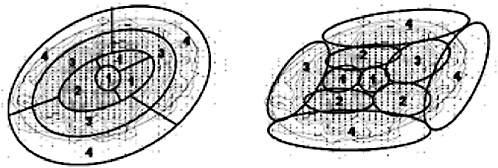
FIGURE 4-6 Two alternatives strategies for the committee’s proposed total sample distribution of facial measurements.
Conclusion
The use of multiple features in the development of face panels is likely to be inherently better than the use of just facial height and width, but it is not yet well understood which features are directly relevant to fit and how they can best be combined.
Recommendation 4-7: Utilize Multiple Features in the Development of Face Panels.
NIOSH should examine the potential effects of a nonlinear relationship between respirator fit and facial dimensions.
REFERENCES
Anthrotech. 2004. A head-and-face anthropometric survey of U.S. respirator users: Final report Prepared by B. Bradtmiller and M. Friess for NIOSH/NPPTL.
Brazile, W. J., R. M. Buchan, D. R. Sandfort, W. Melvin, J. A. Johnson, and M. Charney. 1998. Respirator fit and facial dimensions of two minority groups. Applied Occupational and Environmental Hygiene 13(4):233-237.
Civilian American and European Surface Anthropometry Resource. 2002. Final report from CAESAR. Falls Church, VA: General Dynamics International.
Coffey, C. C., R. B. Lawrence, Z. Zhuang, D. L. Campbell, P. A. Jensen, and W. R. Myers. 2002. Comparison of five methods for fit-testing n95 filtering-facepiece respirators. Appl Occup Environ Hyg 17(10):723-730.
Colten, C. E. July 10, 2006. Presentation to Committee for the Assessment of the NIOSH Head-and-Face Anthropometric Survey of U.S. Respirator Users: Respirators: Design and anthropometry—3M OH&ESD. Pittsburgh, PA: National Personal Protective Technology Laboratory.
Frund, Z. N. July 10, 2006. Presentation to Committee for the Assessment of the NIOSH Head-and-Face Anthropometric Survey of U.S. Respirator Users: Manufacturer’s perspective on anthropometric measurements study & designing masks to meet new panel. Pittsburgh, PA: National Personal Protective Technology Laboratory.
Gross, S. F., and S. W. Horstman. 1990. Half-mask respirator selection for a mixed worker group. Applied Occupational and Environmental Hygiene 5:229-235.
Hack, A. L., and J. T. McConville. 1978. Respirator protection factors: Part I— development of an anthropometric test panel. Am Ind Hyg Assoc J 39(12):970-975.
Hack, A. L., E. C. Hyatt, B. J. Held, T. D. Moore, C. P. Richards, and J. T. McConville. 1974. Selection of respirator test panels representative of U.S. adult facial sizes. Los Alamos, NM: Los Alamos Scientific Laboratory.
Han, D. H., and K. L. Choi. 2003. Facial dimensions and predictors of fit for half-mask respirators in Koreans. AIHA J (Fairfax, Va) 64(6):815-822.
Kim, H., D. H. Han, Y. M. Roh, K. Kim, and Y. G. Park. 2003. Facial anthropometric dimensions of Koreans and their associations with fit of quartermask respirators. Ind Health 41(1):8-18.
Liau, Y. H., A. Bhattacharya, H. E. Ayer, and C. Miller. 1982. Determination of critical anthropometric parameters for design of respirators. Paper read at American Industrial Hygiene Association, Cincinnati, OH.
McKay, R. T. July 10, 2006. Presentation to Committee for the Assessment of the NIOSH Head-and-Face Anthropometric Survey of U.S. Respirator Users: Respirator fitting issues. Pittsburgh, PA: National Personal Protective Technology Laboratory.
Neyman, J. 1934. On the two different aspects of the representative method: The method of stratified sampling and the method of purposive selection. Journal of the Royal Society 97(4):558-625.
Oestenstad, R. K., and L. L. Perkins. 1992. An assessment of critical anthropometric dimensions for predicting the fit of a half-mask respirator. Am Ind Hyg Assoc J 53(10):639-644.
Oestenstad, R. K., H. K. Dillion, and L. L. Perkins. 1990. Distribution of faceseal leak sites on a half-mask respirator and their association with facial dimensions. Am Ind Hyg Assoc J 51(5):285-290.
Zhuang, Z. 2001. Anthropometric survey of respirator users: Study protocol. Pittsburgh, PA: National Institute for Occupational Safety and Health.
———. November 3, 2005. Presentation to Committee for the Assessment of the NIOSH Head-and-Face Anthropometric Survey of U.S. Respirator Users: Respirator fit test panels representing the current U.S. civilian workforce. Washington, DC: National Academy of Sciences Keck Center.
Zhuang, Z., and B. Bradtmiller. 2005. Head-and-face anthropometric survey of U.S. respirator users. J Occup Environ Hyg 2(11):567-576.
Zhuang, Z., J. Guan, H. Hsiao, and B. Bradtmiller. 2004. Evaluating the representativeness of the LANL respirator fit test panels for the current U.S. civilian workers. Journal of the International Society for Respiratory Protection 21:83-93.
Zhuang, Z., Coffey, C.C., and R.B. Ann. 2005. The effect of subject characteristics and respirator features on respirator fit. J Occup Environ Hyg 2(12):641-649.


