
3
Science Concepts and Goals
SCIENCE CONCEPTS AND KEY SCIENCE GOALS IDENTIFIED WITH EACH: A TABULAR PRESENTATION
This chapter discusses eight specific areas of scientific research, termed science concepts, that can and should be addressed during implementation of the initial phases of the Vision for Space Exploration (VSE) as well as the early phases of human exploration activities. An integrated set of prioritized science goals is presented with each concept. Opportunities for the science of Earth and the universe from the Moon are discussed separately in Chapter 6. The science concepts are listed in priority order in Table 3.1 in terms of scientific value. A full discussion of the prioritization of these science concepts and the science goals is contained in Chapter 5.
The key science goals identified with each science concept are summarized in Table 3.1 and discussed extensively in this chapter. The overarching themes of lunar science presented in Chapter 1 are not tied to a single endeavor, but emerge from a multitude of such goals and concepts as broad topics of fundamental science required in order to attain understanding of the solar system. Since the origin and evolution of life in the universe are also of great interest to scientists and the public, those goals that may have important implications for life are highlighted separately in Table 3.1.
DISCUSSION OF SCIENCE CONCEPTS AND KEY SCIENCE GOALS IDENTIFIED WITH EACH
Concept 1:
The bombardment history of the inner solar system is uniquely revealed on the Moon.
The heavily cratered surface of the Moon testifies to the importance of impact events in the evolution of terrestrial planets and satellites and the exceptional ability of the lunar surface to record them all. Lunar bombardment history is intimately and uniquely intertwined with that of Earth, where the role of early intense impacts and the possible periodicity of large impact events in the recent past on the atmosphere, environment, and early life underpin our understanding of habitability. The correlation between surface crater density and radiometric age discovered on the Moon serves as the basis for estimating surface ages on other solid bodies, particularly Mars. Significant uncertainties remain in the understanding of the lunar cratering record and our ability to extend it to other planets of the solar system. Returning to the Moon provides an unparalleled opportunity to resolve some of the fundamental questions that relate to these goals.
TABLE 3.1 Primary Science Goals of Lunar Science Concepts and Links to Overarching Themes
|
|
|
Overarching Themes |
|
|||
|
Science Concepts |
Science Goals |
Early Earth-Moon System |
Terrestrial Planet Differentiation and Evolution |
Solar System Impact Record |
Lunar Environment |
Implications for Life |
|
1. The bombardment history of the inner solar system is uniquely revealed on the Moon. |
1a. Test the cataclysm hypothesis by determining the spacing in time of the creation of lunar basins. |
X |
|
X |
|
X |
|
1b. Anchor the early Earth-Moon impact flux curve by determining the age of the oldest lunar basin (South Pole-Aitken Basin). |
X |
X |
X |
|
X |
|
|
1c. Establish a precise absolute chronology. |
X |
X |
X |
|
X |
|
|
1d. Assess the recent impact flux. |
|
|
X |
X |
X |
|
|
1e. Study the role of secondary impact craters on crater counts. |
|
|
X |
|
|
|
|
2. The structure and composition of the lunar interior provide fundamental information on the evolution of a differentiated planetary body. |
2a. Determine the thickness of the lunar crust (upper and lower) and characterize its lateral variability on regional and global scales. |
|
X |
X |
|
|
|
2b. Characterize the chemical/physical stratification in the mantle, particularly the nature of the putative 500-km discontinuity and the composition of the lower mantle. |
|
X |
|
|
|
|
|
2c. Determine the size, composition, and state (solid/liquid) of the core of the Moon. |
X |
X |
|
|
|
|
|
2d. Characterize the thermal state of the interior and elucidate the workings of the planetary heat engine. |
X |
X |
|
|
|
|
|
3. Key planetary processes are manifested in the diversity of lunar crustal rocks. |
3a. Determine the extent and composition of the primary feldspathic crust, KREEP layer, and other products of planetary differentiation. |
|
X |
|
|
|
|
3b. Inventory the variety, age, distribution, and origin of lunar rock types. |
X |
X |
|
X |
|
|
|
3c. Determine the composition of the lower crust and bulk Moon. |
X |
X |
|
|
|
|
|
3d. Quantify the local and regional complexity of the current lunar crust. |
|
X |
X |
|
|
|
|
3e. Determine the vertical extent and structure of the megaregolith. |
|
|
X |
X |
X |
|
|
4. The lunar poles are special environments that may bear witness to the volatile flux over the latter part of solar system history. |
4a. Determine the compositional state (elemental, isotopic, mineralogic) and compositional distribution (lateral and depth) of the volatile component in lunar polar regions. |
|
|
|
X |
X |
|
4b. Determine the source(s) for lunar polar volatiles. |
|
|
X |
X |
|
|
|
4c. Understand the transport, retention, alteration, and loss processes that operate on volatile materials at permanently shaded lunar regions. |
|
|
|
X |
|
|
|
4d. Understand the physical properties of the extremely cold (and possibly volatile rich) polar regolith. |
|
|
|
X |
|
|
|
4e. Determine what the cold polar regolith reveals about the ancient solar environment. |
|
|
|
X |
|
|
|
|
|
Overarching Themes |
|
|||
|
Science Concepts |
Science Goals |
Early Earth-Moon System |
Terrestrial Planet Differentiation and Evolution |
Solar System Impact Record |
Lunar Environment |
Implications for Life |
|
5. Lunar volcanism provides a window into the thermal and compositional evolution of the moon. |
5a. Determine the origin and variability of lunar basalts. |
|
X |
|
|
|
|
5b. Determine the age of the youngest and oldest mare basalts. |
|
X |
X |
|
|
|
|
5c. Determine the compositional range and extent of lunar pyroclastic deposits. |
|
X |
|
X |
|
|
|
5d. Determine the flux of lunar volcanism and its evolution through space and time. |
|
X |
X |
X |
|
|
|
6. The Moon is an accessible laboratory for studying the impact process on planetary scales. |
6a. Characterize the existence and extent of melt sheet differentiation. |
X |
X |
X |
|
|
|
6b. Determine the structure of multi-ring impact basins. |
X |
|
X |
|
|
|
|
6c. Quantify the effects of planetary characteristics (composition, density, impact velocities) on crater formation and morphology. |
|
X |
X |
|
X |
|
|
6d. Measure the extent of lateral and vertical mixing of local and ejecta material. |
|
|
X |
X |
|
|
|
7. The Moon is a natural laboratory for regolith processes and weathering on anhydrous airless bodies. |
7a. Search for and characterize ancient regolith. |
|
|
|
X |
|
|
7b. Determine physical properties of the regolith at diverse locations of expected human activity. |
|
|
|
X |
|
|
|
7c. Understand regolith modification processes (including space weathering), particularly deposition of volatile materials. |
|
|
|
X |
|
|
|
7d. Separate and study rare materials in the lunar regolith. |
|
X |
X |
X |
X |
|
|
8. Processes involved with the atmosphere and dust environment of the moon are accessible for scientific study while the environment remains in a pristine state. |
8a. Determine the global density, composition, and time variability of the fragile lunar atmosphere before it is perturbed by further human activity. |
|
|
|
X |
|
|
8b. Determine the size, charge, and spatial distribution of electrostatically transported dust grains and assess their likely effects on lunar exploration and lunar-based astronomy. |
|
|
|
X |
|
|
|
8c. Use the time-variable release rate of atmospheric species such as 40Ar and radon to learn more about the inner workings of the lunar interior. |
|
X |
|
X |
|
|
|
8d. Learn how water vapor and other volatiles are released from the lunar surface and migrate to the poles where they are adsorbed in polar cold traps. |
|
|
|
X |
|
|
Science Goal 1a
—Test the cataclysm hypothesis by determining the spacing in time of the creation of lunar basins.
From the returned samples and crater statistics, it is known that that during the past 3 billion years (Ga) the lunar impactor flux was relatively constant with possible variations by a factor of two, which is in good agreement with age data for young impact-melt rocks. It is also known that before 3 Ga ago, the impactor flux was much higher and rapidly decayed in time. The lunar chronology curve is well constrained, with small errors in the age range from about 4.0 Ga to 3.0 Ga. However, major uncertainties still exist for the pre-Nectarian period (more than about 4 Ga) and for the Eratosthenian and Copernican periods (less than about 3 Ga). The steepness of the calibration curve at ages older than about 3.75 Ga, the possibility that the pre-Nectarian surfaces for which crater counts exist may not be older than 4.2 Ga, and the fact that impact-melt lithologies older than 4.15 Ga are lacking indicate that the cratering rate may not increase smoothly according to the present calibration curve from 3.75 Ga back to the time of the formation of the Moon. The radiometric ages of impact-melt lithologies in the returnedsample collection have been used as an argument for a late cataclysm, that is, a spike in the cratering rate around 3.9 Ga ago, just about the time the life on Earth was emerging. However, a possible explanation of the spike is that the geologic setting of the Apollo landing sites led to a selective sampling of material from Nectaris, Serenitatis, and Imbrium. Most observers now agree that the gas retention ages of meteorites from the asteroid belt do not show the spike, but rather only a modest, broad peak from ~4.2 Ga to ~3.5 Ga ago. Furthermore, dated impactmelt clasts in Th-poor, KREEP-poor lunar meteorites, which most likely sample other areas of the Moon besides the Th-rich, KREEP-rich regions among Apollo sites, do not show evidence for a cataclysm at 3.9 Ga (KREEP is the acronym for potassium [K], rare-earth elements [REE], and phosphorus [P]). With currently available data, it is impossible to decide whether a cataclysm occurred or whether the cratering rate smoothly declined with time after lunar origin. This controversy is extremely important because it affects not only lunar science, but the understanding of the entire solar system. For example, models of planet formation and accretion of planetary debris are often based on the supposition that cataclysmic formation of all lunar basins between about 4.0 Ga and 3.8 Ga ago is well established. Determining the ages of impact-melt rocks in lunar meteorites and/or from the South Pole-Aitken (SPA) Basin (the stratigraphically oldest lunar basin; see Figure 3.1) and major impact basins within the SPA Basin will probably resolve this issue. The precision required to date these events accurately requires isotopic analysis of well-chosen samples in terrestrial laboratories.
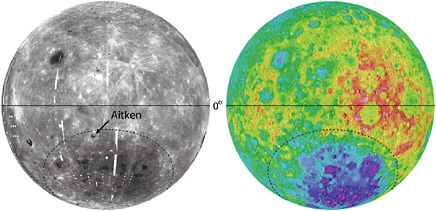
FIGURE 3.1 Farside of the Moon: albedo (left) and topography (right) derived from Clementine data. The outer ring of South Pole-Aitken (SPA) Basin is shown with a dotted line (after Wilhelms, 1987). The enormous SPA Basin is not located at the South Pole, but derives its name from the fact that it extends from the South Pole to the crater Aitken near the equator. SOURCE: Courtesy of Noah Petro and Peter Isaacson, Brown University.
Science Goal 1b
—Anchor the early Earth-Moon impact flux curve by determining the age of the oldest lunar basin (South Pole-Aitken Basin).
The pre-Nectarian period is the time span beginning with the formation of the Moon and ending with the impact of the Nectaris basin, which occurred at ~3.92 Ga to ~4.1 Ga. Since the oldest age of solid lunar surface material determined so far is 4.52 Ga, the pre-Nectarian period is ~600 million years (Ma) long. Our knowledge of the pre-Nectarian system stems from the photogeological identification of some 30 multi-ring basins, including the oldest known basin, the South Pole-Aitken Basin, and their ejecta deposits and returned samples of rocks with absolute ages older than Nectaris. Unfortunately, it is impossible to directly relate the dated pre-Nectarian rock clasts to any specific pre-Nectarian geologic surface unit, because subsequent multiple impact events displaced these samples after their formation. The relative ages of most of the pre-Nectarian multi-ring basins are based on crater counts on their ejecta formations. On the basis of these crater counts, it has been suggested that no multiring basins older than 4.2 Ga are unequivocally recorded. This implies that the oldest basins, including the South Pole-Aitken and Procellarum basins, were formed between 4.2 Ga and 4.1 Ga. However, these ages are poorly constrained because the precise age of the oldest basin, namely, the South Pole-Aitken Basin, has not yet been determined by isotope dating of returned samples. As the oldest multi-ring impact basins are important calibration points for the lunar chronology curve, this has implications with respect to the knowledge of the exact shape of the cratering chronology, which is the basis for absolute dating not only of the lunar surface, but also of other planetary surfaces. Therefore, it is paramount to date the oldest impact basin precisely in order to derive the exact shape of the lunar chronology.
Science Goal 1c
—Establish a precise absolute chronology.
While most geologists agree on absolute ages of the different terrestrial chronostratigraphical systems, there is debate on the ages of the lunar systems. Traditionally the lunar chronostratigraphic systems are based on ejecta blankets of large impact craters and basins that serve as marker horizons similar to terrestrial fossil or ash layers. These impact basins and young craters are stratigraphic benchmarks that allow the global determination of the relative age of lunar surfaces that have not been or cannot be directly accessed. However, there is still considerable debate about the ages of individual impact basins and craters on the Moon. At least two chronostratigraphical systems were defined by the existence or absence of bright rays. Eratosthenian craters would lack such rays, whereas Copernican craters would show these rays. However, newer studies indicate that age assignments solely based on rays might not be reliable. In fact, samples from Apollo 15 that are interpreted to represent material from the rayed crater Autolycus are 2.1 Ga old, hence Eratosthenian in age. Based on returned Apollo 12 samples, which were collected on one of the rays of Copernicus crater, the crater formed about 800 Ma to 850 Ma ago. While radiometric ages of Apollo 12 samples suggest a narrowly constrained age of 800 Ma to 850 Ma for Copernicus, crater counts on the ejecta blanket of Copernicus indicate a significantly older age, of up to 1.5 Ga. This could mean that material from Copernicus was not collected or that the samples do not represent the surface material dated with crater counts. The timing of Tycho was inferred from a landslide on the slopes of the South Massif and the “Central Cluster” craters at the Apollo 17 landing site, interpreted as secondary craters from Tycho. Based on this interpretation, an age of ~100 Ma was proposed for Tycho. However, the geological evidence for the South Massif landslide and the Central Cluster craters being formed by distant ejecta from Tycho remains somewhat equivocal. The exact ages of Copernicus and Tycho are important because they provide important calibration points for the lunar chronology at young ages.
There is also debate on the beginning of the Late Imbrian period, which is defined by the Orientale impact, with some authors favoring an age of 3.72 Ga and others favoring an age of 3.75 Ga. However, it could be almost as old as Imbrium, that is, 3.84 Ga. The problem is that the Orientale basin cannot be dated precisely because no samples in the current collection can unambiguously be attributed to the Orientale formation event. Similarly, there are large uncertainties associated with the beginning of the Early Imbrian period, with ages ranging from 3.77 Ga to 3.91 Ga, depending on which ages are used for the Imbrium impact itself. Finally, the base of the Nectarian period could be as old as 3.85 Ga, 3.92 Ga, or 4.1 Ga, depending on the interpretation of radiometrically dated samples.
Science Goal 1d
—Assess the recent impact flux.
Variability in the recent lunar and terrestrial impact flux may be related to singular solar system dynamic events, such as asteroid breakups, and may have significant effects such as impact-induced mass extinction on Earth (e.g., the Cretaceous/Tertiary [K/T] boundary and currently hotly debated Permian/Triassic [P/Tr] boundary events). On Earth, there is a greater relative number of younger craters, possibly suggesting a recent increase in projectile flux but more likely related to the difficulty of preserving and accessing older craters on a surface shaped by erosion, deposition, and plate tectonics. The Moon more faithfully records the projectile flux in the Earth-Moon system over the past ~3.5 Ga, and researchers can use it to determine whether this flux has been approximately constant, or has exhibited shorter-term variations or periodicity, by determining crater densities on known young surfaces, such as crater ejecta deposits, and radiometric ages of lunar soil spherules. Current literature is contradictory as to whether the impact rate in the inner solar system has increased by a factor of two, stayed constant, or decreased by a factor of three in the last 3 Ga. Since the gross long-term time behavior must have been the same throughout the inner solar system, and perhaps in the outer solar system, radiometric dating of a large number of randomly selected primary impact craters would thus refine the cratering chronology system for all the planets. With more than 35 years passed since the first high-resolution images were taken, it is also possible to directly study how many impact craters have formed since then in order to derive precise estimates of the recent impact flux.
Science Goal 1e
—Study the role of secondary impact craters on crater counts.
New studies of the martian impact crater Zunil revealed a surprisingly large number of small secondary impact craters. Consequently, it was argued that a similarly large number of small impact craters on the Moon could be secondaries. If true, the flux of small primary impact craters on the Moon might have been overestimated, which could have effects on the precise shape of the standard distribution. However, other groups argued that Zunil might only be a special case, not representative for lunar impact craters in general, and that secondary craters can easily be detected and omitted from crater counts. Detailed studies of young lunar impact craters and the distribution and number of their secondary impact craters will help to better understand the process of secondary impact cratering and its possible effects on crater statistics.
Other factors may affect crater counts. Recently there have been presented models on latitudinal asymmetries of up to 20 percent in the number of formed impact craters. Such asymmetries would be greatest for planets that do not have large variations in obliquity, such as Mercury. For this reason it is important to test these models before extrapolating the lunar chronology to other planets. Similarly, it has been argued that there are differences in the cratering rate between the leading and trailing sides of planetary bodies. The degree of these asymmetries depends on the velocities of the celestial projectiles and the Earth-Moon distance.
In summary, the overarching science requirement is to characterize and date the impact flux (early and recent) of the inner solar system.
Concept 2:
The structure and composition of the lunar interior provide fundamental information on the evolution of a differentiated planetary body.
One of the key motivations for studying the Moon is to better understand the origin of the planets of the inner solar system in general and that of Earth in particular. The origin of the Moon is inextricably linked to that of Earth. The precise mode of formation affected the early thermal state of both bodies and, therefore, affected the subsequent geologic evolution. The leading hypothesis at present is that the Moon formed as the result of the impact of a Mars-sized object with growing Earth. However, the details of the process are not clear. Because the Moon’s geologic engine largely shut down long ago, its deep interior is a vault containing a treasure-trove of information about its initial composition, differentiation, crustal formation, and subsequent magmatic evolution. During and immediately after accretion, the Moon underwent primary differentiation involving the formation of
a (presumably) iron-rich core, a silicate mantle, and a light, primordial crust. The initial bulk composition, as well as the pressure and temperature conditions during this separation, will be reflected in its current chemistry, structure, and dynamics. Although researchers have some information on the composition of the outermost layers of the Moon’s crust, that of the bulk crust is less well known, and even its thickness is not well established. The composition of the mantle can only be vaguely estimated, and the presence of compositional stratification, bearing on the late stages of differentiation and the efficiency of subsequent convective mixing, cannot be confirmed or denied. Furthermore, the size and the composition (e.g., Fe versus FeS, or even FeTiO3) of its core are unknown, except for loose bounds on its diameter.
Science Goal 2a
—Determine the thickness of the lunar crust (upper and lower) and characterize its lateral variability on regional and global scales.
Apollo-era analyses of seismic data deduced a mean crustal thickness of around 60 km. However, recent reanalyses of the seismic data indicate that a thinner crust, perhaps 30 km to 45 km thick, is more likely. The amount and quality of available seismic data suitable for constraining the crust are limited, resulting in an uncertainty in crustal volume of nearly a factor of two. There is also an indication of a marked increase in velocity at a depth of about 20 km, which may indicate a more mafic and noritic lower crustal layer with uncertain origin. All of these results come from a single region, and any lateral variability is currently constrained only by non-unique gravity modeling.
Science Goal 2b
—Characterize the chemical/physical stratification in the mantle, particularly the nature of the putative 500-km discontinuity and the composition of the lower mantle.
What is the nature and extent of the 500 km seismic discontinuity? Seismic velocity profiles, derived from ray paths that, for the Apollo network, extended primarily beneath the Procellarum KREEP Terrane (PKT), suggest that a major seismic velocity discontinuity occurs approximately 500 km below the surface (although the existence of this discontinuity has been questioned). The magnitude of this velocity increase would imply that the discontinuity is compositional in origin, with the deeper mantle likely more aluminous or Mg-rich. One possibility is that this boundary could represent the maximum depth of the lunar magma ocean, and an Al- and Mg-rich primitive mantle exists below 500 km. In this case all the Al in the primordial lunar crust must have been extracted from the upper mantle, and much of the mare basaltic magmatism must have involved melting above 500 km. However, some petrologic models imply a depth of melting of at least 1,200 km. If the magma ocean was deeper, then this discontinuity might mark the transition between early olivine- and later orthopyroxene-rich cumulates. Finally, it is possible that it is not a global feature of the mantle at all, but instead merely corresponds to the maximum depth of melting of the local PKT mare source. In any case, the presence of either radial stratification of lateral heterogeneity on this scale in the mantle has major implications for convection and mantle mixing since solidification of the magma ocean.
What is the nature of the lower mantle? In simple density-driven models of magma-ocean crystallization, mantle cumulates become increasingly rich in iron with the progress of crystallization. This mantle cumulate pile would have been gravitationally unstable. It is likely that late-stage ilmenite cumulates should have sunk through the mantle, and the deep, olivine-rich mantle cumulates should have participated in the overturn as well, bringing early-crystallized magnesium-rich olivine to the upper mantle. But models disagree as to the timing, extent, and efficiency of this overturn. Did it act to homogenize the composition of the mantle? Was mixing inefficient, retaining any original stratification within the magma-ocean cumulates, perhaps in an inverted sequence? Was the overturn global, or was it localized in particular regions of the mantle? Seismic information from Apollo becomes increasingly vague below 800 km, providing virtually no illumination of the scientifically critical zone of the Moon’s interior below ~1,100 km. Is there stratification in the deep mantle, or is it well mixed? Is the lower mantle characterized by an increased proportion of Mg-rich olivine, or is there a significant garnet cumulate? Is the lack of observed seismic activity from the farside indicative of partial melting below 1,150 km? What is the mechanism for generating periodic moonquakes at depths of >600 km? Do the lateral variations seen in the upper crust have
roots extending deep into the planet? These questions all bear directly on the nature of the magma ocean and the subsequent thermodynamic history of the Moon.
Science Goal 2c
—Determine the size, composition, and state (solid/liquid) of the core of the Moon.
The size, composition, and state of the lunar core are nearly unknown. Yet these parameters have far-reaching implications. Available evidence suggests that the Moon has a small core, less than 460 km radius. It is likely composed of metallic iron (with some amount of alloying Ni, S, and C), although existing geophysical data are also consistent with a core composed of a dense molten Ti-rich silicate magma. The size and composition of the core are fundamentally important for understanding the Moon’s origin and evolution. In the giant impact hypothesis, a collision between Earth and a Mars-sized object ejects debris and vapor into circumterrestrial orbit. Most of this debris should come from the silicate mantle of the impactor, but current models do not uniquely constrain the amount of iron that would be entrained in this material. Knowledge of the size and composition of the lunar core could constrain the many unknown parameters associated with these models. The formation of an iron core may have affected the composition of the lunar mantle and subsequently the composition of the mare basalts. An early lunar dynamo within an iron-rich core might help explain the magnetizations that have been measured in some of the Apollo samples and the crustal magnetic fields that have been mapped from orbit.
Science Goal 2d
—Characterize the thermal state of the interior and elucidate the workings of the planetary heat engine.
The evolution of the Moon from accretion to its present state is inextricably tied to its thermal history. The amount of heat produced through time and the manner in which it is transported to the surface constitute the engine that drives virtually all geological and geochemical processes. Effective models of these processes require knowledge of fundamental parameters that include interior structure and thermal state. Apollo heat flow measurements are inadequate, both in number and location, to effectively address the current flux of energy from the interior. This leaves a huge gap in knowledge of the bulk composition of the Moon in terms of heat-producing elements, which was a key determinant of the evolutionary path that led to the present state. More generally, the thermal state of the interior, which can be inferred from electromagnetic sounding of the Moon by utilizing its passage through Earth’s magnetosphere and perhaps from the physical state of the core (solid versus molten), provides further insight into areas such as the radial partitioning of radiogenic elements. The existence of an early dynamo, which might leave evidence in the remanent magnetization of igneous rocks, would also constrain the thermal history through inferences of the timing of formation and maintenance of a conducting core.
The Moon does not at present have an active core dynamo, but it has numerous localized remanent crustal magnetic regions of around a few kilometer to hundreds of kilometer scale distributed over its surface, indicating the presence of strong magnetizing fields in the past. Measurements of remanent magnetism on Earth provided the crucial evidence for the understanding of the evolution of Earth’s interior and surface (e.g., seafloor spreading and plate tectonics), and understanding the processes responsible for lunar magnetism hold similar promise. Studies of lunar crustal magnetism could provide a powerful tool for probing the thermal evolution of the lunar crust, mantle, and core, as well as the physics of magnetization and demagnetization processes in large basin-forming impacts. It is also possible that determining the distribution and properties of the strong magnetic anomalies first observed by Apollo will clarify potential magnetic shielding benefits for co-located lunar bases. This investigation will require a focused program of high-resolution mapping of crustal magnetic fields from orbit, together with surface magnetometer surveys of select regions and the return of samples whose orientation on the Moon was recorded.
Data concerning interior structure and dynamics are difficult to obtain but are worth considerable effort to do so. Direct samples of mantle rocks, from the deeply excavated South Pole-Aitken Basin or xenoliths, can provide a detailed glimpse into lower-crust and perhaps even upper-mantle composition. Geophysical measurements are often the best and in some cases the only way to obtain information about the composition and structure of the deep lunar crust, mantle, and core. It is well known from terrestrial experience that seismology is the most sensitive tool for determining deep internal structure. The waves produced by seismic events can provide essential information
bearing on crust and mantle structure and composition and on the size and nature of the core. These measurements can be augmented with analysis of rotational dynamics from precision tracking of surface reflectors. The flow of heat from the Moon’s interior is a primary indicator of the global energy budget in terms of sources (e.g., radiogenic, accretional) and the mechanisms that control its release (convection, conduction, volcanism). Knowledge of the heat flow provides important constraints (through inferences about internal temperatures) on the rheology and dynamic behavior of deeper layers of the Moon, on both global and regional scales. It may also be used to address the depth extent of the asymmetric distribution of KREEP. Magnetic induction studies can probe the conductivity of the deep interior to help constrain the temperature profile as well as aid in the characterization of the core.
Thus, a variety of geophysical and compositional analyses of the Moon will enable researchers to determine the internal structure and composition of a differentiated planetary body.
Concept 3:
Key planetary processes are manifested in the diversity of lunar crustal rocks.
Like Earth, the Moon possesses a crust, a mantle, and possibly even a small core. However, the Moon represents a very different end member of planetary evolution than Earth. The current understanding of the evolution of the Moon is framed by the lunar magma ocean, a concept developed on the basis of Apollo sample studies. According to this understanding, after the Moon accreted, it was completely molten to a depth of hundreds of kilometers. As the molten Moon cooled and crystallized, olivine, pyroxene, and other mafic minerals sank to form a mantle, while plagioclase floated to form the crust. The last liquid to crystallize, containing incompatible elements such as potassium, rare-earth elements, and phosphorus (collectively known as KREEP), was sandwiched between the crust and the mantle. Remelting of the mantle cumulate package drove fire-fountaining, lava flows, and plutonic emplacement, while large impact craters excavated and distributed the KREEP layer over the lunar surface. In this very simplified model, the composition of the crust has been thought of as generally homogeneous at any point on the Moon, modified only by thin, surface basalt flows or later impacts that scrambled the upper crust (regolith).
Although the concept of the lunar magma ocean continues to serve scientists well, geophysical, remote sensing, and sample analyses reveal a lunar crust that varies both laterally and vertically in composition, age, and mode of emplacement (Figure 3.2). The traditional, dichotomous mare-highland classification developed from Apollo experience is inadequate in describing the structure and geologic evolution of the lunar crust. From the global remote sensing coverage of the Clementine and Lunar Prospector missions of the 1990s and the study of lunar meteorites, researchers now know that they have an incomplete sampling of the lunar crust. Armed with a more global view of the Moon, scientists can now pose sophisticated questions about the lunar crust that will uniquely further the understanding of differentiation processes and the origin of the Moon.
Science Goal 3a
—Determine the extent and composition of the primary feldspathic crust, KREEP layer, and other products of planetary differentiation.
Instead of simply mare and highlands, large regions of the Moon have distinct geologic and geochemical characteristics. The surface expression of thorium and iron reveals swathes of the Moon that stand out from one another. These global terrains are inferred to be the result of asymmetry in the crystallizing lunar magma ocean or later large impact events. Large areas of the Moon are covered by nearly pure anorthosite, now called the Feldspathic Highlands Terrane (FHT). Modifying the feldspathic crust is the largest and deepest impact basin on the Moon, the South Pole-Aitken Basin, which may have penetrated a lower crust or mantle component that makes the floor of the basin more mafic than the pristine feldspathic crust. Smaller basins on the lunar farside do not appear to have penetrated deeper than the feldspathic crust, but on the nearside, where the feldspathic crust is thinner, the KREEP layer underlying the crust was excavated by the large, late impact basins such as Imbrium, creating the incompatible-element-rich area called the Procellarum KREEP Terrane (PKT).
Relating these geochemical terranes to the understanding of lunar formation and differentiation remains a fundamental goal of lunar science and will help guide understanding of products of magma oceans on other planets.
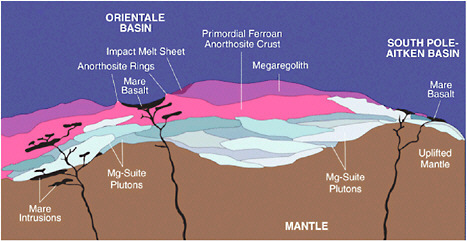
FIGURE 3.2 The complexity of today’s lunar crust, showing craters, plutons, magma conduits, and other features, based on a concept by Paul D. Spudis (Applied Physics Laboratory, Johns Hopkins University). The topmost layer of the crust is composed of a mixture of underlying anorthosite (rock containing more than 90 percent plagioclase feldspar) and lower crustal intrusions of Mg-suite magmas. Mg-suite magmas are slightly younger than anorthosites and may have formed when magma became trapped inside the anorthosite crust. This complicated picture is actually simplified from reality, which makes determining the bulk chemical composition of the lunar crust a difficult business. SOURCE: Courtesy of Planetary Science Research Discoveries, University of Hawaii.
Because of its enormous size the South Pole-Aitken Basin is expected to have excavated more deeply than any other visible lunar basin, but it does not contain a significant KREEP component in its ejecta, whereas the nearside basins do. This appears to reflect a fundamental asymmetry in the subsurface distribution of KREEP layer that is not currently understood and could be addressed by characterizing the incompatible-element signature of rocks from as-yet-unvisited lunar terrains, both by local and regional remote sensing and sample analysis. In another example, isotopic ages of Apollo samples that are understood to be the earliest crustal rocks show significant overlap in ages, inconsistent with a traditional lunar magma ocean view of a primary anorthositic crust later intruded by plutonic rocks. Furthermore, ages of some ferroan anorthosites postdate the age estimates for crystallization of the lunar magma ocean. However, because of the small size and low abundance of radiogenic elements in these rocks, it may be that researchers have not yet sampled a true piece of the pristine lunar crust. More magnesian anorthosite than exists in our sample collection is identified by remote sensing (e.g., in the rings of the Orientale basin) and may represent the primary lunar crust, more tightly bounding researchers’ calculations of the magma ocean process and lunar bulk composition.
Scence Goal 3b
—Inventory the variety, age, distribution, and origin of lunar rock types.
Researchers base their understanding of the major lunar rock types on Apollo sample knowledge. However, all the Apollo and Luna sample-return sites were within or on the edge of the PKT, and there are no returned samples unequivocally originating from the SPA Basin or FHT (although the lack of KREEP-bearing material in many feldspathic lunar meteorites implies that they come from the Feldspathic Highlands Terrane). Additionally, there are no samples collected from bedrock outcrops from the Moon, so the understanding of their origins
is incomplete. The composition or volume of the pristine anorthositic crust of the Moon is not yet known. There is no terrestrial counterpart to KREEP, and the component is elusive as an igneous or plutonic lithology on the Moon. However, this lithology might be the closest thing to an ore on the Moon, where rare elements are concentrated in a specific kind of rock. Some of these rare elements, including U and Th, may be important to future base activities. Understanding how KREEP rocks formed and how they are distributed allows the prediction of where else on the Moon they may be located, even if they are not expressed at the surface. A poorly understood lithology that may be genetically related to KREEP is the magnesian suite of rocks. These rocks are ubiquitous in the Apollo samples and have been thought of as a highland rock type, but it is uncertain whether these rocks are special products of the PKT or represent plutonic activity throughout the lunar crust. Smaller regions contain unique materials that may not be widespread on the lunar surface but can be of great interest to science and in situ resource utilization—for instance, high-Ti basalts and pyroclastic glass deposits.
Science Goal 3c
—Determine the composition of the lower crust and bulk Moon.
The concept of the lunar magma ocean depends to a large extent on understanding the composition and structure of the lunar crust and the bulk composition of the Moon. Key to this understanding is knowing the distribution and volume of plagioclase, mafic rocks, and incompatible-element rich rocks (KREEP). Researchers also need to know the extent of variability among these rocks and whether these materials are related to the pristine crust, later intrusive rocks, or differentiates of thick impact-melt sheets. The South Pole-Aitken Basin may have excavated or melted the lower crust of the Moon or may possibly even provide a window to the lunar mantle. Lunar pyroclastic flows may bring deep-seated rocks to the surface. Global, high-resolution multispectral data will help identify the lateral extent of these materials at the surface, improved geophysical data will help constrain vertical distribution of materials, and sample analysis provides direct knowledge of rock types, lithologic associations, chemical compositions, crystallization ages, and depth constraints. In turn, these data will provide important constraints in interpreting seismic and heat flow data.
Science Goal 3d
—Quantify the local and regional complexity of the current lunar crust.
Geophysical models of the lunar crust are highly dependent on assumptions about the type and distribution of materials across the crust and at depth. Samples and detailed geologic maps from regions that have exhumed materials from depth will provide further constraints on these models, which in turn can highlight new areas of interest for future exploration. The lunar center of figure is offset from its center of mass owing to a thick crust on the lunar farside or a more dense crust on the lunar nearside. Geophysical measurements such as heat flow and seismic reflection data will be able to pin down the crustal thickness and global remote sensing.
Science Goal 3e
—Determine the vertical extent and structure of the megaregolith.
The megaregolith resulted from the bombardment of the early lunar crust by an intense and highly energetic impact flux, including several large bodies that formed the major multiring basins. Large impacts, such as the South Pole-Aitkin Basin impact, could have brought material from as deep as 200 km to the surface and spread it all over the Moon. The early bombardment could have fragmented and mixed crustal materials to depths of kilometers or more. This highly fragmented, partially melted, and subsequently compacted material forms the megaregolith. Although researchers probably have samples of megaregolith in the form of impact breccias, they have not directly sampled this ubiquitous unit of early lunar surface evolution. Detailed studies of ejecta from major basins, along with geophysical probing of the existing megaregolith, will be needed to determine the nature of the megaregolith and its relationship to underlying, unaltered crust.
Understanding when and how the diversity of lunar rocks formed and how they are now distributed allows the prediction of where else on the Moon they may be located, even if they are not expressed at the surface. The gold and silver resources in the American West were not found by chance—rather, prospectors figured out how ore deposits were formed, in what environments, and what their surface expressions were. Then, they were able
to find and exploit the mineral resources. In the exploration of the Moon, it will be necessary to use global remote sensing, regional geologic mapping and geophysical measurements, and comprehensive sample analysis as complementary techniques to fully understand the nature of the lunar crust. Sample analysis from well-characterized sites representing new terrains allows high-precision laboratory analyses of petrology, composition, and radiometric ages and the ability to continue experiments for decades. Global compositional information derived from remote sensing extends the knowledge gained from samples across the entire Moon and helps predict areas where more sampling needs to be done. High spectral resolution is needed for mineral identification and abundance estimates, but high spatial resolution is needed to assess the geologic relations between diverse surface materials. By integrating global remote sensing, detailed regional geology, and precise sample studies, a predictive capability is gained that allows smarter choices about where to send future missions.
In summary, understanding the complete range of lunar rock types, their formation, and their lateral and vertical distribution is critical to scientific understanding as well as to lunar exploration.
Concept 4:
The lunar poles are special environments that may bear witness to the volatile flux over the latter part of solar system history.
The Moon and Mercury share a microenvironment at their poles that is unique in the solar system. The very small obliquity of these small planets causes topographic depressions near the poles to be permanently shaded from sunlight, allowing them to achieve extremely low temperatures, ranging between 25 K and 80 K;1 these temperatures are not expected elsewhere in the solar system within the orbit of Neptune and nowhere else on exposed silicate surfaces. The presence of these cold surfaces adjacent to the hot surfaces of the Moon and Mercury may allow cold trapping of volatile material that has impacted or otherwise been introduced to the surfaces of these objects. Any water or other volatile molecule that encounters a cold-trap surface will be permanently trapped with respect to sublimation, depending on the temperature of the trap and the vapor pressure of the species. The trapping process suggests that the lunar (and mercurian) poles may record a history of volatile flux through the inner solar system over the lifetime of the traps. The committee also notes that the polar regions may provide critical resources, such as high concentrations of hydrogen and possibly water, for future exploration. By answering the science issues described below, important information will also be provided for potential in situ resource utilization opportunities. Therefore, studies of the lunar polar environment provide an opportunity for strong synergies between scientific and exploration goals (see Box 3.1). Polar exploration also will provide information for siting, engineering properties, illumination conditions, and other data important for human exploration.
The diversity of potential sources and of transport, trapping, loss, and retention mechanisms suggests that the lunar and mercurian poles are an extremely complex deposit of volatiles. However, this diversity is matched by a near-total lack of data to constrain understanding. In the case of Mercury, radar observations of the poles show the presence of very high radar reflectivity in polar craters for which models indicate very low temperatures. These radar properties are consistent with thick ice, although other volatile material has been suggested. Similar observations of regions of permanent shade on the Moon—about 20 percent of the permanent shade can be observed from Earth—show no similar regions of high radar reflectivity, indicating that the lunar and polar deposits are fundamentally different. This difference demonstrates that very similar physical conditions can give rise to completely different results. Radar observations made by Clementine of the south polar lunar crater Shackleton showed that this crater exhibited radar scattering consistent with a coherent backscatter opposition effect caused by thick ice; recent ground-based observations confirmed the polarization results of Clementine at Shackleton, but also showed that these conditions occur within craters that are illuminated, suggesting that the Clementine results may also be due to roughness.
While the radar results do not positively indicate the presence of ice at the lunar poles, to contribute a measurable radar signal, ice must be thick and relatively pure; thus a lack of radar detection cannot preclude ice. Significant admixture with lunar soil, or the presence of alternating layers of soil and ice, would not necessarily be detected
|
BOX 3.1 Linkages Between Lunar Resource Utilization, Science, and Human Exploration Minimizing the costs of sustaining an outpost on the Moon requires the use of local resources. Interactions between the field of resource utilization and science lie in the following areas:
Near-term exploration priorities for resource development will focus on understanding the distribution of volatiles in the lunar polar regions. The confirmation of readily extractable hydrogen and oxygen can have a major effect on the exploration strategy itself as well as determine the technologies needed to produce the resources. The key is to understand the lateral and vertical variation of hydrogen (and potentially other useful volatiles) in and outside of permanently shadowed craters, locating the most concentrated and readily useful deposits. Exploration to determine the hydrogen distribution for resource purposes will have many attributes in common with exploration that addresses the scientific questions of where the volatiles came from and how they behave on the lunar surface. Scientific exploration may be more interested in isotopic and small-scale stratigraphic distributions than is resource exploration, but the commonalities of locating and determining concentrations suggest that a common exploration approach will be effective. Also in the near term, excavation techniques may be developed for resource extraction. Development should consider the potential uses of this technology for scientific studies. For example, some excavation techniques may be used more readily than others for excavating trenches in the regolith for the study of regolith structure. Where large amounts (cubic meters) of regolith are obtained for testing resource-extraction techniques, efforts should be made to separate, catalog, and return representative samples of coarse material unsuitable for resource processing. These can contribute to understanding the geologic evolution of local and distant units on the Moon. In addition, the development of materials transportation systems will require an understanding of the physics of particulate materials in the lunar environment. Resource utilization will be advanced by having a better understanding of the behavior of volatiles in the lunar environment. It is known that agitating or crushing lunar regolith releases solar wind gases, and the |
|
production of volatile materials for utilization will increase the probability of environmental contamination by these volatiles. Experiments should be planned on early missions that explore the migration of volatiles in the lunar environment through active release experiments. In the longer term, two resource issues are potentially significant. The first is the distribution of hydrogen outside of the polar permanent shadow. Hydrogen contents of mature lunar regolith are in the range of 50 parts per million (ppm) to 150 ppm by weight. In addition, some regolith breccias have larger concentrations of hydrogen. A nonpolar source of hydrogen may become important if hydrogen at the poles proves difficult to access. Development of exploration techniques that can determine hydrogen distributions to ±10 ppm locally will be useful for understanding regolith formation processes and can help identify higher concentrations of hydrogen for resource purposes. Also, in the long term, as the utilization of lunar resources progresses, it may become necessary to locate richer deposits of less-common elements (e.g., phosphorus). These chemical elements and compounds are likely to be associated with less-common rocks that occur in unusual lunar environments (crater central peaks, excavated lower-crust and mantle materials, and pyroclastics) that will be the focus of exploration activities. In the near term, surveys for unusual rock types, which can be carried out with almost any regolith sample obtainable in very large quantities, will serve both scientific and resource objectives. Orbital compositional data obtained in the near term at high spatial resolution (1 km) will be useful in guiding the exploration for the less-common resources of the Moon. |
by radar. The Lunar Prospector mission detected a distinct neutron albedo deficit over the poles, indicating the presence of hydrogen at maximum concentrations of 150 parts per million averaged over the large 40 km to 50 km footprint of the measurement. If the hydrogen is situated only in permanent shade, then the concentration of water required to give rise to the measured signal is about 1 percent H2O by weight. The neutron albedo data also indicate that hydrogen is not located at the immediate surface. As a consequence, the upper several centimeters may lack hydrogen, or may be desiccated if the hydrogen is in the form of water, which is consistent with micrometeorite gardening and loss from the surface of a thicker, but low-concentration, deposit. The neutron albedo and radar results are also consistent with patchy occurrences of ice with much higher concentrations, though still probably not surface deposits.
The current data answer few questions associated with polar volatile deposits. Radar results for Mercury and neutron spectrometer data for the Moon have achieved the zero-order existence proof that cold trapping of hydrogen-bearing volatiles does occur. However, the chemical identity of the polar materials, their sources and evolution, and the explanation for the differences between Mercury and the Moon are entirely unknown. Without new data, the value of the polar deposits for addressing larger issues in planetary science is unknown. The science goals related to lunar polar volatiles that can be addressed with new studies are given below.
Science Goal 4a
—Determine the compositional state (elemental, isotopic, mineralogic) and compositional distribution (lateral and depth) of the volatile component in lunar polar regions.
Orbital neutron data from Lunar Prospector indicate that the lunar poles have anomalously high hydrogen abundances compared with other parts of the Moon (see Figure 3.3). However, there is little to no information regarding the chemical or physical form of this hydrogen. Based in part on studies of polar temperatures and the expected surface distribution of the polar volatiles, it has been suggested that the hydrogen is mostly composed of water ice. If the polar deposits are dominantly composed of cometary or asteroidal material, one may additionally expect that other volatile elements or compounds would be present in the lunar cold traps. Alternatively, other studies have suggested that the neutron data can be explained as resulting from solar wind implantation, in which case the hydrogen would not be in the form of water ice. There are a variety of processes that may change in situ
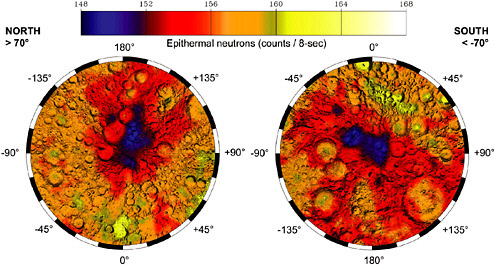
FIGURE 3.3 Polar maps of lunar epithermal neutron counting rates. The dark regions indicate locations of enhanced hydrogen abundances. SOURCE: P. Lucey, R.L. Korotev, J.J. Gillis, L.A. Taylor, D. Lawrence, B.A. Campbell, R. Elphic, B. Feldman, L.L. Hood, D. Hunten, M. Mendillo, S. Noble, J.J. Papike, R.C. Reedy, S. Lawson, T. Prettyman, O. Gasnault, and S. Maurice, Understanding the lunar surface and space-Moon interactions, Reviews in Mineralogy and Geochemistry 60:83-220, 2006. Courtesy of the Mineralogical Society of America.
the compositional and physical form of cold trapped volatiles, regardless of how they were initially deposited—for example, forming organics, clathrates, or clay minerals. Finally, except for indications from neutron data that the hydrogen may be buried by tens of centimeters of dry lunar soil, there is very little information regarding the lateral and depth distribution of polar volatiles.
Science Goal 4b
—Determine the source(s) for lunar polar volatiles.
Many possible sources for polar volatile material exist. Solar wind directly illuminates the cold traps, and solar wind gas can be trapped, as it is trapped in lunar equatorial soil that experiences temperatures as high as 400 K. Comets, wet asteroids, and interplanetary dust particles can contribute their water and other volatiles through transport and trapping to the poles, or by direct impacts into the permanent shade. Ions are continually stripped off Earth’s upper atmosphere, and as the Moon passes through the magnetotail these ions can be trapped at the poles. Unusual and optically very fresh features on the Moon suggest that recent, large-scale, localized outgassing may have provided gases to the poles. Finally, the solar system passes through giant molecular clouds on timescales of tens of millions of years; this extrasolar dust may give up its volatile component to the lunar poles.
Science Goal 4c
—Understand the transport, retention, alteration, and loss processes that operate on volatile materials at permanently shaded lunar regions.
Transport of volatiles to the poles occurs as flows through the lunar atmosphere, so transport mechanisms are intimately related to the understanding of the atmosphere. Some measurements exist on volatile flow between the day and night side; no comparable information exists near the poles that could constrain fluxes, net transport,
and exchange. While cold trapping will tend to capture volatile material arriving via the lunar atmosphere, several loss mechanisms operate to deplete the cold traps. Lyman alpha ultraviolet radiation scattered off hydrogen throughout the solar system can efficiently erode surface ice, while micrometeorite impact can remobilize vapor molecules, subjecting them to photodissociation in sunlight and solar wind sweeping. The solar wind does impact the permanently shaded regions as it is bent by Earth’s magnetotail, subjecting ice in permanent shade to sputtering loss. Paradoxically, the low temperatures may actually promote loss. Surfaces maintaining extremely low temperatures do not allow significant downward migration of volatiles into the regolith, exposing them to loss mechanisms. Intermediate temperatures or regions that experience diurnal temperature variations may be favored for volatile retention.
Meteorite bombardment can sequester volatiles through burial. An optically thick but physically very thin layer of dust protects ice from ultraviolet illumination and sputtering. Volatiles can also be retained if chemically processed in the permanent shade to organics or bound chemically to silicates. Organic production can be stimulated within an ice-bearing silicate regolith by protons produced by cosmic-ray interaction with the lunar surface, or by ultraviolet illumination at the surface, provided temperature cycling is present and sequestration allows this to occur.
The transport of volatile material to the cold trap probably alters the chemical and isotopic composition and relative abundances of volatiles introduced by random impacts on the Moon. Most common cometary volatiles have lifetimes against photodissociation long enough to allow trapping significant quantities at the pole, but the differences in vapor pressure and ionization potential probably cause fractionation en route to the poles.
Finally, studies of transport and alteration processes are also needed for understanding how robotic and human missions to the Moon can affect the pristine lunar polar environment.
Science Goal 4d
—Understand the physical properties of the extremely cold (and possibly volatile rich) polar regolith.
The polar regions may provide a natural laboratory for studying physical conditions of planetary or astrophysical importance. Polar silicate grains, perhaps coated with volatiles, are subject to the same radiation encountered by silicate grains in interstellar space. The host of physical changes that occur as the lunar surface is exposed to space weathering can be studied using polar soil that weathers at extremely low temperatures. For example, the extremely low temperatures may inhibit the formation of glass that is ubiquitous elsewhere on the Moon. In addition, if water ice is present and of utilitarian interest, the physical properties of regolith within the permanent shadow will need to be understood, as they will determine the ease or difficulty of excavating regolith for volatile extraction.
Science Goal 4e
—Determine what the cold polar regolith reveals about the ancient solar environment.
Polar soil may also address important issues in solar science. Equatorial soil heated to very high temperatures releases deeply implanted, high-energy solar wind gas. This gas has an unusual nitrogen isotopic signature not predicted by solar composition models. However, this signature may be due to thermal diffusion and isotopic fractionation. Polar soil in contrast has never been heated, so diffusion can be eliminated as a process affecting the isotopic composition of trapped solar gas.
Analysis of existing data (provided by Clementine, Lunar Prospector, Earth-based radar) and data from planned orbital missions will contribute significantly to understanding of the lunar polar volatile deposits. For example, NASA’s Lunar Reconnaissance Orbiter (LRO) will provide photometry, morphology, topography, and temperature information that will improve knowledge of the polar environment. LRO will also provide information about the hydrogen distribution very near the poles and possible surface frosts if they are present. The Moon Mineralogy Mapper imaging spectrometer on the Indian Space Research Organization’s Chandrayaan-1, could potentially detect water or hydroxyl features through measurement of surfaces illuminated by sunlight scattered by nearby topographic highs. Because the richest deposits are most likely to preserve a record of volatile history and evolution with greatest fidelity, it is important that the location and volatile inventory of such deposits are
determined by the best methods available, including innovative remote sensing approaches that can characterize volatile abundance to latitudes as low as 70 degrees.
Even so, a positive result by upcoming orbital remote sensing missions is unlikely to answer the most compelling scientific questions; these can only begin to be addressed by in situ measurements. Because abundances of scientific importance are far below orbital detection limits, a negative orbital result does not diminish the potential scientific value of the poles, but it does complicate their further investigation if candidate landing sites are not identified.
First, direct in situ measurements of key regolith volatile characteristics within the cold traps, including abundances and chemical, mineralogical, and isotopic compositions, would provide the first meaningful constraints on models. These measurements should include controls consisting of measurements on polar regolith not in permanent shade. While abundances within the cold traps may be spatially variable, analysis of even trace abundances would be of extreme value, so prior knowledge of the richest deposits is not required for significant progress.
Second, characterization of the lunar atmosphere in proximity to the cold traps, including direction information that can be used to infer flows, is essential to understanding the relationship between the atmosphere and the cold traps. This characterization is required prior to human landings to avoid contamination.
Third, spatial variability of volatile deposits within permanently shaded regions needs to be determined, since there are indications that these regions may be patchy within the shaded regions.
Fourth, for the richest deposits, in situ measurements may need to be made as a function of stratigraphy, since there are indications that these deposits are layered. In addition, the in situ regolith measurements will result in a basic understanding about the physical properties of the regolith in permanently shaded regions for which there is no direct information. Characterization of variations in the ancient solar wind would require sampling several depths in the polar regolith.
The results of these initial measurements would guide further investigations. If it can be shown that lunar polar cold traps preserve volatiles with high fidelity, such that source characteristics can be inferred, or if in contrast the volatiles reveal significant degrees of processing (e.g., to complex organics), subsequent, more-detailed analysis is warranted, likely using cryogenically preserved returned samples.
In summary, a unique opportunity exists to characterize the volatile compounds of polar regions on an airless body and determine their importance for the history of volatiles in the solar system.
Concept 5:
Lunar volcanism provides a window into the thermal and compositional evolution of the Moon.
As discussed in Concept 3, understanding of lunar crustal evolution has been tied for many years to somewhat simplified models of the lunar magma ocean, which explained global trends in crustal composition but left many questions unanswered at regional and local scales. The cause of the nearside-farside asymmetry in lunar volcanic activity, for example, remains an unresolved problem. More-complex models of the magma ocean have the potential to address such questions, but they require compositional, temporal, and geophysical constraints to be effective.
Currently, the connections between composition, location, and age of volcanic activities are somewhat limited. On the one hand, the lunar sample collection has yielded detailed composition and age data for a subset of volcanic rocks, but the geologic context needed to interpret them is often lacking. Global remote sensing data, on the other hand, reveals many volcanic rock compositions that do not appear in the sample collection. A return to the Moon offers the opportunity to bridge the gap between the sample collection and the wealth of remote sensing data and to address specifically a number of key goals concerning the understanding of lunar volcanism and the evolution of the Moon.
Science Goal 5a
—Determine the origin and variability of lunar basalts.
Approximately 17 percent of the lunar surface is covered by mare basalts, with the majority having erupted on the lunar nearside. Although they are volumetrically a small part of the total lunar crust, the mare basalts provide critical constraints on the differentiation and thermal history of the Moon. Although many different types of mare
basalts are represented in the Apollo and Luna collections and among lunar meteorites, key basalt units identified from orbit remain unsampled, and consequently their detailed chemistry and absolute ages remain unknown.
Laboratory analysis of well-chosen samples across a range of maria will address these questions. In particular, samples of basalts that erupted on the lunar farside will help elucidate at what depths melting occurred, when eruptions took place, and whether the composition of the mantle is uniform from the nearside to the farside. A range of subsurface sounding methods will permit determination of the thickness and structure of individual benchmark basalt flows. Investigating the thermal state and history of the interior (e.g., through careful measurements of the interior heat flow) will establish the thermal constraints on magma production through time and help answer fundamental questions about melt generation, segregation, and transport.
Science Goal 5b
—Determine the age of the youngest and oldest mare basalts.
Recent crater counts suggest that some of the mare basalts in Oceanus Procellarum might be as young as 1.2 Gaan age unrepresented anywhere in the sample collection and an important calibration point for understanding of both volcanism and the impact cratering flux (see Concept 1). At the other end of the time line, the oldest mare basalts and their link to “pre-mare volcanism” are not well understood. For example, some fragments of high-Al and the KREEP basalts found in the sample collection are older than the oldest known mare samples, but it is not clear if they are distinct volcanic processes or if they are part of a continuum that evolved into mare volcanism.
Samples of the youngest and oldest basalts will help to address these questions and constrain how basaltic processes have evolved over time.
Science Goal 5c
—Determine the compositional range and extent of lunar pyroclastic deposits.
Pyroclastic volcanism offers the most direct sampling of the lunar mantle, as well as immense resource potential with respect to materials such as oxygen, iron, and titanium. Within the existing sample collection, the range of volcanic glass compositions is large, and it is likely that this range will expand even further as new deposits are sampled and their composition and age are assessed. Because of the role of pyroclastic deposits in approximating primary magmas, more examples of these deposits will provide information on the depth of the magma ocean, the character of the lunar mantle, and of course the nature of the mare basalt source regions.
Science Goal 5d
—Determine the flux of lunar volcanism and its evolution through space and time.
Neither the magma production rate through time nor the chemical evolution of these magmas and the thermal evolution of the Moon overall are known. Because of the potential importance of high-Ti basalts and pyroclastic deposits as potential lunar resources, increasing the understanding of lunar volcanism in space and time is important from both a scientific and an exploration perspective. Ultimately, this goal includes and expands on those above, with each answered question contributing to the overall understanding of lunar volcanic processes and their products.
Planned or potential future orbital systems offer some improvement in our knowledge, through elemental and mineralogical mapping of volcanic materials, for example, and crater counts from higher-resolution data to pin down relative ages. But detailed modeling is needed to address the connections between volcanic source regions and surface materials, and such models require better geochemical constraints than are currently available. These constraints can be addressed through a range of landed activities. New mare and pyroclastic samples, selected specifically from benchmark deposits and returned to Earth for detailed analyses, would offer dramatic improvement to current petrologic models. In situ analyses by rovers would further expand the range of samples and add information about their geologic context. With the advent of human fieldwork, core samples through whole sequences of lava flows, or subsurface sounding to determine flow volumes, will all offer critical information needed to build a comprehensive picture of lunar volcanic evolution.
Thus, new samples and a variety of in situ measurements will provide a clear view of the overall history of lunar volcanism and its relation to the Moon’s thermal and compositional evolution.
Concept 6:
The Moon is an accessible laboratory for studying the impact process on planetary scales.
Impact cratering is a fundamental process that affects all planetary bodies. Understanding of cratering mechanics is heavily biased by observations of craters on Earth and in Earth-based laboratories. While this understanding has been scaled as much as possible for lunar gravity, there are many untested hypotheses about lunar cratering, including the detailed structure and rim diameter of multi-ring impact basins, the effects of target composition on crater morphology, the amount of central uplift within craters, the existence and extent of impact-melt sheet differentiation, the mixing of local and ejecta material, and scaling laws for oblique impacts. In this context, the Moon provides unique information because it allows the study of cratering processes over several orders of magnitudes, from micrometeorite impacts on glassy lunar samples, to relatively recent rayed craters (Figure 3.4), to the largest basin in the solar system, the South Pole-Aitken Basin (e.g., see Figure 3.1). The large number of lunar impact craters over a wide range in diameters provides the basis of statistically sound investigations, such as, for example, depth/diameter ratios, which in turn have implications for the possible layering and strength of the lunar crust but can also be extrapolated to other planetary bodies. Thus, the Moon is a valuable, easily accessible, and unique testbed for studying impact processes throughout the solar system.
The National Research Council’s decadal survey report New Frontiers in the Solar System: An Integrated Exploration Strategy asked, “How do the processes that shape the contemporary character of planetary bodies operate and interact?”2 Cratering is one of several such processes, affecting the lunar surface, the crust, and possibly even the mantle; each advance in understanding of cratering mechanics moves researchers closer to answering that key scientific question. Current hypotheses and assumptions about cratering processes underpin many of the hypotheses about the composition and evolution of the lunar crust, and thus the rest of the solar system. For example, answering the question of whether or not impact-melt sheets can differentiate will either open or close a door on the range of potential origins of igneous rocks found on the Moon. Some cratering hypotheses are rarely questioned and have become sufficiently accepted that they are now “rules of thumb.” An example of this involves the amount of central uplift within craters (e.g., see Figure 3.5). Models of crustal structure and character have been derived from data on the composition of central peaks of lunar craters; if these peaks did not originate from the depths currently assumed, then these models might require re-evaluation. Thus, testing and validating both the wildest and the most accepted hypotheses about the cratering process are critical to being able to correctly interpret lunar geology, and ultimately that of the solar system. To achieve this, sample return from craters and basins, including a vertical sample of a basin melt sheet, is needed. In addition, the walls, rim, and central peaks of compositionally diverse major complex craters need to be mapped in geologic detail, beginning with orbital measurements and followed by selected field studies of at least one crater. The structure of large multi-ring basins needs to be mapped through drilling programs or geophysical measurements.
Science Goal 6a
—Characterize the existence and extent of melt sheet differentiation.
Within very short periods of time, impacts transfer enormous amounts of kinetic energy into the target, resulting in shock metamorphism. Above pressures of about 40 gigapascal to 100 gigapascal, whole-rock melting begins, producing so-called impact melts. These impact melts make up about 30 to 50 percent of our sample collection and are extremely important, for example, for dating large lunar impact basins. However, from the terrestrial Sudbury Igneous Complex, it is conceivable that the melt sheet cooled slowly enough to allow differentiation. It is currently unknown if the Sudbury example is a valid analog to large lunar impact basins and whether the lunar melt sheets also underwent significant amounts of differentiation.
Science Goal 6b
—Determine the structure of multi-ring impact basins.
Being more than 400 km in diameter, multi-ring basins are the largest impact structures on the Moon and the planets. The definition of diameters for the various basins varies, depending on the exact criteria and data sets
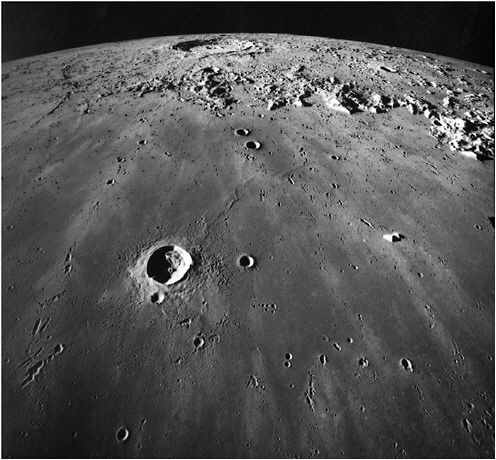
FIGURE 3.4 Copernicus crater (near the horizon, above), 95 km in diameter, and its ray system as seen from orbit during Apollo 17. Lunar impact craters provide direct information about the excavation, transport, and deposition of materials by a major impact event. SOURCE: NASA Apollo 17 AS17-M-2444.
examined. Recently it has been pointed out that the definition of crater diameters of multi-ring basins in the older literature is problematic and should no longer be used. These papers argue for smaller diameters on the basis of geophysical modeling of gravity-field anomalies associated with these basins. However, the definition of the final “rim-to-rim” diameter of a multi-ring basin is difficult and remains a matter of debate. Large terrestrial complex impact structures are frequently eroded to varying degrees. There are also impacts that have been tectonically modified or buried by post-impact sediments (e.g., Chicxulub, Chesapeake). Contrary to the situation with lunar craters, these craters can only be investigated through drilling programs or geophysical techniques, so their detailed structure is not very well known. For example, in the case of Chicxulub, seismic reflection data are available for a faulted rim area and a topographic peak ring, but a loss of coherent seismic reflections does not allow studying the structural details close to the center.
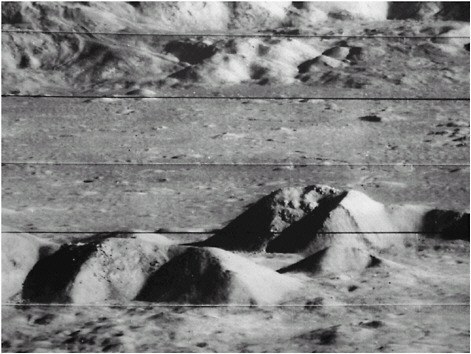
FIGURE 3.5 The central peaks of Copernicus crater. The blocky mountains in the center of the crater are a few hundred meters in height and contain deep-seated material brought to the surface during rebound from the impact. SOURCE: NASA Lunar Orbiter 2.
Science Goal 6c
—Quantify the effects of planetary characteristics (composition, density, impact velocities) on crater formation and morphology.
It is known from Earth that target effects have influence, for example, on the transition diameters between simple and complex craters. Terrestrial impact carters are subject to erosion. While this may be detrimental to establishing morphometric relations, it allows studying terrestrial impact structures at different erosional levels. Together with field observations and drilling data, such studies revealed that central peaks of complex craters are the product of uplift of deeper target lithologies. For terrestrial craters with diameters between 4 km and 250 km, the amount of uplift can be expressed by a simple power law. Attempts to relate the terrestrial data to lunar craters yielded a similar power law. However, this power law only holds for lunar craters that are on the order of 17 km to 136 km, and there are caveats and ambiguities, the resolution of which awaits better data. On Earth, craters in sedimentary target rocks, such as the Ries crater, usually do not show high central peaks. In contrast, craters of similar diameter in crystalline target rocks (e.g., Boltysh, Ukraine) have prominent central peaks. It is assumed that the target properties control the morphological expression of the uplift. Variations in gravity from one planetary body to another also influence the crater morphology. Bodies with lower gravity usually show deeper impacts than those of bodies with higher gravity. All natural impacts are to some extent oblique and have been investigated through computer codes and laboratory experiments. However, verification of computer codes with laboratory experiments remains an open issue. Problems in comparing numerical model with impact experiments
stem from the higher impact velocities and larger impact scales of planetary impacts that can not be reproduced in laboratory experiments.
Science Goal 6d
—Measure the extent of lateral and vertical mixing of local and ejecta material.
Deposition of ejecta is an important factor in the mixing of lunar surface materials. Because this process is very complex on the scale of individual samples, there is only limited consensus on the nature and absolute extent of such mixing. For the Ries crater, it has been demonstrated that local reworked material increases beyond 1 crater radius and comprises 70 to 90 percent of the total clast population of the breccia deposits at 2 to 3 crater radii. Continuing improvements in remote sensing might yield observational data to calibrate the various estimates of mixing ratios as functions of distance.
In summary, implementation of the Vision for Space Exploration presents an opportunity to characterize the cratering processes on a scale that is particularly relevant to understanding the effects of impact craters on planets.
Concept 7:
The Moon is a natural laboratory for regolith processes and weathering on anhydrous airless bodies.
Regoliths, exemplified by the lunar regolith, form on airless bodies of sufficient size to retain a significant fraction of the ejecta from impact events. The regolith has accumulated representative rocks from both local and distant sources since the most recent resurfacing event (e.g., the deposition of lavas or a substantial impact debris layer). It also contains modification and alteration products induced by meteoroid and micrometeoroid impacts, and modifications due to the implantation of solar and interstellar charged particles, radiation damage, spallation, exposure to ultraviolet radiation, and so on. A description of the formation of agglutinates to describe the complexity of regolith processes is shown in Figure 3.6. Knowledge of the processes that create and modify the lunar regolith is essential to understanding the compositional and structural attributes of other airless planet and asteroid regoliths.
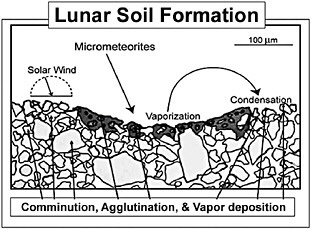
FIGURE 3.6 Micrometeorites impact the lunar soil, some with enough energy to melt the silicate minerals. This melt splashes over grains, quenches to glass, and forms agglutinates. Some melt reaches even higher temperatures and partially vaporizes, only to condense on the surfaces of other grains. SOURCE: Courtesy of Lawrence A. Taylor, University of Tennessee.
Science Goal 7a
—Search for and characterize ancient regolith.
Because the regolith collects the products of the interaction of impactors and radiation with the surface, the composition of ancient regoliths, protected by overlying layers of volcanic materials, may yield information on the time-history of the Sun and interstellar particle fluxes in the inner solar system. Layers of interspersed volcanic rocks and ancient regolith can be observed or inferred in the maria (for example, by the Apollo 17 radar sounder, albeit at greater depths than relevant here), where the periods between successive volcanic flows were periods of new regolith formation. Such layers can be investigated from several perspectives: (1) they contain a record of solar particle irradiation at specific times that can be dated by age determination of underlying and overlying basalts, (2) they accumulated materials that were being ejected from lunar surface petrologic provinces at specific past times, and (3) they contain a cumulative record of the composition of impactors on the Moon at those times. The probability of finding meteorites from the ancient Earth will be greater in regoliths of older age.
Sampling of these ancient regolith layers can be carried out by drilling through interspersed volcanic rock and regolith or by collecting rocks in the walls of impact craters or along rilles. If the ancient regolith layers have been indurated through the thermal effects of the overlyig lavas, they might also be discovered in the rock fragments that surround impact craters. Samples may be available at many mare locations, but targeted collection would benefit from on-site human field observations to identify and retrieve the desired sample materials. For example, a sampling device (e.g., a rover) could sample the stratigraphic column in an impact crater wall or in a rille, with an astronaut making critical observations of the properties of the layered sequence using handheld sensors.
Science Goal 7b
—Determine the physical properties of the regolith at diverse locations of expected human activity.
Most lunar resources will be derived from the regolith. Understanding the mineralogy, volatile concentrations, and physical properties of the regolith and having a better understanding of regolith formation and history will be crucial to exploring for and developing extractive techniques for regolith-based resources. This is particularly true for the polar regions, for which there is no current basis for understanding these properties in detail. The physical properties of the regolith will be essential information for the most effective design of surface structures for use by human explorers. Better determination of the physical properties of the regolith as a function of depth (strength, cohesion, and so on) will be important in the design of processes and technology to excavate and transport lunar regolith for purposes of radiation protection and resource extraction.
The Apollo drill cores were able to reach 3 meters (m) into regoliths that are 6 m to 10 m in thickness. The bottom of the regolith, at its contact with underlying bedrock, is unexplored, as are the physical properties, particularly in terms of fragment size and layering, of the earliest regolith. This may have a bearing on recognizing ancient regolith layers.
Drill holes in the regolith have other uses as well. The 3 m drill holes of Apollo were used to emplace a heat flow experiment. The deeper the drill hole, the more precise the thermal data could be for heat flow determinations, with a 10 m hole representing perhaps an optimal choice with respect to attainability and the expected thickness of fine-grained regolith materials. Measurement of the borehole temperature profile and the thermal diffusivity of the regolith in a 10 m hole will enable small variations in the past solar intensity to be detected against the steady gradient expected from a constant insolation. Interpretation of a lunar borehole thermal profile is straightforward, providing a clean test of proposed scenarios of solar variations extending back several hundred years. This information about the Sun, derivable from the Moon’s regolith temperature profile, has important implications for interpretation of Earth’s currently observed global warming.
Science Goal 7c
—Understand regolith modification processes (including space weathering), particularly deposition of volatile materials.
Understanding the “space weathering” processes that affect the regolith, particularly the distribution of materials volatilized by impacts, is essential to the interpretation of spectral data used to map the distribution of rock
types on the surface. Because the effects of space weathering depend on both the composition and the exposure history of the surface, additional lunar regolith samples that represent materials of different initial composition and age should be prime candidates for study and return to Earth for detailed study. It may be possible to expose artificial surfaces to the lunar environment to examine the effects of micrometeorite impact and volatile deposition. These data will be valuable for the interpretation of remote sensing data of other places on the Moon as well as for other airless bodies.
Science Goal 7d
—Separate and study rare materials in the lunar regolith.
The regolith collects fragments of rocks that come to the Moon as meteorites as well as impact ejecta from across the lunar surface. Owing to the discovery of meteorites from the Moon and Mars on Earth, it is now believed that there has been an exchange of materials between the planets over time. There is no reason to believe that the larger size of Earth or its atmosphere precludes the ejection of materials from Earth, some of which could impact the Moon. Modeling of this phenomenon is a new opportunity for scientists, with the possibility that the models can be verified by the discovery and characterization of terrestrial meteorites on the Moon. The probability of finding such material is small; however, a large quantity of lunar regolith is available and could be sampled if simple, rapid screening techniques are developed. Discovery of pieces of ancient Earth rocks on the Moon could provide a new window into early Earth history.
Likewise, the regolith collects samples of rocks and glasses ejected by impact events all over the Moon, the ejecta from the closest impact event being the most likely to accumulate at a given site. A systematic study of a large amount of regolith, selecting rock fragments of a few millimeters diameter, which are large enough for detailed petrologic and geochemical study, should yield a good sampling of the diversity of lunar surface materials. Techniques to identify rarer or previously unsampled rocks are needed. The correlation of regolith rock types with surface exposures may be possible through detailed spectroscopic analysis in concert with remote sensing data.
In summary, through regolith studies during implementation of the Vision for Space Exploration, multiple opportunities may be addressed that will constrain processes involved in regolith evolution, decipher ancient lunar environments, contribute to understanding the history of the Moon, and provide important information for future human activity on the Moon. It may be possible to deduce recent past solar variability from regolith thermal measurements.
Concept 8:
Processes involved with the atmosphere and dust environment of the Moon are accessible for scientific study while the environment remains in a pristine state.
Science Goal 8a
—Determine the global density, composition, and time variability of the fragile lunar atmosphere before it is perturbed by further human activity.
The nearest example of a surface boundary exosphere (SBE) is the lunar atmosphere. SBEs are tenuous atmospheres whose exobase is at the planetary surface. Because individual atoms and molecules rarely collide in SBEs, kinetic chemistry is all but nonexistent, but important structural and dynamical processes do occur. SBEs are known to exist on Mercury, Europa, Ganymede, Callisto, and Enceladus; they are expected to exist on many other satellites and perhaps even Kuiper Belt objects. SBEs are the least-studied and least-understood type of atmosphere in the solar system but could provide new insights into surface sputtering, meteoritic vaporization processes, exospheric transport processes, and gas-surface thermal and chemical equilibration. The lunar atmosphere is the only SBE atmosphere in the solar system that is sufficiently accessible that researchers can expect to study it in detail using both lander and orbital techniques.
Apollo Lunar Surface Experiments Package (ALSEP) surface station instruments revealed that the mass of the native lunar atmosphere is on the order of 100 tons (3 × 1030 atoms, equivalent to ~1011 cm3 of terrestrial air at sea level [i.e., a cube of terrestrial air roughly 50 × 50 × 50 cubic meters at standard temperature and pressure]). Yet ALSEP total lunar atmosphere mass measurements failed to identify a census of species that comes anywhere
close to the total mass of the lunar atmosphere: in fact, over 90 percent of the molecules in the Moon’s atmosphere are currently compositionally unidentified.
As a result of its low mass, the lunar atmosphere is incredibly fragile. A typical lunar surface access module (LSAM) landing will inject some 10 to 20 tons of non-native gas into the atmosphere, severely perturbing it locally for a time that might range from weeks to months. A human outpost might see sufficient traffic and outgassing from landings, lift-offs, and extravehicular activities (EVAs), for example, to completely transform the nature of this pristine environment. For this reason, the committee recommends a strong early emphasis on studies of the native lunar atmosphere.
The key scientific questions to address are the following: What is the composition of the lunar atmosphere? How does it vary in time with impacts, diurnal cycles, solar activity, and so on? What are the relative sizes of the sources that create this atmosphere and the sinks (loss processes) that attack it?
Science Goal 8b
—Determine the size, charge, and spatial distribution of electrostatically transported dust grains and assess their likely effects on lunar exploration and lunar-based astronomy.
During the Apollo era it was discovered that sunlight was scattered at the lunar terminator giving rise to “horizon glow” and “streamers” above the surface. These phenomena were most likely caused by sunlight scattered by electrically charged dust grains originating from the surface, which is itself electrically charged by the local plasma environment and the photoemission of electrons by solar ultraviolet radiation.
Under certain conditions, the like-charged surface and dust grains act to repel each other, thus transporting the dust grains away from the surface. The limited observations of this phenomenon, together with laboratory and theoretical work, suggest that there are two modes of charged-dust transport: “levitation” and “lofting,” both of which are driven by the surface electric field. Micron-scale dust is levitated at about 10 cm, while <0.1 micron dust is lofted to altitudes higher than 100 km. The Apollo 17 Lunar Ejecta and Meteorites surface experiment directly detected the transport of charged lunar dust traveling at up to 1 kilometer per second. The dust impacts were observed to peak around the terminator regions, thus suggesting a relationship with horizon glow.
It is necessary to make targeted in situ measurements of dust-plasma-surface interactions on the Moon in order to fully understand this critical environment. The plasma, electric-field, and optical measurements that are required for characterizing the lunar dust-plasma environment can be made from orbit to give a global-scale view and from the surface to give a local view. To optimize the characterization of this environment, the committee recommends that measurements from orbit and from the surface be coordinated, so that the connection between processes at these scales can be understood. Several landers would be advantageous, since not every point on the lunar surface experiences the same conditions—for example, locations near the poles will be quite different from those nearer the equator.
Astronauts could be used to distribute a network of sensors on the lunar surface. In addition to measuring the natural environment, the instrumentation should also detect the charge on the astronauts and the dust transport caused by their moving around on the surface. These measurements will reveal how astronauts and equipment are coupled to the dust-plasma environment. From the experiences of the Apollo astronauts, it is known that dust will be a significant impediment to surface operations; therefore, it is crucial that a much better understanding of this environment be obtained as early as possible.
Science Goal 8c
—Use the time-variable release rate of atmospheric species such as 40Ar and radon to learn more about the inner workings of the lunar interior.
The first detection of individual atmospheric species came from the ALSEP and the scientific instrument module (SIM) instruments in the orbiting Apollo service module bay. Among the species discovered by Apollo missions were 40Ar, Po, Pb, Ra, and Rn, all of which emanate from the lunar interior via outgassing. Through the time variability and spatial location of such species, the lunar atmosphere represents a window into the workings and evolution of the lunar interior, including perhaps fractionization and a molten core. After Apollo, ground-based observers detected the alkali tracer species Na and K whose density ratios were close to the lunar surface ratio, suggesting that part of the atmosphere originates from the vaporization of surface minerals by processes such as
solar wind sputtering and micrometeorite impact. Na and K are also present in the SBE atmospheres of Mercury, Io, and other Galilean satellites, thereby strengthening the utility of lunar SBE studies for enhancing knowledge of similar atmospheres across the solar system.
Science Goal 8d
—Learn how water vapor and other volatiles are released from the lunar surface and migrate to the poles where they are adsorbed in polar cold traps.
Evidence for volatile species, including H2O, CO, CO2, and CH4, was found sporadically by Apollo sensors, but these detections remain unconfirmed. The detection and study of volatiles are of great scientific interest and have obvious implications related to the trapping of ices that could represent resources to be exploited at the lunar poles. The expected sources of volatiles include comets, the solar wind, and meteoroids. Sinks include photodissociation, Jeans escape, solar wind pickup, and condensation. Once released from the surface by heating, sputtering, or other processes, the volatiles perform ballistic hops in a random walk across the surface. As the terminator is approached, the hops get smaller until the volatiles are adsorbed on the surface in darkness only to be released again at dawn. Modeling shows that there is a net migration toward the poles where the volatiles may be condensed in permanently shadowed depressions or craters. Future measurements should be designed to determine what processes (thermalization, release rate, and velocity) control atmospheric migration and what the efficiency of transport to the poles is.
Early observational studies to address these issues and the concern over human-induced modification of the ancient, native lunar environment should include the following:
-
A complete census and time variability of the composition of the lunar atmosphere;
-
Determination of the size, charge, and spatial distribution of electrostatically transported dust grains;
-
Determination of the time variability of indigenous (e.g., outgassing, sputtering) and exogenous (e.g., meteorite and solar wind) sources (see Figure 3.7);
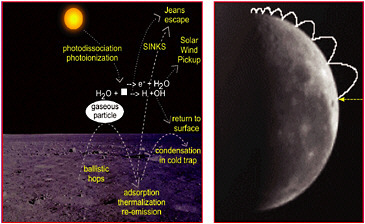
FIGURE 3.7 Lunar volatile transport. SOURCE: D.H. Crider and R.R. Vondrak, The solar wind as a possible source of lunar polar hydrogen deposits, J. Geophys. Res. 105:26773, 2000, ©2000 American Geophysical Union. Reproduced by permission of American Geophysical Union.
-
Determination of the average rate of volatile transport to the poles, including sunrise/sunset dynamics; and
-
Determination of typical loss rates by various processes (e.g., photoionization, surface chemistry, Jeans escape, Michael-Manka mechanism).
Such studies could be completed from early surface networks, fixed or mobile landers, or orbiters, or a combination of any two, with experiments that would include ion-mass spectrometers, optical/ultraviolet spectrometers, and cold cathode gauges. Later, as rocket traffic and human activities perturb the lunar atmosphere from its native state, studies of the environmental effects of human and robotic activity would be highly illuminating, as an “active experiment” in planetary-scale atmospheric modification.
Before extensive human and robotic activity alters the tenuous lunar atmosphere, it is important to understand its composition, transport mechanisms, and escape processes. At the same time, the lunar dust environment must be well characterized so that effective human exploration and astronomical observations can be planned.


