




Below is the uncorrected machine-read text of this chapter, intended to provide our own search engines and external engines with highly rich, chapter-representative searchable text of each book. Because it is UNCORRECTED material, please consider the following text as a useful but insufficient proxy for the authoritative book pages.
Part II: Preventive Intervention Research T here have been many areas of progress in preventive intervention research since the 1994 Institute of Medicine (IOM) report Reducing Risks for Mental Disorders: Frontiers for Preventive Intervention Research. The volume, reliability, and richness of experimental research have significantly improved in part because of significant advances in the methodological approaches applied to intervention research. Randomized trials, which were strongly recommended in the 1994 IOM report, have expanded (see Figure 1-1). Research has identified beneficial preventive interventions throughout young peopleâs development and for a range of outcomes. As the body of intervention research has increased, the number of studies that include economic analyses to explore the costs and benefits of these interventions has also increased, further supporting the value of these approaches. This makes a case for supplementing traditional universal health care approaches, such as prenatal care, immunizations, and policies that sup- port families, to support the healthy development of young people. This report cannot cover the hundreds of randomized controlled trials that have been conducted since the 1994 IOM report. Instead, the analysis cites and draws on the findings of the several dozen relevant meta-analyses and systematic reviews, which themselves are testimony to the substantial increase in relevant research. The analysis also highlights specific interven- tions that have been tested and refined in several well-designed randomized controlled trials; some include analyses of cost-effectiveness or long-term outcomes. Although this does not include the many interventions for which some evidence is available, or even all that have been labeled by other groups as effective, it does focus on interventions that have been most rig- 151
152 PREVENTING MENTAL, EMOTIONAL, AND BEHAVIORAL DISORDERS orously evaluated and illustrates the potential to prevent numerous mental, emotional, and behavioral (MEB) disorders and the problem behaviors related to them. Box II-1 highlights some of the major outcomes of these interventions. In some areas in which evidence is more limited but there is clear conceptual potential, we mention interventions that appear promising but have not been tested in multiple experimental evaluations. BOX II-1 Outcome Highlights of Preventive Interventions Prevention of Child Maltreatment ⢠Meta-analyses have found that interventions that promote family wellness and provide family support are successful in preventing child maltreatment. ⢠Home visiting programs have demonstrated reduced physical abuse, aggres- sion, and harsh parenting. ⢠Comprehensive early education programs have demonstrated reduced child maltreatment. Academic Achievement ⢠School-based social and emotional learning programs that include academic achievement as an outcome had effects equivalent to a 10 percentage point gain in academic test performance (Durlak, Weissberg, et al., 2007). Violence Prevention ⢠School-based violence prevention programs have effects that would lead to a 25-33 percent reduction in the base rate of aggressive problems in an average school (Wilson and Lipsey, 2007). Conduct Problems ⢠The Good Behavior Game reduced disruptive and aggressive behavior and reduced the likelihood that initially aggressive students would receive a diag- nosis of conduct disorder by sixth grade (Wilcox, Kellam, et al., 2008), or that persistently highly aggressive boys would receive a diagnosis of antisocial personality disorder as a young adult (Petras, Kellam, et al., 2008). ⢠Linking Interests of Families and Teachers reduced levels of aggressive Âbehavior (Eddy, Reid, and Fetrow, 2000). ⢠Fast Track reduced self-reported antisocial behavior and, for children at highest risk, reduced incidence of conduct disorder and attention deficit hyperactivity disorder (Conduct Problems Prevention Research Group, 2007). Depression ⢠Meta-analyses have found that interventions to prevent depression can both reduce the number of new cases of depression in adolescents and reduce
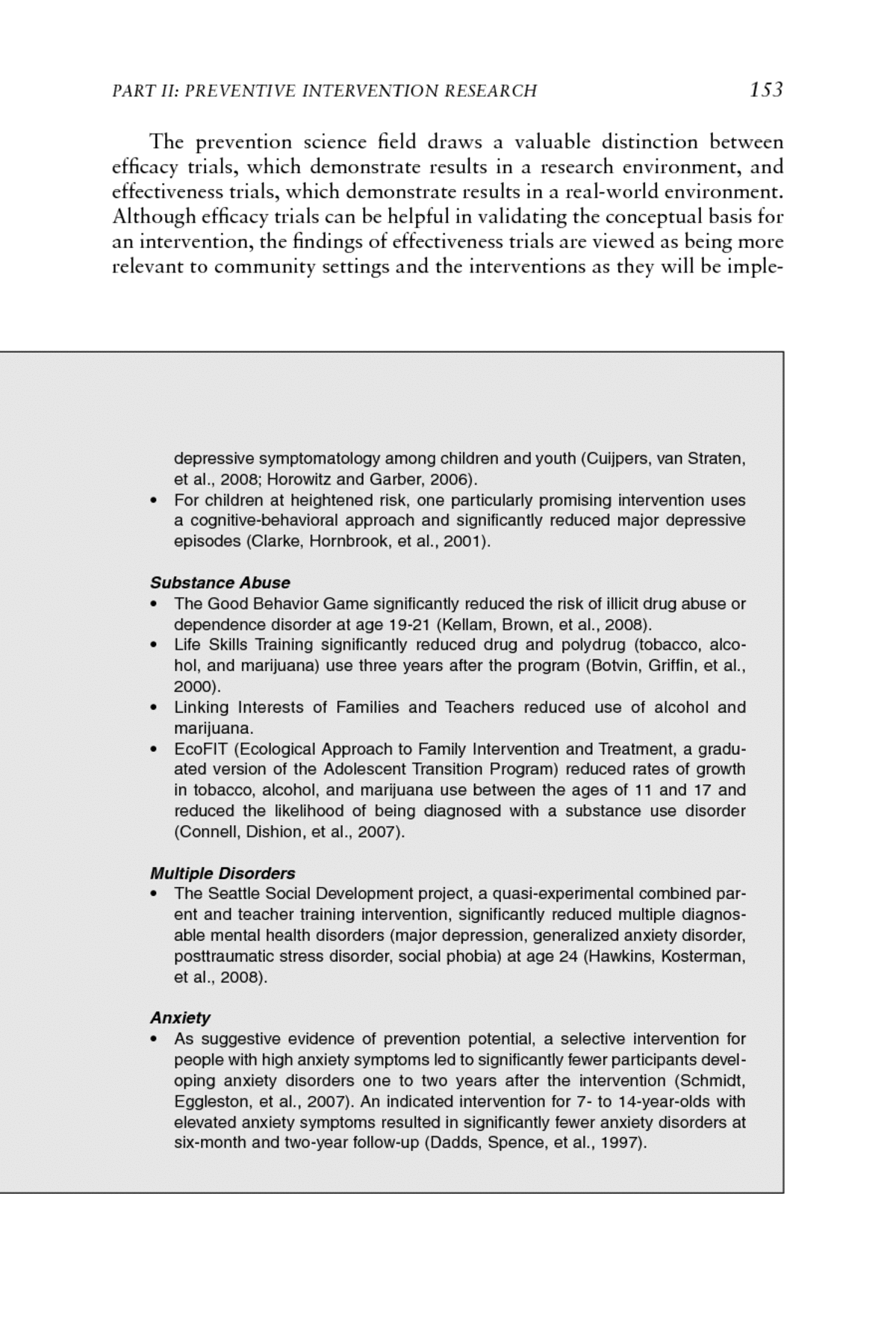
PART II: PREVENTIVE INTERVENTION RESEARCH 153 The prevention science field draws a valuable distinction between efficacy trials, which demonstrate results in a research environment, and effectiveness trials, which demonstrate results in a real-world environment. Although efficacy trials can be helpful in validating the conceptual basis for an intervention, the findings of effectiveness trials are viewed as being more relevant to community settings and the interventions as they will be imple- depressive symptomatology among children and youth (Cuijpers, van Straten, et al., 2008; Horowitz and Garber, 2006). ⢠For children at heightened risk, one particularly promising intervention uses a cognitive-behavioral approach and significantly reduced major depressive episodes (Clarke, Hornbrook, et al., 2001). Substance Abuse ⢠The Good Behavior Game significantly reduced the risk of illicit drug abuse or dependence disorder at age 19-21 (Kellam, Brown, et al., 2008). ⢠Life Skills Training significantly reduced drug and polydrug (tobacco, alco- hol, and marijuana) use three years after the program (Botvin, Griffin, et al., 2000). ⢠Linking Interests of Families and Teachers reduced use of alcohol and marijuana. ⢠EcoFIT (Ecological Approach to Family Intervention and Treatment, a gradu- ated version of the Adolescent Transition Program) reduced rates of growth in tobacco, alcohol, and marijuana use between the ages of 11 and 17 and reduced the likelihood of being diagnosed with a substance use disorder (  Connell, Dishion, et al., 2007). Multiple Disorders ⢠The Seattle Social Development project, a quasi-experimental combined par- ent and teacher training intervention, significantly reduced multiple diagnos- able mental health disorders (major depression, generalized anxiety disorder, posttraumatic stress disorder, social phobia) at age 24 (Hawkins, Kosterman, et al., 2008). Anxiety ⢠As suggestive evidence of prevention potential, a selective intervention for people with high anxiety symptoms led to significantly fewer participants devel- oping anxiety disorders one to two years after the intervention (Schmidt, Eggleston, et al., 2007). An indicated intervention for 7- to 14-year-olds with elevated anxiety symptoms resulted in significantly fewer anxiety disorders at six-month and two-year follow-up (Dadds, Spence, et al., 1997).
154 PREVENTING MENTAL, EMOTIONAL, AND BEHAVIORAL DISORDERS mented in everyday practice. The tide has begun to turn, with effectiveness trials beginning to emerge. As discussed in Part I, young people develop in the context of their families, schools, and communities. Interventions designed to support healthy emotional and behavioral development and prevent disorder take place largely in the contexts of these support systems. Such interventions as prenatal care, home visiting, parenting skills training, programs designed to mitigate specific family-based strain (e.g., bereavement, dealing with a men- tally ill parent), and some public policies share a goal of improving family functioning and creating nurturing environments. Many other interventions aimed at a range of problem behaviors have been developed to reach young people through schools, and community-wide approaches have begun to emerge. Some interventions combine aspects of family-based interventions with school-based approaches. These family, school, and community-wide approaches are discussed in Chapter 6. Chapter 7 includes a discussion of preventive interventions that are targeted at specific disorders rather than at specific settings. Delivered in m  ental health, health, and school settings, these interventions deal directly with children, with parents, and with the whole family. Chapter 7 also includes interventions targeted at mental health promotion, including inter- vention strategies related to modifiable lifestyle factors. The range of developmental phases in a young personâs life offers vari- able opportunities for intervention. Interventions are designed to address differential risk and protective factors prominent in a particular develop- mental stage or the emergence of symptoms that tend to occur at different ages. Most of the interventions discussed in Chapters 6 and 7, regardless of their mechanism, target young people during one or more developmental phases (see Figure II-1). Preventive interventions are characterized by the level of risk of the population targeted for intervention. Screening, typically thought of in the context of indicated preventive interventions, in which individuals demonstrate elevated symptom levels that precede a diagnosis of disorder, may have applications for universal and selective interventions as well. The nation should proceed with caution, however. These issues are discussed in Chapter 8. Family-, school-, and community-based interventions can help reduce the significant personal, family, and social costs of MEB disorders and related problem behaviors. These costs and available economic analyses of some of the interventions discussed in Chapters 6 and 7 are outlined in Chapter 9. Finally, significant methodological advances since 1994 have increased the reliability of causal inferences possible from preventive intervention research and provided the field with solid guidelines on the design and
Interventions by Developmental Phase Prior to Early Early Young Conception Prenatal Infancy Childhood Childhood Adolescence Adolescence Adulthood Pregnancy Prenatal prevention care Home visiting Early childhood interventions Parenting skills training Social and Classroom-based curriculum to behavioral prevent substance abuse, skills training aggressive behavior, or risky sex Prevention of depression Prevention of schizophrenia Prevention focused on specific family adversities (Bereavement, divorce, parental psychopathology, parental substance use, parental incarceration) Community interventions Policy FIGURE II-1â Interventions and their targeted developmental stages. 155 Fig II-1.eps
156 PREVENTING MENTAL, EMOTIONAL, AND BEHAVIORAL DISORDERS conduct of quality research. These developments are discussed in Chapter 9, which also provides a bridge to Part III, New Frontiers, by outlining some of the methodological challenges and opportunities for the next generation of prevention research. The evidence presented here has important practical implications for the practices of the schools, family service agencies, and health care pro- viders that are involved at each stage of the development of young people. Taken together, the evidence shows that the nation could support the healthy development of many more young people.
