






Below is the uncorrected machine-read text of this chapter, intended to provide our own search engines and external engines with highly rich, chapter-representative searchable text of each book. Because it is UNCORRECTED material, please consider the following text as a useful but insufficient proxy for the authoritative book pages.
Appendix D Update of SBIR Fast Track Case Studies Rosalie Ruegg TIA Consulting SELECTION OF A SUBSET OF EARLIER FAST TRACK CASES FOR UPDATE In an earlier NRC study of the SBIR Fast-Track initiative, members of an NRC research team conducted a series of case studies of SBIR projects which included both Fast-Track and non-Fast Track participants. Of the total of 55 project case studies conducted for the earlier study, 17 were Fast Track cases, and 38 were non-Fast Track cases. While the cases centered on projects, they also treated the companies that received the SBIR awards and conducted the research. There were slightly fewer companies than projects because several case-study projects were conducted by the same company, but in the case of the Fast Track projects, there was a one-to-one correspondence between projects and companies: 17 projects carried out by 17 companies. A preliminary search of the 17 previous Fast Track companies was done using Dun & Bradstreet company reports to determine which of the companies could still be found. Of the 17 companies, 10 were found to have reports on file. While it is possible that some of the remaining seven companies also may be still in existence, no Dun & Bradstreet reports were found for them, and further searches for contact information came up empty. Moreover, not all of the 10 companies for which Dun & Bradstreet reports were on file could be foundâalthough 9 of the 10 were found. AN OVERVIEW OF THE 55 EARLIER CASE STUDIES The previous case studies, from which the 10 Fast Track companies were drawn, were conducted by five different researchers, focused on projects and associated award recipients in different regions of the country, and on a variety of research questions. A brief summary follows of the earlier five sets of 115
116 APPENDIX D cases which included the Fast Track award recipients, with illustrative research questions and findings from each set:1 (1) Researcher John Scottâs set of 14 cases included six Fast Track and eight non-Fast Track projects in 13 companies.2 Illustrative Research Questions and Findings: Question: In the absence of the SBIR funding, would the research projects have been undertaken in the same way or at the same pace? Finding: It was concluded that the projects would not have been undertaken in the same way or at the same pace in absence of the SBIR program, due to the expectation that they would have been under funded. Question: Were there differences between Fast Track and non-Fast Track projects in their estimated lower-bound social rates-of-return? Finding: As a group, the Fast Track projects were estimated to have higher prospective lower-bound social rates of return. (2) Researcher Albert Linkâs set of 12 cases included six Fast Track and six non-Fast Track projects in 12 companies.3 Illustrative Research Questions and Findings: Question: Do Fast Track projects progress more rapidly than standard SBIR awards? Finding: Fast Track projects proceeded to Phase II research faster than non- Fast Track projects. Question: Do the Fast Track projects commercialize more rapidly than the non-Fast Track projects? Finding: Fast Track projects developed a commercialization strategy sooner than non-Fast Track projects, but those Fast Track projects did not anticipate having commercial products sooner than non-Fast Track projects. 1 In addition to the 55 case studies, the earlier study of Fast Track included a survey of 379 Phase II awards. 2 Study focus and key findings of John Scottâs case study set were reported in âAn Assessment of the Small Business Innovation Research Program in New England: Fast Track Compared with Non- Fast Track Projects,â in National Research Council, The Small Business Innovation Research Program: An Assessment of the Department of Defense Fast Track Initiative, Charles W. Wessner, ed., Washington, DC: National Academy Press, 2000, pp. 104-105. 3 Study focus and key findings of Albert Linkâs case study set were reported in âAn Assessment of the Small Business Innovation Research Fast Track Program in Southeastern States,â in National Research Council, The Small Business Innovation Research Program: An Assessment of the Department of Defense Fast Track Initiative, op. cit., pp. 194-210.
APPENDIX D 117 (3) Researcher Maryann Feldmanâs set of five cases included one Fast Track and four non-Fast Track projects.4 Illustrative Research Questions and Findings: Question: What has been the role of DoDâs SBIR in financing bioscience research? Finding: DoDâs SBIR was found to have played a substantial role in financing bioscience research, with the study documenting more than $240 million in SBIR awards for bioscience-related research by small firms. Question: How does funding of small start-up biotech companies by DoE and NIH compare? Finding: DoD and NIH funding of the projects examined was found to be complementary; these agencies funded different applications, and it was common for a firm that received DoD funding to subsequently apply to NIH. (4) Researchers David Audretschâs, Juergen Weigandâs, and Claudia Weigandâs set of 12 cases included zero Fast Track and 12 non-Fast Track5 Illustrative Research Questions and Findings: Question: To what extent have recipients of SBIR awards altered their career choices as a result of SBIR, particularly by commercializing their knowledge by starting a new firm? Finding: Study results suggested that the SBIR influenced the career paths of scientists and engineers by facilitating the start-up of new firms; it was found that a significant number of the scientists and engineers would not have become involved in the commercialization process in the absence of SBIR. Question: Has the behavior of recipients of SBIR awards âspilled overâ by inducing other colleagues to commercialize their knowledge in the form of starting a new firm? 4 Study focus and key findings of Maryann Feldmanâs case study set were reported in âRole of the Department of Defense in Building Biotech Expertise,â in National Research Council, The Small Business Innovation Research Program: An Assessment of the Department of Defense Fast Track Initiative, op. cit., pp. 251-274. 5 Study focus and key findings of the case study set of David Audretsch, Juergen Weigand, and Claudia Weigand were reported in âDoes the Small Business Innovation Research Program Foster Entrepreneurial Behavior? Evidence from Indiana,â in National Research Council, The Small Business Innovation Research Program: An Assessment of the Department of Defense Fast Track Initiative, op. cit., pp. 160-193.
118 APPENDIX D Finding: The study concluded that as a result of the demonstration effect by SBIR-funded commercialization, a number of other scientists altered their careers to include commercialization efforts. (5) Researcher Reid Cramerâs set of 12 cases included four Fast Track and eight non-Fast Track6 Illustrative Research Questions and Evidence-Based Answers: Question: What organizational characteristics differentiate the SBIR companies? Finding: Three categories of firms were found among the case-study firms, resulting in the following classification by firm type: (1) contractor firms, (2) technologies firms, and (3) scientific firms. Question: Are there benefits from the SBIR beyond commercial sales? Finding: Benefits of the case-study companies were not only expressed in terms of commercial sales, but also in terms of expanding basic research, responding to government needs, and developing applications for technology. UPDATING THE 10 FAST TRACK CASES The current study has focused on updating the earlier Fast Track cases that could be found, but without the single-project focus of the earlier study and without pursuing the research questions of that earlier study. Rather, the focus of this update is on the company: on major changes in the company over the nearly 10 years since the earlier case was performed; on shifts in the companyâs technology focus and application areas over the period; on the extent of commercialization by the company and specifically on commercialization of its SBIR-funded technology; on the number of SBIR awards received by the company; and on company views about SBIR and Fast Track awards, and, where relevant, Phase II Enhancement awards. The updated case studies are based on telephone interviews with owners, presidents, or designated points of contacts within the companies; supplementary information from the companies provided by email correspondence; information gleaned from company Web sites; news releases; Dun & Bradstreet company reports; SBA SBIR and Fast Track on-line awards databases; and the earlier case studies. The interview discussions focused on the following topics: 6 Study focus and key findings of Reid Cramerâs case study set were reported in âPatterns of Firm Participation in the Small Business Innovation Research Program in Southwestern and Mountain States,â in Naitonal Research Council, The Small Business Innovation Research Program: An Assessment of the Department of Defense Fast Track Initiative, op. cit., pp. 160-159.
APPENDIX D 119 ⢠Verification of current company location and contact information, founding date, and ownership structure. ⢠Verification of the number and type of SBIR awards the company has received, including Fast Track and Phase II Enhancements, the agency making the award, the year and amount, and the project title, as reported by on-line SBA databases. ⢠Major company developments over the nearly 10 years since the previous case studies were done. ⢠SBIR effects, if any, on the firm. ⢠Commercialization status, including whether the companyâs SBIR awards have led to commercial products, including use of SBIR project results by DoD. ⢠Views about the SBIR program in general. ⢠Level of satisfaction with Fast Track. ⢠Identification of any problems or shortcomings with Fast Track ⢠Identification of any positive aspects of Fast Track. ⢠Suggested changes to Fast Track. ⢠Views about whether they would consider proposing again to SBIR; proposing again for a Fast Track award; or proposing for a Phase II Enhancement award; factors influencing their decisions. Table App-D-1 lists the 10 company cases selected for updateânine of which were found still in existence. Of the nine found, seven agreed to cooperate with the study. Entries are provided for all 10 of the companies, but information derived from interview is available only for the seven which cooperated. The table provides overview information for the 10 companies, including the following: location; forms of ownership and major changes since 1998; founding dates; technology focus then and now; number of employees then and now; and the number of SBIR awards received over a specified period. In addition to the information summarized in Table App-D-1, the individual cases provide the following kinds of information: descriptions of major changes experienced by the companies since the original Fast Track case study was performed about 10 years ago; application areas for technologies then and now; descriptions of company commercialization; and company views of the SBIR program, of Fast Track, and, where applicable, of Phase II Enhancement awards. An analysis of aggregate findings for each kind of information collected follows. Location As would be expected given the regional distribution of the original case studies, the Fast Track cases for update are geographically dispersed. Three are located in the northeast; two in the west; and five in the south,
120 APPENDIX D although one of the latter was acquired by a company headquartered in California. Ownership and Size At the time the case studies for these 10 companies were originally done, all were small, privately owned companies. Two were woman owned, and one of the woman-owned companies was also minority owned. Half had 10 or fewer employees, and all but one had no more than 26 employees. A single company had more than 100 employees. At the time of the update, one of the companies (Picolight) had been acquired by a very large, publicly held company, and another (CG2) had been acquired by a privately owned company larger than CG2, though still a small company. One company (Opts) appears no longer to exist. The remaining companies showed no change in ownership. Two (Hyperion Catalysis and Matis) had become larger; three (Synkinetics, AvPro, and Summitec) had become smaller; and two (Yardney and PTS) remained little changed in size. Founding All but one of the 10 companies was started between 1982 and 1995. At the time of the original case studies, three of the companies (Picolight, Opts, and CG2) were less than five years old. Of these three, two had been acquired by larger companies prior to this case study update, and one had gone under. The oldest company, Yardney, started in 1944, began to use SBIR awards in the early 1990s to advance its battery technology for defense and aerospace applications. One of the companies, Picolight, was a second startup by a former AT&T Bell Laboratories researcher. One of the companies, Synkinetics, was a spin-off company of MITâs Lincoln Laboratory in the early 1980. Another, Matis, was started in 1990 to respond to U.S. defense scientific computing needs, and has maintained close academic ties. Yet another of the companies, Summitec, started in 1987 to conduct defense R&D, had shifted away from R&D. Technology Focus and Application Areas Of the nine companies found, all had stayed in the same general technology field from the time of the earlier case studies to the present. At the same time there were significant shifts in focus, technical advances, and new applications. Yardney, for example, used its SBIR awards to develop high performance Li-ion batteries for defense and aerospace applications, a change from its former battery line. CG2 broadened its virtual reality capabilities and
APPENDIX D 121 broadened the applications beyond missile simulation testing to virtual training in urban assault and homeland defense, flight training, ground vehicle training, and additional weapons system simulation. Picolight advanced from developing its VCSEL platform technology to developing VCSEL-based transceivers and other devices for communication systems. Synkinetics advanced from fuel efficiency transmission technology to a patent-protected transmission system. AvPro made advances in moving its advanced process control technology for fabricating composite aerospace structures onto the shop floor. Hyperion Catalysis advanced from conducting carbon research to improving its manufacturing process technology for making carbon nanotubes and applying its carbon nanotube technology to making plastic parts for automobiles, electronics including flat-panel displays, and advanced batteries. In contrast to most of the companies which generally advanced their technologies, Summitec stayed in the general field of information technology, but moved out of research. It shifted from pursuing software for transmission of video images over narrow bandwidth for military applications, to providing technical services in information technology to government agencies. Commercialization The seven companies for which interviews were conducted were asked about their commercialization. Of the seven cooperating, six reported that they had commercialized technologies which they had developed. Six offered products for sale and several also provided services. The seventh (Summitec), having shifted its business away from R&D, offered a commercial service. Speaking specifically about commercializing their SBIR-funded technologies, two of the seven companies (Summitec and Hyperion Catalysis) stated explicitly that they had not commercialized their SBIR-funded technologies. Four (Yardney, Picolight, AvPro, and CG2) emphasized that they had commercialized their SBIR-funded technologies. One (Matis) spoke of commercializing its technology but did not directly connect commercialization to SBIR-funded projects. Four (Yardney, AvPro, CG2, and Matis) of the seven companies were supplying products and services primarily for military applications. At least two (Picolight and Hyperion Catalysis) of the seven companies had developed strong applications in civilian markets. One (Summitec) was providing information technology services to the Department of Energy. Number of SBIR Awards Received Six of the 10 companies received no more than five SBIR awards, and three received three or fewer. One received seven awards. Then there were three of the 10 companies that received considerably more awards: Yardney (56), Picolight (17), and CG2 (22). An observation is that the companies that
122 APPENDIX D received the most SBIR awards over the period examined included three of four that reported commercializing their SBIR-funded technologies, as well as the two companies (Picolight and CG2) that were acquired by larger companies. The small number of respondents means that these observations can not be generalized. Views on the SBIR Program Of the seven companies who provided comments on the SBIR program, three were extremely enthusiastic about the SBIR program in general. Of the three who were enthusiastic, Picolightâs founder called the SBIR program, âExcellent.â Adding, âIt works.â He went on to describe how he was able to build the foundation of his companyâs device technology and his company on SBIR awards. Yardneyâs President explained how the SBIR program had been particularly important to his company in helping it boost its R&D and sustain a research group, establish a new technology needed by aerospace and defense clients, and provide a path for implementation. The designated spokesperson for CG2said, âSBIR in general is fantastic,â and elaborated that the SBIR gives small companies the chance to take on high-risk research and to undertake more advanced topics of DoD interest. These three were the companies that had the most experience with the SBIR program and the most recent awards. Three companies (Summitec, Hyperion Catalysis, and Matis)ânone of whom had received SBIR awards since the original case studies were doneâ thought that the program had been satisfactory and could recall no specific problems. Matisâ President also noted that the SBIR awards had promoted company growth and helped the company to generate revenues. Views on Fast Track and Phase II Enhancement Awards Given that all of the companies had received Fast Track awards but only two (CG2 and Yardney) had received Phase II Enhancement awards, it is not surprising that company comments focused on Fast Track rather than Phase II Enhancement awards. Yet, because a decade had passed since their last Fast Track award, institutional memory of these companies did not appear to be strong in most cases. According to Matis, Fast Track was âsatisfactory,â but it did not recall the Fast Track award it received in 1997 as being âvery significant.â According to CG2, the company sees both Fast Track and Phase II Enhancement awards as âhaving value,â but noted that âthe discussion of Fast Track has not come up recently in proposal planning.â According to Hyperion Catalysis, Fast Track âworked well,â but no specifics were given. Several companies did have relatively vivid recall of their earlier Fast Track awards. AvProâs President, for example, said the third-party financing requirement of Fast Track was instrumental in enabling his company to obtain an SBIR Phase II award. Without Fast Trackâs third-party financing
APPENDIX D 123 requirement, he doubted that his company would have been able to obtain the Phase II award because of what he considered a ânegative response of academic reviewers to technical challenges associated with manufacturing and process innovations.â As another example of recallâbut of a contrasting effectâ Picolightâs President praised Fast Track as being particularly helpful in helping him secure financing from third-party investors and leverage the SBIR award into a much larger investment amount. Thus, in the case of AvPro, Fast Trackâs major significance was in obtaining SBIR funding, whereas for Picolight, Fast Trackâs major significance was in obtaining the third-party financing. Several of the company respondents spoke of their perceptions of the comparative roles of Fast Track and Phase II Enhancement Awards, rather than of their specific experience. According to CG2âs spokesperson, the company sees these awards as having quite different functions, stating, âFast Track is better for simpler projects where the research gap is of prime concern, and Phase II Enhancement is better for longer, larger, more complex projects that require more funding to get the R&D to Phase III.â Yardney said that it had more interest in the âfaster funding featureâ of Fast Track, than in the larger funding amount offered by Phase II Enhancement. Several of the companies said they were unfamiliar with the Phase II Enhancement award, but expressed interest in learning more. An interesting observation regarding Fast Track was that while none of the seven responding companies were negative about Fast Track, none had received additional Fast Track awards since the award it received in the late 1990sâthe award that was the subject of the earlier case studies. It appeared that none of the companies had applied for additional Fast Track awards, but this was only implied and has not been verified. Yet all of the responding companies who were still in R&D expressed potential future interest in both Fast Track and Phase II Enhancement Awards. Suggestions for Improvements in SBIR Four of the responding companies offered comments that either directly or indirectly suggested changes to strengthen the SBIR program. AvProâs President urged that there be greater receptivity toward proposals that address technical challenges to implementing practical process and manufacturing technologies. According to him, overly academic reviews of proposals tend to give low scores to proposals that aim at addressing process and manufacturing technologies, because these reviewers tend not to appreciate the technical difficulties of integrating technologies in a shop-floor environment. (AvPro had found the Fast Track program to be a way around this problem.) Hyperion Catalysis described SBIR awards as âvery difficult to obtainâ and as ârequiring substantial company time to work through the processââa comment which does not necessarily imply a problem with SBIR, but is worth considering since it may suggests undue application difficulties. Hyperion
124 APPENDIX D Catalysis also expressed disappointment that its efforts to take its Fast Track technology into use by DoD had failed. Yardneyâs President spoke about the erosion of the research-funding power of a Phase I SBIR award and the urgent need for an increase to ensure that this award continues to serve its intended purpose. Picolightâs President had a comment on why SBIR does not work better for many companies, with implied advice for companies on how they might change the way they approach SBIR, as well as potential advice on how better to formulate SBIR topics and reviews. He postulated that many companies tend to be less successful in building strong technology bases and companies from SBIR because they chase in scattered directions available SBIR topics rather than closely align their proposals with well-thought-through company goals. From the perspective of SBIR, this comment might imply that avoiding over-specification (i.e., unnecessarily constrained) specification of topics would give companies more leeway to align proposals with company goals. It may also imply that greater attention be given by administrators of proposal solicitations or reviewers of proposals to the alignment of proposed projects with company goals. The individual cases study updates follow.
APPENDIX D 125 Advanced Processing Technology (AvPro), Inc. Case Study7 COMPANY INFORMATION Addresses: AvPro, Inc. 2795 Broce Dr. Suite A Norman, OK 73072 and P.O. Box 1696 Norman, OK 73070 Telephone: 405-360-4848 Fax: 405-360-4899 Email: alongbrake@avproinc.com Web site: <http://www.avproinc.com> Year Started: 1990 Ownership: Privately owned corporation President: Thomas Rose Number of Employees: Earlier Case Study (Approx. 1999): 10 Current Case Study (2007/2008): 7 Company Changes Since Earlier Case Study: AvPro has continued as a small company working in the area of processing controls for manufacturing composite aerospace structures. On the surface, there are few apparent changes, but there have been important changes below the surface in terms of shifts toward more advanced approaches for controlling composites processing to meet the challenges of increasing complexity of composite structures. The major change since the earlier case has been the implementation of systems using the outcome of the Fast Track SBIR at major companies such as Vought, Boeing, and General Atomics. Implementation of these systems has 7 The following informational sources informed this case study: a telephone discussion with Thomas Rose, company founder/owner/president, February 21, 2008; the Web site of AvPro, Inc.; Dun & Bradstreet company report; SBA on-line Tech-net; and on-line Fast Track file.
126 APPENDIX D resulted in lower manufacturing costs and greater ability to record and manage the processing of composites. These successes are building blocks to developing a fundamental shift in approach to composite material processing. By retaining a small but constant staff, it has been possible for AvPro to address the diverse technologies involved and survive for the time it takes for the technology to mature. While AvPro remains small, it has access to many resources through collaboration with both military and commercial research and development centers. According to the Companyâs President, Tom Rose, this approach permits AvPro to have a major impact without a major overhead. TECHNOLOGY, APPLICATIONS, AND COMMERCIALIZATION Technology Focus: Earlier Case Study (Approx. 1999): Processing science and control systems for composites Current Case Study (2007/2008): Advanced process control and equipment management Application Areas: Earlier Case Study (Approx. 1999): Composite aerospace structures Current Case Study (2007/2008): Composite aerospace structures Commercialization of Technology: AvPro has provided process control systems that are directly derived from the commercialized versions of its SBIR developments. It has provided process control systems to the U.S. Air Force, U.S. Army, GKN Aerospace, Vought, Lockheed, Boeing, Nordam and many smaller fabricators of composite structures. The Companyâs focus is process control applied to the production of composites for aircraft structures. According to Dr. Rose, the company strives to take advances in process control to the shop floorânot an easy task and one for which the challenges tend to be underappreciated. He explained that composite production companies have little downtime to accommodate the incorporation of changes in process, as well as a low tolerance for interruptions that may occur as the workforce adjusts to changes. Perhaps more significant, Dr. Rose sees a âcatch 22â wherein engineering activities cannot design in the requirement for a new technology that has not been demonstrated in the shop. The shop, in turn cannot justify capital equipment costs and training without the requirement for the technology upgrade from engineering. Dr. Rose pointed out that while it may appear that such a transition is simply a logistics challenge, there are in fact many technical challenges that require talent of a caliber similar to those required for an SBIR project. Reflective of these challenges, AvPro initially focused on embedding advanced capability into control systems it sold to fabricators, and has now
APPENDIX D 127 turned its focus on engineering activities to begin to utilize the embedded capabilities to verify critical changes in material during bonding, sealing, and fabricating composite structures. SBIR, FAST TRACK, AND PHASE II ENHANCEMENTS SBIR Grants, 1994-2007: 4 (See Table App-D-2 for details.) Fast Track Awards: 1 Phase II Enhancement Awards: 0 Views on SBIR and Fast Track: Recalling AvProâs earlier experience with Fast Track, Dr. Rose, said, âFast Track makes a lot of sense.â He cast his comments on Fast Track in the context of a difficulty he said companies like his often face in getting SBIR approval on proposals for manufacturing and process innovations that have their technical challenges in issues of integration and overcoming barriers to implementing sophisticated, often fragile systems in a hardened and workable form in a real shop-floor environment. Often, he said, academic reviewers do not appreciate this type of proposalâfavoring proposals that address more fundamental research issues. Thus, according to Dr. Rose, the main advantage of Fast Track to his company was not so much bridging the financing gap, but rather helping it to get the Phase II award at all, which he doubted would have happened without Fast Track. Dr. Rose thought that the attention given by Fast Track to a companyâs ability to attract third-party investment significantly improved AvProâs ability to gain approval of its proposed process research project. He saw no problems with Fast Track, but rather viewed it as a step towards a type of change that he would encourage the SBIR program to emphasize even more: that is, a greater acceptance of proposals that address technical challenges to implementation of practical manufacturing and process technologies. In support of his argument that public funding of process technologies, including SBIR funding, is justified, Dr. Rose pointed out that just as academic research adds to the publicly available knowledge base, so do process and manufacturing technologies where industry acceptance of the resulting materials requires extensive testing and certification by third parties of the production processes. He explained that most of the data needed to implement a change in process must ultimately reside in the public domain because the data are used by regulatory agencies as well as for litigation activities in case of an adverse event. A private company that takes on the task of implementing and documenting process change in industries such as the aeronautics industry can increase its exposure to lawsuits while incurring substantial costs that its competitors do not
128 APPENDIX D incur because they can readily access the resulting data in the public domain. If this type of work is done under public funding the industry and the nation stand to benefit without creating an unfavorable business proposition for the innovating company or early adopters, he explained. Once the data is in the public domain and a regulatory compliance framework is established, the playing field is leveled and the risk of implementing the innovation is greatly reduced. Views on Phase II Enhancement Awards: Dr. Rose noted that AvPro has had no experience with Phase II Enhancement awards, but expressed interest in themâparticularly given that they also use third-party financing as a selection criterion.
APPENDIX D 129 CG2, Inc. Case Study8 COMPANY INFORMATION Address: CG2, Inc. (Now Quantum3D Huntsville Development Center) 1525 Perimeter Parkway Suite 160 Huntsville, AL 35806 Quantum3D Corporate Headquarters 6330 San Ignacio Ave San Jose, CA 95119 Tel: 408-360-8700 Fax: 408-361.9965 Web site: <http://www.cg2.com> Year Started: 1995 Acquired in 2002 by: Quantum3D 6330 San Ignacio Avenue San Jose, CA 95119 Phone: 408-361-9999 Web site: <http://www.quantum3d.com> Ownership: CG2 is a wholly owned subsidiary of Quantum3D, a privately owned corporation. Number of Employees: Earlier Case Study (Approx. 1999): 15 (CG2 only) Current Case Study (2007/2008): 12 (CG2 only); 83 (CG2/Quantum3D consolidated) 8 The following informational sources informed this case study: a telephone interview with Sandra Vaquerizo, designated point of contact, CG2, Inc., Orlando R&D Office, February 14, 2008, followed by email correspondence on February 15 and 22, 2008; the Web sites of CG2 and Quantum3D; a press release about the merger; Dun & Bradstreet company report; SBA on-line Tech-net; and on-line Fast Track file.
130 APPENDIX D Revenue: Earlier Case Study (Approx. 1999): not available (CG2 only); $19.6 million (Quantum3D consolidated) Current Case Study (2007/2008): $1.8 million (CG2 only); $21.8 million (CG2/Quantum3D consolidated) Company Changes Since Earlier Case Study: The most significant change concerning CG2, Inc. has been its merger in 2002 with Quantum3D, a leading developer and manufacturer of commercial off-the-shelf, open-architecture, real-time computing solutions for visual and sensor simulation and training markets. This merger provided CG2 with a close commercial partner that reportedly positioned CG2 better to commercialize the results of its R&D. TECHNOLOGY, APPLICATIONS, AND COMMERCIALIZATION Technology Focus: Earlier Case Study (Approx. 1999): Virtual reality scene generation Current Case Study (2007/2008): Software products and services for 3D graphics visualization, real-time image generation, simulation Application Areas: Earlier Case Study (Approx. 1999): Virtual testing of missiles to lower testing costs Current Case Study (2007/2008): Virtual training in urban assault and homeland defense, flight training, ground vehicle training, and weapons system simulation and assessment Commercialization of Technology: CG2 successfully completed the 1997 Fast Track proposal, and subsequently generated revenue based on the technology. Following the merger with Quantum3D, CG2 maintained its focus on research for government clients, and additional product lines were launched in the military, aerospace, and commercial visual simulation and training markets through Quantum3D.9 SBIR, FAST TRACK, AND PHASE II ENHANCEMENTS SBIR Awards, 1997-2007: 22 (See Table App-D-3 for details.) 9 CG2 Commercialization Report, accessed at <http://www.dodsbir.net/submission/CompanyCommercialization/Report.asp?mode=>.
APPENDIX D 131 Fast Track Awards: 1 Phase II Enhancement Awards: 1 (Note: the company reported that it had received a Phase II Enhancement award, but did not identify when the award was received.) Views on SBIR: CG2âs Sandra Vaquerizo, the companyâs designated spokes person for the interview, said, âSBIR in general is fantastic. It gives small companies the chance to take on high-risk research. It allows companies to undertake more advanced topics of DoD interest.â Views on Fast Track and Phase II Enhancement Awards: According to Ms. Vaquerizo, the company has had one Fast Track award and one Phase II Enhancement award. Discussion of Fast Track has reportedly not come up recently in proposal planning. While the company sees both Fast Track and Phase II Enhancement awards of value, the company sees them as having quite different functions. For small firms trying to avoid the funding gap, it sees Fast Track as most desirable. Ms. Vaquerizo noted, âAlthough DoD provides a Phase II option to avoid the funding gap, funding from this source is often running months behind, meaning that other sources of bridge funding, such as Fast Track, are quite relevant.â Continuing, she said, âFast Track is better for simpler projects where the research gap is of prime concern, and Phase II Enhancement is better for longer, larger, more complex projects that require more funding to get the R&D to Phase III.â
132 APPENDIX D Hyperion Catalysis International Case Study10 COMPANY INFORMATION Address: Hyperion Catalysis International, Inc. 38 Smith Place Cambridge, MA 02138 Tel: 617-354-9678 Fax: 617-354-9691 Email: info@hyperioncatalysis.com Web site: <http://www.hyperioncatalysis.com> Year Started: 1982 Ownership: Privately owned corporation Vice President of Engineering: James Leacock Number of Employees: Earlier Case Study (Approx. 1999): 20 Current Case Study (2007/2008): 6011 Company Changes Since Earlier Case Study: The Company, founded in 1982 to develop novel forms and morphologies of carbon, tripled in size since the earlier case study was done. It has since become a world leader in carbon nanotube development and commercialization.12 Annual sales in 2007 were reported at $4.7 million.13 The company continues to conduct research, but has focused its R&D on improving manufacturing process technology for carbon nanotubes and on developing new application areas. As it has grown in size over the past 10 years and developed more product sales, the company has funded its R&D from internal funding 10 The following informational sources informed this case study: a telephone interview with Dr. James Leacock, vice president of engineering, Hyperion Catalysis International, February 28, 2008; the companyâs Web site; the companyâs Dun & Bradstreet report; SBA on-line Tech-net; and on-line Fast Track file. 11 Companyâs 2007 Dun & Bradstreet report. 12 <http://www.hyperioncatalysis.com>. 13 Companyâs 2007 Dun & Bradstreet report.
APPENDIX D 133 sources. It has shifted away from defense applications to applications in civilian markets. TECHNOLOGY, APPLICATIONS, AND COMMERCIALIZATION Technology Focus: Earlier Case Study (Approx. 1999): Novel forms and morphologies of carbon Current Case Study (2007/2008): Carbon nanotube technology, carbon and graphite products Application Areas: Earlier Case Study (Approx. 1999): Ultracapacitors based on nano- fiber electrodes for hybrid electric vehicles and military systems Current Case Study (2007/2008): Plastic parts for automotive, electronics, and emerging application areas including flat- panel displays, advanced batteries and fuel cells, and plastic reinforcement. Commercialization of Technology: According to Dr. Leacock, the earlier Fast Track award did not lead to successful commercialization or take-up by defense agencies. However, out of its larger carbon nanotube R&D efforts, the company has developed and commercialized a flagship technology: a conductive, vapor grown, multi-walled carbon nanotube, called FIBRIL⢠nanotube. FIBIL nanotubes are reportedly being used commercially to make high performance conductive plastics for applications requiring demanding performance. Indicative of the companyâs continuing pursuit of commercialization and growth, it had at the time of the case update job postings for three business development managersâfor the automotive industry, semiconductor industry, and catalyst support. SBIR, FAST TRACK, AND PHASE II ENHANCEMENTS SBIR Grants, 1996-2007: 3 (See Table App-D-4 for details.) Fast Track Awards: 1 Phase II Enhancement Awards: 0 Views on SBIR: Given that the company has received no SBIR awards since 1997, Dr. Leacock, the companyâs Vice President for Engineering, was reaching back in memory to recall Hyperion Catalysisâ experience with the SBIR program. As he
134 APPENDIX D recalled, the companyâs experience with the program was satisfactory and there were no problems. At the same time, he said, the awards were very difficult to obtain and required substantial company time to work through the process. Subsequently, the company has pursued no further participation in the program, but was not ruling it out for the future. Views on Fast Track: According to Dr. Leacock, the Fast Track award worked well. However, the company was disappointment that it was not successful with follow-on efforts to apply the technology in the intended defense applications.
APPENDIX D 135 Matis, Inc. Case Study14 COMPANY INFORMATION Address: Matis, Inc. 1255 Biltmore Dr. NE Atlanta, GA 30329 Telephone: 404-248-9821 Fax: 404-248-0154 E-mail: matis@matis.net Web site: <http://www.matis.net> Year Started: 1990 Ownership: Privately owned, woman-owned corporation President: Elena Matis-Oliker Number of Employees: Earlier Case Study (Approx. 1999): 5 Current Case Study (2007/2008): 12 Company Changes Since Earlier Case Study: The company was started by its officers in 1990, in response to U.S. defense-related scientific computing needs. It appears since to have broadened its client base from DoD to include private industry. While it continues to be small, it has more than doubled its number of employees over the past 10 yearsâfrom 5 to 12. The company continues to work closely with the academic community, and collaborates with mathematicians, physicists, computer scientists, and software engineers from the United States, Germany, Israel, and Russia. The companyâs slogan is âmathematical models and algorithms turned into software.â 14 The following informational sources informed this case study: a telephone discussion with Elena Matis-Oliker, company founder/owner/president, followed by an email response to questions asked, February 13, 2008; the company Web site; Dun & Bradstreet company report; SBA on-line Tech- net; and on-line Fast Track file.
136 APPENDIX D TECHNOLOGY, APPLICATIONS, AND COMMERCIALIZATION Technology Focus: Earlier Case Study (Approx. 1999): Software tools, simulation Current Case Study (2007/2008): Software tools, mathematical models, computer aided design, scientific computing, optimization methods, 3D visualization Application Areas: Earlier Case Study (Approx. 1999): Simulation of environment of antenna systems on aircraft and ships Current Case Study (2007/2008): Simulation of environment of antenna systems on aircraft, ground vehicles, and ships; rapid prototyping, medical imaging Commercialization of Technology: The company offers several products. DOVA (Diffraction Over Virtual Airframe) uses high-frequency and differential geometric techniques to compute radiation patterns of platform-mounted antennas. GeomFix is described as a toolbox for fixing geometry of surface models. It can be used to convert an existing CAD model into a model suitable for engineering analysis and computations, to construct new models, and to fix deficiencies in models. Matis also offers services. One service is to transform real life geometries of clients into models suitable for rapid prototyping, medical imaging, electromagnetic computations, computational fluid dynamics, and engineering analysis and computations. Another service for clients is to compute antenna radiation patterns SBIR, FAST TRACK, AND PHASE II ENHANCEMENTS SBIR Grants, 1996-2007: 2 (See Table App-D-5 for details.) Fast Track Awards: 1 Phase II Enhancement Awards: 0 Views on SBIR: According to the companyâs president, receiving the SBIR awards promoted growth and helped it to generate revenues. This reference is to the 1996 Phase I and 1997 Phase II Fast Track awardâthe only SBIR awards received by the company during the period examined.
APPENDIX D 137 Views on Fast Track and Phase II Enhancement Awards: While the company found its experience with Fast Track âsatisfactory,â it did not find the Fast Track aspect of the award it received in 1997 to be very significant. It has had no experience with Phase II Enhancement awards. According to the companyâs president, to obtain funds for new and innovative research and development, it would consider proposing again to the SBIR programâincluding proposals both for Fast Track and for a Phase II Enhancement award.
138 APPENDIX D OPTS, INC. CASE STUDY15 Note: The company was not located. COMPANY INFORMATION Last Address Found: Optical Processing Technology & Systems (Opts) Inc. 2302 Triana Blvd SW Suite B Huntsville, AL 35805 Telephone: 256-883-2911 (Disconnected) Year Started: 1994 Ownership: Privately owned corporation, majority owned by founder Number of Employees: Earlier Case Study (Approx. 1999): 5 Last D&B Report in 2003: 9 Current Case Study (2007/2008): unavailable, assumed to be 0 Company Changes Since Earlier Case Study: The company could not be located. The companyâs Dun & Bradstreet report was last revised in 2003. That report noted that in 2001 a chapter eleven bankruptcy filed in U.S. bankruptcy court, Decatur, AL, was dismissed. Corporate and business registrations were reported as of May 2007, but on-line searching and calls to telephone numbers listed in the past for the company failed to locate the company. TECHNOLOGY, APPLICATIONS, AND COMMERCIALIZATION Technology Focus: Earlier Case Study (Approx. 1999): Hardware to enhance images for missile targeting Last D&B Report 2003: Computer systems design 15 The following informational sources informed this case study: Dun & Bradstreet company report; SBA on-line Tech-net; and on-line Fast Track file.
APPENDIX D 139 Application Areas: Earlier Case Study (Approx. 1999): U.S. defense-related missile targeting Last D&B Report 2003: Computer integrated systems for commercial and industrial applications Commercialization of Technology: No information was obtained SBIR, FAST TRACK, AND PHASE II ENHANCEMENTS SBIR Grants, 1996-2007: 4 (See Table App-D-6 for details.) Fast Track Awards: 1 Phase II Enhancement Awards: 0 Views on SBIR: No information was obtained. Views on Fast Track and Phase II Enhancement Awards: No information was obtained.
140 APPENDIX D Picolight Incorporated Case Study16 COMPANY INFORMATION Company Status: In 2007, Picolight was acquired by JDS Uniphase Corporation. Address: Former Picolight Incorporated 1480 Arthur Avenue Louisville, CO 80027 is now the Colorado location (at the above address) of JDS Uniphase Corporation 430 N. McCarthy Boulevard Milpitas, CA 95035 Tel: 303-530-3189 (Colorado location) Fax: 303-527-7419 (Colorado location) Web sites: <http://www.picolight.com> (Picolightâs Web site was still accessible as of 2-29-08) <http://www.jdsu.com> Year Started: 1995 (Picolight) Ownership: Privately owned, venture-funded corporation prior to its acquisition in 2007 by JDS Uniphase Corporation (JDSU), a publicly held, large corporation (NASDAQ: JDSU) Founder and CTO of Picolight Prior to its Acquisition: Jack Jewell Number of Employees: Earlier Case Study (Approx. 1999): 26 (Picolight, Inc., only) Current Case Study (2007/2008): 95 (current number at the former Picolight location of JDSU) 16 The following informational sources informed this case study: a telephone interview conducted February 29, 2008, with Dr. Jack Jewell, chief technical officer (CTO) of Picolight, Incorporated, prior to the companyâs acquisition by JDSU; the still-accessible Web site of Picolight; JDSUâs Web site; a press release announcing the acquisition of Picolight by JDS Uniphase; Dun & Bradstreet company report; SBA on-line Tech-net; and on-line Fast Track file.
APPENDIX D 141 Company Changes Since Earlier Case Study: At the time of the earlier case study, it was noted that Picolight was one of several of the SBIR case-study firms that had already identified clients and firm clusters its products would serve. In addition, Picolight was called out in the earlier case as a having generated additional investment far exceeding the SBIR contract amount and the required third-party Fast track match. The company obtained funding from leading venture capital companies. Subsequently, Picolight achieved four-fold growth by developing and commercializing its technology prior to its acquisition by JDSU in May of 2007. JDSU is a large company with approx. $400 million in quarterly revenue,17 and a leader in broadband and optical innovation. TECHNOLOGY, APPLICATIONS, AND COMMERCIALIZATION Technology Focus: Earlier Case Study (Approx. 1999): Vertical cavity surface-emitting laser (VCSEL) technology Current Case Study (2007/2008): VCSEL-based optical pluggable transceivers and component technologies Application Areas: Earlier Case Study (Approx. 1999): Switches and routers for communications applications Current Case Study (2007/2008): High-speed optical interconnects for switches and routers for communication systems requiring high data rates, low power consumption, and high reliability, including enterprise networks, data centers, campuses, and metro networks Commercialization of Technology: Picolightâs founder and Chief Technical Officer, Jack Jewell, is a recognized pioneer in the development and commercialization of the companyâs vertical cavity surface-emitting laser (VCSEL) technology. VCSELs are semiconductor lasers that emit light vertically through the surface of a wafer rather than through its edges. Prior to its acquisition by JDSU, Picolight had successfully commercialized its VCSEL-based technology platform, and was offering a family of VCSEL-based optical transceivers and components to link network elements. Although the company did not sell its devices directly to DoD, Mr. Jewell thinks DoD likely is using its devices, secured through other clients of Picolight. 17 JDSU Press Release, âJDSU Completes Acquisition of Picolight,â May 29, 2007; BARRONâS, Tech Trader Daily, âJDSU Beats the Street,â February 5, 2008; and JDSUâs Web site, <http://www.jdsu.com>.
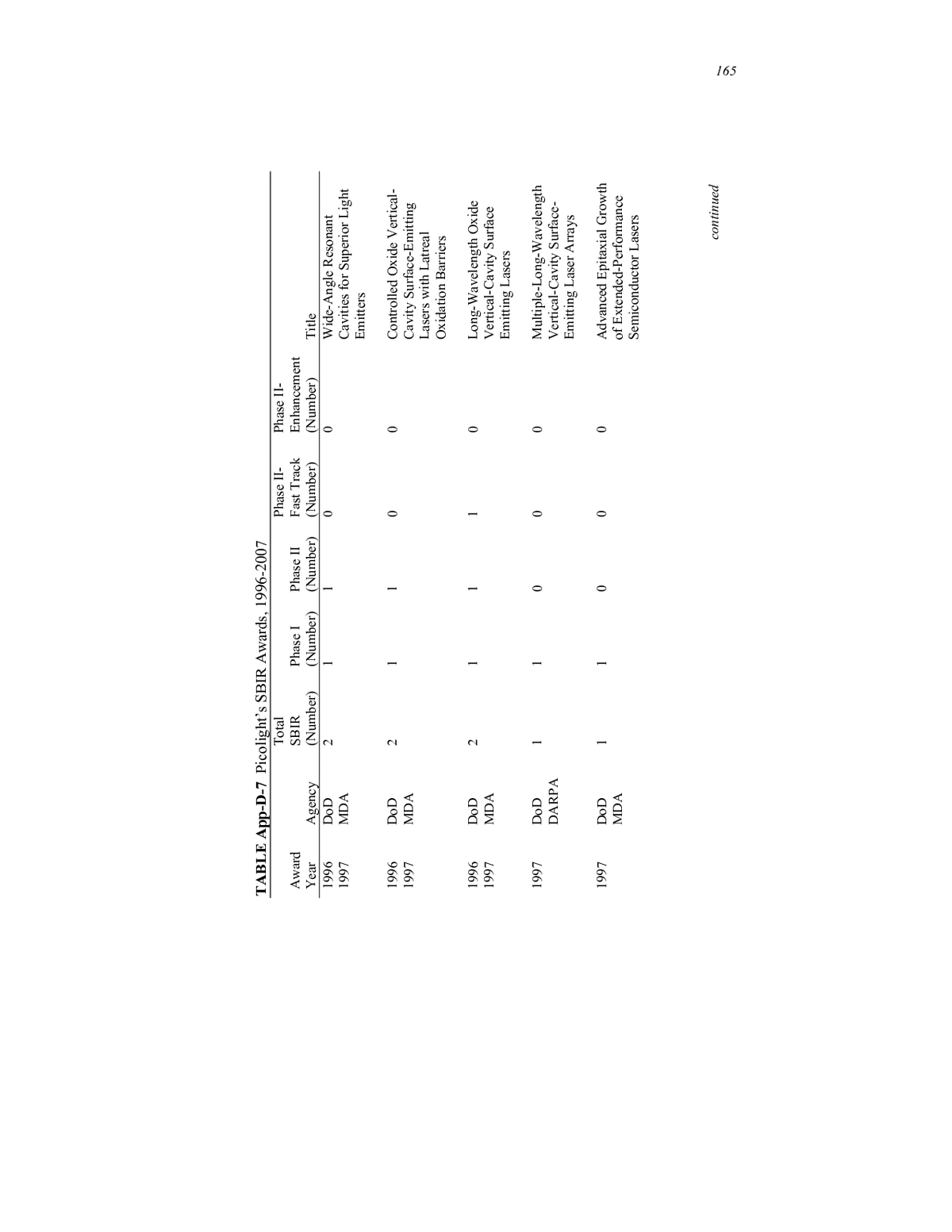
142 APPENDIX D According to a company marketing brochure, at the time of its acquisition, Picolight had a rapidly expanding customer base, and, as of mid- 2005, had shipped in excess of four million VCSEL-based devices to its customersâprimarily communications companies in the United States and abroad, the latter reached through an international network of partners.18 Picolightâs acquisition by JDSUâwith its optical communications business segmentâbrings a vertically integrated manufacturing model that may foster the further commercial development of VCSEL products. SBIR, FAST TRACK, AND PHASE II ENHANCEMENTS SBIR Grants, 1996-2007: 17 (See Table App-D-7 for details.) Fast Track Awards: 2 Phase II Enhancement Awards: 0 Views on SBIR: In the words of Dr. Jewell, Picolight founder, the SBIR program is âexcellentâ and âit works.â He described how he built the foundation of his companyâs device technologiesâand his companyâfrom SBIR awards. Table App-D-7 shows the intensity of SBIR funding between 1996 and 2000, when he was building the companyâs technical base. To get the most out of the SBIR program, Dr. Jewell emphasized that a company should align its SBIR proposals with its business goals and stay focused, as he had done. He noted, in contrast, that some companies make a mistake of chasing in scattered directions depending on whatever SBIR topics are posted. By seeking only funding that was compatible with his companyâs goals, Dr. Jewell was successfulâafter six Phase II SBIRsâin building a technology base and a company with products for sale. Views on Fast Track: According to Dr. Jewell, Fast Track was very helpful to him in securing his second angel round of investment. It was Fast Trackâs leveraging of third- party funding that he found most attractive about the programârather than its help in bridging between Phase I and Phase II funding. He explained that Fast Track gave him a persuasive case to make with potential investors that enabled him to leverage the SBIR award into a much larger investment. 18 Picolight marketing brochure, available as of February 21, 2008, at <http://www.picolight.com/UserFiles/PDF/corp_brochure.pdf>.
APPENDIX D 143 Power Technology Services (PTS), Inc, Case Study19 Note: The Company did not provide an interview COMPANY INFORMATION Addresses: Power Technology Services (PTS), Inc. 7800 Netherlands Dr. Raleigh, NC 27502 Tel: 919-362-1501 Email: ptsco@mindframe.net Web site: none found Year Started: 1984 [Source: previous case study]; 1992 [Source: 2007 Dun & Bradstreet] Ownership: Privately owned corporation President: John Driscoll Number of Employees: Earlier Case Study (Approx. 1999): 5 Current Case Study (2007/2008): 6 Company Changes Since Earlier Case Study: The company appears to have changed little since the last case study was done. It continues as a very small firm, operating as a group of engineers and consultants, with a focus on research, development, and manufacture of specialty semiconductors. TECHNOLOGY, APPLICATIONS, AND COMMERCIALIZATION Technology Focus: Earlier Case Study (Approx. 1999): Research of double-sided flip chips 19 The following informational sources informed this case study: Dun & Bradstreet company report; SBA on-line Tech-net; and on-line Fast Track file. The company did not respond to requests for a telephone interview.
144 APPENDIX D Current Case Study (2007/2008): Research, development, and manufacturing of semiconductors Application Areas: Earlier Case Study (Approx. 1999): Hybrid electric power systems for military electric tanks Current Case Study (2007/2008): No information obtained Commercialization of Technology: No information obtained SBIR, FAST TRACK, AND PHASE II ENHANCEMENTS SBIR Grants, 1996-2007: 7 (See Table App-D-8 for details.) Fast Track Awards: 1 Phase II Enhancement Awards: 0 Views on SBIR: No information obtained Views on Fast Track and Phase II Enhancement Awards: No information obtained
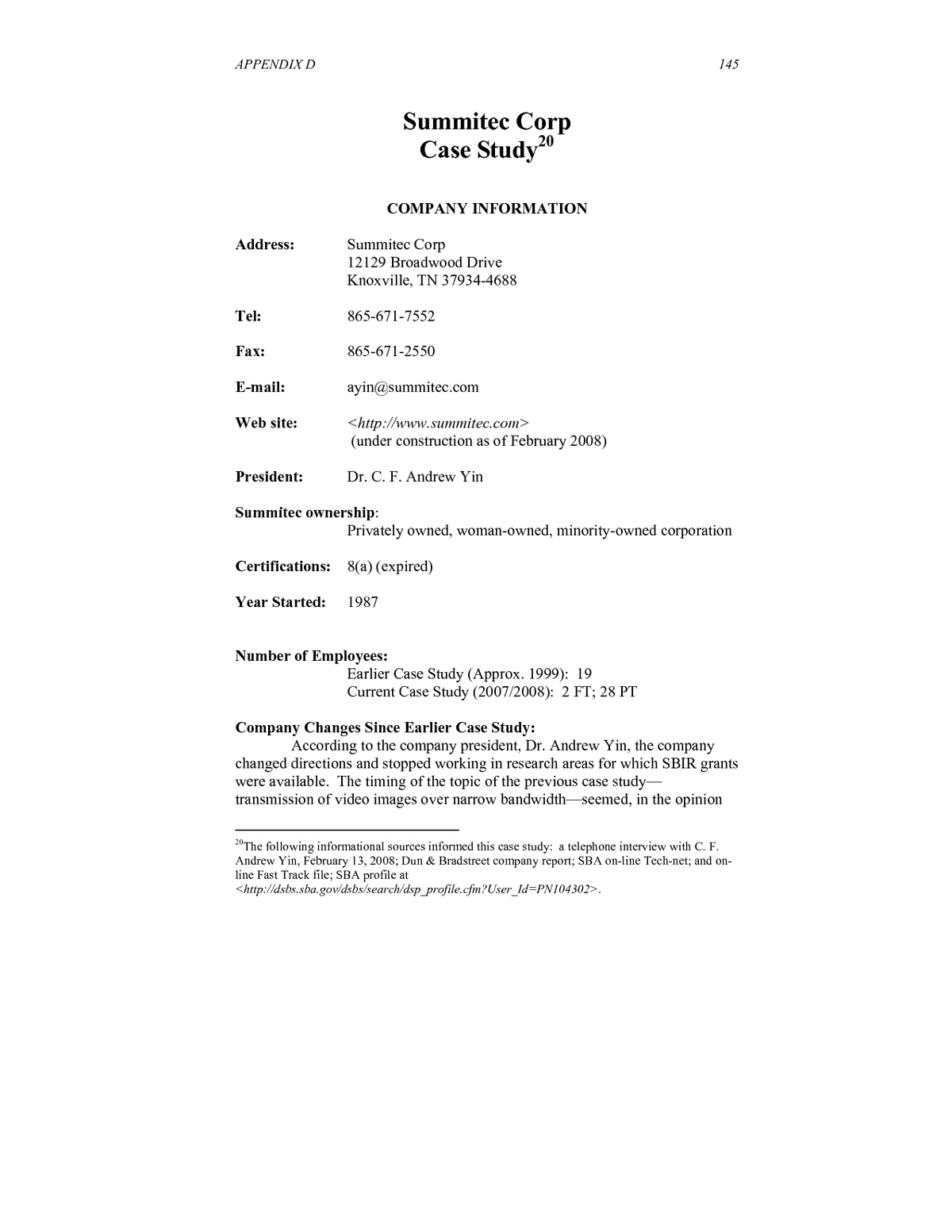
APPENDIX D 145 Summitec Corp Case Study20 COMPANY INFORMATION Address: Summitec Corp 12129 Broadwood Drive Knoxville, TN 37934-4688 Tel: 865-671-7552 Fax: 865-671-2550 E-mail: ayin@summitec.com Web site: <http://www.summitec.com> (under construction as of February 2008) President: Dr. C. F. Andrew Yin Summitec ownership: Privately owned, woman-owned, minority-owned corporation Certifications: 8(a) (expired) Year Started: 1987 Number of Employees: Earlier Case Study (Approx. 1999): 19 Current Case Study (2007/2008): 2 FT; 28 PT Company Changes Since Earlier Case Study: According to the company president, Dr. Andrew Yin, the company changed directions and stopped working in research areas for which SBIR grants were available. The timing of the topic of the previous case studyâ transmission of video images over narrow bandwidthâseemed, in the opinion 20 The following informational sources informed this case study: a telephone interview with C. F. Andrew Yin, February 13, 2008; Dun & Bradstreet company report; SBA on-line Tech-net; and on- line Fast Track file; SBA profile at <http://dsbs.sba.gov/dsbs/search/dsp_profile.cfm?User_Id=PN104302>.
146 APPENDIX D Dr. Yin, too far in advance of the market at the time the project was completed. Rather than continue pursuit of that technology, the company dropped its research focus and began providing technical support services to government agencies. TECHNOLOGY, APPLICATIONS, AND COMMERCIALIZATION Technology Focus: Earlier Case Study (Approx. 1999): Compression-like software for transmission of video images over narrow bandwidth Current Case Study (2007/2008): Technical services in information technology Application Areas: Earlier Case Study (Approx. 1999): Video communication for surveillance of bombing targets Current Case Study (2007/2008): Technical services for government agencies Commercialization of Technology: Summitec did not commercialize its SBIR-sponsored technology for transmitting video images. Instead, the company shifted its business focus to providing technical services to government agenciesâcurrently the U.S. Department of Energy. SBIR, FAST TRACK, AND PHASE II ENHANCEMENTS SBIR Grants, 1996-2007: 2 (See Table App-D-9 for details.) Fast Track Awards: 1 Phase II Enhancement Awards: 0 Views on SBIR: According to the company president, Dr. Yin, the SBIR program âworks okay.â Rather than problems with the SBIR, it was changing conditions with the company and a change in business focus that caused the company not to submit further proposals to SBIR following the Fast Track award in 1997. Views on Fast Track and Phase II Enhancement Awards: The company has had one Fast Track award and no Phase II Enhancement awards. According to Dr. Yin, the company was satisfied with its Fast Track experience, but due to changes in the business since that time does
APPENDIX D 147 not expect to propose for additional SBIR-, Fast Track-, or Phase II Enhancement awards.
148 APPENDIX D Synkinetics, Inc., Case Study21 Note: The company did not provide an interview. COMPANY INFORMATION Address: Synkinetics, Inc. 5 Whittier Street Framingham, MA 01701 Tel: 508-879-2400 Fax: 508-879-2433 Email: info@synk.com Web site: <http://www.synk.com> Year Started: 1982 according to previous case study; given on Web site as early 1990s; left blank in D&B Ownership: Privately owned corporation CEO: Kent George Number of Employees: Earlier Case Study (Approx. 1999): 8 Current Case Study (2007/2008): 2 (2007 Dun & Bradstreet report) Company Changes Since Earlier Case Study: The company was a spin-off company of MITâs Lincoln Laboratory in the early 1980s, founded to develop and commercialize ideas developed at the Laboratory. No additional information was obtained. 21 The following informational sources informed this case study: the company Web site; Dun & Bradstreet company report; SBA on-line Tech-net; and on-line Fast Track file. The company did not respond to requests for a telephone interview.
APPENDIX D 149 TECHNOLOGY, APPLICATIONS, AND COMMERCIALIZATION Technology Focus: Earlier Case Study (Approx. 1999): Precision drive mechanism Current Case Study (2007/2008): SYNKdrive® technology Application Areas: Earlier Case Study (Approx. 1999): Fuel efficiency of vehicles Current Case Study (2007/2008): Fuel efficiency of marine and vehicle equipment; for use in hybrid transmissions, aerospace drive trains, and agriculture equipment Commercialization of Technology: According to its Web site, the company has a number of strategic partners and affiliates in the development of its SYNKdrive® technology. SBIR, FAST TRACK, AND PHASE II ENHANCEMENTS SBIR Grants, 1994-2007: 5 (See Table App-D-10 for details.) Fast Track Awards: 1 Phase II Enhancement Awards: 0 Views on SBIR: No information was obtained Views on Fast Track and Phase II Enhancement Awards: No information was obtained
150 APPENDIX D Yardney Technical Products, Inc., Case Study22 COMPANY INFORMATION Address: Yardney Technical Products (YTP), Inc. 82 Mechanic St. Ste 2 Pawcatuck, CT 06379 Tel: 860-599-1100 Email: Lois@yardney.com (Secretary of Company President, Mr. Yevoli) Web site: <http://www.yardney.com> Year Started: 1944 as Yardney Electric Corporation Ownership: Privately owned corporation with a parent holding company President/COO: Vincent Yevoli, Jr. Number of Employees: Earlier Case Study (Approx. 1999): 155 Current Case Study (2007/2008): 15023 Company Changes: The Company already had a long history at the time of the earlier case study. It was founded in 1944 under a different name (Yardney Electric Corporation) and in a different location (New York City). It was acquired by the Whittaker Corporation in 1969, and moved to its present location (Pawcatuck, CT) in 1970. Then in 1990, the company was acquired by the companyâs present CEO, Richard Scibelli, from within Whittaker and the corporate name was changed to its current name. In 1995 a holding company, Ener-Tek International, was formed and became the parent company of Yardney. Throughout its history, the company has consistently focused on battery technology, but has shifted emphasis on the type of battery, moving from 22 The following informational sources informed this case study: a telephone interview with Vince Yevoli, Yardney president and chief operating officer; the company Web site; Dun & Bradstreet company report; SBA on-line Tech-net; and on-line Fast Track file. 23 2007 Dun and Bradstreet report.
APPENDIX D 151 lithium thionyl-chloride and nickel battery product lines to lithium-ion battery technology, while maintaining its silver-zinc battery technology. TECHNOLOGY, APPLICATIONS, AND COMMERCIALIZATION Technology Focus: Earlier Case Study (Approx. 1999): Rechargeable batteries for defense applications Current Case Study (2007/2008): High energy density batteries for defense applications Application Areas: Earlier Case Study (Approx. 1999): Defense missions requiring high performance batteries Current Case Study (2007/2008): Air, land, sea, and space applications needing high performance battery systems, including aircraft, directed energy weapons, DoD radios, medical electronics, medical implants, missiles, professional cameras, robotics, spacecraft, unmanned combat vehicles, and other support applications Commercialization of Technology: The Companyâs SBIR awards have enhanced its battery researchâ particularly its Li-ion battery research in recent yearsâand the enhancements have gone directly into improving the performance of batteries supplied for use in aerospace and defense applications. The company maintains a small production line to meet its customersâ specialized needs. It works in cooperation with the Department of Defense, NASA, and major defense contractorsâincluding Boeing, Lockheed Martin, and othersâto provide batteries used in such programs as Minuteman III ICBM, Delta II/IV, and Atlas V, the Mars Explorer Rover missions, the USAF B-2 Bomber and Global Hawk aircraft, and the U.S. Navy Advanced Seal Delivery System.24 Annual sales are reported at $20 million in the companyâs 2007 Dun & Bradstreet report. SBIR, FAST TRACK, AND PHASE II ENHANCEMENTS SBIR Grants, 1991-2007: 56 (See Table App-D-11.) SBIR Phase I: 39 SBIR Phase II: 15 24 <http://www.yardney.com>.
152 APPENDIX D Fast Track Awards: 1 Phase II Enhancement Awards: 1 Views on SBIR: Yardneyâs President and COO, Vince Yevoli, said that the SBIR program has been particularly important in boosting the R&D program of this long established, on-going company. According to him, the SBIR program enabled Yardney to build its Li-ion battery capabilities from scratch, and to get the resulting high-performance battery systems into government applications with little delay. In summary, he listed three ways in which the SBIR program had been invaluable to Yardney: (1) It had provided the basis for establishing the companyâs Li-ion battery technology; (2) it had enabled the company to maintain a research group on a sustained basis; and (3) it had provided a path for implementing research results directly into production and application. When asked how the SBIR program might be improved, Mr. Yevoli responded that the research-funding power of a Phase I award has badly eroded with time and an increase is needed to ensure that this award continues to serve its intended purpose. Views on Fast Track and Phase II Enhancement: Although the companyâs Fast Track award has been sufficiently long ago that there was little specific memory of the experience, Mr. Yevoli was willing to discuss both Fast Track and the Phase II Enhancement awards. He noted that the reason the company had not proposed for either of these awards in recent years was that its business model had not included seeking third-party financing for its technology implementations. Rather, it had followed the practice of self-financing the move of enhanced performance capabilities directly into its current product line and directly supplying its products to aerospace and defense customers. However, Mr. Yevoli could see a potential future interest of the company in Fast Track and third-party financing. He emphasized that the faster funding feature of Fast Track which keeps researchers employed between Phases I and II is of greater interest to his company than the larger funding amounts offered by Phase II Enhancement.
TABLE App-D-1 Ten Fast Track Companies Identified for Update: Their Location, Ownership, Founding Date, Technology, Number of Employees, and Number of SBIR Awards Received Fast Track Ownership Number of Number Companies and Change Technology Employees of SBIRs Selected for in Ownership Founding 1998 2008 1998 2008 (Period Update Location Since 1998 Date Received) Advanced Norman, OK Privately 1990 Processing Advanced 10 7 4 Processing owned small science and process control (1994- Technology corp; no control and equipment 1997) (AvPro), Inc. change systems for management composites CG2, Inc. Huntsville, Al Privately 1995 Virtual reality Software 15 12 of 22 owned small scene products and 100 (1997- corp; generation services for 3D total 2007) acquired by graphics Quantum3D, visualization San Jose, CA, also a priv. owned small corp. Hyperion Cambridge, Privately 1982 Novel forms Carbon nanotube 20 60 3 Catalysis MA owned small and technology, (1996- Intnatâl. corp; no morphologies carbon and 1997) change of carbon graphite products continued 153
154 TABLE App-D-1 Continued Fast Track Ownership Number of Number Companies and Change Technology Employees of SBIRs Selected for in Ownership Founding 1998 2008 1998 2008 (Period Update Location Since 1998 Date Received) Matis, Inc. Atlanta, GA Privately 1990 Software tools, Software tools, 5 12 2 owned small, simulation mathematical (1996- woman- models, 1997) owned corp; computer aided no change design, scientific computing, etc. Opts, Inc. Huntsville, Privately 1994 Hardware to Computer 5 9 4 AL owned small enhance systems design (2003); (1996- corp; appears images for (2003) 1997) to have gone missile 0 out of targeting (2008)? business Picolight, Louisville, Privately 1995 Vertical cavity VCSEL-based 26 95 of 17 Inc. CO owned, surface- optical 1,000s (1996- venture- emitting laser pluggable total 2000) funded small (VCSEL) transceivers and corp; technology component acquired by technologies JDS Uniphase Corp.,
Milpitas, CA, a publicly held large corp Power Raleigh, NC Privately 1984/ Double-sided R&D and 5 6 7 Technology owned small 1992* flip chips manufacture of (1996- Services corp; no semiconductors 2005) (PTS), Inc. change Summitec Knoxville, TN Privately, 1987 Compression- Technical 19 2 FT & 2 Corp. woman- & like software services in 28 PT (1996- minority- for information 1997) owned small transmission of technology; a corp; no video images change in focus change in over narrow away from R&D ownership bandwidth Synkinetics, Framingham, Privately 1982/ Precision drive SYNKdrive® 8 2 5 Inc. MA owned small early mechanism (1994- corp; no 1990s** 2000) change continued 155
156 TABLE App-D-1 Continued Fast Track Ownership Number of Number Companies and Change Technology Employees of SBIRs Selected for in Ownership Founding 1998 2008 1998 2008 (Period Update Location Since 1998 Date Received) Yardney Pawcatuck, Privately 1944 Rechargeable Batteries 155 150 56 Technical CT owned batteries for (particularly Li- (1991- Products, Inc. corporation defense ion) for defense 2007 with a parent applications applications holding company; no change NOTE: *1984 was given as the founding date by the previous case study; 1992 was given by the companyâs 2007 Dun & Bradstreet report; **1982 was given as the founding date by the previous case study; early 1990s is given at the companyâs Web site.
TABLE App-D-2 AvProâs SBIR Awards, 1994-2007 Total Phase II- Phase II- Award SBIR Phase I Phase II Fast Track Enhancement Year Agency (Number) (Number) (Number) (Number) (Number) Title 1994 DoD 2 1 1 0 0 Fiber Optic Raman 1995 AF Sensors for the Remote Determination of Composite Chemical Characteristics 1996 DoD 2 1 1 1 0 Low Cost Curing and 1997 AF Repair Process for Composites Totals 4 2 2 1 0 157
158 TABLE App-D-3 CG2âs SBIR Awards, 1997-2007 Total Phase II- Phase II- Award SBIR Phase I Phase II Fast Track Enhancement Year Agency (Number) (Number) (Number) (Number) (Number) Title 1997 DoD 2 1 1 1 Virtual Reality Scene Army Generation by Means of Open Standards 2002 DoD 4 2 2 0 Material Encoded Navy Textures with Computer Generated Forces Personal Computer Graphics Support for Texel Level Sensor Simulation 2003 DoD 4 4 0 0 PC Based Dynamic AF Real-Time Infrared Army Image Generation Army Capacity MDA PC Based Real-Time Infrared/Millimeter Wave Scene Generator Scene Management for Complex
Environments Advanced Scene Generation Techniques 2004 DoD 4 2 2 0 Military 3-D Army Visualization Navy Utilizing Gaming Army Technology New Modeling and Simulation Technology for Night Vision Goggle Mission Rehearsal Infrared/Millimeter Wave Scene Generator Advanced Scene Generation Techniques continued 159
160 TABLE App-D-3 Continued Total Phase II- Phase II- Award SBIR Phase I Phase II Fast Track Enhancement Year Agency (Number) (Number) (Number) (Number) (Number) Title 2005 DoD 4 3 1 0 PC Scene MDA Generation Bridge Navy Architectures for Navy Streaming Balanced Army Computation Light Detection and Ranging (LIDAR) Surface Feature Extraction Tool New Weather Depiction Technology for Night Vision Goggle (NVG) Training Military 3D Visualization Utilizing Gaming Technology 2006 DoD 2 1 1 0 New Weather Depiction Technology for Night Vision Goggle (NVG) Training
2007 DoD 2 0 2 0 Surface Feature Navy Extraction Tools Using LIDAR Data Enabling Cross- Domain Exploitation of a Common Geospatial Database Totals 23* 13 9 1 1 (year not identified) NOTE: *According to the company, it has received a Phase II Enhancement award. However, the year was not identified, and it is not included in the year-by-year data. 161
162 TABLE App-D-4 Hyperion Catalysisâs SBIR Awards, 1996-2007 Total Phase II- Phase II- Award SBIR Phase I Phase II Fast Track Enhancement Year Agency (Number) (Number) (Number) (Number) (Number) Title 1996 DoD 2 1 1 1 0 Ultracapacitors Based on 1997 MDA Nano-fiber Electrodes 1997 DoD 1 1 0 0 0 Affordable Nanotube Based DARPA âMolecular Compositesâ Totals 3 2 1 1 0
TABLE App-D 5 Matisâ SBIR Awards, 1997-2007 Total Phase II- Phase II- Award SBIR Phase I Phase II Fast Track Enhancement Year Agency (Number) (Number) (Number) (Number) (Number) Title 1996 DoD 1 1 0 0 0 A Novel Computational AF System for Real-Time Analysis and Prediction 1997 DoD 1 0 1 1 0 of An Virtual Reality AF Scene Generation by Means of Open Standards Totals 2 1 1 1 0 163
164 TABLE App-D-6 Optsâ SBIR Awards, 1996-2007 Total Phase II- Phase II- Award SBIR Phase I Phase II Fast Track Enhancement Year Agency (Number) (Number) (Number) (Number) (Number) Title 1996 NASA 2 1 1 0 0 Adaptive Compression Network 1997 1997 DoD 2 1 1 1 0 Imaging Automatic Gain Army Control for Target Acquisition, Automatic Target Recognition and Tracking Totals 4 2 2 1 0
TABLE App-D-7 Picolightâs SBIR Awards, 1996-2007 Total Phase II- Phase II- Award SBIR Phase I Phase II Fast Track Enhancement Year Agency (Number) (Number) (Number) (Number) (Number) Title 1996 DoD 2 1 1 0 0 Wide-Angle Resonant 1997 MDA Cavities for Superior Light Emitters 1996 DoD 2 1 1 0 0 Controlled Oxide Vertical- 1997 MDA Cavity Surface-Emitting Lasers with Latreal Oxidation Barriers 1996 DoD 2 1 1 1 0 Long-Wavelength Oxide 1997 MDA Vertical-Cavity Surface Emitting Lasers 1997 DoD 1 1 0 0 0 Multiple-Long-Wavelength DARPA Vertical-Cavity Surface- Emitting Laser Arrays 1997 DoD 1 1 0 0 0 Advanced Epitaxial Growth MDA of Extended-Performance Semiconductor Lasers continued 165
166 TABLE App-D-7 Continued Total Phase II- Phase II- Award SBIR Phase I Phase II Fast Track Enhancement Year Agency (Number) (Number) (Number) (Number) (Number) Title 1997 DoD 2 1 1 0 0 Fiber-to-the-Desk Laser 1999 MDA Transmitters and Receivers 1997 DoD 2 1 1 1 0 Stable Single Mode Oxide 1998 Navy Vertical Cavity Surface Emitting Lasers 1997 HHS 1 1 0 0 0 On-Airway-Ideal Spectroscopic Sensor for Carbon Dioxide 1998 DoD 1 1 0 0 0 Passively Aligned Single- MDA Mode VCSEL Transceivers 1999 DoD 1 1 0 0 0 High-Performance 1550nm MDA Vertical-Cavity Surface- Emitting Lasers 1999 DoD 2 1 1 0 0 Viable 2.5-10 GHz 1300nm 2000 Navy VCSEL Arrays Totals 17 11 6 2 0
TABLE App-D-8 PTSâs SBIR Awards, 1996-2007 Phase II-Fast Phase II- Award Total SBIR Phase I Phase II Track Enhancement Year Agency (Number) (Number) (Number) (Number) (Number) Title 1996 DoD 2 1 1 1 0 A New Dual-Gated 1997 DARPA DMCT for Hybrid Electric Power Systems 2002 DoD 2 1 1 0 0 Novel High Current 2003 AF Switch for Spacecraft Power Bus Control 2002 DoD 2 1 1 0 0 Thermionic Converters 2004 OSD Based on Nanostructured Carbon Materials 2005 DoD 1 1 0 0 0 Cold Cathode for AF Traveling Wave Tubes Totals 7 4 3 1 0 167
168 TABLE App-D-9 Summitecâs SBIR Awards, 1996-2007 Phase II- Phase II- Award Total SBIR Phase I Phase II Fast Track Enhancement Year Agency (Number) (Number) (Number) (Number) (Number) Title 1996 DoD 2 1 1 1 0 Very Low Bit-Rate Error- 1997 Navy Resilient Video Communication Totals 2 1 1 1 0
TABLE App-D-10 Synkineticsâ SBIR Awards, 1994-2007 Phase II- Phase II- Award Total SBIR Phase I Phase II Fast Track Enhancement Year Agency (Number) (Number) (Number) (Number) (Number) Title 1994 DoD 2 1 1 0 0 Precision Speed 1996 DARPA Reducer for Robotics and Manufacturing 1996 DoD 2 1 1 1 0 High Precision 1997 MDA Gimbal Systems 2000 DoD 1 1 0 0 0 Navy Totals 5 3 2 1 0 169
170 TABLE App-D-11 Yardneyâs SBIR Awards, 1991-2007 Phase II- Phase II- Award Total SBIR Phase I Phase II Fast Track Enhancement Year Agency (Number) (Number) (Number) (Number) (Number) Title 1991 DoD 2 1 1 0 0 Development of Silver-Zinc 1993 Navy Cells of Improved Life and Energy Density 1993 DoD 1 1 0 0 0 Lithium-ion Rechargeable 1997 NASA Battery System with Sulfur- Dioxide-Based Electrolyte 1993 NASA 1 1 0 0 0 High-Energy-Density, 1994 Rechargeable, Nickel-Zinc Cells with Improved Cycle Life 1994 DoD 1 1 0 0 0 Improvement of High Power Navy Silver-Zinc Rechargeable Batteries for Underwater Vehicles 1994 DoD 2 1 1 0 0 High Rate Bipolar 1996 Navy Lithium/Thionyl Cloride Power Source for Missile Guidance
1995 DoD 2 1 1 0 0 Low Cost, High Rate, High 1996 AF Energy Density Lithium-Ion Batteries 1996 DoD 1 1 0 0 0 Development of a Synergetic DARPA Battery Pack (SBP) 1996 DoD 2 1 1 0 0 Advanced Development 1997 OSD Program for a Lightweight, Rechargeable âAAâ Zinc-Air Battery 1996 DoD 2 1 1 1 0 Low Cost, Lightweight, 1997 OSD Rechargeable Lithium-ion Batteries 1997 DoD 1 1 0 0 0 Exploratory Development of Army Novel Manganese Oxide Cathode Materials for High Performance Lithium-ion Batteries 1997 NASA 1 1 0 0 0 A High Cycle Life, High Energy Density Battery Using A Metal Oxide Anode Material continued 171
172 TABLE App-D-11 Continued Phase II- Phase II- Title Award Total SBIR Phase I Phase II Fast Track Enhancement Year Agency (Number) (Number) (Number) (Number) (Number) 1997 NASA 2 1 1 0 0 A High Performance Lithium 1998 Battery Using An Alloy Anode 1998 DoE 1 1 0 0 0 A Mixed Metal Oxide Anode Material for High Energy Density Li-ion Batteries 1999 DoD 2 1 1 0 0 Thin Film, Flexible Space 2000 AF Battery 1999 NASA 1 1 0 0 0 A Mixed Oxide Negative Electrode Material for Li-ion Batteries 2000 DoD 2 1 1 0 0 Tin Based Negative Electrode 2001 Army Materials 2000 NASA 2 1 1 0 0 Title not found 2001 DoE 1 1 0 0 0 Intermediate Temperature Solid Oxide Fuel Cell Development
2002 DoE 1 1 0 0 0 The Development of a Polyvlent Battery System 2002 DoE 1 1 0 0 0 The Development of a Low- Cost Separator with Improved Performance 2002 DoD 2 1 1 0 0 Development of a Novel, 2003 MDA Thin Film Lithium-ion Battery Technology 2002 DoD 2 1 1 0 0 Development of Onboard 2003 MDA Power Sources for Interceptor Missiles 2003 DoD 3 1 1 0 1 An Ultra-lightweight Lithium AF Air Battery for Unmanned Air Vehicles 2003 DoD 1 1 0 0 0 Advanced High Energy Army Batteries 2003 DoD 2 1 1 0 0 Innovative Manufacturing 2004 MDA Processes continued 173
174 TABLE App-D-11 Continued Phase II- Phase II- Title Award Total SBIR Phase I Phase II Fast Track Enhancement Year Agency (Number) (Number) (Number) (Number) (Number) 2003 DoD 1 1 0 0 0 Aluminum-Air Fuel Navy Cell/Battery Research 2004 DoD 2 1 1 0 0 Lithium-Air Technology Army 2004 DoD 1 1 0 0 0 Ballistic Missile System MDA Innovative Power Storage Devices 2004 DoD 1 1 0 0 0 Assessing Useful Remaining Navy Life of Li-ion Batteries after Deep Discharges 2005 DoE 1 1 0 0 0 Low Temperature Performance of Li-ion Batteries 2005 DoD 1 1 0 0 0 Pressure Tolerant Power Navy Source for Off-Board Sensor 2006 DoE 1 1 0 0 0 State-of-Charge Technology Navy for Zn-air Battery Systems
2006 DoD 1 1 0 0 0 New and Improved Army Nonaqueous Electrolyte ComponentsâSalts & Solvents 2006 DoD 1 1 0 0 0 Innovative Lightweight OSD Metal-Air Cell Cases for Non-Rechargeable Batteries 2007 DoD 1 1 0 0 0 A Phase I SBIR Proposal to MDA Lower the Cost and Improve the Manufacturing of Li-ion Batteries 2007 DoD 2 1 1 0 0 Lithium-Air/Lithium-Ion Army Hybrid Battery for Military Use 2007 DoD 1 1 0 0 0 Phase I Nano-Engineered OSD Anode Materials for rapid recharge High Energy density Lithium-ion Batteries continued 175
176 TABLE App-D-11 Continued Phase II- Phase II- Award Total SBIR Phase I Phase II Fast Track Enhancement Year Agency (Number) (Number) (Number) (Number) (Number) Title 2007 DoE 1 1 0 0 0 Radically Designed High AF Energy Metal-Air Cell for Unmanned Aerial Vehicles 2007 NASA 1 1 0 0 0 Nano-Engineered Materials for Rapid Rechargeable space Rated Advance Li- Ion Batteries 2007 DoD 1 1 0 0 0 Energy Storage System for DARPA Very High Altitude Very Long Endurance Solar Aircraft Totals 56 39 15 1 1
