




Below is the uncorrected machine-read text of this chapter, intended to provide our own search engines and external engines with highly rich, chapter-representative searchable text of each book. Because it is UNCORRECTED material, please consider the following text as a useful but insufficient proxy for the authoritative book pages.
The U.S. CommiTmenT To Global healTh Recommendations for the Public and Private Sectors Committee on the U.S. Commitment to Global Health Board on Global Health
THE NATIONAL ACADEMIES PRESS 500 Fifth Street, N.W. Washington, DC 20001 NOTICE: The project that is the subject of this report was approved by the Governing Board of the National Research Council, whose members are drawn from the councils of the National Academy of Sciences, the National Academy of Engineering, and the Institute of Medicine. The members of the committee responsible for the report were chosen for their special competences and with regard for appropriate balance. This study was supported by contracts between the National Academy of Sciences and the Bill & Melinda Gates Foundation (Contract 43531); Burroughs Wellcome Fund (Contract 1007183); Google. org (Contract 4-2008); Merck Company Foundation (unnumbered grant); Rockefeller Foundation (Contract 2007 HE 005); U.S. Department of Health and Human Services (National Institutes of Health) (N01-OD-4-2139, TO #191); Centers for Disease Control and Prevention (Contract 200-2005- 13434); U.S. Department of Homeland Security (Office of International Affairs and Global Health Security, Office of the Assistant Secretary for Health Affairs) (Contract HSHQDC-08-P-00190); and U.S. Department of State (Bureau of International Security and Nonproliferation) (Contract S- LMAQM-07-GR-227). Any opinions, findings, conclusions, or recommendations expressed in this publication are those of the authors and do not necessarily reflect the view of the organizations or agencies that provided support for this project. Library of Congress Cataloging-in-Publication Data The U.S. commitment to global health : recommendations for the public and private sectors / Committee on the U.S. Commitment to Global Health, Board on Global Health. p. ; cm. Includes bibliographical references. ISBN 978-0-309-13821-5 (pbk.) 1. World healthâGovernment policyâUnited States. I. Institute of Medicine (U.S.). Committee on the U.S. Commitment to Global Health. II. National Academies Press (U.S.) [DNLM: 1. World HealthâUnited States. 2. Financing, GovernmentâUnited States. 3. Public PolicyâUnited States. WA 530 AA1 U58 2009] RA441.U73 2009 362.1âdc22 2009033431 Additional copies of this report are available from the National Academies Press, 500 Fifth Street, N.W., Lockbox 285, Washington, DC 20055; (800) 624-6242 or (202) 334-3313 (in the Washington metropolitan area); Internet, http://www.nap.edu. For more information about the Institute of Medicine, visit the IOM home page at: www.iom.edu. Copyright 2009 by the National Academy of Sciences. All rights reserved. Printed in the United States of America The serpent has been a symbol of long life, healing, and knowledge among almost all cultures and religions since the beginning of recorded history. The serpent adopted as a logotype by the Institute of Medicine is a relief carving from ancient Greece, now held by the Staatliche Museen in Berlin. Front cover: Select photos reprinted with permission from Leila Batmanghelidj. Suggested citation: IOM (Institute of Medicine). 2009. The U.S. Commitment to Global Health: Rec- ommendations for the Public and Private Sectors. Washington, DC: The National Academies Press.
âKnowing is not enough; we must apply. Willing is not enough; we must do.â â Goethe Advising the Nation. Improving Health.
The National Academy of Sciences is a private, nonprofit, self-perpetuating society of distinguished scholars engaged in scientific and engineering research, dedicated to the furtherance of science and technology and to their use for the general welfare. Upon the authority of the charter granted to it by the Congress in 1863, the Academy has a mandate that requires it to advise the federal government on scientific and technical matters. Dr. Ralph J. Cicerone is president of the National Academy of Sciences. The National Academy of Engineering was established in 1964, under the charter of the National Academy of Sciences, as a parallel organization of outstanding engineers. It is autonomous in its administration and in the selection of its members, sharing with the National Academy of Sciences the responsibility for advising the federal government. The National Academy of Engineering also sponsors engineering programs aimed at meeting national needs, encourages education and research, and recognizes the superior achievements of engineers. Dr. Charles M. Vest is president of the National Academy of Engineering. The Institute of Medicine was established in 1970 by the National Academy of Sciences to secure the services of eminent members of appropriate professions in the examina - tion of policy matters pertaining to the health of the public. The Institute acts under the responsibility given to the National Academy of Sciences by its congressional charter to be an adviser to the federal government and, upon its own initiative, to identify issues of medical care, research, and education. Dr. Harvey V. Fineberg is president of the Institute of Medicine. The National Research Council was organized by the National Academy of Sciences in 1916 to associate the broad community of science and technology with the Academyâs purposes of furthering knowledge and advising the federal government. Functioning in accordance with general policies determined by the Academy, the Council has become the principal operating agency of both the National Academy of Sciences and the National Academy of Engineering in providing services to the government, the public, and the scientific and engineering communities. The Council is administered jointly by both Academies and the Institute of Medicine. Dr. Ralph J. Cicerone and Dr. Charles M. Vest are chair and vice chair, respectively, of the National Research Council. www.national-academies.org
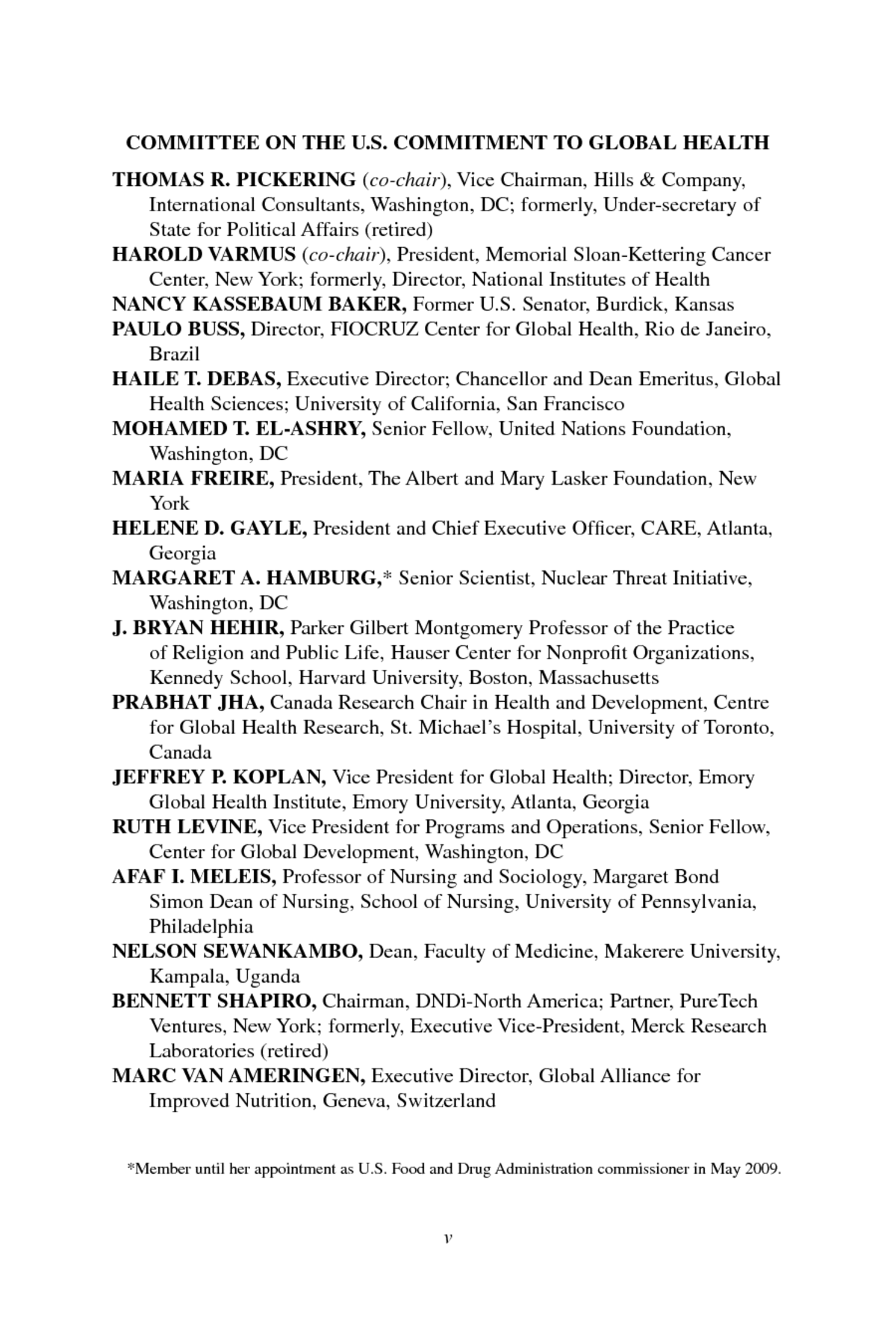
COMMITTEE ON THE U.S. COMMITMENT TO GLOBAL HEALTH THOMAS R. PICKERING (co-chair), Vice Chairman, Hills & Company, International Consultants, Washington, DC; formerly, Under-secretary of State for Political Affairs (retired) HAROLD VARMUS (co-chair), President, Memorial Sloan-Kettering Cancer Center, New York; formerly, Director, National Institutes of Health NANCY KASSEBAUM BAKER, Former U.S. Senator, Burdick, Kansas PAULO BUSS, Director, FIOCRUZ Center for Global Health, Rio de Janeiro, Brazil HAILE T. DEBAS, Executive Director; Chancellor and Dean Emeritus, Global Health Sciences; University of California, San Francisco MOHAMED T. EL-ASHRY, Senior Fellow, United Nations Foundation, Washington, DC MARIA FREIRE, President, The Albert and Mary Lasker Foundation, New York HELENE D. GAYLE, President and Chief Executive Officer, CARE, Atlanta, Georgia MARGARET A. HAMBURG,* Senior Scientist, Nuclear Threat Initiative, Washington, DC J. BRYAN HEHIR, Parker Gilbert Montgomery Professor of the Practice of Religion and Public Life, Hauser Center for Nonprofit Organizations, Kennedy School, Harvard University, Boston, Massachusetts PRABHAT JHA, Canada Research Chair in Health and Development, Centre for Global Health Research, St. Michaelâs Hospital, University of Toronto, Canada JEFFREY P. KOPLAN, Vice President for Global Health; Director, Emory Global Health Institute, Emory University, Atlanta, Georgia RUTH LEVINE, Vice President for Programs and Operations, Senior Fellow, Center for Global Development, Washington, DC AFAF I. MELEIS, Professor of Nursing and Sociology, Margaret Bond Simon Dean of Nursing, School of Nursing, University of Pennsylvania, Philadelphia NELSON SEWANKAMBO, Dean, Faculty of Medicine, Makerere University, Kampala, Uganda BENNETT SHAPIRO, Chairman, DNDi-North America; Partner, PureTech Ventures, New York; formerly, Executive Vice-President, Merck Research Laboratories (retired) MARC VAN AMERINGEN, Executive Director, Global Alliance for Improved Nutrition, Geneva, Switzerland *Member until her appointment as U.S. Food and Drug Administration commissioner in May 2009. v
IOM Anniversary Fellow RODERICK K. KING, Instructor of Social Medicine, Department of Global Health and Social Medicine, Harvard Medical School; Senior Faculty, Massachusetts General Hospital Disparities Solutions Center, Boston, Massachusetts Study Staff SARAH SCHEENING, Study Director-Program Officer BETH HAYTMANEK, Senior Program Associate KATE MECK, Senior Program Assistant JULIE WILTSHIRE, Financial Associate PATRICK KELLEY, Director, Board on Global Health Consultant PARUL SUBRAMANIAN, Editor vi
Reviewers This report has been reviewed in draft form by individuals chosen for their diverse perspectives and technical expertise, in accordance with procedures approved by the National Research Councilâs (NRCâs) Report Review Commit - tee. The purpose of this independent review is to provide candid and critical com- ments that will assist the institution in making its published report as sound as possible and to ensure that the report meets institutional standards for objectivity, evidence, and responsiveness to the study charge. The review comments and draft manuscript remain confidential to protect the integrity of the deliberative process. We wish to thank the following individuals for their review of this report: Margaret E. Bentley, University of North Carolina Gillings School of Global Public Health Jo Ivey Boufford, New York Academy of Medicine Mickey Chopra, Health Systems Research Unit, Medical Research Council Yank D. Coble, Center for Global Health and Medical Diplomacy, Univer- sity of North Florida Lord Nigel Crisp, British Department of Health Ernest Darkoh, BroadReach Healthcare Nils Daulaire, Global Health Council Robert M. Einterz, Indiana University School of Medicine Victoria G. Hale, Institute for One World Health Steven C. Phillips, Global Issues and Projects, Exxon Mobil Corporation Peter Piot, Institute for Global Health, Imperial College K. Srinath Reddy, Public Health Foundation of India vii
viii REVIEWERS Jeffrey Sturchio, Corporate Council on Africa William M. Tierney, Indiana University School of Medicine, Regenstrief Institute, Inc., and Regenstrief Center for Healthcare Improvement and Research Jacques van der Gaag, The Brookings Institution and University of Amsterdam Sten H. Vermund, Vanderbilt University Suwit Wibulpolprasert, Ministry of Public Health, Thailand Although the reviewers listed above have provided many constructive com- ments and suggestions, they were not asked to endorse the conclusions or rec- ommendations nor did they see the final draft of the report before its release. The review of this report was overseen by Dr. Enriqueta C. Bond, Burroughs Wellcome Fund, President Emeritus, and Dr. Elaine L. Larson, School of Nurs- ing, Columbia University. Appointed by the NRC and the Institute of Medicine, they were responsible for making certain that an independent examination of this report was carried out in accordance with institutional procedures and that all review comments were carefully considered. Responsibility for the final content of this report rests entirely with the authoring committee and the institution.
Acknowledgments This report is a product of the cooperation and contributions of many people. The committee would like to thank all the speakers and moderators who par- ticipated in committee meeting and workshops, as well as others who provided information and input. Olusoji Adeyi Jennifer Chow Dovelyn Rannveig Agunias Michael Clemens George Alleyne Corrie Conrad Danielle Altares Lola Dare Margaret Anderson David de Ferranti Zhipeng Bai John Dirks Timothy Baker Paula Dobriansky Gillian Barclay Mark Dybul Loren Becker Andrew Dykens David Bell Robert Eiss Seth Berkley Christopher Elias Stefano Bertozzi Tim Evans Alpheus Bingham Alex Ezeh Robert Black Anthony Fauci Stephen Blount Mark Feinberg Joel Breman David Fidler Donald Bundy Harvey Fineberg Karen Cavanaugh Christopher Fox Shaoyu Chang Seble Lemma Frehywot Kendra Chittenden Clark Freifeld ix
x ACKNOWLEDGMENTS Thomas Frieden Carol Medlin Elain Gallin Jed Meline Patricia Garcia Robert Mikulak Laurie Garrett Anne Mills Roger Glass Emily Mok Rachel Glennerster Carlos Morel Lawrence Goldberg Stephen Morrison Lawrence Gostin Fitzhugh Mullan Warner Greene Philip Musgrove F. Gray Handley Huseyin Naci Leslie Hardy Ann Nelson Arlen Hastings Peter Nsubuga Robert Hecht Rachel Nugent Paul Herrling Kelechi Ohiri Karen Hofman Tara OâToole Peter Hotez Ariel Pablos-Mendez Adnan Hyder Aasim Padela Maria Ivanova Joy Phumaphi Dean Jamison Patricia Pittman Ryan Jense Jennifer Prah Ruger Clarion Johnson Eileen Quinn Michael Johnson Jason Rao Jennifer Kates Patricia Riley Alison Kelly Mario Rodriguez Simon Kennedy Khama Rogo Gerald Keusch Aimee Rose Mary Kindhauser Mark Rosenberg Nicole Klingen Tiaji Salaam-Blyther Linda Kupfer Mathu Santosham David Lipman Lois Schaefer Suzanne Levy Lily Schuermann Daniel Low-Beer Julian Schweitzer Nita Lowey Ian Smith Josh Lozman Kirk Smith William Lyerly Marc Smolinski Jennifer Lyons Anthony So Rhona MacDonald Alfred Sommer Dee Mahan Michael St. Louis Donald Mahley Ashley Stevens Joanna Maselko Evan Stewart Colin McCord David Stuckler David McCoy Jeffrey Sturchio Victoria McGovern Todd Summers
xi ACKNOWLEDGMENTS Christopher Taylor Peg Willingham Mary Lou Valdez Rachel Wilson Monique Wasunna Derek Yach Joe Weinstein Elias Zerhouni The committee would like to thank the Institute of Medicine interns that contributed to the study process: Roland Dimaya, Megan Ginivan, Swathi Pad- manabhan, and Lana Worobec. This report would not have been possible without the generous financial con- tributions from the project sponsors: the Bill & Melinda Gates Foundation; Bur- roughs Wellcome Fund; Google.org; Merck Company Foundation; Rockefeller Foundation; U.S. Department of Health and Human Services: Centers for Disease Control and Prevention and National Institutes of Health; U.S. Department of Homeland Security (Office of International Affairs and Global Health Security, Office of the Assistant Secretary for Health Affairs); and U.S. Department of State (Bureau of International Security and Nonproliferation).
Contents Acronyms and Abbreviations xvii SUMMARY 1 1 INTRODUCTION 17 Defining Global Health and the Scope of This Report, 18 Building on Prior Success and New Commitments to Strengthen Global Health Achievements, 24 Future Commitments to Global Health, 32 References, 33 2 SCALE UP EXISTING INTERVENTIONS TO ACHIEVE SIGNIFICANT HEALTH GAINS 39 Achieve the Millennium Development Goals by 2015, 39 Prepare for Emerging Global Challenges of the Twenty-First Century, 52 Address Neglected Health Systems, 62 References, 68 3 GENERATE AND SHARE KNOWLEDGE TO ADDRESS HEALTH PROBLEMS ENDEMIC TO THE GLOBAL POOR 79 Generate Knowledge to Benefit the Global Poor, 79 Share Knowledge That Enables Local Problem Solvers, 94 References, 101 xiii
xiv CONTENTS 4 INVEST IN PEOPLE, INSTITUTIONS, AND CAPACITY BUILDING WITH GLOBAL PARTNERS 107 Long-Term Institutional Capacity Building, 107 Rectify the Health Workforce Crisis, 117 References, 126 5 INCREASE U.S. FINANCIAL COMMITMENTS TO GLOBAL HEALTH 131 Finance the Global Health Funding Gap, 131 Address the Global Health Research Funding Gap, 144 References, 149 6 SET THE EXAMPLE OF ENGAGING IN RESPECTFUL PARTNERSHIPS 153 Global Health Governance, 153 Global Partnership, 155 Local Partnership, 160 References, 166 7 CALL TO ACTION 169 A Prominent Role for Health in U.S. Foreign Policy, 169 Increase Coordination and Coherence Within the U.S. Government, 173 Call for Summit to Highlight U.S. Commitment to Global Health, 179 References, 180 APPENDIXES A STATEMENT OF TASK 183 B COMMITTEE BIOGRAPHIES 185 C PUBLIC COMMITTEE MEETING AGENDAS 193 D WORKING GROUP MEETING AGENDAS 197 E COMMISSIONED PAPER Global Health Governance Report, by Lawrence O. Gostin and Emily A. Mok 203 F COMMISSIONED PAPER Sharing Knowledge for Global Health, by Anthony D. So and Evan Stewart 247
Tables, Figures, and Boxes TABLES 1-1 Example of Science Contribution to Decline in Infectious Disease Mortal - ity in the Twentieth Century, 24 5-1 Top 12 Organizational Funders of Neglected Diseases, 146 FIGURES 1-1 Infant mortality rates by income per person, 23 2-1 MDG 4: Deaths of children under 5 per 1,000 live births (1990, 2006, and 2015 target), 41 2-2 MDG 5: Maternal deaths per 100,000 live births (1990, 2005, and 2015 target), 43 2-3 Burden of disease in disability-adjusted life-years (DALYs) by cause and WHO region (2004), 57 3-1 All diseases reported to HealthMap from January 14 to February 12, 2009, 98 5-1 Allocable aid for health (2006), 134 5-2 Net official development assistance (2008), 135 5-3 State Department Global HIV/AIDS Initiative (GHAI) and USAID spend - ing on global health (2001-2008), 137 xv
xvi TABLES, FIGURES, AND BOXES 5-4 Left: Top seven causes of death below age 70 in low- and middle-income countries (2001). Right: U.S. government funding for global health by major subsector and for the Global Fund, FY 2008, 139 7-1 U.S. government global health architecture, 174 BOxES 1-1 The Committeeâs Approach to the Study Process, 18 1-2 WHO Comission on the Social Determinants of Health, 21 2-1 United Nations Millennium Development Goals, 40 2-2 Drugs and Vaccines for Tuberculosis Research, 47 2-3 Human African Trypansomiasis: Diagnosis and Treatment, 49 2-4 Cancers That Affect Only Women, 59 3-1 Smallpox Eradication Made Possible by a Series of Research Discoveries, 80 3-2 Identifying Promising Interventions, 88 3-3 An Advanced Market Commitment (AMC) for Pneumococcal Vaccine, 91 3-4 Improving Connectivity in Low- and Middle-Income Countries, 96 4-1 Building Capacity of Researchers: The Role of U.S. Federal Executive Branch Agencies, 108 4-2 National Public Health Institutes: Integrating Vertical Programs and Enhancing Public Health Capacity, 112 4-3 Rebuilding Ugandaâs Makerere University Through Institutional Partner- ships, 114 4-4 Health Sector Human Resource Strategies to Address the Workforce Cri - sis, 120 5-1 Health and Poverty During Economic Downturns, 133 6-1 Strengthen the World Bankâs Comparative Advantage, 157
Acronyms and Abbreviations AAMC Association of American Medical Colleges ACT artemisinin-based combination therapy AIDS acquired immunodeficiency syndrome AITRP AIDS International Training and Research Program AMC Advance Market Commitment AMFm Affordable Medicines Facility for Malaria ASMQ artesunate and mefloquine BCG bacille Calmette-Guérin (vaccine against TB) BHGI Breast Health Global Initiative BMS Bristol Myers Squibb CDC Centers for Disease Control and Prevention CVD cardiovascular disease DALY disability-adjusted life-year DGPHCD Division of Global Public Health Capacity Development DHS U.S. Department of Homeland Security DNDi Drugs for Neglected Diseases Institute DOD U.S. Department of Defense DOTS directly observed treatment, short-course (for TB) EPA U.S. Environmental Protection Agency xvii
xviii ACRONYMS AND ABBREVIATIONS FACT Fixed-dose Artesunate-based Combination Therapies FCTC Framework Convention on Tobacco Control FDA Food and Drug Administration FELTP Field Epidemiology and Laboratory Training Program FETP Field Epidemiology Training Program FIC Fogarty International Center FRIND Funds for R&D in Neglected Diseases FY fiscal year GAVI Global Alliance for Vaccines and Immunization GBC Global Business Coalition on HIV/AIDS, Tuberculosis, and Malaria GDP gross domestic product GeoSentinel Global Emerging Infections Sentinel Network GHAI Global HIV/AIDS Initiative (State Department) GHC Global Health Corps GHS Global Health Service Global Fund Global Fund to Fight AIDS, Tuberculosis, and Malaria GNI gross national income GOARN Global Outbreak Alert and Response Network HHS U.S. Department of Health and Human Services HINARI Health InterNetwork Access to Research Initiative HPV human papilloma virus IANPHI International Association of National Public Health Institutes IDI Infectious Diseases Institute IDRC International Development Research Centre IEE Independent External Evaluation IHP+ International Health Partnership IHR International Health Regulations IOM Institute of Medicine iOWH Institute for OneWorld Health LLIN long-lasting insecticide-treated net MDG Millennium Development Goal MDR-TB multidrug-resistant tuberculosis MIDRP Military Infectious Diseases Research Program MIT Massachusetts Institute of Technology MPHI Mesoamerican Public Health Institute NGO nongovernmental organization
xix ACRONYMS AND ABBREVIATIONS NIH National Institutes of Health NPHI National Public Health Institute NSC National Security Council ODA overseas development assistance OECD Organisation for Economic Cooperation and Development OMB Office of Management and Budget PAL Poverty Action Lab (MIT) PDA personal data assistant PDP product development partnership PEPFAR Presidentâs Emergency Plan for AIDS Relief PHEIC public health emergency of international concern PhRMA Pharmaceutical Research and Manufacturers of America PPP public-private partnership Prep pre-exposure prophylaxis SAFE surgery, antibiotics, face cleanliness, and environmental improvement SARS severe acute respiratory syndrome STI sexually transmitted infection SWAp Sector-Wide Approach T.b. Trypanosoma brucei TB tuberculosis TDR Special Programme for Research and Training in Tropical Diseases TEHIP Tanzania Essential Health Interventions Project UCSF University of California, San Francisco UN United Nations UNDP United Nations Development Programme UNESCO United Nations Educational, Scientific, and Cultural Organization UNICEF United Nations Childrenâs Fund USAID U.S. Agency for International Development WHO World Health Organization
