
1
Introduction and Background
This report provides recommendations targeted to improving two very large and important child nutrition programs overseen by the U.S. Department of Agriculture (USDA): namely, the National School Lunch Program (NSLP) and the School Breakfast Program (SBP). The school meal programs hold the potential to provide nearly all the nation’s schoolchildren with access to nutritious, low-cost meals to support their growth, development, and health.
The purpose of the NSLP, as summarized in the 1946 enabling legislation, is “as a measure of national security, to safeguard the health and well-being of the Nation’s children and to encourage the domestic consumption of nutritious agricultural commodities and other food” (National School Lunch Act, P.L. 79-396, Stat. 281 [June 4, 1946]: §2). Congress authorized the SBP as a pilot program in 1966 (Child Nutrition Act, P.L. 89-642 [October 11, 1966]). When Congress permanently authorized the SBP in 1975 under an amendment to the Child Nutrition Act (P.L. 94-105 [October 7, 1975]), it stated “it is the purpose and intent of the Congress that the school breakfast program be made available in all schools where it is needed to provide adequate nutrition for children in attendance” (Martin, 2008). Among the indications of need are large proportions of low-income children in the school and children who must travel long distances to school.
The potential reach of the school meal programs is very large: the NSLP is available in 99 percent of U.S. public schools and in 83 percent of private and public schools combined (USDA/ERS, 2004); the SBP is available in 85 percent of public schools (USDA/FNS, 2007a). If a school participates in one or both of the school meal programs, any child who attends the school
may have access to the school meal. During the 2005–2006 school year, more than 49.1 million children were enrolled in U.S. public schools (U.S. Department of Education, 2007a).
In turn, about 60 percent of children in schools that offer school meals eat a lunch provided by the NSLP (USDA/FNS, 2007a). In fiscal year (FY) 2007, an average of 30.6 million schoolchildren participated in the NSLP on each school day. About 24 percent of children in schools that offered the SBP participated in the program, on average, equaling 10.1 million children each school day. In FY 2007, the participating schools served about 5.1 billion lunches at a federal cost of approximately $8.7 billion and 1.7 billion breakfasts at a federal cost of $2.2 billion (USDA/ERS, 2008a).
Both the NSLP and the SBP provide a safety net for children in need, given the provisions that make school meals available free or at a reduced cost to eligible participants. If the child lives in a household whose income is at or below 130 percent of the federal poverty level (or if the household receives food stamps,1 Temporary Assistance for Needy Families, or assistance from the Food Distribution Program on Indian Reservations), the child is eligible for a free school lunch and a free school breakfast. The McKinney-Vento Homeless Assistance Act (P.L. 100-77 [1987]), as amended by the No Child Left Behind Act (P.L. 107-110 [2001]), states that students who are identified by a school district as homeless or highly mobile automatically qualify for free meals and do not need to complete the full application process (U.S. Department of Education, 2004).
A child is eligible for a reduced-price meal if the household income is between 130 and 185 percent of the poverty level (USDA/ERS, 2008b). Ordinarily, children from households with incomes over 185 percent of the poverty level pay full price. Even full-price meals, however, are subsidized by the government to a small extent through both cash reimbursements and the provision of USDA (commodity) foods (see Chapter 10).
Notably, in addition to providing food through the federal school meal programs, schools generally offer foods through à la carte service in the school cafeteria, school stores and snack bars, and vending machines. Food obtained from these sources and consumed at school is considered to be competitive food—food that competes with the school meal programs. Moreover, some schools have an open campus policy that gives students the opportunity to obtain food from commercial food establishments. The report Nutrition Standards for Foods in Schools (IOM, 2007a) recognizes that many of the competitive foods that are offered are not foods that are encouraged by the Dietary Guidelines for Americans. That report provides recommended standards for competitive foods to encourage students to
consume foods that are healthful and to limit food components such as fats, added sugars, and sodium.
THE COMMITTEE’S TASK
USDA has sought the assistance of the Institute of Medicine (IOM) to provide recommendations to revise the nutrition- and food-related standards and requirements for the NSLP and the SBP. This request relates to the congressional requirement that USDA issue new guidance and regulations for the Nutrition Standards and Meal Requirements of the school meal programs (Child Nutrition and WIC Reauthorization Act, P.L. 108-265). The specific charge to the committee is shown in Box 1-1.
The committee’s overall task was to review and assess the food and nutritional needs of schoolchildren in the United States on the basis of the 2005 Dietary Guidelines for Americans (HHS/USDA, 2005) and the Dietary Reference Intakes (DRIs) (IOM, 1997, 1998, 2000a, 2001, 2002/2005,
|
BOX 1-1 Charge to the Committee
|
2005) and to use that review as a basis for recommending revisions to the Nutrition Standards and Meal Requirements for the NSLP and the SBP. As part of its task, the committee was asked to consider the critical issues identified by the Food and Nutrition Service (see Appendix C). The overall goal was the development of a set of well-conceived and practical recommendations for nutrients and Meal Requirements that reflect current nutrition science, increase the meals’ contents of key food groups, improve the ability of the school meal programs to meet the nutritional needs of children, foster healthy eating habits, and safeguard children’s health. The request to the committee specified that the recommendations be designed to be economical and to keep program costs as close as possible to current levels adjusted for inflation.
Current law requires the programs to provide meals containing one-third of the Recommended Dietary Allowance (RDA) for lunch and one-fourth of the RDA for breakfast. Congress adopted this language in 1994 before the development of the new conceptual approach and nutrient reference standards related to DRIs. Therefore, the committee’s task included a request to compare differences (with examples and rationale) between basing standards on the RDA and basing the standards on values obtained using newer methods recommended by the IOM (2003).
The committee’s work was divided into two phases. Phase I was completed with the release of the report Nutrition Standards and Meal Requirements for the National School Lunch and Breakfast Programs: Phase I. Proposed Approach for Recommending Revisions (IOM, 2008). That report covers the identification and review of the available data and information, the proposed criteria, an assessment of the food and nutrient intakes by schoolchildren, a description of the committee’s planning model, and the analytic methods that it proposed to use to develop recommendations for revising the standards. Following the release of the Phase I report, the committee accepted comments from interested parties and held discussions of that report during a public workshop (see workshop agenda and a summary of public comments in Appendix D). This Phase II report builds on the Phase I effort and is the final report of the committee’s work.
SCHOOL MEAL PROGRAMS OVERVIEW
Federal regulations have a major influence on the operation of the school meal programs and help to characterize them. To receive federal reimbursement, which accounts for a large share of the financial support for the programs, they are currently required to
-
operate on a nonprofit basis,
-
provide meals at no cost (free) or at a reduced price to children who qualify and are certified on the basis of household income,
-
offer and serve meals that meet minimum nutrition standards and whose food components or menu items are consistent with program regulations, and
-
meet offer versus serve (OVS) provisions of the National School Lunch and Child Nutrition Act Amendment (P.L. 94-105 [1975]) and subsequent amendments (P.L. 95-166, 97-35, 99-591). These provisions allow student choice as long as the number of items chosen meets the minimum specified by the as served standard. OVS is mandatory for senior high school meal programs and optional for the lower grades.
USDA establishes rates for reimbursement based on the number of qualifying meals served. In addition, using data on NSLP participation for the previous year, it sets a value for the commodity entitlement that the school districts may obtain.
The school meal programs are mistakenly believed by many to be mainly a USDA food distribution program. In reality, USDA foods account for only about 15 to 20 percent of the food served (USDA/FNS, 2008a). Concern has been expressed about the nutritional quality of USDA foods. However, great strides have been made: an increasing number of USDA foods can help the NSLP meet Dietary Guidelines and are highly acceptable to students (see Chapter 10).
Nutrition Standards and Meal Requirements
The program regulations that are the subject of this report are the Nutrition Standards and Meal Requirements. The elements of the current regulations pertaining to the Nutrition Standards and Meal Requirements are illustrated in Figure 1-1. The current planning model, which guided the development of the regulations, uses the 1995 Dietary Guidelines for Americans (HHS/USDA, 1995) and the 1989 RDAs (NRC, 1989).
The left-hand side of Figure 1-1 briefly describes each of the elements of the school meal process, and the right-hand side shows how the elements are connected to provide a pathway to a nutritious school breakfast or lunch. Under the OVS provision, the child’s selections are out of the direct control of the provider. Consumption of the food is a key part of ensuring the health of children, but it is out of the direct control of the meal’s providers as well. Although it is desirable that Nutrition Standards and Meal Requirements take into account the acceptability of meals to students to the extent possible, key factors that affect students’ selection and consumption of the food, such as the environment in which the meals are served and the quality of the food served, are beyond the scope of this report.
The Nutrition Standards provide the health foundation for the NSLP and the SBP. The related Meal Requirements facilitate the actions needed to implement the Nutrition Standards and develop menus and meals. At
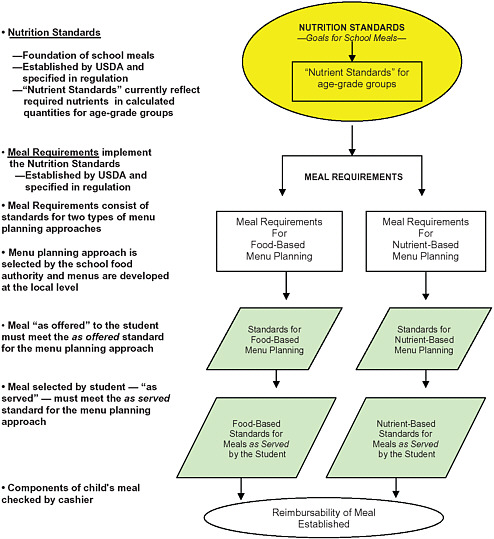
FIGURE 1-1 Relationships among current Nutrition Standards, Meal Requirements, and eligibility for federal reimbursement.
present, Meal Requirements include meal standards for two general types of menu planning approaches:2
-
the food-based menu planning (FBMP) approach, which focuses on the types and the amounts of foods to be offered to meet the Nutrition Standards; and
-
the nutrient-based menu planning (NBMP) approach, which makes use of computer software to plan menus that meet the Nutrition Standards.
Local school food authorities3 (SFAs) decide which menu planning approach to use and, hence, which set of meal standards is to be followed. Currently, approximately 70 percent of schools use the FBMP approach (USDA/FNS, 2007a). Existing meal standards for the two most common types of menu planning (the traditional approach and the nutrient standard menu planning approach) appear in Appendix E.
Figure 1-2 identifies the standards that are the main focus of the committee’s task and illustrates their interrelationships. The committee’s task requires that its recommendations for new Nutrition Standards be consistent with the current (2005) Dietary Guidelines for Americans and with current nutrient reference values and methods of applying them. As noted earlier and shown in Figure 1-2, the Nutrition Standards apply equally regardless of the meal planning approach used.
Description of the Current Nutrition Standards
The Healthy Meals for Healthy Americans Act of 1994 (P.L. 103-448, Sec. 106(b)) requires that the Nutrition Standards of the NSLP and the SBP meals remain consistent with the most recent the Dietary Guidelines for Americans. Current regulations used the 1995 Dietary Guidelines for Americans to specify a minimum and maximum for the amount of total fat and a maximum for the amount of saturated fat. Legislation passed in 1996 (Personal Responsibility and Work Opportunity Reconciliation Act of 1996, P.L. 104-193 [August 22, 1996]) mandated that school meals provide on average, over a 5-day week, at least
-
(school lunch) one-third of the RDA of the Food and Nutrition Board, and
-
(school breakfast) one-fourth of the RDA.
The law does not specify the nutrients to be included.
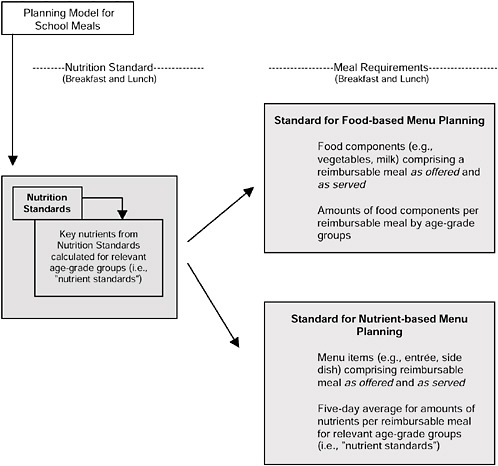
FIGURE 1-2 Current standards for school breakfast and lunch under review by the committee.
The existing USDA regulations cover calories4 and five nutrients that are to be provided by school meals. The five nutrients were chosen because of the roles they play in promoting growth and development (USDA/FNS, 1995), and they were intended to serve as a practical proxy for other nutrients. The Nutrition Standards specify the minimum amounts of calories and the five nutrients and the maximum amount of saturated fat for selected age-grade groups (e.g., grades 7–12). The Nutrition Standards also list the recommended (but not required) levels of cholesterol, sodium, and dietary fiber in the school meals. These nutrients and the other dietary components
are identified on the nutrition labels of food products, providing an important source of information for school menu planners.
Description of Meal Requirements
Existing Meal Requirements differ depending on which menu planning approach is chosen by the SFA. The Meal Requirements lay out standards for reimbursable meals as they are offered to students and, under the OVS provision of the law, as they are served to students.5 Tables 1-1 and 1-2 summarize the standards for reimbursable meals as offered and as served for the two general types of meal planning approach. Details on the amounts of foods may be found in The Road to SMI Success: A Guide for Food Service Directors (USDA/FNS, 2007b).
Under the OVS provision (USDA/FNS, 1976), which is mandatory at the high school level, a student may select (be served) fewer menu items than must be offered. For the selected meal to be reimbursable, however, the number of selections must match the number specified in the as served standard. For example, as indicated in Table 1-1 for food-based menu planning, a lunch selected by a high school student that consisted of one serving of fluid milk, one serving of meat or meat alternate, one serving of grain/bread, and no servings of fruits and vegetables would be reimbursable. In nutrient-based menu planning, a lunch that included only the entrée and one side dish (for example) would be reimbursable.
REASONS FOR THE UPDATING OF NUTRITION STANDARDS AND MEAL REQUIREMENTS
Congressional Mandate
In recognition of the need to update and revise the Nutrition Standards and Meal Requirements for the school meal programs, Congress incorporated requirements in the 2004 Child Nutrition and WIC6 Reauthorization Act (P.L. 108-265). In particular, the act requires USDA to issue guidance and regulations to promote the consistency of the standards for school meal programs with the standards provided in the most recent Dietary Guidelines for Americans and DRIs. A new edition of the Dietary Guidelines and the complete set of DRIs, both of which encourage intakes of foods and
TABLE 1-1 Reimbursable School Meals Planned Using a Food-Based Approach: Standards for Food Components as Offered and as Served, by Type of Meal
|
Meal |
As Offered |
As Served |
|
Breakfasta |
(Total of four items) |
Students must select three of the four itemsb |
|
Lunchc |
(Total of five items) |
Senior high school level: students must select three of the five items Grades below senior high school level: students must select either three or four of the five items |
|
aThe minimum amount of food that must be offered is the same from kindergarten through grade 12, except that an additional serving of any of the grains or breads is optional for students in grades 7 through 12 under the enhanced food-based approach; the range is shown in Appendix Table E-1. bOffer versus serve for breakfast is optional at all grade levels. cThe minimum amounts of food that must be offered depend on the age-grade group and the approach (traditional or enhanced). SOURCE: Derived from USDA/FNS, 2007b. |
||
TABLE 1-2 Reimbursable Breakfast and Lunch Planned Using a Nutrient-Based Approach: Standards for Menu Items as Offered and as Served, by Type of Meal
|
Meal |
As Offered |
As Served |
|
Breakfasta |
Schools must offer at least three menu items:
|
|
|
Lunchb |
Schools must offer at least three menu items:
|
|
|
aOffer versus serve (OVS) for breakfast is optional at all grade levels. bOVS is optional in grades below senior high level. SOURCE: Derived from USDA/FNS, 2007b. |
||
nutrients that have been associated with good health and chronic disease prevention, were released after the latest set of Nutrition Standards and Meal Requirements regulations had become effective.
In response to the congressional mandate, USDA has updated some of its materials for food service professionals to include information on the 2005 Dietary Guidelines for Americans. For example, the Menu Planner for Healthy School Meals (USDA/FNS, 2008b) includes a description of the 2005 Dietary Guidelines for Americans and guidance on how to implement them in school programs. Fact Sheets for Healthier School Meals includes guidance on preparing and serving meals consistent with the Dietary Guidelines (USDA/FNS, 2009a).
Consistency with Dietary Guidelines for Americans
Among the changes needed to improve consistency with the 2005 edition of Dietary Guidelines for Americans are the following:
-
Increasing the emphasis on food groups to encourage a healthier food consumption pattern, especially by offering variety and a larger amount of fruits and vegetables, and by offering whole grains as a substitute for some refined grains, and
-
Limiting the intake of saturated fat, trans fat, cholesterol, added sugars, and salt by offering foods such as fat-free (skim) milk or low-fat milk, fewer sweetened foods, and foods with little added salt.
Consistency with Dietary Reference Intakes
The DRI values and the recommended approaches for applying them produce a markedly different basis for the Nutrition Standards than do the 1989 RDAs (the reference values on which the existing Nutrition Standards are based). The DRIs cover many more nutrients and include four types of reference values (see Chapter 3 for details). The DRIs are “intended to help individuals optimize their health, prevent disease, and avoid consuming too much of a nutrient” (IOM, 2006, p. 1). For groups of people, such as school-aged children, the aim of the DRI values is to achieve usual intake distributions for nutrients such that (1) the prevalence of intakes that are inadequate is low and (2) the prevalence of intakes at risk of being excessive also is low. Chapter 7 provides comparative information related to possible Nutrition Standards based on the RDAs and those set using methods recommended by the IOM (2003).
Other Considerations
Ease of Implementation of Regulations
The implementation of the current Nutrition Standards and Meal Requirements poses challenges for many school food operators and their schools (IOM, 2008). The Food and Nutrition Service and other stakeholders have called for a simplification of the meal planning regulations for reimbursable meals. The committee addresses ease of implementation in its methods of developing the Meal Requirements (Chapters 5 and 6) and in its discussion of implementing the recommendations in Chapter 10.
Children’s Health and Well-Being
Currently, overweight and obesity are major health concerns for the nation’s children (CDC, 2008; Ogden et al., 2008). The development of recommendations for Nutrition Standards and Meal Requirements for school meals must consider evidence related to the promotion of growth and development and a healthy weight. At the same time, the school meal programs play a key role in helping to alleviate food insecurity and inadequate intakes. The recommended standards will need to achieve an appropriate balance—that is, avoiding excessive calories while allowing for enough appropriate calories and nutrients to support the needs of those children with inadequate intakes.
REVISED TERMINOLOGY
In the course of its work, the committee determined that a new term was needed to accurately represent its recommendations. In particular, the committee developed recommendations for Nutrient Targets rather than Nutrition Standards. The rationale for the change in terminology appears in Chapter 4. This new term appears below where applicable in the description of the organization of the report.
SUMMARY AND ORGANIZATION OF THE REPORT
The school meal programs help guard the health and well-being of the nation’s children, in large part through the implementation of a complex set of Nutrition Standards and Meal Requirements. Congress mandated an update of the Nutrition Standards and Meal Requirements following the release of new scientific evidence in Dietary Guidelines for Americans (HHS/USDA, 2005) and in a series of reports on DRIs (IOM, 1997, 1998, 2000a, 2000b, 2001, 2002/2005, 2003, 2005).
The overall goal of the committee was the development of a set of well-conceived, practical, and economical recommendations for updating the current Nutrition Standards and Meal Requirements—recommendations that reflect current nutrition and health science, increase the meals’ contents of specified food groups, and improve the ability of the school meal programs to meet the nutritional needs of children, foster healthy eating habits, and safeguard children’s health.
The following chapters describe the processes used by the committee to meet that goal and present its findings, conclusions, and recommendations. Chapter 2 lays the foundation for revising the Nutrition Standards and Meal Requirements. Chapter 3 describes children’s food and nutrient intakes and identifies possible areas of concern. Chapters 4 and 5 describe the processes used to develop the Nutrient Targets and Meal Requirements, respectively. Chapter 6 provides perspective on the iterative nature of the processes and on challenges that confronted the committee. Chapter 7 presents the recommendations for Nutrient Targets and Meal Requirements. Subsequent chapters cover food cost and market effects; the projected impact of the recommended Nutrient Targets and Meal Requirements; and recommendations for implementation (including monitoring), evaluation, and research.


