
2
Foundation for Revising Nutrition Standards and Meal Requirements
To provide a firm foundation for revising the Nutrition Standards and Meal Requirements, the committee carefully considered its overall approach and major challenges, which are summarized here. In addition, this chapter presents the rationale for (1) establishing three age-grade groups representing elementary school, middle school, and high school and (2) setting mean values for the total daily calorie requirements for those age-grade groups, which have been rounded to 1,800, 2,000, and 2,400 calories, respectively.
THE APPROACH
The committee’s approach to developing recommendations for revisions to the Nutrition Standards and Meal Requirements for the School Breakfast Program and the National School Lunch Program included numerous steps. The committee
-
Developed and applied a set of working principles to guide the selection of evidence and the types of analyses and reviews to be conducted and to focus committee deliberations. The working principles, shown in Box 2-1, were developed during Phase I and applied throughout the study.
-
Developed a set of criteria to assist in deriving and evaluating the recommendations. These criteria, shown in Box 2-2, were developed during Phase I and slightly revised during Phase II in response to feedback on the Phase I report (IOM, 2008).
|
BOX 2-1 Working Principles for Determining Recommendations for Revisions to the Nutrition Standards and Meal Requirements for School Meals
|
|
BOX 2-2 Criteria for the Nutrient Targets and Meal Requirements for the School Breakfast Program and the National School Lunch Program Criterion 1. The Nutrient Targets and Meal Requirements are consistent with current dietary guidance and nutrition recommendations to promote health—as exemplified by the Dietary Guidelines for Americans and the Dietary Reference Intakes—with the ultimate goal of improving children’s diets by reducing the prevalence of inadequate and excessive intakes of food, nutrients, and calories. Criterion 2. The Nutrient Targets and Meal Requirements will be considered on the basis of age-grade groups that are consistent with the current age-gender categories used for specifying reference values and with widely used school grade configurations. Criterion 3. The Nutrient Targets and Meal Requirements will result in the simplification of the menu planning and monitoring processes, and they will be compatible with the development of menus that are practical to prepare and serve and that offer nutritious foods and beverages that appeal to students of diverse cultural backgrounds. Criterion 4. The Nutrient Targets and Meal Requirements will be sensitive to program costs and school administrative concerns. |
-
Set key parameters including age-grade groups and total daily mean calorie requirements for each group. The methods used to set these parameters are described later in this chapter.
-
Assessed schoolchildren’s dietary intakes and considered relevant laboratory data and health effects of inadequate or excessive intakes. Dietary intakes included food groups, food subgroups, energy, and nutrients. The purpose was to identify the food and nutrient intakes of concern for specified age-grade groups. Chapter 3 covers this topic.
-
Examined and tested various approaches for developing the Nutrient Targets, including energy targets. The committee used methods recommended by the Institute of Medicine (IOM, 2003) when applicable. Chapter 4 covers this topic.
-
Determined that only one approach to meal planning would be recommended and that the Nutrient Targets would be the scientific basis of the standards for menu planning, but they would be only one of the elements considered when developing these standards. Chapter 5 covers the development of the Meal Requirements.
-
Using an iterative approach (described in Chapter 6), applied the criteria listed in Box 2-2 to finalize the committee’s recommendations for the Nutrient Targets and Meal Requirements, giving special emphasis to
-
the practicality of the Meal Requirements. Chapter 7 presents the recommendations. In applying the criteria, the committee considered
-
the food cost implications of the recommended revisions (see Chapter 8) and
-
the effects of various assumptions on potential nutrition-related outcomes (see Chapter 9).
In addition, the committee addressed potential market effects of the recommended revisions. This content is covered in Chapter 8.
As a result of the committee’s process and decisions, a new figure was needed to illustrate the recommended elements in the pathway to a nutritious school meal (see Figure 2-1).
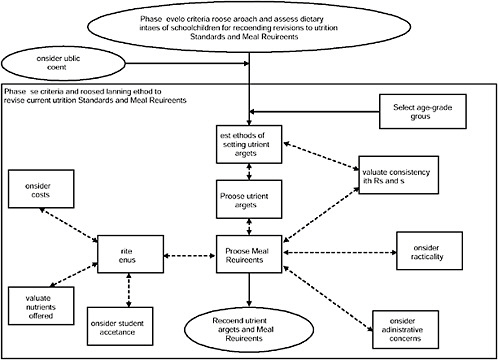
Figure 2-2 illustrates the complex nature of the process used by the committee to revise the Nutrition Standards and Meal Requirements for the school meal programs. The first box that addresses Nutrient Targets, for example, indicates that methods need to be developed for setting those targets. The boxes on either side that specify considering or evaluating specific elements relate to the application of the committee’s criteria. The double arrows and dashed lines indicate the iterative steps in the process. For example, initial proposals for the Meal Requirements were tested to determine how well they aligned with the committee’s criteria, and the results were used to modify the proposals to achieve a better fit. Extensive analyses provided the foundation for the recommendations. The major product of the process was a set of recommendations for Nutrient Targets and Meal Requirements.
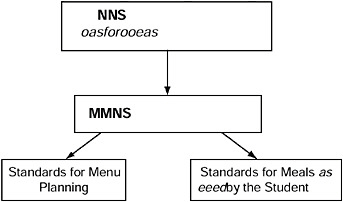
FIGURE 2-1 Depiction of the recommended elements in the path to nutritious school meals. In this figure and throughout the remainder of the report, the committee uses the term as selected by the student (or simply as selected) rather than as served to apply to standards for reimbursable meals.
MAJOR CHALLENGES IN APPLYING GROUP PLANNING APPROACHES FOR SCHOOL MEALS
For some decisions, especially those focused on applying recommendations given in Dietary Guidelines for Americans (HHS/USDA, 2005), the process for setting Nutrient Targets was straightforward. The application of Dietary Reference Intakes (DRIs) to inform the decision-making process, however, was quite complex.
A report by the IOM (2003) lays out a framework for using DRIs to plan nutrient intakes for groups. The DRI process involves “identifying the specific nutritional goals, determining how best to achieve these goals, and, ultimately, assessing if these goals are achieved” (IOM, 2003, p. 7). According to the framework, the overall goal is “to determine a distribution of usual nutrient intakes that provides for a low prevalence of inadequate intakes and a low prevalence of intakes that may be at potential risk of adverse effects due to excessive intake” (IOM, 2003, p. 8). The IOM report provides scientifically based guidance for selecting the specific goals for different kinds of groups but acknowledges that research is needed on techniques and other aspects of group planning.
Using the DRI framework to develop Nutrient Targets and Meal Requirements for school meals poses a number of challenges. The major challenges include the following:
-
Any age-grade grouping of schoolchildren is very heterogeneous in terms of the calorie and nutrient needs of the members of the group (consider, for example, small sedentary adolescent females and large adolescent male athletes). The methods for planning for heterogeneous groups covered in Dietary Reference Intakes: Applications in Dietary Planning (IOM, 2003) are described as based on theory rather than on evidence and are in need of further research. This school meals report presents one of the first applications of methods recommended by the IOM for developing targets for planning meals. The applications differ somewhat from those used by an earlier committee to develop recommendations for revision of the food packages for the Supplemental Nutrition Program for Women, Infants, and Children (WIC) (IOM, 2005).
-
The children who participate in one or more school meal programs obtain only a part of their daily intake from the school meal(s). To estimate changes in total daily intake and the resulting changes in the prevalence of inadequate and excessive intakes, an assumption must be made about how changes in the school meals will affect intake at other eating occasions.
-
The relationship of Nutrient Targets to children’s food and nutrient consumption is complex. Schoolchildren’s food selections affect their actual intake. School meal programs typically offer children a range of choices
-
within menu item categories (e.g., a choice of milks, a choice of entrées), and the offer versus serve provision of the law allows children to refuse some of the foods that must be offered (e.g., they may decline to take a milk or a grain). In addition, children may not eat all the food they select. Chapters 6 and 7 address this topic in detail.
The nature of these challenges highlights the importance of the third step in the DRI process: “assessing if these goals are achieved.” Such assessment can occur only after implementation of the Nutrient Targets and Meal Requirements and thus is beyond the scope of this committee’s work. Nonetheless, such assessments must occur and their outcomes serve as the basis for future enhancements of the school meal programs. The focus of related research is outlined in Chapter 10 of this report.
DEFINING KEY PARAMETERS: AGE-GRADE GROUPS AND ENERGY REQUIREMENTS
Establishing Age-Grade Groups
Establishing age-grade groups of schoolchildren was the first step in the formulation of the Nutrition Standards and Meal Requirements. The U.S. Department of Agriculture (USDA) asked the committee to recommend age-grade groups that reflect the stages of growth and development in children and adolescents.
Currently, the age groupings for the Nutrient Targets are based in part on age groupings in the 1989 Recommended Dietary Allowances (NRC, 1989). Current Meal Requirements for the School Breakfast Program specify one grade range—kindergarten through grade 12—regardless of the menu planning approach being used. However, some menu planning approaches include a breakfast option for grades 7 through 12 that allows somewhat more food for these older children. Current Meal Requirements for the National School Lunch Program are set for an array of grade groupings,1 which differ by the type of menu planning approach used (USDA/FNS, 2007b).
To determine the most appropriate age-grade groups, the committee considered two major elements:
-
evidence on current school grade spans and grade organization trends and
-
the DRI age categories for school-aged children (4–8 years, 9–13 years, and 14–18 years).
Grade Organizations
Data from the National Center for Education Statistics (U.S. Department of Education, 2007b) indicate that the most common grade organizational plan in school districts throughout the nation has three tiers. The plans vary somewhat but typically encompass elementary school (kindergarten or grade 1 through grades 5 or 6), middle school (grades 5 or 6 through grade 8) (U.S. Department of Education, 2000), and high school (grades 9 through 12). McEwin et al. (2003) report that since the 1970s there has been a steady movement from a two-tier plan (e.g., grades kindergarten through 8 and grades 9 through 12) to a three-tier plan, most commonly grades kindergarten through 5, 6 through 8, and 9 through 12. The U.S. Department of Education (2000) reports that nearly all the new middle schools served children in grades 6 through 8.
Comparison of Dietary Reference Intake Age Groups with Grade Organizations
The DRI age groups are based on biological evidence about children’s development (IOM, 1997). The committee considered how the ages of children included in the three most common grade spans (grades kindergarten through 5, 6 through 8, and 9 through 12) compare with DRI age groupings (Table 2-1). It concluded that the three grade spans in Table 2-1 would provide the basis for practical yet developmentally appropriate age-grade groupings for use in developing the Nutrient Targets and Meal Requirements. The kindergarten through grade 5 group received special attention because it includes children from two DRI age groups.
In conclusion, the most practical and developmentally appropriate age-grade groups for use in developing the Nutrient Targets and Meal Requirements are as follows:
|
Type of School |
Age Range (years) |
Grade Range |
|
Elementary school |
5–10 |
Kindergarten through 5 |
|
Middle school |
11–13 |
6 through 8 |
|
High school |
14–18 |
9 through 12 |
These age-grade groupings were used in setting the Nutrient Targets and the standards for menu planning.
TABLE 2-1 Age Spans for Typical Grade Organizations Compared with Age Ranges for Dietary Reference Intakes
|
Grade Span |
Typical Age Span for the Grade Spana (years) |
Corresponding DRI Age Rangesb (years) |
|
K–5 |
5–10 or 11 |
4–8 and 9–13 |
|
6–8 |
11–13 or 14 |
9–13 |
|
9–12 |
14–18 |
4–18 |
|
NOTES: DRI = Dietary Reference Intakes; K = kindergarten; y = years. SOURCES: aU.S. Department of Education, 2001; bIOM, 1997. |
||
Estimated Energy Requirements
To set Nutrient Targets for school meals it is essential to determine appropriate estimates of average daily energy requirements by age-grade group—values that are applied to both the males and females in the group. Of necessity, these values will be too high for some children (mainly the youngest elementary schoolchildren and the adolescent females) and too low for others. Using the methods described below, the committee sought to achieve a satisfactory balance.
Energy requirements for males and females ages 5 through 18 years were estimated using the age- and gender-specific Estimated Energy Requirement equations in Dietary Reference Intakes: Energy, Carbohydrate, Fiber, Fat, Fatty Acids, Cholesterol, Protein, and Amino Acids (IOM, 2002/2005). To apply these equations, the committee needed to specify the height and weight of males and females ages 5 through 18 years and to make assumptions regarding their physical activity level. The values selected and the rationale for their selection are provided below.
Height and Weight Adjustments
Three sources of data on the height and weight of school-aged children were considered: (1) the 2000 Centers for Disease Control and Prevention (CDC) growth charts (Kuczmarski et al., 2000), (2) the National Health and Nutrition Examination Survey (NHANES) covering 1999–2004 (Personal communication, Dr. Nancy Cole and Mary Kay Fox, Mathematica Policy Research, Inc., March 2009), and (3) the third School Nutrition Dietary Assessment study (SNDA-III) that collected data during the 2004–2005 school year (USDA/FNS, 2007a). Ultimately, the committee decided to use median heights and weights from the 2000 CDC growth charts because they are the reference standards for healthy U.S. children. Both the NHANES 1999–2004 data and the SNDA-III data were ruled out because of higher median weights and higher prevalence of obesity, relative to the
CDC reference standards, reflecting recent increases in obesity among U.S. youth. For a similar reason, the CDC did not use data from NHANES-III (1988–1994) when updating the growth charts in the late 1990s (IOM, 2002/2005).
Physical Activity Level Assumptions
To calculate the Estimated Energy Requirement, one needs an estimate of an individual’s usual physical activity level (PAL). Self-report methods of estimating a child’s physical activity, such as physical activity questionnaires or diaries, have low validity (Adamo et al., 2009; Corder et al., 2008; Janz et al., 1995; Sallis and Saelens, 2000). Therefore, to assign a PAL to school-aged children, the committee relied mainly on available accelerometry data.
Physical Activity Level of U.S. Children Accelerometers (physical activity monitors) are small electronic devices programmed to detect and record the magnitude of accelerations of the body. The chief advantage of accelerometers over self-report methods is that they provide an objective measure of engagement in physical activity. Also, the magnitude (intensity) of an activity may be captured on a minute-by-minute basis, thereby providing a better measure of engagement in moderate and vigorous physical activities than is possible with a self-report questionnaire.
The committee reviewed accelerometer data from a number of studies (Janz et al., 2005; McMurray et al., 2008; Nader et al., 2008; Troiano et al., 2008; Troped et al., 2007; Whitt-Glover et al., 2009). However, the only accelerometer data that were used by the committee were collected as part of the 2003–2004 NHANES2 and analyzed by Troiano et al. (2008). None of the other studies collected data on a nationally representative sample of children. Rather, most involved cohort or convenience samples of children in one geographic area or several regions, males or females only, or children within a narrow age range (e.g., middle school children). Nonetheless, with only one exception (Nader et al., 2008), the results of the less representative studies were fairly consistent with the NHANES results. Using the same NHANES data set used by Troiano and colleagues (2008), Whitt-Glover and coworkers (2009) found no significant differences in physical activity by socioeconomic status.
The analysis of the NHANES accelerometer data provided estimates of the average number of minutes per day that Americans spend engaged in moderate and vigorous intensity physical activities. Table 2-2 presents the
|
2 |
A detailed description of the NHANES physical activity monitor procedures may be found at http://www.cdc.gov/nchs/nhanes/nhanes2003-2004/exam03_04.htm. |
TABLE 2-2 Mean Minutes per Day of Engagement in Moderate or Vigorous Physical Activity,* NHANES 2003–2004
|
Age (years) |
Males (min/d)a |
PAL Classificationb |
Females (min/d)a |
PAL Classificationb |
|
6–11 |
95.4 |
Active |
75.2 |
Active |
|
12–15 |
45.3 |
Low active |
24.6 |
Sedentary |
|
16–19 |
32.7 |
Low active |
19.6 |
Sedentary |
|
NOTES: min/d = minutes per day; NHANES = National Health and Nutrition Examination Survey; PAL = physical activity level. *Minutes of vector magnitude readings indicative of engagement in moderate or vigorous physical activity based on age-specific criteria. SOURCES: aTroiano et al., 2008; bIOM, 2002/2005. |
||||
TABLE 2-3 Physical Activity Level Category Classifications Used to Calculate Estimated Energy Requirements of School-Aged Children, by Age and Gender
|
Ages (years) |
Males |
Females |
|
6–10 |
Active |
Active |
|
11–13 |
Low active |
Low active |
|
14–18 |
Low active |
Low active |
mean minutes per day that U.S. children were found to be engaged in moderate or vigorous physical activities and the PAL categories that correspond with each. To summarize the results, for most age and gender groups, the average total daily minutes of engagement in moderate or vigorous activities fit within the active or low active categories. However, the average total daily minutes of engagement in moderate or vigorous activity for females ages 12–15 and 16–19 years fit within the sedentary activity category.
Physical Activity Level Categories The PAL categories the committee selected for use in estimating the energy requirements of males and females of various ages are presented in Table 2-3.3 For young males of all ages and females ages 5–10 years, the categories selected match those indicated by the NHANES 2003–2004 accelerometer data (Table 2-2). However, for females ages 11–13 and 14–18 years, the committee determined that a low active rather than a sedentary category of classification was warranted for use in the calculation of the Estimated Energy Requirements for two reasons:
|
3 |
The committee recognizes that the data summarized in Table 2-2 are for somewhat different age groups but considers them close enough to use as a basis for PALs. |
-
Public health measures call for at least a low-active level of physical activity for children of school age.
-
Calorie levels need to be high enough to allow for planning school meals that meet an appropriate portion of schoolchildrens’ food and nutrient needs.
The assumption of the low-active PAL resulted in Estimated Energy Requirements for the females in the two older age-grade groups that are about 20 percent higher than would be calculated using a sedentary physical activity level. When the Estimated Energy Requirements for the males and females are averaged, however, the result is only about 8 percent higher. Furthermore, offering a small amount of extra calories may be justified for the adolescents because the range between the male and female calorie requirements is large (especially for the high school ages). Thus, the active boys may need the additional calories, while the inactive girls would have the option to choose or to consume less.
Information about how these classifications were used in the calculation of the Estimated Energy Requirements for males and females of school age appears in Appendix F.
Mean Estimated Energy Requirements
The Estimated Energy Requirements determined by the process described above appear in Appendix F. The mean Estimated Energy Requirement was then calculated by gender and by age-grade group (5–10 years for kindergarten through grade 5, 11–13 years for grades 6 through 8, and 14–18 years for grades 9 through 12). The calculated mean daily calorie requirements for males and females by age-grade group appear in Table 2-4.
TABLE 2-4 Calculated Mean Daily Calorie Requirementsa by Age-Grade Group for Males and Females Separately and for Both Genders Combined
The committee used these mean daily calorie levels by gender and age-grade group when setting the preliminary nutrient targets for vitamins, minerals, and protein (see Chapter 4). Rounded mean daily calorie levels for both genders combined (1,800, 2,000, and 2,400 calories) were used in calculations to set minimum and maximum calorie targets for school meals (see Chapter 4) and in calculations related to the Meal Requirements.
SUMMARY
The committee used a seven-step approach to the design of Nutrient Targets and Meal Requirements. The major challenges identified are the need to work with complex interrelationships among heterogeneous groupings of children for whom school meals provide only part of their nutritional intake and for whom food preferences differ. Data-based methods were used to provide a basis for two key decisions that were critical to the development of recommended Nutrient Targets and Meal Requirements: the setting of age-grade groups for school meals and the calculation of appropriate values for mean total daily calorie requirements for males and females in those age groups. The age-grade groups chosen were 5–10 years (kindergarten through grade 5), 11–13 years (grades 6 through 8), and 14–18 years (grades 9 through 12). Subsequent chapters address the assessment of schoolchildren’s dietary intakes, other data related to the children’s nutritional health, the development of the Nutrient Targets and Meal Requirements, various analyses, and recommendations and guidance for implementation.


