
CHAPTER FIFTEEN
Solar Radiation Management
For over 45 years, proposals for deliberate, large-scale manipulation of Earth’s environment—or geoengineering (see Box 15.1 and Figure 15.1)—have been put forward as ways to potentially offset some of the consequences of climate change. For example, whitening clouds, injecting particles into the stratosphere, or putting sunshades in space could increase Earth’s reflectivity, thereby reducing incoming solar radiation and offsetting some of the warming associated with increasing GHG concentrations. Although few if any voices are promoting geoengineering as a near-term option to limit the magnitude of climate change, the concept has recently been gaining more serious attention as a possible backstop measure to be used if traditional strategies to limit emissions fail to yield significant emissions reductions or if climate trends become disruptive enough to warrant extreme and risky measures.
Questions decision makers are asking, or will be asking, about solar radiation management and other geoengineering approaches include the following:
-
Can the negative impacts associated with increasing atmospheric greenhouse gas (GHG) concentrations be reduced or offset by intentionally intervening in the climate system? If so, how?
-
What undesirable, unintended consequences might result from such interventions? How could these consequences be anticipated or detected?
-
Who should decide, whether, when, and how to intentionally intervene in the climate system?
-
What institutional mechanisms would be needed to initiate, carry out, monitor, and respond to the impacts—foreseen and unforeseen—of such an effort?
-
Which types of interventions might be most socially acceptable and what frameworks for evaluation, governance, and compensation should be used?
In this chapter, we briefly review what is known about proposed solar radiation management (SRM) approaches and related governance and ethical issues and conclude with a discussion of the research needed to better understand SRM. Carbon dioxide removal approaches are addressed in Chapters 9, 10, and 14 and in the companion report Limiting the Magnitude of Climate Change (NRC, 2010c). Note that SRM research is in its infancy and that most conclusions should be regarded as preliminary.
|
BOX 15.1 Geoengineering: Solar Radiation Management and GHG Removal The term geoengineering refers to deliberate, large-scale manipulations of the Earth’s environment designed to offset some of the harmful consequences of GHG-induced climate change (see AGU, 2009; AMS, 2009; NRC, 1992b; The Royal Society, 2009). Geoengineering encompasses two very different classes of approaches: carbon dioxide removal (CDR) and solar radiation management (SRM). Figure 15.1 depicts the most commonly discussed options in both these categories. CDR approaches (also referred to as post-emission GHG management or carbon sequestration methods) involve removal and long-term sequestration of atmospheric CO2 (or other GHGs) in forests, agricultural systems, or through direct air capture with geological storage. These techniques and their implications are discussed in the companion report Limiting the Magnitude of Future Climate Change (NRC, 2010c) and are also mentioned in several previous chapters. There is no consensus regarding the extent to which the term geoengineering should be applied to various widely accepted practices that remove CO2 from the atmosphere (e.g., reforestation). SRM approaches, the focus of this chapter, are those designed to increase the reflectivity of the Earth’s atmosphere or surface in an attempt to offset some of the effects of GHG-induced climate change. |
HISTORY OF SOLAR RADIATION MANAGEMENT PROPOSALS
In November of 1965, the Environmental Pollution Panel of the President’s Science Advisory Council (PSAC) for the first time informed a president of the United States about the threats posed by increasing atmospheric CO2 concentrations. Their report stated:
The climatic changes that may be produced by the increased CO2 content could be deleterious from the point of view of human beings. The possibilities of bringing about countervailing climatic changes therefore need to be thoroughly explored. A change in the radiation balance in the opposite direction to that which might result from the increase of atmospheric CO2 could be produced by raising the albedo, or reflectivity, of the earth (PSAC, 1965).
The topic of SRM was also taken up in the National Research Council’s 1992 report Policy Implications of Greenhouse Warming (NRC, 1992b). That report noted:
[W]e are at present involved in a large project of inadvertent “geoengineering” by altering atmospheric chemistry [i.e., by increasing GHG concentrations], and it does not seem inappropriate to inquire if there are countermeasures that might be implemented to address adverse impacts.… Our current project of “geoengineering” involves great uncertainty and risk. Engineering coun-
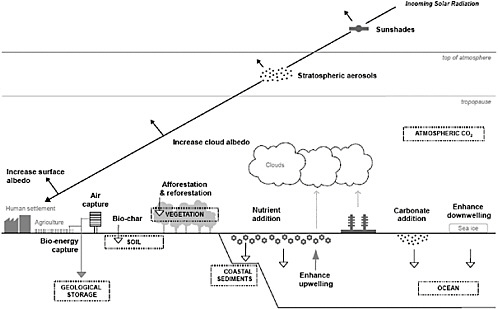
FIGURE 15.1 Various geoengineering options, including both solar radiation management and carbon dioxide removal. Dashed boxes represent carbon reservoirs (e.g., soil, ocean); black arrowheads represent shortwave radiation and are associated with solar radiation management; white and gray arrowheads pointing down correspond to a variety of natural and engineered processes, respectively, for removing CO2 from the atmosphere; the thicker, gray arrowhead pointing up represents enhanced ocean upwelling, which could conceivably help to remove CO2 from the atmosphere by enhancing biological activity at the ocean’s surface; and the thinner gray arrowheads correspond to increased cloud condensation nuclei sources. SOURCE: Lenton and Vaughn (2009).
termeasures need to be evaluated but should not be implemented without broad understanding of the direct effects and potential side effects, the ethical issues, and the risks.
The PSAC (1965) and NRC (1992b) reports suggested that proposals to increase the reflectivity of the Earth (and to remove GHGs from the atmosphere) be thoroughly examined. This sentiment was echoed by many participants at the geoengineering workshop held in June 2009 as part of the suite of activities for the America’s Climate Choices study (Appendix F), as long as such research does not undermine other critical climate research efforts (see the discussion of ethical issues below), including research on adapting to the impacts of climate change and on conventional strategies for limiting the magnitude of future climate change (i.e., reducing fossil fuel consumption, deforestation, and other activities that contribute to climate forcing). Critically, these evaluations should explore the intended effects of geoengineering approaches and their potential unintended side effects, as well as the ethical, institutional, social, and political aspects of intentional manipulation of the climate system.
PROPOSED SOLAR RADIATION MANAGEMENT APPROACHES
A number of different SRM methods have been proposed. This subsection briefly outlines some of the approaches that have been discussed in the literature (Keith, 2000; Rasch et al., 2008) and briefly summarizes their potential to reduce total radiative forcing. Other sources, including a recent report by the Royal Society (2009), provide a more comprehensive description. The relative advantages and disadvantages, potential for unintended consequences, and governance and ethical issues associated with these approaches are discussed in the next subsection. It should be noted that, unlike many other areas of research discussed in this report, these issues have undergone relatively little scientific scrutiny, with most of the relevant research done by a few small groups of scientists working with limited resources. Thus, many of the conclusions presented here must be regarded as preliminary and subject to revision.
Space-Based Options
A variety of options have been proposed for placing vast satellites in space, typically at the L1 point1 between Earth and the Sun (Early, 1989). However, to compensate for the increase in GHGs, nearly 4,000 square miles (10,000 square kilometers) of reflective
surface would need to be constructed and put into orbit each year—or approximately an additional 10 square miles per day each and every day—for as long as CO2 emissions continue increasing at rates comparable to today’s (Govindasamy and Caldeira, 2000). Due to the magnitude of spaced-based deployment required for such an undertaking, and the enormous cost of putting objects into orbit, these options appear impractical for addressing threats posed by climate change this century.
Stratosphere-Based Options
One of the most widely discussed options for SRM involves the injection of sulfate aerosols into the stratosphere, although other types of particles could potentially serve the same function. As discussed in Chapter 6, particles can reflect solar radiation back to space, offsetting some of the warming associated with GHGs. The amount of sulfur that would need to be supplied to the stratosphere to offset the radiative forcing associated with GHG emissions could be delivered through a variety of means, including aircraft and artillery shells, with relatively small direct costs (Crutzen, 2006; NRC, 1992b; Robock et al., 2009; The Royal Society, 2009). Since sulfate particles are also injected into the stratosphere by volcanic eruptions, cooling following recent eruptions serves at least as a general “proof of concept” for this approach. For example, in the year following the eruption of Mount Pinatubo in June 1991, global temperatures cooled by approximately 0.9°F (0.5°C; Trenberth and Dai, 2007). Process understanding could be developed through small-scale tests, but an understanding of global climate effects would require either reliance on models or tests that would be of global scale and at least one-tenth the size of a full deployment. Full deployment would require a long-term, uninterrupted commitment to continued injection at the scale of tens of kilograms of material per second injected quasi-continuously. A sudden cessation after a sustained deployment could result in rapid temperature increases over a period of a few years, causing potentially severe impacts on ecological and social systems (Matthews and Caldeira, 2007).
Cloud-Based Options
A range of options have been proposed to “whiten” clouds, or make them more reflective, by increasing the number of water droplets in the clouds. The most widely discussed proposal involves whitening low clouds over remote parts of the ocean by
spraying a fine seawater spray in the air (Latham, 2002). This approach may be able to offset some or most of the radiative forcing associated with a doubling of atmospheric CO2 (Bower et al., 2006; Latham, 2002). Process understanding relevant to this approach (e.g., cloud physics) can be tested at relatively small scales (Salter et al., 2008), although such tests would not permit direct inference of climate consequences of large-scale deployment. Another proposed cloud-based approach involves the seeding of high cirrus clouds with heterogeneous ice nuclei to reduce their coverage, potentially using commercial airplanes (Mitchell and Finnegan, 2009). While this method is not technically an example of SRM, it could potentially increase the amount of longwave (infrared) radiation emitted to space, which would cool the Earth.
Surface-Based Options
It has been proposed that global warming could be slowed by whitening roofs to reflect more sunlight back to space (Akbari et al., 2009). Under certain circumstances, whiter roofs could both reduce heating costs and help keep the Earth cool by reflecting sunlight back to space. Others have proposed growing more reflective crops (Ridgwell et al., 2009). Both approaches, if applied on a global scale, could potentially yield a modest cooling effect (The Royal Society, 2009), and white roofs also have the potential for co-benefits such as reducing urban heat islands (see Chapter 12). To date, studies indicate limited potential for such approaches, and the efficacy and environmental consequences of these approaches have yet to be carefully studied.
POSSIBLE UNINTENDED CONSEQUENCES
The overall climatic and environmental responses to SRM approaches are not well characterized. All proposed approaches have the potential for unintended negative consequences for both environmental and human systems. While the magnitude of the consequences is generally proportional to the scale on which the approach is deployed (painting an individual home white would yield fewer impacts—and be more easily reversible—than injecting millions of tons of sulfur into the stratosphere), several issues associated with large-scale deployment merit discussion.
First, none of the SRM approaches would stem ocean acidification (see Chapter 9) associated with enhanced atmospheric CO2 levels. This is a key difference between SRM approaches and the CDR approaches discussed in Chapters 9 and 14 and in the companion report Limiting the Magnitude of Future Climate Change (NRC, 2010c).
Second, despite the potential for SRM approaches to offset warming in a globally averaged sense, local imbalances in radiative forcing could still lead to regional climate shifts, and the impact of SRM on precipitation and the hydrologic cycle is not very well understood. Short-term volcanic eruptions are not a good direct analog of long-term deployments, yet they provide valuable tests of our process understanding and ability to simulate the climate response to such forcings. Currently climate models underestimate the magnitude of the observed global land precipitation response to 20th-century volcanic forcing (Hegerl and Solomon, 2009) as well as human-induced aerosol changes (Gillett et al., 2004; Lambert et al., 2005), suggesting that these models may not reliably predict the simultaneous effect of SRM approaches on both precipitation and temperature (Caldeira and Wood, 2008). Some modeling studies (Robock et al., 2008) indicate that sulfate aerosol injection could decrease rainfall in the Asian and African monsoons, thereby affecting food supplies. Observational studies also reported that the Ganges and Amazon rivers both experienced very low flows immediately following the eruption of Mount Pinatubo (Trenberth and Dai, 2007). With regard to cloud-based options, it is also unclear if changes to cloud properties in one region could lead to “downwind” changes in the hydrologic cycle, including changes to precipitation.
For the injection of sulfate aerosols, an additional concern exists: the potential for increased concentrations of stratospheric aerosols to enhance the ability of residual chlorine, left from the legacy of chlorofluorocarbon use, to damage the ozone layer, especially in the early spring months at high latitudes. A sudden increase in stratospheric sulfate aerosol could strongly enhance chemical loss of stratospheric polar ozone for several decades, especially in the Arctic (Tilmes et al., 2008). There is also some evidence, however, that sulfate injection, by scattering some of the sunlight that does reach the Earth’s surface, could actually boost ecosystem productivity and crop yields—this could disturb natural ecosystems but be an unintended co-benefit for agricultural systems (Gu et al., 2003; Roderick et al., 2001).
Finally, many SRM approaches require continuous intervention with the climate system in order to offset the forcing associated with GHGs. At some point in the future, if geoengineering were abandoned following its deployment, the adjustment of the climate system to the accumulated GHGs could involve warming on the order of several degrees Fahrenheit per decade (Matthews and Caldeira, 2007), a rate far greater than that estimated for the planet in the absence of geoengineering.
GOVERNANCE ISSUES
The deployment of SRM approaches has been discussed as a means of buying time for society to develop more effective ways to reduce GHG emissions, to avoid having to reduce emissions, and to produce a global cooling within years and decades in order to avert or reduce damage from a “climate emergency” (Lane et al., 2007) such as ice sheet collapse, rapid GHG degassing from melting permafrost, or other abrupt shifts in climate (see Chapter 6). Regardless of the ability of an SRM intervention to effectively buy time or avert crisis, several governance issues are associated with the decision to test or deploy SRM.
Due to the global nature of SRM, and especially considering some of the potential unintended consequences discussed in the preceding subsections, most analyses suggest that some sort of international framework—whether a series of bilateral or global, multilateral treaties—will be needed for governing SRM (e.g., Virgoe, 2009). Currently, no widely agreed-upon international governing body or legal or regulatory framework exists to govern the testing or deployment of SRM methods. Recent conferences on this topic have discussed how such a framework might be developed; the Council on Foreign Relations’ Workshop on Unilateral Planetary-Scale Geoengineering (Ricke et al., 2008) suggested the application of standards such as “encapsulation” (the degree to which SRM releases material into the environment) and “reversibility” (the ability to terminate and reverse the effects of SRM) (The Royal Society, 2009), and another recent conference recommended voluntary governance mechanisms and basic principles to guide future geoengineering research (Asilomar Scientific Organizing Committee, 2010), but international endorsement and formal adoption by relevant research institutions and governments have not been undertaken. Because some research groups may be ready to test SRM approaches in the near term, there is also a near-term need to define what kinds of field experiments might be permitted in the near term while a broader regulatory framework is developed. Without a clear international agreement and relevant international and complementary national institutions, the probability of unilateral testing or deployment of SRM is elevated. Such unilateral action could potentially result in international tension, distrust, or even conflict (Virgoe, 2009), which could compromise the physical feasibility of SRM or increase the economic cost (Gardiner, 2010).
ETHICAL ISSUES
Intentional climate alteration, including SRM, raises important issues with respect to ethics and responsibility (Gardiner, 2010; Jamieson, 1996). First and foremost is the is-
sue of equity. Issues of inequities include unequal representation in relevant decision-making bodies in relationship to benefits, and intergenerational equity, where future generations inherit the long-term commitment to certain types of interventions, or face the consequences involved in phasing out past SRM interventions. Second, consideration of SRM may pose a “moral hazard,” where focus on SRM as a solution to climate change may detract from efforts to reduce GHG emissions or adapt to the consequences of climate change, or create an institutional inertia that essentially commits us to its deployment (Gardiner, 2010). Finally, there is the question—probably impossible to discern scientifically but nonetheless powerful in coloring public debate—about the “appropriate” place of the human species in the global ecology and whether human attempts to control the complex Earth system are a matter of hubris or a desirable evolution (e.g., Jamieson, 1996; Keutartz, 1999; Lovelock, 2008; Schneider, 1996, 2008).
Issues of ethics are likely to affect the social acceptability and political feasibility of planetary-scale, intentional manipulation of the climate system. Judging from past experience with siting and deployment of potentially fear-invoking technologies, these issues may dominate the political process (e.g., Douglas, 1985; Erikson, 1994; Fischhoff, 1981; Freudenburg and Pastor, 1992; Kates et al., 1984). Little if anything is known at present, however, about how U.S. citizens or other countries perceive SRM or other geoengineering options, and improved understanding of these perceptions may be critical inputs to governance discussions.
RESEARCH NEEDS
Improve understanding of the physical potential and technical feasibility of approaches. None of the SRM approaches have proceeded beyond the level of relatively simple analyses, small-scale laboratory experiments, and preliminary computer simulations. Hence, only a little is known about how effective proposed approaches would be at achieving their stated goals, or how possible it would be to actually deploy them. For example, in the case of stratospheric sulfur aerosol injection options, modeling and experiments to improve understanding of how particles aggregate in the stratosphere are needed. Because this and similar basic research questions relevant to climate engineering would also improve fundamental knowledge about the atmosphere, they could contribute more broadly to understanding the physical climate system. Engineering and cost analyses of different approaches are also likely to be useful as options are explored.
Focus research attention on the potential consequences of srm approaches
on other aspects of the earth system, including ecosystems on land and in the oceans. Because the coupled human-environment system is large and complex, it is impossible to fully anticipate all consequences of a geoengineering intervention in advance, or any other type of intervention for that matter. Nevertheless, it is possible to predict and anticipate some of these consequences through a combination of analysis; small-scale de minimis experiments; and climate, Earth system, and integrated assessment modeling. Again, in the case of stratospheric sulfur aerosol injection options, experiments that evaluate how increases in diffuse solar radiation would affect ecosystem productivity or how stratospheric particles might affect the ozone layer could be carried out. Similarly, modeling studies and analysis of observations around volcanic eruptions may provide insight into the changes to be expected in the hydrologic cycle from SRM.
Develop metrics and methods for informing discussions and decisions related to “climate emergencies.” There are at least two components to this research need. For use of SRM as a potential “backstop option” in the case of an emerging “climate emergency,” improved observations and understanding of climate system thresholds, reversibility, and abrupt changes (see Chapter 6)—for example, observations to let us know when an ice sheet or methane hydrate field may become unstable (e.g., Khvorostyanov et al., 2008; Shakhova et al., 2010)—could inform societal debate and decision making about needs for deployment of a climate intervention system. Second, there is no consensus on what constitutes a “climate emergency,” nor is there a consensus regarding when an SRM deployment might be warranted. The notion of an “emergency” is not simply a scientific concept, but one that involves both scientific facts and human values—quite similar to discussions about “dangerous interference in the climate system” (e.g., Dessai et al., 2004; Gupta and van Asselt, 2006; Hansen, 2005; Lorenzoni et al., 2005; Oppenheimer, 2005; Smith et al., 2009). To some people, losing Arctic ecosystems constitutes a climate emergency, whereas to others the declaration of an “emergency” might require widespread loss of human life. Therefore, to inform a broader discussion of how society wants to address issues of risk, climate intervention cannot be studied in isolation but must be placed in a broader context considering, for example, drivers of climate change, climate consequences, sociopolitical systems, and human values.
Develop and evaluate systems of governance that provide models for decision making about whether, when, and how to intentionally intervene in the climate system. Because decisions about intentional alteration in the climate system will have widespread consequences, options for governance, including different types of institutions, assigned decision makers, procedures, norms, and rules and regulations, will be needed and can be provided through analysis. Much can be learned, for exam-
ple, by studying past environmental and national security agreements, the siting and deployment of large-scale technology, and the conditions under which cooperation or conflict develops. Further research can help elucidate when and what type of governance might be useful not only for deployment but also for field experiments that can be reasonably expected to involve risks of negative consequences. Decisions about intentional interventions in the climate system require not only an understanding of the physical climate system response but also how these climate responses affect differentially vulnerable people and things people need or care about such as food and water security.
Improve detection and attribution of climate change so as to provide an adequate baseline of observations of the “nonengineered” system with which to compare observations of the “engineered” system. Just as it is a nontrivial exercise to quantitatively attribute observed climate change among different climate forcing agents, distinguishing the effects of intentional climate intervention from other causes of climate change to ascertain the effectiveness of SRM approaches is a nontrivial task. Detection and attribution of climate change, and evaluation of all actions taken to respond, including initial testing, will require enhanced observing systems and analyses covering a wide array of climate and other environmental variables, especially more complete observations of energy flows in Earth’s climate system. In particular, preparations are needed to carefully observe the effects of the next major volcanic eruption.
Measure and evaluate public attitudes and test communication approaches to effectively inform and engage the public in decision making. Past experience with large and potentially dangerous technologies (or technologies perceived as dangerous) shows the importance of involving the public in advancing ideas and deliberations regarding testing or deployment of climate engineering approaches (see references above). However, little is known at this time about how different publics would perceive such large-scale interventions, what their attitudes are, how they should be engaged, and how best to communicate the complex issues concerning climate engineering. Also, attitudes and communicative approaches are likely to change over time and require periodic reassessment.
Develop an integrated research effort that considers the physical, ecological, technical, social, and ethical issues related to srm. Much of the research and observations needed to advance the scientific understanding of SRM approaches are also needed to advance general understanding of the climate system and related human and environmental systems. Examples of dual-purpose research include studies of the climate effects of aerosols, cloud physics, and how ecosystems, ocean circulation, permafrost, and ice sheets respond to changes in temperature and precipitation.
There is, however, additional research that would be needed to support full evaluation of SRM approaches (just as there is with other options for limiting the magnitude of future climate change), including a variety of social, ecological, and physical sciences (see Chapter 4). Such an effort would no doubt draw on many of the experts already engaged in climate change research, but would also need to engage new disciplines and expertise to aid in issues related to governance, public acceptance, and ethics.


