
CHAPTER FOUR
Resources for Effective Climate Decisions
What tools are useful in informing decisions about climate change? This chapter discusses how decisions regarding complex organizational, institutional, and individual choices are generally made and places climate-related decisions within that framework. While the America’s Climate Choices (ACC) Advancing the Science of Climate Change (NRC, 2010b) discusses the state of the science of decision making and the latest research on decision support, this chapter focuses on specific resources and tools, ranging from simple maps and graphs to more complex models, that are used in decisions and actions about climate change (see Table 4.1). Of course, many actors make many climate-relevant decisions without the aid of complex tools. Some decisions are made through the use of sophisticated or data rich computer-based decision-structuring techniques, but others are made through informal methods that might include conversations with experts, personal opinions about costs and benefits, or fragmented and incomplete information that may or may not be relevant to the local situation. In formulating courses of action, people and organizations respond to many different kinds of signals, including evidence of institutional norms of conduct, social influences, and relatively simple but persuasive information products derived from scientific research. Decision tools generate results based on the assumptions and data, which will vary depending on the user. For example, models that estimate the costs of climate change that heavily discount future values tend to produce results with lower costs and less urgency for immediate action, and graphs that only show short-term trends and variability may suggest lower risks than those with longer time scales. Those who hold doubts about the necessity of taking action to reduce emissions or invest in adaptation may rely on tools that include assumptions that minimize the risks and costs of climate change and on scientific literature that supports these assumptions. In contrast, those who are more concerned to act may select tools that allow for the exploration of possible extreme changes or place a high value on future damages.
These choices are easily illustrated by how different decision makers interpreted the model results published in the Stern Review on the Economics of Climate Change (Stern, 2007). Figure 4.1 shows the model-based estimates of average global losses in income per capita using several sets of assumptions, including (a) whether climate
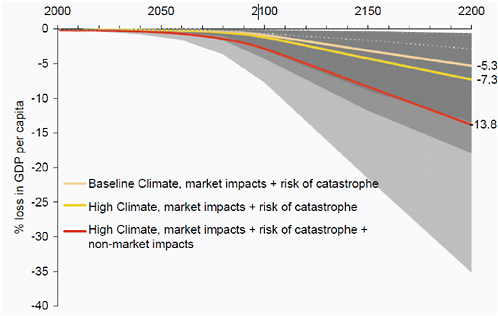
FIGURE 4.1 The impact of climate change on global GDP per capita. SOURCE: Stern (2007).
has a medium (baseline) or high sensitivity to greenhouse gas emissions, (b) whether impacts are only those which can be monetized (market impacts) or whether non-market impacts such as loss of species are included, and (c) whether there is a risk of rapid climate change (risk of catastrophe) or if climate will change slowly. The graph also includes a shaded area that represents the probabilities (or chance) of impacts from a 5 to 95 percent level.
A conservative interpretation of this graph, a decision support tool in itself, might select the baseline climate, where only market impacts and the lower end of the probability of impact such that the loss of gross domestic product (GDP) in 2200 would be less than 5 percent. However, a decision maker who is worried about high climate sensitivity and the chance, however small, of serious impacts, would conclude that the costs could be as high as 35 percent of GDP per capita. The varying interpretations of such graphs and model outputs are one of the sources of disagreement about how to respond to climate change. In addition, when the Stern Review summarized the damages, future damages were not discounted, estimating them at up to 14.5 percent of future consumption. Conversely, those who consider it more rational to discount
future costs would conclude that damages would only be about 4.2 percent (at a 1.5 percent discount rate).1 The debates over the Stern Report are more than academic because the analysis became the basis for the U.K. government’s decisions about emission reduction targets and adaptation policy. What the case illustrates are the enormous challenges in providing clear and useful support tools for decision makers, and the importance of transparency about the assumptions that underpin the results.
WHOSE DECISIONS? WHICH RESOURCES?
As chapters 1 and 2 make clear, informing climate-related decisions involves many kinds of activities, products, and services, including identifying decision makers’ information needs, producing decision-relevant knowledge and information, creating information products based on this information, disseminating these products, and encouraging and facilitating their use. Because responding to climate change necessitates so many different decisions, many groups in society can benefit from decision support tools, including officials in the executive branch of government, members of Congress, agency personnel at federal, state, and local levels, and persons in leadership positions in large corporations, small businesses, and non-profit organizations. They also include residents of communities and neighborhoods, households, and individuals. Decision support tools and resources must thus be adapted for a broad range of decision makers and decision-related challenges. Additionally, strategies to aid decision making must recognize what is distinctive and challenging about climate-related decision making while at the same time drawing upon knowledge developed in comparable decision arenas. The sections that follow first discuss how climate-related decisions can be conceptualized and then move on to discuss special challenges associated with climate-related decision making and resources that can help inform and improve decision making among public, private, and non-profit sectors.
Institutions such as the U.S. Congress and organizations ranging from large federal bureaucracies to corporations and small businesses are faced with numerous decisions on an ongoing basis, including various climate-related decisions. General research on decision making in organizations provides insight into what drives decision making for organizational and institutional actors. There is also a solid empirical basis for understanding household and individual decision making on environmental issues that can inform climate-related decisions at those levels of analysis. Box 4.1 provides examples of social science research needs to support decision making, including
|
BOX 4.1 Social Science Research Needs Research for and on decision support would improve the design and function of public and private decision support systems (NRC, 2009a). Science for decision support provides information that decision makers need and includes both “fundamental research on human processes and institutions that interact with the climate system (e.g., risk-related judgments and decision making, environmentally significant consumption, institutions governing resource management)” (NRC, 2009a), including the following:
|
research into human courses of action as well as how to most effectively communicate the information needed by decision makers.
The Basis for Decision Making in Organizations and Institutions
Many tools that exist to support organizational and institutional decision making rest either implicitly or explicitly on rational choice and assumptions. The rational choice perspective sees actors making decisions in order to actualize their preferences in an efficient and calculated manner—based mostly on an estimate of the economic costs and benefits of actions. Bargaining and negotiation are seen as involving various forms of exchange, which are again driven by preferences for particular outcomes.
The science of decision support builds knowledge about how to inform decisions effectively, including the following:
|
Assumptions about organizational rationality, instrumentalism, and concern with costs and benefits form the underpinning for many approaches to decision support, including those discussed in this chapter. Such approaches are useful, particularly when limits on rationality are acknowledged; when the values at stake and the consequences of decisions are conceptualized broadly; and when considerations that are not easy to quantify, such as the cultural meanings associated with iconic species and places, are taken into account.
There are alternative ways of thinking about decision making that can supplement and sometimes even supplant models based on rational choice. Some alternative approaches are rooted in scientific knowledge concerning naturalistic and actual decision making, based on studies of how organizations and institutions decide on courses
of action in real world situations (March, 1994). This emphasizes non-instrumental and non-economic drivers of decision making, such as beliefs, norms, and “logics of appropriateness” (March and Olsen, 2004) that are embedded in and reinforced by cultural practices within entities that are faced with making decisions. Countering the classical rationalistic approach to decision making, scholarship on naturalistic decision making emphasizes that under certain conditions action can precede reflection; that decisions may be only loosely linked to the quantity and quality of available information; and that historically developed rules and routines constitute a stock of knowledge upon which actors draw when they are faced with making decisions. Indeed, even the use of formal decision support tools to inform decisions about climate change and other issues is embedded in cultural practices that are characteristic of some organizations, but not others.
The social science perspective known as institutionalism (DiMaggio and Powell, 1983, 1991; Drori et al., 2006; Meyer and Rowan, 1977; Scott, 2001; Suddaby and Greenwood, 2005) also offers insights on decision making. Institutional theories tend to down-play the rationalistic and instrumental sources of organizational practices, including decision making. One insight is that organizational decision makers may choose a particular course of action not because they have systematically weighed its costs and benefits, and not because the decision increases efficiency and profits, but rather because of other factors, such as the imposition of new regulations, or pressures created by formal and informal standards developed within groups of similar entities, or even the diffusion of similar decisions and practices within specific organizations and professions. Institutionalists would argue that the desire to adhere to “green” building standards, obtain Leadership in Energy and Environmental Design (LEED) certification, reduce carbon footprints, or build structures that exceed hazard loss reduction codes and standards may be partly instrumentalist in nature, but it may also stem from the desire to achieve status or reputational capital within a particular organizational field, or even from simple bandwagon effects. A key institutionalist insight is that organizations quite often do not decide and act alone but instead are influenced by broader “decision making ecologies” in which they are embedded. Put another way, by virtue of their network ties, individual organizations are susceptible to influence by network partners, and such ties also influence decisions (Cyert and March, 1992).
For example, small organizations that are part of a supply chain that is dominated by a large retailer and that are financially dependent on that retailer are likely to comply with the large retailer’s rules and requirements, including those associated with climate change mitigation and adaptation, without having to go through complex cost-benefit calculations or other formal decision support exercises. For such organizations, even if they are not inclined to comply, requirements articulated by a dominant
supply-chain partner are sufficient to induce changes in behavior. Recognizing the importance of symbolism, shared norms governing conduct, other elements of organizational and institutional culture, and network-based sources of influence is a requirement for providing support for decisions and actions in the climate change arena.
The Basis for Public Decision Making
Decisions by members of the general public are critical for climate change mitigation and adaptation. Too often, members of the public are viewed merely in terms of their role as consumers. From this point of view, decision support is equated with providing information so that the public can make informed choices about which automobiles or appliances to purchase, or whether to drive to work or take public transportation. Such decisions are of course important in shaping responses to climate change. Equally important, however, is the power that the public has to influence decisions that are made by governmental, corporate, and non-profit actors. Like organizations public decisions can be seen as based on rational or cultural principles and influenced by factors, such as networks and status aspirations, which stem from an institutionalist perspective on decision making. Decision support activities must recognize the dual role of members of the public as both consumers and citizens who can take an active role in influencing the decisions made by other entities (Nerlich et al., 2010). Public influence can take a variety of forms, including voting, lobbying, and social movement activity that seeks to influence policy agendas. Historically, both better-off and less-privileged segments of the U.S. population have mobilized on a variety of environmental issues and controversies. Concern with environmental issues is sometimes greater among higher-status groups in the United States, but lower-income and minority groups also mobilize to take action on environmental issues, particularly when such issues are framed as reflecting environmental inequities and questions of fairness. The fact that climate change is increasingly being viewed as having disparate and inequitable effects is influencing political positions on climate change issues, including positions taken by publics in the United States and around the world (Roberts and Parks, 2006).
Risk and Decision Support
In Chapter 3 we recommend an iterative risk management approach to responding to climate change and this has implications for the resources and tools needed to support effective decisions. A risk management approach assumes that decision support tools, whether simple graphs or complex models, provide information about the level
of uncertainty and error, the chances of occurrence, and the amount of confidence associated with analysis of climate change, its impacts, and the effectiveness of responses. The Intergovernmental Panel on Climate Change (IPCC) Working Group I, for example, provided estimates of probability (e.g., very likely is equivalent to 90 percent likelihood of occurrence) and of confidence (e.g., high confidence is an 8 out of 10 chance of being correct) for each of their main conclusions (IPCC, 2005). Because these terms can be confusing it is important that decision tools be as clear as possible about how error, uncertainty, probability, or confidence is defined or expressed.
Research suggests that, even when risks are communicated clearly, other factors such as emotions are important in shaping decisions with respect to various risks (Finucane, 2008). This is not to say that decision makers behave irrationally in the face of risk-related information. Rather, research stresses that positive and negative emotions of various kinds are bound up with cognitive calculations concerning risk. Emotions that enter into risk calculations include fear and dread, outrage, feelings of distrust or protectiveness, love, and empathy. Views on decisions related to climate change may thus be colored by emotional responses to a wide variety of objects of concern, including nature in general, particular species at risk from climate change, ideologies and what they imply for social and political action, government, free markets, and regulation. This is not meant to imply that emotions somehow diminish decision making capabilities. Rather, the point is that many if not most decisions cannot be separated from the emotions that accompany them, and that many points of view on climate change are not just about climate. Public receptiveness to risk-related information is influenced by a range of factors, including psychological attributes such as fatalism and religiosity; social characteristics such as race, class, and gender; and a host of other influential factors. Providing support for decision making is, in other words, a complex task that must include both attention to the information that is provided and attention to relevant social and cultural characteristics of those who are the intended recipients of the information. Other factors, such as the time and energy required to acquire, process, and understand new information, must also be taken into account in decision-support efforts. Technical reports like this one contain executive summaries for just that reason: members of some audiences to which this report is directed lack the time to read the entire report, but will instead read the executive summary and will potentially make decisions based on that condensed information.
DECISION SUPPORT TOOLS: THEIR CHARACTERISTICS AND USES
Decision tools are structured methods for evaluating the results of different decisions and provide a way of assessing the impacts, costs, and benefits or different decisions
and strategies (including the option of not making a decision and allowing “business as usual”). Table 4.1 demonstrates an array of tools commonly used to aid effective decisions and actions related to climate change. Decision tools are as old as the human race itself, ever since the days when the peoples of the earth prognosticated about the future by studying the motions of the stars and planets, interpreted messages hidden in the entrails of animals, and consulted oracles. In modern times, decision methods based on expert judgments, deliberative consultations, historical records, and actuarial analyses slowly replaced those earlier methods in many regions of the world. Currently, computer-based information systems are extremely significant in helping decision makers use data and models to improve their decision making capabilities. In line with contemporary society’s reliance on information technology and with advances in the art and science of visualization, there are now a wide variety of computer-based tools to help inform effective decisions and actions related to climate change. These include earth system models, impact models, various economic modeling techniques (including cost-effectiveness and cost-benefit analyses), integrated assessment models, and a range of other computer-based tools and products for engaging users and the public in deliberative decision processes or for helping them access and evaluate information related to alternative strategies. Many tools now include explicit consideration of uncertainties and are able to incorporate spatial detail through the use of Geographical Information Systems (GIS).
But many decision makers use a basic set of accessible decision support tools that include graphs, maps, images, GIS, and spreadsheets. One example of the demand for decision tools is that of local water managers. At a 2008 workshop, hosted by the Arizona Water Institute, participants identified a need for tools that provide information on how the accuracy of hydrological variability, patterns of seasonality, and groundwater might change with climate warming, improved snowmelt/runoff models, strategic monitoring of summer precipitation, groundwater recharge, and water quality. Participants also requested tools with better visualization and explanation of data limitations and more personal engagement with scientists providing decision support (Jacobs et al., 2010).
Although a wide spectrum of tools currently exists, few have the capacity to work across international, national, regional, and local scales. The fact that so many tools exist can also create confusion on which tools are the most appropriate for particular decisions. Additionally, the same tool used with different assumptions or design specifications may result in different results. Decision makers often turn to federal or state agencies, local universities, and national or international assessment reports to provide information on the merit of such tools to support climate-related decisions.
TABLE 4.1 Tools Commonly Used to Aid Effective Decisions and Actions Related to Climate Change
|
Tool |
Main Uses in Decision Making |
|
Basic toolbox |
Graphs, maps, spreadsheets, images, GIS—used in local analysis of climate change and to communicate trends, patterns, impacts and alternatives |
|
Earth systems models (e.g., general circulation models, carbon cycle models, climate forecast models) |
Predict climate (e.g., seasonal forecasts, past climate) Estimate how emissions (and alternative emission paths) will affect global and regional climate Understand how changes in climate or other factors (e.g., land use) might affect global carbon and biogeochemical cycles Explore and communicate key uncertainties Assess the global climate implications of some geoengineering options |
|
Impact models (e.g., ecosystem models, crop models, water resource models, disease models, coastal models) |
Analyze the impacts of changes in climate on the environment and human activity Explore the interactions of climate with other changes (e.g., in water demand, land use, agricultural technology, vulnerability) to understand range of impacts Examine the potential for adaptation to reduce impacts |
|
Economic models (e.g., cost-effectiveness and cost-benefit analysis, individual choice modeling/agent-based models, input-output models) |
Estimate and analyze the costs and benefits of various policies and assumptions to limit emissions, develop cost-effective energy policies Understand the results of individual economic decisions about use of energy, land, and other resources |
Some decision tools are also highly technical, which requires training and also stakeholder engagement in the development of the tools to ensure the output is useful for decision makers. For example, the International Research Institute (IRI) runs training programs and online tutorials for users to understand climate forecast maps. A number of private sector companies and consultancies offer workshops in how to calculate GHG emissions or involve stakeholders in decisions.
Not only do decision makers have difficulty in interpreting and applying climate prediction in practice, there is often a mismatch between needs of decision makers at
|
Tool |
Main Uses in Decision Making |
|
Integrated Assessment Models |
Provide an integrated assessment of how alternative policies influence an interconnected system that links human and natural system activities, emissions, climate, impacts, technology options, and/or economics |
|
Assessments |
Bring together a broad range of qualitative and quantitative information to provide an overall state of the science (such as IPCC), policies, or climate change in a region |
|
Tools to evaluate and incorporate opinions, judgments (e.g., surveys, expert elicitation, and structured deliberation) |
Understand and integrate the views of experts and citizens about climate change and policies |
|
Policy simulations |
Explore the implications of alternative policies using games and heuristic methods |
|
Decision matrices and use of criteria to search databases |
Structure and weigh alternative options, identify options from database of available strategies (e.g., adaptation options, greenhouse gas reduction strategies) |
|
Participatory decision techniques (e.g., participatory GIS, structured stakeholder involvement) |
Collective decision making |
|
Emission calculators (e.g., Life Cycle Analysis, GHG accounting) |
Calculate emissions embodied in products, estimate emissions from firms, sectors, and regions |
multiple levels and in different sectors and the available information resources. This also requires stakeholder engagement for the development of such tools to ensure that the output is useful (Nicholls, 1999). “Boundary organizations” that provide assistance in collaborations among scientists, decision makers, and practitioners, can help ensure that tools are structured in ways that meet decision makers’ and end-users’ needs, while at the same time ensuring that scientific results are accurately conveyed.
The effectiveness of any decision tool depends on whether it provides information
that is relevant to decision makers. Tools need to be useful at space and time scales that are meaningful and relevant for specific decisions and decision makers, and they also need to be based on up-to-date and reliable information (see also NRC, 2009a). For example, water resource mangers require methods and tools that are able to provide early warnings for potential droughts, assess their potential impacts, and help evaluate potential responses. Drought information varies over time and space, and different users may require information at daily, weekly, or longer timescales. Droughts can span counties, states, and river basins, but those boundaries do not always coincide with management regions. Any decision tool must address the diverse requirements of regional decision makers.
This report does not attempt to summarize or evaluate all the tools that exist for climate-related decision support. It is difficult to identify sources of comprehensive information on the full range of decision support tools, including their appropriate uses and limitations. Rather, this report highlights examples of the use of resources for assessing options and making decisions in the climate change arena. This chapter discusses decision resources that are used for addressing the following illustrative problems faced by different types of decision makers. These problems include: local level decision making reducing emissions at national and international levels; informing state level emissions reductions; informing efficiency decisions at the firm or household level; understanding impacts and informing adaptation; assessing the value of information for resource allocation; and using assessments as tools for effective climate-related decisions. Representative tools for supporting such decisions are discussed in the sections that follow.
The Basic Toolbox
At a minimum, most decision makers need a basic and accessible set of information to understand and make choices about climate change. As an example, a local government official seeking to manage both the causes and the consequences of climate change in their jurisdiction might require the following:
-
Background briefing materials on the science of climate change (especially diagrams and graphs that illustrate the links between emissions and temperature, temperature and sea level rise, trends in emissions and climate variables at global level, basic question and answer (Q&A) about areas of uncertainty and skepticism, documentary film, and web sites);
-
Information about observed climate impacts and vulnerabilities (e.g., water supply, ecosystems, crop yields, fires)—graphs, maps, verbal reports from those
-
affected, case studies, and both remote and ground level photo images (see Figure 4.2);
-
Information and analysis about climate conditions (e.g., temperature, precipitation, drought, storms, and sea level rise) and how they may be changing in the local area—most easily conveyed by graphs and maps with some statistics on trends, variability, and data reliability (see Figure 4.3);
-
Projections of what climate change may mean for the local area (and for other regions of relevance such as trading partners and economic competitors)—graphs and maps showing temperature, precipitation, and sea level based on easily understandable best- and worst-case scenarios with confidence and probability estimates and examples of potential climate impacts (e.g., river flows, ecosystem shifts);
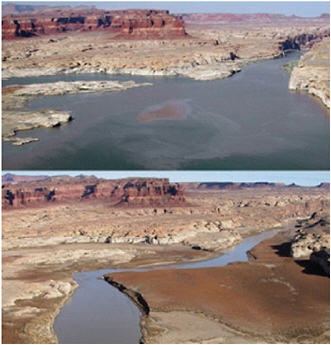
FIGURE 4.2 Lake Powell before and after 2002 drought. This type of image enables decision makers to see the effects of specific changes in climate without the need to interpret data or graphs. SOURCE: John C. Dohrenwend, U.S. Geological Survey.
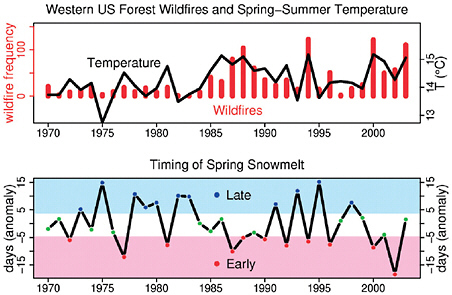
FIGURE 4.3 The top graph shows the positive relationship between annual frequency of large (>400 hectare) wildfires (bars) and average spring and summer temperatures (line) in western U.S. forests. Using the same x-axis, the bottom graph shows the first principal component of the center timing of streamflow in snowmelt dominated streams (pink = early, white = average, blue = late). This is an example of a graph that can provide useful information on observed climate impacts to decision makers. SOURCE: Westerling et al. (2006).
-
Information on trends and patterns in GHG emissions and their drivers—graphs or spreadsheets for major facilities, land uses, population groups, zip codes, etc., expert opinion on future trajectories and the potential impact of policies; and
-
Information on the economic and health impacts of climate variability and potential changes—current costs and benefits, morbidity, and mortality in spreadsheets or tables.
While many of these tools seem quite simple, they are by no means easy to provide or interpret. For example, there are many gaps in the understanding of regional climate trends, impacts, and vulnerabilities, especially at a level of detail that can generate accurate maps. Climate change projections, and associated impacts, are still uncertain, especially at the local level where many decisions are being made. Many locally available decision support products may not provide clear information on error, probability, or confidence in particular data sets or projections. Local case studies and reports
from local experts and residents may lack quality control or careful documentation. Many local decision makers are now familiar with Geographic Information Systems (GIS) and use them for analysis and visualization in planning and communicating with the public. Geovisualization tools also include commercial web-based geoinformation such as Google Earth that has several tools relating to climate and environmental change. These tools can be used as support for decisions about climate change, especially in showing how coastlines, ecosystems, and settlements may be affected by climate change, and are already widely used in responding to climate related disasters (e.g., Federal Emergency Management Agency (FEMA); Greene, 2002; Shaw et al., 2009).
Figure 4.3 shows some examples of graphics provided to local decision makers by the Southwestern Climate Change Network with information on temperature trends, fire, and drought risks.
Decision Tools to Inform International and National Emission Reduction Strategies
Computer simulation models provide a crucial resource for supporting many climate-related decisions. The success of such decisions will often depend on the extent to which models can take into account the complicated interaction of physical systems such as the ocean and atmosphere, biological systems such as forests and estuaries, and societal systems such as migration, settlement patterns, and various forms of economic activity. Simulation models are especially useful in decision making in part because the choice of which model to use forces users to be specific about the options and potential consequences they are considering. Often, these models can be used by decision makers in various levels of government and at different political jurisdictions (international, national, and state or regional levels).
Earth System Models
Earth system models can aid decision making at both international and national scales. About twenty different large climate models (mostly general circulation models or GCMs) exist worldwide to help inform decisions about reducing GHG emissions. In general, these models take a trajectory of atmospheric GHG concentration and calculate the response of the global atmosphere and oceans over many decades to answer questions such as how global temperature and precipitation patterns might change if atmospheric GHG concentrations double over the 21st century. Several of these models are based in the United States, and most of the models have been tested, com-
pared, and evaluated through the IPCC Working Group I (WG I), U.S. Climate Change Science Program (CCSP), and various model intercomparison exercises (e.g., Coupled Model Intercomparison Project—CMIP).
The results of simulations that examine the impacts of different GHG concentrations (e.g., 450 ppm) on future climate have been influential internationally by informing discussions of the UN Framework Convention on Climate Change, where the mandate to “avoid dangerous anthropogenic climate change” demands understanding the links between emissions and global and regional climate change risks. The model results informed decisions by the European Union and others to try and limit climate change below 2°C above preindustrial levels, as well as proposals by various countries, scientists, and NGOs to reduce emissions by up to 80 percent by 2050 or set targets such as 350 ppm. The global and regional climate projections produced by different model scenarios have been used to develop global and regional projections of impacts on water, ecosystems, and other sectors and as the basis for estimating economic losses associated with those impacts.
Taking into account both the scale of U.S. emissions and the size of the country, global climate models are somewhat useful in understanding the global climate impacts of alternative U.S. (and other major emitters) emission choices and for understanding the impacts of various emission futures on climate at the regional level. For example, the U.S. National Assessment (USGCRP, 2001), an assessment mandated by the U.S. Congress in the Global Change Research Act of 1990 (P.L. 101-606), used climate scenarios generated by climate models using a set of alternative emissions scenarios generated by IPCC. At the same time, efforts to support decision making based on climate models must recognize a number of limitations of the models. First, it is important to understand that models are abstractions of reality and that their scale, initial conditions, and assumptions about processes are simplifications that necessarily incorporate considerable uncertainty. Second, the scale of the models is such that the impacts of regional and local emissions choices are not usefully captured in the modeling process. The accuracy of regional and local climate projections is also severely limited by vagueness with respect to topographic details and by the fact that some key processes (such as precipitation) are not included or are oversimplified in the models.
The significance and complexity of the earth system requires a subset of models that focus on specific aspects of climate change and its impacts, many of which are relevant for informing different kinds of decisions such as policies on sequestration of carbon in forests and soils, for estimating overall carbon budgets at global and regional levels, and for understanding the feedbacks that may increase or decrease overall risks of climate change and the impacts of climate policies. For example, carbon
cycle models (as well as models for methane and other gases and aerosols) have been developed to understand how carbon dioxide is released and absorbed by oceans and land, how these natural processes are affected by anthropogenic emissions and land use changes, and how climate change itself may alter the release and absorption of carbon dioxide and other GHGs.
The most commonly used global climate models are not actually used for long-term decisions about climate change, but rather for understanding how climate changes on a seasonal to decadal scale—time scales that are especially relevant for some decision makers. Global climate models are also used in experiments that try to downscale climate change scenarios using mesoscale models.
Integrated Assessment Models
Earth system models are often linked to economic models or to simulations of the evolution of the global economy over time, with a particular focus on how the economy in different regions of the world generates and consumes energy (CCSP, 2007). These integrative models can be used to answer questions concerning, for example, what mix of energy technologies (e.g., coal, oil, natural gas, wind, nuclear, and solar) might emerge in different regions of the world if policies were put in place to limit atmospheric concentrations of GHGs to different target levels. Such models can also provide information on how much would it cost to produce energy using such a mix of technologies. Integrated assessment models lie at the core of attempts by IPCC to link the work of Working Groups I, II, and III by using emission scenarios based on mitigation options to climate change projections and impacts. They also underpin global assessments of the costs and benefits of alternative mitigation and adaptation strategies, such as those conducted by the Stern Review (Stern, 2007). A network of integrated models has been created as the Energy Modeling Forum (EMF), a set of tools that uses different models to assess alternative futures and policy options. Simulations such as the Energy Information Administration’s National Energy Modeling System (NEMs) address similar questions, with a focus on the United States and time horizons of a few decades.
Such climate, energy, and economic simulations can help support risk management decision making by providing information to aid learning over time. For instance, they can help describe options for and the implications of achieving various goals proposed for emissions reductions policies, such as the 2°C temperature limit beyond preindustrial levels recently endorsed by the G-8. Consistent with a risk management framework, these models cannot identify exactly what emissions path would
be needed to hold temperatures below any given value but rather can suggest the scale of reductions needed to ensure a reasonable chance of achieving that target (Figure 4.4).
Integrated energy-economic simulations can also suggest the types of energy technologies that need to be deployed and the potential economic costs of meeting these emission reduction targets. Given the large uncertainties involving any projections of factors such as the cost and performance of future technologies and the growth of the global economy, these models give no definitive answer to such questions. However, the long residence time of some greenhouse gases in the atmosphere means that a certain amount of warming is already underway despite the future of technology and the economy (for ideas about difficulties in making such projections, see CCSP, 2007). Regardless of the inevitable uncertainties, these models reliably emphasize important themes that could prove very useful to informing a risk management framework. For instance, they suggest the importance of allowing flexibility over time, and geographic location in allocating emission reductions, and they also emphasize the need to take the needs of different economic sectors into account. The costs of meeting any given climate target are always lower when such flexibility is allowed. The models also suggest key contingencies that must be considered in meeting various reduction goals. For instance, despite the uncertainties, the models all suggest it is very unlikely that global temperatures can be held below 3°C without significant advances in energy efficiency, the widespread use of carbon capture and storage with coal-fired power plants, and the participation of the United States, India, and China (see Limiting the Magnitude of Climate Change, NRC, 2010d).
Climate, economic, and energy simulations can also prove helpful in informing choices about near-term emission reductions in the context of emission reduction decisions that might be taken in future decades. For example, the research community has identified attractive near-term limiting strategies that account for future learning about important factors such as the sensitivity of the climate to human emissions, the cost of new energy technologies, and the willingness of various countries to implement emission reduction policies. Experiments have also shown how outcomes can differ depending on the assumptions made. However, common themes emerge across all such experiments, such as the importance of beginning emission reductions in the near-term in order to reduce the possibility that sudden emission reductions will be needed in the future and to keep open the ability to decide later to hold climate changes below levels that appear especially risky. Models also differ in their treatment of uncertainty (see Box 4.2). The models that treat uncertainty as if it is resolved prior to decision making are referred to as deterministic; those that allow for adaptive management or iterative decision making over time are referred to as stochastic. Stochas-
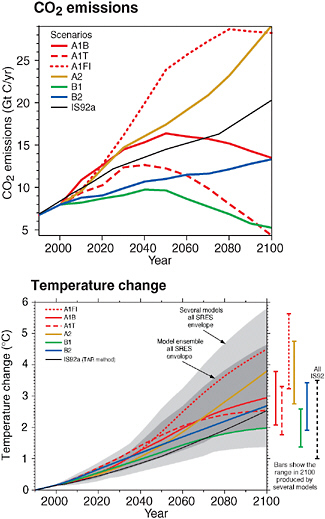
FIGURE 4.4 This figure shows the greenhouse gas concentrations and mean surface temperature from a set of climate models across a range of greenhouse gas emission scenarios. Such model results help show the range of emission paths that might prove consistent with a 2°C temperature limit. SOURCE: IPCC (2001).
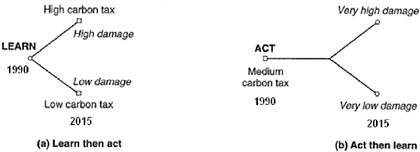
tic models are particularly useful for exploring near-term hedging strategies in the face of such key uncertainties as the existence and nature of tipping points. Stochastic models can be used to address such questions as how much GHG emissions should be reduced in the near-term given the longer term uncertainties. Both deterministic and stochastic models can be used to support decision analyses that address uncertainty in a variety of different ways. Integrated assessment models can describe a set of scenarios or support a probabilistic analysis where subjective probabilities are elicited
from experts regarding the likelihood of key uncertainties and the models then used to identify optimum policy responses.
Integrated Assessment models help decision makers anticipate and understand the consequences of decisions involving complicated, interacting systems and help them structure complex decisions. But like all models, integrated assessments present important challenges. First, those who use models need to understand the purposes for which a model was designed and how those purposes relate to the questions the user would like to answer. For instance, climate, economic, and energy models can provide much information about the potential benefits and costs of choosing a particular emissions reduction target, but determining the best course of action (to the extent that a single best course can be said to exist) under multiple uncertainties is much more complex. As discussed earlier, decisions about climate change are not based only on climate-related information. Practical policy choices require consideration of value judgments and political impacts well beyond anything included in current models. Second, analyses of problems involving multiple variables and sources of uncertainty present complex computational challenges. Optimization problems are straight-forward to formulate but become increasingly difficult to solve as problem-related variables and dimensions increase. Researchers continue to seek ways of addressing these challenges.
Additionally, evaluating many climate-related decisions makes it necessary to make projections about the future behaviors of systems ranging from the climate to new technologies—behaviors that are inherently very difficult to anticipate. Unlike models used by engineers designing cars and airplanes or by weather forecasters predicting the weather, many models that might be very useful for informing climate-related decisions cannot be validated until decades after those decisions needed to be made. Unlike models that can be validated by historical records and real time observations, models of climate-related decisions that involve projection decades into the future are hard to validate in the near term (Collins, 2007). Even when a model has successfully reproduced past observations, that alone cannot guarantee it will successfully predict future changes. Even with these limitations, models still can inform decisions within an iterative risk management framework by demonstrating the implications of alternative assumptions and the conclusions that will likely hold despite uncertainties, such as the risks of allowing GHG emissions to continue to increase at current rates.
Further complicating matters, the economic components of models typically include key (and sometimes controversial) assumptions about the valuation of non-market impacts, such as the impacts of climate change on ecosystems or health, and also about discounting future costs and benefits. Overall results of modeling efforts can be
quite sensitive to these assumptions. This is illustrated in the debates over the conclusions of the Stern Review (that the cost of mitigation now is much less than the costs of damages later), where varying the assumptions about non-market impacts and discount rates produced significantly different cost estimates (Beckerman and Hepburn, 2007; Dasgupta, 2007; Nordhaus, 2007; Stern et al., 2006).
Despite their limitations, integrated models offer some useful insights for decision making. They show that, under uncertainty, hedging our bets is a good strategy for current decisions, even though it could result in emission reduction choices that might not be optimal if perfect information about the future were available now. Models that incorporate subjective probability judgments of experts about points of uncertainty in climate science can be helpful by showing the sensitivity of outcomes of near-term decisions to long-term uncertainties.
Policy Simulations
In some situations policy simulation can result in powerful learning experiences that provide decision makers and the public with information they can use to better evaluate the decisions and implications associated with current policy issues (Geurts et al., 2007). Simulation exercises can also engage the emotions of decision makers by making them viscerally aware of the complex nature of the decision making process and of challenges they might have previously overlooked. The information in policy simulations is presented as a projection of what the future might look like with explicit assumptions about specific scenarios. Policy makers are thus able to consider how they might respond to a given situation once they understand the assumptions behind it. These simulations have long proved valuable to policy makers in the national security policy area (Mayer, 2009). A group of officials might spend a day role playing members of the National Security Council in the midst of a crisis. The experience of, for instance, working with colleagues in an exercise that calls for writing recommendations for the President in presumed aftermath of the detonation of a nuclear weapon on U.S. soil can help participants recognize weaknesses in current contingency plans and perhaps lead to a lasting appreciation for the importance of safeguarding nuclear materials.
In recent years, policy simulations have begun to make use of computer models to better predict the outcomes of policy choices. For instance, a number of computer simulations, available over the web and in other venues, provide a menu of alternative spending cuts or tax increase options and, by giving participants an opportunity to try to balance the federal or a state budget, may provide evidence about the difficulty of some of the tradeoffs involved. More sophisticated policy simulations may play out
the evolution of complex systems and, by allowing participants to intervene and try to influence the evolution, provide insight into what type of interventions might prove effective and the ways in which some seemingly beneficial actions can go seriously awry. Such simulations range from widely available products like SimCity to a research field that produces “serious games.” These games are educational and entertaining ways for interested citizens to become informed on important policy decisions and their associated implications.
Policy simulations are beginning to be used to support climate-related decisions. For instance, the Climate Rapid Overview and Decision-Support Simulator (C-ROADS), developed by a team at the Massachusetts Institute of Technology, Ventana Systems, and the Sustainability Institute, is a simple model that traces the implications of alternative GHG abatement policies and their ability to meet various types of emission reduction targets (see Figure 4.5). The model allows users to examine the impacts of a wide
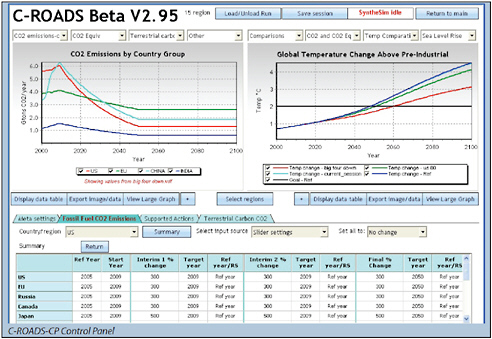
FIGURE 4.5 The control panel of the C-ROADS Climate Simulator is intended to help decision makers understand and interpret various emissions scenarios and climate responses. SOURCE: ClimateInteractive (2010).
range of policy proposals under consideration by governments or proposed by advocacy groups. The simulation is designed for easy, real-time use with groups of individuals. It has been used to support mock negotiation exercises with decision makers from government, business, and NGOs. These exercises help participants develop a better understanding of inertia, long time lags, and other often misunderstood fundamental dynamics of the climate system that make near-term action important to reach the many desired climate goals.
In general, models such as C-ROADS can be useful in providing insights into certain parts of the complex climate problem, such as the difficulty of maintaining various temperature limits. For example, what would it take in terms of emissions reductions by Annex B and non-Annex B countries in the Kyoto Protocol to limit temperature to 2°C above preindustrial levels? The model calculates this with the help of simplified data on atmospheric concentrations and climate models fitted to more complex physical systems models. The target is reached by posing a series of “what if” questions in terms of the reductions made by each country in a hypothetical coalition.
There are a variety of other simulations that can be used by policy makers and the public. These include the Framework to Assess International Regimes for differentiation of commitments (FAIR) (Den Elzen and Lucas, 2005) or the “good enough” tools provided by Socolow and Lam (2007). FAIR is designed to provide information on environmental impacts and the costs associated with projected mitigation efforts. Socolow and Lam (2007) provide tools for assessing the types of actions needed on various time scales and the consequences of not taking any action at all. These kinds of simulations have been successful in engaging many members of the public in assessing alternative climate futures. For example, more than 2 million players undertook policy simulations with Red Redemption’s Climate Challenge video game on the BBC Science and Nature web site.2
Informing State and Regional Level Emissions Reductions
A number of states have taken action to reduce GHG emissions, both on their own and in regional partnerships with other states (see Chapter 2). In formulating their plans, states, much like national governments, have relied on a variety of tools to determine what reduction strategies to use and to estimate the ultimate environmental and economic impacts of these strategies. Some of these tools, as discussed in the previous section, are used by decision makers in many different levels of government and have
enabled states to plan for and begin to implement their GHG reduction programs. There are, however, some practical limitations to their effectiveness in some cases.
States looking to develop climate action plans need to assemble scientifically based knowledge in three areas: (1) baseline GHG emissions in the state, (2) projection of what those emissions would be by a designated target date without implementing any reduction strategies (a business-as-usual reference case), and (3) a compilation of the GHG reduction strategies the states could use, with the potential emissions reductions. This is normally done in the context of a target for GHG emissions reductions that has been established within political arenas. In developing their reduction plans, states and regions have commonly worked with a facilitating group, such as the World Resources Institute (WRI), the Pew Center, the Center for Climate Strategies (CCS), or the Great Plains Institute, to help guide them through the process.
Most states and regions have selected 1990 (which was used in the Kyoto discussions) or 2005 as a baseline year. They typically determined the GHG emissions in the baseline year by a combination of actual emissions data (principally from large emitters such as power plants), and with tools (usually formulas) provided by the facilitators for sectors such as agriculture, transportation, and smaller industry, where no precise measurements have been kept. They have estimated the business-as-usual emissions—which assumes no policy changes through the target date—by modeling done at the same time as modeling for the reduction strategies. The information that goes into the reference case may differ by jurisdiction, but it typically includes forecasts for population, employment and GDP, fuel cost, and technology performance and cost.
The universe of possible reduction strategies is developed in consultation with the facilitators and is not meant to be the list of what will be recommended. Generally, these lists include power plant reductions, transportation, agriculture, landfills, energy efficiency, renewable energy standards, and many other potential strategies. In analyses for cap-and-trade policies, much of the determination of who would be covered by the cap and what strategies to employ is driven by the jurisdiction and those they recruit to provide assistance. This has been done very differently in different jurisdictions. In some cases, groups were created encompassing a wide range of stakeholders (NGOs, potentially affected business sectors, academic experts, civic and religious leaders, labor, and others) to sort through the potential strategies and select those which they wanted to include, as well as to determine who they believe should be covered under the cap. The latter discussion typically considers the potential amount of reductions from inclusion of each class of emitters, as well as the ability to accurately administer the cap in each sector. In other jurisdictions, the decisions about what to in-
clude under the cap, and which strategies to employ, were made by a group of public officials and then taken through a stakeholder process, much as would be done in an environmental rulemaking procedure. In either case, stakeholders are involved in the process, and time is needed to allow for their involvement.
Within the United States, many environmental laws and regulations also require processes of public participation. Acquiring public participation is often challenging due to the public’s understanding of the climate change issue (see Chapter 8). Careful use of tools can improve public understanding and provide a structured analysis of public concern and willingness to respond. When the determinations have been made as to the targets, which emitters would be included under a cap, and which potential strategies would be examined, additional modeling is employed. Modeling is done by a fairly limited number of firms, so many of the jurisdictions employed the same modelers.
Here again, the outcomes of modeling efforts depend on the information fed into the models. As a result, a great deal of time is spent developing the assumptions that underlie the model (for example, about whether new coal plants will be built or retired, what natural gas prices are likely to be, what role energy efficiency and renewable resources will play in the jurisdiction, what new laws will affect energy usage, etc.). The modelers develop the reference case, with which a comparison can be made to the results modeled when factoring in the GHG reduction strategies the group has settled upon. The models are used as guides to find the most efficient or cost-effective strategies and are not presumed to provide a definitive solution.
States also use modeling to help determine the economic impacts of particular strategies. Models can forecast costs to consumers of implementing policy strategies, as well as impacts on jobs (even by particular sectors), and on the GDP of the jurisdictions. As with emissions modeling, the results depend on good assumptions and data, and this modeling is also expensive and time consuming. However, for the stakeholder processes, as well as for communicating the benefits of a particular public policy, having this information is essential.
Modeling is valuable because it enables decision makers to consider both individual strategies and interactions among them. For example, if a policy to increase the fuel economy of cars and another to increase the amount of mass transit are examined separately, double counting of the reductions may result. The modeling takes these overlapping strategies into account.
The kinds of processes described here give decision makers modeling results, assistance from a facilitating group to provide them with perspective of other jurisdictions,
and input from stakeholders. Done correctly, such analyses can guide decision makers with difficult policy choices.
Informing Efficiency Decisions at the Firm and Household Levels
As awareness about climate change and responses to climate change increase through the private sector, many businesses are assessing how their activities affect the environment and the environmental performance of their products. One of the key tools used to assess the role of GHGs in a firm’s operations and products, and to identify steps to reduce them, is life cycle analysis (LCA). LCA is a technique to assess the environmental aspects and potential impacts associated with a product, process, or service by compiling an inventory of relevant energy and material inputs and environmental releases; evaluating the potential environmental impacts associated with identified inputs and releases; and interpreting the results to improve the quality of decision making. The process includes an assessment of raw material production, manufacture, distribution, use, and disposal, including each transportation step necessary by the product’s existence. LCA can be done for the full life cycle, from manufacture to use to disposal (cradle-to-grave) or from manufacture to the factory gate (cradle-to-gate), with variants that include cradle to cradle (where materials are recycled), and well-to-wheel (used for transport fuels).
Several LCA studies have aided manufactures in the decision making process regarding products or processes that have the least impact to the environment or society. For example, an early study by the Tellus Institute demonstrated that over 95 percent of environmental costs are created by the production of packaging, including energy used and toxins created, rather than in the disposal of products (Tellus Institute, 1992). LCA is also at the core of eco-labels that are designed to inform consumers about the environmental impacts of products (Cowell et al., 2002).
Most LCA is undertaken using dedicated, often private sector, software packages such as GaBi, SimaPro, and TEAM. The U.S. National Renewable Energy Laboratory hosts a U.S. Life Cycle Inventory Database that provides information on cradle-to-grave accounting. The Environmental Protection Agency (EPA) provides several LCA tools on its web pages, including a Waste Reduction Model that estimates GHG impacts of solid waste (WARM); the Recycled Content Tool, which calculates the life cycle GHG and energy impacts of certain materials (ReCon); the National Recycling Coalition (NRC) Environmental Benefits Calculator (which determines the GHG content of waste materials); the Northeast Recycling Council (NERC) Environmental Benefits Calculator (for states and organizations to measure benefits from recycling); and the Durable
Goods Calculator (DGC) which calculates the GHG content of disposing and recycling of household goods. The U.S. Department of Energy provides a fuel cycle model for evaluating transport engine and fuel alternatives (GREET), and internationally the ecoinvent portal (www.ecoinvent.com) provides tested and science based LCA data for more than 4,000 activities in industry, agriculture, and waste management.
LCA has been used to optimize the environmental performance of both individual products and individual companies. For example, the University of Michigan Center for Sustainable Systems conducted a study in 1999 on the life cycle assessment of the Stonyfield Farms product delivery system. The study found that choice of container size for products places the greatest burden on the environment, with smaller containers having more impact than larger containers. The study also made several recommendations to the Stonyfield Farms Company to reduce impact. LCA has been a valuable tool for a company’s decision making.
LCA analysis is useful when parameters can be quantified and then reduced, and is an important step in some of the GHG management strategies discussed in Chapter 6. Once again, the quality of an LCA is only as good as the data that go into it, and it is especially important to use up-to-date information, especially where production processes change rapidly (Ayres, 1995; Reap et al., 2008a,b). Uncertainty pervades LCA where data are not available and when subjective decisions are made about what costs to include and exclude. For example, insufficient data on the GHG emissions of a production method or product can lead to large uncertainties in LCA analysis (see Chapter 6 for further discussion on GHG management). Comprehensive LCA can be expensive, and it can also be difficult when relevant information is proprietary or sensitive. Some classic LCA controversies have involved everyday goods such as paper versus plastic grocery bags and disposable versus washable diapers. Standards are important but often are of limited usefulness for LCA. For example, ISO 14048 sets international standards for nomenclature and frameworks for life cycle inventory but provides little guidance on specific data models.
UNDERSTANDING IMPACTS AND INFORMING ADAPTATION DECISIONS
Although impact models can be included as elements in the integrated assessment models described in the previous section, they are more commonly used to estimate the impacts of climate change on particular sectors and to assess how adaptation might reduce these impacts. Also, many are already used in existing management frameworks for analyzing the impacts of current climate variability and other decisions on water resource management, agriculture, ecosystems, coastal regions, energy man-
agement, disasters, and health. Many of these methods are described in the reports of IPCC Working Group II and by the companion ACC reports Adapting to the Impacts of Climate Change (NRC, 2010a) and Advancing the Science of Climate Change (NRC, 2010b). Because of their operational use in current decision making, many impact focused models have been customized for particular places and groups of decision makers, account for uncertainty, and allow for interactive exploration of policy options and future scenarios. In line with discussions at the beginning of this chapter, research on actual decision making shows that, although computer tools may be used to evaluate alternatives, many decisions are made without models and are based, for example, on individual judgment, collective discussion, institutional trends, and political pressure. Decisions may differ from what model results would recommend, and results may be cited only when supporting decisions that have been made on other grounds (Brewer, 1975).
Tools supporting adaptation decisions are numerous and varied. For example, many different simulation tools and optimization models are used in the management of water resources. Such tools can estimate impacts on hourly, daily, and seasonal time scales and may include forecasting and modeling of runoff, groundwater, irrigation, reservoirs, water quality, demand, and water management.
Similarly, both simulation and statistical models are used to understand impacts and inform agricultural decision making, taking into account biophysical conditions (e.g., climate and weather, soils), input availability (water, fertilizer, improved seeds, labor, machinery), and economy (e.g., costs, prices, subsidies). Such models can allow farmers and other decision makers to anticipate the effects of climate extremes and seasonal forecasts, adjust the use of inputs and production to local conditions and international trade, and explore policy options, including emergency relief, incentives, and environmental regulation.
Coastal management also uses a range of modeling and decision tools to prepare for severe storms, assess alternative land uses, and analyze management options that might include coastal protection, warning systems, and building regulations. These models must be carefully calibrated to take into account local conditions because of the ways in which particular coastal formations and human activities influence the impacts of climate and management options.
Managing ecosystems in the context of climate variability has also led to the development of both general and customized tools for predicting and managing the effects of drought, fire, and other climate related influences on forests, grasslands, wetlands, and other landscapes. These are sometimes used for real time prediction and management
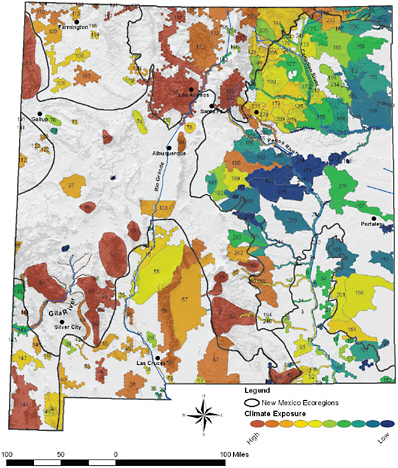
FIGURE 4.6 Climate change “exposure” of key conservation areas. This type of map can aid decision makers as they explore options for future conservation or adaptation efforts. SOURCE: TNC New Mexico Conservation Science Program (2008).
(e.g., for fire and insect infestations) but are also used to explore longer-term alternative management options (see Figure 4.6).
Urban impact assessments can involve modeling and integration of multiple elements of the urban system, including the sensitivity and vulnerability of water resources, energy use, industrial production, and transport to climate conditions. With respect to public health, there is a growing emphasis on models that can indicate how vari-
ous climate conditions, such as extreme heat and excess moisture, can influence the severity and extent of health problems such as asthma, infectious diseases such as influenza, and various vector-borne diseases. Models can be used to anticipate the evolution of epidemics and also to allocate resources such as vaccines and health care professionals.
Using these kinds of tools for informing decisions on adaptive responses to climate change has considerable potential, but users must also consider model limitations. Models based on current conditions or those of the recent past may be limited in their ability to predict impacts resulting from future climate changes, such as those that are outside the range of past experience. Other model limitations stem from deficiencies in the ability to predict future non-climate related changes such as social and economic trends. And even if projections turn out to be correct, options for adapting to future climate conditions—for example, strategies for protecting endangered species—may be limited. Table 4.2 provides a useful overview of key advantages and disadvantages relating to the use of various methods of constructing regional climate change scenarios in climate impact assessments.
Examples of decision support tools for climate change adaptation used by U.S. based projects in coastal and water management are described in Boxes 4.3 and 4.4.
UNDERSTANDING THE VALUE OF INFORMATION FOR RESOURCE ALLOCATION
Globally, governments are spending billions of dollars annually on research programs to improve the knowledge base for future climate related decisions. In an era of highly constrained resources, it is not surprising that policy makers are interested in the value of reducing uncertainty and in what kinds of research will yield the highest payoff. Decision tools can be used to estimate the value of new information, which can help decision makers plan research programs and determine which trends to monitor to best implement an iterative risk management strategy. The types of decision tools used to inform a particular climate-related investment will depend, in large part, on the nature of the decision under study and the quality of available information (see Box 4.5). In the climate area, investments are often parsed into five areas, related to: limiting the magnitude of climate change; adaptation, or reducing vulnerability to climate change; research and development to expand the range of mitigation and adaptation options; improved scientific information to provide the foundation for better informed decisions in the future; and geoengineering, or technologies and activities aimed at changing the heat balance of the earth.
In decision theory, the value of information in these and other areas is calculated in
TABLE 4.2 Options for Constructing Regional Climate Change Scenarios Listed in the Order of Increasing Complexity and Resource Demand
|
Method (application) |
Advantages |
Disadvantages |
|
Sensitivity analysis Resource management, Sectoral |
1. Easy to apply; 2. Requires no future climate change information;3. Shows most important variables/system thresholds; 4 Allows comparison between studies. |
1. Provides no insight into the likelihood of associated impacts unless benchmarked to other scenarios; 2. Impact model uncertainty seldom reported or unknown. |
|
Change factors Most adaptation activities |
1. Easy to apply; 2. Can handle probabilistic climate model output |
1. Perturbs only baseline mean and variance; 2. Limited availability of scenarios for 2020s. |
|
Climate analogues Communication, Institutional, Sectoral |
1. Easy to apply; 2. Requires no future climate change information; 3. Reveals multisector impacts/vulnerability to past. climate conditions or extreme events, such as a flood or drought episode. |
1. Assumes that the same socio-economic or environmental responses recur under similar climate conditions; 2. Requires data on confounding factors such as population growth, technological advance, conflict. |
|
Trend extrapolation New infrastructure (coastal) |
1. Easy to apply; 2.Reflects local conditions; 3. Uses recent patterns of climate variability and change; 4. Instrumented series can be extended through environmental reconstruction; 5. Tools freely available. |
1. Typically assumes linear change; 2. Trends (sign and magnitude) are sensitive to the choice/length of record; 3. Assumes underlying climatology of a region is unchanged; 4. Needs high quality observational data for calibration; 5. Confounding factors can cause false trends. |
|
Pattern-scaling Institutional, Sectoral |
1. Modest computational demand; 2. Allows analysis of GCM and emissions uncertainty; 3. Shows regional and transient patterns of climate change; 4. Tools freely available. |
1. Assumes climate change pattern for 2080s maps to earlier periods; 2. Assumes linear relationship with global mean temperatures; 3. Coarse spatial resolution. |
|
Method (application) |
Advantages |
Disadvantages |
|
Weather generators Resource management, Retrofitting, Behavioural |
1. Modest computational demand; 2. Provides daily or sub-daily meteorological variables; 3. Preserves relationships between weather variables; 4. Already in widespread use for simulating present climate; 5. Tools freely available. |
1. Needs high quality observational data for calibration and verification; 2. Assumes a constant relationship between large-scale circulation patterns and local weather; 3. Scenarios are sensitive to choice of predictors and quality of GCM output; 4. Scenarios are typically time-slice rather than transient. |
|
Empirical downscaling New infrastructure, Resource management, Behavioural |
1. Modest computational demand; 2. Provides transient daily variables; 3. Reflects local conditions; 4. Can provide scenarios for exotic variables (e.g., urban heat island, air quality); 5. Tools freely available. |
1. Requires high quality observational data for calibration and verification; 2. Assumes a constant relationship between large-scale circulation patterns and local weather; 3. Scenarios are sensitive to choice of forcing factors and host GCM; 4. Choice of host GCM constrained by archived outputs. |
|
Dynamical downscaling New infrastructure, Resource management, Behavioural, Communication |
1. Maps regional climate scenarios at 2050km resolution; 2. Reflects underlying land-surface controls and feedbacks; 3. Preserves relationships between weather variables; 4. Ensemble experiments are becoming available for uncertainty analysis. |
1. Computational and technical demand high; 2. Scenarios are sensitive to choice of host GCM; 3. Requires high quality observational data for model verification; 4. Scenarios are typically time-slice rather than transient; 5. Limited availability of scenarios for 2020s. |
|
Coupled AO/GCMs Communication, Financial |
1. Forecasts of global mean and regional temperature changes for the 2020s; 2. Reflects dominant earth system processes and feedbacks affecting global climate; 3 Ensemble experiments are becoming available for uncertainty analysis. |
1. Computational and technical demand high (supercomputing); 2. Scenarios are sensitive to initial conditions (sea surface temperatures) and external factors (such as volcanic eruptions); 3. Scenarios are sensitive to choice of host GCM; 4. Coarse spatial resolution. |
|
SOURCE: Wilby et al. (2009). |
||
|
BOX 4.3 Decision Support for Coastal Responses to Climate Change Decision makers in coastal areas face a daunting set of challenges associated with climate change such as sea level rise; habitat destruction; invasive species; damage to natural protective systems such as wetlands, dunes, and barrier islands; land loss; increased vulnerability of critical infrastructure facilities such as ports and transportation systems; and property and population vulnerability. Coastal regions also face a variety of population and development pressures as growing numbers of Americans migrate to those areas in search of the amenities they value. Many tools and strategies are being used to assist decision makers in coastal regions. Three examples of initiatives and the decision support resources offered include the following:
The program provides grants and technical assistance to support adaptation efforts in estuarine settings, actively seeks to develop networks that can serve as conduits for information on best practices and convenes workshops for grant recipients, publishes newsletters, and provides space on its web site for inter-project communication. CREP maintains an extensive web portal that includes access to a “Climate Ready Estuaries Toolkit” that contains a suite of GIS-based risk and vulnerability assessment tools and databases for monitoring climate change. The site also enables users to access CCSP Synthesis and Assessment Products, materials that can be used in education and outreach programs, and information on how to obtain funds for local programs. CREP also assists decision makers through publications that structure problems and lay out options for climate change adaptation, including maintaining and restoring wetlands; maintaining sediment transport; preserving coastal lands development and infrastructure; maintaining shorelines through both “soft” measures such as marsh creation to slow shore erosion and “hard” measures such as the construction of sea walls and breakwaters; and maintaining water quality and availability.
|
All three programs discussed here seek to address decision makers’ needs in a variety of ways. Such approaches include providing information on decision-relevant topics (e.g., climate impacts, model adaptation plans, model legislation, and policy initiatives); making analytic tools and databases more widely available; establishing and sustaining networks for information sharing; engaging in public outreach and education activities; and employing a variety of other stakeholder engagement strategies. |
|
BOX 4.4 Resources for Implementing Iterative Risk Management in the Water Resources Sector A variety of data sources, simulation models, and decision support methods exist to help water managers incorporate climate change into their operations and plans. As one example, this case study describes how Southern California’s Inland Empire Utilities Agency (IEUA) has used a water management simulation model, down-scaled climate projections, and decision support software in a participatory stakeholder process to implement an iterative risk management approach to improve its ability to respond to climate change. The IEUA, a wholesale water and wastewater provider in Riverside County, California, is legally required every few years to prepare or update a plan demonstrating how they will ensure their community’s access to water. At present, IEUA serves slightly fewer than one million people relying primarily on local groundwater and imports from Northern California. To serve its growing population, IEUA in 2005 completed a 25-year water plan that called for the agency to increase the agency’s groundwater use by 75 percent and its recycled water use by 600 percent by 2025. But as recently as 2005, IEUA had not considered the potential impacts of climate change on its long-range plan. However, in 2007 the agency conducted—with the assistance of a RAND-led team funded under the National Science Foundation’s (NSF’s) climate change decision making under uncertainty (DMUU) programa—a vulnerability and response option analysis to determine whether and how the potential for future climate change should cause them to alter their 2005 plan. To conduct this analysis, the RAND team combined a water management model (WMM) with downscaled regional climate projections from an ensemble of atmosphere-ocean generation circulation models (AOGCMs). The water management model, built using the Water Evaluation and Planning (WEAP) modeling environment (see http://www.weap21.org for more information), simulated the IEUA region’s hydrology, water supply, and water demand. To address the challenge of planning under uncertainty the simulation was designed to evaluate the performance of IEUA plans under a wide range of future scenarios, each of which reflects plausible trends in climate change and other planning assumptions. The model reported two measures of plan performance: the reliability of the IEUA system in meeting all projected demand and the cost of implementing the agency’s base plan and any additional actions needed to improve reliability in some scenarios. Using an iterative risk management framework, the WEAP simulation was explicitly designed to consider adaptive strategies, those designed to monitor changing conditions and respond over time. In particular, the model began with a specified set of near-term actions IEUA might take, such as investments to increase the use of wastewater recycling or improved water use efficiency. Beginning in 2015 and every 5 years thereafter in the simulation, the model evaluates whether supply has been sufficient to meet demand over the previous 5 years. If the gap between demand and supply exceeds |
|
some specified threshold, the simulation implements additional actions as specified by the strategy under consideration. Climate change is not the only important uncertainty facing IEUA, so the study also considered a wide range of cases representing different assumptions about the agency’s ability to implement its aggressive new groundwater and recycling programs, as well as different assumptions about events outside the agency’s service area such as those affecting supplies of imported water. The RAND team then used a decision analytic approach called robust decision making to implement the iterative risk management approach using this simulation model and ensemble of future climate projections. With decision support software designed for this purpose, the study used the simulation model to follow its current plan into several hundred different futures, each characterized by one of the future weather sequences and one set of assumptions about the agency’s future level of success in implementing its plans, and future supplies of imported water. Each of these cases explores how the candidate strategy will perform given some particular set of “what if” assumptions about the future state of the world. The study then used statistical analysis to identify the key factors that would cause the agency’s plans to fail to meet its performance goals. This analysis suggested IEUA’s 2005 plan would fail in the future if all the following factors occurred simultaneously: a significant decrease in precipitation, any decrease in the share of precipitation that infiltrated into the groundwater basin, and significant impact of climate change on the availability of future imports. Other failure modes were identified which included other important factors such as the need for IEUA’s recycling program to meet its ambitious goals. The agency then used this information to create visualizations describing the strengths and weaknesses of alternative plans and the tradeoffs among them. The project collaborators and IEUA used these results to help identify and evaluate potential ways to augment its plan to improve its ability to address these challenging conditions. The simulation model, climate projections, and decision analysis were developed through a series of workshops with IEUA managers and technical staff, local elected officials, and representatives of local business, environmental, and other groups in the IEUA region (Groves and Lempert, 2007; Groves et al., 2008). These workshops were interspersed with in-depth technical reviews with IEUA technical staff and the RAND team developing the model and climate data. Based on this analysis and interactions, IEUA decided to augment its 2005 Urban Water Management Plan by increasing its current water use efficiency programs in the near-term and by monitoring and updating if necessary its plans in the future. |
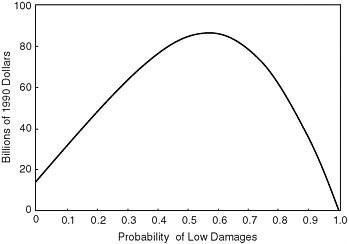
the context of the decision it is intended to inform. In the realm of climate change decision making, there are not only multiple uncertainties, but also multiple decisions to be made by diverse entities, as well as multiple outcomes of each decision. Decision theoretic techniques can also be applied to estimate how much outcomes could be improved if additional information could reduce uncertainty about the future, even if the resulting information is imperfect. It is also important to note that information that may have little or no value for decisions about limiting climate change may nevertheless have high value for adaptation. Additionally, information that does not necessarily reduce uncertainty, in the sense of narrowing the width of the probability distribution of outcomes, such as information generated from deterministic models and scenarios, can still have a high value for improving decisions.
ASSESSMENTS AS TOOLS FOR CLIMATE-RELATED DECISION MAKING
Integrated assessment models are just one method used in the process of developing broader assessments of environmental issues which bring together a wide range of scientific information and analysis to provide state of the art summaries for decision makers. Assessments are collective, deliberative processes by which experts review, analyze, and synthesize scientific knowledge in response to users’ information needs relevant to key questions, uncertainties, or decisions (NRC, 2007a) and as such constitute an important interface between science and policy. The U.S. Global Change Research Act (1990) mandates regular (4 year) assessments of global change impacts on key sectors. However, only two major U.S. assessments of climate change have been conducted—a national assessment in 2001 and the recent CCSP synthesis and assessment exercise (USGCRP, 2009). Hundreds of U.S. scientists have participated in the high profile assessments of the IPCC, and climate change has also been an important component of international assessments of ecosystems (MEA, 2005), Arctic climate impacts (ACIA, 2004), and stratospheric ozone (WMO, 2007). Reports by the Congressional Research Service also serve as focused assessments for policy makers. Assessments can establish the basic significance of an issue and communicate it to decision makers. They can also respond to particular scientific questions of high policy relevance and can evaluate whether policies are delivering expected benefits.
The NRC (2007a) has identified 11 elements of effective assessments (Box 4.6), where effectiveness is defined in terms of salience (ability to communicate relevant information to users), credibility (high-quality technical basis), and legitimacy (fairness and impartiality). The NRC also observed that the most common weaknesses in assessments are a mismatch between the scope of the assessment, inadequate funding, and the inability to match assessment goals with the needs of decision makers.
|
BOX 4.6 Elements of Effective Assessments
SOURCE: NRC (2007a). |
The Informing panel endorses these elements and key recommendations of the report, and includes the following:
-
Those requesting assessments should develop a guidance document that provides a clear strategic framework, including a well-articulated mandate and a detailed implementation plan realistically linked to budgetary requirements. The guidance document should specify decisions the assessment intends to inform; the assessment’s scope, timing, priorities, target audiences, leadership, communication strategy, funding, and the degree of interdisciplinary integration; and measures of success.
-
The burden of assessments on the scientific community should be proportional to the aggregate public benefits provided by the assessment. Alternative modes of participation or changes to the assessment process—such as limiting material in regularly scheduled assessments or running “nested” or phased multiscale assessments—should be considered. As appropriate, U.S. assessments should acknowledge the work of the international community and avoid redundant efforts.
-
The intended audiences for an assessment should be identified in advance, along with their information needs and the level of specificity required. In most cases, the target audience should be engaged in formulating questions to be addressed throughout the process in order to ensure that assessments are responsive to changing information needs. Both human and financial resources should be adequate for communicating assessment products to relevant audiences. Clear guidelines and boundaries should ensure both salience to those requesting the assessment and legitimacy, especially with respect to the perceived influence of those requesting the assessment might have over the scientific conclusions drawn. A strategy for identifying and engaging appropriate stakeholders should be included in the assessment design to balance the advantages of broad participation with efficiency and credibility of the process. Capacity building efforts for participants from various disciplines should be undertaken in order to develop a common language and a mutual understanding of the science and the decision making context. This capacity building may be required to ensure the most salient questions are being addressed and to meaningfully engage diverse stakeholders in assessment activities.
Building on the NRC study (2007a), our panel identified other considerations that should be taken into account when assessments are used as decision support tools, such as the following:
-
Assessments, such as the IPCC and CCSP, have become overwhelming in their scope, size, and demands on the scientific community. It is often hard for decision makers to identify the key messages and information that are relevant to the choices they face. More focused assessments to support specific questions and decisions may be more effective, especially if they are concise and clearly responsive to decisions and stakeholders.
-
Assessments tend to be focused on information of relevance to governments at national and regional scales, and they often fail to address concerns and decisions of local governments, the private sector, and civil society. As discussed in Chapter 2 of this report, given the importance of non-federal actors as both
-
users and sources of information, greater attention should be paid to their decision needs and to their inclusion in the production of assessments.
-
There is value to viewing assessment as an ongoing process of engagement with stakeholders which provides regular updates on climate, impacts and responses and responds to the information needs of both federal and nonfederal decision makers. However this requires a commitment to supporting the process, to listening and responding to stakeholders, and to the information systems that are needed for the assessments.
-
As the United States and international communities make decisions that have significant economic and development implications for countries, business interests, and other communities, the assessments (such as IPCC) on which these decisions are based become matters of “high politics” with much greater scrutiny of their legitimacy and of review processes. This demands even greater care in the preparation, transparency, and communication of assessment products, especially in the communication of uncertainty, social, economic, and ecological impacts, and results of relevance to particular interest groups and regions.
CONCLUSIONS AND RECOMMENDATIONS
A variety of tools and resources exist for informing decision making about climate change. Each of them has advantages and disadvantages, but many are overlooked or misunderstood in the portfolio of decision tools used by decision makers. It is frequently argued that a major purpose of analysis is insights, rather than numbers. Decision tools work best when they provide decision makers with an analytical framework for thinking about a particular problem. With a problem as multifaceted as the climate problem, issues can quickly become intractable. Without systematic procedures for “working the problem,” decision makers often become confused and reluctant to act even in cases where action is needed.
Among all the tools that are available, decision makers need to select tools that are capable of providing the information they need. This points to the necessity of providing information within time frames and geographic scales that are relevant to decision makers as well as information on the uncertainties associated with those time scales. Communicating tool results is also important and this requires partnering with stakeholders when making decisions.
The Science Panel report (NRC, 2010b) has identified key research needs in developing decision support tools (see also Box 4.1). There is clearly a need to develop tools
for responding to climate change, and this need will continue to evolve as tools are designed to be decision-specific. Our review suggests several important challenges in the use and development of decision tools and methods to inform decisions about climate change. These include a mismatch between the global, aggregate, or national scale of climate and energy models and the needs for decision making at more local or sectoral scales; controversies over how to handle economics, uncertainties, and subjective judgments; user misunderstandings about the assumptions and limits of methods; major information gaps; and the need to ensure that assessment activities are effective, are focused, and respond to user needs.
Observational systems and databases are critical to developing tools and the evaluation of methods for modeling, mapping, networking, and decision making. The Federal government has an important role in supporting such information systems as we discuss in subsequent chapters. We find that “value of information” techniques may be helpful in order to inform decision makers on the relative value of investments to improve understanding across key unknowns in the climate system. Where such expertise does not reside in particular agencies, experts should be engaged from outside these agencies (e.g., academia) to provide the requisite skills.
The discussion of assessments as a decision support tool is based on the NRC (2007a) report on lessons learned from assessments and we endorse the recommendations of this report and its suggestions for effective assessments. We judge that future assessments may need to be more focused on specific questions and decisions developed in consultation and collaboration with decision makers.
The panel, in preparing this chapter, also found it difficult to identify good reviews and clear unbiased discussions of the full range of decision support tools, their appropriate uses and limitation. We therefore conclude that there could be a stronger role for the Federal government to provide better guidance on decision support tools for climate decisions, perhaps through a climate tools database, network, and best practice examples. This could be considered part of a broader attempt to provide climate and carbon management services.
At the same time, the panel also recognizes that formal decision-analytic procedures may not constitute the tools of choice for many decision makers. Support for decisions comes from a wide range of sources that include mandates, standards, and regulations; informal norms that govern procedures and practices adopted by decision-making entities; priorities and practices that are diffused within interpersonal and interorganizational networks; and institutional pressures that produce alignments among entities pursuing similar goals. While solutions to climate-related problems should never rely on these kinds of sources alone, it is important to note their significance
as drivers of decision making, both in the climate arena and more generally. Formal decision tools may be used to illuminate choices, but they may also be used to validate strategies that have already been decided upon on other grounds. Resources that support decision making are myriad and varied, ranging from sophisticated computer simulations, to scenarios of climate futures presented in the form of GIS visualizations, to films and documentaries, and to less elaborate materials that merely inform decision makers about what measures their counterparts have decided to undertake. Decision makers themselves determine which decision support resources are most relevant in the context of the dilemmas they face, and for that reason all efforts to provide such resources must begin with an understanding of decision maker needs.
Recommendation 5:
-
The federal government should support research and the development and diffusion of decision support tools and include clear guidance as to their uses and limitations for different types and scales of decision making about climate change.
-
The federal government should support training for researchers on how to communicate climate change information and uncertainties to a variety of audiences using a broad range of methods and media.


